Showing posts with label John Carradine. Show all posts

Tuesday, September 7, 2021

Mary of Scotland

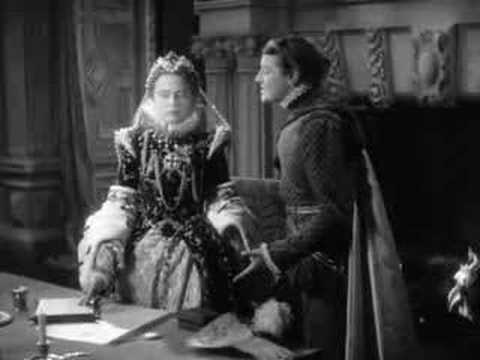
Mary of Scotland (John Ford, 1936) The film, written by Dudley Nichols from Maxwell Anderson's play, begins with an odd preamble, giving an overview of the whole Mary, Queen of Scots/Elizabeth R situation, and ending with the hopeful suggestion that they are "all equal now," buried close to each other in Westminster Abbey. Cheery thought, and, despite what the play and movie say, the only time that Elizabeth and Mary were in the same room together.*

It's a problematic film. betraying its stage roots (the speeches are very formal, stylized, and performed theatrically, with no overlap and AT THE TOP OF EVERYBODY'S LUNGS, as if trying to reach the last row of the balcony) although Ford works overtime to find interesting angles to shoot from. So much Hollywood gossip swirls around this film**part of Hepburn's "box-office poison" cycle (she'd just bombed with Sylvia Scarlett and more were on the way)—that one is hesitant to bring it up as sources for the film's problems, which are many. 

But the main fault lies with Anderson's play, which lionizes Mary (Katherine Hepburn) while demonizing Elizabeth, and the production goes right along with it—Mary's first lines are a prayer to God for returning safely to Scottish shores, while Elizabeth's is ordering people around and played (by Florence Eldridge) as if she were Edward G. Robinson. It would have been nice if this subject were a little more nuanced, as it involves two strong women in positions of power with men as being subjective, if constant irritants. One wishes that the two could have gotten together and agreed that all the men surrounding them were jerks and done something about that, rather than engaging in power plays for England's throne.
But, that's not how history went, and the play plays fast and loose enough with the facts as it is. And this is Mary's movie, to the point where Hepburn is the only cast member with close-ups—jarring close-ups that have the feel of insert shots as the lighting changes dramatically from the establishing shotsElizabeth is only seen in full shots that emphasize costume over performance.
There are joys to be had, though. Ford's penchant to use unruly horses is much in evidence, and the animals are particularly out of control on the sound-stages that dominate the film. And Frederic March is something of a revelation, boisterous and accented, his is the best performance in the film. And Ford's presentation is never less than spectacular, as has been mentioned, giving the film a scope that it wouldn't have had in other's hands.
 
 
A not-altogether successful film, but interesting to see.


* This is a problem with most of the films dealing with Mary, Queen of Scots—historically, they never did appear (that we know—something Lucy Worsley might some day let us in on it) in the same room, although there were letters sent back and forth. It might have something to do with studio politics and ginning up the drama. Traditionally, the two have been played by stars (Vanessa Redgrave and Glenda Jackson in 1971's Mary Queen of Scots, and more recently Saoirse Ronan and Margot Robbie in 2018's Mary Queen of Scots) and so there must be some re-writing of history in order to get Acting Queens to spar off each other, even if the real Queens did not.
 
** Ford was unhappy making it, and—as he occasionally did—walked off the film in the midst of shooting on day. I can't be sure, but when I read Hepburn's autobiography, I seem to recall her saying that she directed for the rest of the day and seemed to think nothing of it. And...take a look at this scene on YouTube. There is a portion where Mary addresses James Stuart, Earl of Mowbray, where the conversation is at cinematically clashing angles, perhaps to favor a flattering angle...well, let's face it, of both actors. It's an odd choice by Ford if he, indeed, did make it.

Saturday, October 10, 2020

The Invisible Man (1933)

Oh. It's October (still). Guess I need to pay attention to Horror Films.

The Invisible Man (James Whale, 1933) There have been so many versions of "The Invisible Man"—in movies and television, including a version released this year just as the COVID-19 virus started emptying theaters directed by Leigh Wannell and starring Elisabeth Moss—but, this one, directed by the ingenious James Whale (he of the classic Frankenstein and The Old Dark House and portrayed in Gods and Monsters) hews very closely to H. G. Wells' original novel (sub-titled "A Grotesque Romance" and both serialized and published in 1897), both in circumstance and (and this is crucial) in tone. I'm reading Wells' story now (and so can you here) and, although there is always a sense of the fantastical with Wells, it is apparent that in this one Wells was having a bit of a jape at the village-life residents among whom he grew up. With the exception of the demented Griffin ("The Invisible One" he's called in the film's credits), the other characters are bumpkins and simple folk, who fall about themselves in states of slapstick buffoonery at the sight and pranks of the one who can't be seen.
It's less a novel of horror or of adventure as it is a sadistic comedy. The Invisible man, Griffin, comes to the village of Iping, having finished his experiments, completed them on himself, and emboldened with his power to be a covert agent of destruction, made his way to the village to try and find the process to reverse the change. Swathed in bandages, bulky stolen clothes, a floppy hat, dark glasses and a prosthetic nose, he's a mummified presence as he makes his way through a snow-storm (the better to see him with when he's invisible later in the film). It's a stark sight as he bursts through the door takes a sitting room with his notebooks and flasks, demanding privacy for his task. To pay his way, he resorts to thievery, shedding his clothes and invading a local vicar's home to steal the funds. He is confronted by the constabulary and town officials, he dis-robes and, in naked invisibility, tweaks and thwarts his would-be captors who are helpless to defend themselves from his attacks. 
This must have seemed like a gaudy feast for Whale, who was fond of combining the horrorific with a giddy, satiric chauvinism towards "the others" of whom, as a closeted gay man, he felt apart from, hid from, but also could feel superior to for hiding in plain sight with his secret. It's certainly a delicious visual opportunity for Whale to portray Griffin's mummified presence as he makes his way through a snow-storm (the better to see him with when he's invisible later in the film) then bursts through the door of an Inn—with the same progressively closer jump-cuts he employed in Frankenstein and The Bride of.... Whale (and his screenwriter R.C. Sherriff hewed close to the book—Wells was still quite alive and visible enough that he had script approval—but inserted a sympathetic mentor with a daughter enamored of the mad-man (had they ever talked?) and turned the novel's colleague, Kemp into a spurned rival for his affections.
Whale ramps up the comedy—there is a lot of slapstick of rabble being tossed about with mocking color comedy from the unseen Griffin. Dis-embodied bicycles run through the street and gets thrown at the chasing mob (one of whom is supposedly Walter Brennan, although you can't recognize him in the film). Whale-favorite Una O'Connor is encouraged to play her "shocked" scenes to a delightfully strident hysteria, and the villagers portrayed as yokels—swear to god, the initial arresting bobby walks into the room and "Python's" "Wot's all this, then?" The giddiness reaches a peak when a room runs down the street pursued by a skipping pair of pants while Griffin sings "Here we go gathering nuts in May..." It's all fun and games until somebody gets hurt, and Whale features a couple on-screen murders—Griffin bashes a policeman's head in with a chair—and a train sabotage ensures that the Invisible Man wins the body-count tally of the Universal monsters.
He's helped immeasurably by the on-screen non-presence of Claude Rains—making his American film debut and he was cast when Whale, in an adjoining room, heard his voice in a failed screen-test for another role. Rains had grown up in a theatrical family, had enjoyed stage roles and was a well-regarded teacher at The Royal Academy of Dramatic Art (Good Lord, he taught Olivier, Gielgud and Laughton!) and it's a tour-de-force of acting without expression, as you don't see Rains' face until the final shot. Where Whale's other actors in the film sometimes act as if they're still in silent films, Rains has the best of both worlds, acting by mime and the sound of his vibrant voice (and he can over-act because he's playing crazy, but without any betraying mugging)!
Whale knew talent and high up in the cast are two actors who would burn brightly and not fade: Henry Travers—who played the angel Clarence in Capra's It's a Wonderful Life and the unsuspecting father in Hitchcock's Shadow of a Doubt—is a bit stifled (that we're used to, anyway) as Griffin's mentor and Gloria Stuart, who appeared in Whale's The Old Dark House, but is most well-known for playing "Old Rose" in James Cameron's Titanic (and, yes, she was "a bit of a dish") plays the ingenue/love interest for audiences who were looking for some kind of normalcy amidst the madness—her and Travers' characters do not appear in Wells' narrative.
In the interest of transparency (*cough*), one should say the special effects of the Universal house-technicians run from some ingenious wire-work and primitive "blue-screen" (actually black velvet) opticals to some dodgy miniature work for that train derailment. And there are some shots that you just look at and wonder "how'd they do that?"—even 87 years on. It makes a little thrill that, even in the era of CGI's Uncanny Valley, makes even un-seeing believing.
Claude Rains makes his only appearance in The Invisible Man.

Friday, April 10, 2020

The History of John Ford: Stagecoach (1939)

When Orson Welles was asked what movies he studied before embarking on directing Citizen Kane he replied, "I studied the Old Masters, by which I mean John Ford, John Ford, and John Ford." 

Running parallel with our series about Akira Kurosawa ("Walking Kurosawa's Road"), we're running a series of pieces about the closest thing America has to Kurosawa in artistry—director John Ford. Ford rarely made films set in the present day, but (usually) made them about the past...and about America's past, specifically (when he wasn't fulfilling a passion for his Irish roots). 

 In "The History of John Ford" we'll be gazing fondly at the work of this American Master, who started in the Silent Era, learning his craft, refining his director's eye, and continuing to work deep into the 1960's (and his 70's) to produce the greatest body of work of any American "picture-maker," America's storied film-maker, the irascible, painterly, domineering, sentimental puzzle that was John Ford, John Ford, and John Ford.


Stagecoach (John Ford, 1939) This classic western was hailed as the first "adult western" when it premiered and changed many folks' minds about the viability of the dusty genre to tell stories beyond those of bank-robbers and Indians and greedy rustlers and romancing school-ma'rms. Oh, and singing cowboys. It went beyond childhood fantasies and explored something beyond the white hat/black hat simplicity of early "oaters" to look at things like hypocrisy and duplicity.

Ford tells the story (based on a script by Dudley Nichols from a story, "Stage to Lordsburgh" by Ernest Haycox ) of a motley group of passengers thrust together on an event-filled stagecoach ride to Lordsburgh. That's the bones of it. But, it's not so much the location work, the horses, or the gun-play as it is the interaction between a coach of people on the outskirts of civilization—or what passes for "civilization" out there on the prairie. 
The stagecoach is being driven by Buck (Andy Devine) with Marshall Curley Wilcox (George Bancroft) riding shotgun; the Marshall is taking that position because there's news that "The Ringo Kid" has broken out of prison, vowing revenge on the Plummer brothers for the murder of his father and brother. The Plummers are in Lordsburgh, so chances are "Ringo" is headed there, as well, giving the Marshall a chance to catch him before any one else is killed.
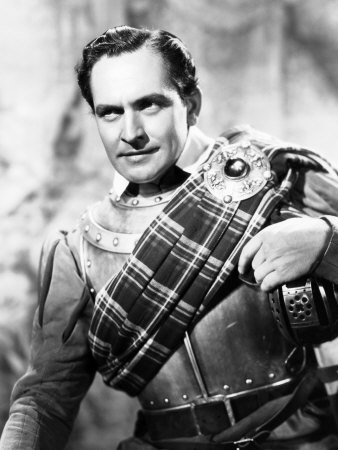
But, there's another reason: Geronimo is on the warpath, and a stagecoach is just the sort of thing he and his Apache band will be looking for. Not that the passengers loading in the town of Tonto in the Arizona Territory are all that valuable: there's Lucy Mallory (Louise Platt), a young Army wife with a secret on the last leg of a journey to re-unite with her husband; the gambler Hatfield (John Carradine), who takes pity on the woman for her long journey and chooses to accompany her; there's Sam Peacock (Donald Meek), a liquor salesman. The city's "Law and Order League" are kicking out two of the passengers: Doc Boone (Thomas Mitchell), the town doctor and town drunk, and "a lady of pleasure," Dallas (Claire Trevor). A last minute addition is the town banker, Henry Gatewood (Berton Churchill), who blusters and bullies his way onto the stage, making for crowded conditions.
They don't make much head-way until they run into another orphan—"Ringo" (John Wayne), yep, just as the Marshall thought, on his way to Lordsburgh with death on his mind, but a horse that's gone lame, and so he hails down the stage with a rifle-cock, dust-blown and sweating in one of the grandest introductions that Ford ever allowed one of his actors.* "Ringo" does intend to confront the Plummers, but he's glad to see the Marshall and Buck, anyway, as they're old friends. And, heck, sure, he did a jail-break, but there's no reason to get ornery about it, as the Marshall's just doing his job and he sure could use that coach-ride.
It might've been healthier to catch the next one. It's crowded on that stagecoach and Ringo is relegated to the floor, caught in the middle between bickering, loathing, and often drunken passengers. Ringo stays friendly and guileless. So much so that he treats Dallas with the same respect that he does Mrs. Mallory—at the first stop at Dry Fork, when everyone else sits for a lunch-break, he offers her a chair (next to him, in fact), the haughtier passengers move away from their company. At Dry Fork, their cavalry escort moves on to Apache Wells—there's been an incident and Mallory's husband has gone off with them—but, the coach passengers vote to move on despite the lack of troops watching over them.
They make it to Apache Wells, but their stay there will be unexpectedly long: first, Mrs. Mallory is informed that her husband has been injured in a skirmish with Apaches nearby, which leads to a medical emergency that forces them to stay the night, forces Doc Boone to sober up, and allows some folks' opinion of Dallas to change. 

But not Ringo. Her actions only cements his opinion of her, and before the next day dawns, he proposes to her, which just puts her in a state of confusion. She thinks he's naive and doesn't know about her, but he doesn't care. Then, there's the little matter of his heading for Lordburgh—he's not going to let go of his blood-feud, and for Dallas, that's a prospect that can only lead to a very short marriage and widow's weeds.
Dallas and Ringo concoct a desperate plan for his escape—she grabs a rifle, he grabs a horse and he's off before Wilcox can notice he's gone. But, once he does, it doesn't take him long to find him. He's stopped, looking off at the horizon. The Apaches are sending war-signals, and no matter what delicate condition the passengers are in, they're heading for Lordsburgh, pronto.
There begins a sequence for which Ford became famous—a desperate chase across the desert with no cover in sight, with everyone riding at top-gallop, break-neck. This one is augmented and devised by the work of legendary stuntman/arranger Yakima Canutt (who was recommended for the job by Wayne). To this day, it's an amazing show of guts and bravery. The most amazing of which are two shots that are unbroken—where Canutt plays an Apache warrior who leaps from his horse to the lead-horse of the stagecoach, is then "shot" by Ringo and falls back between the horses and between the wheels of the wagon. The other he doubles for Ringo, as he leaps from horse-back to horse-back trying to retrieve the reigns of the lead horses dropped by Buck when he's shot during the fire-fight.
Canutt's work was so respected by Ford that the stunt-man was put on the payroll of every subsequent Ford film (unless he was working on another picture), whether his services were needed or not.

Stagecoach was made in that Golden Year of 1939, probably the apex of Hollywood output as far as high-end quality. It has aged very well, balancing out things that seem merely quaint today (but were radical in its era) with things that still boggles the mind and eye. One of those things is the cinematography of Bert Glennon, a workmanlike photographer who Ford would rely during his RKO days before setting up stables at 20th Century Fox. Ford would call on him again for his glorious Wagonmaster.
It's been remade (twice, both wildly inferior to the original), made John Wayne a star, won Thomas Mitchell his Oscar, and changed the Western genre from kiddie fare to acceptable adult material. It also earned Ford another of his innumerable "Best Director" nominations at the Academy Awards.

And Orson Welles watched it forty times before making Citizen Kane.
John Wayne walking in 1939, the way he'd walk the rest of his Western career.

* It's a "truck-in" shot, a difficult maneuver as you have to maintain focus for the entire distance. They didn't, as one can see in Stagecoach, even though it has a great effect. But, they would when Ford did the same trick on Wayne in The Searchers. Why he did it for Wayne here is one of those John Ford mysteries. Wayne had worked in the background of a lot of Ford films, and the director was definitely grooming him to become an actor—even a star. But, director Raoul Walsh got him first, changing Marion Morrison's name to "John Wayne" and starring him in his film The Big Trail, a massive wide-screen (65 mm and stereo sound) wagon-train epic, which is a great movie, but it failed to make back its substantial costs at the box-office. Wayne was left to languish, making B and C-grade Westerns at Monogram and Mascot Studios, until Ford wore off his "snit" about Wayne's seeming "betrayal" and cast him in Stagecoach. This elaborate intro shot may have been Ford's penance.

Wednesday, July 10, 2019

The Last Gangster

The Last Gangster (Edward Ludwig, 1937) Six years after ushering in the gangster film with his portrayal of Johnny Rico in Little Ceasar for Warner Brothers, Edward G. Robinson was playing another one named Joe Krozac in a property titled Another Public Enemy, written by William Wellman, the man who wrote and directed James Cagney's Public Enemy. For whatever reason, the property made it over to M-G-M, not the tough-as-nails "Home of the Crime Drama" Warner Brothers, and got gussied up with the Metro house style and a more family-friendly story-line. The result is a curious mixture of crime and melodrama, re-titled The Last Gangster.  

In this one, Robinson plays Joe Krozac, a mob-boss with a very loose mob, but a lot enemies, including the Kile brothers, whom he manages to wipe out except for one, Acey Kile (Alan Baxter) who manages to survive but swears revenge. 
It's bad timing because Krozac has taken an extended trip to Europe and returns with a bride from the old country, Talya (Rose Stradner), who knows nothing of his criminal activities. But, she can't help but notice the prosperity and shady character's in Joe's life, like Curly (Lionel Stander), who's a bit sketchy. But, you'd think she'd notice there's something a little "off" about Joe; when she announces she's pregnant, Joe's response is "Why, I'm so happy I'd like to go up and punch someone in the nose!"
But, life...and the law...can be inconvenient. Joe is convicted of tax evasion and sent to Alcatraz for ten tears—that's a lot of childhood to miss out on—and he vows that no pen can hold him, not for ten years. But, life is different on the inside and although his reputation helps, there are enemies on the inside, plus his gang on the outside, who want to know where he stashed all his loot before going to the Big House.But, however big he talks, he's still there when Talya gives birth—to a boy. Visitations to Alcatraz are bittersweet, as Joe cannot hold his child, but only watch him through prison-grills. On one of those visits, a newspaper scribbler named Paul North (James Stewart) sees the poignant scene and decides to make hay out of it, feigning sympathy for Talya and buying the child a toy gun, all the better to get a picture of the toddler making like father, like son and plastering it all over the newspaper. His editor is happy, but North quits in a fit of delayed conscience.
North apologizes to Talya, and she is drawn to his remorse, something completely foreign to Joe Krozec. Eventually, their marriage breaks down—Talya divorces Krozec and marries North, adopting Joe's child—and Joe loses track of them, as they move and North changes his name.

Stewing prison, Joe can't do anything about it, but he's determined to get his family back.

Robinson was attracted to the movie, even though he'd tired of playing gangsters, preferring better scripts and better writers than the genre churned out. And even though Wellman was associated with the genre—and grown out of it—the ideas of the story, originally titled "Another Public Enemy," were less concerned with mob life, but its consequences, and M-G-M was a cut above the more meat-and-potatoes Warner lot.
Still, The Last Gangster is more soap than pulp, and as much as script-writer John Lee Mahin tries to keep the script tough, he can't help but make the mobster more sympathetic than the good folks like the North family. Probably, it's Robinson's portrayal, which is far stronger than Stradner's "woe is me" immigrant wife (Louise Rainer was originally sought, but turned it down) and Stewart's weak portrayal.*
It has to be considered some kind of misfire when the actions of responsible people who are genuinely doing the right thing for a child, can't generate more sympathy over a jilted mobster. 

The Last Gangster would not prove to be the last gangster role for Robinson—just one of the lesser ones.

* I'm always fascinated by odd pairings of stars and seek them out to see what the results of such chemistry experiments are. Anybody expecting sparks between Robinson and Stewart will be disappointed. It's Robinson's show and Stewart's merely a dull co-star. The two wouldn't appear in another movie together until 1964's Cheyenne Autumn, but had no scenes together.

Wednesday, August 30, 2017

Olde Review: The Shootist

Written August 11, 1976

The Shootist (Don Siegel, 1976) I was briefing through the movie reviews of various magazines in the grocery store a year or so ago, when I came across Richard Schickel's review of McQ or Brannigan (probably Brannigan), in which he remarked that a proper bicentennial project would be to come up with a decent script for John Wayne.

I was hoping
Rooster Cogburn might be it, but that was a waste..of time...and talent. And besides, as much as I like "Rooster" Cogburn as a character, the acceptance of Wayne's acting that suddenly sprang up smacked a bit too much of "Well, we'll like him as long as the old galoot knows he's a joke." Well, there were times in True Grit when Wayne—the Wayne as the screen force—came through. I didn't want to see Wayne made fun of or exploited. I wanted to see him triumph, as of old, in his now twilight years, and as John Wayne, the very fine actor.

So, I am delighted at The Shootist and delighted with it. It is about Wayne, as about Books (instant cliché time). Why else would Siegel in his opening use shots of old Wayne movies (and mostly Howard Hawks Wayne films, where Wayne played a character built out of his own persona, rather than playing "honest-to-God" characters ala John Ford) and with young boys—in Red River and Rio Bravo—as Wayne the mentor, as he is, in an odd way, in this film. Siegel is still a little obvious in his handling of things, but the ideas are so good, who cares? He literally numbers Wayne's days. And what a nice idea for a living legend and soon-to-be-immortal legend to have his birthday and the day of his death on the same day, on a gravestone that doesn't mark its day.
Death hangs over this film, in conversation, in song, in thought, in way of life. But this is nothing new. Death has walked with Wayne through many a picture. For a long time. Both were winners in the end, and, as in real life, Death must have his due.

Update in the present: The Shootist is the film John Wayne went out on, and as a summation of his career, and as the last ring of the bell, it's nearly perfect, even though the film is a bit flawed. Still, director Siegel did a masterful job of keeping all of the many stars corralled (there was a lot of people wrangling to be in it) and Wayne healthy, although there were times when he was too weak to be on-set (although he was, at that time, cancer-free). And even though star Wayne and director Siegel got on like a house-afire (the two couldn't have been more different, politically) there were still dust-up's about the way Siegel, the most economical—in that he never shot "coverage"—and least fancy of directors, would line up shots. Lauren Bacall, who was no doubt reliving her own time of dealing with cancer with husband Humphrey Bogart, braved up through the movie, and provided a steely shoulder for Wayne to lean on. Stewart signed on for a cameo, comprising the most jarring scene; it's Stewart who provides the cancer diagnosis and there's just enough edge in it to recall his furious characters in his 50's Westerns directed by Anthony Mann. And Richard Boone, John Carradine, Harry Morgan, and Hugh O'Brian did the same out of respect and love for their old co-star, and Ron Howard, whose eyes were now set on a directing career instead of acting, still pursued the juvenile lead one last time. The budget was tiny, but top-heavy with stars...and history.
All those guest stars work against the film and make it lose focus a bit. You get the feeling that Siegel might not have gotten all the coverage he might have wanted--sequences seem stretched a might' thin in places. But, overall, the film works well.
With time, perspective...and maybe a slight blurring of facts...one can look at The Shootist as the death of the Western—a sturdy movie genre for decades. The 60's had slowed it down, made them seem irrelevant, but one could still count on a number of Westerns being shot every year...until John Wayne died. And then...nothing.
A few things crop up here and there. Tombstone and its cousin Wyatt EarpEastwood's classic (and Oscar-winning) Unforgiven, and Silverado, which reminded how good a time an intelligent Western could be. The television series "Deadwood" is a wickedly nifty updating of the "Gunsmoke" stories of a frontier town, and 3:10 to Yuma briefly revived interest in the Old West and its ways. But a case can be made that without Wayne in the saddle, green-lighting a Western has become a difficult proposition.
Why bother? Wayne kept the genre alive for so long, but with his passing, they became less viable.
They might still come back. Turner will do a period piece, a Zane Grey adaptation, once in awhile, "Lonesome Dove" certainly proved popular, and even Brokeback Mountain made a contribution. But that 3:10 to Yuma popularity was certainly encouraging. Ed Harris likes to make Westerns...and good ones.
Then there's the curious phenomenon of the Western morphing into another genre--Science Fiction, precisely. The "Back to the Future" series capped off with an Old West yarn, and it was easy to see the gun-slinger in Han Solo in Star Wars, the fight in the bar, etc. and, Joss Whedon created a future Western in the "Firefly" series, and its movie-spin-off, Serenity. The new version of "Westworld" confuses the issue even more. It's funny. Just as the western was a broad enough genre to encompass all sorts of morality plays that would reflect today's society, so, too does the Science Fiction story. The two overlap, and share much the same elasticity, that frequently it turns into a case of "You got Science Fiction in my Western/You got Western in my Science Fiction."
Maybe the Western hasn't rode into the sunset just yet.

Maybe it's just waiting for a new dawn.

Or a new star to guide her.


Wednesday, July 12, 2017

Hitler's Madman

Hitler's Madman (Douglas Sirk, 1943) Of all the butchering that has gone on in the world since Cain slew Abel, one episode has always fascinated me—the murder of Lidice, Czechoslovakia by the Nazi's during World War II, Hitler's revenge for the murder of his favorite SS man Reinhard Heydrich. The events were recently documented in the film Anthropoid, but I'd often wondered why a version hadn't been made before.

The answer is...of course, it had. 


Hitler's Madman was made at Producers Releasing Corporation, a small, low budget studio not long after the real-time events took place. Filming took place over one week. It's highly fictionalized; only one Czech assassin (Alan Curtis) makes it to Lidice to carry out the attack on Heydrich, helped by his lover (Patricia Morrison) and a local partisan, and Heydrich is ambushed on a forest road and not a city street in Prague.
As in real life, the assassination of Heydrich is weeks in the planning, lightning-fast in its execution, but its ramifications are huge, as Hitler takes his revenge by decimating a Czech town and murdering its citizens (Lidice was chosen as a practical alternative to the city suspected of keeping the assassins hidden, which had a strategically valuable munitions plant). Hitler's Madman spends a lot of time among the Lidice people, living their lives (as best they can) under the yoke of "The Protector" (as Heydrich was designated), an SS sadist, who takes a hands-on approach to occupation, making University visits to root out sedition, choosing daughters of suspected dissidents to send to the Russian front as prostitutes, and taking a supremely cavalier attitude to the populace, who are kept alive only if they're useful—like the mayor, a Nazi loyalist who will turn in any sign of talking against the Germans. One suspects he would have served the Communists equally well, if he'd lived.
Carradine's Heydrich takes a sadistic joy out of goose-stepping on the citizens. For instance, during the town's celebration of St. Mark, intended to bring the town together and inspire a good planting season, Heydrich goes straight for the jugular—the town priest, who stands up to him without provoking him or doing anything that might get him arrested. When Heydrich sees that his presence doesn't inspire any threat that he might take action against and intimidate the towns-folk, he takes the priest's vestments draping the statue of St, Mark and wipes his boot with them. When the priest charges at the front, he is machine-gunned in front of his parishioners. Heydrich has the last word: "So, I can't provoke you, eh?"
Well, he almost has the last word...

Hitler's Madman boasted one movie veteran of note—John Carradine, a well-established character actor, who plays Heydrich with an amused detachment and sardonic menace, a villain role he plays with a restrained relish. Carradine is the only "name" in the cast, but the material and the production values (for a Z-list studio) so impressed M-G-M that they bought it for distribution, their only addition being that previously mentioned "line-up" of Lidice daughters, thus alloying them to make use of their stable of starlets—including Ava Gardner (her 15th film appearance including shorts)—for extra exploitable appeal.
Ava Gardner is the third woman on the right hiding her face.
Credit for that production value must go to its German expatriate director Douglas Sirk (born Hans Detlef Sierck in Hamburg Germany, 1897) who, along with Fritz Lang and Billy Wilder, fled Germany and Europe in the late 1930's, while Hitler was just paying lip-service to the damage he'd do. Sirk, even under the skid-road conditions of the studio, still manages to make memorable images, despite having dull heroic leads, and a screenplay that's all over the map drawing from rumor, remembrance, and, as its propagandistic spine, the poem "The Murder of Lidice"** by Edna St. Vincent Millay
Sirk had more than artistic inspiration to draw upon while making Hitler's Madman—he had actually met Reinhard Heydrich, whom, he said "made my blood run cold."
For me, who's known of the events for years, it is an interesting film to view, especially as it contains a scene at Heydrich's death-bed (with little basis in reality as Heydrich was in so much pain from his injuries that he was slipping into and out of coma the last days of his life) that is chilling and fitting, as it shows the dying nazi-crat with no remorse, no sentimentality, and has the added ironic conclusion that Heydrich is just another layer in the tissue of lies the Nazi's use to prop themselves up, with filled with mythic lies that had no basis in reality. At the end, face-to-face with the reality of his own death, Heydrich has no constitution for Nazi theatrics and platitudes, and in his last words, reveals himself to be even more of a monster near-death than he was in life.
HIMMLER: Heil Hitler.
HEYDRICH: Don't bother me with that nonsense. I am in pain.
HIMMLER: Nonsense. You don't know what you're saying, Heydrich. I bring you greetings from our beloved fuehrer.
HEYDRICH: I don't want his greetings. Or yours. I want to live. Did you catch the assassins?
HIMMLER: Everything possible is being (done).
HEYDRICH: Everything possible is being done, that's all I hear.
HIMMLER: You mustn't strain yourself.
HEYDRICH: Can't you send some doctors from Berlin? Instead of these horse-doctors?
HIMMLER: You may leave
DOCTORS: Heil Hitler! (They exit, leaving Himmler alone with Heydrich)
HIMMLER: A soldier dies with courage, Herr Heydrich.
HEYDRICH: A true Nazi, eh? I would like to see how you and your feuhrer would act if your insides were shot out. Why can't I get morphine? It's getting dark. I want to live!
HIMMLER: You are dying for the fuehrer, Heydrich.
HEYDRICH: I don't want to die. I'm not going to die for the fuehrer or anyone else. I want to live. You'll face death one of these days, Himmler. And your fuehrer. All of you will face death. All of you. There's another thing I'll tell you. Here. Closer. We'll lose. The Russians will win. The Poles, the British, the Czechs. The Americans will win. We'll be the only ones to lose. And why? Why will they win? I'll tell you. You were too weak, that's it. Every day, I had to shoot thirty. It should have been three hundred, Himmler. Three thousand. Day for day, three...I should have done away with them all. All of them. All of them. Kill them if you want to be safe. Every day. All of them. Shoot them. Shoot them. All of them.

His fellow countryman, Fritz Lang, would direct his own version of events, Hangmen Also Die!, in 1943. We'll look at that very different film tomorrow.

**
The Murder of Lidice
by Edna St. Vincent Millay (abridged in The Saturday Review, 10/17/1942)

IT was all of six hundred years ago,
It was seven and if a day.
That a village was built which you may know
By the name of Lidice.

Not a stick, not a stake and stone remain
To mark where the fair Danubian plain
Was rich in cattle and rich in grain
In far Bohemia,
In a village called Lidice.
(At least, that is what they say)

But all of the villagers worked as one
(As ever since then these folks have done)
To build them a village to sit in the sun
As long as the Danube River should run
Through far Bohemia;
And they named it Lidice . . .

They built them a church and they built them a mill,
And on the fair Danubian plain.
For to shrive their souls and to grind their grain,
 And to feed them wholesomely . . .

And close together like swallows' nests
They built their houses on the low crests
Of the banks of the river that turned the mill.
And each man helped his neighbor to lay
The stones of his house, and to lift its beams;
Till strong in its timbers and tight in its seams
A village arose called Lidice . . .

How did the year turn, how did it run.
In a village like Lidice?
First came Spring, with planting and sowing;
Then came Summer, with haying and hoeing;
Then came Autumn, and the Harvest Home . .

And always in Winter, with its brief bright day,
Toward the end of the quiet afternoon,
(Children at school, but coming home soon,
With crisp young voices loud and gay;
Husband at Kladno, miles away.
But home for supper, expected soon)
Toward the end of the Winter afternoon .
 . .
The wise, kind hands and contented face
Of a woman at the window, making lace . . .
A peaceful place .. . a happy place . . .

How did the year turn—how did it run
In the year of nineteen-forty-one ?—•
In a village called Lidice?
First came Spring, with planting and sowing;
Then came Summer, with haying and hoeing;
Then came Autumn, and the Harvest Home . . .

Then came Heydrich the Hangman, the Hun . . .

"Mirko, the Rakos barns are full;
It's time to harvest the sugar beets."
"Hush with your clack while a man eats!
I'll think of the harvest and sugar beets
When the evening meal is done.
I've much on my mind, wife—I heard say
From the metal-workers in Kladno today
That Heydrich the Hangman comes our way—
God's curse on him!"
                   "Husband, the things you say!
Heydrich's but Hitler's tool."

"What do you take me for,—a fool?
God's curse on him, anyway."
"Cross yourself, Mirko!" "I did." "And pray."
"I'll pray when my supper's done."

"Husband why is your face so grey?"

"My face is grey from fear.
Heydrich the Hangman died today
Of his wounds, the men in Kladno say."

"Good riddance to wicked rubbish, I say . . .
No man was he, but a ravening beast . . .
Do they know who killed him? "
"Not yet, they say:
Though they've smoked him out for many a day . . .
But they claim we hid him here."

"Here? Here in Lidice?"
"Here in Lidice."
"If I knew where they hid, I'd not give them away."
"Yes .. . All of the village feels that way.
But heavy's the price we'll have to pay,
If they're not found, I fear.
How it will turn I could not learn . . .
But my face with fear is grey."

An officer walked in Wilson Street,
A German officer jaunty and smart;
A sabre-cut on his cheek he bore.
And tailored well were the clothes he wore,
His uniform dapper and smart.
And he hummed a waltz, as he strolled toward
A group of men by a high bill-board,
And he smiled and softly stopped in his tracks
As he studied the stooped and troubled backs
Of poor men reading the word "Reward!"

(REWARD! . . . REWARD! . . . REWARD! . . . REWARD! . . .
TWO HUNDRED THOUSAND CROWNS I N GOLD! . . .
FOR INFORMATION LEADING TOWARD
THE CAPTURE OF THE COWARDLY AND RUTHLESS KILLERS
OF REINHARD HEYDRICH!
REINHARD HEYDRICH! . . .
HEYDRICH THE PURE I N HEART!)

He looked at their backs and smiled, and thought,
"Heydrich's killer's as good as caught!"
For well he knew what money can do
To a poor man's mind (and a rich man's, too—
For the more a man owns the more he owes.
And the more he must have, and so it goes).

They marched them out to the public square.
Two hundred men in a row;
And every step of the distance there,
Each stone in the road, each man did know—
And every alley in doorway where
As a carefree boy, not long ago.
With boys of his age he would hide and run
And shout, in the days when everyone
Was safe, and free,—and school was out . . .
Not very long ago . . .
And he felt on his face the soft June ciir,
And thought, "This cannot be so!"

The friendly houses, the little inn
Where times without number he had been
Of an evening, and talked with his neighbors there
Of planting and politics—(not a chair
At any table he had not sat in)
And welcomed the newcomer coming in
With nod of greeting, of "Look, who's here!"—
Spoken friendly across the rim
Of a mug of Pilsen beer . . .

And the men he had greeted with loving shout.
And talked about football with, and about
The crops, and how to keep Hitler out . . .
Were lined up with him here . . .

And one man thought of the sunny row
In his garden, where he had left his hoe;
And one man thought of the walnut trees
He had climbed, and the day he broke his arm,
But it had not hurt, as his mind hurt now—
How happy his boyhood, how free from harm!

And one who was dying opened his eyes.
For he smelled smoke, and stared at the skies
Cloudy and lurid with smoke and flame;
From every building it billowed; it came
From every roof, and out it burst
From every window,—none was the first;
From every window about him burst
The terrible shape of flame,
And clawed at the sky, and leapt to the ground,
And ran through the village with a crackling sound
And a sudden roar where a roof fell in;
And he thought of his mother, left alone
In the house, not able to rise from her chair;
And he got to his elbows, and tried to crawl
To his home, across the blood in the square,
But at every step did slip and fall,
For the slippery blood was everywhere.

Oh, many a faithful dog that day
Stood by his master's body at bay.
And tugged at the sleeve of an arm outflung;
Or laid his paws on his master's breast,
With panting jaws and whimpering cries,
Gazing into his glazing eyes
And licking his face with loving tongue;
Nor would from his dead friend depart,
Till they kicked in his ribs and crushed his heart . .

The women and children out to the Square
They marched, that there they might plainly see
How mighty a state is Germany!—
That can drag from his bed unawake, unaware,
Unarmed, a man, to be murdered where
His wife and children must watch and see;
Then carted them off in truck and cart
Into Germany, into Germany,—
The wives to be slaves of German men;
The children to start life over again,
In German schools, to German rules,—
As butchers' apprentices.
And hail and salute the master mind
Of the world's chief butcher of human-kind . . .

They knocked on the door where a young wife bore
Her first, her last man-child;
She heard them coming down Wilson Street,
She heard from the square the machine-gun shots
That told her her man was dead;
And she bit and tied in a slippery knot
The cord of the fine man-child he'd got,
And slung him under the bed . . .
She rose on trembling arms to greet
The men who entered Wilson Street;
"There's nobody here but me!" she cried;
And her eyes were bright and hot in her head . . .
"I'm far too sick of the fever," she said,
"Into Germany, into Germany
For to be marched or led ... "
But the baby wailed from under the bed—
And they by the heels with a harsh shout
Did drag him out—but the baby bled—
So against the wall they banged his head,
While the mother clawed at their clothes and screamed.
And screamed and screamed, till they shot her dead.

Now, not a stake was left on a stone,
Nor the frame of a window-sill
Where a woman could lean in the dusk alone,
Her arms aware of the warmth of the stone,—
In Lidice, in Lidice—
Yet they say that it stands there still!

Yes, those who have been there solidly say
That every night when the moon is right.
That during the tenth of June all day,
And thin and strange when the sun sets
And the moon comes out, Ste. Margaret's—
Spire and nave and people at prayer
Are plainly seen and you can pass
Your hand through the beautiful colored glass
And draw it back . . . and no blood there!

And they say that men of an evening meet
And talk together in Wilson Street
And draw deep breaths of the air . . .
Though Wilson Street with the rest of the town
Burned down on the tenth of June, burned down,
And there is nothing there . . .
The Germans say there is nothing there.

Good people, all from our graves we call
To you, so happy and free;
Whether ye live in a village small
Or in a city with buildings tall,
Or the sandy lonesome beach of the sea.
Or the woody hills, or the flat prairie;
Hear us speak; oh, dear what we say;
We are the people of Lidice.
Hear us speak; oh, hear what we say,
Who and where soever ye be . . .
Unless ye would die as we!

Dead mouths of men once happy as you.
As happy as you and as free,
Till they entered our country and slaughtered and slew,
And made us do what we hated to do.
And then—oh, never forget the day!—
On the tenth of June in '42
They murdered the village of Lidice!

Dead men, dead men.
Up through the ashes of Lidice
Telling you not to be caught as they
All in the morning of a June day
Were caught, and shot and put out of the way . . .
(At least, that is what they say)
Telling you not to eat or drink
One morsel of food, one swallow of drink
Before you think, before you think
What is the best way
To keep your country from the foe you hate—
Keep it from sloping bit by bit
Down to what is the death of it—

The whole world holds in its arms today
The murdered Village of Lidice,
Like the murdered body of a little child
Happy and innocent, caught at play.
The murdered body, stained and defiled,
Tortured and mangled, of a helpless child,—

And moans of vengeance frightful to hear
From the throat of a world, must reach his ear.
The maniac killer who still runs wild,
Where he sits, with his long and cruel thumbs.
Eating pastries, rolling the crumbs
Into bullets (for the day is always near
For another threat, another fear.
Another killing of the gentle and mUd)
But a moaning whine of vengeance comes.
Sacred vengeance awful and dear;
From the throat of a world that has been too near
And seen too much, at last too much—
Whines of vengeance sacred and dear.
For the murdered body of a helpless child—
And terrible sobs unreconciled!

Careless America, crooning a tune!—
Catch him! Catch him and stop him soon!
Never let him come here!

Think a moment: are we immune ?

Oh, my country, so foolish and dear,
Scornful America, crooning a tune,
Think. Think: are we immune?—
Catch him, catch him and stop him soon!
Never let him come here!

Ask yourself, ask yourself: What have we done?—
Who, after all, are we?—
That we should sit at ease in the sun,
The only country, the only one,
Unmolested and free?
Catch him! Catch him! Do not wait!
Or will you wait, and share the fate
Of the village of Lidice?
Or will you wait, and let him destroy
The Village of Lidice, Illinois?
Oh, catch him! Catch him, and stop him soon!
Never let him come here!