Showing posts with label Claire Trevor. Show all posts

Friday, April 10, 2020

The History of John Ford: Stagecoach (1939)

When Orson Welles was asked what movies he studied before embarking on directing Citizen Kane he replied, "I studied the Old Masters, by which I mean John Ford, John Ford, and John Ford." 

Running parallel with our series about Akira Kurosawa ("Walking Kurosawa's Road"), we're running a series of pieces about the closest thing America has to Kurosawa in artistry—director John Ford. Ford rarely made films set in the present day, but (usually) made them about the past...and about America's past, specifically (when he wasn't fulfilling a passion for his Irish roots). 

 In "The History of John Ford" we'll be gazing fondly at the work of this American Master, who started in the Silent Era, learning his craft, refining his director's eye, and continuing to work deep into the 1960's (and his 70's) to produce the greatest body of work of any American "picture-maker," America's storied film-maker, the irascible, painterly, domineering, sentimental puzzle that was John Ford, John Ford, and John Ford.


Stagecoach (John Ford, 1939) This classic western was hailed as the first "adult western" when it premiered and changed many folks' minds about the viability of the dusty genre to tell stories beyond those of bank-robbers and Indians and greedy rustlers and romancing school-ma'rms. Oh, and singing cowboys. It went beyond childhood fantasies and explored something beyond the white hat/black hat simplicity of early "oaters" to look at things like hypocrisy and duplicity.

Ford tells the story (based on a script by Dudley Nichols from a story, "Stage to Lordsburgh" by Ernest Haycox ) of a motley group of passengers thrust together on an event-filled stagecoach ride to Lordsburgh. That's the bones of it. But, it's not so much the location work, the horses, or the gun-play as it is the interaction between a coach of people on the outskirts of civilization—or what passes for "civilization" out there on the prairie. 
The stagecoach is being driven by Buck (Andy Devine) with Marshall Curley Wilcox (George Bancroft) riding shotgun; the Marshall is taking that position because there's news that "The Ringo Kid" has broken out of prison, vowing revenge on the Plummer brothers for the murder of his father and brother. The Plummers are in Lordsburgh, so chances are "Ringo" is headed there, as well, giving the Marshall a chance to catch him before any one else is killed.
But, there's another reason: Geronimo is on the warpath, and a stagecoach is just the sort of thing he and his Apache band will be looking for. Not that the passengers loading in the town of Tonto in the Arizona Territory are all that valuable: there's Lucy Mallory (Louise Platt), a young Army wife with a secret on the last leg of a journey to re-unite with her husband; the gambler Hatfield (John Carradine), who takes pity on the woman for her long journey and chooses to accompany her; there's Sam Peacock (Donald Meek), a liquor salesman. The city's "Law and Order League" are kicking out two of the passengers: Doc Boone (Thomas Mitchell), the town doctor and town drunk, and "a lady of pleasure," Dallas (Claire Trevor). A last minute addition is the town banker, Henry Gatewood (Berton Churchill), who blusters and bullies his way onto the stage, making for crowded conditions.
They don't make much head-way until they run into another orphan—"Ringo" (John Wayne), yep, just as the Marshall thought, on his way to Lordsburgh with death on his mind, but a horse that's gone lame, and so he hails down the stage with a rifle-cock, dust-blown and sweating in one of the grandest introductions that Ford ever allowed one of his actors.* "Ringo" does intend to confront the Plummers, but he's glad to see the Marshall and Buck, anyway, as they're old friends. And, heck, sure, he did a jail-break, but there's no reason to get ornery about it, as the Marshall's just doing his job and he sure could use that coach-ride.
It might've been healthier to catch the next one. It's crowded on that stagecoach and Ringo is relegated to the floor, caught in the middle between bickering, loathing, and often drunken passengers. Ringo stays friendly and guileless. So much so that he treats Dallas with the same respect that he does Mrs. Mallory—at the first stop at Dry Fork, when everyone else sits for a lunch-break, he offers her a chair (next to him, in fact), the haughtier passengers move away from their company. At Dry Fork, their cavalry escort moves on to Apache Wells—there's been an incident and Mallory's husband has gone off with them—but, the coach passengers vote to move on despite the lack of troops watching over them.
They make it to Apache Wells, but their stay there will be unexpectedly long: first, Mrs. Mallory is informed that her husband has been injured in a skirmish with Apaches nearby, which leads to a medical emergency that forces them to stay the night, forces Doc Boone to sober up, and allows some folks' opinion of Dallas to change. 

But not Ringo. Her actions only cements his opinion of her, and before the next day dawns, he proposes to her, which just puts her in a state of confusion. She thinks he's naive and doesn't know about her, but he doesn't care. Then, there's the little matter of his heading for Lordburgh—he's not going to let go of his blood-feud, and for Dallas, that's a prospect that can only lead to a very short marriage and widow's weeds.
Dallas and Ringo concoct a desperate plan for his escape—she grabs a rifle, he grabs a horse and he's off before Wilcox can notice he's gone. But, once he does, it doesn't take him long to find him. He's stopped, looking off at the horizon. The Apaches are sending war-signals, and no matter what delicate condition the passengers are in, they're heading for Lordsburgh, pronto.
There begins a sequence for which Ford became famous—a desperate chase across the desert with no cover in sight, with everyone riding at top-gallop, break-neck. This one is augmented and devised by the work of legendary stuntman/arranger Yakima Canutt (who was recommended for the job by Wayne). To this day, it's an amazing show of guts and bravery. The most amazing of which are two shots that are unbroken—where Canutt plays an Apache warrior who leaps from his horse to the lead-horse of the stagecoach, is then "shot" by Ringo and falls back between the horses and between the wheels of the wagon. The other he doubles for Ringo, as he leaps from horse-back to horse-back trying to retrieve the reigns of the lead horses dropped by Buck when he's shot during the fire-fight.
Canutt's work was so respected by Ford that the stunt-man was put on the payroll of every subsequent Ford film (unless he was working on another picture), whether his services were needed or not.

Stagecoach was made in that Golden Year of 1939, probably the apex of Hollywood output as far as high-end quality. It has aged very well, balancing out things that seem merely quaint today (but were radical in its era) with things that still boggles the mind and eye. One of those things is the cinematography of Bert Glennon, a workmanlike photographer who Ford would rely during his RKO days before setting up stables at 20th Century Fox. Ford would call on him again for his glorious Wagonmaster.
It's been remade (twice, both wildly inferior to the original), made John Wayne a star, won Thomas Mitchell his Oscar, and changed the Western genre from kiddie fare to acceptable adult material. It also earned Ford another of his innumerable "Best Director" nominations at the Academy Awards.

And Orson Welles watched it forty times before making Citizen Kane.
John Wayne walking in 1939, the way he'd walk the rest of his Western career.

* It's a "truck-in" shot, a difficult maneuver as you have to maintain focus for the entire distance. They didn't, as one can see in Stagecoach, even though it has a great effect. But, they would when Ford did the same trick on Wayne in The Searchers. Why he did it for Wayne here is one of those John Ford mysteries. Wayne had worked in the background of a lot of Ford films, and the director was definitely grooming him to become an actor—even a star. But, director Raoul Walsh got him first, changing Marion Morrison's name to "John Wayne" and starring him in his film The Big Trail, a massive wide-screen (65 mm and stereo sound) wagon-train epic, which is a great movie, but it failed to make back its substantial costs at the box-office. Wayne was left to languish, making B and C-grade Westerns at Monogram and Mascot Studios, until Ford wore off his "snit" about Wayne's seeming "betrayal" and cast him in Stagecoach. This elaborate intro shot may have been Ford's penance.

Saturday, October 21, 2017

Raw Deal

Raw Deal (Anthony Mann, 1948) There's something just a wee bit different about this film-noir featuring the director-cinematographer team of Anthony Mann and John Alton (who were responsible for so many moodily-lit film-noir films that managed to excel in their ability to transcend their B-movie budgets and actually display something of unforgettable visual artististry). It's told from the woman's perspective as she observes the plight her boyfriend-paramour is going through in trying to exact revenge on the gangland boss who did him dirt. Her plans are to spring him out of prison and go on the lam, out of the country, but, first, she has to convince him to let his unfinished business go. And since that unfinished business has a good share of 50 grand attached to it. 

Well...men can be so practical, sometimes.


I mean, he IS still in prison and all.

Joe Sullivan (Dennis O'Keefe) has a lot of time juice-stewing while in the slammer. He's taken the fall for the no-good-high-roller rat named Ricky Coyle (Raymond Burr) and ended up serving time and wasting it. His only high-points in the gray-bar hotel are when the do-gooder legal case-worker Ann Martin (Marsha Hunt) comes to visit him to try and get him out of jail if he'd just turn state's evidence. She's a cute kid and all ("Next time you come up, don't wear that perfume...it doesn't help a guy's good behavior"), but Joe's got other plans for busting out. 
And that's where Pat Cameron (Claire Trevor), our narrator, comes in. She's been working angles outside, so that she and Joe can run away together, even if it is on the lam. Trouble is, Pat's a little on the desperate side and naive, and the plan that she's got for springing Joe comes straight from Ricky Coyle, who's having a very good time spending Joe's share of the loot and doesn't have any plans to split it. It doesn't occur to Pat that, should his prison-break succeed, it won't be just the cops they'll be running from, but Coyle's gang, as well.
But no one but Pat figures on Joe's resourcefulness and he does manage to escape...but just barely. A bullet-riddled gas tank from the attempt and "a dragnet tighter than a fist" forces them to start altering plans and Joe decides to hide out for a couple days at the one address that might hold a sympathetic soul, Ann's. Plan B is to take Ann hostage (for the police...and maybe for Joe) and meet up with Rick at Crescent City to settle scores. Joe and Rick have different ideas of what that means, and so he sends some hit-men to meet up with Joe and rid Rick of the problem for once and for all.
The triangulated action, between the pursuers and the pursued—who have their own internal tensions—makes it a more complicated plot than most noirs, despite the lack of mystery inside it. It's a standard chase, but coming at different angles, with the "wanted" man circled by two forces that want him dead or back in prison, and two women who want him alive, but with conflicting emotions about what that might entail. In the meantime, Mann never gives you a sense of space or of freedom. There's always a sense of entrapment from the dark frames of doors to the grill-work on the prison windows and everyday fences...right down to the veils that the women wear, even if it's a little premature to be in mourning. Still, in the noir-niverse, one can never start too early.
Despite the artistry, Mann directs with a rough savagery that, at times, is unnerving. At one point, during a party that Coyle is giving, the true villainy of the man is displayed by his throwing a flaming chafing into the face of one of the party-goers. It shocks, and makes one a little wary of what might come. The action is brutal, with a particularly frenzied fight at the end that leaves you shocked and more than a little relieved when the end comes and you can vacate this dark Hell that starts in prison and never really leaves.

Thursday, August 17, 2017

Murder, My Sweet

Murder, My Sweet (Edward Dmytryk, 1944) A neat trick, this. Although the third Raymond Chandler adaptation to make it to the screen—the first being The Falcon Takes Over (taken from the same source novel as this—Farewell, My Lovely) co-opted as a story-line in the George Sanders "Falcon" movie series, and the second, Time To Kill (based on "The High Window") featuring Lloyd Nolan's popular Michael Shayne character, Murder, My Sweet is the first to feature Raymond Chandler's "slumming angel", Philip Marlowe.*  

The main departure is the title: Chandler's choice, "Farewell, My Lovely," was ditched after a preview screening because those first viewers were expecting more of a musical, as the movie starred Dick Powell, who was a mainstay of that genre and not the first person casual movie-goers would think of as a slightly soft-boiled detective sifting through the grime of Los Angeles. The name was thus changed to something suggesting more violence than tap-dancing...and probably to protect the innocent.**
Dmytryk and writer John Paxton do a fair job of keeping the first-person narration intact (the set-up is that Marlowe is being grilled by the usual suspicious police and he's giving his side of how things went down), and keeping a steady pace that's surprisingly fast. Although they didn't use Chandler's exact phraseology, they do a nicely watered down, tightened-up version of it for cinema audiences for whom thinking too much of the cleverness of a metaphor as it passes by their cerebellum might slow down a film's momentum. Call it "Chandler Lite." Although a lot of it is quite good, if less surly. One of my favorites is when someone says they don't like Marlowe's manners: "Yeah, I've gotten complaints, but they keep getting worse."
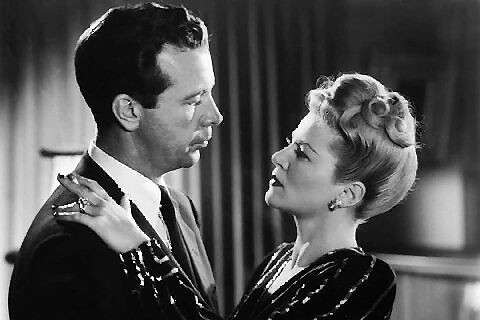
Powell can't get too far from his roots—he does a fancy two-step
in the "mausoleum" of a foyer.
It works, especially for the speed of this film. For the role of Marlowe, especially the first one, Dmytryk and the studio made an odd choice in Dick Powell, an A-lister in musicals. But, he's very effective. He's got a lived-in face, like a hound's, not a matinee idol's, slightly doughy (as is his body-type, despite being told he's "in good shape"—that's Marlowe to a wife-beater "T."), and you believe that Powell would be a reflexive weisenheimer—something about the "hoofer" background. The light comedy experience makes the sarcasm go down very well.
And Dmytryck has the noir feeling down, too, being as he was one of the architects of the style. Begin your movie in transition so the audience has a lot of questions it has to answer, go heavy on the atmosphere and always exit the scene with a sardonic quip. You already know you're in the hands of a master with the sequence that introduces "Moose" Malloy (Mike Mazurki) who just suddenly appears as a menacing reflection in the window that only appears because of the intrusion of a nearby flashing neon light. It's as disconcerting...well, as disconcerting "as a tarantula on an angel food cake", thank you very much! Dmytryck also has fun dancing around the brim of the Hayes Code in the two knock-out sequences of Marlowe being knocked out—always a hallmark of Marlowe stories and fans of inky pools of blackness, Long Goodbyes and Big Sleeps (or "Big Lebowski's," if you'd rather, later).
Indispensible in the mix is a high concentration of sass which is provided by that queen of the formClaire Trevor, whose performance as an evil step-monster is almost too much of a good thing. Murder, My Sweet would have been a rich enough story without her. Her presence and its tilting of the sexual equation slams this one deep onto the classic shelf. Powell would play Marlowe again on television, but this initial outing made him definitive...until Bogart came along.
But, for the record books...Chandler always said that Powell was his favorite version of Marlowe.

* The Big Sleep with Bogart as Marlowe was made the same year, but not released until two years later.

** They finally got around to using the title in the 1975 Dick Richards remake that starred Robert Mitchum, who would have been too pretty for Marlowe in his youth, but had aged into a wrinkled world-weariness that worked. When he was approached by producer Elliott Kastner and financier Sir Lew Grade to play the part—after their first choice, Richard Burton (??!!), had turned it down—Mitchum says that he said: "Why don't you just re-release Murder, My Sweet with Dick Powell and we can all go to the beach?"

Wednesday, May 20, 2015

The Amazing Dr. Clitterhouse

The Amazing Dr. Clitterhouse (Anatole Litvak, 1938) Warner Brothers programmer featuring Edward G. Robinson, allowing him to stretch his acting chops beyond his gangster type-casting while keeping him tied to the genre that made him a star with Little Caesar. It's a bit different than the play by Barré Lyndon (about a criminologist who invites a bunch of thugs to his house for research); adapted by John Wexley and John Huston, the Warners version is less talky and more action-oriented, with the doctor actively involved in the research.

Robinson plays a brilliant well-to-do physician who becomes fascinated with the criminal mind. Evidently mis-reading the dictum as "Physician, steal thyself," he starts to do some personal tests, committing actual robberies, to see how it affects his vitals. That gives him some information, but only about himself, and that hardly is enough to satisfy his curiosity. Interrupted from one attempted safe-grab at a high-society party by an actual criminal gang, led by one "Rocks" Valentine (Humphrey Bogart, who hated this movie), Clitterhouse, seeing an opportunity to increase his results, seeks an "in" with the crooks, asking to meet their "fence," reputed to be the best in the city. That contact turns out to be a woman (Claire Trevor), who is impressed with "The Professor" and invites him to join the Valentine gang.
"Ooops!"  You do NOT want to meet early Humphrey Bogart in a dark room.
Clitterhouse takes a six-week sabbatical, saying that he is going to vacation in Europe, when what he's really doing is merely going to the wrong side of the tracks...and the law.  As part of the Valentine gang, he sets up a series of robberies with ever-increasing stakes. Pretty soon, the dynamic of the group begins to change with "The Professor" becoming an increasingly more valuable member of the the Valentine gang, even supplanting "Rocks" himself (which the thug does not like in any way, even going so far as trying to kill the doctor in one of the heists). He has more than one reason to do that—Jo and the doctor's mutual respect is starting to turn to affection.
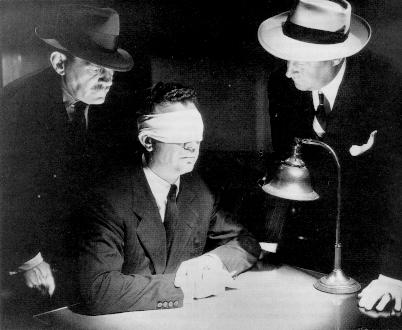
"The Professor" runs some tests—that's Ward Bond holding the lamp.
The six weeks fly by, and "The Professor" announces he's going to quit (it being time to go back to work and write his study), but that's not good enough for "Rocks" (who, if you'll remember, is the same guy that tried to knock off "The Professor" in the last paragraph—fickle). The hood learns the doctor's true identity, and shows up at his swanky Park Avenue office to blackmail him into planning more robberies by threatening to reveal his criminal past to the World, and worse (to Clitterhouse) threatening to keep Clitterhouse from publishing his research. Now, Clitterhouse is a smart man and just might realize that "Rocks" is hardly a credible (or consistent) source of information to The World or Academia. But, he doesn't. He takes "Rocks'" threat seriously. Seriously enough to commit one more crime...
Bogart looks deadly with a gun even lounging in a chair.
Up until that point, The Amazing Dr. Clitterhouse is a pretty standard light drama veering on comedy, due to its central idea and the "lovable lug" nature of the hoods, which Warner did to keep their profitable gangster genre alive, appease the clergy, and keep the Hays Office at bay. But, at the blackmail juncture, Clitterhouse turns a bit perverse with a twist that strains credulity, but is amusing in a cynical kind of way. It's that unexpected final gambit that makes the movie a little more than run-of-the-Warner-mill.

That and the cast. Robinson could play class and squalor, refined or brutish and play it genuine either way. It was the public-at-large that favored him in gangster roles, but his potential was limitless (except maybe for playing basketball players). Bogart may have hated the movie, but he manages to keep "Rocks" a threat and remain true to the story and keep it credible. And Trevor plays her role with charm and a bit of bite, with no hint of the vulnerability that she would show the next year in John Ford's Stagecoach (which would win her a Best Actress Oscar.  Bogart, Robinson and Trevor would reunite ten years later with writer-now-director John Huston in Key Largo.
Bogart and Robinson greet Eleanor Roosevelt on the set of Clitterhouse.