Showing posts with label Edward Dmytryk. Show all posts

Sunday, August 11, 2019

Crossfire (1947)

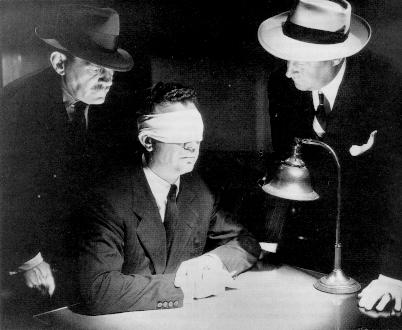
Crossfire (Edward Dmytryk, 1947) Shadows of a fight splay out diagonally across one apartment wall. Then a body flies across the room, knocking out the one remaining light. Everything goes black until hands twist alight the bulb in the lamp on the floor, exposing only the lower part of the room. One man is dead on the floor, another is conked out in an over-stuffed chair. The third is busy: he checks the body for signs of life, runs for the chair and rousts the man out of it. Then, more light as a door opens and two back-lit figures rush into the corridor, and are gone. 

It's film-noir done by two of the best Hollywood had to offer in the genre, writer John Paxton and director Edward Dmytryk, making a scene of violence with no dialogue and an efficient way of shooting that tells you what's going on but not by who, keeping the mystery alive in that movie short-hand that seems to have gone out of fashion in an expositioned-to-death world. Paxton and Dmytryk had done the Dick Powell version of "Farewell, My Lovely" (retitled Murder, My Sweet in case anybody thought that it was another Dick Powell musical) and in this Dore Schary production for RKO, they were using the form in the call for social justice in the case of antisemitism. This B-movie was taking on the subject the same year as the A-list Gentleman's Agreement.
Except the book it was based on wasn't about anti-semitism. That novel, "The Brick Foxhole," written by future movie writer-director Richard Brooks, didn't have a Jewish murder victim. In it, the man was homosexual, but it would take a few more decades before Society and Hollywood would have the grit to tackle that, without putting its own derogatory coloring on it. But, Dmytryck was determined to make a statement out of it, especially in light—or dark—of the Holocaust of the recent war. And he couched it in a film noir with two separate investigators, three actors named Robert, and a whole lotta flashbacks.
That opening scene is a chiaroscuro portrayal of the murder of one Joseph Samuels (Sam Levene) and it's up to police Captain Finlay (Robert Young) to track down the culprit who beat Samuels savagely to death. The first to talk is Samuels' girlfriend who found the body. From her and a wallet found at the crime scene, Finlay finds out with whom she and Samuels had drinks with earlier. Then, a knock at the door reveals "Monty" Montgomery (Robert Ryan), who knows what the girl-friend is talking about and tells his side of the story, giving Finley leads...and three suspects. But, no motive.
What's different is that the three suspects are all pre-deployment soldiers in the U.S., not unlike Monty himself. And the most suspicion falls on Mitchell (George Cooper), who was there that night, and has had a rough time of it in the Army. His sergeant, Keeley (Robert Mitchum) explains: "He's homesick. He's wifesick. Maybe she said something in one of her letters that made him suspicious of her love life. I don't know. Anyway, he's got snakes. He's been nuts. But not nuts enough to kill somebody." Keeley's friends with Mitchell and has tried to get his wife to visit him to straighten him out. Instead, Mitchell's been going sweet on a bar hostess (Gloria Grahame), who may or may not be married, but is only interested in him for the booze he buys while she's keeping him company.
Sgt. Keeley starts his own investigation, trying to protect his pal, Mitchell, from Finley and the cops and to find out what happened that night in Samuels' apartment before Finley can find and arrest him. He finds Mitchell in a movie theater and is able to find out that Mitchell and two other soldiers had drinks with Samuels before going to the scene of the crime. And then murder happened. But why? Finley's interview with another soldier, Floyd (Steve Brodie) doesn't reveal any motive.
It's when Finley and Keeley's parallel investigations stop working at cross-purposes and they begin to collaborate that it becomes clear that it was a hate crime, and their interview with Grahame bar-hostess and another pertinent murder points them to the real culprit and his impulses which seem to run counter to what the war that was just won was all about, and that the underlying issues of that war have their own parallels imbedded inside the United States, as well. Finley sums it up in one of the tidy little speeches in the film: "Hating is always the same, always senseless. One day it kills Irish Catholics, the next day Jews, the next day Protestants, the next day Quakers. It's hard to stop. It can end up killing men who wear striped neckties. Or people from Tennessee."
The film was a wake-up call hidden inside a police thriller, with the dark hues of the grimier, more cynical post-war sensibilities that were the underpinnings of the film-noir genre. But, rather than cut-throat gangsters and the criminally-motivated, Crossfire hit closer to home. It garnered Academy Award nominations for Grahame and Ryan, as well as for director and screenplay. It also is one of the few films in the B-movie domain of the noir films to be nominated for Best Picture.

Thursday, August 17, 2017

Murder, My Sweet

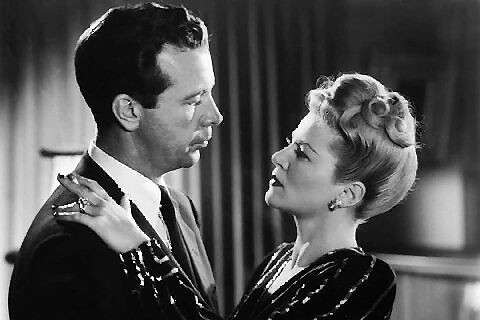
Murder, My Sweet (Edward Dmytryk, 1944) A neat trick, this. Although the third Raymond Chandler adaptation to make it to the screen—the first being The Falcon Takes Over (taken from the same source novel as this—Farewell, My Lovely) co-opted as a story-line in the George Sanders "Falcon" movie series, and the second, Time To Kill (based on "The High Window") featuring Lloyd Nolan's popular Michael Shayne character, Murder, My Sweet is the first to feature Raymond Chandler's "slumming angel", Philip Marlowe.*  

The main departure is the title: Chandler's choice, "Farewell, My Lovely," was ditched after a preview screening because those first viewers were expecting more of a musical, as the movie starred Dick Powell, who was a mainstay of that genre and not the first person casual movie-goers would think of as a slightly soft-boiled detective sifting through the grime of Los Angeles. The name was thus changed to something suggesting more violence than tap-dancing...and probably to protect the innocent.**
Dmytryk and writer John Paxton do a fair job of keeping the first-person narration intact (the set-up is that Marlowe is being grilled by the usual suspicious police and he's giving his side of how things went down), and keeping a steady pace that's surprisingly fast. Although they didn't use Chandler's exact phraseology, they do a nicely watered down, tightened-up version of it for cinema audiences for whom thinking too much of the cleverness of a metaphor as it passes by their cerebellum might slow down a film's momentum. Call it "Chandler Lite." Although a lot of it is quite good, if less surly. One of my favorites is when someone says they don't like Marlowe's manners: "Yeah, I've gotten complaints, but they keep getting worse."
Powell can't get too far from his roots—he does a fancy two-step
in the "mausoleum" of a foyer.
It works, especially for the speed of this film. For the role of Marlowe, especially the first one, Dmytryk and the studio made an odd choice in Dick Powell, an A-lister in musicals. But, he's very effective. He's got a lived-in face, like a hound's, not a matinee idol's, slightly doughy (as is his body-type, despite being told he's "in good shape"—that's Marlowe to a wife-beater "T."), and you believe that Powell would be a reflexive weisenheimer—something about the "hoofer" background. The light comedy experience makes the sarcasm go down very well.
And Dmytryck has the noir feeling down, too, being as he was one of the architects of the style. Begin your movie in transition so the audience has a lot of questions it has to answer, go heavy on the atmosphere and always exit the scene with a sardonic quip. You already know you're in the hands of a master with the sequence that introduces "Moose" Malloy (Mike Mazurki) who just suddenly appears as a menacing reflection in the window that only appears because of the intrusion of a nearby flashing neon light. It's as disconcerting...well, as disconcerting "as a tarantula on an angel food cake", thank you very much! Dmytryck also has fun dancing around the brim of the Hayes Code in the two knock-out sequences of Marlowe being knocked out—always a hallmark of Marlowe stories and fans of inky pools of blackness, Long Goodbyes and Big Sleeps (or "Big Lebowski's," if you'd rather, later).
Indispensible in the mix is a high concentration of sass which is provided by that queen of the formClaire Trevor, whose performance as an evil step-monster is almost too much of a good thing. Murder, My Sweet would have been a rich enough story without her. Her presence and its tilting of the sexual equation slams this one deep onto the classic shelf. Powell would play Marlowe again on television, but this initial outing made him definitive...until Bogart came along.
But, for the record books...Chandler always said that Powell was his favorite version of Marlowe.

* The Big Sleep with Bogart as Marlowe was made the same year, but not released until two years later.

** They finally got around to using the title in the 1975 Dick Richards remake that starred Robert Mitchum, who would have been too pretty for Marlowe in his youth, but had aged into a wrinkled world-weariness that worked. When he was approached by producer Elliott Kastner and financier Sir Lew Grade to play the part—after their first choice, Richard Burton (??!!), had turned it down—Mitchum says that he said: "Why don't you just re-release Murder, My Sweet with Dick Powell and we can all go to the beach?"