Showing posts with label Boris Karloff. Show all posts

Sunday, October 20, 2019

The Old Dark House (1932)

The Old Dark House (James Whale, 1932) It is a dark and stormy—one might say "dreadful"—night. Trying to negotiate the way to Shrewesbury amidst a blinding rain on a road prone to crippling muddiness and threatening landslides are Philip Waverton (Raymond Massey), his wife Margaret (Gloria Stuart...from Titanic?) and friend Roger Penerel (Melvyn Douglas), slap-dasherly young people without a care in the world, except for what little irritations cross their bourgeois path—like how full is the whiskey flask? On such a night, maps and directional instincts can become stymied. Finding a large, sturdy house (more importantly, the lights are on), they pull up and knock on the large and imposing door. They are allowed entrance by the master of the house, Horace Femm (Ernest Thesiger), self-described as "rather a nervous man" who allows his hulking man-servant, Morgan (Boris Karloff) to give them access from the deluge outside, although he is less welcoming than one might wish.
If he is reluctant, his sister Rebecca (Eva Moore) is even less so. A bit of a religious-hysteric, she is more than a little bitter at her treatment within the family, feeling persecuted, and if her perception of her family is skewed, her reaction to outsiders, and, worse, these particularly un-devout young people is openly hostile. She has one bottom-line: "No BEDS!" She's probably fearing orgies under her roof.                                                          
The guests will have to be comfortable in the drawing room, although Margaret is soaked to the skin and insists on changing clothes, which she is allowed to do in one of the Femm bedrooms under Rebecca's watchful, judgmental eye, who tells a brief history of her treatment within the "sinful and godless" Femm family*, and revealing that the father of the Fenn's, 102 year-old Roderick Femm, is still alive and living in the house. Despite this one consideration, the Femm's are determined to keep the Waverton's and Penerel in the drawing room and discourage them from trying to access any other part of the house for their safety. They are particularly warned about Morgan, whom Horace describes as an "uncivilized brute" and "rather dangerous"—he has a tendency to drink a little and molest a lot. Femm fortunes evidently preclude them from hiring a replacement.
Just as the first guests are getting comfortable being uncomfortable at the Femm's, they are joined by two others: Sir William Porterhouse (Charles Laughton), a genial and bellicose bloke, with his evening companion "Ducane"—a chorine whose real name is Sophie Perkins (Lillian Bond), who are far more free-spirited and liven things up a bit, but create a bit more frisson, adding a little more chaos in the mix bottled up in the barely-contained Femm house. Libations are provided and a dinner served, But on such a night, things can not go smoothly. The electricity goes out in the storm, and when Philip goes to retrieve an oil lamp from upstairs—Horace, it seems, is too scared to go—and he notices a couple of locked rooms, one of which has a voice coming from inside it.
Penerel and the chorus-girl start to get chummy, and the brute Morgan (it seems) has gotten into the liquor and he attacks poor Margaret the first chance she is alone. At this point, lines are drawn in the wood floors and the night becomes one of survival and the discovery of secrets that have been hidden away for years. And although it has all the trappings and tropes of a horror film, under Whale's direction there is a giddy, giggling sense of humor bubbling just under the surface that is campy and knows just how far to push the material as far as commentary and suggestiveness.
Whale is clearly having fun with the project (based on J.B. Priestly's 1927 novel "Benighted"), the second project he made after his success with Frankenstein, and although he turns down the German Expressionism he wrought in that film, the film is richly textured, not only between levels of light and dark in subject and dialogue, but also pictorially, thanks to his Frankenstein cinematographer Arthur Edeson, who would move from Universal to the Warner Brothers and make his mark on such films as The Maltese Falcon and Casablanca. It appears to be a stepping-stone to the extreme arch-tone he took in his subsequent The Bride of Frankenstein.

The Old Dark House also marked the Hollywood debut of actor Charles Laughton, who would quite quickly rise in the ranks from talented character actor to star and eventually director. 
The Old Dark House is one of those wonders of the pre-Code era, where the subject matter could be broadened (as well as the moral implications of characters' actions), leaving audiences with endings with moral ambiguities, and troubling implications, rather than satiate them with happy endings. You could almost look at The Old Dark House as a hybrid of the horror, Romantic Gothic, and even noir genres to create an unsettling thrill-ride that leave one disturbed even after one has exited the theater.
The trouble with those pre-Code films, however, was that once the Hays Code came into play, many films, to ensure further booking into theaters, were censored, or even re-shot to meet the new stringent standards placed on movie entertainment. The ones which could not be "rehabilitated" were confined behind locked doors in the vaults of the studio and, in many cases, forgotten and abandoned.

The Old Dark House was considered a lost film until it was dug up from the Universal racks in 1968 and restored, saved from the depredations that time and its storage on flammable nitrate film would inflict on it. Rather than left to rot, it was exhumed, and another classic Horror film, one of its most curious and perverse entries, was saved from the grave.
*
"They were all godless here. They used to bring their women here - brazen, lolling creatures in silks and satins. They filled the house with laughter and sin, laughter and sin. And if I ever went down among them, my own father and brothers - they would tell me to go away and pray, and I prayed - and left them with their lustful red and white women!"
Director Whale goes to town during this sequence—probably because it's so talky—with distorted mirror and lens effects to disorient the viewer, and to add his own visual commentary on sister Rebecca's rant.

Friday, October 4, 2019

Frankenstein (1931)

I've spent quite a few October's on this blog presenting all sorts of reviews of horror films (and the tradition continues this year), but I've never published reviews of the "Big Two" horror films—Frankenstein and Dracula. Well, it's never too late. Time to unearth them from another archive.

Frankenstein (James Whale, 1931)

"We are about to unfold the story of Frankenstein, a man of science who sought to create a man after his own image without reckoning upon God. It is one of the strangest tales ever told. It deals with the two great mysteries of creation – life and death. I think it will thrill you. It may shock you. It might even – horrify you. So if any of you feel that you do not care to subject your nerves to such a strain, now's your chance to – uh, well, we warned you."
Every young boy's horror touchstone—and if we're to believe Víctor Erice's El Espíritu de la colmena every little girl's, too. One of Carl Laemmle Jr.'s ghoul gallery of public domain necromancy movies that spawned dozens of sequels and dozens of imitators, all inferior to the craft of these primitive films, made at the fog-shrouded dawn of the Sound era.
But towering above them all in the pounding hearts, toad-squirming minds, and knocking knees of horror fan-dom is the story of "The Modern Prometheus" and the Monster to whom the public bequeathed his name. Frankenstein boasts odd beginnings. Written by Percy Bysshe Shelley's frail flower of a wife, aged 18 when she conceived it, during a Gothic night's creativity, "Frankenstein's" story and it's several graves-deep inner meanings had been a classic for decades. It had been filmed before (even by Thomas Edison), but Laemmle's production, directed by James Whale has emerged as the one with the biggest boots to fill.
It might be because of its introduction (reproduced above). Edward Van Sloan walks out onto the filmed stage and warns us of the subject matter to come and the blasphemous implications of a man not "reckoning upon God." It's a good tactic—a carnival barker's come-on—for rather than warn us away, it whets the audience's appetite for the terrors to come.
And James Whale doesn't disappoint. Whale's life has merged with Legend (the movie Gods and Monsters), but his German-expressionism-influenced eye and sense of the absurd (which would come to full flower in the follow-up, The Bride of Frankenstein) created a sinister world of vast-shadowed hallways, spitting whirling laboratories, and castle chambers that resembled gargantuan funeral homes.

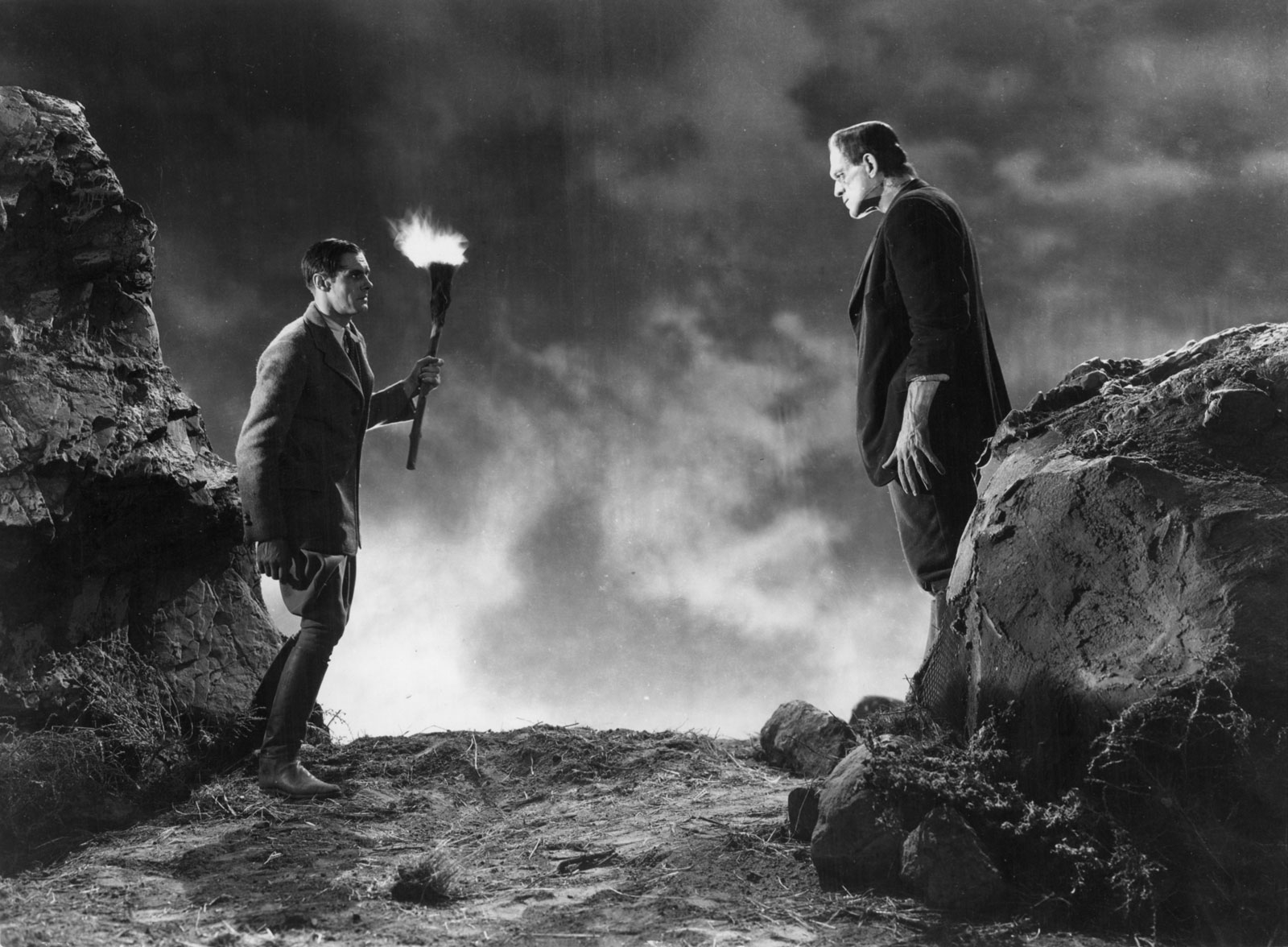
Before going on to the actors, homage must be paid to the craftsmen: Art Director Charles D. Hall, whose bizarre designs for the film give it its scale and majestic decay; and, of course, make-up artist Jack Pierce, who transformed a slight British actor named Karloff into a 7-foot, barrel-chested, electrode-studded,* flat-skulled (and copyrighted) hulk. There have been many subsequent designs for Frankenstein's piece-meal monster, but none have been so iconic as the Whale-Pierce-Karloff version.
Karloff's contribution cannot be slighted—including his removal of an upper dental plate to give the Monster a dented, off-kilter face. But mention should be made of Colin Clive's hyper-bi-polar doctor (he was a wayward medical student in Shelley's tale), prone to manic exultation or fainting dead away in emotional extremis. The good doctor's a bad drama queen. As his house-keeper would say in the sequel, he's a queer fellow.
There's another reason to celebrate the longtime classic-ness of James Whale's Frankenstein. It and it's sequel The Bride of Frankenstein may be two of the greatest gay-themed movies to come out of straight, Hayes Code mainstream Hollywood. I had a film professor who was studying Bride and told of his curiosity about the air of exoticism in the first two "Frankenstein" films, when that "queer" line came out, it was the lightning-bolt that was the key. What is Frankenstein and The Bride of Frankenstein except the story of a man (or two men in Bride, with Frankenstein and Professor Pretorius collaborating) trying to by-pass God (and women) to give birth.** 
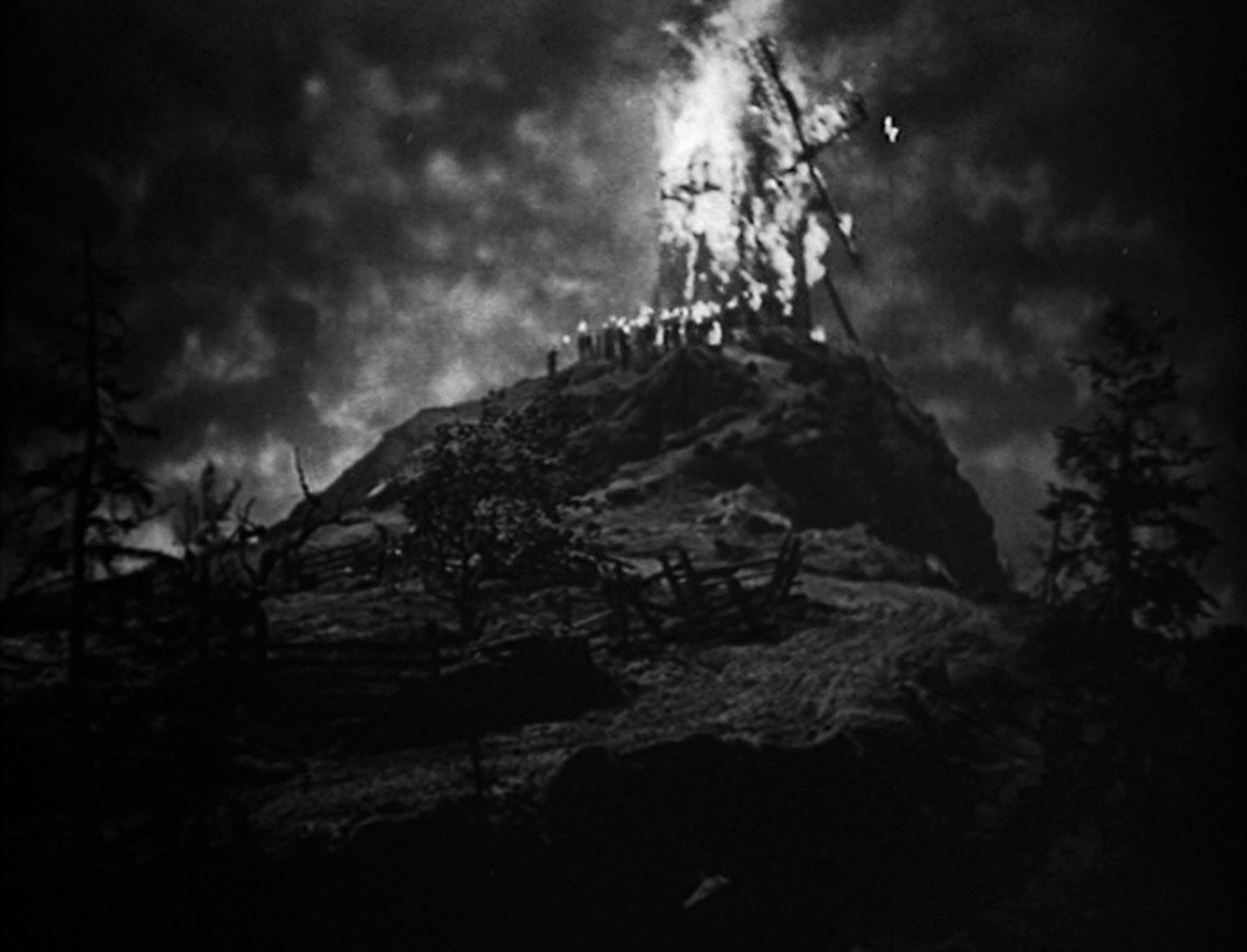
The melancholy cruelty of Nature and mob-hysteria towards the different permeates both of Whale's "Frankenstein" films,*** and turns Monster into mirror, a figure of identity rather than horror, and occurs whether the audience is gay or straight. There's a reason the shunned figure of Frankenstein's Monster resonates: he's an outcast, yearning but misunderstood, tortured, but sympathetic. And though kept prisoner in a castle dungeon rather than a closet, he would emerge sequel after sequel, never vanquished—indomitable—his super-human will-to-live allowing him to see another day. As they say in Jurassic Park, "Life will find a way."
Frankenstein is one gifted director's roaring protest against the Nature of Things ... and man's intolerance. 
* One of the basic copy-rights of the Universal design are the electrodes sticking out of the Monster's neck. Though "Frankenstein," the story, is in the public domain--one of the main reasons Francis Ford Coppola produced a version years ago--and anyone can do a re-make, those electrodes, and the rest of the make-up design, are the commodity of Universal Pictures. When Mel Brooks made his Young Frankenstein in the 70's, he by-passed the neck-studs...with zippers.

**When he presented his theory in class, one of the students remarked "That's kind of mind-blowing..." to which he replied, "I'm glad you said 'mind...'"

*** Christopher Isherwood also used Frankenstein and Pretorius (dubbed "Polidori") to create a more homo-erotic version of the story...for NBC television...when he wrote the teleplay for "Frankenstein: The True Story"


Wednesday, June 12, 2019

Smart Money (1931)

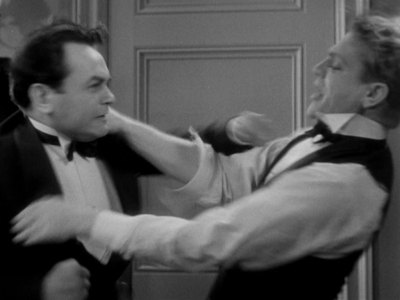
Smart Money (Alfred E. Green, 1931) Done-on-the-cheap Warner Bros. programmer made the year after Edward G. Robinson's star-turn in Little Ceasar and the same year as Cagney's in The Public Enemy and is an version of the studios' series of spare, street-tough films that would dominate their output in the 30's and 40's, glamorizing the life of a gangster, but making sure that they came to a bad end.

Robinson plays Nick the barber, a lucky Greek son of a gun, who runs a gambling joint in the back-room of his tonsorial parlor (thus making both ends of his establishment a "clip-joint.") Nick is king of his own gambling castle, and while its good to be the king,there's the tendency to want to expand the fiefdom by conquering new territory.

With a stake firmly established from his cronies back home, he takes off for New York to take on the big city gamblers, wished well by all the lovable mooks he's already taken for a ride at the train station.  But, what he learns is its a whole new game in the tony high rises, where only part of the bluffing and double-dealing occurs at the table. Why, even the hat-check girl is looking to separate you from your cash. Nick learns to trust no one, and to bluff his way out of any situation with a cock-sure patter of platitudes.  But, that's a slippery slope, and he soon finds that success costs.  
Its a treat to see Robinson and Cagney play off each other, the only time they did so—Robinson all-voice and punchy delivery, and Cagney sly and bantamy, physically, in one of his rare supporting roles. They're chummy at the beginning, but when success shows up, they start to have territory issues, its murder. This one is all performance, in varying styles, between character actors fresh out of the silent era, and the leads who were blazing new trails, and the director's hand is almost invisible.
Green is known, but mostly unknown, as the director of The Jolson Story, The Jackie Robinson Story, The Eddie Cantor Story...making that a "storied" career. He was a fine director of women and coaxed terrific performances from Bette Davis and Barbara Stanwyck early in their careers—and they were already formidable. He was fast, versatile and would direct up to five pictures a year. He didn't shy away from racy material in the pre-Code era and would tackle it directly with shameless brio. And he's remarkably free of the sort of Hollywood white-wash that was prevalent at the time. Minorities were cast, and not caricatured or minstrelled in his films, but treated like any other character actor, which is quite remarkable to see in that day and age. His output was undistinguished when you look at the titles (and there are 111 of them), but individually, it would be interesting to see a few more of them (I've seen this one, The Jackie Robinson Story and Baby Face) to see if that liberal sensibility is maintained throughout.


Wednesday, March 22, 2017

The Criminal Code

The Criminal Code (Howard Hawks, 1931) The Hawks canon has always been about liberte, egalite, fraternite, and of the power of the group to come together to create something greater than the whole. So...a Howard Hawks prison movie?

Depends on the story, of course. But, The Criminal Code fits right into the Hawks niche, right down to the central authority figure who will give you a fair shake as long as you prove yourself worthy by adhering to their code as a "professional."
 
That figure is newly-installed warden Mark Brady (played by John Huston's dad, Walter) who's been brought up from his previous position as District Attorney. He's overseeing the imprisonment of some of the very men he sent to prison, so the resentment in "the yard" is palpable. So much so that his first day on the job, when he looks out of his office window overlooking the prison yard, he is greeted with cat-calls and "boo's" and the mutterings of threats. He responds, as any member of the court would, by confronting his accusers and going amongst them to talk and let them know what "the rules" are—look them eye to eye to say that as long as they kept their noses clean, there won't be any issues. 
He's not without a heart, and he knows that he's responsible for the cons...and for a lot of them being there. He takes an interest in one young man (Phillip Holmes) that he sent away, now on his sixth year in the stretch, who's about to crack from the strain. He offers the kid, Robert Graham, a job as his valet, hoping that the change in situation and out of the harsh conditions of the prison's jute mill, will improve his psychological condition. It should come as no surprise that it does, especially once Brady's daughter (played by Constance Cummings) takes an interest in young Graham.
But, it's a prison movie, and it wouldn't be one if there wasn't an escape attempt made that would put Graham's improved life in peril. Three hoods—one of them Graham's former cell-mate Ned Galloway (Boris Karloff)—plan an elaborate escape, but during the attempt one of the prisoners is shot and killed. Galloway discovers that the other of the escapee's ratted them out, violating the prison code of silence, and he secretly plans revenge, warning Graham to stay away from that particular prisoner.
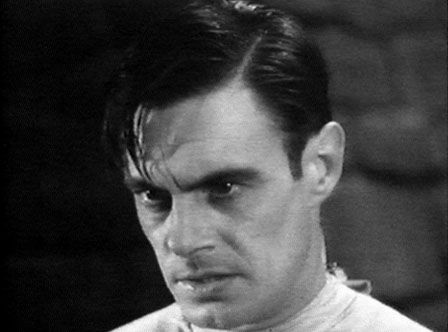
Even without seeing his face you can see the menace of Karloff
But, Graham is found, by happenstance, near the body, and even though evidence isn't found that he did it, and despite Brady's ministrations to save himself and tell him who the culprit is, Graham won't betray the ethic of the prison yard, even if it means taking the fall himself. Reluctantly, Brady sends him to solitary confinement.
It is unusual, for a Hawks film, for the communal spirit be the one amongst the prisoners, but the emphasis on the code of silence as the one mark of the professional prisoner that must be kept above all else runs right alongside the usual stoicism, the "keep-it-amongst-ourselves" attitude of the enclave that you'll find in most of the director's work. That it is among the criminal element makes The Criminal Code (with the title's double meaning) stand out from every other posse of professionals, be they cowboys, pilots, race-drivers, newspapermen, even big-game trappers.
The Criminal Code is a "pre-code" film, meaning it was made before the establishment of The Hays Code—Hollywood's attempt to police itself, amid calls that films were starting to depict too many immoral acts and that it might have an effect on the country. Even though there is quite a bit of violence and some of the prison guards are seen as corrupt, the "bad guys" end up punished and the "good guys" are given a second chance. It was still early in the days of Hollywood's own "code" and a few listed improprieties could be seen to still eke their way onto the silver-screen. Over the next few weeks, we'll occasionally be looking at some of those films to see what Hollywood was getting away with, so soon after the advent of "the talkies."

Saturday, October 29, 2016

Black Sabbath (1963)

Black Sabbath (aka I Tre Volti Della Paura—The Three Faces of Fear) (Mario Bava, 1963) One of those Italian horror film omnibi that contracted for distribution with American International Pictures for the drive-in crowd, and one of those that eked out more than passing interest. AIP was under some condition to bowdlerize the thing to make it their own—of course, they dubbed it into English and their lab, Pathecolor, put a different tinge on things (the screencaps of the original are much more vibrant and beautiful), and Boris Karloff served as "host" (just as he'd been doing for the TV series "Thriller"), as well as appearing in one of the three segments. They also changed the order of the three stories, starting with "A Drop of Water" and ending with Karloff's turn in "The Werduluk" and made significant changes to one of them that somewhat confused the issue.

The origins of the three stories are a bit controversial, supposedly in the public domain, but not definitively. They resemble what producers would do with the later "Night Gallery" series, having the same "vibe" and conciseness to keep the shooting costs low.

The three stories were a mixed body-bag of settings and plot (although AIP did some judicious editing to try to give one of them—"The Telephone," which was a psychological thriller piece—more of a supernatural slant like the others. The one thing that unifies them is Bava's beautiful color cinematography and an elaborate production design that, at times, takes one's breath away.
"The Drop of Water"—London, 1910: Jacqueline Pierreaux plays a nurse who is called to the mansion of a medium who has died that night to prepare the body for burial. Noticing a large sapphire ring on her finger, she pockets it and notices strange things begin to happen. The medium's corpse eyes open and freaks the nurse out—the weird woman is dead but her eyes seem to be accusing her. The sound of dripping water (she has knocked a glass of water over in fright) becomes a steady rhythm and she is constantly being pestered by a fly. She goes home. The drips start again. A pestering fly appears. The lights go out. The medium's corpse appears in the bed. SHRIIIEK!
"The Drop of Water" leads the American AIP version, but it was the last of the trio in the original Italian version because it has the creepiest concept and has a steadily increasing amount of tension that finishes with a nicely open-ended coda.
"The Telephone"—Modern day, France: A high-class call-girl (Michele Mercier—she's not acknowledged as such in the American version—returns to her apartment and gets ready for bed. The phone rings. No one's there, not even heavy breathing. She hangs up hesitantly. The phone rings again. There's someone on the other line. She hangs up. 

The phone rings again. This time the caller identifies himself as "Frank" (and at this point, the two versions diverge—in the Italian version, Frank is her former pimp who she testified against, landing him in prison, and in the American version, he's a former lover who's dead). He calls her, threatening her, and she worriedly calls her friend Mary (Lydia Alfonsi) to come over and help. Mary does so, but what Rosy (the call-girl) does not realize is that it is Mary who has been making the phone-calls, disguising her voice.
At this point, things get very confusing—the Italian version has Rosy and Mary as former lesbian-lovers, which isn't mentioned in the AIP version, and the American version has some chicanery with a letter that appears and manifests some ghostly writing. The ending remains the same, but slightly confused given the departures from the original. But, one gets the impression the main reason to have the story is to allow a lot of shots of Mercier in a negligee.
"The Werduluk" 18th Century Russia: Vladimir Durfe (Mark Damon) is on a long journey and comes across a body, with a large knife in its chest and missing its head. He secures the knife and continues on his travels.
He stops for the night at a rural inn, which is in chaos. Giorgio (Glauco Donorato) explains that the family is upset because his father Gorca (Karloff) has been missing for five days, having set off to kill a "wurdalak," a living corpse who feasts on the blood of the living. Durfe notices that the kitchen knife set is missing one piece, the very one that he recovered from the body on his travels. Giorgio offers Durfe a room for the night and begins to ask questions about what he knows, but before they become answered when Gorca enters the room, with the head of the wurduluk, which he then leaves hanging on a post in front of the cottage to warn others.
Well, that's great for outside, but what about inside? Gorca's manner is different than what his family members expect and they begin to fear that before he killed the vampire-creature, he might have been set-upon himself. Gorca's return may be the ultimate good new/bad news scenario.
Karloff displays more energy than he'd had in years and doesn't depend on his reputation to play the old vampire-hunter. In the meantime, Bava's cinematography is at its most flamboyant, letting go of realistic touches to bathe the story in experimental lighting and exotic color schemes.
The music scores differ, also: the Italian version has a more moody score, and the AIP score (by Les Baxter) "mickey-mouses" a bit, over-accentuating the shocks and surprises. If one has seen the original, the music might reduce one to giggles.

And, oh yes, speaking of music, it's where "the band" got its name.