I'm re-running this piece as today marks the 100 Anniversary of the publishing of The Great American Novel, "The Great Gatsby".
It is in the public domain; the copyright expired January 1, 2021.
"There are no second acts in American lives"
F. Scott Fitzgerald
Maybe in America, but in Hollywood, there are. We call them "remakes." Like Dashiell Hammett's "The Maltese Falcon"; Warner Brothers did three versions beforethey got it rightand then, wisely, they stopped. If they tried it again, the end-result would be reviled, because it would inevitably and unenviably be compared to the 1942Humphrey Bogart-John Huston version and it would be found lacking, not only as a film, but as an adaptation of the source material. It is so close, in spirit, if not the letter, there'd be no point. You can't improve on it. But not "the great American novel"—"The Great Gatsby," written in 1925 by F. Scott Fitzgerald, who was finding his feet trying to define the American culture that was exploding out of the fortunes garnered during The Industrial Age into The Post-Gilded Age. It seems that every decade somebody unearths it from American Literature 101 and tries again to do right by it. And the attempts started the year after it was published...
"For we must consider that we shall be as a city upon a hill, the eyes of all people are upon us; so that if we shall deal falsely with our God in this work we have undertaken, and so cause Him to withdraw His present help from us, we shall shame the faces of many of God's worthy servants, and cause their prayers to be turned into curses . . ."
John Winthrop, 1630
(Herbert Brenon, 1926) Based on the Broadway adaptation byOwen Davis and directed byGeorge Cukor, the silent adaptation in the words ofNew Yorker critic Richard Brody "got the parties right"—why wouldn't they being so close to the source?—and featuredWarner Baxteras Gatsby,Lois Wilsonas Daisy Buchanan,Neil Hamiltonas Nick Carraway andWilliam Powellas George Wilson (eh? Powell could have played either Gatsby...or Tom Buchanan...and nailed it), this version (despite extensive searches) is one of those silent films that has been lost through the ususal causes of time, neglect, poor storage and the explosive nature of its nitrate stock. The only evidence remaining of it is the trailer, which you can see below, old sport.
Reportedly, Scott and wife Zelda saw it in 1927 and walked out half-way through. Their opinion Zelda mentioned to their daughter Scottie in a letter: "We saw The Great Gatsby at the movies. It's ROTTEN and awful and terrible and we left."
The secret of a great success for which you are at a loss to account is a crime that has never been found out, because it was properly executed.
Balzac
(Elliott Nugent, 1949)Richard Maibaum—who is best known for scripting so manyJames Bond films—was the guy behind the '49 version, urging friendAlan Laddto make it. As producer-writer of the film, Maibaum had casting control, and as Ladd saw it as a great acting opportunity (and Paramount had him under contract), the studio used it as a carrot to influence Ladd to do other films. Maibaum and the original director John Farrow(interestingly, father ofMia, see below) disagreed over who should play Daisy and when Farrow wouldn't let go of the idea ofGene Tierney, he was canned over Maibaum's choice, Betty Field. This version starts in the present as Nick Carroway (Macdonald Carey) and Jordan Baker (Ruth Hussey), old married couple, visit Gatsby's simple grave ("But it's not him, Nick, it's not his style." "No, he'd have fancied something like Grant's Tomb.") etched with an inscription from the Bible—Proverbs 14:12 (which is "There is a way that seemeth right unto a man but the ends thereof are the ways of death.")
Just to position us time-wise, Carey's Nick lamely has to add "He seems like someone we knew in another time, another life, another world..." Well, it was "the Jazz Age" and Prohibition and, since then, there'd been a world war (with selfless rationing) where everyone was doing their part (as legend goes), but it is only useful hand-holding for those who have no idea the story takes place in the past (it doesn't help that knowledge that the fashions and dances are more contemporary, but the cars have a vintage feel). One would think one could get a clue from the dates on the head-stone, though.
This moral distancing from the story probably served a short-sighted convenience at the time, post-World War II, but it certainly doesn't serve the story very well. Perhaps it was to provide an enveloping "Happy Ending"—it all turned out all right in the end for Nick and Jordan, the secondary characters, so everything's fine. Too bad about the folks the story is about, though, huh?
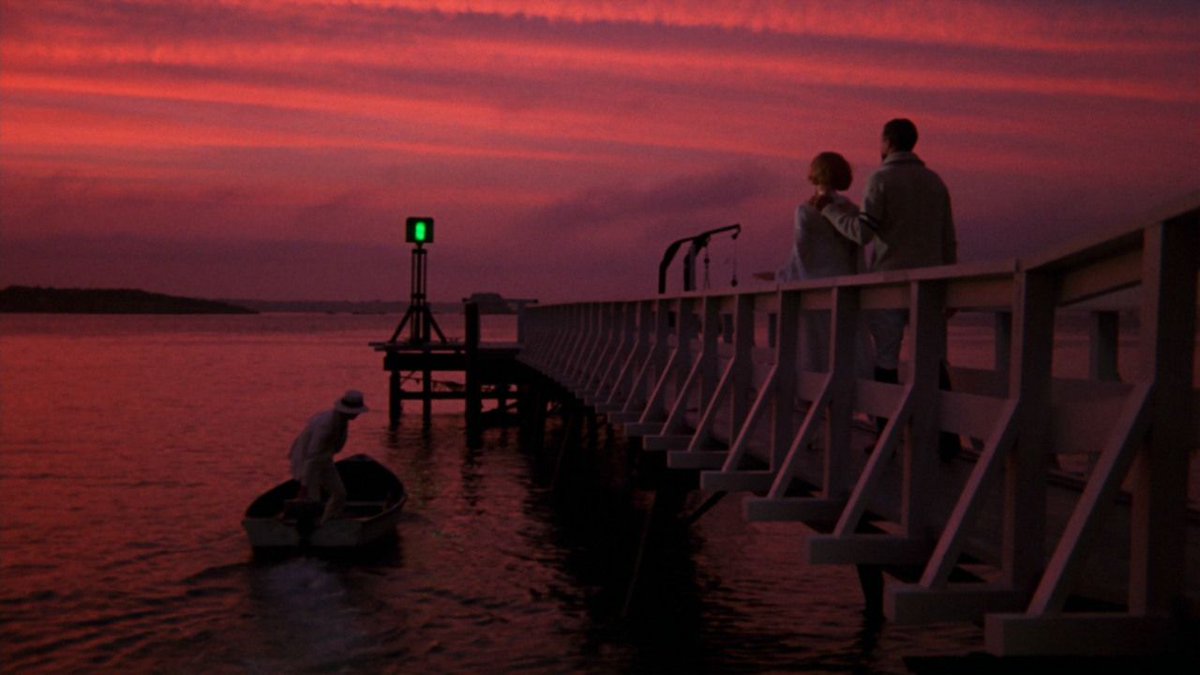
In the book it is rumored that Gatsby once killed a man, but the 1949 makes it clear that he has...at least one...as he guns down a car full of holes and sends it crashing while on a bootlegging run. Ladd's Gatsby is less a man of mystery than a man of many mysteries, none of them seeming to ring true. We see Gatsby accompanied by Myron Lupus (Ed Begley) and "man" Klipspringer (Elisha Cook, Jr.) the day Gatsby drives up to "the valley of ashes" to find the lavish house at West Egg. Lavish it may be, but this version of "Gatsby" has a studio feel to it, all back projection and false sky-prosceniums. It's slightly claustrophobic and, despite the abundance of faux-white marble around, looks fairly cheap. Gatsby buys the West Egg mans' and walks outside through studio-"fog" to see the beckoning light from the Buchanan dock "just" across the way.
Cut to a party with Nick Carroway in attendance, but no idea why he's there. He runs into Gatsby purely by accident, suspecting him to be just another partyer and, after "bouncing" one of his "bootlegger" pals from the premises, imposes on Nick to host "the get-together" with cousin Daisy (Betty Field), he takes the opportunity during one of his parties to explain his history with an out and out fabrication that even Nick sees right through, so he tells another one about working for a man who bequeaths him a tidy sum of money. "That was in the old days when I was a sucker. Then I wised up." He doesn't waste any time asking Nick—second-cousin to Daisy Buchanan—to arrange a meeting, even offering some stock market business: "Every man has his price, Mr. Carroway. What's yours?"
The meeting is arranged with an anxious Gatsby and an ambivalent Nick and the affair between the two parted lovers begins anew. At least, that's what we're lead to assume—Ladd was so concerned about his image that he does not allow his Gatsby to be shown kissing a married woman. In fact, there's a lot of self-censorship going on: it's okay to show Gatsby plugging away at his gangster rivals, but any extra-marital affairs, whether between Gatsby and Daisy (or Tom Buchanan (Barry Sullivan) and Myrtle Wilson (Shelley Winters, nice casting that) or lost between scenes; there's even an attempt by Daisy and Tom to try to warn Gatsby that he's being hunted by a murderous George Wilson (Howard DaSilva), just to show you that they're not "bad people," despite all appearances to the contrary. That's just not the book.
Where the movie shines is in Ladd's portrayal of Gatsby—movie-star confident, but almost child-like in his devotion to Daisy (when the Buchanan's attend a Gatsby party, Ladd's host is only too anxious to steal her for a dance and the look on his face is ecstatic), which leads to a dull confusion of realization when his dreams go south. It's a nice portrayal, even if it's been buffed to appease the censors. And there's something of a practical casualness when he's seen shooting people at the beginning, a reflection of the casual cruelty that will lead to his down-fall later in the movie.
(Jack Clayton, 1974), The only reason Paramount's head of production,Robert Evans, wanted to make a movie of "The Great Gatsby" was because his wife (at the time) Ali MacGrawwanted to play Daisy Buchanan.*That was enough for Evans—at the time, the Paramount "golden boy"—to start an elaborate pre-production of a multi-million dollar picture, hiring his Godfather directorFrancis Ford Coppolato write the script and Jack Clayton to direct. Then, MacGraw signed to doThe GetawaywithSteve McQueenand the Evans-MacGraw marriage collapsed. Evans was not about to continue the picture with MacGraw in thelead, so he went casting to no real satisfaction, untilMia Farrow, who'd worked with the producer on Rosemary's Baby wrote him a note that said "Bob, can I be your Daisy?" She was signed, which rounded out an otherwise excellent cast, which included one veteran from the 1949 version—Howard DaSilva, who played the cuckolded George Wilson in that version, plays Meyer Wolfsheim "the man who fixed the 1919 World series" (who was identified as "Myron Lupus" in the 40's version—showing that the latter film wasn't afraid to tackle the anti-semitism of the novel or the prejudices of the moneyed upper-class as expressed byTom Buchanan, played snakily byBruce Dernin "the Redford version").
This was the first adaptation I had seen, and my memories of "The Great Gatsby" are always associated with the season of Summer. I read the book during a vacation and this one was released in that season and it's reflected in the shimmering cinematography suffused with scrimmed lenses and star-filters as well as the veneer of sweat carefully applied by the make-up staff that provides its own kind of veil for the stars. The '74 Gatsby has a distance to it that separates its audience with a gauzy wall that undercuts the drama and makes us not care a fig about the people in it. Everything looks great, but the figures in the center could use some work.
Part of the fault lies in the stars: Robert Redford is a great choice for Gatsby as a vision of the man, but Redford is an intelligent actor who has always fought his looks, and here he overthinks it. His meeting with Nick is faltering, fumbling, and a bit embarrassed, it is not that of a man setting up the gambit for which he has compromised his integrity and risked his soul. The only time you see a flash of how good Redford could be is when he nearly comes to blows with Tom Buchanan—Clayton cuts to his fist tightening, then to a close-up of Redford flashing his million dollar smile. He wants the fight. He's the poor boy who didn't get to marry the rich girl and wants to paste the face of the guy who did.
William Goldmandesperately wanted to do the screenplay for Gatsby—at the time Truman Capotewas taking a stab at it—but came away delighted with Coppola's screenplay. Not the movie made from it, however ("they basically ignored it" said Coppola). Goldman blamed Clayton's direction—"Jack Clayton is a Brit...he had one thing all of them have in their blood...a murderous sense of class," he wrote in his follow-up to "Adventures in the Screen Trade", "Which Lies Did I Tell?" The people, the revelers, are fools and he shows the squalor, rather than the foolish hope that befalls every one that burns the candle at both ends, gambles on a "get-rich-quick" scheme, or thinks that there might be a reckoning.
That's the spirit you want to end the Tragedie of "The Great Gatsby." What does Clayton's version leave us? With a tacked on credit sequence of decamping partiers over a squeamish version of "Ain't We Got Fun?" Maybe they wanted to leave us with something upbeat to walk up the aisle to, rather than contemplate what has gone before. I remember seeing that part of the movie as a slap in the face. It made a facile treatment only that more cynical.
* Well, maybe not the only reason—Evans still harbored the idea of becoming a movie-star despite having much more power in Hollywood that a mere actor would. Given his ego and the dream-world in which he lived, he might have imagined himself in the Gatsby role, as he certainly lived the lifestyle. He certainly must have saw himself as some prototype of Gatsby. But, after this movie's box-office, his productions became more desperate, less sure—he was set up to star with Jack Nicholson in the second part of the Chinatown trilogy—and he became addicted to drugs and it all came crashing down. He must have certainly read the Gatsby novel...he just didn't heed it.
"Yours in Great Depression" During the Baz Age or I'm Half Crazy All for the Love of You....
There have been several versions of F. Scott Fitzgerald's Great American Novel that have hit the big screen since the novel was first published in 1925, and nobody seems to get it right, if "right" can be got at all. There's a "lost" silent version with Warner Baxter, a 1949 version adapted by Richard Maibaum with Alan Ladd that emphasized Gatsby's gangster roots, the Robert Evans vanity production of 1974 with Robert Redford and Mia Farrow, directed bloodlessly by Jack Clayton. It's a challenge to produce such a tragedy that has a boisterous first act, and such a downer of a second, but that is what makes it so special, and so American. In fact, the best version must be taken out of the novel, which was written in the midst of the period in which it was set, and take into account future events—the stock market crash in 1929 and the following "Great Depression," which sounded the death-knell for The Jazz Age with a long sustained flat note. Fitzgerald's prescient, cautionary novel proved historically accurate with 20/20 foresight to the extent that you cannot make a movie of it un-ironically, given the past that was its future, and you cannot make a complete movie of it while remaining blind to what it did not foresee in reality, but captured artistically and thematically.
Baz Luhrmann's version of The Great Gatsby jumps into that irony with both feet and splashes around in it, kicking and squealing like a child drunk with a secret. It was a weird decision to film it in 3-D, but given the way Luhrmann uses it, in vivid eye-popping colors, emphasizing the swoop of camera moves and the solidness of glass partitions, and the illusion of the reflections shimmering over it—and particularly in how he photographs our last views of East Egg, in a way that rather lovingly visualizes the novel's last line ("So we beat on, boats against the current, borne back ceaselessly into the past")—one begins to wonder any other way to do it.** In a way, the movie feels like one big "Vertigo zoom" in three-dimensions (starting at the beginning credits) with an art-deco pattern that falls away to the production company logos and ending with an unfamiliar one—until you see it pop up again in Jay Gatsby's monograms.
Then, we begin the touchstones, green light on the dock, the Egg's, the parties, the infinite closet of shirts, the infidelities, "the man who fixed the 1919 World Series" (played by Bollywood superstarAmitabh Bacchan...) Dr. T.J. Eckleburg, Oculist (correctly spelled this time—it wasn't in the 1974 version), the fights, all done in Luhrmann's hyper-speed (which is maintained throughout, as opposed to his previous filmAustralia, which flagged after the first 45 minutes), in a style somewherebetweenPreston Sturges, Sam Raimi, andTex Avery, making the performances somewhat inconsistent (but more on that later). The swooping, veering style allows for some fore-shadowing plummets down skyscrapers and serves as a visual counter-point to Jay-Z's thumping, pumping soundtrack, which is surprisingly synchronous, although slightly discordant and certainly anachronistic. It does lend the film a sense of vital excitement, however shallow, that communicates to the spirit of those times to the "youngsters" in the audience.
"One big 'Vertigo' zoom"
The neatest touch that the director throws into this Great Gatsby is the framing story paralleling F. Scott Fitzgerald, as Nick Carraway (Tobey McGuire), incarcerated in a sanatorium to dry out, composes the story at the behest of his psychiatrist (Jack Thompson), which allows Fitzgerald's words to flow out and become part of the story (the name of the sanatorium is Perkins Sanatorium, after Fitzgerald's editor, the brilliant Max Perkins, a nice little in-joke) and become part of the narrative, succinctly and effortlessly, providing a touch of elegance and perspective to the visual shenanigans.
Even that is a little problematic, as you can't believe those words and that phrasing are coming out of McGuire's googly-eyed Candide in this version—Sam Waterston's Nick in the '74 vintage and even Paul Rudd's in the 2000 BBC take, both have the mature feel for Carraway's observer/muse/co-dependent enabler—something you can't see in McGuire. It's a miscalculation, but not due to any mis-casting issues, so much as Luhrmann's ADD approach to direction.
Leonardo DiCaprio's Gatsby is prone to such inconsistency as well. After establishing Gatsby as a figure of extravagant mystery and a certain false style, Luhrmann has him marching up to Nick's cottage, servants in line behind, an image that recalls a parade. It brings a laugh, but is far too comic for the character. Sure, he's nervous, anticipating the forthcoming tea, and he's slightly out of his element. But the effect takes away from all aspects of the character, even though it plays into Gatsby's too-romantic notions of reclaiming his past. Nor does it help that DiCaprio still looks like a boy-child here.
But where the casting falls off the most isCarey Mulligan as Gatsby's lost-love, Daisy Buchanan, the instrument of his downfall. It's a tough character to cast, as difficult asGone with the Wind's Scarlett O'Hara, seemingly worldly-wise (but actually sheltered), and fatally shallow, selfish in the moment, and murderously practical in the long run.** She needs to be someone who can dash all hopes by merely averting her gaze, and fascinating enough to attract it. And she has to evoke some sympathy for her acts, despite her flaws and practiced weaknesses. As good an actress as Mulligan is (and has been), her Daisy comes across, finally, unknowable and not interesting enough to be an object of obsession, as she must be for the whole tale to work.
In fact, it would be tough to think of a modern actress who could be so cool in her actions, and attractive to risk everything for. Stanwyckcould do it, and Hepburn (Katherine), but it would take a full infusion of actorly personality to pull off. With Mulligan, there's no spider's web of promise, only a longing weakness, around which the story can revolve. And at the pace Luhrmann spins the film, that character needs to have a substantial spine to keep it from flying apart, to make you realize what someone would risk everything for, and that spine can't be made of pixel-dust.
It's not there. Luhrmann provides substantial spectacle and very crowded frames with detailed evocation of the times, but the people caught in it cannot hold the thing together. It's just another variation of the theme. As such, it's an interesting, but not a great "Gatsby." Maybe—in another decade, after the book has aged a century—some entrepreneurial spirit, with hope and devotion in their eyes, will take on "Gatsby" and, rather than repeat, try to re-create the past and give us a truly great "Gatsby."
"Gatsby believed in the green light, the orgastic future that year by year recedes before us. It eluded us then, but that's no matter—tomorrow we will run faster, stretch out our arms farther...And then one fine morning--
So we beat on, boats against the current, borne back ceaselessly into the past."
F. Scott Fitzgerald
"The Great Gatsby"
** The 3-D also helps the special effects, which, in Luhrmann's vision have a distant postcard version of things and see quite a bit distanced from the real live action going on out front. In fact, I imagine the film looking pretty crummy in 2-D, especially in the shots where the large estates look like models (this was confirmed when I later saw it on television).
** “Her face was sad and lovely with bright things in it, bright eyes and a bright passionate mouth, but there was an excitement in her voice that men who had cared for her found difficult to forget: a singing compulsion, a whispered “Listen,” a promise that she had done gay, exciting things just a while since and that there were gay, exciting things hovering in the next hour.”
Shane(George Stevens, 1953) George Stevens came back from World War II a changed man...and a changed director. As documented in Mark Harris' book "Five Came Back" and its subsequent documentary, Stevens had started his career a director of comedies, but, after the war, he became a different film-maker. His service in the Second World War was in the combat motion picture unit from 1944 to 1946, where he documented the landing at Normandy, the Battle of the Bulge, the liberation of Paris and the uncovering of the horrors at the Dachau concentration camp, where he stated that he realized his function deepened from simple documentarian to collecting evidence of the greatest atrocities of the century. His footage was crucial in the post-war Nazi trials, but, he found no solace in the role he played. As he wrote to his first wife in 1945 "if it hadn't been for your
letters . . . there would have been nothing to think cheerfully about,
because you know that I find much [of] this difficult to believe in
fundamentally."
Coming back from the war, he co-founded Liberty Films with fellow Army Signal Corpsmen Frank Capra and William Wyler, but made no films for the fledgling production house and the company folded. He would not make another film until I Remember Mama (1948), a film that bore some resemblance to his own upbringing in America. Then, 1951's A Place in the Sun, a dark tale of a man's duplicity and fall from grace, won him an Academy Award for Best Director.
His follow-up film was far-afield from the subject matter that was associated with Stevens both pre-war and post-war—a Western that sharply demarcated right and wrong, almost naively making a world where good wins out over bad, without the complications and hollow justifications of an adult sensibility, Shane.
In the Jackson Hole Valley of the Grand Tetons, the family Starrett are homesteading in a wild area still trod by deer and elk. In fact, in one miraculous shot an elk frames an approaching stranger between its antlers. When Joe jr. (Brandon De Wilde), out stalking deer with his bullet-less rifle, spots the stranger coming onto their land, he alerts his Pa (Van Heflin), who is still trying to get rid of a stump he's been hacking away at for months. He and wife Marian (Jean Arthur) have been homesteadingin Jackson Hole for some time, but he is frequently being sabotaged by cattle baron Rufus Ryker (Emile Meyer), who claims the land as his for grazing rights and has made it a campaign to rid the valley of "squatters," by having his men (including Ben Johnson and John Dierkes) run roughshod over Starrett's and the other homesteaders' properties).
So, Joe Sr. isn't altogether welcoming, seeing a stranger enter his property. He tells the buckskin wearing newcomer (Alan Ladd), who is suspiciously vague about what he's dong there, to vamoose.
As bad luck would have it, before Shane can reach the fence, Ryker and his goons show up with news. It seems Ryker is going to be providing beef for the nearby reservation and he needs Starrett's land for them to graze. Joe refuses and things start to get testy, until, finally, Ryker starts making threats.
At which point, the stranger re-enters the scene and introduces himself as "a friend of Starrett's" and seeing how he's armed, too, Ryker backs off with a final warning to clear out or the Rykers will clear them out themselves. The stranger's intervention casts him in a different light to Starrett, and introductions are made.
The stranger's name is "Shane." Just "Shane." No indication if that's christian or surname. And, for his stance on behalf of Starrett's family he's invited to stay the night and have a meal, which he compliments as "an elegant dinner." Then, without any prompting, he goes out and works on cutting out that stump as a thanks. Starrett goes out to help and between the two of them, they're able to clear the stump at night-fall, a task that the homesteader had been working on weeks. Starrett asks if Shane wants to work there, as he most certainly seems to want to help.
So, who is Shane? He doesn't say where he came from, and as to where he's going? "Heading North—one place or 'nother. Some place I haven't been." Some place he isn't known is what he means. That would seem to be a contradiction as he's quiet. Polite. Keeps his counsel. Knows his place even if he doesn't have a place. He's rootless...in a community trying to establish them. He feels comfortable there, despite that, but never so comfortable that he can't be snapped out of it at the first sign of trouble. He doesn't make trouble, but he's seen enough to know trouble will almost certainly come to him as it seems to have come to him in the past.
He's twitchy. When little Joey pumps his unloaded rifle, Shane whips around, ready to draw down on him. He's haunted, probably because of his skill with a gun and having had to use it. And he's ridden into a situation where trouble could come from across the fence, ready to tear that fence down if it's in the way. Ryker is one of those breed of men who fought hard to establish his stake and will fight just as hard to keep things the way they were when there was no one else but him. He's not interested in community—he's all the community he needs—and he resents seeing what he thinks is his from being parceled out to newcomers. To "others."
It's why the homesteaders are being harassed. Some have suffered enough intimidation that they're threatening to leave and it's only the entreaties of Starrett that keep them from leaving. Shane, himself, is on the receiving end of those taunts from one of Ryker's men, Calloway (Johnson), which ultimately leads to an old-fashioned bar-fight that wrecks the Grafton bar. Given the intervention of Shane into the struggle, Ryker brings in reinforcements, a sadistic gunfighter named Jack Wilson (Jack Palance), who takes a satisfied glee in gunning down anyone he can provoke into a fight.
For a Western of that era, Stevens ramped up the level of violence than what audiences were used to. His fights were messy affairs that were tightly edited to maximize the cuts and scrapes one associated with the usual dust-ups. And anyone seeing Shane remembers the shoot-outs where a bullet could propel a person backwards like they were yanked off their feet (which they were, due to some discrete cabling).In such a world it's no wonder that Marian Starrett tells her young son "Joey, don't get to liking Shane too much." There's always the possibility that a man such as Shane won't be sticking around for too long, whether riding out of town or being buried in the cemetery that overlooks the slip of a town. But, the kid can't really help himself. Shane is something of a mystery, not saying much, but giving the child the same level of attention as he does the father and the mother. That makes an impression on a kid. And his proficiency with his fists and his guns—all fascinating to little Joey—endears the man to the boy.*
Stevens is playing with Myth in Shane, and nowhere so boldly as in little Joey's hero-worship of the competent stranger, his version of a White Knight, who gives him a lesson in strength in restraint (something Joey doesn't quite comprehend) as well as the cold competency in "doing what has to be done." To standing up in the face of wickedness, not backing down, no matter the consequences, and fighting the good fight. At times, it's almost too much, with Stevens cutting back and forth between fights and Joey's wide-eyed reactions to the fireworks.
And it all comes to a head when, once the killing is done, Shane takes his leave, having brought resolution—but hardly peace—to Jackson Hole. The dirty work is done, and just as there was no place for a killer like Wilson, there isn't for Shane, either. And despite the child's entreaties, there is no going back...not from what you've done. And not from what you've seen. It's a weird scene, simultaneously a bit over the top, but also punches the gut on an emotional level. Even more so when you take in George Stevens' history in the war.
That ending resonates...and haunts. Not so much as a small child's plaintive pleas, but of the echoes embedded in them of a director who had seen the worst atrocities perpetrated by man, and, through that boy, implores the darkening wilderness for a world of forbearance and a return of the merely and simply decent.
In context, Shane is so much more than "a Western", and is heart-breaking. Fundamentally.
* And to the point, author Raymond Chandler (who'd written a couple of Ladd's noirish movies) had said this about Ladd some years earlier: "Ladd is hard, bitter and occasionally charming, but he is after all a small boy's idea of a tough guy."
This Gun For Hire(Frank Tuttle, 1942) We talked about James Cagney's sole directorial effort—Short Cut To Hell—in May (that long ago?). My opinion of Cagney is exospherically high, but the film he made was not all that great, despite having as its source a well-regarded early Graham Greene novel. Although it had its moments, it just wasn't all that good; it was (in my opinion) a problem with the creepy lead, and lackluster script and...direction (Cagney preferred producing over directing—he didn't like telling people what to do, he said).
But, Short Cut To Hell was a remake of a significant 1942 Paramount film that was an early example of film noir—which is usually associated with the POST-war period of cynicism in the world-view—and that turned a slight Hollywood contract player*into a star,Alan Walbridge Ladd Jr. (as proof, look at the poster where Ladd is buried at the bottom—that would change on subsequent one-sheets).**
Ladd plays Philip Raven, and we first meet him in a dingy apartment, sweating in a slept-in suit and tie when his alarm clock going off. Time to go to work. He pulls out a folder and puts his gun in it. He feeds a visiting stray-cat and roughs up the house-maid who tries to shoo it away. Raven's a cat-person. Stands to reason. Cats are independent. Dogs are exceedingly loyal and might slow you down. But, Raven, despite the ornithological name, is a feral stray—he's loyal to no one and has no ties. He does freelance work and once he's paid, he's gone. Don't pay him...well, that's just one more job. Work is tough, but it's steady.
Not so much for Ellen Graham (Veronica Lake). Oh, she has skills—she's a cabaret performer who sings and does sleight-of-hand. But, the offers are few and far-between and usually have hands attached to them. That's okay, though, she likes the looks on would-be-lotharios' faces when she tells them her boyfriend (Robert Preston) is a cop. His work is steady, too, and so much so that he can't accompany Ellen for an audition she's got at a club. Maybe he should have. Because here is where things start to get complicated.
That nightclub she's auditioning for is owned by Willard Gates (Laird Cregar), who's also a busy man. He has two jobs. Besides the nightclub, he's a problem-solver for Nitro Chemical under the direct supervision of Alvin Brewster (Tully Marshall), who isn't above a little advantageous war-profiteering by selling to the country's enemies. And he's just hired Raven to kill a guy who's got a dossier on the sale and is planning to blackmail Nitro Chemical with it. Raven does his usual efficient job of axing the blackmailer and his secretary, but he's a bit of a "one-and-done" kind of guy.
His employer, Gates, plays a long game. He pays off Raven with marked bills, then goes to the police to report that Nitro has had money stolen from its payroll and (fortuitously!) has the serial numbers of the bills that were stolen. And guess who the detective is that he gives the list to? Ellen's boyfriend, natch! If Raven spends any of that money, it's going to be traced right back to him. Gates gets rid of the blackmailer and the guy hired to kill him in one swoop. Nitro Chemical can continue to sell poison gas to the Japanese. Simple.
Not so fast. On one front, Ellen is given a detour after her audition by the federal government in the form of Senator Burnett (Roger Imhof), who wants her new job at Gates' nightclub to be a front for spying on her employer. She's an all-American gal, so she says "Yes, sir!" Meanwhile, Raven is starting to feel the heat from those marked bills he's been using around town, so much so that he barely manages to avoid a stake-out at the flea-bag hotel he's staying at. He decides that he better blow San Francisco as fast as possible...and find that weasel Gates and make him pay...with interest. He heads to the train station to get a train to Los Angeles, where Gates is headquartered.
Small world. Gates is heading home on the train first class, and so is his new hire, Ellen. Smaller train. Ellen and Raven end up seated next to each other and rather than "meet cute" they "meet loot" when he rifles through her billfold for some loose change. She notices that she's a bit lighter in dough, and she tells him to fork it back or she's calling the porter. Raven's on the run, so he sheepishly hands back the pickings and grunts an apology, and she keeps a close stink-eye on the guy.
And Gates? He's about to go to the dining car (not that he could use skipping a meal) when he spies Raven and Ellen sitting next to each in coach. He gets spooked and has the porter wire ahead to Los Angeles that the man the San Francisco cops are looking for is ON THAT TRAIN! How does he know what the guy looks like when they don't even know? W-well...never mind that, he's ON THAT TRAIN!
Once everybody's in Los Angeles is when things turn a little nasty: Raven takes Ellen hostage but let's her go, boyfriend starts to panic and up the search for Raven, Ellen gets invited to Gates' house for dinner and because she's a good little soldier/spy, she goes, Gates' sadistic man-servant (Marc Lawrence) has pretty twisted ideas of how to get rid of her, Raven comes a-stalkin' for Gates with an eye toward murder, and pretty soon, bullets are flying and people are running all around Los Angeles, trying to dodge those bullets.
Director Frank Tuttle is not on anyone's list of great, influential directors, but his work on this and another Ladd/Lake film—an adaptation (the second, in fact) of Dashiell Hammett's The Glass Key—at least earns him some mention in any article on the development of film noir. He'd worked from the silent days of 1922 to 1959 (where he ended his career working on two pot-boilers for Ladd's production company). His primary directing days were for Paramount Pictures, but, a member of the Communist Party, he was blacklisted and, like many others, moved to Europe where he could still be considered for work. Returning to Hollywood years later, he'd pick up work from Ladd, who was loyal to the man who made him a star, but also because Tuttle was stylish without doing any damage to a budget.
I've always liked Lake—although her male co-stars often complained about her—she's always come across as someone who had a thought in their head, even playing milquetoast roles. She had a confident swagger about her and made the most out of comic lines, and walked that fine tightrope of sarcasm, but without any real malice. Both men and women liked her, which made her something of a sensation (and may I say that Lauren Bacall owed her a lot!). She was barely 20 making This Gun For Hire—having just finished filming Sullivan's Travels.
Ladd was ten years older, but seemed younger and more vulnerable, certainly quieter and more restrained. But, there was a cold dead-ness in his eyes, that made an audience curious and commanded their attention, and he was All-American handsome, but not in a modelish way. Ladd looked more comfortable frying up eggs than having them served to him, and he radiated working class that most stars couldn't.He'd look at a glass of champagne that was handed to him before he drank it. He was relatable—something the kid who played the part in Cagney's version certainly wasn't.
So, call it noir-lite, with its respect for higher authority and its "choir of angels" ending, but This Gun For Hire is, if not a blueprint, at least a first-draft rendering of what would pass for the naked bulbs and slanting shades and grit of film noir. It made bad look really good.
* Ladd had been in films since 1932 in scores of small roles--you can see him in the shadows in the screening room at the beginning and walking the halls of Xanadu at the end in Citizen Kane.
 "There are no second acts in American lives"



 "Yours in Great Depression" During the Baz Age


