Showing posts with label Martin Balsam. Show all posts

Wednesday, November 20, 2024

The Bedford Incident

The Bedford Incident (James B. Harris, 1965) A veritable volume of Bartlett's Quotations fills my head after seeing The Bedford Incident

For instance, the astronaut's description of his job as "98% tedium punctuated by moments of sheer terror," and Elwood P. Dowd's "You can be 'oh-so-smart' or 'oh-so-pleasant'—I recommend "pleasant." Then, because the story is basically, "Moby Dick in The Cold War," there are all sorts of Melville quotes...and one bad joke: "Cook 'em, Dan-O."

It's that last one that sticks, though. The Bedford Incident is, basically, a terrible, terrible joke with a possible several mega-tonnage punchline. And director James B. Harris, who, before making this film, was Stanley Kubrick's film-making partner, can't have missed the thought as his ex was making an out-and-out comedy of errors out of the nuclear arms race.  

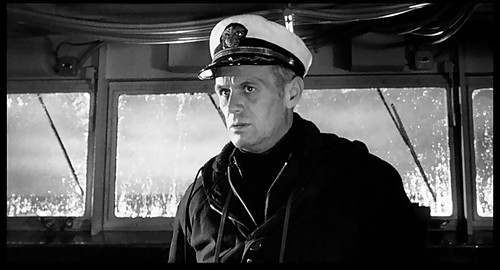
But where that one took to the air, The Bedford Incident plays out at sea in a cat-and-mouse game between a Soviet nuclear sub and a naval destroyer. In command is Captain Eric Finlander (Richard Widmark, steely with just a touch of baleful twitchiness that goes full-on berzerkoid in an interview), a determined commander who takes enormous pride in the proficiency of his crew, and in the hunt and pursuit of his targets. As an advisor is a former Nazi U-boat commander Wolfgang Shrepke (Eric Portman), who was responsible for the most tonnage (ours) sunk during the second World War. Also on board is reporter Ben Munceford (Sidney Poitier), who serves as an exposition conduit and Royal Pain In The Ass. Among the crew are Martin Balsam as the ship's new doc, James MacArthur as a too-eager ensign, Wally Cox as the sonar bat, and if you're watching early and quickly, there's a young Donald Sutherland as a garbage analyst—garbage being clues to conditions on the enemy boat, and age-analysis gives tracking position and history.
It shows how extreme the measures are on the Bedford, how detail oriented, how precise, how strategic and how puckered the thought processes go into keeping an eye on the enemy. And once found, Finlander will pursue chasing Soviet subs out of territorial waters, even forcing them to stay underwater until they're desperate for air, provoking confrontation. When your Nazi adviser tells you he's scared of your methods, it means you might be going so overboard as to pro-actively lower the life-rafts.

If you're immersed at all in pop-culture, you can see elements of Bedford in such disparate strategy plays as "Star Trek" and The Hunt for Red October. And such gamesmanship is all well and good in limited skirmishes. But, when the arsenal is nuclear? Do you really want a cigarette in a room full of gasoline?
 

No, and that the game is played despite the mega-stakes makes the movie and its characters seem not just petty, but a little dim for all the talk of brilliance. The point of hubris is well taken, but the point was better made as an out-and-out black comedy about short-term, selfish interests in the face of global catastrophe.

Saturday, March 12, 2022

Al Capone

Saturday is traditionally "Take Out the Trash" Day.

Al Capone (Richard Wilson, 1959) No fortune was ever made without a little larceny. That's the way I first heard it. But, the quote (attributed to Balzac) is "The secret of great fortunes without apparent cause is a forgotten crime, because it was properly done."
 
Okay, a little touch of pretension to lead off a review of this cheap B-movie made around the time the movie market was starting to be overrun by gangster pictures, which had previously had their hey-day in the pre-Code early 1930's. The Code stated that criminals were not to be glorified, and certainly not mentioned by name—Howard Hawks had made Scarface in 1932, but the titular character played by Paul Muni was named Tony Camonte—not Al Capone (despite the "nickname" association). When Breen and the Hays Code cracked down on the mob in movies there had been one exception, the 1945 low-budget film Dillinger
But, as the Production Code was being attacked from all fronts, the smaller studios and production companies took chances on the criminal element as a box-office draw. The first script for Al Capone was rejected by the PCA, as "glorification" of Capone, without a "counter-balancing good" and "an overemphasis on violence and slaughter." A toned-down draft was subsequently submitted and accepted, and although J. Edgar Hoover would grumble about it (and the other gangster-themed films throughout the late 1950's-early 1960's), the mobs were taking over the screens.
It must have been tough not to "glorify" Capone, as he steeped himself in glorification; if there was an American oligarch of crime, it was Al Capone. The movie plays fast and loose with the facts—yeah, Capone started in New York, but the picture starts with him (played at high volume by
Rod Steiger) working as a bodyguard for Johnny Torrio (Nehemiah Persoff), who runs an "emporium" specializing in "booze, gambling, and broads"—the movie glosses over the fact that Capone was merely 20 years old, already married with a kid (they're never mentioned). Capone thinks Torrio too soft and lacks ambition, but a meeting with higher-up "Big Jim" Colosimo (Joe De Santis) brings him a mentor more in line with how he'd want to handle things. And Colosimo knows Caruso. That's more like it.
With Prohibition, Capone devizes ways to keep the booze flowing and the money coming in, but his bosses aren't as keen to taking chances and challenging the turf of their rivals. Capone eliminates the roadblocks and intimdates his foes, all the time keeping control of politicians and paying off the police...except for Sgt. Schaeffer (
James Gregory), who eventually becomes Captain and makes Capone his personal mission. Capone lives large and fairly untouched. But it isn't until the St. Valentine's Day massacre that Capone starts to feel any pressure, plus his relationship with the wife of one of his victims doesn't go smoothly, as well.
Some of it's true. Some of it is borrowed from Shakespeare—director Richard Wilson had worked on Welles' version of Macbeth—and it's all staged on back-lots and made-for-television angles on the cheap...as most of the product of these independent gangland films were. Still, one gets a sense of time and place, even if it sometimes feels like it's in a bubble. And Steiger is a roaring gorilla throughout, not afraid to rattle the balcony seats or bust a blood vessel. There are times when you want to laugh, but then Steiger will do something with just an eye-flick that lets you in that his gangster in not just all sound and fury, but a show-man and strategist as well. He's a combination of adult and child, with a habit of murderous tantrums. It would be an understatement to call it a bravura performance, and it comes perilously close to prosciutto. 
It's not a great film, but it is "properly done." Balzac would have been proud.


Thursday, September 30, 2021

The Anderson Tapes

The Anderson Tapes
(Sidney Lumet, 1971) The second of the five films that Sean Connery would ultimately make with Sidney Lumet, an unlikely pairing of the Scots actor and the New York director, but the two obviously enjoyed working together, as Connery's next project with him 
(The Offencewas one of the "vanity" projects he was allowed to make for returning to the role of James Bond in Diamonds Are Forever, and Lumet was Connery-picked to direct, no doubt in loyalty to the director, as their first project, The Hill, allowed the world to see that the star of the "007" films had a range that extended outside the spy field.
 
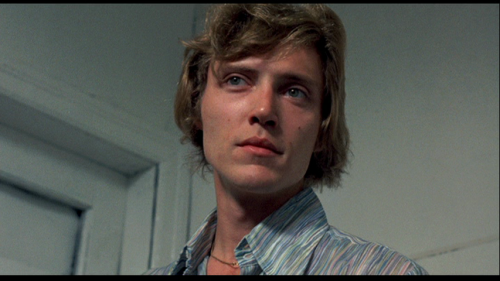
The Anderson Tapes, however, was a different creature, entirely. An extended heist film, in which Connery, Martin Balsam, and (introducing) Christopher Walken participate in what must be the slowest caper in history, the casing of a luxury apartment building in New York City. Connery plays Duke Anderson, a con just released from a ten year stretch in prison, who can't wait to do another score. The inspiration is his girlfriend Ingrid (Dyan Cannon), a high-end call-girl, who has been set up in a luxury apartment by another man.
But, things have changed in the ten years since Anderson was free. Unbeknownst to him, he is under constant surveillance by three different agencies: Ingrid's apartment is bugged by a private detective hired by her "keeper;" the FBI is tracking Black activists, whose headquarters is at a flop where the thieves meet; the IRS is phone-tapping the Mafia Boss (Alan King), who is funding the heist; and the Bureau of Narcotics is keeping tabs on one of the group's members. 
All of these groups are keeping a running record of the planning of the break-in...but none of them are coordinated or sharing information, 
 and the surveillance work is so concentrated on their individual subjects, that nothing is put together to prevent it from happening.  
 
It's hard to determine exactly what is being decried here—that our privacies are being invaded to such an extent, or that this intelligence isn't being cross-referenced to prevent actual crimes and thus is working to cross-purposes and is...dumb. One gets the impression that there is no stance being taken, rather that it's to present A Big Irony, that undercuts how events play out, eventually. 
But, that was Lumet's specialty—he frequently spaced his flat-out movie drama assignments with "Ironies," (as opposed to "Comedies") that, their point having been made half-way through the movie, wear out their welcome by the often dissatisfying end of the tale. Everybody looks a little stupid here: the agencies, for their tunnel-vision, the crooks for their own utter lack of surveillance as the crime goes about, and the NYPD, whose very elaborate storming of the apartment complex is literally over-the-top.
Lumet was not the best director for comedy as he had a tendency to sledge-hammer things—like Martin Balsam's mincing interior decorator/antiques smuggler (yeah, yeah, "it was the times," I suppose—prejudice always has "a time"), but there are some joys to be had, besides Connery doing something different and Walken's debut: appearances by Max Showalter, Margaret Hamilton (her last role), and "crazy old lady"(their own form of prejudice) Judith Lowry, as well as Ralph Meeker and SNL pioneer Garrett Morris as Gotham police.

Lumet would hit his stride later in the decade (with the sure editorial hand of Dede Allen), but this one is only moderately successful.
 

Wednesday, June 9, 2021

The Taking of Pelham One Two Three

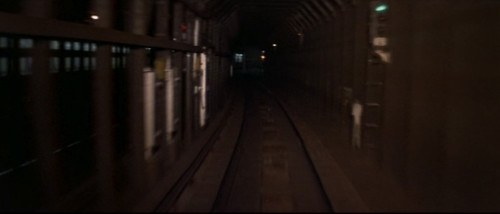
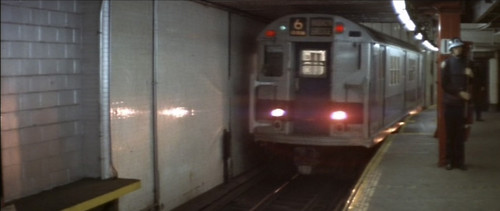
The Taking of Pelham One Two Three (Joseph Sargent, 1974) Taut, no-frills caper thriller about the hi-jacking of a New York subway train by a group of color-named conspirators. Veteran director Joseph Sargent and cinematographer Owen Roizman create a gritty landscape of dark passages and harsh fluorescent lighting while the Transit police try to negotiate with the hi-jackers, and the hi-jackers deal with their internal squabbles and a subway car of jumpy New Yorkers

It's like anything: Nothing's easy. 

This one's the first of more adaptations than necessary (a TV version was broadcast in 1999 with Edward James Olmos and Vincent D'Onofrio, and Tony Scott is making a new one with Denzel Washington and John Travolta*) of John Godey's rather spare novel, but is the best of the bunch, having the advantage of a witty script penned by Peter Stone, screenwriter of Charade and the musical "1776." Stone realized the bare-bones plot of the novel wouldn't sustain a movie, and fleshed out the characters with a jokey, schlumpfy "attitude" that keeps the slow parts entertaining, especially when played by two wily character actors like Walter Matthau and Jerry Stiller.

Matthau gets the advantage of playing a fairly straight character with a muffled humor, while Stiller makes the sarcasm of his dispatcher as dry as Brooklyn dust. By contrast, the hi-jackers (Hector Elizando, Martin Balsam, Earl Hindman, and led by Robert Shaw, who plays it cold as ice) are twitchy no-nonsense cyphers cloaked in anonymity. For a change, it's the cops who are the interesting ones, as they race against time to secure a million dollars in ransom and deliver it before hostages begin being killed.
The direction and lighting take their cues from the documentary style of The French Connection,** as does the funky score by David Shire. The film employed a new process of "flashing" the film, allowing the filmmakers to still get detail in the dimly lit (and graffiti-less by MTA request) subway tunnels without having to set up extensive lighting that would have delayed production—and due to the grimy, rat-infested locations—risked the health of cast and crew (who wore masks when cameras weren't rolling).
But Stone's script is the factor that nudges the film beyond its thriller origins and give it a cynical style. 

In fact, it is so well done, that one questions the need to do another version.


* We'll put that one up next week.

**Owen Roizman was the DP for that film, as well.

Wednesday, May 18, 2016

Seven Days in May (1964)

Seven Days in May (John Frankenheimer, 1964)  May 18th.

Mark it in your calendars (or in notes for future trivia contests). That is the day the government of the United States was scheduled to be overthrown by a military coup organized by the Joint Chiefs of Staff, over a nuclear treaty signed by the United States and Russia and ratified by the Senate.
 
But it never happened. Not even in the movies.

Still, May 18th was the day. The year was never mentioned...almost as a caution.

The early 60's were a great time for filmed political thrillers in the States. Kennedy was president, the world was at war (coldly) and the fictional machinations were filmed in a very appropriate black-and-white, just like the television sets that brought the news into our homes. It was a time distant from the years of World War II when the words of politicians and leaders were taken at face value, even if the individuals were two-faced. Cynicism about the government and political overreach began to settle over the populace with the threat of nuclear weapons, the McCarthy hearings, Ike lying about the U-2 incident, each in their own way chiseling at the foundations of the monuments we had in place in DC. 
Books and movies started to reflect that cynicism like The Best Man, The Manchurian Candidate, Advise and Consent, maybe Fail-Safe. And this one, Seven Days in May, from the the team that wrote "Fail-Safe," for this movie adapted by Rod Serling and directed by Manchurian director Frankenheimer, with an eye towards reflecting the world as it is...or as we would see them playing out on TV. Serling was overseeing "The Twilight Zone" series at the time, but this one was not too off his comfort "zone" by being equal parts suspense, intrigue, and character study, in words, terse, circumspect, and dripping with irony. Serling's writing could be a little ripe and on the nose, even spoken through gritted teeth and tight lips, as when Ava Gardner tells Kirk Douglas"I'll make you two promises: a very good steak, medium rare. And the truth, which is very rare."
Douglas plays Colonel Martin "Jiggs" Casey, adjutant to the fifth most powerful man in the world, but maybe the most charismatic, General James Mattoon Scott (Burt Lancaster), head of the Joint Chiefs of Staff under President Jordan Lyman (Fredric March). The nuclear arms treaty is extremely controversial, causing violent protests outside the White House.
Briggs is a good soldier, snap-to and does his job, he's loyal to his boss and doesn't make waves (important for a Marine). But, odd things are starting to add up. There's the office pool on the Preakness that's passing between official channels between the Joint Chiefs, which is odd. But, what's odder is the reaction of Scott's "body-man" Colonel Murdock (Richard Anderson) who gets hot under the collar-buttons when Briggs mentions that betting pool. It isn't casual water cooler talk, it's treated like an international incident with the grunt who mentioned getting stationed out of the way to Hawaii. Odd.
Then, Briggs gets a visit from an old pal, Colonel "Mutt" Henderson (Andrew Duggan) who tells him about his current assignment at a secret base in Texas designed for interrupting television signals and designed for "seizure," "like the Commies already had the stuff, and we had to get it back.." That and Scott's accelerating role on the political stage, aiming for a run for the White House.  A somewhat heated conversation with a saber-rattling Senator (Whit Bissell) at a Washington function is the final worry. Briggs follows the Senator back from the party to a clandestine meeting at General Scott's house...when the Senator has already mentioned he'd be out of town.
It's just enough incongruous parts and shady behavior for Briggs to go to the White House to vent his suspicions to the President—there's going to be a coup by the military to take over the government. The President is concerned but cautious. Briggs is sent out to get details on the wisps of evidence that he has, while the President's Aide (Martin Balsam) is sent to make a call on the one military chief, Vice-admiral Farley Barnswell (John Houseman-his first screen debut, although uncredited) who has not opted into the "pool" to provide written evidence of the conspiracy. One of Lyman's closest associates in the Senate, Senator (Edmond O'Brien) heads to Texas to see what he can find out about the hidden base, while Briggs starts to gather evidence, including from Scott's discarded mistress (Ava Gardner).
It soon becomes clear that there is, indeed, a coordinated effort from a particularly dedicated cabal to take over the government, either during a nuclear training exercise or the President's upcoming trip to his weekend retreat—the President maneuvers his schedule, making Scott adjust his plans, which are then monitored by government agencies. But, how will it play out? It's an elaborate chess game with many moving parts with the final component being the medium of television, the direct link to the populace on whom the ultimate decisions of governing rests.
There's a lot of talk, as Serling goes overtime with terse conversations behind locked doors. It's drama, but Serling disliked raised voices, just like Washington does (or used to). There was never a time when the theatrics of the circus didn't invade governance, but before entertainers and the pulpit entered the fray, the popular conception of government conversation was discourse and debate, not some hard-balling cross-fire competition to be the loudest voice that doesn't pause for breath as is the impression made by the info-tainment of today's television. Why, General Scott's braying passion sounds downright reasonable in today's age of clowns. "You got something against the English language, Colonel?" barks the President when Briggs tippy-toes around his suspicions. Now, everyone does. Today's government speaks the language or lawyers and liars. Snake-oil salesmen.
Frankenheimer films in high-contrast black-and-white, with the high light-levels of television lights and offices and the deep shadows of parking lots and other holes of skullduggery. It's like he wants to show pictorially that the best governance is the one in the light and not the ones that scurries away from it. And for all the surveillance gear on display, conspiracy can still hide in plain sight. Especially if no one is really looking.
Seven Days in May is a classic movie and a repudiation to the old saw that looks to a savior or "a man on a white horse." Those who engage in hero-worship or ignore the media of manipulation are just bound to be disappointed, if only they were smart enough to admit it. It is also a great movie that should play in the Church of the Eternally Naïve as they endlessly chant "It can't happen here."

March 18th.

Remember, the year isn't given.

Tuesday, December 9, 2014

Tora! Tora! Tora!

Tora! Tora! Tora! aka (トラ・トラ・トラ!) (Kinji Fukasaku/Toshio Masuda/Richard Fleischer, 1970) "The American Pacific Fleet was attacked and partially destroyed by Japan on . . . Sunday Morning December 7, 1941. This attack led to the entering of the United States into World War II. All of the events and characters depicted are true to historical fact."

20th Century Fox's former studio head
Darryl F. Zanuck had served in the second World War, and spent his senior years at 20th by the overseeing of large movies showcasing major battles of that war, his most prominent being The Longest Day, based on Cornelius Ryan's book documenting the Normandy Invasion.  But, in 1966 plans were put in place to make an historically accurate film about the Pearl Harbor attack, based on Ladislas Farago's "The Broken Seal."  Ambitious in its scope, the film would be made with both Japanese and American crews, and for a great deal of the pre-production the man in charge of the Japanese unit was director Akira Kurosawa (who did extensive work on the screenplay).  Kurosawa agreed to the film, thinking that David Lean was making the American section, but when he discovered it was, instead, Richard Fleischer, the Japanese master bent some rules in order to allow himself to be "fired" from the film.  He was replaced by two directors known to be as efficient and workmanlike at bringing films in on-time and under-budget as Fleischer.  The intention was not to make great art, but to make an historically accurate film, devoid of trumped-up drama (From Here to Eternity had done that already) and stick to the main subject of the planning and execution of the attack.
The result, although accurate, is rather flat. Fleischer's American scenes seem drab and stale and, peopled with character actors like Jason Robards, E.G. Marshall, Joseph Cotten and Martin Balsam, lacking in star power.* The Japanese sequences, perhaps because they have less of an American film studio-feel, seem to have more verve and energy...and better performances. The movie seems to reflect the situation of the real life events: the Japanese have all the bright ideas, while the Americans have the lethargy associated with "a sleeping giant."** Still, the battle sequences and attack footage is extraordinarily well done, a combination of L.B. Abbott's and A.D. Flowers' model work and the Fox Studio's sometimes hair-raising practical effects crews and stuntmen.
I attended the premiere of Tora! Tora! Tora! with my family at a special showing at the old Paramount theater in Seattle. It was a special preview for the local chapter of the Pearl Harbor Survivors, of which my father, John Wilson, late of the U.S.S. Missouri, was a member. The only story my Father ever told of the war was the events of December 7th, when he was waiting on the dock of the U.S.S. Arizona to attend on-board church services with his friend, Howie Whims, who, for whatever reason, was late. Were it not for his buddy's tardiness, my Father would have been aboard the doomed Arizona at the time of the attack, and likely might have joined the ranks of the sailors who are still entombed there.***
It was an odd thing sitting in that audience with that audience. 29 years previously, they had witnessed the true horrific events of what was being fictionalized on screen. The mistakes made (by both sides) that made the devastation so complete was laid out for all to see. But, however good the effects and pyrotechnics, they couldn't recreate the carnage of that day: the deafening noise, the stench of burning oil that enveloped Pearl for weeks, the bodies, the desperation; the sight of good friends and comrades-in-arms caught in the gears of the attack and lost forever.**** 
The retired sailors sat stonily, watching the film—no doubt poor competition for the memories unreeling in their own heads and hearts and souls. There was a smattering of applause when a Japanese zero was shot down, but it was unenthusiastic, hardly celebratory. For them, it was a film about—and I say this hopefully—the worst day of their lives. However artfully done, however accurately portrayed, who would want to sit through that?  As Sam Fuller succinctly put it in The Big Red One, "Surviving is the only glory in war."  

I hope, on that day, they could appreciate their own glory.


As part of the marketing of the film, 20th Century Fox had artist Robert McCall do a series of designs for use in poster art (as he had with 2001: a Space Odyssey). The images are quite extraordinary.

* Actually, it's not a bad strategy.  Less attention is paid to the actors on-screen to the advantage of the story.  Films such as Zanuck's The Longest Day or A Bridge Too Far become parlor games after awhile ("Look!  There's Sal Mineo and Richard Beymer! Isn't Gene Hackman in this movie?")

** That's taken from the thing the movie is most famous for—Yamamoto's assessment of the attack ("I fear all we have done is to awaken a sleeping giant and fill him with a terrible resolve").  Even Michael Bay's Pearl Harbor used it.  It's a good line, making the Imperial General seem both prescient and tragic.  Unfortunately, it appears that, historically, Yamamoto never actually said it.

*** It's one of the reasons I have no patience with Michael Bay's post-Titanic disaster, Pearl Harbor: there is one shot, meticulously recreated, following the path of the most damaging bomb that struck the ship—one of those CGI-sailors scrambling for cover below could likely be my Father, and it irks me that Bay's sensibilities had more gung-ho enthusiasm for the bombs than for the victims.

**** Those sailors' names are etched in stone at the Pearl Harbor Memorial, which is constructed over the still capsized hulk of the Arizona, which still burbles oil to the surface to this day.  But, there's another section, a more recent section, with fresher names cut into the rectangular portal that leads under the surface to the Arizona.  It's for survivors of the attack, who after living through the war, living a full life with wives and families, still chose as their final resting place the ship in the Harbor where they lost so many friends.  I never fully understood "survivor's guilt" until I saw that.