Showing posts with label The Cold War. Show all posts

Wednesday, November 20, 2024

The Bedford Incident

The Bedford Incident (James B. Harris, 1965) A veritable volume of Bartlett's Quotations fills my head after seeing The Bedford Incident

For instance, the astronaut's description of his job as "98% tedium punctuated by moments of sheer terror," and Elwood P. Dowd's "You can be 'oh-so-smart' or 'oh-so-pleasant'—I recommend "pleasant." Then, because the story is basically, "Moby Dick in The Cold War," there are all sorts of Melville quotes...and one bad joke: "Cook 'em, Dan-O."

It's that last one that sticks, though. The Bedford Incident is, basically, a terrible, terrible joke with a possible several mega-tonnage punchline. And director James B. Harris, who, before making this film, was Stanley Kubrick's film-making partner, can't have missed the thought as his ex was making an out-and-out comedy of errors out of the nuclear arms race.  

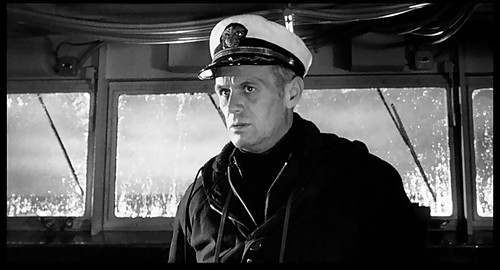
But where that one took to the air, The Bedford Incident plays out at sea in a cat-and-mouse game between a Soviet nuclear sub and a naval destroyer. In command is Captain Eric Finlander (Richard Widmark, steely with just a touch of baleful twitchiness that goes full-on berzerkoid in an interview), a determined commander who takes enormous pride in the proficiency of his crew, and in the hunt and pursuit of his targets. As an advisor is a former Nazi U-boat commander Wolfgang Shrepke (Eric Portman), who was responsible for the most tonnage (ours) sunk during the second World War. Also on board is reporter Ben Munceford (Sidney Poitier), who serves as an exposition conduit and Royal Pain In The Ass. Among the crew are Martin Balsam as the ship's new doc, James MacArthur as a too-eager ensign, Wally Cox as the sonar bat, and if you're watching early and quickly, there's a young Donald Sutherland as a garbage analyst—garbage being clues to conditions on the enemy boat, and age-analysis gives tracking position and history.
It shows how extreme the measures are on the Bedford, how detail oriented, how precise, how strategic and how puckered the thought processes go into keeping an eye on the enemy. And once found, Finlander will pursue chasing Soviet subs out of territorial waters, even forcing them to stay underwater until they're desperate for air, provoking confrontation. When your Nazi adviser tells you he's scared of your methods, it means you might be going so overboard as to pro-actively lower the life-rafts.

If you're immersed at all in pop-culture, you can see elements of Bedford in such disparate strategy plays as "Star Trek" and The Hunt for Red October. And such gamesmanship is all well and good in limited skirmishes. But, when the arsenal is nuclear? Do you really want a cigarette in a room full of gasoline?
 

No, and that the game is played despite the mega-stakes makes the movie and its characters seem not just petty, but a little dim for all the talk of brilliance. The point of hubris is well taken, but the point was better made as an out-and-out black comedy about short-term, selfish interests in the face of global catastrophe.

Tuesday, August 17, 2021

The Iron Petticoat

The Iron Petticoat (Ralph Thomas, 1956) There are many reasons a film can be withdrawn from circulation. In some cases, like Frank Sinatra's withdrawal of Suddenly and The Manchurian Candidate, it is the fear that the influence of the film might have had on current events, in much the same way as Stanley Kubrick withdrew A Clockwork Orange for many years in England, due to what seemed to be several copycat crimes related to it.

Bob "I probably should have done this with Phyllis Diller" Hope and his estate kept The Iron Petticoat out of America after its initial release until...November, 2012...when TCM showed it for the first time in this country since its release, (with the exceptions of a couple of private screenings). It's been available in Europe and throughout the rest of the world, but not in the States, owing to a disagreement between Hope and the film's original author, the esteemed Ben Hecht, who wrote the thing for Katherine Hepburn, with an eye toward re-teaming her with Cary Grant. But, Grant was still on his on-again-off-again retirement at the time and passed, Hope sashayed in, and proceeded to hand it to his gag-writers who refashioned the script more to Hope's style than Hepburn's...or Hecht's. To be fair, stars do this all the time, re-writing scripts to their liking and their strengths, but Hecht took the issue public in the Hollywood press, leading to a Hope-ful response. For whatever reasons, Hope, who had the distribution rights in the U.S., kept it out of circulation after its initial run, making it a curiosity.
Would that the unearthing of this film, with the unlikely match-up of Hope and Hepburn, the first movie producing credit of Bond producer Harry Saltzman, be anything more than that.  But, like Schrödinger's cat, once seen, there is certainty, and in this timeline, it ain't good. The story of a Russian aviatrix (Hepburn) who defects to Europe and is squired by an American Air Force Major (Hope) under orders to keep her on our side is a few notches shy of Ninotchka, and is almost entirely charmless. No one's at the top of their game here, with the exception of some of the character actors (Robert Helpmann, James Robertson Justice). Hope seems to have that hapless "I'm bombing here" look on his face without the curl to his lip that inspired confidence. And Hepburn? There's a distinctive overabundance of iron, as if she were trying to be her own Berlin Wall to hold her own in the project. And where Garbo played Ninotchka with a stiff world-wary calm ("like a Vulcan" I compared it to), Hepburn is loud and forceful, projecting her words to the top of "the house" (more like a Klingon). And if Melvin Douglas' ardent suitor in the earlier Lubitsch film softens his Moscovite's demeanor, Hope's stand-offishness—keeping her at golf-club's length—does nothing towards making this one either romantic or comedic.
No film should be locked away in a vault, but for this one, the only joy in it is  its seeing the light of day again. It is only when it sees the light of the projector that the disappointment starts.