Showing posts with label Sean Connery. Show all posts

Saturday, June 1, 2024

Meteor (1979)

Saturday is traditionally "Take Out the Trash Day"...

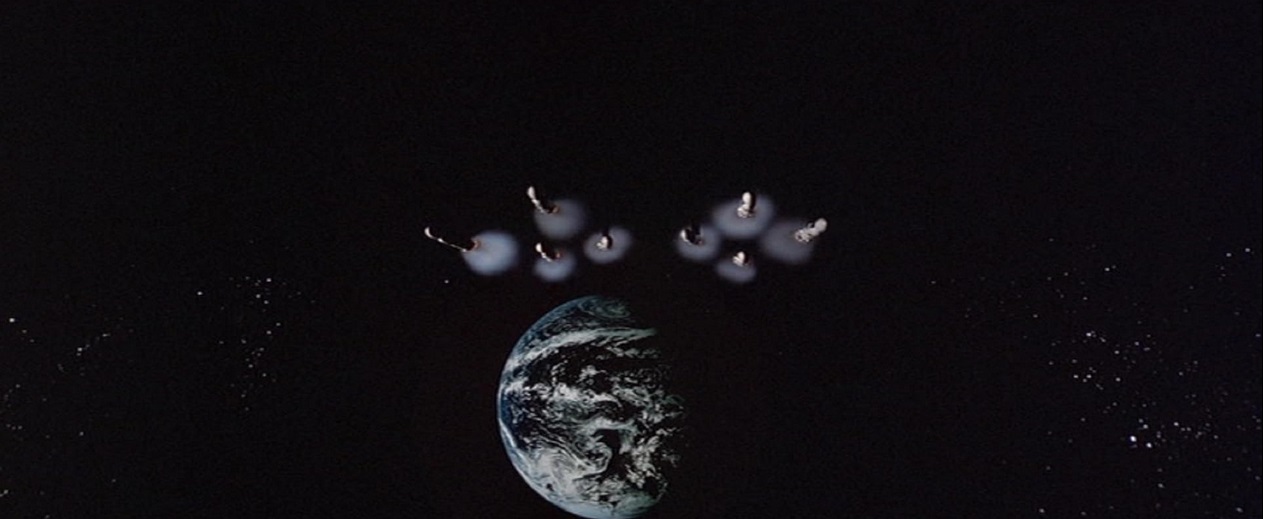
Meteor (Ronald Neame, 1979) A co-production between Shaw Bothers Studios, Warner Brothers, Nippon Herald Films and American International Pictures, featuring a script by Edmund H. North (who wrote The Day the Earth Stood Still and co-wrote Patton) and Stanley Mann (who wrote a couple of Sean Connery's early films) and featuring a cast that probably ate up most of the movie-budget—ConneryNatalie WoodBrian KeithKarl MaldenHenry Fonda, Martin Landau, and Trevor Howard all under the direction of Ronald Neame, who directed The Poseidon Adventure. The story was the most high-profile of topics—an asteroid (called "Orpheus") is headed for Earth and American and Russian scientists must cooperate and use their own orbiting nuclear defense systems to destroy it before it hits Earth and creates a global catastrophe.

What could possibly go wrong?
 
Budgeting. That's what could go wrong.
 
Although a lot of the writing in Meteor is overwrought, the cast does alright with it, and Neame's direction isn't particularly flashy, but manages to keep things moving briskly.
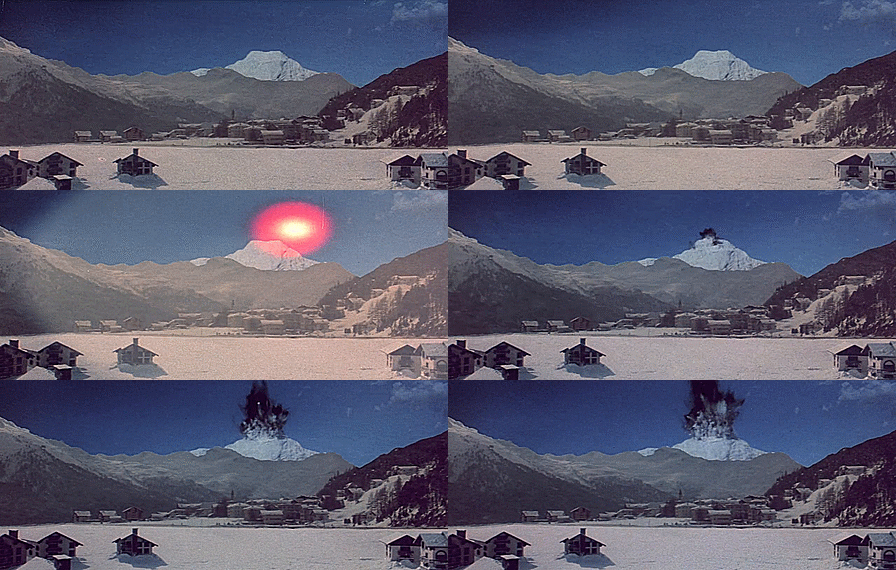
But, by the time all of that was done, the movie's coffers had little room left for post-production and special effects. It didn't help that by the time attention was being paid to the post-production, the group assigned to do the effects of the large threatening asteroid and the missiles designed to destroy it was summarily fired for the work for being below expectations.*
Now, there's a lot of grousing these days that "special effects don't make good movies." Goodness knows there have been a lot of movies where the special effects were sub-par, even in the 1970's (Logan's Run, for instance), even after the water-shed moment of the Star Wars premiere. And one has merely to look at the output of AIP's
post-Star Wars coat-tails films to see that their effects work was "made-in-the-garage" quality.
So, one is left with a Frankenstein-monster of a movie: An able cast with a somewhat shaky script (with some truly cringe-inducing dialogue), spliced with sub-par special effects sequences that—despite the many limitations—seem to go on forever, with no real editing scheme to create tension, but plopped into the film to fill the time with the shakiest of continuities.
There's no finesse to it at all—how could there be when the film was being pieced together so close to the premiere? One can only console oneself with a sequence where the all-star cast gets drenched in mud while trying to escape their command headquarters through the New York City subway system. The images call to mind so many derogatory descriptions for the movie. "Disaster" being the kindest one.
Hollywood wasn't quite done with the concept yet: 1998 saw the release of not one, but two "asteroid-threatening-the-Earth" movies: Armaggedon and Deep Impact

Apparently, there's a lot of "rockery" in neighborhood-space. And nothing new under the sun.

* Actually, two groups of special effects studios were let go, sucking up a lot of the "post" budget and pushing the time-line for the eventual team—they had a mere two months to complete the work before the premiere!

There was another major up-ending of expectations in the post-production: John Williams was given the job of writing the score for Meteor, but the production delays and the revolving door of special effects artists prevented any sort of semblance of "picture lock" for him to compose music for it before he had to go off and work on Steven Spielberg's 1941. Laurence Rosenthal was then hired to compose the score, which ended up being rather good—amazing, given his time-constraints.

Thursday, September 30, 2021

The Anderson Tapes

The Anderson Tapes
(Sidney Lumet, 1971) The second of the five films that Sean Connery would ultimately make with Sidney Lumet, an unlikely pairing of the Scots actor and the New York director, but the two obviously enjoyed working together, as Connery's next project with him 
(The Offencewas one of the "vanity" projects he was allowed to make for returning to the role of James Bond in Diamonds Are Forever, and Lumet was Connery-picked to direct, no doubt in loyalty to the director, as their first project, The Hill, allowed the world to see that the star of the "007" films had a range that extended outside the spy field.
 
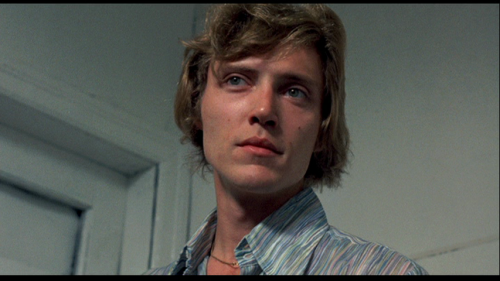
The Anderson Tapes, however, was a different creature, entirely. An extended heist film, in which Connery, Martin Balsam, and (introducing) Christopher Walken participate in what must be the slowest caper in history, the casing of a luxury apartment building in New York City. Connery plays Duke Anderson, a con just released from a ten year stretch in prison, who can't wait to do another score. The inspiration is his girlfriend Ingrid (Dyan Cannon), a high-end call-girl, who has been set up in a luxury apartment by another man.
But, things have changed in the ten years since Anderson was free. Unbeknownst to him, he is under constant surveillance by three different agencies: Ingrid's apartment is bugged by a private detective hired by her "keeper;" the FBI is tracking Black activists, whose headquarters is at a flop where the thieves meet; the IRS is phone-tapping the Mafia Boss (Alan King), who is funding the heist; and the Bureau of Narcotics is keeping tabs on one of the group's members. 
All of these groups are keeping a running record of the planning of the break-in...but none of them are coordinated or sharing information, 
 and the surveillance work is so concentrated on their individual subjects, that nothing is put together to prevent it from happening.  
 
It's hard to determine exactly what is being decried here—that our privacies are being invaded to such an extent, or that this intelligence isn't being cross-referenced to prevent actual crimes and thus is working to cross-purposes and is...dumb. One gets the impression that there is no stance being taken, rather that it's to present A Big Irony, that undercuts how events play out, eventually. 
But, that was Lumet's specialty—he frequently spaced his flat-out movie drama assignments with "Ironies," (as opposed to "Comedies") that, their point having been made half-way through the movie, wear out their welcome by the often dissatisfying end of the tale. Everybody looks a little stupid here: the agencies, for their tunnel-vision, the crooks for their own utter lack of surveillance as the crime goes about, and the NYPD, whose very elaborate storming of the apartment complex is literally over-the-top.
Lumet was not the best director for comedy as he had a tendency to sledge-hammer things—like Martin Balsam's mincing interior decorator/antiques smuggler (yeah, yeah, "it was the times," I suppose—prejudice always has "a time"), but there are some joys to be had, besides Connery doing something different and Walken's debut: appearances by Max Showalter, Margaret Hamilton (her last role), and "crazy old lady"(their own form of prejudice) Judith Lowry, as well as Ralph Meeker and SNL pioneer Garrett Morris as Gotham police.

Lumet would hit his stride later in the decade (with the sure editorial hand of Dede Allen), but this one is only moderately successful.
 

Friday, April 23, 2021

Anytime Movies #10: Goldfinger

While I catch up on the reviews still in "Draft" phase here, I'll re-run a feature I ran when I first started this blog seven years ago,* when it was suggested I do a "Top Ten" List.

I don't like those: they're rather arbitrary; they pit films against each other, and there's always one or two that should be on the list that aren't because something better shoved it down the trash-bin.

So, I came up with this: "Anytime" Movies.


Anytime Movies are the movies I can watch anytime, anywhere. If I see a second of it, I can identify it. If it shows up on television, my attention is focused on it until the conclusion. Sometimes it’s the direction, sometimes it’s the writing, sometimes it’s the acting, sometimes it’s just the idea behind it, but these are the movies I can watch again and again (and again!) and never tire of them. There are ten (kinda). They're not in any particular order, but the #1 movie IS the #1 movie. 


I’m an unrepentant James Bond fan.


Yes, the movies are sexist and exploitive--frozen in the hardened amber of 60’s attitudes and prejudices.

They’re filled with mink-lined sadism, clueless Brit' snobbery and snarky humor only drunken frat' boys laugh at.

I love it.  And Goldfinger (1964) is the epitome of it all.

Call it a “guilty pleasure” if you must and place it at the end of this list, but homage must be paid and credit given.

There may be better films in the series (that would be its predecessor, the slightly more sober From Russia With Love- and I have warm spots in my heart for OHMSS, the nasty/silly Diamonds Are ForeverThe Living Daylights and "the Craigs"). Certainly there are more elaborate and flashy ones, with more spectacle, where you walk out talking about the sets (and not much else).
But Goldfinger has it all, managing to take a middling Fleming thriller (even though Anthony Burgess listed it in his “99 Novels: The Best in English Since 1939” as representative of the Bond series) and improve on it—a rarity in the films. The screenplay (by series veteran Richard Maibaum and utility closer Paul Dehn) is an efficient series of traps and foreshadow-dropping gold nuggets of information that pay off later in the story: Bond’s improvised electrocution of an assailant in a seemingly-unrelated pre-titles sequence sets us up with information for another situation later, as does a casual conversation about discharging firearms in a pressurized airplane cabin (since disproved by the “Mythbusters”) Maibaum and Dehn toss out a group of characters early (and fittingly) to streamline the Big Set-Piece—Goldfinger’s raid on Ft. Knox—and go Fleming one better; instead of the unworkable book idea of physically stealing the gold, the screenwriters just devise a way to irradiate it, making it unexploitable, crashing the U.S. economy while increasing the worth of the villain’s holdings. Neat. They also update the book’s nasty “Perils of Pauline” sequence with a circular saw by strapping Bond to a slab of gold being bisected by the recently-developed laser beam.
Maibaum excelled at plot and structure, but it was Dehn, a radicalized gay writer who had worked as a propaganda instructor at the OSS "Camp X" during WWII, who tossed in the more cheeky touches. There’s a cool re-appraisal of Bond as a hero in this film. He’s basically kicked between situations beyond his control, something which irked star Sean Connery who saw Bond as an active investigator. Connery was also miffed at some Bond set-ups—the seagull disguise at the very beginning of the film, although he did embrace Bond stripping off a wet-suit to reveal a white linen tuxedo jacket, which he wears to a seedy South-of-the-Border bar (The “cluelessly-overdressed Bond” joke would be done to death in the films until Timothy Dalton put an end to it --although Pierce Brosnan still had his Bond pathologically straighten his tie, even underwater).
His third time out, Connery is finally casual with Bond while tossing in odd little bits of business to suggest that Bond is inches away from being clobbered on a regular basis. The villains are memorable, and the women have defined personalities (for once) with Shirley Eaton’s “golden girl” displaying as much aggressive sexuality as Bond (Eaton, and Gert Frobe, as Goldfinger, had their vocal parts dubbed by other actors). Of course, there's also the gadgetry: the "homer," the lethal bowler hat, the hi-tech exoticism of the laser beam. 
And then, there’s the car.
John Barry’s score is the blaring frosting on the cake: repeating chimes announcing the presence of the villain or anything having to do with gold; sinuous strings, compounding like snakes, creep during the laser beam sequence and Goldfinger’s signature theme blats out in brass clusters. And although other artists’ Bond songs have topped the charts, no one’s topped its theme song (with lyrics by Leslie Bricusse and Anthony Newley) for brio and outrageousness. No one has ever “belted” a song like Shirley Bassey does this.
It also has my two favorite lines from any Bond film. The first, adapted from Fleming:
This is gold, Mr. Bond. All my life I’ve been in love with its color, its brilliance, its divine heaviness.

And from Maibaum and Dehn, a line so good, it’s amazing no thriller had used it yet:
Bond: Do you expect me to talk?
Goldfinger: No, Mr. Bond, I expect you to DIE!

At the time this film was released—1964—all of this was new and glittering like the bullion Goldfinger hoped to exploit. Now, the Bond series has passed the 50th anniversary (appropriately golden) from its first release, and has become something of an institution, spawning imitations, copies, inspirations, and parodies—the glut of "tentpole" superhero films take their playbook from the audaciousness of the Bonds. The series has had to re-invent itself several times in its history, and seems to be in a zenith with the films featuring Daniel Craig. As the line from Skyfall put it, Bond's hobby seems to be resurrection. Now, A-list directors and major stars are making the Bonds, a sign of respect and affection. And, although the prospect has seemed doubtful every now and again, "James Bond Will Return."
It's a sign of the power of the franchise that when it was announced that the latest Bond film would be delayed (just two tantalizing weeks before its opening) due to the Coronavirus pandemic, other films started falling from their scheduled dates like bad gold-plating. All of Hollywood is waiting for Bond to save the day...and the theater box-office. With any luck—and some "discipline, discipline" on the part of the populace—the latest Bond film, No Time to Die, will release in the U.S. in October 2021...

Anytime Movies
Goldfinger
Bonus: Edge of Darkness


* And, on Sunday, we'll put up a "Don't Make a Scene" feature from each week's film.

Wednesday, October 14, 2020

The League of Extraordinary Gentlemen

The League of Extraordinary Gentlemen (Stephen Norrington, 2003) We've talked about The League of Gentlemen, Basil Dearden's ingenious caper movie. Writer Alan Moore had a devious idea for what he called "The League of Extraordinary Gentlemen," a comic series he created for the "America's Best Comics" publishers. He'd had editorial problems—"notes" as they're called—with the major comic book companies because he'd write stories for their licensed/trademarked characters only for editors to tell him "we/they can't do that, as we need the characters to sell breakfast cereal/action figures/underoo's/whatever." Rejection. It was just this sort of thing that forced him to create new characters for his landmark "Watchmen" series, when the characters he wanted to use (and rather irrevocably, too) were considered "too marketable or exploitable" by the company that had acquired them. He couldn't kill them off, give them less than honorable intentions—anything the Comics Code Authority considered "unheroic."
Quatermain, Tom Sawyer, Dorian Gray, The Invisible Man, Mina Murray and Captain Nemo

But, for this "League of Extraordinary Gentlemen" he decided to make up his team consisting of characters that appeared in works in the public domain, where nobody could squawk or...sue...for that matter...over their use and what Moore wanted to do with them. So, his book has Mina Murray, recent paramour of Count Dracula, recruited by British agent Campion Bond (yeah, "they're" related) to recruit a team which consists of: Allan Quatermain from H. Rider Haggard's books (particularly "King's Solomon's Mines"), Captain Nemo from "20,000 League Under the Sea," Dr. Griffin from "The Invisible Man", and Stevenson's Dr. Jekyll (and if he's in, so is Mr. Hyde). The first story had the League recruited by Bond's  spy-master boss, "M" (who is eventually revealed to be Professor Moriarty) to look into the smuggling of the valuable anti-gravity mineral "cavorite" (from H. G. Wells' "First Men in the Moon") involving a Chinese criminal named "The Doctor" (who resembles Fu Manchu). The next series had them battling invading Martians during that bothersome "War of the Worlds" incident. A library of literature and "alternate histories" were there for Moore to exploit and the series enjoyed great success in comics circles.
Connery, being the biggest star, becomes the de facto leader of "The League"

Moore's work had already made it to the screen—The Hughes Brothers had adapted his "Jack the Ripper" series "From Hell"—and there had been talk of making a film of his "Watchmen" since the time it was published. Moore was apathetic—he hadn't liked the From Hell film and found the attempts to adapt his work tedious and less than faithful—and vowed to have nothing to do with them.
Mina Murray—a vampire in broad daylight in Africa

It would seem hard to screw up "The League of Extraordinary Gentlemen", however. The characters were well-known, Moore had breathed a less Victorian sensibility into them—while remaining true to the original concepts. But, that was assuming people read books. The screenplay—by James Dale Robinson—became a patchwork of Moore's concepts and studio-dictated "ideas," such as the character of Dorian Gray (played by Stuart Townsend), who for the film is not only immortal, but also unkillable, Mina (in the film and played by Peta Wilson) is not just immortal but a full-fledged vampire, The Invisible Man (played by Jason Flemyng) is another character entirely (use rights could not be obtained for Wells' character of Dr. Griffin), and—for the benefit of American audiences who might find the film too "European"-centric, a character named "Tom Sawyer" (played by Shane West) is added as a member of the U.S. Secret Service; there is nothing extraordinary about him, other than he might be able to paint fences. The thing is: if somebody doesn't know who "Dr. Jekyll" or "Captain Nemo" is, they're not going to know who "Tom Sawyer" is, either.
Captain Nemo (played by Naseeruddin Shah) is true to Jules Verne's Prince Dakkar version—not Disney's—but the emphasis is on Sean Connery's Alan Quatermain. His salary took a big chunk out of the budget, and, as one of the film's producers, he and the director clashed so often they nearly came to blows. Connery subsequently retired from acting—except for some voice-work, and Norrington, citing studio interference and the difficulty of working with large crews, stated he's never direct a large studio film again. They might have added Mary Lincoln to the characters if only to ask "How was the play?"
Quatermain reasons with Hyde

Where the film sticks to Moore's original it's rather good: Connery's a fine Quatermain—but the film-makers misspell his name at a rather crucial point—and the other actors acquit themselves rather well given what they have to do; the most unnerving thing is the sight of the gargantuan Hulk-like Mr. Hyde, even though it recalls the way artist Kevin O'Neill drew him in the books. Nemo's Nautilus also recalls the "Scimitar of the Sea," although how it could traverse the canals of Venice without scraping bottom remains a mystery, along with how Dorian Gray can survive multiple gun-shots and how a vampiric Mina can go out in the noon-day sun of Africa.
But, then, there's not much to the story. Moore's book was so "inside" that it would have left audiences in the library-dust. So, there's no "cavorite" and the main villain is "M"/Moriarty disguised as a phantom menace known as The Fantom (and played somewhat tepidly by Richard Roxburgh), whose scheme is to build the League in order to discover their secrets and thus make replicas of them for a rampaging world-conquering army of vampires, invisible men and Id-creatures armed with Nemo's technology. The question lies: they needed Quatermain to do that? Not really, and given that there were enough members of the League capable of double/triple-crossing their ranks, such a formation becomes unnecessary...even an empty effort that just delays things. Moriarty would never do that. I doubt Gaston Leroux's "Phantom" would do that. Even Andrew Lloyd Weber's "Phantom" wouldn't do that...he might fit in a song-soliloquy, but he'd get on with it.
It's something of a mess, and it's such a gory mess that even the several gateways to literature it provides ends up as so many dead-ends; no parent would take their kids to see this, although so many kids have some of these characters in their culture growing up (well, the last time I was a kid, they were). Such a waste of good material and the potential that Moore made of it, one of the most fanciful pastiches to come out of the comics world and out of literature.

An extraordinary waste, fiction be told.
The Nautilus crests...


Wednesday, July 15, 2020

Woman of Straw

Woman of Straw (Basil Dearden, 1964) It wasn't much of a stretch for Sean Connery, in a filming break between From Russia With Love and Goldfinger, to play the cad Anthony Richmond in Woman of Straw (he also filmed Alfred Hitchcock's Marnie in the same period). His speaking voice is still "posh," the toupee is slightly fluffy (using the "drama" one, not the "action" one) and even the suits he wears would be reused in the third Ian Fleming adaptation. One who had seen Goldfinger first—a good bet as Woman of Straw did not do well at the box-office—could be forgiven for have a sense of deja vu watching him in this film and thinking he'd be drawing a Walther PPK and making a quip at any moment.

There is the added atmosphere provided by the sets of Ken Adam, which give the film added size and sheen—they even reuse the ridiculously long dining table for an intimate dinner joke.
So, there's a distracting shadow of Bond throughout the film, even though it's a different boiling pot of intrigue throughout. Richmond is the nephew and prince-in-impatient-waiting to kingpin Charles Richmond (Ralph Richardson), an irritable man of means, bitter due to the death of his wife and his confinement to a wheelchair. Charles is in constant need of care, but keeping a nurse around, given his cantankerousness is a problem. His home staff (Johnny Sekka, Danny Daniels) are only consistent because they are minorities and lower class—they have no other option than to put up with his obstinance and impotent sadism.
So "Tony"—acting as his uncle's solicitor—brings in a new nurse, Maria Marcello (Gina Lollobrigida), and she's a bit different. She's "foreign"—Italian, to be blunt about it—attractive, and a bit more assertive than the home-grown "angels of mercy" who have been dispatched, no doubt under emotional duress, from the old tycoon's employ. And this angel has a bit of a devil to her. She won't put up with Charles' guff and is just about to walk out of the situation when Anthony makes a proposal. 
What he proposes is this: stay in their employ, as "the old man" is less of an ogre with her, and maybe they both can profit by it. Tony's father was cut out of the family business by Charles and Tony knows that when the old man dies, he'll only inherit £20,000. But, if Maria marries the old man...and he dies...she'll inherit his fortune. The only thing Tony asks is £1M for providing the opportunity. Maria is attracted to Tony and her mother lives a poor existence in Italy and the money would certainly benefit her. So, she agrees to the plot.
Being a nurse is tough duty, even if one is a nurse in a gilded cage, but Maria sticks it out, doing battle with Uncle Charles about diet, exercise and medicine, while Tony purrs in her ear about the end-game. But, at one point, Maria decides that she's had enough and returns to Italy...only to be surprised that Uncle Charles travels there to ask her to come back. The old man evidently has a soft spot for her and so Tony's plan might actually work, so she relents, and Uncle Charles soon finds her to be indispensable. An extended yacht holiday cements their relationship, and Tony is pleased when Charles asks him to change his will—Tony will get £40,000 now—but Maria will become the new beneficiary, as he intends to marry her.

But, she'll only become the beneficiary...if he dies.
That's when the complications ensue and the film becomes one of small details and intricacies as opposed to personalities. The film falls off somewhat, despite adding a couple more characters—police investigators and such—and a murder plot that needs a bit too much suspension of belief to pull off.

And—spoiler alert (but is it really?)—the victim is actually the most interesting character—and player—in the movie. Richardson's thorny old coot is such an irascible sort that once he warms up, you miss him when he goes, leaving you with two conspirators, neither of whom you know too well and neither of whom are entirely trustworthy. 
What's an audience to do?

The filmmakers clearly intend sympathies to go with Lollobrigida's Maria, who is set up to "take the fall" for Charles' demise, but the collapse of the previously strong woman we witnessed—and Lollobrigida's playing of it—leave one a bit suspended (with very little suspense) and leaves her a woman in peril with only the actions of people we don't know to get her out of it. That third act weakness is an issue with other Dearden films I've seen, which can have terrific set-up's but unsatisfying (no, that's too strong a word—let's say "troubling") resolutions.
Now, back to Connery. Turns out his Tony Richmond is the dark side of Hamlet—taking revenge against his Uncle who ruined and cuckolded his father—but is in no way a hero. In fact, although Connery, once "established" in his career, played killers, cads, and cons throughout, he very rarely played the traditional villain role—the only other I can recall post-50's is the movie version of The Avengers. That his "bad guy" is only a shade more serious than his portrayal of his James Bond says a lot about the actor...and that particular character.*
On the whole, Woman of Straw, is a slightly better film than a "for completist's only" watch. It may interest those who like their Hitchcock-type films with a froth of soap opera.
* This is so "inside" that it only rates an asterisk: Connery's villain meets his well-deserved demise by a stunt contrivance that would be echoed in a not-too-believable method of tripping up Bond's fight-partner in the opening of Thunderball.  Deliberate? Like his mentioning of another of his films—Another Time, Another Place—later in that film? 

Saturday, June 20, 2020

Tarzan's Greatest Adventure

Saturday is "Take Out the Trash" Day.

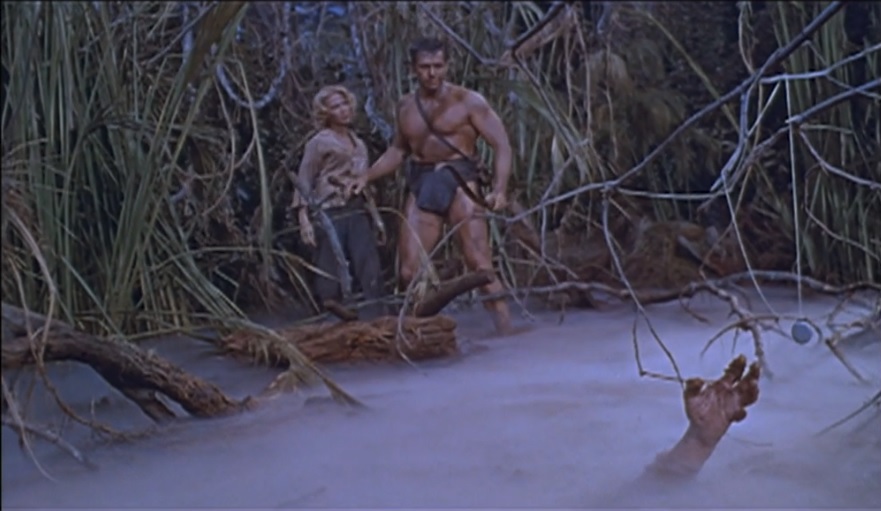
Tarzan's Greatest Adventure (John Guillermin, 1958) A rather ludicrous film that still has its fascinations as a Saturday afternoon programmer, and for its cast (which includes a couple of future Knights of the Realm), its place in the film timeline, and its rather straight-forward take on Edgar Rice Burroughs' John Clayton II, the Viscount Greystoke (a.k.a.): there's no "me Tarzan, you Jane" (there's no "Jane!") pidgining as in earlier Hollywood-based films and he speaks an American-accented English; there's precious little time spent with "Cheeta"—an invention of the films; and there's hardly any mysticism and tribalism to the film to the point where one might question one was in Africa, at all.

Basically, it's about a guy who lives near the jungle, who is renowned by the authorities for his native skills and regard for the normal state of affairs—a sort of glorified park ranger who can swing through trees.

The film begins with a bit of racial effrontery: three white men, posing as black, perform a night-raid on the small village of Mantu, stealing dynamite and leaving the village doctor and a radio operator dead. Before he dies, the radio operator has time to transmit one word: "Slade." The signal must be good, because it alerts the authorities and is heard over the radio by a passing plane piloted by the female lead, Angie (Sara Shane), a pilot and model (naturally).
Tarzan (Gordon Scott) is awakened by jungle drums alerting him that something is wrong in Mantu. Leaving room-mate Cheeta to keep watch on his place, he canoes over to Mantu as the funeral for the slain is taking place. The right proper Colonel Sundley tells him of the night's raid by suspected tribesmen and the presence of root-dye found on the premises. Tarzan "sherlocks" that the raiders were whites disguising themselves as black, and is informed by Angie—model-pilot—that she had heard the name "Slade" over her radio in the night, which clicks with Tarzan—there was a ruthless hunter named Slade who had passed through some time back and, after some snippy badinage with Angie (where he concludes she's just an annoying icky girl), he sets off to look for this "Slade."
"Slade" (Anthony Quayle) is up the river with his gang of uni-named ne'er-do-well's: O'Bannion (Sean Connery), a drunken griper; Dino (Al Mulock), a mulish thug, Kruger (Niall MacGinnis), a German who has all the information for their larcenous quest; and Toni (Scilla Gabel) because a trip up a stifling African river with a bunch of sweating mobsters is such an attractive adventure. Their quest is to find an abandoned diamond mine and the initial raid on Mantu was to get the dynamite necessary to blow the diamonds out of the mine. Sounds stable. It may be the only thing stable on the entire boat—everybody bitches and bickers and they may do themselves in before Tarzan can find them.
Tarzan has his own issues making his way paddling a canoe in pursuit. It seems this "Angie" is also in pursuit in her small plane and manages to crash it before she can get far enough to give away Tarzan's position to the thieves. But, she's not exactly "jungle-ready"—barely avoiding a crocodile exiting her craft—so besides taking on a gang of cut-throats, he has to have the woman as an albatross along the way. Being a "one-ape-man" kind of job, this leaves Tarzan a little miffed.
But, if Angie can't cope with the jungle, neither can the thieves; before Tarzan can even get close to them, the conditions start making life worse for the crooks—the boat develops trouble, and crooks start losing their numbers one by one by the many dangers in the brush. By the time Tarzan can form an assault—by bow and arrow—the odds are increasingly in his favor.
The thing is as pulpy as they come, appropriate given the author. Most of the animals are stock-footage and rarely share a frame of film with the actors. The dialog is the kind that is sledgehammer-subtle, and the male chauvinism is very prominent as the males couldn't be more condescending in their attitude. Scott's Tarzan is serviceable in an American Hero kind of way, and one wonders where he gets his hair-cut out there in the wild, not to mention how smooth-shaven he is. Of course, the acting honors go to the crooks—specifically, Connery doing the loutish acting he was specializing in the 1950's and Quayle, whose Slade is such a psycho snake that you actually think that he might be a challenge for the King of the Jungle.
There's just enough violence to be "that" side of creepy—even though everyone dies in a nicely secure studio setting, and most of the mutilation is suggestively out-of-frame. Guillermin manages to make the movie move quickly and sometimes interestingly, but is never in any danger of being more than a jungle adventure designed for not quite discriminating adolescent caucasian males.

And for fans of Quayle and Connery. Guilty as charged. 
It's also, no doubt, the "whitest" movie ever centered around Africa.