Saturday is "Take Out the Trash" Day.
Tarzan's Greatest Adventure (John Guillermin, 1958) A rather ludicrous film that still has its fascinations as a Saturday afternoon programmer, and for its cast (which includes a couple of future Knights of the Realm), its place in the film timeline, and its rather straight-forward take on Edgar Rice Burroughs' John Clayton II, the Viscount Greystoke (a.k.a.): there's no "me Tarzan, you Jane" (there's no "Jane!") pidgining as in earlier Hollywood-based films and he speaks an American-accented English; there's precious little time spent with "Cheeta"—an invention of the films; and there's hardly any mysticism and tribalism to the film to the point where one might question one was in Africa, at all.
Basically, it's about a guy who lives near the jungle, who is renowned by the authorities for his native skills and regard for the normal state of affairs—a sort of glorified park ranger who can swing through trees.
The film begins with a bit of racial effrontery: three white men, posing as black, perform a night-raid on the small village of Mantu, stealing dynamite and leaving the village doctor and a radio operator dead. Before he dies, the radio operator has time to transmit one word: "Slade." The signal must be good, because it alerts the authorities and is heard over the radio by a passing plane piloted by the female lead, Angie (Sara Shane), a pilot and model (naturally).

Tarzan (Gordon Scott) is awakened by jungle drums alerting him that something is wrong in Mantu. Leaving room-mate Cheeta to keep watch on his place, he canoes over to Mantu as the funeral for the slain is taking place. The right proper Colonel Sundley tells him of the night's raid by suspected tribesmen and the presence of root-dye found on the premises. Tarzan "sherlocks" that the raiders were whites disguising themselves as black, and is informed by Angie—model-pilot—that she had heard the name "Slade" over her radio in the night, which clicks with Tarzan—there was a ruthless hunter named Slade who had passed through some time back and, after some snippy badinage with Angie (where he concludes she's just an annoying icky girl), he sets off to look for this "Slade."

"Slade" (Anthony Quayle) is up the river with his gang of uni-named ne'er-do-well's: O'Bannion (Sean Connery), a drunken griper; Dino (Al Mulock), a mulish thug, Kruger (Niall MacGinnis), a German who has all the information for their larcenous quest; and Toni (Scilla Gabel) because a trip up a stifling African river with a bunch of sweating mobsters is such an attractive adventure. Their quest is to find an abandoned diamond mine and the initial raid on Mantu was to get the dynamite necessary to blow the diamonds out of the mine. Sounds stable. It may be the only thing stable on the entire boat—everybody bitches and bickers and they may do themselves in before Tarzan can find them.

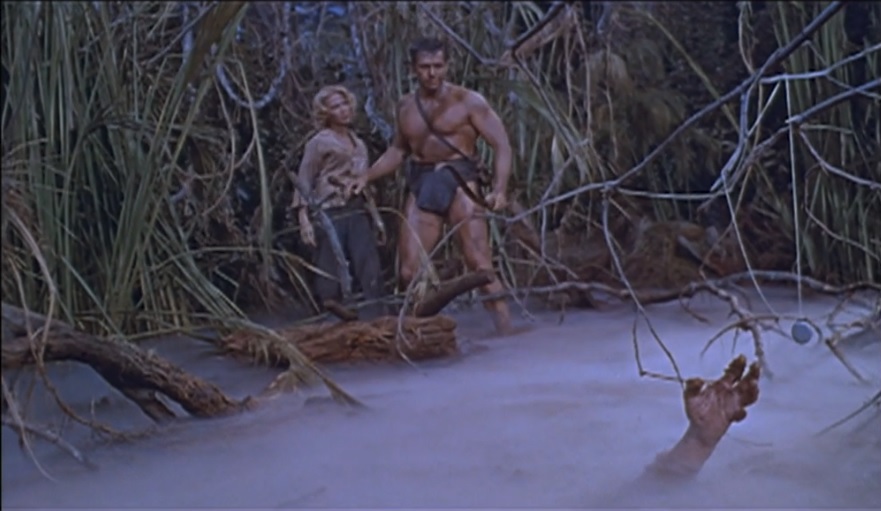
Tarzan has his own issues making his way paddling a canoe in pursuit. It seems this "Angie" is also in pursuit in her small plane and manages to crash it before she can get far enough to give away Tarzan's position to the thieves. But, she's not exactly "jungle-ready"—barely avoiding a crocodile exiting her craft—so besides taking on a gang of cut-throats, he has to have the woman as an albatross along the way. Being a "one-ape-man" kind of job, this leaves Tarzan a little miffed.
But, if Angie can't cope with the jungle, neither can the thieves; before Tarzan can even get close to them, the conditions start making life worse for the crooks—the boat develops trouble, and crooks start losing their numbers one by one by the many dangers in the brush. By the time Tarzan can form an assault—by bow and arrow—the odds are increasingly in his favor.

The thing is as pulpy as they come, appropriate given the author. Most of the animals are stock-footage and rarely share a frame of film with the actors. The dialog is the kind that is sledgehammer-subtle, and the male chauvinism is very prominent as the males couldn't be more condescending in their attitude. Scott's Tarzan is serviceable in an American Hero kind of way, and one wonders where he gets his hair-cut out there in the wild, not to mention how smooth-shaven he is. Of course, the acting honors go to the crooks—specifically, Connery doing the loutish acting he was specializing in the 1950's and Quayle, whose Slade is such a psycho snake that you actually think that he might be a challenge for the King of the Jungle.

There's just enough violence to be "that" side of creepy—even though everyone dies in a nicely secure studio setting, and most of the mutilation is suggestively out-of-frame. Guillermin manages to make the movie move quickly and sometimes interestingly, but is never in any danger of being more than a jungle adventure designed for not quite discriminating adolescent caucasian males.
And for fans of Quayle and Connery. Guilty as charged.
It's also, no doubt, the "whitest" movie ever centered around Africa.


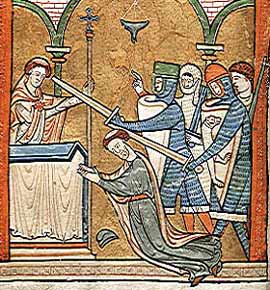
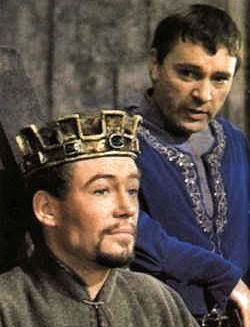
 This turn of events—and character—does not sit well with the "perennially adolescent" first Plantagenet King, and in a drunken rage shouts, "Can no one rid me of this meddlesome priest?" and he has barons who are perfectly willing to take on the job. Becket, in death, becomes a folk-hero to the Saxons, and Henry, in his remorse, and for political expediency, has himself flogged and petitions for Becket's sainthood.