Showing posts with label Audrey Hepburn. Show all posts

Wednesday, June 5, 2024

They All Laughed (1981)

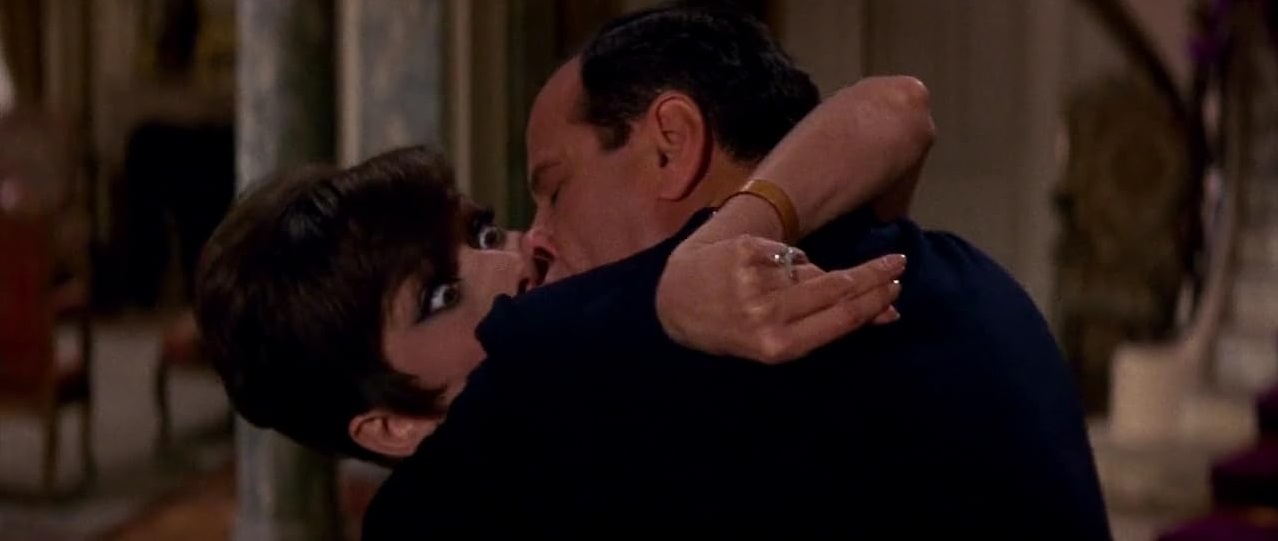
They All Laughed (Peter Bogdanovich, 1981) There's something sweet and low-down about Peter Bogdanovich's They All Laughed, a mid-summer night's urban romance-a-thon set to country music in the heart of New York City. Part detective story, part romance, part Altman-esque roundelay, part screwball comedy, it's another of those Bogdanovich love-letters to the style of old movies that reflected life through a rose-colored filter. 


It isn't life as it is, or life as it should be, but life as you'd want it to be, suffused with the pangs and dangers that new love energizes into life and makes it crisp. New York has never looked better, because it's seen through the eyes of a hopeless romantic—all of the excitement with none of the hassles. Would that the same were true of the various trysts and liaisons zipping through the movie.

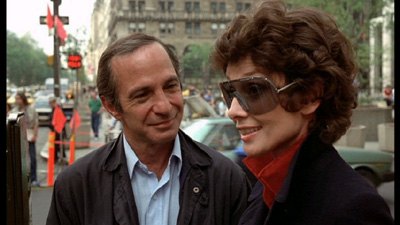
They All Laughed also has a fresh feel to it, with a mix of movie veterans and spry new-comers (and some of the production crew) all intermingling and bringing some zing to the proceedings. Ben Gazzara proves himself the best heir to Bogart for portraying tough guys with a tarnished heart of gold, and Audrey Hepburn is indescribably Audrey Hepburn, coquettishness shimmering through the worry-lines of experience. John Ritter fulfills the promise of a leading man capable of grace and ungraceful slapstick that was only hinted at in the leering farce of "Three's Company." Then there's the trio of model-actresses in various stages of crossing that dash--Colleen Camp, Patti Hansen, and the doomed Dorothy Stratten. Of the production staff, Blaine Novak, the film's co-screenwriter makes for an entertaining odd-ball/voice of reason, and producer George Morfogen plays, appropriately, a harried boss.
Gazzara, Ritter and Novak are all investigators for a Big Apple detective agency, and the first two are sent to trail two supposedly errant wives in the city, and before you can sing "
Laura is the face in the misty light," the stalking has turned to love...completely the opposite from what you'd expect in New York City.
Put aside the on-set intrigues and backstage stories, They All Laughed is a sweet-spirited romp. The country-western music dates it a bit, and a sad nostalgia permeates it now. But it's one of the best of Peter Bogdanovich's productions that doesn't retreat into the past to garner its good graces. And with his mixed cast of professionally-minded veterans and star-crossed amateurs, he probably felt more freedom working on this film than three of his previous elephantine-proportioned ones (Daisy Miller, At Long Last Love and Nickelodeon). Certainly with his guerrilla crew (working without permits) led by Wim Wenders DP Robby Müller, the film has the energy and snap of what one would consider an indie hit these days. But in 1981, critics and industry folk had the knives out for Bogdanovich, making this an overlooked gem—a true labor of love in a medium that held a lot of heart-break for the director.
The View from 2024: I was surprised that I hadn't moved over my review of They All Laughed from the old web-site to the new one. My memory of the movie is still fresh—and my memory of writing the review is fresh, as well—that it still feels like it was yesterday.

I remember taking anybody I could think of to see it—it was playing at The Egyptian Theater in Seattle—in an exclusive run from a print owned by Bogdanovich (the movie had a less-than-good distribution deal and Bogdanovich, still grieving over the death of Dorothy Stratten, bought back the film and determined to distribute it himself, a move that bankrupted him).

It was good enough to be a hit, but the director had that trio of earlier failures and had become box-office poison. He'd made a slight critical comeback with Saint Jack—which also starred Gazzara—which was executive produced by Roger Corman, Bogdanovich's old boss at AIP...and Hugh Hefner of Playboy magazine. It was through Hefner that Bogdanovich met Dorothy Stratten...and everything fell apart.

They All Laughed didn't make money, but over time, it has become a cult favorite, its caché increasing over the years, now it's championed by Wes Anderson, Quentin Tarantino, and Noah Baumbach. For the rest of his career, when he had the chance, Bogdanovich kept trying to recreate the magic of They All LaughedIllegally Yours, The Thing Called Love, and She's Funny That Way—they all have their charms, but never recreated what he had in that film.

Friday, May 10, 2024

How to Steal a Million

How to Steal a Million (William Wyler, 1966) Writer Harry Kurnitz (who the story for Hatari!, the novel for A Shot in the Dark, and the screenwriter for Witness for the Prosecution and a couple entries of the "Thin Man" series) could be counted on to deliver a solid story that never really amounted to what it promised...that is, other than to entertain and entertain mightily. Especially if all the elements were in place—good photography, cracker-jack actors, an ornate location or two. He didn't write important pictures. He wrote fluff. Good fluff. That would satisfy audiences, and make critics suspicious that they were being conned.

The story goes that director William Wyler, after directing Audrey Hepburn to an Oscar for Roman Holiday, wanted to re-team her with co-star Gregory Peck for another rompish movie, this time set in Paris. In the forseeable future, however, Hepburn and Wyler worked on The Children's Hour together, Wyler had directed a little film called Ben-Hur, and Peck had won his Oscar for To Kill a Mockingbird. Somehow, the elements wouldn't gel until Wyler put together Hepburn and Peter O'Toole—who was toiling in an endless stream of drama parts, and was probably attracted to the idea of something lighter for a change.
What the fuss is all about...
The story concerns one Charles Bonnet (Hugh Griffith), whose French estate contains some of the world's most renowned art treasures, and who, also, maybe coincidentally, is also one of the world's most unknown art forgers. His daughter Nicole (Hepburn, all Givenchy'd up and no place to go—O'Toole's character makes a crack about it later in the movie) is constantly worried that Dad is going to go too far some day and the Paris gendarmes will come knocking at their door and the family's wealth and reputation will be as worthless as one of Daddy's forgeries.
Wyler, exploiting the film's wide-screen presentation,
must really love that staircase.
So, imagine her dismay when guards, police and armored cars come to the drive-way. Charles assures her that he is merely lending one of his collection, "The Cellini Venus", to the Kléber-Lafayette Museum* for display and the heavy armory is for safe passage. Except for one tiny detail—that "Cellini Venus" is a forgery, too, sculpted by Charles' father and the model for it being his mother. What's more, it is probably more susceptible to being realized as a forgery than one of the family's many paintings. Her father is not worried, and the small Venus is whisked away for display. Nicole is not so reassured.
It doesn't help that while father Charles attends a celebratory soiree at the museum, Nicole** must confront a burglar, one Simon Dermott (O'Toole), caught in the act of examining one of the Bonnet Van Gogh's. In a tuxedo, he's exceptionally well-dressed for burgling, a move no doubt inspired by Charles' absence for the night. But, he's charming enough to be able to disarm the situation, although she does manage to ruin the line of sight by accidentally shooting him in the arm. "Oh, it's just a flesh wound" Nicole scolds. "But it's MY flesh!" he retorts.
Nicole should be worried. Dermott is something of a fraud himself. Plus, the Bonnet household is being circled by art dealer DeSolnay (Charles Boyer), who has decided to look into the Bonnet provenance and have it investigated. And a rather eccentrically driven American wheeler-dealer (Eli Wallach) wants to obtain the "Venus" by any means necessary—including marrying Nicole. 
And then, there's the major complication: insurance. Charles Bonnet is not worried about the Venus being determined a forgery, as he is merely loaning it out and it need not be examined for authenticity. He thought. But, as the museum has to insure the statue from theft, it must go through the formality of a "technical examination, which will expose the fakery. Bonnet has already signed the papers, inadvertently giving the Museum permission to its study, so surely that will expose the family.
Nicole then decides—mad-cap that she is—to hire Demott (the only burglar she knows) to steal the statue before it can be found out. It takes about an hour of cute dialogue, spry encounters, several costume changes and that nearly lethal incident of "meet-cute" before we get there. The rest of the movie documents the long, drawn-out robbery which relies on false alarms—and we see all of them.
There is magnetism involved among the principal actors—Hepburn pirouettes in her own spotlight, and O'Toole observes, amused. Wyler, on the other hand, is content to make sure we see how expansive the sets are, like he was still filming Ben-Hur. Those sets, however, never seem more than nattily-dressed cavernous sound-stages (his next film would be the equally ornate Funny Girl). How to Steal a Million is a trifle, with all the consistency of just-applied meringue, and with as much confectioner's sugar.
One interesting thing to ponder is what might have been. For the role Wallach eventually played, Walter Mathau (who was in Hepburn's Charade and starred on Broadway in Kurnitz's "A Shot in the Dark" was approached but wanted too much money. Cast instead was George C. Scott, who, unfortunately, turned up late for his first day of shooting...like, after lunch. Wyler, who was already worried that O'Toole and Griffith, two notorious drinkers, were in danger of derailing the project, would not abide such behavior in a third, and promptly fired Scott, which, apparently, greatly upset Hepburn.
 
One can only imagine...
Face it. Whatever the plot, this is what audiences wanted to see.
 
* It's fictional, but then so is The Cellini Venus...

** Interestingly, she is again caught in her bed reading a book involving Alfred Hitchcock (as was also the case in Roman Holiday). I don't know if this was a nod to his fellow director by Wyler, or if Hepburn was attempting to court Hitch to appear in one of his films (although the film Charade is considered the next best thing), but the two never collaborated. Maybe because Hepburn would not have let Hitchcock decide what she wore.

Friday, March 8, 2024

Roman Holiday

Roman Holiday
(
William Wyler, 1953) The legend has it that when Gregory Peck returned from filming Roman Holiday with Audrey Hepburn on location in Rome, he advised someone at Paramount that they might have to change the billing and put her name above the title—"that girl's going to win an Academy Award!"
But, getting to that point was a long, involved road. It originated with Dalton Trumbo, who, following a year-long stint in prison for contempt of Congress for not "naming names" to the House Un-American Activities Committee, was living in Mexico City. He was in financial straits, not being able to sell scripts to Hollywood—who'd provided a good income to him since 1935—owing to being "blacklisted" by the industry. He still wrote, producing 10 screenplays, and forwarded them to "fronts" who would sell the ideas to the studios for a cut of the proceeds. Trumbo's reverse-Cinderella story, Roman Holiday, was sold to Frank Capra's Liberty Films by one such front, Ian McLellan Hunter for $50,000 (all of which he paid to Trumbo), and Hunter was hired by the studio to work on the script.
 
The first director attached to it was Frank Capra himself, who wanted Cary Grant and Elizabeth Taylor for the parts of the deceptive reporter and princess, respectively. Taylor was unavailable and Grant, after reading the script, decided his part would be overshadowed by the part of the princess. Capra left the project when his budget demands would not be met, and he sold the script back to Paramount.
George Stevens was briefly attached, but it ended up with director William Wyler, who had some stipulations: a larger budget, Jean Simmons and Cary Grant to star, and filming to be done totally in Rome. Grant—again—wouldn't do it and Simmons was under contract to RKO and its owner Howard Hughes wouldn't loan her out except for a sizable fee. So, Wyler opted to cut his losses—he insisted on filming in Rome (and Paramount had some frozen funds that could be utilized and Rome's studio Cinecittà was back up and running). Gregory Peck—who was looking for lighter roles than he was being offered—was signed (although he, too, was worried about being overshadowed by the female lead), and Wyler decided to look for an unknown actress, which is when he heard about a new European actress, who was doing theater in small parts in movies.

 
Wyler left instructions to keep the camera rolling after the screen test—so the story goes—and the young actress was asked questions about her background, including her time growing up in Belgium during World War II. Everyone who saw the test was charmed by it. Hepburn got the role. But, first, she had a commitment to a Broadway role starring in "Gigi"—she had been picked by Collette herself for the role—and as Peck was held up in over-runs shooting The Snows of Kilimanjaro, the production was delayed.

In the meantime, many writers' hands worked on Roman Holiday besides Hunter, including Ben Hecht, Preston Sturges, Valentine Davies, and—when in Rome—John Dighton, who was there to punch up scenes whenever a location found by Wyler would peak his interest. Cast and crew were not afraid to make changes or make suggestions.
The film begins with a Paramount Newsreel examining Princess Ann (Hepburn) from "one of Europe's oldest ruling families" (although they never mention of what country
*) on a tour to "improve trade relations" and although she projects a serene calmness publicly she's starting to crack. She's 19, royally supervised and expected to amiably meet and greet hundreds of dignitaries, all of whom seem to belie the term. And although this is a reverse-Cinderella story, she does have one thing in common with her fairy-tale predecessor—she has shoe problems. There's only so much time you can spend standing in the damn things! Plus, although she is touring Europe, she sees very little of it, cloistered in luxurious quarters with her only bed-time reading her full itinerary for the next day. And yet outside her window, life is happening, people are partying and enjoying life. And Rome, even though it's the Eternal City, can't wait forever.
 
She melts down. to the point where she has to be sedated to get some sleep so she can keep up the busy tour. And maybe it's the sleep-drug talking, but the princess gets it in her crowned head to escape her gilded dignitary's cage and go out into the night, un-escorted, unchaperoned, and unceremoniously. Where Cinderella wanted to see how the other 2% lived, Ann wants the 98% of possibility the world just within her regal wave can offer. She sneaks out of her embassy and finds her way into town.
And then, the sedative kicks in. 
 
Lucky for her, Joe Bradley (Peck), a reporter for a Rome-based wire service is late coming home from an evening poker game among colleagues and happens upon her. Thinking her drunk, he tries to get her on her feet, then pours her into a cab and, with no place else to put her, takes her to his apartment ("Is this the elevator?" she bleerily asks when they get there) to sleep it off. There is some chaste teasing about sleeping arrangements that ends up with Bradley being late for his day's assignment—an interview with Princess Ann—only to discover...she's been sleeping in his bed. And suddenly he concocts a scheme to get a big story, given his special "access."
Her government has put out a cover story to explain her mysterious disappearance has had to cancel all activities due to a "sudden illness"...so Joe makes a bet with his boss that he can get an exclusive with the princess. All well and not exactly good. A lot of subterfuge has to be done to get that story. The princess wants to have her adventure but not let on that she's at any way royal. Joe conspires to get his story without letting on that he's a reporter—and he wants pictures, which he gets with the third wheel of the adventure, bohemian photographer Irving Radovich (an ebullient and funny 
Eddie Albert), who is constantly taking photographs with camera concealed in a lighter.
The production was, basically, a working holiday for cast and crew, and the incidents on the princess' "day off" center on aspects and sights of an elaborate tour of Rome with the Colosseum, the Trevi Fountain, the Spanish Steps, with stops for gelato, vespa-hopping, dinner and dancing and, ironically, "the Mouth of Truth" which might prove to be daunting to two people who spend the day under false identities.
Peck has rarely been allowed to be this light—and he's surprisingly subtle and slyly humorous playing a roguish Prince Charming, and Hepburn is perpetually adorable as a princess with the crown off. As Pauline Kael remarked "when she smiles, we're all goners," but leavened somewhat by eyes that always have a shade of melancholy—her wartime childhood probably had something to do with that—and it comes in handy for her scenes as a princess trying to escape the weight of her heritage while knowing that she'll never be able to get away with it...or from it.
Just as Cinderella had to return from the ball and back to the ashes, Princess Ann's fantasy has to come to an end and she must return to her origins. But, Cinderella got to have a happy ending. For Princess Ann, no ending can be completely happy. But, Roman Holiday does, at least, provide a modicum of satisfaction where the lies fall away along with the fantasies. If someone can only acknowledge the truth...however painful it might be...one can at least admit that they're being true...to themself.
 
And that's the lovely thing about Trumbo's story. It's not a sad ending (although not a happy one), but there is a level of satisfaction in the warm glow of memory, free of fairy tales, despite all the pomp and circumstances getting in the way. And the memory of Roman Holiday always brings an admiring smile to my face.
Dalton Trumbo was finally acknowledged to have written the story that won the 1953 Academy Award and in 1993 an Oscar was given to his widow. Trumbo died in 1976. 
"...She has us all in thrall, and when she smiles we're all goners."
Pauline Kael

* The film never says, but one can assume that it isn't any of the stops on the tour which include London, Amsterdam, Paris or Rome. Although I did find an example of a script excerpt, which names the country as "Coravia" (wherever that is).


Tuesday, February 13, 2024

Love in the Afternoon (1957)

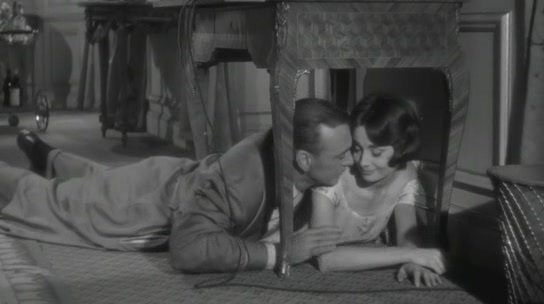
Love in the Afternoon (Billy Wilder, 1957) Light Billy Wilder film from the effervescent days when he was directing Audrey Hepburn at the start of her career.

This one had me smiling immediately with Maurice Chevalier's opening narration—"Zis is the city, Paris France"—echoing Jack Webb's "Dragnet" opening. Chevalier plays a private detective, Claude Chavasse, specializing in "matrimonial work," and lately the case-work has been dominated by one subject, American millionaire Frank Flannagan (Gary Cooper), who is cutting a wide swath through the world's female population, both married and unmarried divisions. The work has turned Chavasse into a cynic about the paths of love—he's gumshoed too many of them—in marked contrast to his daughter, Ariane (Hepburn), a cello player (hold that image in your head for a moment), still wide-eyed at the prospect of romance, and fascinated with her father's work, something he does his utmost to discourage.
When she gets wind that a cuckolded husband (John McGiver, hyperventilating amusingly in fine comic fashion) plans on breaking in on his wife's tryst to ventilate Flannagan, she steps in from the balcony to insert herself into the situation. This leads inevitably (in the movies, at least) to an affair between the elder lothario and the young ingenue, one that she manipulates by trying to talk a competitive game in conquests. The situation is ripe with comic possibilities, which Wilder exploits every chance he gets, even using Flannagan's moving musical accompaniment (the final assault is preceded by a four piece rendition of "Fascination").

Much has been made of Cooper's age in the film, and it is an issue. Cary Grant was supposed to be Flannagan (Wilder had been trying to entice Grant into one of his films for years) but when a deal wasn't reached,
* Cooper, who at 56 was Grant's senior by three years, was hired. Cooper is an odd fit, as opposed to younger men like, say, Gregory Peck (as in Roman Holiday) or William Holden (in Sabrina), but Wilder works around it, initially, keeping Coop' in shadow to emphasize his "mystery man" status, and Cooper's early performance is, interestingly, boyish and somewhat immature.

And that's the point. Flannagan is a man-child, used to getting everything he wants. And Ariane has her choice between younger men—immature and unsophisticated—and Flannagan—sophisticated but immature. All it takes for him to grow up is a level of commitment, something he's avoided his whole life by having a train to catch. Both character arcs feel complete and satisfying, even though it is the "7-10 split" of May-December romances, and one feels a little creepy watching them make out.
And a little guilty, in the same way that it was tough to watch the denouement of Wilder's Sabrina. Okay, it's charming that she likes the old guy, but if he really was thinking this through, with all this new-found maturity, wouldn't he be thinking about her, and what she has to look forward to in a life with him (which can be summed up in one word..."short")?
And then, one considers Wilder, and the blithe, darkly cavalier sensibility that he brought to the movies, moral though his stand-point might be. One can imagine Wilder, the guy who ended Some Like It Hot with "Nobody's perfect," with a similar tag for this movie: "Aren't you concerned about the age difference?"  "If she dies, she dies..."
 At this point, Grant was getting concerned about his age and being paired with young actresses ("robbing the cradle, again" is how James Stewart summarized the situation late in his career), but his misgivings must have subsided enough to co-star with Hepburn in Charade for Stanley Donen six years later.

Thursday, May 20, 2021

My Fair Lady: Much Ado About Doolittle

My Fair Lady (George Cukor, 1964)

One day I'll be famous, I'll be proper and prim 
Go to Saint James so often I will call it Saint Jim 
One evening the king will say Oh Liza, old thing, 
I want all of England your praises to sing 
Next week, on the twentieth of May 
I'll proclaim Liza Doolittle day 
All the people will celebrate the glory of you 
And whatever you wish and want I gladly will do 
Thanks a lot, King says I in a manner well-bred 
But all I want is Henry Higgins 'ead
"Just You Wait, Henry Higgins"

'Tis the 20th of May, and I have come here to argue the future of Ms. Eliza Doolittle. Just the fact that I use that title no doubt betrays my feelings on the matter. 

The movie that studio mogul Jack Warner made of the Lerner and Lowe musical version of "Pygmalion" is a faithful adaptation of the famous Broadway hit (although I find it—despite the many joys of Cukor playing up the fantasy, but making the film immaculately stage-bound—rather elephantine, looking (ironically) at any nearby time-piece around the "Get Me To the Church On Time" number. And the musical is a faithful adaptation of the 1938 film version of Pygmalion, starring Wendy Hiller and Leslie Howard, the screenplay of which is credited to Bernard Shaw*, who wrote the original play. It's a bit more faithful to that movie than the play itself, given the note on which the author ended it.
You know the story: based of the Greek myth of Pygmalion—a sculptor who fell in love with a statue of his making—"Pygmalion"/My Fair Lady tells the story of an academic of grammar, who attempts to turn a cockney flower-girl into a lady of manners, able to pass the scrutiny of the upper-class. The "expert dialectician and grammarian", Prof. Henry Higgins, espouses a belief that the class system is a charade, a veil or pretense in society that is, with the proper dialect and appropriate apparel that can be exposed as a mere veneer. The secret is that Higgins is so comfortable in his own place in society that he can act like a lout and not be considered base.
Higgins is also a misogynist, which makes his taking on the transformation of flower-girl Eliza Doolittle a task that makes him susceptible to transmogrifying his role as teacher/mentor/task-master to possessiveness and coveting her, and then taking umbrage when her transformation emboldens her independent spirit. Once you're used to be the upper-hand of uneven power dynamic, any change will feel like a sacrifice. He will always see her as a creature of the gutter—and never let her forget it—even while he has fallen in love with his creation. Never mind that her soul is of her own making and not his, and she is an individual with her own thinking, her own wishes and dreams, far removed from that of her manipulator.** In Higgins' mind, a student should always be subservient.
Shaw understood that. He took umbrage with producers and directors who would change his play's ending—Eliza chooses a life of independence and walks out on Higgins—and impose a "happy ending" where Eliza comes back to the professor, to supposedly live a life of dependence. Most gallingly, Higgins reacts to this (in the 1938 presentation and the musical) with the line "Eliza, where the devil are my slippers?" It's a knife in the back of an already appalling scene.
Shaw added a post-script to his play, entitled "What Happened Afterwards" in which he argues that, despite the apparent need to sustain the relationship between the two lead characters, it runs counter to his intent of the play (and the inspiration for it). Still, when the 1938 film was made, the producers plopped a five second shot of Eliza, present in the room, returned like an obedient pet, and the musical-makers took their cue from it.

It is so wrong. The triumph of Eliza Doolittle is her own, merely proctored by the professor. Why should she come back, when the musical numbers make their mutual antipathy so clear? Eliza, at one point, imagines overseeing Higgins' demise ("Just You Wait, Henry Higgins") and towards the end calls him out on his narcissism and egotism ("Without You"—"so go back in your shell, I can do bloody well...").
In My Fair Lady, Higgins is given the final number, expressing his feelings for Eliza, both pro and con ("I've Grown Accustomed to Her Face"—really, is that the best you can do?) as he vacillates between his own fantasies of the disastrous consequences of her leaving him and his own measured longing for her. This is not a match made in heaven...even if it sells in the box office.

In recent years, there have been experiments—Bartlett Sher's revival had Eliza return, Higgins delivers his "slippers" line, and then Eliza exits the stage through the audience. Okay, if you want to remain true to the text and the spirit of the film. But, better to be true to Shaw. Instead, have Higgins crawl back to his shell of a study, play his gramophone of Eliza's voice ("I washed me face and hands before I came, I did...") and have him say the line "Eliza, where the devil are my slippers" to empty air, leaving him true to his nature, for all the bloody good it does him. 

Give him his scene, his song, his recordings and his memory and leave him with that. And his illusions.

It may be a tragedy for him. But, it's a triumph for Eliza.
* Also credited are Cecil Lewis, Ian Dalrymple, and W.P. Lipscomb, who all won that year's Oscar for Best Writing (Adapted Screenplay). Shaw added the ballroom scene with Karpathy and added montages of the training (which were directed and edited by a young David Lean).

** If you're looking for a comparable theme in the movies, Vertigo springs immediately to mind, as well as the tendency of its director, Alfred Hitchcock, to transform his actresses into his image of perfection, and then treat them—particularly "Tippi" Hedren—abominably, when they didn't acquiesce to his needs.
I'll use any excuse to show Bob Peak's poster-art

Thursday, May 17, 2018

Robin and Marian (1976)

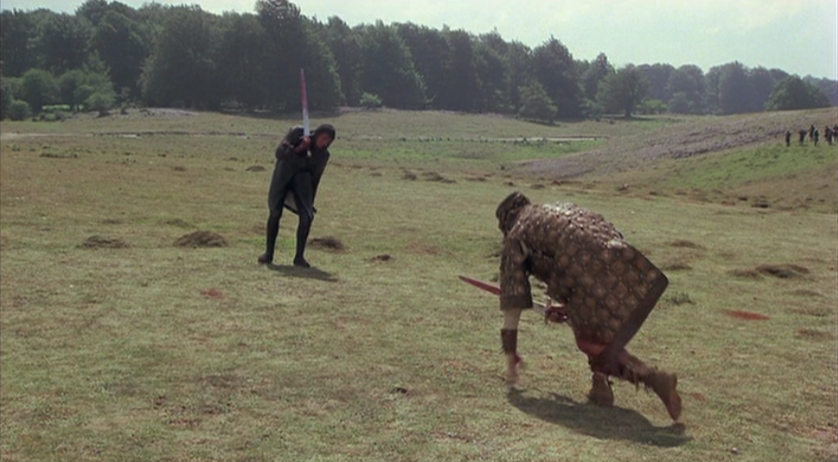
Robin and Marian (Richard Lester1976) On paper, it looks perfect. The author of The Lion In Winter jumping a few years ahead in the story to tell of the end of Richard the Lionheart's bloody Crusades, and the return of Robin Hood and the loyal Little John to Sherwood Forest, where they find a lot has changed. Directing would be Richard Lester, who had returned to A-list prominence with his extraordinary staging of The Three Musketeers/The Four Musketeers. He was becoming the "go-to" guy for period dramas, finding ways to bring a mature light-heartedness to any dreary point in history (or more appropriately, he would ignore Hollywood sound-stage pretense and show historical periods a bit more accurately--for example, his fly-filled Rome in the otherwise schtick-filled A Funny Thing Happened On the Way to the Forum). In the years since, his successes had been spotty: Juggernaut, his all-star take on the disaster film, sank at the box-office (never mind--watch it!), as did his dream-project Royal Flash bringing his "Musketeers" adapter George MacDonald Fraser's character to the big screen.
But Robin and Marian had that Goldman script (unfortunately, Goldman's other produced screenplay They Might Be Giants, although good for naming rock bands, also failed at the box-office despite the star-power of a post-Patton George C. Scott and Joanne Woodward) and a dream-cast. Goldman wanted Nicol Williamson as Robin and maybe Sean Connery as Little John. Lester got them, but reversed the roles, which Goldman had to admit, worked. Robert Shaw would re-unite with his From Russia With Love co-star (and golfing partner) as the Sheriff of Nottingham. Richard Harris would play King Richard, Denholm Elliott and Ronnie Barker (of "The Two Ronnies") would be Merry Men. Ian Holm would appear as the weasley King John. But, with the role of Maid Marian, they hit the mother-lode: after nearly a decade off the screen, producer Ray Stark coaxed Audrey Hepburn to play the older, wiser lost love of Robin Hood.
Filming was done in Spain (Lester's old haunt from Musketeers and A Funny Thing Happened On the Way to the Forum) and completed quickly--Lester's a "one-take" kind of director which always appealed to Connery.
Then things started to go wrong.The script by Goldman is charming, but often relies, as did The Lion in Winter on piquant anachronisms--the kind of "Isn't that funny? They talk like we do!" approach to historical drama that can be a bit cloying. "You never wrote!" complains Maid Marian at one point in the script about Robin Hood's many years away. "I don't know how!" says Robin in perplexed reply. But there are some nice things--the over-all theme of living past your prime or need, combined with Robin's nostalgia for the old days and his childish belief that he can make things right again on all fronts. 
There are some nice little cliche-bashings. I remember a couple of cut-away shots of Nicol Williamson's Little John looking pained at Robin and Marian expressing affection for each other, and thinking, "Oh Lord, they're going to make Little John gay!" which I thought was a pretty cheap way to bring in relevance to the story. But it proves to be a clever gambit. Later in the film when Marian goes to John and begs him to keep Robin out of battle, she makes the same assumption. "You've always been jealous of me! But you had him all those years!" Williamson beautifully underplays this scene "Yer Rob's lady," he mumbles. "What?" she cries. "If ye'd been mine, I'd never've left." and Williamson chucks the apple he was eating into the night where it arcs and disappears. Nice set-up. Nice turn. As is the ending, recreating the myth of Robin firing one last arrow through the window, telling John to bury Marian and he where it lands. In Lester's last shot, it never falls to earth.
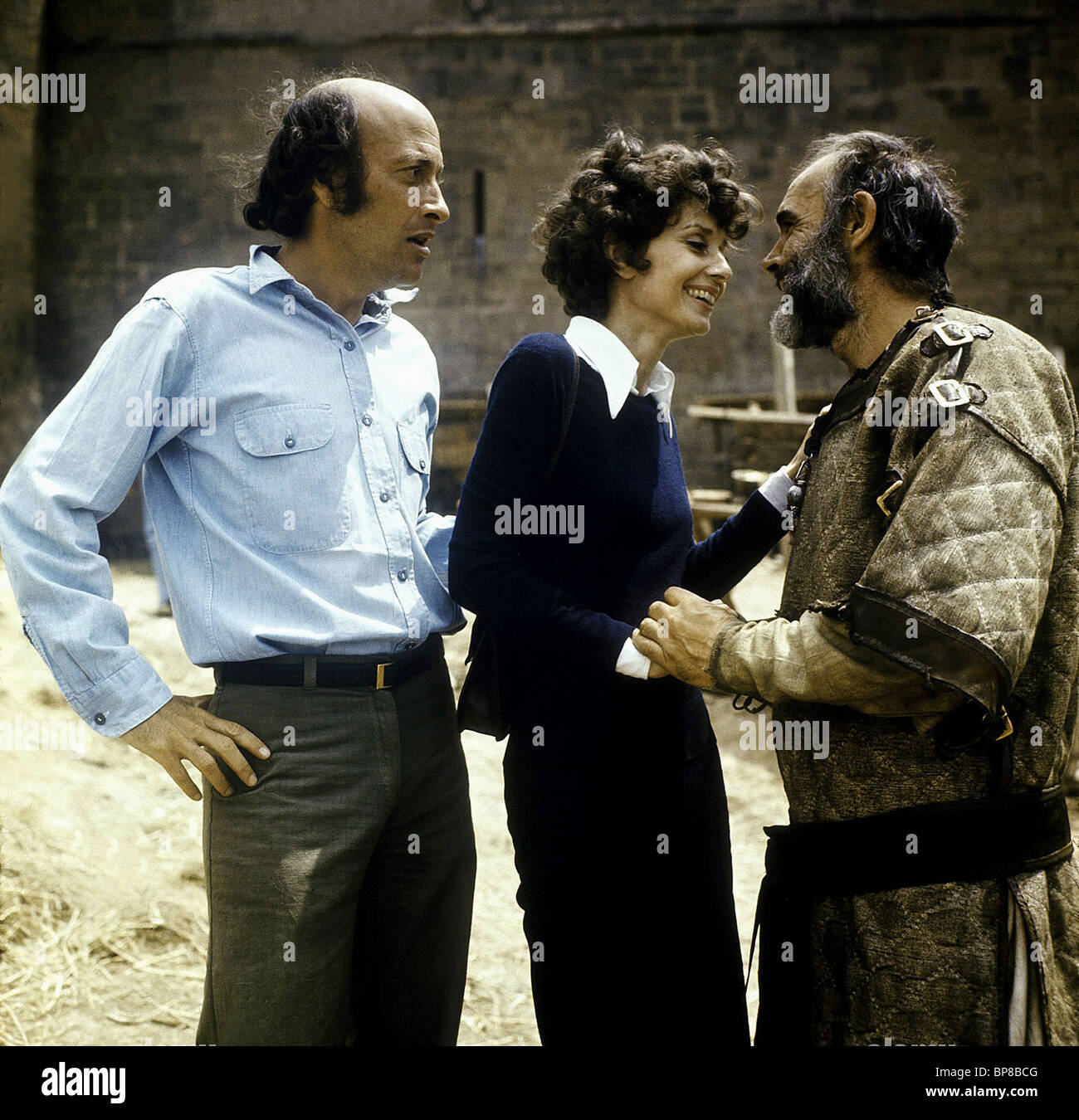
The charm of the script no doubt appealed to Hepburn--she has a speech at the end that most actresses would kill for, though, practically, it slows the film to a crawl at a very critical time. There are publicity pictures of Lester and Connery showing her around the set, but Hepburn, given Lester's directorial approach of "You act, I'll shoot" might have been a bit put off by his quick approach and lack of hand-holding. 
She made complaints about some of the gristlier aspects to Lester's cut, particularly to his opening the film with a shot of ripe fruit, and ending it, with the fruit rotting in the sun. This is a brilliant way to express an aspect of the story--that Robin, and Marian too, have overstayed their usefulness. And the film is gritty. The staging of an opening scene in a burned-out desert fortress feels more like everybody's waiting for Godot rather than King Richard. And Lester keeps his own anachronisms well-chosen, for example Robin Hood's morning routine--waking up in the forest, stretching, brushing his teeth with a fir branch, and reaching for a good ball-scratch until he sees Marian waking up--Connery's hopping attempt to be nonchalant is priceless. 
And the violence is rough stuff. People die very badly in the film despite the chain-mail and armor, and the wounds they suffer are played up. Lester seemed determined to counter-act any chirpiness in the film by bringing it down to Earth. Maybe this upset Hepburn.
But for whatever reason, producer Ray Stark chose to take control. Initially, Lester employed Michel Legrand, his composer for the Musketeers films, to write a period-appropriate score—Legrand opting, instead, to write something a bit more modern, more mature, which Lester wasn't entirely happy with. Stark, hearing the score, and not having control over much else, replaced it with a quickly put-together (two weeks, reportedly) score by John Barry, who'd worked with Lester before (on The Knack...And How to Get It and Petulia) and whose James Bond scores for Connery were well-known. He also won an Oscar for the music for Goldman's The Lion in WinterBarry's a wonderful composer, but the main-stay of his score is a bucolic love theme that frequently bounces over the scenes and makes them too sweet for a film about the passing of youth and the end of days. It's sounds like it would be more appropriate for a film about frolicsome otters than Robin and Marian. Perhaps Stark thought that would be enough to soothe the blue-haired ladies going to see Audrey Hepburn's first film in a decade. Given her rather cute performance, maybe it would have been a good idea to re-cast her, too. Perhaps she took the role as a chance to get another Oscar (she won in 1954 for Roman Holiday--Katherine Hepburn won for her starring role in The Lion in Winter). She didn't get it. Nor did the blue-hairs show up. The film was not a major hit at the box office.
Having now heard the Legrand score (a bit of which is below), one hears a nice maturity to the score in marked contrast to Barry's. Although it might not be as up-beat, I find it preferable for the film that Lester ultimately made, despite producorial intentions. But we'll never know. Robin and Marian is locked in a bizarre nether-world where it's at once too sweet, but also stark and unsentimental. Lester could make mis-concieved films, but his approach to counter-point Goldman's sentimentality in a world of hardship was a good one. One would have liked to have seen that version of the film.


Compare and Contrast: the same section of film 
scored by Legrand (left) and Barry (right)