I Know Where I'm Going! (Michael Powell/Emeric Pressburger, 1945) Wendy Hiller stars as Joan Webster, a determined woman whose whole life has been planned out and played out according to her own well thought-out scenario. Now, she's traveling to the Scottish Highlands to marry her industrialist fianceé (head of Consolidated Chemical Industries) on the Island of Kiloran. But to get there—and become "Mrs. Consolidated Chemical Industries"—she must book boat passage from the Island of Mull. But Nature and Fate conspire to keep her Mulling and scuttle her schedule, while the cutely eccentric citizens cast a spell all their own.

By all accounts, it should never have been made. Powell and Pressburger were going to make A Matter of Live and Death for the Rank Organization after a request that they make a film that might help cement relationships between the British and Americans. But, the plan was to make A Matter of Life and Death partially in Technicolor (why "partially" is best explained by seeing the movie). But with all the Technicolor cameras being used by the American military for training films, The Archers (the company name of Powell and Pressburger) had to delay filming until they became available.
What to do in the meantime?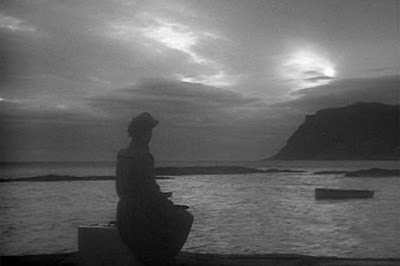 Pressburger knew that Powell loved spending his initial down-time after a movie by going to the Scottish islands and proposed a story about a woman who wanted to make a transit to an island but couldn't and by the time one's available she's made the decision that she no longer wants to go.
 Pressburger wrote the story in a whirlwind four days, and Powell and he fine-tuned over a matter of a couple weeks. Initially to star Deborah Kerr and James Mason, The Archers had to navigate their own troubled waters as Kerr had a contract at M-G-M and couldn't get out of her commitment (either that or Powell and Pressburger didn't have the money—they certainly didn't!—to pay M-G-M to loan her out) and Mason didn't want to spend his days "camping out" with the crew in an out-of-the-way location. Wendy Hiller, whom Powell and Pressburger had wanted for The Life and Death of Colonel Blimp—her parts had been played instead by Kerr!—was signed and Roger Livesey was ultimately cast as one of the island's residents (ironically Livesey was doing a play in London and never went to the Hebrides locations, but did his part in the studio filming—Mason needn't have worried about the rough conditions).
 For Powell and Pressburger, it was something of a lark, and allowed them to continue an anti-materialist theme that they'd started with their previous film, A Canterbury Tale, of the aesthetics of rural life, while also breaking their four-film streak of making war films. A whimsical love story was just what was needed. A whimsical love-story with a third-act action sequence where our heroes nearly drown in the Corryvreckan whirlpool, but a delightful one, nonetheless.
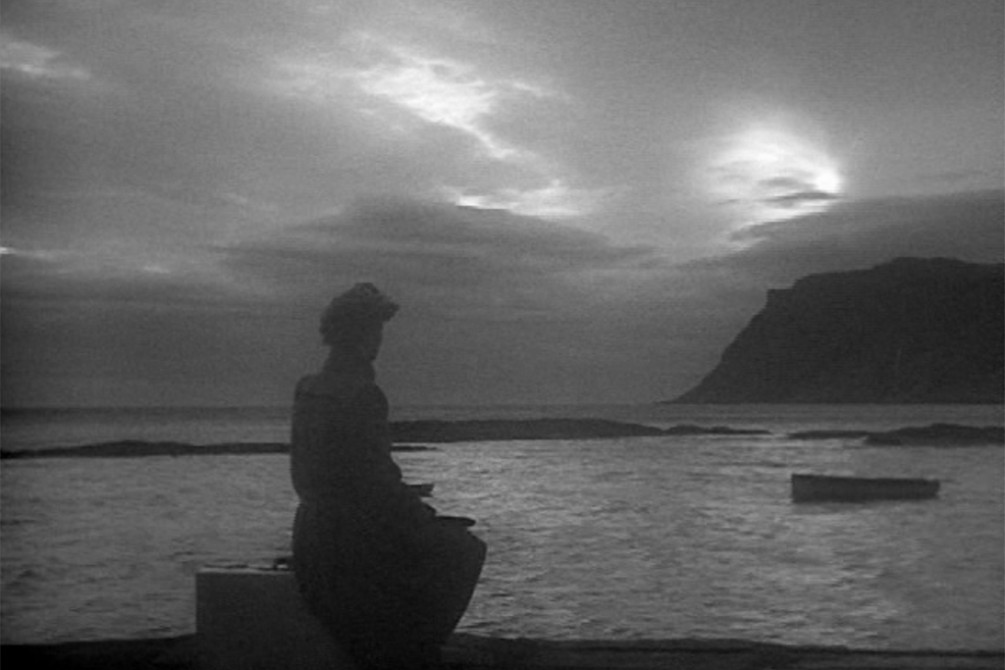


Powell and Pressburger create a film concoction with fantasy elements, surreal dream sequences and musical interludes, taking a straightforward story and applying an extremely creative approach to it. The story may seem overly familiar, but not the approach to it which keeps one watching intently to see not so much what will happen, but how. No less an expert as writer Raymond Chandler wrote of it: "I've never seen a picture which smelled of the wind and rain in quite
this way nor one which so beautifully exploited the kind of scenery
people actually live with, rather than the kind which is commercialised
as a show place."
It's a lost little gem that shows what a creative force "The Archers", the team that made The Red Shoes, could be. Also, look for a short appearance by a child-actress named Petula Clark. Yup, that one.


