Showing posts with label Nicol Williamson. Show all posts

Thursday, May 14, 2020

Return to Oz (1985)

Return to Oz (Walter Murch, 1985) In 1980, when Walter Murch talked to Disney about working on a project, the subject of L. Frank Baum's "Oz" books came up. Disney had acquired the series in 1954 and some filming had been done on an adaptation of later stories, but it was never completed, and the company's rights to do anything with them were about to expire. Murch and writer Gill Dennis started work on a screenplay based on threads and characters from later books in the series. When filming began, things turned contentious with a change in executive producers (Gary Kurtz out and Paul Maslansky in), Murch being fired for a time—and rehired with the assurances of George Lucas, Francis Ford Coppola and Steven Spielberg, and a regime-change at Disney which lost any interest in promoting the film as something different from what an audience saturated with memories of the 1939 musical would expect.

The result was a fascinating film, truer to Baum, but far different in tone from M-G-M's The Wizard of Oz.

The thing is, the films' DNA are so similar, it's the presentation that's very different.

Six months after Dorothy Gale (Fairuza Balk—10 years old at the time) survived the terrible twister that decimated her family's farm, she is still having sleepless nights and talking incessantly about her friends visited in another land far away from the flat colorless expanse of Kansas, even prattling on that a key she has found with what she interprets as the word "Oz" in the bow fell with a shooting star to tell her that they're in trouble. For her folks, Aunt Em' (Piper Laurie) and Uncle Harry (Matt Clark), who have troubles of their own and are still re-building and trying to scratch together a farming existence, this is not only impractical, but troubling. Perhaps it's time to see a specialist. An advertisement in the local paper gives Em' a possible solution.
Dr. J. B. Worley (Nicol Williamson) runs a local asylum and boasts great success using electroshock therapy ("It's the 20th Century! The age of electricity!") and, after some condescending questions about "Oz" and how she got back from there ("Where are those ruby slippers now?" "I lost them!"), he is only too quick to prescribe strapping Dorothy down and zapping her fantasies away. But, before the procedure can be performed, an electrical storm causes a power black-out, and Dorothy is saved by another little girl who escapes with her until they stumble in the dark and Dorothy falls into the river, a chicken coop providing her only life-line.
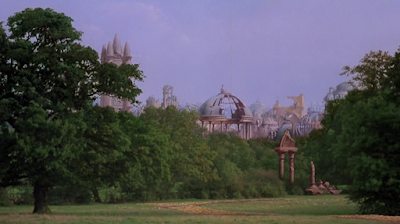
The next morning, she wakes up in Oz, but not the Oz she remembers—Munchkinland is in ruins, the yellow brick road is just rubble and everyone in the city of Oz, including the Cowardly Lion and the Tin Woodsman, has been turned to stone and King Scarecrow is missing! With the help of her favorite Kansas farm-chicken, Billina—who has followed her to Oz and can now talk—Dorothy manages to avoid capture by a roving pack of malicious "Wheelers" and uses her "Oz" key to open a door when she's trapped in a hallway to escape them.
She finds one of Oz's mechanical soldiers and reads the instructions how to start him up. Its name is "Tik-Tok" and with its help, Dorothy captures one of the Wheelers and they're told what has befallen the emerald city: Oz was attacked by the Nome King, who took the Scarecrow captive, turned all of the Ozians to stone and has plucked every last emerald from the city to his mountain-lair across the Deadly Desert, which will kill anyone who dares to walk across it. Dorothy is desperate to find the Scarecrow and the captured Wheeler tells her that Princess Mombi (played by three actresses—Jean Marsh, Sophie Ward, and Fiona Victory—for a reason), who lives now in Oz, can tell him what happened to the Straw-King.
The little party travels to the only part of Oz that hasn't fallen to ruin, where the Princess lives, and are informed that the Scarecrow has been taken captive by the Nome King. They also find out that Princess Mombi collects heads, and switches hers out whenever the fancy strikes her, bringing them to life with her Powder of Life (naturally...or unnaturally). Meeting Dorothy, she finds she has a good head on her shoulders, so she locks her up in her attic until Dorothy is old enough to be usable. Out the window attic, Dorothy can see the mountain of the Nome King, where the Scarecrow is held captive, enticingly in the distance across the Deadly Desert.
But, one finds all sorts of interesting things in attics—for example, there's Jack Pumpkinhead, who has been "powdered" into existence by Mombi, and together, he and Dorothy devise a plan to escape, using Jack's height and agility, a couch, a couple of plants and the mounted head of a Gump, but only if she can get downstairs and get the Princess's Powder of Life. Jack gets the door open, and starts to assemble their transport, while Dorothy sneaks down to Mombi's quarters while the headless princess sleeps. She is able to find the Powder, but not without waking up one of the heads, and while the Princess scrambles to find her head—or any head—Dorothy runs back up to attic, and just in the nick...she and her companions are able to hop on their Gump-plane and crash through their attic-prison window. It's off to the Nome King's mountain. 
More perils ensue, and Dorothy must play a game of wits with the Nome King if she wishes to save her friends, the Princess is after Dorothy after her escape, and there's also the matter of the mysterious girl who saved her back in Kansas. Dorothy must muddle through and save the day, before she can earn her reward to go back home, having made new friends and dispatched troubles and enemies.
Return to Oz did not perform well at the box office, perhaps due to the differences from the 1939 M-G-M musical with its dependence on sprightly songs and fantasy characters portrayed by heavily made-up (but easily recognized as) human actors with a distinctly vaudevillian approach to the material. There were also rumblings of the film being too scary for children, despite being given a "PG" rating (the more restrictive PG-13 rating had been available since Summer 1983), with its threatened electroshock therapy, scary characters like the Wheelers, a headless Princess Mombi, and decidedly evil Nome King (without the theatricality of, say, the Wicked Witch of the West).
This is is a bit disingenuous, as M-G-M's film also had a lot of traumatizing aspects, such as the flying monkeys, a liberal use of very real fire against the Scarecrow, and the intense hour-glass scene as Judy Garland's Dorothy is forced to watch her life run out.
To say nothing of a tornado that imperils Dorothy and crushes a character on its crash-landing in Oz; Baum's initial "Oz" books are rife with ingenious ways to traumatize Dorothy enough to get her back to her safe, if constantly jeopardized, fantasy-land. Let's be real about the fantasy—Oz is a sublimating dream-land caused by physical peril that helps Dorothy deal with the vagaries of real life (amplified in the movies, as in the original film, the Scarecrow, Woodsman and Lion all have Kansas counterparts as field-hands and the Wicked Witch is Kansas' worst-neighbor-in-the-world Elmira Gulch, and in Murch's follow-up, the Nome King is a manifestation of Dr. Worley and Mombi is his less-than-empathetic nurse).
Murch's cherry-picking of elements from Baum, particularly his sequels "The Marvelous Land of Oz" and "Ozma of Oz" is seamless, but complicated, and the added electroshock therapy peril is an ingenious way to threaten to "cure" Dorothy of her dreams, and a particularly cruel one, given their therapeutic value to the girl and, thus, the transposition of Worley with the Nome King is inspired (Baum used earthquakes and being swept off ocean liners as traumas in the books but the doctor intends to rob the girl of her "safe-place" making the cure worse than the disease).
Murch's presentation might also be somewhat disturbing, but in a very basic way: the 1939 "musical" was all done on sound-stages, even the Kansas scenes, giving the film a safer, artificial look, but in Return to Oz, things are filmed on location outside, giving a heightened sense of reality—even the ruined Oz is filmed with natural light, which might have had a subliminal effect on the reality of the movie, making it more menacing.
Perhaps that's an overreach, but the reaction to Murch's Oz film was more in its relationship to the musical version of Oz than to itself as its own adaptation of Baum (and one should remember that, although a critical success, The Wizard of Oz was not considered a box-office success that year, only making back its costs with a 1949 re-release). And, that is a big factor. M-G-M's version had traumatizing elements, sure, but sublimated it with a happy tune every 10 minutes in a constant bi-polar yin-yang of emotion—danger/release-danger/release.
Return to Oz didn't have that steady stream of emotional tonic to off-set the troubles, merely showing the resolution of those troubles in the story-line. Without the constant insulin-drip of song cluing audiences in to how people were feeling, The Wizard of Oz would be alarming, as well, inspiring folks to look for a soothing poppy-field somewhere.
I remember Roger Ebert's review of The Phantom Menace, where he wrote: "If it were the first 'Star Wars' movie, 'The Phantom Menace' would be hailed as a visionary breakthrough. But this is the fourth movie of the famous series, and we think we know the territory" By comparison to the earlier films (and, more importantly, our memories of them), The Phantom Menace came up short. But, taken on its own, it's still an amazing movie—it just didn't have all the inter-species hugging and celebrating of A New Hope.
And that may be the issue: Return to Oz is an amazing, smart intricate little film that actually does right by Baum, even improving on his spare style a bit. But its charms are ones of the intellect, rather than the Garland musical vehicle, wearing its heart on its sleeve.

It really should come as no surprise, really, that we would find more endearing the Tin Woodsman, always in danger of rusting from his own tears, than we would the Scarecrow, who only had a brain.

Oz help us all.

Thursday, May 17, 2018

Robin and Marian (1976)

Robin and Marian (Richard Lester1976) On paper, it looks perfect. The author of The Lion In Winter jumping a few years ahead in the story to tell of the end of Richard the Lionheart's bloody Crusades, and the return of Robin Hood and the loyal Little John to Sherwood Forest, where they find a lot has changed. Directing would be Richard Lester, who had returned to A-list prominence with his extraordinary staging of The Three Musketeers/The Four Musketeers. He was becoming the "go-to" guy for period dramas, finding ways to bring a mature light-heartedness to any dreary point in history (or more appropriately, he would ignore Hollywood sound-stage pretense and show historical periods a bit more accurately--for example, his fly-filled Rome in the otherwise schtick-filled A Funny Thing Happened On the Way to the Forum). In the years since, his successes had been spotty: Juggernaut, his all-star take on the disaster film, sank at the box-office (never mind--watch it!), as did his dream-project Royal Flash bringing his "Musketeers" adapter George MacDonald Fraser's character to the big screen.
But Robin and Marian had that Goldman script (unfortunately, Goldman's other produced screenplay They Might Be Giants, although good for naming rock bands, also failed at the box-office despite the star-power of a post-Patton George C. Scott and Joanne Woodward) and a dream-cast. Goldman wanted Nicol Williamson as Robin and maybe Sean Connery as Little John. Lester got them, but reversed the roles, which Goldman had to admit, worked. Robert Shaw would re-unite with his From Russia With Love co-star (and golfing partner) as the Sheriff of Nottingham. Richard Harris would play King Richard, Denholm Elliott and Ronnie Barker (of "The Two Ronnies") would be Merry Men. Ian Holm would appear as the weasley King John. But, with the role of Maid Marian, they hit the mother-lode: after nearly a decade off the screen, producer Ray Stark coaxed Audrey Hepburn to play the older, wiser lost love of Robin Hood.
Filming was done in Spain (Lester's old haunt from Musketeers and A Funny Thing Happened On the Way to the Forum) and completed quickly--Lester's a "one-take" kind of director which always appealed to Connery.
Then things started to go wrong.The script by Goldman is charming, but often relies, as did The Lion in Winter on piquant anachronisms--the kind of "Isn't that funny? They talk like we do!" approach to historical drama that can be a bit cloying. "You never wrote!" complains Maid Marian at one point in the script about Robin Hood's many years away. "I don't know how!" says Robin in perplexed reply. But there are some nice things--the over-all theme of living past your prime or need, combined with Robin's nostalgia for the old days and his childish belief that he can make things right again on all fronts. 
There are some nice little cliche-bashings. I remember a couple of cut-away shots of Nicol Williamson's Little John looking pained at Robin and Marian expressing affection for each other, and thinking, "Oh Lord, they're going to make Little John gay!" which I thought was a pretty cheap way to bring in relevance to the story. But it proves to be a clever gambit. Later in the film when Marian goes to John and begs him to keep Robin out of battle, she makes the same assumption. "You've always been jealous of me! But you had him all those years!" Williamson beautifully underplays this scene "Yer Rob's lady," he mumbles. "What?" she cries. "If ye'd been mine, I'd never've left." and Williamson chucks the apple he was eating into the night where it arcs and disappears. Nice set-up. Nice turn. As is the ending, recreating the myth of Robin firing one last arrow through the window, telling John to bury Marian and he where it lands. In Lester's last shot, it never falls to earth.
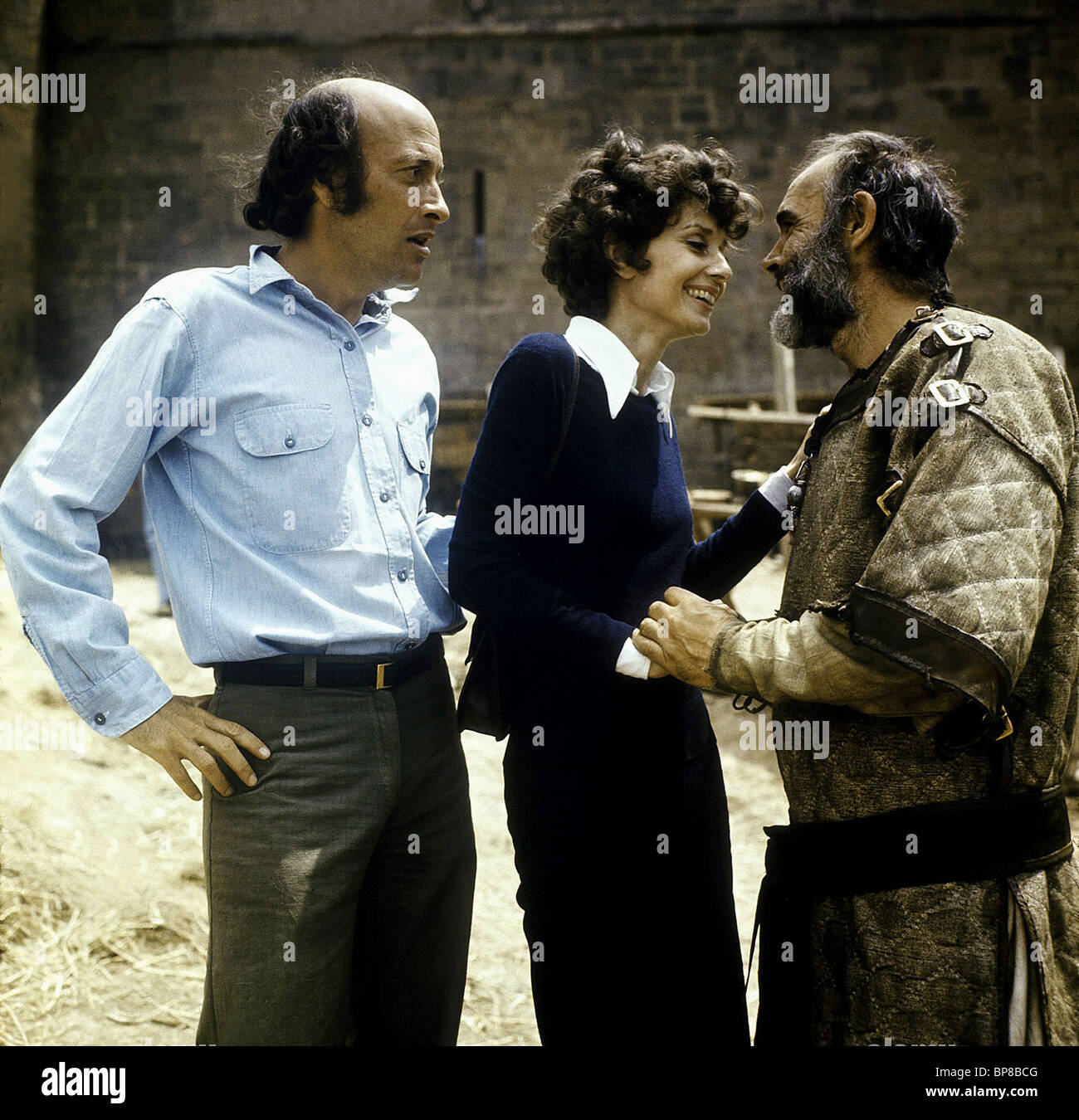
The charm of the script no doubt appealed to Hepburn--she has a speech at the end that most actresses would kill for, though, practically, it slows the film to a crawl at a very critical time. There are publicity pictures of Lester and Connery showing her around the set, but Hepburn, given Lester's directorial approach of "You act, I'll shoot" might have been a bit put off by his quick approach and lack of hand-holding. 
She made complaints about some of the gristlier aspects to Lester's cut, particularly to his opening the film with a shot of ripe fruit, and ending it, with the fruit rotting in the sun. This is a brilliant way to express an aspect of the story--that Robin, and Marian too, have overstayed their usefulness. And the film is gritty. The staging of an opening scene in a burned-out desert fortress feels more like everybody's waiting for Godot rather than King Richard. And Lester keeps his own anachronisms well-chosen, for example Robin Hood's morning routine--waking up in the forest, stretching, brushing his teeth with a fir branch, and reaching for a good ball-scratch until he sees Marian waking up--Connery's hopping attempt to be nonchalant is priceless. 
And the violence is rough stuff. People die very badly in the film despite the chain-mail and armor, and the wounds they suffer are played up. Lester seemed determined to counter-act any chirpiness in the film by bringing it down to Earth. Maybe this upset Hepburn.
But for whatever reason, producer Ray Stark chose to take control. Initially, Lester employed Michel Legrand, his composer for the Musketeers films, to write a period-appropriate score—Legrand opting, instead, to write something a bit more modern, more mature, which Lester wasn't entirely happy with. Stark, hearing the score, and not having control over much else, replaced it with a quickly put-together (two weeks, reportedly) score by John Barry, who'd worked with Lester before (on The Knack...And How to Get It and Petulia) and whose James Bond scores for Connery were well-known. He also won an Oscar for the music for Goldman's The Lion in WinterBarry's a wonderful composer, but the main-stay of his score is a bucolic love theme that frequently bounces over the scenes and makes them too sweet for a film about the passing of youth and the end of days. It's sounds like it would be more appropriate for a film about frolicsome otters than Robin and Marian. Perhaps Stark thought that would be enough to soothe the blue-haired ladies going to see Audrey Hepburn's first film in a decade. Given her rather cute performance, maybe it would have been a good idea to re-cast her, too. Perhaps she took the role as a chance to get another Oscar (she won in 1954 for Roman Holiday--Katherine Hepburn won for her starring role in The Lion in Winter). She didn't get it. Nor did the blue-hairs show up. The film was not a major hit at the box office.
Having now heard the Legrand score (a bit of which is below), one hears a nice maturity to the score in marked contrast to Barry's. Although it might not be as up-beat, I find it preferable for the film that Lester ultimately made, despite producorial intentions. But we'll never know. Robin and Marian is locked in a bizarre nether-world where it's at once too sweet, but also stark and unsentimental. Lester could make mis-concieved films, but his approach to counter-point Goldman's sentimentality in a world of hardship was a good one. One would have liked to have seen that version of the film.


Compare and Contrast: the same section of film 
scored by Legrand (left) and Barry (right)

Friday, April 21, 2017

The Seven Percent Solution

The Seven Percent Solution (Herbert Ross, 1976)  The tag-line on the poster says it all: "Confounding!"

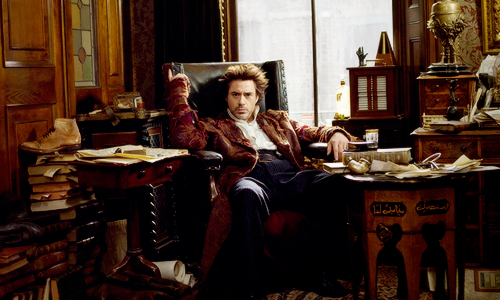
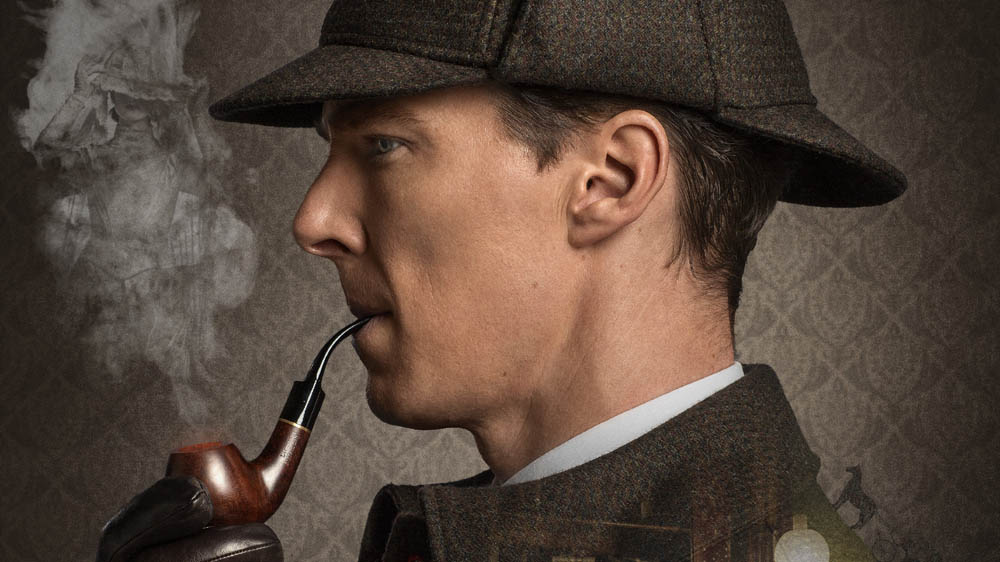
I'm a big fan of the character of Sherlock Holmes. But I'm not a purist. As long as you get the traits right, I don't mind—I've enjoyed the turns by Robert Downey Jr and Benedict Cumberbatch (and Hugh Laurie's "House") that have veered away from the typical show of Holmes—deerstalker, Meerschaum, Inverness cape—the trappings which had little to do with the character, but more with past portrayals that stuck, like barnacles, in the public mind. As long as the intellect is there, the piercing observations, the ennui, the dramatic flourishes, the personal demons, then I am happy. I am less so when injecting a romantic element to it. Holmes is not a romantic, but a pragmatist. Love is a symptom to him, a motive, to be observed and not practiced, lest he fall into the same vulnerable state as so many of his clients and their tormentors. It was Holmes' implacable intellect that was an antidote to the salacious effronteries to the morals of the Victorian era, as well as such horrifying concepts as The Giant Rat of Sumatra, "a story for which the world is not yet prepared" (although we might be ready after being ground down by the Trump Administration).

Nicholas Meyer's first novel, a Sherlock Holmes parenthetical pastiche, "The Seven Percent Solution" is a good read. The writer (and eventual director—Time After Time, Star Trek's II and VI, The Day After) has a sharp mind and sense of the dramatic. He researches and connects the dots for good drama. It is his conceit that the whole business of Holmes' obsession with Professor Moriarty, his "death" at the Reichenbach Falls in "The Final Problem," absence and reappearance in "The Empty House" are all fabrications to explain Holmes' three year absence and sabbatical from 1891 to 1894 ("The Great Hiatus") while taking treatment for cocaine addiction from the psychologist Sigmund Freud. It's a very clever thesis—Freud had used cocaine and was a proponent of it in limited quantities for medicinal purposes (especially addiction to morphine), but the addictive issues of the drug led him to disavow it and stop its use completely in 1896. 
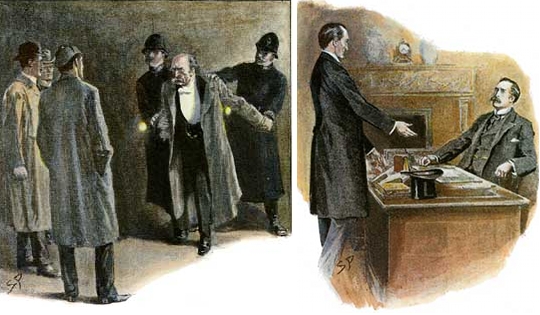
It is October 24, 1891 and Dr. John H. Watson (Robert Duvall—let that sink in for a moment.....okay) is called to his old haunts at 221B Baker Street, four months after his marriage to Mary Morston (Sammantha Eggar), which, of course, had led to his moving out of his former residence shared with Sherlock Holmes (Nicol Williamson). The landlady, Mrs. Hudson, warns him that Holmes is behaving strangely and, indeed, Holmes is heard shouting that he may only be disturbed if it is Professor Moriarty. Watson finds Holmes' room locked and Holmes will only allow him in if he can disclose where he keeps his tobacco. 
Entering, Watson is disturbed by the disarray of Holmes' drawing room—more than it usually is—and by Holmes excitable erratic behavior. Watson suspects that Holmes has been using the needle again, and goes off to the Diogenes Club to seek advice from Holmes' smarter (and older) brother Mycroft (Charles Gray) and the two plan a deception to get the detective to Vienna and into the care of a doctor named Sigmund Freud (Alan Arkin, eventually), who has some history of dealing with addiction and hysterics. But what will be the ruse?
The two visit Professor James Moriarty (Laurence Olivier), a mathematician who has had some history with the Holmes family and was, in fact, the Holmes boys' math tutor. Moriarty is aware of the younger Holmes' ravings about him and would like the matter settled without bringing in his solicitor, but he is aghast at the suggestion that he leave London immediately...for Vienna of all places. Sherlock Holmes cannot help himself but pursue, and so, agitated, he and Watson travel to Vienna to confront his "Napoleon of crime."
What he finds, instead, is Sigmund Freud, calm, resolute, who has heard of Holmes (even if Holmes has never heard of him), but Holmes' art of deduction is not dwindled by his weaknesses, and after a long dissertation from the observation of Freud's study, he has what amounts to a complete dossier of Freud's background and character—leading him to suspect that he is not an agent of Moriarty...and so he turns on Watson, calling him "an insufferable cripple," to which Watson promptly cold-cocks him and knocks him out. Elementary.
When Holmes recovers, Freud shames him for turning on his friend, who only has his best interests in mind, and begins Holmes' treatment, which involves hypnosis, "talk therapy," and treatment for withdrawal symptoms, all done in the safety of Freud's home, where Freud's nightmarish struggles with his addiction create delusions and flashbacks of past cases and new horrors. But, once the night-sweats, trembling and visions stop, Holmes is still a depressive, not unlike Freud, and the two doctors use Holmes in the help of another of Freud's patients,  a singer named Lola Devereaux (Vanessa Redgrave), who is found by the Rhine in a seeming attempt to commit suicide over her own cocaine addiction. Her case, though, is much more complicated. Indeed, it may involve a conflict that will engulf the whole of the continent of Europe.
You can't fault the cast, even Robert Duvall makes a fine Watson despite much sniffing about his casting, and Williamson is a superb Holmes—maybe too good, in fact. His Holmes is a lightning intellect and Williamson races through his dialog—he is, after all, playing a cocaine addict—that oftentimes he leaves you in the dust about a fine point in the story that seems to need a bit more weight while he has moved onto other matters. Arkin is marvelous as always, but there is a bit of humorlessness to him that keeps the best of Arkin under wraps. Gray's Mycroft is so good that he reprised the role in Granada TV's definitive series with Jeremy Brett. Olivier and Redgrave, alas, are underused, and a cameo by Joel Grey can only be described as curious.
One wishes it were better. The problem is not in the casting, but in the director. Herbert Ross is a fine choreographer, but as a director, he has always presented a style that is rather flat and nondescript, as if he plunked the camera down and, luckily, the actors got in the way. One expects a certain amount of "stiff-upper-lip" in a Holmes story—it is Victorian England, after all—but The Seven Percent Solution is merely stiff, and belabored. The latter quality never more so than in Ross' attempts at surrealism and psychedelia when portraying Holmes' withdrawals. It's clumsy and not very convincing—like when Sidney Lumet used a distorting lens to show monstrosity in a person (as if the actor's performance wasn't enough). In an effort to convince audiences that the film is set in the past (I presume), it is photographed with a smeary-gauzy look by Oswald Morris (who seems to be trying to emulate Geoffrey Unsworth...but why?) and the production is designed by the legendary Ken Adam (with Peter Lamont) with an air towards over-stuffing every frame with detail—some camera framing suggests that Ross was more interested in the decor than the actors. John Addison's score is unmemorable, and ironic as, once again as he did with Hitchcock's Torn Curtain, he took the place of—one can hardly say he "replaced"—Bernard Herrmann, who was in line to score it before he died—but it does boast one song by Stephen Sondheim, that has since gone under the title of "I Never Do Anything Twice."
It feels like a lost opportunity: some good pieces here, some bad there, but it never adds up to a completed puzzle, something that Holmes—were he actually real—would never allow. Perhaps, someday, someone will solve it, and come up with a better Solution