"I would like, if I may, to take you on a strange journey."
The following was part of a series reviewing the ASUW film series at the University of Washington that were broadcast on KCMU-FM in 1976--I found the old scripts and thought it might be interesting to post them here--with no editorial alteration. I have no doubt that my attitude to some of these films has changed over the years--ageing does that--but to just erase my opinions from back then and tack on my new-found objections would do a disservice to the reviewer who was just a "stinky kid" back then. It'd be like --I don't know--talking over a movie or something! Or throwing bread at the screen!
The Rocky Horror Picture Show (Jim Sharman, 1975)  This Saturday's films at 130 Kane Hall are The Rocky Horror Picture Show and Private Parts. They're a little freaky. No. They're not. They're a LOT freaky. Take, for example, The Rocky Horror Picture Show. Rock biggie Lou Adler produced it. Jim Sharman directed it with assistance from a lot of other people's work, notably Brian DePalma's Phantom of the Paradise. And like ...Paradise, it's a rock-musical-horror-picture hybrid. Unlike ...Paradise, Rocky Horror has a sci-fi element and a great deal less subtlety.
You know the plot. Two nice people--two niiiiice people (Barry Bostwick and Susan Sarandon)--are driving down the road during a rainstorm. They get a flat tire and look for a phone, and, of course, they come upon a light in the House of Dr. Frank N. Furter, scientist.
Dr. Furter (Tim Curry) refers to himself as a "trans-sexual transvestite from Transylvania" and when he first appears in stilletos, garter belt and heavy make-up, there's more than enough evidence to take him at his word. As with Mel Brooks' Young Frankenstein, the sexuality that's only hinted at in the early "Frankenstein" films of James Whale is made overt. No longer do we have the Father-Creator/Son-Creation love of the first "Frank.." film, this scientist creates "Rocky" as a...toy.
It's bizarre. Maybe too bizarre for some.* But as long as the thing takes itself so lightly, it's harmless and engaging. Half-way through the third reel**, however, the film begins to take itself somewhat half-way seriously and bogs itself down.
But there are things to recommend: the special effects of Wally Veevers, who worked on 2001, the performances of the actors familiar and unfamiliar, especially Susan Sarandon (Joe, The Front Page, The Great Waldo Pepper) and one of my favorite actors Charles Gray--he plays every role the same way, and his, by no means, small role as the Narrator of the film is in his finest arch tradition. But the actor who steals the show is Tim Curry, mincing around the thing like Carol Burnett playing Gloria Swanson. Whatever reservations you may have of the film, it is his force of personality and presence that makes the whole thing work as well as it does.
-------------------------------------------------------------------------------------------------
I sound like such a prude with this. But, it was 1976 and that was a long time ago.
One can't argue with Rocky Horror as a cultural phenomenon, but it still doesn't hold up too well as a film. Perhaps that's why it ended up as such an "audience participation" project (well, that and the music and the dancing--duh!)--"Mystery Science 3000" never took on any classics. It offers a chance for the audience to camp-out and out-camp the film.
And it bears a re-visit: the print I saw of it had severe sync problems--10 minutes out of sync, actually. That can spoil your appreciation of anything! And Tim Curry vaulted from this into mainstream films--but he's never had a role that so dominated a film as this one.
Also...and this has nothing to do with the movie...there was a teaser trailer attached to the film for a film I'd heard a couple of rumors about and was interested in seeing: a little movie called Star Wars.
The Rocky Horror Picture Show is part of the National Film Registry. Bra-vo to the Library of Congress. Let's do the Time-Warp again.
* This was written in 1976, and Rocky Horror had only been released the previous year and died a grisly and unprofitable death at the box-office. You know...the rest of the story. The Rocky Horror Picture Show was, appropriately, unearthed and brought back from the dead at revival houses and turned into a Midnight Movie staple--not so much for the film, but for the lively audience participation. The Rocky Horror Picture Show struck a chord in the youth market and any excess displayed in 1975 became a part of the popular culture...to the horror of some. But you can't argue with success. FOX did a remake of it and aired it on October 20, 2016...on broadcast television. Times change and culture changes with it.
** I was watching a 16mm print, but I would hazard a guess to say that I'm referring to the point in the big "RKO" extravaganza where Frank N. Furter must face his demise. Bummer.
The Seven Percent Solution (Herbert Ross, 1976) The tag-line on the poster says it all: "Confounding!"
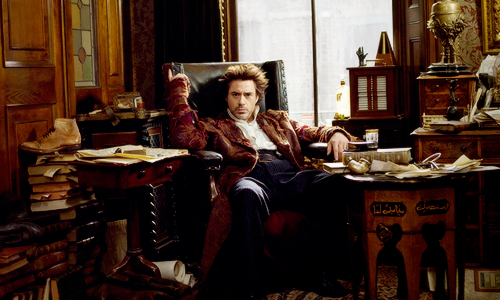
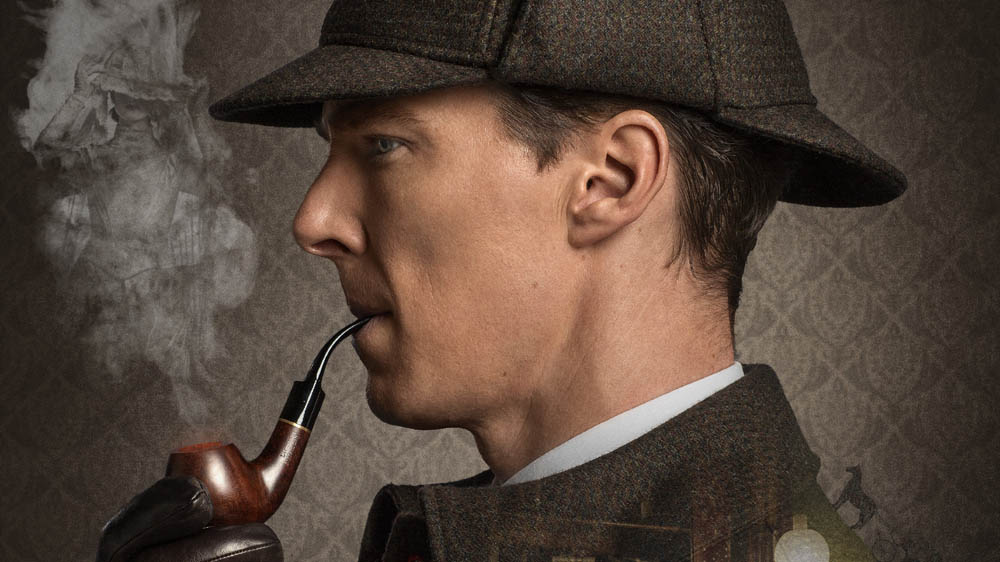
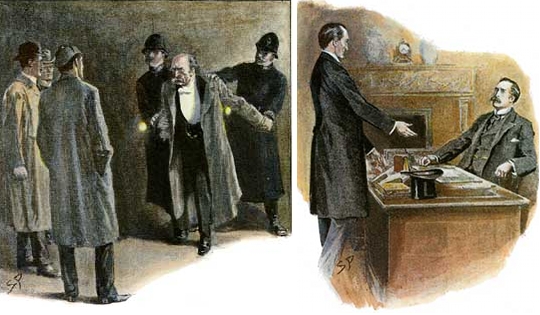
I'm a big fan of the character of Sherlock Holmes. But I'm not a purist. As long as you get the traits right, I don't mind—I've enjoyed the turns by Robert Downey Jr and Benedict Cumberbatch (and Hugh Laurie's "House") that have veered away from the typical show of Holmes—deerstalker, Meerschaum, Inverness cape—the trappings which had little to do with the character, but more with past portrayals that stuck, like barnacles, in the public mind. As long as the intellect is there, the piercing observations, the ennui, the dramatic flourishes, the personal demons, then I am happy. I am less so when injecting a romantic element to it. Holmes is not a romantic, but a pragmatist. Love is a symptom to him, a motive, to be observed and not practiced, lest he fall into the same vulnerable state as so many of his clients and their tormentors. It was Holmes' implacable intellect that was an antidote to the salacious effronteries to the morals of the Victorian era, as well as such horrifying concepts as The Giant Rat of Sumatra, "a story for which the world is not yet prepared" (although we might be ready after being ground down by the Trump Administration).

Nicholas Meyer's first novel, a Sherlock Holmes parenthetical pastiche, "The Seven Percent Solution" is a good read. The writer (and eventual director—Time After Time, Star Trek's II and VI, The Day After) has a sharp mind and sense of the dramatic. He researches and connects the dots for good drama. It is his conceit that the whole business of Holmes' obsession with Professor Moriarty, his "death" at the Reichenbach Falls in "The Final Problem," absence and reappearance in "The Empty House" are all fabrications to explain Holmes' three year absence and sabbatical from 1891 to 1894 ("The Great Hiatus") while taking treatment for cocaine addiction from the psychologist Sigmund Freud. It's a very clever thesis—Freud had used cocaine and was a proponent of it in limited quantities for medicinal purposes (especially addiction to morphine), but the addictive issues of the drug led him to disavow it and stop its use completely in 1896.

It is October 24, 1891 and Dr. John H. Watson (Robert Duvall—let that sink in for a moment.....okay) is called to his old haunts at 221B Baker Street, four months after his marriage to Mary Morston (Sammantha Eggar), which, of course, had led to his moving out of his former residence shared with Sherlock Holmes (Nicol Williamson). The landlady, Mrs. Hudson, warns him that Holmes is behaving strangely and, indeed, Holmes is heard shouting that he may only be disturbed if it is Professor Moriarty. Watson finds Holmes' room locked and Holmes will only allow him in if he can disclose where he keeps his tobacco.

Entering, Watson is disturbed by the disarray of Holmes' drawing room—more than it usually is—and by Holmes excitable erratic behavior. Watson suspects that Holmes has been using the needle again, and goes off to the Diogenes Club to seek advice from Holmes' smarter (and older) brother Mycroft (Charles Gray) and the two plan a deception to get the detective to Vienna and into the care of a doctor named Sigmund Freud (Alan Arkin, eventually), who has some history of dealing with addiction and hysterics. But what will be the ruse?

The two visit Professor James Moriarty (Laurence Olivier), a mathematician who has had some history with the Holmes family and was, in fact, the Holmes boys' math tutor. Moriarty is aware of the younger Holmes' ravings about him and would like the matter settled without bringing in his solicitor, but he is aghast at the suggestion that he leave London immediately...for Vienna of all places. Sherlock Holmes cannot help himself but pursue, and so, agitated, he and Watson travel to Vienna to confront his "Napoleon of crime."

What he finds, instead, is Sigmund Freud, calm, resolute, who has heard of Holmes (even if Holmes has never heard of him), but Holmes' art of deduction is not dwindled by his weaknesses, and after a long dissertation from the observation of Freud's study, he has what amounts to a complete dossier of Freud's background and character—leading him to suspect that he is not an agent of Moriarty...and so he turns on Watson, calling him "an insufferable cripple," to which Watson promptly cold-cocks him and knocks him out. Elementary.

When Holmes recovers, Freud shames him for turning on his friend, who only has his best interests in mind, and begins Holmes' treatment, which involves hypnosis, "talk therapy," and treatment for withdrawal symptoms, all done in the safety of Freud's home, where Freud's nightmarish struggles with his addiction create delusions and flashbacks of past cases and new horrors. But, once the night-sweats, trembling and visions stop, Holmes is still a depressive, not unlike Freud, and the two doctors use Holmes in the help of another of Freud's patients, a singer named Lola Devereaux (Vanessa Redgrave), who is found by the Rhine in a seeming attempt to commit suicide over her own cocaine addiction. Her case, though, is much more complicated. Indeed, it may involve a conflict that will engulf the whole of the continent of Europe.

You can't fault the cast, even Robert Duvall makes a fine Watson despite much sniffing about his casting, and Williamson is a superb Holmes—maybe too good, in fact. His Holmes is a lightning intellect and Williamson races through his dialog—he is, after all, playing a cocaine addict—that oftentimes he leaves you in the dust about a fine point in the story that seems to need a bit more weight while he has moved onto other matters. Arkin is marvelous as always, but there is a bit of humorlessness to him that keeps the best of Arkin under wraps. Gray's Mycroft is so good that he reprised the role in Granada TV's definitive series with Jeremy Brett. Olivier and Redgrave, alas, are underused, and a cameo by Joel Grey can only be described as curious.

One wishes it were better. The problem is not in the casting, but in the director. Herbert Ross is a fine choreographer, but as a director, he has always presented a style that is rather flat and nondescript, as if he plunked the camera down and, luckily, the actors got in the way. One expects a certain amount of "stiff-upper-lip" in a Holmes story—it is Victorian England, after all—but The Seven Percent Solution is merely stiff, and belabored. The latter quality never more so than in Ross' attempts at surrealism and psychedelia when portraying Holmes' withdrawals. It's clumsy and not very convincing—like when Sidney Lumet used a distorting lens to show monstrosity in a person (as if the actor's performance wasn't enough). In an effort to convince audiences that the film is set in the past (I presume), it is photographed with a smeary-gauzy look by Oswald Morris (who seems to be trying to emulate Geoffrey Unsworth...but why?) and the production is designed by the legendary Ken Adam (with Peter Lamont) with an air towards over-stuffing every frame with detail—some camera framing suggests that Ross was more interested in the decor than the actors. John Addison's score is unmemorable, and ironic as, once again as he did with Hitchcock's Torn Curtain, he took the place of—one can hardly say he "replaced"—Bernard Herrmann, who was in line to score it before he died—but it does boast one song by Stephen Sondheim, that has since gone under the title of "I Never Do Anything Twice."

It feels like a lost opportunity: some good pieces here, some bad there, but it never adds up to a completed puzzle, something that Holmes—were he actually real—would never allow. Perhaps, someday, someone will solve it, and come up with a better Solution.

 This Saturday's films at 130 Kane Hall are The Rocky Horror Picture Show and Private Parts. They're a little freaky. No. They're not. They're a LOT freaky. Take, for example, The Rocky Horror Picture Show. Rock biggie Lou Adler produced it. Jim Sharman directed it with assistance from a lot of other people's work, notably Brian DePalma's Phantom of the Paradise. And like ...Paradise, it's a rock-musical-horror-picture hybrid. Unlike ...Paradise, Rocky Horror has a sci-fi element and a great deal less subtlety.