Showing posts with label Herbert Ross. Show all posts

Thursday, March 22, 2018

Play It Again, Sam

Play It Again, Sam (Herbert Ross, 1972) Woody Allen was well into his directing career in 1972, but when Paramount Pictures brought his play, "Play it Again, Sam" to the movies, he was relegated to adapting the script and starring in it (despite the fact that his agents Charles H. Joffee and Jack Rollins—who would be the long time producers on his films—were also part of the production team). The directing duties were given to Herbert Ross, who'd done the musical numbers for Funny Girl, and had directed the musical version of Goodbye, Mr. Chips (for MGM), The Owl and the Pussycat (again with Streisand for Columbia) and a drama T.R. Baskin (for Paramount), possibly because one of the producers was Arthur P. Jacobs—who'd produced the musical of Mr. Chips. It might have been that Allen's films up to that point—Take the Money and Run, Bananas, and a couple of short satire films for PBS—had a rough, low-budget feel to them and Ross could give them the necessary big-screen gloss. 

Allen explained that his impetus was three-fold: he had no interest in directing one of his plays for the screen (a rule he forgot when he directed 1994's TV movie of Don't Drink the Water); he was tied up with trying to get his farce of the best-seller Everything You Wanted to Know About Sex*; and he thought that if someone could make something charming of the film, it could only help build an audience for his own films.
Good choices, those; He was right on all counts. Play it Again, Sam reached a wider audience than Allen's previous movies and set up an audience attracted to his comedy (and his nebbish persona) for his subsequent films. He also must have gotten some pointers from observing Ross on this film as his following films exhibited a better directorial panache, while still keeping the autonomy he enjoyed as a talented independent film-maker outside the studio system.
In the film, Woody plays Allan Felix, the recently-divorced editor of of a fringe film magazine ("Film Weekly") and "one of the life's great watchers" (as his ex describes him). She's left him because he's no fun, risk-averse ("I'm red-haired and fair-skinned—I don't tan, I STROKE!"), and just watches movies, while she wants to have a happy, active life. He worries that will give him a heart attack. When we first see him, he's watching Casablanca, (probably for the umpteenth time), rapt. He's much more comfortable in a movie theater, where he can passively absorb and not act, or engage, or "be" in the world (the movie is set in San Francisco, rather than New York). He's a bit adrift, but that might be less a result of his divorce, than a symptom of his own, which probably contributed to it.
He begins to ruminate over his situation, going over his split in his mind, and having imaginary conversations with Humphrey Bogart (Jerry Lacy) whom he idolizes and wants to emulate. But, Bogart's advice isn't very realistic: "Dames are simple, kid," Bogart's spirit tells him early on. "I never met one who hasn't understood a slap in the mouth or a slug from a 45." Bogart is much more comfortable in his own skin (if he had skin), and he basically advises Allan to "man up" (or the 1972 equivalent as  filtered through the '40's). And as far as being dumped is concerned? "Nothing a little bourbon and soda can't fix."
Alcohol, however, makes Allan nauseous. He pours his heart out to his best friends, Dick Christie (Tony Roberts), a preoccupied stock-broker and his model-wife Linda (Diane Keaton). Dick tells Allan his divorce is an opportunity to be free, "to sow wild oats", to go and meet women, but when they set Allan up with some of their friends, he is beset with insecurities and a false brio that make every date a disaster—even their friend, a nymphomaniac, rejects him. Barely able to sustain anything more than half-a-date, Allan starts to become a third wheel in the life of Dick and Linda.
Allan: That's quite a lovely Jackson Pollock, isn't it?
Museum Girl: Yes, it is.
Allan: What does it say to you?
Museum Girl: It restates the negativeness of the universe. The hideous lonely emptiness
of existence. Nothingness. The predicament of Man forced to live in a barren,
Godless eternity like a tiny flame flickering in an immense void with nothing but waste,
horror and degradation, forming a useless bleak straitjacket in a black absurd cosmos.
Allan: What are you doing Saturday night?
Museum Girl: Committing suicide.
Allan: What about Friday night?
Allan wants a relationship ("Where'd you learn THAT word, a shrink?" scoffs Bogart) like they have, but even that marriage isn't all it's cracked up to be. With every change of venue, Dick has to check in with "the office" to make sure they know where he can be reached (this is in 1972—the pre-history of cell-phones) and his frequent absences make the neurotic Linda feel abandoned and needy and she ends up spending more time commiserating with the equally needy Allan. With so much in common, pretty soon, their friendship turns to affection and Allan starts envisioning having an affair with her, but struggles with his conscience about cheating with his best-friend's wife.
Egged on by Bogart, Allan pursues Linda, even as he has visions of the result such an indiscretion will have—Dick dramatically walks into the sea in one, and in another he's a vengeful Italian (eh?) seeking to filet Allan for making him a cuckold. But, the Bogartian prodding, like a gat in the lower spine, has him pursuing the low hanging fruit with self-esteem issues that bothers to give him the time of day...if only she'd give him a night.
What's interesting about Play it Again, Sam is what it gets wrong. In the same way, that the lead male of (500) Days of Summer achieves his idea of romance from "a mis-reading of The Graduate," Allan's Bogart-familiar is a mis-reading of the Bogart persona, emphasizing all the things that Allan lacks with not much else. Lacy's Bogart is ostensibly in the guise of the early 1940's Bogart in the era of his Sam Spade-Richard Blaine-Philip Marlowe personas. But, as hard-bitten as Bogart's character would appear in their respective films, there was always a sensibility of decency deeply rooted in the character, less interested in scoring with the ladies than in doing the right thing and living to a code of ethics that this Bogart would probably mock. It's an over-simplification to say that Allan's Bogart manifestation is Bogart—or any amalgam of his screen persona's (unless you throw in a couple of his gangster parts), so much as a projection of what Allan thinks he lacks. He ultimately has to abandon Bogart's advice and look to himself to do the noble thing, for which he's awarded with a boost in his self-esteem, a chance to re-enact one of his favorite movie scenes, and a salute of sorts from his errant bad angel.
Looking at the film today with 21st Century sensibilities, there are some cringe-inducing lines and a general sensibility—insensitivity, more accurately—that the world of women is a bit like a buffet for an indiscriminate diner...at least from a man's perspective (which is the only perspective this film has). "Playboy" for nerds. It's funny, sure. Funny and churlish. And one imagines the real Bogart, head bowed, sadly contemplating the glowing end of his cigarette, over being misused and misrepresented in the name of a misogyny he'd probably have curled his lip at. Woody Allen's Bogart is not the one I remember—tearing his guts out while confessing "I won't because all of me wants to..."**
It makes me recall that when I watched Play it Again, Sam all those years ago, my loyalties shifted subtly and radically away from Allan Felix to Linda Christie and her predicament (in much the same way that Allan Felix's character must also shift to...finally...do what's right by her). A lot of that has to do with Keaton's winsome playing of the character. But, a lot of it has to do with the realization that heroes...even projected ones...have to be heroic, if they have to win our trust and admiration. And you don't do that by looking around for heroes, but by looking for it within.

Here's looking at yourself, kid.


* but were afraid to ask. 

** 

Friday, April 21, 2017

The Seven Percent Solution

The Seven Percent Solution (Herbert Ross, 1976)  The tag-line on the poster says it all: "Confounding!"

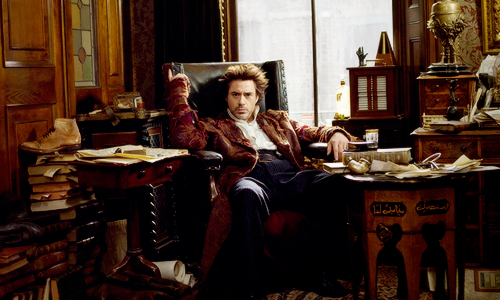
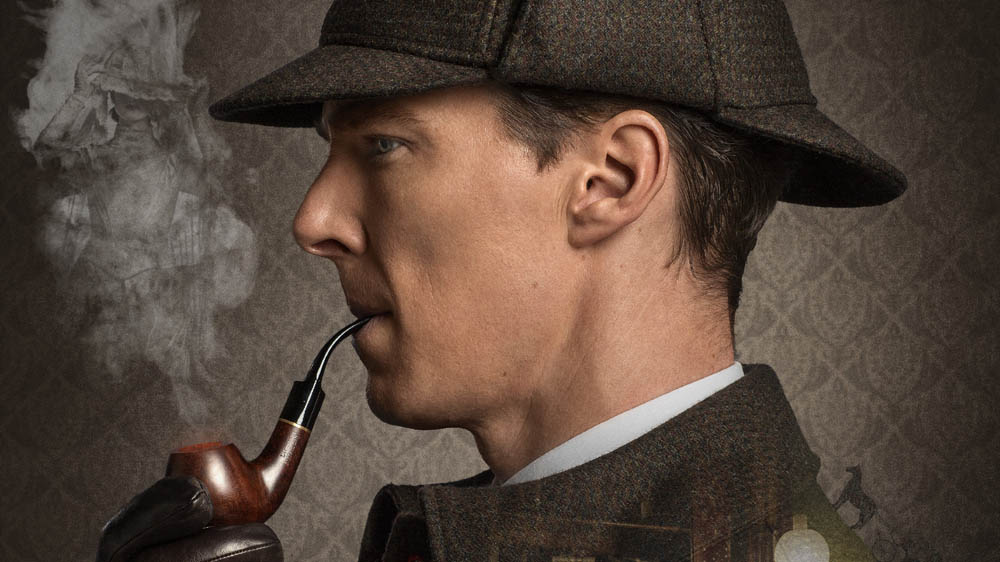
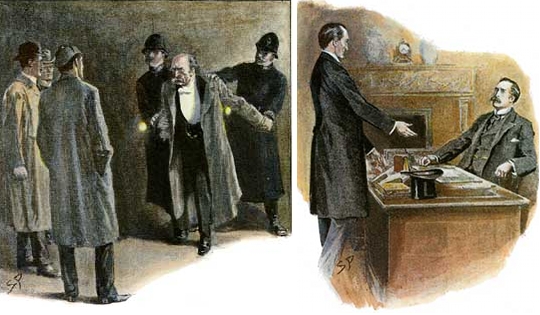
I'm a big fan of the character of Sherlock Holmes. But I'm not a purist. As long as you get the traits right, I don't mind—I've enjoyed the turns by Robert Downey Jr and Benedict Cumberbatch (and Hugh Laurie's "House") that have veered away from the typical show of Holmes—deerstalker, Meerschaum, Inverness cape—the trappings which had little to do with the character, but more with past portrayals that stuck, like barnacles, in the public mind. As long as the intellect is there, the piercing observations, the ennui, the dramatic flourishes, the personal demons, then I am happy. I am less so when injecting a romantic element to it. Holmes is not a romantic, but a pragmatist. Love is a symptom to him, a motive, to be observed and not practiced, lest he fall into the same vulnerable state as so many of his clients and their tormentors. It was Holmes' implacable intellect that was an antidote to the salacious effronteries to the morals of the Victorian era, as well as such horrifying concepts as The Giant Rat of Sumatra, "a story for which the world is not yet prepared" (although we might be ready after being ground down by the Trump Administration).

Nicholas Meyer's first novel, a Sherlock Holmes parenthetical pastiche, "The Seven Percent Solution" is a good read. The writer (and eventual director—Time After Time, Star Trek's II and VI, The Day After) has a sharp mind and sense of the dramatic. He researches and connects the dots for good drama. It is his conceit that the whole business of Holmes' obsession with Professor Moriarty, his "death" at the Reichenbach Falls in "The Final Problem," absence and reappearance in "The Empty House" are all fabrications to explain Holmes' three year absence and sabbatical from 1891 to 1894 ("The Great Hiatus") while taking treatment for cocaine addiction from the psychologist Sigmund Freud. It's a very clever thesis—Freud had used cocaine and was a proponent of it in limited quantities for medicinal purposes (especially addiction to morphine), but the addictive issues of the drug led him to disavow it and stop its use completely in 1896. 
It is October 24, 1891 and Dr. John H. Watson (Robert Duvall—let that sink in for a moment.....okay) is called to his old haunts at 221B Baker Street, four months after his marriage to Mary Morston (Sammantha Eggar), which, of course, had led to his moving out of his former residence shared with Sherlock Holmes (Nicol Williamson). The landlady, Mrs. Hudson, warns him that Holmes is behaving strangely and, indeed, Holmes is heard shouting that he may only be disturbed if it is Professor Moriarty. Watson finds Holmes' room locked and Holmes will only allow him in if he can disclose where he keeps his tobacco. 
Entering, Watson is disturbed by the disarray of Holmes' drawing room—more than it usually is—and by Holmes excitable erratic behavior. Watson suspects that Holmes has been using the needle again, and goes off to the Diogenes Club to seek advice from Holmes' smarter (and older) brother Mycroft (Charles Gray) and the two plan a deception to get the detective to Vienna and into the care of a doctor named Sigmund Freud (Alan Arkin, eventually), who has some history of dealing with addiction and hysterics. But what will be the ruse?
The two visit Professor James Moriarty (Laurence Olivier), a mathematician who has had some history with the Holmes family and was, in fact, the Holmes boys' math tutor. Moriarty is aware of the younger Holmes' ravings about him and would like the matter settled without bringing in his solicitor, but he is aghast at the suggestion that he leave London immediately...for Vienna of all places. Sherlock Holmes cannot help himself but pursue, and so, agitated, he and Watson travel to Vienna to confront his "Napoleon of crime."
What he finds, instead, is Sigmund Freud, calm, resolute, who has heard of Holmes (even if Holmes has never heard of him), but Holmes' art of deduction is not dwindled by his weaknesses, and after a long dissertation from the observation of Freud's study, he has what amounts to a complete dossier of Freud's background and character—leading him to suspect that he is not an agent of Moriarty...and so he turns on Watson, calling him "an insufferable cripple," to which Watson promptly cold-cocks him and knocks him out. Elementary.
When Holmes recovers, Freud shames him for turning on his friend, who only has his best interests in mind, and begins Holmes' treatment, which involves hypnosis, "talk therapy," and treatment for withdrawal symptoms, all done in the safety of Freud's home, where Freud's nightmarish struggles with his addiction create delusions and flashbacks of past cases and new horrors. But, once the night-sweats, trembling and visions stop, Holmes is still a depressive, not unlike Freud, and the two doctors use Holmes in the help of another of Freud's patients,  a singer named Lola Devereaux (Vanessa Redgrave), who is found by the Rhine in a seeming attempt to commit suicide over her own cocaine addiction. Her case, though, is much more complicated. Indeed, it may involve a conflict that will engulf the whole of the continent of Europe.
You can't fault the cast, even Robert Duvall makes a fine Watson despite much sniffing about his casting, and Williamson is a superb Holmes—maybe too good, in fact. His Holmes is a lightning intellect and Williamson races through his dialog—he is, after all, playing a cocaine addict—that oftentimes he leaves you in the dust about a fine point in the story that seems to need a bit more weight while he has moved onto other matters. Arkin is marvelous as always, but there is a bit of humorlessness to him that keeps the best of Arkin under wraps. Gray's Mycroft is so good that he reprised the role in Granada TV's definitive series with Jeremy Brett. Olivier and Redgrave, alas, are underused, and a cameo by Joel Grey can only be described as curious.
One wishes it were better. The problem is not in the casting, but in the director. Herbert Ross is a fine choreographer, but as a director, he has always presented a style that is rather flat and nondescript, as if he plunked the camera down and, luckily, the actors got in the way. One expects a certain amount of "stiff-upper-lip" in a Holmes story—it is Victorian England, after all—but The Seven Percent Solution is merely stiff, and belabored. The latter quality never more so than in Ross' attempts at surrealism and psychedelia when portraying Holmes' withdrawals. It's clumsy and not very convincing—like when Sidney Lumet used a distorting lens to show monstrosity in a person (as if the actor's performance wasn't enough). In an effort to convince audiences that the film is set in the past (I presume), it is photographed with a smeary-gauzy look by Oswald Morris (who seems to be trying to emulate Geoffrey Unsworth...but why?) and the production is designed by the legendary Ken Adam (with Peter Lamont) with an air towards over-stuffing every frame with detail—some camera framing suggests that Ross was more interested in the decor than the actors. John Addison's score is unmemorable, and ironic as, once again as he did with Hitchcock's Torn Curtain, he took the place of—one can hardly say he "replaced"—Bernard Herrmann, who was in line to score it before he died—but it does boast one song by Stephen Sondheim, that has since gone under the title of "I Never Do Anything Twice."
It feels like a lost opportunity: some good pieces here, some bad there, but it never adds up to a completed puzzle, something that Holmes—were he actually real—would never allow. Perhaps, someday, someone will solve it, and come up with a better Solution