There's going to be a Lambcast recorded this weekend for a much-beloved John Huston film, and I've been reading up on Huston to get ready for it. I have a "Now I've Seen Everything" feature on the director (in two parts) that might be perused. And there's little orphan of a review for an orphan of a movie that too many people have forgotten, but I think is a great Huston film.
Fat City(John Huston, 1972) Fat City got a lot of positive critical attention when it came out in '72 and one sees why. It must have been surprising for a lot of critics that, after a couple of movies (The Kremlin Letter, Sinful Davey, A Walk with Love and Death) that seemed to be desperate to reach a youth market or cater to the looser restrictions on subject matter, that the veteran director could still pull off a gritty down-on-your-heels story and make something new out of it—the old dog still had some tricks up his sleeve, and could do a change-up of genre and tone and come up with something as impressive as the young turk's starting to enter the field, like Friedkin and Coppola.
But it shouldn't have surprised anybody. Huston was a gambler by trade and by hobby, and was never afraid of taking on different approaches to telling a story. Sure, he could take a misstep here and there, especially when he tried to do something "of the times," rather than in his own perennial classicism. It was always story for Huston, and he was never afraid to take things in complex directions.
Fat City is a tale of two boxers—Tully (Stacy Keach) and Ernie (Jeff Bridges) one on the way up and one on the way down, but the only difference between the two, career-wise, is in the timing. Ernie is in the early rounds of the bout, all puppyish energy and vigor. Keach's Tully is in the later stages of the fight, battered, bruised, and tired, having known defeat and the occasional victory, always just out of reach of a right jab. When we first encounter them, Ernie has yet to have his first professional fight.
Tully is a couple years out of the ring, barely subsisting. He's scarred over, but that hardening of tissue, mostly keeps the sense-memory of past victories ringing in his head. Both mean are trying to get into the ring, one with no way of knowing what will come when he's in it, and the other all too aware of the toll it will take...but, anything is better than his current situation. As it's said in The Shawshank Redemption, you either gotta get busy living or get busy dying. In this case, living is fighting. And for the older pugilist, there's still some fighting to be done, rounds to go before he sleeps.
Huston has had many great male performances under his direction, from such as Bogart, Gable, Clift, Brando, Connery, Finney, but I don't think I've ever seen a better performance in one of Huston's films than Stacy Keach in this.* In whatever you've seen him in, nothing prepares you for the internalized pain that Keach conveys in every aspect of his performance. And there's one moment that will stay with me for the rest of my life. During the fight-centerpiece of the film, when Tully makes his comeback, he's knocked to the canvas, but never counted out. He spends an interminable nine seconds on his knees and elbows, head hanging—and there's a moment, a long moment, when you wonder if he's going to get up—if he even wants to get up. Then, he rolls up into a rickety stance to complete the last few seconds of the round. The fighters retreat to their corners and Keach sprawls on his stool, as the cut-men treat a bleeding gash over his left eye.
Huston stays on Keach's face, and there is no expression on it—none. So, you go to his eyes, which are dead, betraying no light and no spark. There may be nothing going on in his mind except the most primal reptile instincts to survive; his head is a black hole, nothing leaves, and there may be nothing to leave. He's a shell, hollow and broken. That look will show up again in the film, as a final note, lacking in grace, the soundtrack empty, giving a brief glimpse of death, a living one, yes, but a death that still haunts.
Keach in Huston's Fat City
* Everybody is good in this, but one should also note Susan Tyrrell's feisty, free-wheeling performance of a drunk bar-fly that is on par with Keach's and feels so real you want to throw up your hands and give up.
While I catch up on the reviews still in "Draft" phase here, I'll re-run a feature I ran when I first started this blog seven years ago,* when it was suggested I do a "Top Ten" List.
I don't like those: they're rather arbitrary; they pit films against each other, and there's always one or two that should be on the list that aren't because something better shoved it down the trash-bin.
So, I came up with this: "Anytime" Movies. Anytime Movies are the movies I can watch anytime, anywhere. If I see a second of it, I can identify it. If it shows up on television, my attention is focused on it until the conclusion. Sometimes it’s the direction, sometimes it’s the writing, sometimes it’s the acting, sometimes it’s just the idea behind it, but these are the movies I can watch again and again (and again!) and never tire of them. There are ten (kinda). They're not in any particular order, but the #1 movie IS the #1 movie.
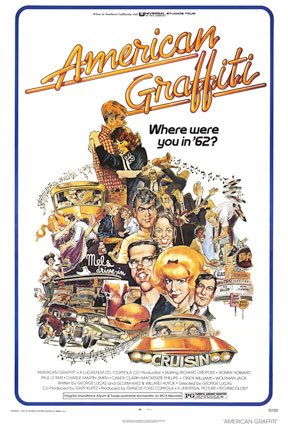
What's George Lucas' best film? For most, it's probably Star Wars (I'm sure there's some poor soul out there who likes Radioland Murders). There's a lot to like about his charmingly scruffy homage to the Buck Rogers serials. But one wonders what direction his career might have gone if he hadn't felt the need to exploit that first "Star Wars" movie as much as he did. It seems the more he explained about his initial concepts the worse the movies got, and the more rich and famous they made him, the more elephantine and fossilized they became.
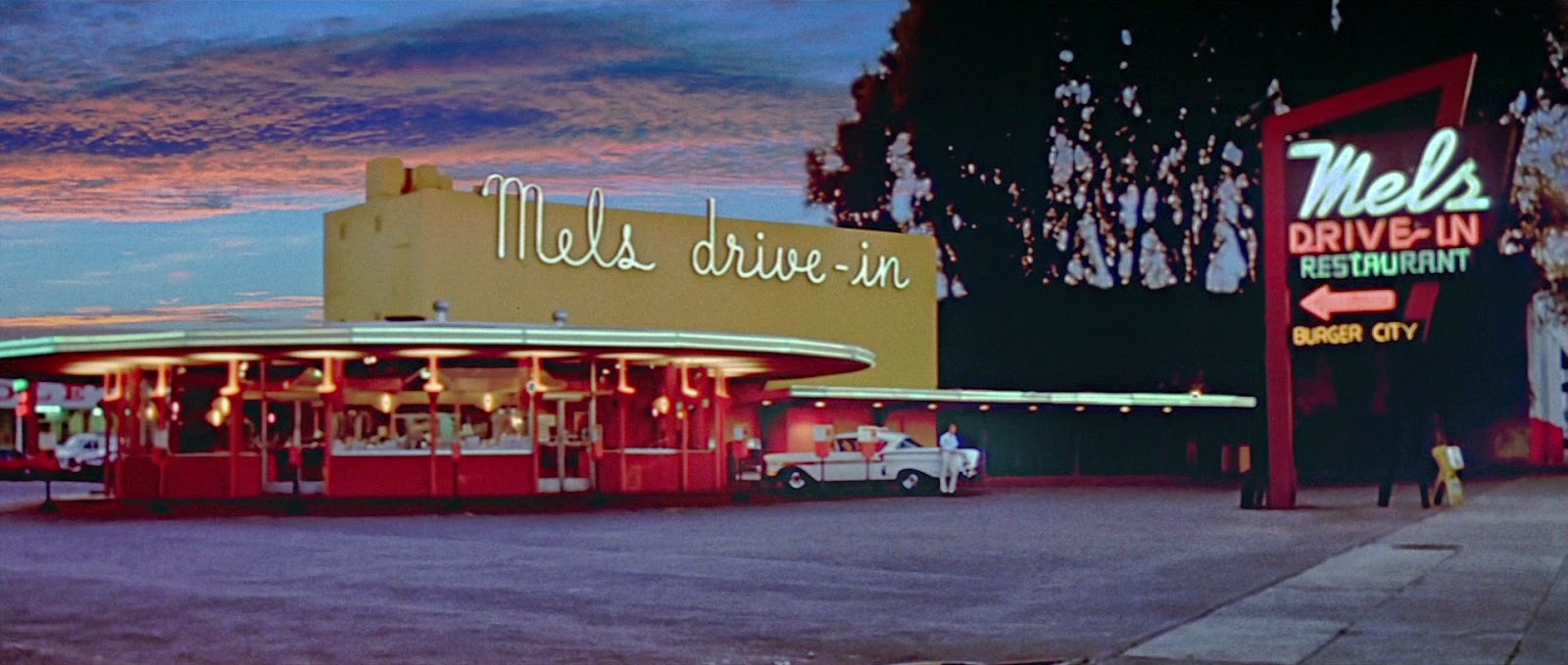
Lives intersect, couples form and break apart, lies are told, misunderstandings abound (to really make it Shakespeare all you'd need is a set of twins), while the majority of kids drive endlessly in circles--not going anywhere, but hoping to, and if not tonight, there's always tomorrow. They're not going anywhere.
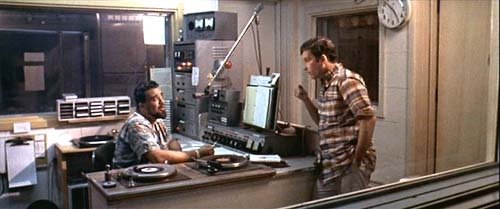
In the background are the constant echoes of rock n' roll pouring out of car windows and reverberating down the hallways and back-alleys, broken only by the howls and shrieks of the common thread in their lives, Wolfman Jack. All the kids have their Wolfman myths and he acts as sage, seer, siren and Master of Ceremonies for the evening's adventures. He's also the Fool and "The Man Behind the Curtain." Ultimately the long night's journey leads to his door-step, and, in disguise, dispenses his wisdom to the seeker.
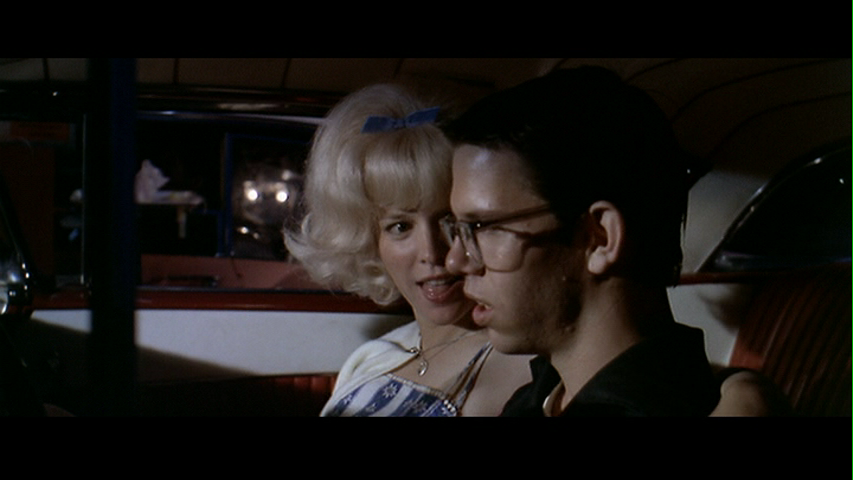
The Siren
One thing Lucas always knew was how to make a curtain call and American Graffiti is his best. As Curt flies off to college, he is left two signs of passage: the white T-bird reappears one last time to remind him what he's giving up, while locked away in his plane, the sounds of the radio station that have buoyed and sustained all the characters throughout the night fades to static. For the first time in the film there is no music and in the silence that creates, broken only by the drone of the plane we're told the rest of the story. Terry "goes missing" in Vietnam. Steve is an insurance salesman in town. John is killed by a drunk driver. Curt's a writer in Canada. After that punch in the gut, Lucas unsentimentally hammers it home with one of the cheeriest songs in the Beach Boys catalog—"All Summer Long," dismissed earlier in the film as "surfing shit." Lucas turns the future into a sobering fate—the film is set in 1962. The next year would signal the end of the innocence of the 50's and American Graffiti is a sweet farewell to trivial concerns and living in the past.
The Knight-Mentor
Lucas has said that he based the boys on different aspects of himself in high school--the intellectual, the nerd, the sosh' and the JD. Lucas' lesson in this, and all of his work seems to be "Advance or Die." It's the lesson of Graffiti. It is certainly the basis of the story of Anakin Skywalker. So what became of Lucas? Did he follow his own advice? Well, you could say he went to the future with Star Wars, but he set it in the far-away past. Then he built an Empire of his own...in his hometown.
The Trailer for American Graffiti--in the style of Beach Blanket movie
American Grafitti touched me in two ways. I had already been inspired by Lucas' first film, THX-1138 with its inventive sound-scape, to seek out his work and the work of his sound editor Walter Murch.Grafitti was their second collaboration and pretty much sealed my fate for going into sound work. Listening to it now, it's crude and has a lot of holes and bad edits, but the innovations are just as unique 30 years later and just as inspiring. On top of that, the unglamorous portrayal of a radio disc jockey's life (yet romantic in its anonymous/omnipresent effect on a community) made me think "I could do that!" and I started my sound career spinning discs at a radio station. My last job as such was at a station with a glass window that looked out on the town's "loop." Sort of like watching American Graffiti in reverse. That was KEDO-AM in Longview, Washington--long ago bulldozed.
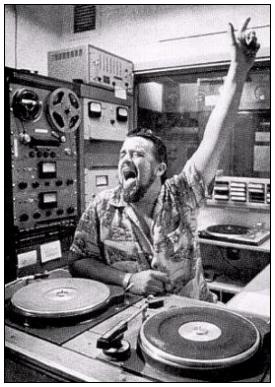
Wolfman Jack explains it all for you, baby
I'd just done a "Don't Make a Scene" segment for American Graffiti* and was looking forward to writing new "insights" on this film, but reading it again, no, I pretty much covered them all. Not that American Graffiti is that simple—it's just that given Lucas' skimpy out-put, there's not a lot of complexity in his ouvre. It is interesting that Lucas goes the Joseph Campbell route in this film before he actually read "The Hero with a Thousand Faces" and used the "seeker's path" for the construction of Star Wars. He was already using it here and doing variations of it for the four Lucas-aspects, each with different fates (a cautionary tale, indeed). He also uses the cross-cutting on different fronts that would be his staple in the "Star Wars" films, but interestingly in his first Star Wars (A New Hope) and this film, there is no cross-cutting at the end, everyone is melded into the final story-line, buttoning everything up nice and neat. He wouldn't do that again.
Mort Drucker's original artwork for American Graffiti
The Big Sleep(Michael Winner, 1978) You already know that it's going to be a bit problematic with the very first shot of this adaptation. This later version of Raymond Chandler's first detective novel—cobbled together from elements of his short stories and published in 1939—starts right where the novel starts—with detective Philip Marlowe (played, as in 1975's Farewell, My Lovely, by Robert Mitchum) driving up to the Sternwood Estate for an interview to taking a job.
The thing is he's driving on the wrong side of the road. That's a clue. When you've been over-stewed in Chandler pot-boilers about L.A.'s most geographically-associated gumshoe that sort of thing stands out like the proverbial tarantula on angel food. He's not in Los Angeles, where they drive on the right (that is "non-left") side of the road, he's in London, held over from The War, it seems, and he's driving a Mercedes. Already you feel that something is very wrong, even before he does his interview. It's not your Grandfather's Philip Marlowe.
The interview with Sternwood (James Stewart) goes well, as far as it goes. The General is being blackmailed—it's not the first time—and his son-in-law Rusty Regan usually handled such things one way or another. But, Rusty has disappeared. There are rumors, but just that. Marlowe has been recommended by Scotland Yard and he accepts the assignment, but not before he's been told about the Sternwood girls, Charlotte (Sarah Miles, Mitchum's co-star in Ryan's Daughter) and Camilla (Candy Clark), who Marlowe has already met ("She tried to sit on my lap...while I was standing up," a line used in the book and both movies. For this version, the names have been changed—from "Vivian" and "Carmen"—to protect the not-so-innocent.
After taking his leave of the General, who has complained of fatigue, he is commanded to the bedroom of Charlotte, who demands to know what Marlowe has been hired for—possibly to find her missing husband? Marlowe says it's the general's business and none of hers, and she leaves unsatisfied and unimpressed.
Marlowe's first stop is to the bookstore of H. R. Geiger, whose name is on the notes. By subterfuge, he concludes that the shop is not a book store, per se, but rather a front for a pornography distributor. He has a bit of disagreement with the shop's receptionist, Agnes (Joan Collins), who develops an instant dislike to Marlowe's pestering.
Marlowe stakes out Geiger's flat and sees lights flashing inside. The last flash, though, is from a gun-shot and Marlowe breaks in to find much amiss: Camilla, drugged and naked in front of a camera, the film missing, drug paraphernalia strewn about, and Geiger dead on the floor with a gunshot wound in the forehead. He checks the backway to look for the killer, but has missed him. Camilla is certainly in no shape to have done it, she's high out of her mind, the bar of which is set pretty low to begin with. The best thing to do is throw something on Camilla and get her home, pronto. He'll come back to the house later.
That's after he gets some well-deserved shut-eye; the bags under Mitchum's eyes are starting to look like suitcases. But, he gets called by The Yard (in the person of John Mills) to watch a car being dragged from the water. In it is the Sternwood's chauffeur, dead. A little too close to home, even if your home is a mansion, ain't it? Heading back to his office, Marlowe finds older sister Charlotte waiting for him, still wanting to know what the General has hired him for—no dice, lady—and to tell him they're being blackmailed by somebody else, this time with naked pictures of Camilla...from the previous evening's recreations. Marlowe tells her to pay up and she says she can borrow the money from gambling boss Eddie Mars (Oliver Reed in full hissing snake mode). Hmmm. Isn't there a rumor that Rusty ran off with Mars' wife? Bears investigating.
Well, one can get into the weeds very quickly here, and the movie's only 30 minutes in. There is a famous story about the Howard Hawks-Humphrey Bogart-Lauren Bacall version done in the 40's where there was a body but nobody had any idea who killed him. The writers didn't know. Hawks didn't know. Chandler didn't care—"that's your job" he told the movie-makers. By that time, Hawks didn't care, either. There's a line in both movies "so many guns. So few brains." Well, there are so many corpses that keeping track of them all without a toe-tag is an exercise in fatality. The 1978 version wants everything nice and tidy and explained, whether we care or not. Where, the 1946 version kept that information vague and unresolved, Winner doubles down to explain it with voice-over and a flash-back sequence introduced with a picture-spinning rotation (the edge of the frame threatening to slap us awake). He needn't have bothered.
What this version of The Big Sleep does well is to fill the film with so many good British actors that one gets dizzy remembering them all: Miles, Mills, Reed, Harry Andrews, Collins, Edward Fox (he's good!), Colin Blakely, Richard Todd, James Donald, who are clearly enjoying their versions of American 1940's types. It's just that it's set in the 1970's and the transition makes some of the scenes a little bit campy, like the actors are having too good a time "slumming." But, this one doesn't feel like one of those old B-movie shadow-fests. It's film-noir with the lights on, and one fairly squints from that and volunteering too much information.
There's no style, just a lot of substance. And although it's a slightly more faithful version of the Chandler novel in the tawdry specifics, thanks to deep-sixing the Hays Code, nothing much is gained—other than the feeling that this would have been really racy in the 1940's, but in the era of buying nudie mags at the 7-11, it's merely people going to too much trouble for little return.
One of my favorite lines from the earlier version is in the scene when Vivian comes to Marlowe's office and gives him the envelope with Carmen's nudes. He takes a look at them and cracks "She takes a good picture..." It's funny and sick and rude and if you didn't know what he was talking about, you'd never know, so far does it fly beneath the censor's radar.
And it's clever, something that Winner's "bleed-by-the-numbers version" never really achieves. Should have known when I first saw the Mercedes driving up the left lane. This movie was going the wrong way.
While I have a few reviews "in the works," It's as good a time as any to re-boot (actually transplant from the old movie blog) a feature I started years ago, when it was suggested I do a "Top Ten" List.
I don't like those: they're rather arbitrary; they pit films against each other, and there's always one or two that should be on the list that aren't because something better shoved it down the trash-bin.
So, I came up with this: "Anytime" Movies. Anytime Movies are the movies I can watch anytime, anywhere. If I see a second of it, I can identify it. If it shows up on television, my attention is focused on it until the conclusion. Sometimes it’s the direction, sometimes it’s the writing, sometimes it’s the acting, sometimes it’s just the idea behind it, but these are the movies I can watch again and again (and again!) and never tire of them. There are ten (kinda). They're not in any particular order, but the #1 movie IS the #1 movie. What's George Lucas' best film? For most, it's probably Star Wars (I'm sure there's some poor soul out there who likes Radioland Murders). There's a lot to like about his charmingly scruffy homage to the Buck Rogers serials. But one wonders what direction his career might have gone if he hadn't felt the need to exploit that first "Star Wars" movie as much as he did. It seems the more he explained about his initial concepts the worse the movies got, and the more rich and famous they made him, the more elephantine and fossilized they became.
Lives intersect, couples form and break apart, lies are told, misunderstandings abound (to really make it Shakespeare all you'd need is a set of twins), while the majority of kids drive endlessly in circles--not going anywhere, but hoping to, and if not tonight, there's always tomorrow. They're not going anywhere.
In the background are the constant echoes of rock n' roll pouring out of car windows and reverberating down the hallways and back-alleys, broken only by the howls and shrieks of the common thread in their lives, Wolfman Jack. All the kids have their Wolfman myths and he acts as sage, seer, siren and Master of Ceremonies for the evening's adventures. He's also the Fool and "The Man Behind the Curtain." Ultimately the long night's journey leads to his door-step, and, in disguise, dispenses his wisdom to the seeker.
The Siren
One thing Lucas always knew was how to make a curtain call and American Graffiti is his best. As Curt flies off to college, he is left two signs of passage: the white T-bird reappears one last time to remind him what he's giving up, while locked away in his plane, the sounds of the radio station that have buoyed and sustained all the characters throughout the night fades to static. For the first time in the film there is no music and in the silence that creates, broken only by the drone of the plane we're told the rest of the story. Terry "goes missing" in Vietnam. Steve is an insurance salesman in town. John is killed by a drunk driver. Curt's a writer in Canada. After that punch in the gut, Lucas unsentimentally hammers it home with one of the cheeriest songs in the Beach Boys catalog--"All Summer Long," dismissed earlier in the film as "surfing shit." Lucas turns the future into a sobering fate--the film is set in 1962. The next year would signal the end of the innocence of the 50's and American Graffiti is a sweet farewell to trivial concerns and living in the past.
The Knight-Mentor
Lucas has said that he based the boys on different aspects of himself in high school--the intellectual, the nerd, the sosh' and the JD. Lucas' lesson in this, and all of his work seems to be "Advance or Die." It's the lesson of Graffiti. It is certainly the basis of the story of Anakin Skywalker. So what became of Lucas? Did he follow his own advice? Well, you could say he went to the future with Star Wars, but he set it in the far-away past. Then he built an Empire of his own...in his hometown.
The Trailer for "American Graffiti"--in the style of Beach Blanket movies
American Grafitti touched me two ways. I had already been inspired by Lucas' first film, THX-1138 with its inventive sound-scape, to seek out his work and the work of his sound editor Walter Murch.Grafitti was their second collaboration and pretty much sealed my fate for going into sound work. Listening to it now, it's crude and has a lot of holes and bad edits, but the innovations are just as unique 30 years later and just as inspiring. On top of that, the unglamorous portrayal of a radio disc jockey's life (yet romantic in its anonymous/omnipresent effect on a community) made me think "I could do that!" and I started my sound career spinning discs at a radio station. My last job as such was at a station with a glass window that looked out on the town's "loop." Sort of like watching American Graffiti in reverse. That was KEDO-AM in Longview, Washington--long ago bulldozed.
Wolfman Jack explains it all for you, baby!
I'd just done a "Don't Make a Scene" segment for American Graffiti and was looking forward to writing new "insights" on this film, but reading it again, no, I pretty much covered them all. Not that American Graffiti is that simple—it's just that given Lucas' skimpy out-put, there's not a lot of complexity in his ouvre. It is interesting that Lucas goes the Joseph Campbell route in this film before he actually read "The Hero with a Thousand Faces" and used the "seeker's path" for the construction of Star Wars. He was already using it here and doing variations of it for the four Lucas-aspects, each with different fates (a cautionary tale, indeed). He also uses the cross-cutting on different fronts that would be his staple in the "Star Wars" films, but interestingly in his first Star Wars (A New Hope) and this film, there is no cross-cutting at the end, everyone is melded into the final story-line, buttoning everything up nice and neat. He wouldn't do that again.
 Fat City (John Huston, 1972) Fat City got a lot of positive critical attention when it came out in '72 and one sees why. It must have been surprising for a lot of critics that, after a couple of movies (The Kremlin Letter, Sinful Davey, A Walk with Love and Death) that seemed to be desperate to reach a youth market or cater to the looser restrictions on subject matter, that the veteran director could still pull off a gritty down-on-your-heels story and make something new out of it—the old dog still had some tricks up his sleeve, and could do a change-up of genre and tone and come up with something as impressive as the young turk's starting to enter the field, like Friedkin and Coppola.