Showing posts with label Clark Gable. Show all posts

Thursday, March 13, 2025

Run Silent, Run Deep

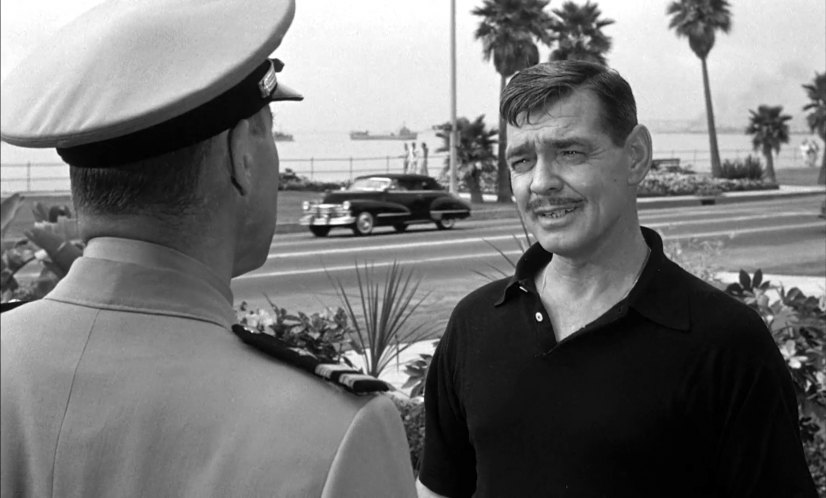
Run Silent, Run Deep (Robert Wise, 1957) One of those general entertainment movies that manages to do so many things exceptionally well that one comes away grateful for the experience. Directed by Robert Wise with a true sense of claustrophobia, the script by John Gay maintains a strict military accuracy while displaying a keen sense of drama, psychology and brevity. A psychological drama, a war film, a story of mystery as well as redemption, the film manages to pull everything off with a propulsive rhythm and fine performances throughout.

Produced by Hecht-Hill-Lancaster, Burt Lancaster the producer takes a back-seat to his star, Clark Gable, the older actor in one of his understated roles that takes into account his age. Gable's the flawed figurehead with shades of Ahab who finagles his way into the command of the S.S. Nerka patrolling the Pacific during World War II, having already lost one sub and and a frustrating convalescence at a desk-job.
Lancaster
's exec Jim Bledsoe is torqued because Gable's Cmdr. "Rich" Richardson has pulled rank to get command—his command—and is
now drilling the men to dive and shoot a torpedo within a record 35 seconds. The already suspicious crew starts to snarl about all this practice with nothing to show for it. Then a lucky strike convinces some of them the new Captain is golden, while the other half think he's out to torpedo their mission. Lancaster turns into a reluctant arbiter.
But, in their first attempt to sink Richardson's unsinkable Japanese war-ship things don't go so well leaving crew-members dead and injured and Lancaster in command.

Robert Wise
is a master of filming people at work with a story-teller's eye for finding the perfect angle (without calling attention to it and himself) and an editor's sense of pace and construction. Wise is also a chameleon of style tamping down his presentation of professionals doing their jobs while also being able to ramp up the spectacle for the unreal worlds of musicals and science fiction. Given his work on this film, you could see why he'd be the perfect choice for the similarly set-bound Star Trek: The Motion Picture.

He also makes goods use of the usual crew of character actors who make up the Nerka's lovable mugs: Jack Warden, Brad Dexter, Don Rickles, Nick Cravat and Joe Maross. The close quarters of a submarine makes the authentic plainness of their faces all the more important and brings them to a prominence near the bright lights of Gable and Lancaster. Both those lights are shaded somewhat, with Lancaster doing subtle, measured work, the kind that would dominate his later career. Gable, even subtler, is the King, here in his twilight, still burning brighter than the vast majority of actors. By this time, Gable was moving slower and had learned the power of economy and his Captain Richardson draws you in.

Finally, the story is a cracker-jack construction. Just when you think you've got it figured out, screenwriter Gay throws in an added complication that ramps up the idea that these are men strategizing in chaos and only repeated dips into the boiling oil of battle can make them seasoned enough to think clearly through the smoke and death.


Run Silent, Run Deep is an intelligent tribute to the fighting services without resorting to jingoism, racism or choired flag-waving. The film-makers' respect for the professionalism under duress of sub-crews runs silent and deep.

Wednesday, January 10, 2024

Wife vs. Secretary

Well, gosh, here's an oddity: One of those reviews where I can pinpoint right where and when I wrote it. 

I was living on Whidbey Island, which—at the time—had very little cable/internet service (I lived smack-dab in the middle of the island and "intermittent-net" only got to those residences on the North and South parts of the island closest to the mainland). I relied on a Hughes satellite dish system for the internet (and my first forays into the blogosphere), and I think the TV might have depended on rabbit-ears. But, I missed those old movies; I started a habit of renting DVD's from the library. But, here, I got to luxuriate in a cable experience.

Wife vs. Secretary (Clarence Brown, 1936) One of those forays off "The Rock" allowed me an evening of cable TV, and when I have a choice I head straight for Turner Classic Movies-easily the best channel for watching movies on the television dial. 

TCM treats the movies they show with respect--without commercial interruption, and in the proper theatrical aspect (widescreen if its a widescreen movie). They also show rare films, silent films, foreign films, things that any other channel with "movie" in its name wouldn't dare show in their efforts to cram as many commercials into each film as possible (Hello, AMC, you whore!)*

So, that night I had the chance to catch a movie I'd never heard of, called Wife vs. Secretary, which starred Clark Gable, Myrna Loy (as the "Wife") and Jean Harlow (as the "Secretary").
It was an M-G-M programmer, designed to exploit three of its biggest stars, and particularly Gable—the man is given so many loving close-ups, you actually begin to think he was being shot through gauze. Anyway, his V.S. Stanhope is a publishing tycoon, seeking to expand his properties—he's aggressive, a "man's man," and keeps terrible office-hours, seeing his loving, trusting wife only for an early breakfast and a late formal dinner party. 
His "Girl Friday" is Helen "Whitey" Wilson, a career-girl who keeps pace with Stanhope for the sheer exhilaration of seeing how fast the company can grow. That leaves her boy-friend a bit mopey, and considering he's played by a proto-
Jimmy Stewart, that's saying quite a bit. An extended business trip to Cuba that leaves the Stanhope and Wilson drunk and in the same hotel room almost sparks a romance, but both of them are just sober enough to think it's a dumb idea. But that doesn't keep the wife and boyfriend from suspecting the worse. It's interesting to see a pretty standard melodrama done with such snap—the timing of the stars crackles.
Now, I said this was a programmer,
Gable had been in three previous films with Loy and four with Harlow, so they were all old veterans, and the movie sails by with quick dialog, impossibly rich surroundings (it's M-G-M), quite a few sophisticated laughs, and a very old school lesson in morality and suspicions gone awry. But it all turns out right in the end, as long as the career-girl gives up her job and "settles down," that is. Retro-chauvinism aside, though, it's a fascinating look at a typical night at the movies from 1936, cranked out like an automobile, but with obvious care, a nice sheen, and only the best parts.
* My! Where did THAT come from? Well, a little history is in order for those of you showed up late. AMC started life—on October 1, 1984—as American Movie Classics, which had the innovative idea of running old movies commercial-free and unedited, and even (by the time I got around to it) in letter-boxed format for widescreen films (rather than using the widely available "pan-and-scan" versions that filled up a television screen but cut the amount of the movie's picture-image. When I first got addicted to AMC the host was broadcaster Nick Clooney, brother of Rosemary and father of George. But—and I did not know this at the time I wrote this—they faced severe competition when Ted Turner bought the M-G-M/Warner Brothers film library (AMC were showing quite a few of those movies, but not exclusively). By the time Turner Classic Movies started up, AMC was feeling the heat and, facing competition from TCM—as well as legal issues with TCM—the channel began taking commercials, first between films, and then interrupting their movies for them. By 2007, with the acquisition of the series "Mad Men," AmC started moving away from old movies and started pursuing original programming...where it stands today.
 
If you're wondering why Scorsese and Spielberg and being so vocal about TCM not changing under the aegis of Warner Brothers Discovery, it's because they've seen it happen before...with AMC.

Thursday, July 28, 2022

Mogambo

Mogambo  (John Ford, 1953) It's good to be The King. When you're Clark Gable, King of Hollywood, you can forgive a lot of shortcomings on the acting front. Mogambo, situated in Africa, and for a large part photographed there, makes Gable the King of the Jungle and no less predatory than some of the denizens. If the film has a shortcoming, and it has a few, it's that it depends so much on Gable's charisma to carry what is essentially an under-written "man's man" of a role—one who will take a woman in his arms and plant one with a mere change in the barometer, his, hers or Nature's. Gable's Vic Marswell is so fragile in his moods, he's practically bi-polar, swinging from cranky to rapacious to "I don't care," running hot and cold and more than a little unreadable either way. And for the women in the film, Eloise "Honey Bear" Kelly (a plucky Ava Gardner), a recklessly adventurous widow—she has a great summing-up line: "There's a lot of snarling in this joint!"—and Lina Nordley (Grace Kelly, still in her neurotic, fragile period), wife of Marswell's current client, it creates a weird triangle that I.Sosceles himself couldn't figure out. 
Maybe it's the heat of Africa, or maybe it's the wild life of the wildlife, but both of these women, with lots going for them, still neurotically slam themselves like meteors into Winslow's orbit. And while the heat and flash are nice, things burn out mighty quick. And the only explanation is "it's Gable," in a writer's shorthand that defies logic, common sense, or understandable motivation (other than box-office). It's just assumed that any woman's going to throw themselves at the King, no matter how much of a tiger trap he might be.
That shaky "given" aside, it's a nice adventure entertainment, directed by John Ford with a painterly eye trained on a new canvas. The Technicolor cinematography—by Freddie Young (doing the English studio shots) and Robert Surtees—is absolutely gorgeous, whether in the blinding sunlight of a native village, or the shadowy slats of a "civilized" encampment (The film's second unit was directed by famed stunt-man Yakima Canutt). Ford is a long way from the locations he favored in his Westerns, but adjusts, employing his fascination with native culture in the same diversions of including the faces of the tribes, distinguishing them from each other and, in a single set up, putting the flavor of the place on obvious display. He's truly recharged and energized by Africa, his camera roaming all over, finding the picturesque and telling details.
*

And it's interesting to note (to me, anyway) that Ford is essentially making a Howard Hawks movie: a group of professionals and semi-professionals trying to eke out a living (and a kind of focused community) despite their differences. Hawks and Ford would knowingly tip their hats to each other in their projects—if it didn't interfere with their own process—and there are a lot of the Hawks hallmarks here—the group sing-along, the loaning and sharing of a cigarette as relationship sub-text, the strong females (one of whom is "just one of the boys"), and the alpha male who has a code, few words, and manages to mangle them around the opposite sex.
**

Even if the emotions run a little too high and there's way too much drama to get any real work done, there's a lot in Mogambo to like, that is pleasing to the eye. The story's not much, but it sure is interesting to see how Ford tells it.


Gardner and Kelly-revealed in their environments


* One of my favorite shots is a simple one of Gable and company walking the high grass on a trapping trip, shot at ground level, looking up through the wisps at the party.  How much less interesting would that shot have been from any other angle?  How much less would it have said about the conditions there, while making the most of the surroundings?  Ah, I'm probably getting all "academic" here.  Ford probably shot it that way to avoid seeing a garbage heap in the distance.  

** Hawks made his own version of the "African trapper" story—Hatari—ten years later with John Wayne (although internet sources say Gable was to co-star "but who believes the Internet?") with a more cohesive group (the kids have the relationship problems, not the leader) turning the story into a metaphor for a film-making crew).  The differences are night and day—in style and atmosphere—despite the similarities in subject matter.  In Hawks, the relationships are background, while the job is center-stage.  In Ford, it's the other way around.  They'd make an interesting double-bill.