Showing posts with label Christopher Lee. Show all posts

Friday, October 11, 2024

Frankenweenie (2012)

In this recycled review, I spend a lot of time complaining about Tim Burton recycling material...("...the nerve!")

Speaking of nerves and things, this was written at the time of the film's exhumation....

Recycled Material From the Grave
or
"I Can Fix This..."

Really, it's a little soon for Tim Burton to be re-making one of his own films—albeit his first live-action short for Disney. One worries that maybe he's run out of ideas, or that he's simply doing what he's always done—take a property and combine it with that goofy blend of the kinky and ghoulish that he has made his own...it's just that this time the property is his...and he's already made it his own once. Maybe, he looked at this product of his younger self with limited resources and thought "I can do better. I can do more." Or along the lines of young Victor Frankenstein, he looked at it his earlier creation and vowed "I can fix this."
At the time of the live-action short, Disney looked at the product of their young animator...and promptly dumped it...only acknowledging it when Burton became an A-list director (with some studio hesitancy) with the first "Batman" film.
* Now, Disney is crowing about its brand new Burton movie, and one can only imagine the wry smile that must produce for the director. It was natural for Disney to want an expansion—they owned the property—and although this new version of Frankenweenie has a lot of (dare I say) re-animation of material, it did give Burton a chance to give it a little more depth and play around without the inhibitions of live action.
I say inhibitions rather than limitations because the differences are exhibited in a weird and rather contrary way, given that the film is done with puppet figures: emotion. The character of
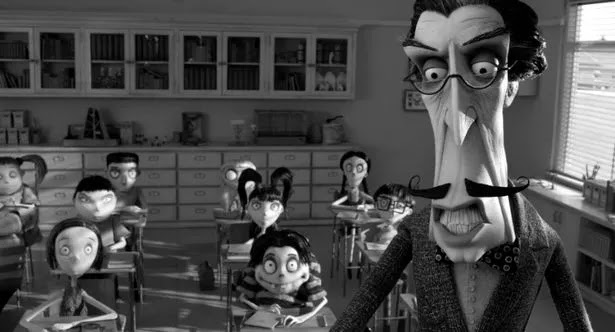
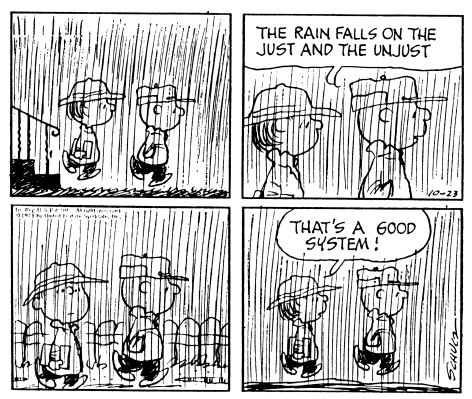
Sparky exhibits a far greater depth of moods than a trained pit-bull terrier could exhibit in live action, not only in its darker moments, but especially in moments of joy—the animation of the dog running elicits fond feelings immediately, as the puppet is rarely touching the ground in motion, not unlike Charles Schulz's "Peanuts" kids who hover over the ground in transit. And although the human figures are Burton cyphers (resembling the human character designs of his first film Vincent) they are still soulful, their eyes expressing more emotions than their faces will betray.
Given that the subject matter is about a mad scientist of a little boy who runs the parallel path of his literary namesake to re-animate his beloved dog, killed in a traffic mishap, there's a lot of room for high emotion there, and far more than in the motivations of the original story.

But, Burton takes it further and makes it more than about young Victor. Taking pages from The Nightmare Before Christmas and Batman Returns, he stages the denouement at a city festival that brings all parties together in one spot, the communal experience gone awry.
Seems that Victor's work has attracted a lot of attention among his classmates, and as there's a science fair going on, all the kid's are doing the same thing—literally, the same thing, bringing to life their dead pets with very mixed results, and providing Burton a chance to explore other species of monster movies (and recreating scenes from them) than just the one, paying tribute to each, just as he does by including a scene from friend Christopher Lee's turn as "Dracula."
Like Victor's experiment, this is a labor of love as Burton—just as with the earlier short—resurrects the movies he loved as a kid, long-buried memories that never really leave, and have influenced Burton throughout his career. It's a fun, resonant electrification of his earlier work, with just enough fresh in it to make it worth the effort and bring it back to new life in leeched black-and-white (which Burton always manages to make look sumptuous). Now, if only we could see something wholly new and original from him, that would be some experiment.

The original Frankenweenie


Brad Bird's "Family Dog" (from Steven Spielberg's "Amazing Stories") based on animation designs by Tim Burton

* It did find it's way to Paul Reubens who'd been trying to find a suitable director to collaborate on his long-in-the planning Pee-Wee Herman movie he'd been dreaming about.  Frankenweenie convinced him to contact Burton.


Saturday, October 5, 2024

The Satanic Rites of Dracula

Oh! Look at the month! It's October, so it looks like, over the next 30 days, I'll be dumping a bunch of the horror films I've saved up over the year. You have been warned.

Oh! And Saturday is traditionally "Take Out the Trash" Day.


The Satanic Rites of Dracula (aka Dracula and his Vampire Bride)(Alan Gibson, 1973)  The last of Christopher Lee's appearances as Dracula in the Hammer series is in this scraping-the-bottom-of-the-coffin sequel to Dracula A.D. 1972. The same writer. The same director. And Christopher Lee and Peter Cushing are in it, as well as Michael Coles as Inspector Murray and the character of Van Helsing's granddaughter Jessica returns, although not played by Stephanie Beachum this time, but by Joanna Lumley. If you'll recall, in the previous entry, Dracula died after being pushed into a pit conveniently filled with stakes, with the added help of Dr. Lorrimer Van Helsing (Cushing) using a shovel to push the stakes deeper into him, and him turning to ash on the spot.
 
This movie's aim is so low they don't even explain how Dracula gets resurrected from that outcome—he just shows up at the 31 minute mark of the movie as if nothing had ever happened. At this point, you'd think the man would learn to avoid anything sharper than a rubber ball!
The exploitation level is very high—so much so that Lee's Dracula is barely in it—and there's less of a Dracula plot and more of a spy-thriller aspect to it, as least initially, as an agent from MI6 escapes captivity while downstairs four prominent Englishmen are taking part in a ritual (presumably to revive Dracula but that runs counter to the timeline laid out in the movie) involving a naked blonde* and the blood of a chicken. It's a long ritual, judging by the simultaneous-event-cross-cutting, that the agent has time to escape, whisked to HQ and burbles a 30 minute tape record of his experience, then dies and the micro-film in his wristwatch camera gets developed by the time it's over.
 
By the time the movie is over, you'll realize that the 'satanic rites" opening and closing the films are irrelevant and Dracula has no vampire bride, making you wonder just what either of the titles had to do with the movie. Did I mention that, although the movie was released in Britain in 1973, it didn't get released in the U.S. until 1978? Not that it was particularly missed.
Anyway, MI6, being so efficient and all, determines they'll need outside help so they contact Inspector Murray "of the Yard" who helps identify the four big-shot Englishmen (one of them's a Nobel Prize winner in biology, but you'd never know it as he's played
Freddie Jones in full "gibbering" mode!) and makes the leap to blood sacrifices in order for him to say "Blood? I know somebody who knows a thing or two about blood!"
Cue Peter Cushing as Professor Van Helsing! He agrees it's all pretty suspicious and as the biology genius is an old acquaintance of his, he goes off to visit him, while MI6 agent Torrence (
William Franklyn), Murray and Van Helsing's granddaughter Jessica go out to where the dead agent was held captive to blunder about asking questions of whatever suspicious conspirator they can find. They find those, but they also find a coven of vampirettes in the basement/wine-cellar. Crikey, that sounds out-of-place!
Okay, everybody stumbles about, but the upshot is that Dracula has posed as a real estate developer (!) living in the penthouse of the high-rise built on the very spot where he died in the previous film. Living like Howard Hughes and amassing a fortune in downtown London, he has financed the creation of a  form of bubonic plague with enhanced virulency that he plans to unleash upon—dare I say it?—the world. It sounds exactly like a Bond-villain plot,
** but Dracula isn't holding the world to ransom—he just wants to do it (BECAUSE he's Dracula!).
Oh, there's stakings, an electrocution, the stronghold being set on fire and Jessica unconscious on a sacrificial altar...again!...before the big fight between Dracula and Van Helsing, which ends with Dracula being caught in hawthorn bushes. Hawthorn bushes. Okay, Wikipedia says that works, folklorically—just like turning on the sprinkler system dispatches the vampirettes in the basement—but, damn!, dramatically, it's a bit underwhelming. Now, I could understand Dracula not having a weed-whacker yet as they'd only been invented in 1971, but...if the guy's so rich he can fund a bubonic plague program, why can't he afford a gardener? It would have kept him from getting stuck—and then staked—by Van Helsing in the end.
Thankfully, nobody built a high-rise on that patch of Earth, as there wasn't a sequel...not with Lee's Dracula, anyway. He wouldn't be back. Cause of death is officially hawthorn branches and multiple stake-wounds. But, I think that's a cover-up. Judging by The Satanic Rites of Dracula, he died of anemia.

* I remember seeing this on one of the Elvira presentations of horror movies and there's so much gratuitous nudity that at one point she interjects "Uh...what's our "blurring" budget on this one?"
 
** Lee would do that NEXT year as the villain in The Man with the Golden Gun.

Saturday, October 21, 2023

Dracula A.D. 1972

Saturday is traditionally "Take Out the Trash" Day.

Dracula A.D. 1972
(Alan Gibson
, 1972) Things were pretty darned weird in Merry Olde England back in the early 70's. There were the copy-cat "Clockwork Orange" crimes—allegedly—going on. And then, there was the thing with "The Highgate Vampire." Click on the link for the details, but it involved kids (probably inebriated or just "larking"), some disruptions of graves at Highgate Cemetary, reports of "spectral figures" and two determined publicity-seekers trying to make some sort of names for themselves. Names besides "nutters," that is.

But, the impetus for an "updated" contemporary Dracula film was the relative success of AIP's Count Yorga, Vampire released in 1970. Yorga was set in modern times, had ornate gothic furnishings pulled out of storage for atmosphere, and...pulchritude, something the M-G-M "Dark Shadows" films limited. There's always been predatory sex in the vampire films—you could say, it's in their blood—but Yorga laid it on a bit thick—it was originally envisioned as a soft porn film, which AIP objected to as most of its business came from drive-in theaters. Even after a toned-down filming, it still had to go through six passes from the MPA to get the desired GP rating.

This did not go unnoticed at rival Warner Brothers studio, which had a contract with London's Hammer Studios, who hadn't put out a Dracula movie since 1970. Plans were made to make a new Dracula film, this time—for the first time—set in contemporary times.
Kids. Jessica (
Stephanie Beacham), the granddaughter of Professor Lorrimer Van Helsing (Peter Cushing, returning after a long absence from the family lineage), is hanging out with the wrong crowd. Her boyfriend, Bob (Pip Miller) is crushing with this weird character named Johnny Alucard (Christopher Neame, and I know, I know, you already know...) who boozes, drinks, smokes dope, goes to parties with bad rock-bands, and holds satanic rituals. Yes, he holds satanic rituals (which makes a little weed now and then sound therapeutic) in derelict churches. Of which there seem to be a lot in modern times. And as he calls out the spirits of the undead, he asks for volunteers for sacrifice. All I can say is that weed is really good because the most appropriately-dressed-in-black Laura Bellows (Caroline Munro) volunteers.
Bad move, Laura, despite getting some exclusive screen-time. Johnny puts Laura on the altar (always a bad sign!) fills a chalice with ashes (guess whose?), opens a vein and drips his blood into it. Now, the chalice fills up with enough blood to reach the brim, and Johnny Alucard should be passing out losing that much blood, but, no, he's alert enough to chew the scenery with his performance and pour the mixture (which looks like it came from Sherwin Williams) all over Laura, understandably freaking her out.
This is, of course, to mark her for the first victim of Dracula (
Christopher Lee), who is revived by the ceremony...much to Alucard's surprise (but then, he might be a little woozy)...and sinks his teeth into Laura's neck, then dump the body at a construction site, where the local constabulary find her. Interesting that she hasn't turned into a vampire in the meantime. Most of the other kids will be turned into blood-suckers throughout the course of the movie, so why Laura doesn't is a curiosity.
Not that Dracula A.D. 1972 is a movie of any great consistency especially, or even a movie with any redeeming qualities at all...save for the performances of Lee and Cushing, who have the great professionalism to never take the movie less than seriously. It's more than a little dumb. Dracula's plan in this is to make Jessica--the last descendant of his arch-enemy, Van Helsing--into his living slave. Not that Van Helsing, who we've learned in a prologue was killed in an encounter with the Count a couple of centuries previously, is in any shape to care. But, it's up to her gramps, Professor Lorrimer Van Helsing, who has been asked by the police for help in the rash of recent vampire killings happening in London, to prevent her from suffering a fate was than death.
Really? Van Helsing has to spell it out for himself (or the audience?)
One suspects he wouldn't be too good at Wordle.
There are, of course, complications as Dracula turns Alucard into a vampire, who wastes no time in biting his pals. And Alucard is appointed point-man in dealing with the old man. But, Johnny's something of an idiotic narcissist...why else would he go by that name (not that Van Helsing is too quick in figuring it out).
One senses that the director is less concerned with showing off his star Christopher Lee
than Stephanie Beacham's breasts.
But, story-logic doesn't seem to be director Gibson's main concern. He seems to more concerned with rapid shooting and getting as much footage into the can. Then, you look at some of his shot choices, and his priorities seem to be in wedging in as much of his female co-stars' anatomies as he possibly can, even to the point of ridiculousness. One spends more time suppressing embarrassed giggles than horrified shivers. Prurient is the word for Dracula A.D. 1972. Prurient...and puerile.
Grandfather Van Helsing only thinks to cover her up until the END of the movie.
Caroline Munro, Stephanie Beacham, Marsha Hunt and Janet Key love the publicity.
But Christopher Lee does not look happy...at...all.

Tuesday, January 3, 2023

Captain Horatio Hornblower (R.N.)

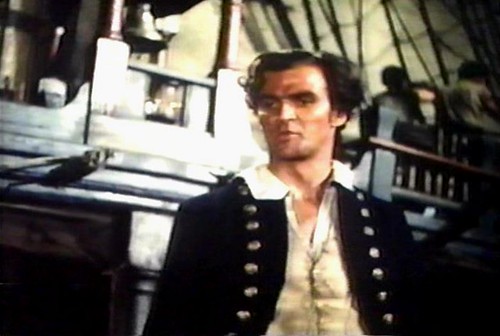
Captain Horatio Hornblower (R.N.)* (Raoul Walsh, 1951) Supposedly C.S. Forester himself adapted his first three Hornblower novels to make the screen-story for this swashbuckling distillation of the Royal Navy's fictional hero. It is 1805, and his majesty has sent the HMS Lydia on a secret mission. England is at war with Spain and France, and Hornblower must enlist the aid of a mad South American dictator in the war efforts a world away. But, upon arriving, Hornblower's distaste for the assignment and the "El Supremo" (Alec Mango) has him violating the Admiralty's standard orders, and when he captures the massive El Natividad (commanded by a very young Christopher Lee), he is forced to turn over the ship to the mad-man. Heading for home, he finds out that Spain is now England's ally (oops!) and he must re-take the massive ship on open seas, risking his crew and an unwanted passenger, Her Ladyship Barbara Wellesley (Virginia Mayo), sister to tthe Duke of Wellington and betrothed to Admiral Leighton (Denis O'Dea).
The crew is very British (
including a young Stanley Baker), but its Captain is played by the very American Gregory Peck
,** ramrod-stiff and stoic, so even though the accent is wrong, the attitude is just so—Forrester's Hornblower is a stoic, constantly questioning himself and his failings, reflected in his constant lecturing and drilling of his crew. And Raoul Walsh is the perfect man to direct, as the action director has a keen eye toward the psychological and characters with complicated motivations. Peck has the attitude, but is a bit uneasy when called upon to display the comical aspects of the still-upper-lip Hornblower—his uneasy "harumphs" are constantly dubbed in to make more of them than Peck could convey on-set. But for the brooding and irritation (and the authoritarian air), Peck is fine.
The battles are well-choreographed for the times—one can practically see the wires yanking pieces of ship-railing past the players—and sometimes the falling masts and ropes get a little out of control, but the model-work and staging are excitingly done. A fine way to spend a rainy afternoon.

* The added "R.N." because the British version of the title included them, the American did not. As with the recent Master and Commander, nothing is made of Hornblower maybe having to fight the American Navy, as he might have seven years in the future.
 
** The screen-rights were acquired for a vehicle for Errol Flynn, but after Flynn's previous movies had poor ticket sales (and the actor was proving difficult to manage), other actors (including Burt Lancaster) were considered. Peck got the part. Lancaster would star in The Crimson Pirate the next year.

Wednesday, October 19, 2022

Dracula (1958)

Dracula (aka Horror of Dracula)
(Terence Fisher, 1958) Jimmy Sangster's screenplay for the initial Hammer version of Dracula starts out much as Bram Stoker did—with an entry in the diary of Jonathan Harker (John Van Eyssen). Castle Dracula (in Klausenburg) is a good deal cleaner than previous domiciles (no cobwebs, no dust, but then the Count (Christopher Lee) does state his housekeeper is "away"), although it does an ever-present atmosphere of mist—one can even see Jonathan Harker's breath in his quarters.
 
But, Harker is not there to sell the place (as in the novel and so many versions). He announces that he is pleased to be accepted as the castle's "librarian" but he writes that he wants to "stop his reign of terror forever." You'd think, then, that he'd be a bit more wise to night-gowned beauties asking for help in the middle of the night, or that he might have come with holy water or a crucifix or a bible or some garlic of something. Or to choose his priorities on whom to stake a bit more wisely. 
Within days after Harker's arrival, Dr. Van Helsing (
Peter Cushing) arrives at the Klausenburg Inn inquiring about Harker, and is stonewalled until he goes up to the castle. Upon entering the grounds, he sees a coach leaving in a big hurry, and investigating further, he finds two coffins in the basement, one holding a staked vampire woman turned old with age, and in the other, Jonathan Harker. Van Helsing makes quick work of him with a stake through his heart.
Returning to Karlstadt (Karlstadt?), Van Helsing informs the family of Harker's fiancee, Lucy (
Carol Marsh), of the young man's death. Lucy has taken ill...with anemia...and her brother Arthur Holmwood (Michael Gough) and his wife Mina (Melissa Stribling), who rebuff the doctor despite his reputation as "a very eminent man." They choose to delay telling her the terrible news until she recovers. There's not much chance of that, as it turns out.
Van Helsing may be "very eminent" (as Stoker described him as a philosopher a "metaphysician") but he seems to have a weird specialty. We seem him dictating his thoughts on vampirism, and it gives us a veritable "Vampire Rulebook" for this film's iteration of the myth. He tells us that vampires are allergic to light (and that sunlight is fatal), that vampires are "repelled" by the odor of garlic, that the "power of the crucifix symbolizing the power of good over evil, protects the human being but exposes the vampire or victim when in advanced stages."
"Victims consciously detest being dominated by a vampirism but are unable to relinquish the practice, similar to addiction to drugs. Ultimately, death results from loss of blood, but, unlike normal death, no peace manifests itself for they enter into the fearful state of the Undead." Changing into bats or wolves is dismissed later as "a common fallacy." It's in the Stoker, but sometimes a vampire's weakness is actually budgetary.
That also may be why so many of the characters from the Stoker novel are missing (as they are in the stage play), or switched out. Lucy Winestra and Mina Murray are transferred to a more nuclear Holmwood family, Quincey Morris is sent to a farm, and Dr. John Seward's presence is minimal and there's no Renfield or mention of an asylum. Then, again, there's no transcontinental travel, either. Everybody stays on the continent. Stoker's novel is boiled down to the minimal, but in a different way than the Hamilton Deane/John L. Baldeston play (which was copyrighted and held by Universal). And, of course, it being Hammer, there are bit-pieces for character actors, some of which are rather comic.
The treatment of the Count is a bit different. Christopher Lee has 16 lines, all of them in the first fifteen minutes. The rest of the time, he is silent and menacing, baring his fangs and growling—it IS difficult to deliver dialogue when you're slurshing through fangs. There is no pretense that he is a nobleman, or even having the manners of a member of the upper class. He is a monster, a hunter, with no motivations other than to feed. And his close-ups are animalistic, with reddened eyes, wolfish fangs and without the thought of even wiping his mouth to take away the blood of his victims. But, despite that, there is a carnality to him that enflames the ladies (it is Hammer, after all) and makes them toss garlic, doff crucifixes and open balcony doors in lustful invitation to him.
There is also an overt physicality to this Dracula, as well, no doubt owing to the lack of dialogue. During the first confrontation between Harker and Dracula, Lee leaps over a large dining room table to attack Harker, at one point, running up stairs three at a time to make an escape, and, during the climactic confrontation, Van Helsing—or Cushing's stunt-double—goes full-on Douglas Fairbanks to rip down the drapes to let in the sun-light in order to reduce Dracula to ash. Talk about leaving a carbon foot-print!
Lee is quite amazing in the movie and makes a stark contrast to the cool, collected Cushing, but, the most remarkable performance belongs to Carol Marsh as the poor, unfortunate Lucy, who exhibits a wily lust before she is dispatched and then, abject terror when she is stopped from attacking her brother-in-law by a relentless Van Helsing (Marsh was also noticeable as "Rose" in Brighton Rock). She's quite amazing, especially considering the performances of Lee and Cushing, which could overshadow anyone, and which are considered—even without the benefits of vampirism—immortal.

Saturday, October 8, 2022

To the Devil a Daughter

Saturday is traditionally "Take Out the Trash" Day...
 
To the Devil a Daughter (1976) The last Hammer horror film. Would that they have gone out with something better.
 
It looks so promising, though. With a cast that features Christopher Lee, Richard Widmark, Honor BlackmanDenholm Elliott, and a pre-fame Nastassja Kinski, photographed by an A-list cinematographer, based on a novel by the same author of Hammer's The Devil Rides Out (Lee's favorite of his many Hammer films). But that 1967 film boasted a script by Richard Matheson and was directed by Hammer's most successful director, artistically and financially, Terence Fisher.
 
To the Devil a Daughter had neither of them.
 
The movie bounces back and forth in time, but the story proper begins when writer John Verney (Widmark) is on a book tour in London promoting his latest book on the occult, "The Devil Walks Among Us." At a party given by his friends Anna (Blackman) and David (Anthony Valentine), Verney is approached by Henry Beddowes (Elliott), who asks Verney a favor. Will he go to Heathrow Airport pick up his daughter Catherine (Kinski), who he believes to be in the hands of a mysterious religious sect called Children of the Lord. Why can't he go himself? Well, that's a long story to be told in flashback later.
A flashback more recent than the one that starts the movie, where Father Michael Rayner (Lee) is excommunicated from the Catholic Church for heresy. Rayner, it seems, has gone over to "the dark side" and, in Bavaria, established the Children has a satanic cult with the intention of bringing an incarnation of the demon Astaroth to Earth. And who does he plan to be the bearer of such deviltry? Why, Catherine, of course, who has been raised by the sect for just such purposes, as promised to them by her mother, a member of the Children. Henry was witness to all this and forced not to interfere lest he come to a hellish end.
Hence the machinations of putting Verney into the middle of it, as he "knows the occult" and might be able to fight off the Order. It seems a bit flimsy—Michael Crichton wrote about medicine, but I think I'd want a different doctor to operate on me—but the movie's got to start somewhere. Verney manages to fool Catherine's minders and stash her in his apartment, but Rayner and his flock use black magic and all sorts of arcana to try and find Catherine, and its up to Verney to try to save her soul.  
Despite a good cast and the photography of David Watkin (he worked on it between shooting Mahogany and Robin and Marian), To the Devil a Daughter is some of the worst kind of ghoulish tripe to come out of the post-Exorcist era, taking itself way too seriously, even while some of the instances and special effects make you want to giggle (a bloody demon puppet being the most egregious example). Despite all this, the cast remains stoic and professional, not even hinting of suppressed laughter or inordinate eye-rolling (although Widmark, reportedly, tried to quit a couple times. Damn professional, I think. The creepiest thing about it is Kinski was only fourteen when she made it—it was her second film—and a lot was asked of her. In fact, too much.
 
After the movie came out, Wheatley, who found it not only inept, but obscene, asked Hammer to never again adapt one of his novels. Now, that's saying something. But, one could hardly blame him. The only reason to see it, actually, is for Lee, who thought highly of Wheatley, and seemed to relish the chance to do a Draculish version of a cleric, combining priestly authority with malevolence.