Showing posts with label Daniel Craig. Show all posts

Friday, December 23, 2022

Glass Onion: A Knives Out Mystery

Is This Reality?
or
People Who Live in Glass Onions Shouldn't Throw Parties

When last we left renowned detective Benoit Blanc (Daniel Craig), he was solving the suspiciously unsuspicious death at the head of the Thrombey clan. In that mystery, one of the biggest puzzles was why he was there in the first place. Oh, he'd been hired, alright, he just didn't know by whom. It was just one of the intricate mysteries at the center of Catherine Wheel of Cutlery that defined that family and was—unofficially and unadmittably—its family crest.

Now, in Glass Onion (unnecessarily sub-titled "A Knives Out Mystery"*), he's inserted into a similar situation; he finds himself an uninvited guest to an improbable clique-gathering of rich-niks on an exclusive Greek island, at the behest of tech-billionaire Miles Bron (Edward Norton), who has sent mystery boxes to his clutching clutch of friends (whom he dubs "The Disruptors") that, when solved, offers an invitation to his Greek hideaway/headquarters for a weekend that promises a murder mystery and a prize to whoever solves his murder.
The guests are all old friends/associates with Miles: there's Lionel Toissant (Leslie Odom Jr.), a scientist working from Bron's company "Alpha"; there's Birdie Jay (Kate Hudson), former model, "influencer" and CEO of "Sweetypants" loungewear and her assistant Peg (Jessica Henwick)—charged with protecting the Birdie Jay "brand" due to her client's frequent faux pas; there's Duke Cody (Dave Bautista), a men's rights internet "influencer" and his girlfriend Whiskey (Madelyn Cline); there's Connecticut governor Claire Debella (Kathryn Hahn), who has been helped to office by Miles; and finally, there's Cassandra Brand (Janelle Monáe), who co-founded Alpha with Miles and who had been cut out of the company after clashing with him over a new energy fuel, "Klear."
As it's set in 2020 and there's a pandemic on, everyone is required to wear masks until spritzed with an oral COVID remedy. Once everybody's in place, everybody's happy to see each other, surprised to see Blanc, and shocked that Cassandra had "the balls" to attend. Bron is surprised to see Blanc, as well, but for a different reason—he never invited him. Who did? Along with the game that's about to be played, it is one more mystery. Everyone gets settled and gets acquainted, re- or otherwise. It becomes apparent that people are keeping secrets, and most are in some sort of debt to Bron. So, why these folks, why a murder mystery, and...why Blanc?
Why, indeed? But, to mention any more of the details will be to give away 70% of the movie. Why so much? Because you see events played out at least 2½ times. At one point, there is a cameo by Yo-Yo Ma (there are a ton of them**) where he explains what a fugue is, only to have writer-director Rian Johnson do a story version of the same concept in the very movie. Johnson is clearly having fun with the form (just as he did with the "Star Wars" universe, frustrating as it was for Orthodox Fans) and employs some of the hardest tropes in the genre in new and inventive ways. In fact, it rather reminded me of the way Robert Zemeckis capered within his Back to the Future movie in the Part II of the series (which was the one I enjoyed the most). Things are not always what they seem the first time around.
Johnson's co-conspirators in the thing are clearly enjoying themselves: Hudson has rarely been better, clearly enjoying going "all-out" in her performance, and the two actors who have the least screen-cred—Henwick and Cline—are given meaty roles to play, rather than after-thoughts. Norton is his subtly slick self. But, the stand-out (besides Craig's enjoying re-toying with the Blanc character) is Monáe, who has the toughest role, but pulls it off with what would appear to be the least amount of effort. It's part of the charm of the movie.
The other lovely thing about what Johnson is doing with the Blanc series is the sociological perspective. Just as Billy Wilder made movies that played with—and passed a sort of judgment on—the mores of their times, Johnson is making sly comments on worth and celebrity these days.
One doesn't have to make a large leap to figure out who the inspiration for Miles Bron is, but one could also make a case for a few other venture-capitalists who have a great idea but a better way to make other people pay for it. Once the money has rolled in, they can "exert influence" to buy secure the talent needed to make it work. If it doesn't work, you end up in court for fraud. If it does work, well, that was the intention, and if it works a little bit, you can spin it to say it was a complete success. This would be called "public relations."

As such, Blanc sticks out like a sore thumb in the crowd. He's not a "disrupter" (although he's better at it than anybody else on the island), but looks for truth within the bounds of "the System" among all the spinners, shakers, hangers-on, and wannabe's that surround him. Everybody talks a good game, but for Blanc it's no game. Lying is easy, but hard truths are...hard. Even when no one will admit to it. But, then, they have their reasons, and their reasons are that fame is fleeting if not buttressed with hard cash. Truth lasts.
Beneath it all, it's a fight for Truth—far beyond anything else that might be transitorially valuable. But, it's a hidden message hiding in plain sight among the cameos, trickery, feints, and revelations that Johnson delights in cramming into every frame with the hope of throwing you off the scent. My favorite example is the guy who lives on the island who wanders, drunken or high, into the frame and waves off with a "Just ignore me." But, should you? The character is named Derol, but I have a sneaking suspicion his real name might be "Red." As in the Herrings?

* Is that because no one would associate it without the allusion to Knives Out, or no one (at this point) is familiar enough with the character of Benoit Blanc? It's a mystery, itself. As such, that appendage is as irrelevant (and will be increasingly so) as the titles of the so-called "Thin Man" series.
 
**
Benoit Blanc on a Zoom call.
That would be Stephen Sondheim, Natasha Lyonne, Kareem Abdul-Jabbar and Angela Lansbury. 
 
This is just a distraction...and a nearly naked attempt to get clicks.


Friday, October 8, 2021

No Time to Die

James Bond's Swann Song
or
In The War of Orphans, Winning is Who You Leave Behind
or
"Tell Mother I Died Game" ("Well, It Just Goes to Show No One's Indestructible")
 
The continuity-conscious Daniel Craig era of the James Bond series has had a through-line simmering throughout all of its previous four films—"Don't trust anyone." 

From Craig's first film, Casino Royale, when the newly designated "00" agent James Bond has a moment of romantic weakness with the wrong person, continuing to the next film when he finds that his service has been compromised, and that the allied CIA works to cross-purposes, through Skyfall, where his boss "M" (Dame Judi Dench) sacrifices agents (including himself) indiscriminately, to the last one, where he discovers he can't even trust his past, this version of Bond walks under a cloud of suspicion, never letting his armor down, lest he be betrayed...by anyone. 

By the time of Craig's fourth film, SPECTRE, he has tipped so far over the edge that he draws down on a random mouse to ask it "Who sent you? Who are you working for?"   

As the song (from Quantum of Solace) says: "...someone that you think that you can trust is just another way to die."

The official series' 25th entry*, No Time to Die, sees Craig's James Bond retired in Jamaica and recruited—by CIA pal Felix Leiter (Jeffrey Wright)—for an operation that eventually reunites him with the people he does trust to go after people he can't, something involving a missing scientist. Another one. Hey, the series has been going on for nearly 60 years, everything can't be original and nor would the many "James Bond" devotees not allow the "familiarity factor" to creep into the story ("Where's the Aston Martin?" "Where's the martini line?" "I didn't hear 'Bond...James Bond!" "Is he going 'rogue' again?"**).
Still, with all the Fleming novels having been filmed—in one form or another—and a good smattering of the short stories included, the filmmakers have been hard pressed to keep Bond current, the movie-plots being set "a few minutes from now" with call-backs from past novels and films spattered in, as well as acknowledgments from other sources that the producers use to know that they know they're being watched.*** And the films have for the most part been formulaic—Pre-Credit Sequence/Main Title/Meeting with M/Visit to Q/Two Women (at least) with one being of mixed loyalty/The Sacrificial Lamb/Meet the Villain/Big Finish (with Explosion)/Sting in the Tail With a Challenging Henchman/"James Bond Will Return in..."—so that there were things you could count on. Rules were played with, but some you just didn't violate.
 
No Time to Die up-ends them.
As I mentioned, the Craig films are continuity-conscious. When last we left James Bond (Daniel Craig, pushing it this time, in all aspects—age, acting, etc...), he had crushed the international crime league, S.P.E.C.T.R.E., and brought to ground (literally) its ring-leader, Ernst Stavro Blofeld (Christoph Waltz)—but didn't kill him—instead walking off into the London night with Dr. Madeleine Swann (Lea Seydoux), daughter of the mysterious SPECTRE middle-man Mr. White (seen in three of the Craig's). The last shot of SPECTRE had the two seated in Bond's recently re-constructed Aston Martin, sharing smug, self-satisfied smiles. They were meant for each other.
No Time to Die begins with an episode from the past (not involving Bond, but will), and the story of the two scar-crossed lovers on a European honeymoon of sorts that is ruined when Bond is attacked visiting the grave of...Vesper Lynd (the "other woman" from Casino Royale). Coincidence? Not much of one, and as Swann and Bond are high-tailing it out of there, it's revealed that Blofeld has engineered the whole thing from his prison and implicates Madeleine. Despite her protests, Bond puts her on a train and she's out of his life. Bond and his trust-issues again.
In the past, we'd gotten used to the disappearing Bond-girl act, where after the final clinch of each movie, she is never seen...or mentioned...again. "Who?" But, the fact that Seydoux is even there—and she's the only actress playing the same Bond-woman part over two movies—means that she's special. And that the producers have "borrowed" a piece of music from the series' past (written by John Barry!!) to serenade the Bond-Swann romance means she's more than special. More on that later—Madeleine Swann Will Return.
Five years later and Bond is retired in Jamaica and alone, spending his days fishing, cooking and (probably) drinking. One day, he comes back to his house and sees evidence that someone had been there—someone who smokes cigars. He goes into town, realizes he's being followed, and manages to catch the culprits in the act. It turns out to be Leiter and a State Department official Logan Ash (Billy Magnussen) who are trying to get Bond to help track down Valdo Obruchev (David Dencik), a biochemist who has recently been kidnapped by SPECTRE. Bond had a hand in bringing him in during his tenure, and under the agency's careful watch, the man had been working on something called the Heracles Project, a form of targeted weaponized virus. MI6 lost him and the CIA is trying to get him back.
But, they're not the only one. Also tracking him in Jamaica is a "00" agent from MI6, in fact, the new "007" ("I'll bet you thought they'd retired it"), Nomi (Lashana Lynch), who's also on the look-out for the chemist. Despite her warnings to back off, Bond travels to Cuba, where SPECTRE agents seem to be gathering. Nomi is there too, and with the help of a new CIA agent (Ana de Armas), Bond walks right into a viper's nest.
The Cuba sequence, with its fights, the jokey repartee of Bond and "Paloma," their pauses to drink, while Nomi is skulking in the background looking for opportunity is probably the highlight of the film. It works like a violent dance, with a Cuban jazz background (part of Hans Zimmer's functional score) that gives it verve and a sense of hysteria. That it follows one of the creepiest scenes in a Bond film probably helps to provide that sense of chaotic relief.
But, just because that's the giddy apex of the movie doesn't mean the rest of its bad. There's a hell-bent Aston Martin chase in an Italian villa, a spooky cross-country shoot-out through a foggy Norwegian forest that is terrific, and another example of those spectacular villain lair designs that have always set the series apart from its competitors. 
This is another of those Bond films that stun for how well done the practical effects are, the cinematography—by not one of the upper tier of photographers—is lush and colorful, the editing is crisp and tight (while giving you a sense of continuity and flow—something not apparent in Quantum of Solace), and the sheer kinetic verve of the action sequences goggle. Credit director Cary Joji Fukunaga for his precise direction and making a movie that never feels like it's 2 hours 46 minutes in length ("We Have All the Time in the World," indeed!). It's a bit of a miracle, really.
Fukunaga has also inspired Craig's most intense performance as Bond, part of which must also be credited to Phoebe Waller-Bridge's re-write of the original Purvis/Wade script. Fukunaga's practice of letting the actors "wing it" gives the film a richer, fuller life, much more than the standard Bond direction of "line (beat)/funny line (beat-beat)" that makes the viewing of the older films of the series seem awkward. Here the dialogue fairly scampers when Craig's present, and only slows to a crawl when Rami Malik's puppet-master Safin appears. "He's kinda creepy" is how he's described early and, indeed, he is, reminiscent of a trembling Peter Lorre, with a philosophy that's a bit hard to decipher, though natter on about it he does. The Bond villains have some motivation, whether it be greed, errant activism, or a power grab. Safin is simply crazy, but a self-important, rambling crazy.
Now, this is going to be a spoiler-free review, but, as mentioned, this one up-ends things, but not in a way that anyone who's read a book by Bond-creator Fleming wouldn't recognize. Because the Bond films have only flirted with a strict continuity lately means they can get away with it with no harm done. The older films had a strict "Bond is fresh with each adventure" edict, which the Craig films have ignored. Bond never got hurt in the old films, but now they keep track of the scars. This is Craig's last film—he's been doing it for 16 years, longer than anybody, and wife Rachel Weisz was getting annoyed he was coming home broken. There will be another Bond, but whether the series will be as continuity-conscious next go-'round hasn't been decided. 
Original Bond producer Cubby Broccoli always maintained that Bond should be "at the top of his game" and that nobody would be interested in an "early Bond" origin story. When his kids got control, they tried it with Craig and it's worked. But, now that they've done it, there's no need to do it again. Bond may go a different route, like going back to stand-alone movies. Maybe they'll do Cold War period pieces. Maybe they'll remake a couple of the bad ones. Who's to say? And who's to say who'll be the next Bond. Finding Craig was something of a miracle despite the initial nay-saying, so I'll trust their judgment on the matter.
 
One thing is certain and that is, as the credit says "James Bond will Return." As long as the British flag flies, and the box office receipts are healthy.


* "Official" refers to the films made by EON Productions (founded by Harry Saltzman and Albert R. Broccoli), starting with Dr. No in 1962, and featuring the Ian Fleming titles they had the film-rights to, which—at the time—excluded "Casino Royale" and (owing to an early '60's plagiarism suit) "Thunderball". "Casino Royale" appeared ("unofficially") as an episode of CBS-TV's "Climax" (starring Barry Nelson as "Jimmy" Bond, American) and a 1967 "spoof" film starring David Niven, Peter Sellers and Woody Allen, before EON got the rights to it for the first of Daniel Craig's films. Thunderball became an EON presentation when the fellow who won that lawsuit wanted to make his movie with Sean Connery and worked out a deal with EON to "present" the film—with Connery—thus avoiding any competition that might hurt box-office receipts. However, when that same guy wanted to remake Thunderball (which, contractually, he could do after ten years), things were so contentious between him and EON that both sides battled in court before that remake (called Never Say Never Again and starring Sean Connery) was released in 1983, the same year as EON's Octopussy starring Roger Moore. EON now owns the rights to both the books "Casino Royale" and "Thunderball" (even including those "un-official" movie versions). They've since been doing original stories for ages, (and over several agents), and it's a wonder when some morsel of the original Fleming writing sneaks undercover into the films.
 
** The series' Bond has "gone rogue" in On Her Majesty's Secret Service, Licence To Kill, Die Another Day, Casino Royale, Quantum of Solace, Skyfall, and SPECTRE. It's as if the producers have preferred Bond's role to be less a company man and more of a rebel.
 
*** Hmm. Live and Let Die was put in during the craze for "Blax-ploitation" films, The Man with the Golden Gun was taken out of its novel-locale of Cuba to be set in Hong Kong, Thailand, and Cambodia to catch the "Kung-Fu" craze, Moonraker timed to take advantage of the Star Wars-prepped audience, Octopussy threw in some Indiana Jones action, Goldeneye's Xenia Onatopp was a soul-sister to Never Say Never Again's Fatima Blush, the fight sequences of late owe much to the "Bourne" series, and the Austin Powers movies stole all of the series' leering jokes leaving the Craig films to be a bit more stoic—although the Bond screenwriters stole the "villain-is-a-relation-to-the-hero" bit from Goldmember...as either series might say "Tit for Tat" 
 

Tuesday, June 1, 2021

The Adventures of Tintin: The Secret of the Unicorn

Written at the time of the film's release...

"The Adventures of Tintin in the Uncanny Valley"
or
"Spielberg Straight Up, No Chaser"

Everyone knows how dynamic and visceral a film-maker Steven Spielberg is. At times, he can even approach overkill, bouncing along on his little adventures, then, happily, sailing right over a cliff. Take 1941, for example, or Indiana Jones and the Kingdom of the Crystal Skull, both films of such excess that they immediately inspired ridicule. That exuberance tries the patience of many film-goers who want the director who features the Moon in his corporate logos to come back down to Earth. The term "nuking the fridge" was derisively created for the fourth Indy film (as if credulity hadn't already been crossed in the  series before...)

But, imagine (if you will...or even can) Spielberg without any constraints. I'm talking the regular constraints of film-making, the type that keep things down to the possible and even legal. Things like time, budget, light, focal-lengths, physics, natural laws (like gravity), and even the constraints for safety imposed by studio legalities and The Humane Society. Take those away—take them all away—and imagine what sort of film Steven Spielberg would make.

Scary thought, isn't it?
Now, with Peter Jackson producing, Spielberg has made his first "Avatar"-style movie, with mostly motion-capture technology, but virtually all CGI—there's no angle he can't shoot from, no perspective he can't take, no transition he can't achieve...whatever Spielberg can think, he can put on the screen, with no compromises and The Adventures of Tintin: The Secret of the Unicorn (based on three of the many Hergé books), shows what an unfettered Spielberg is capable of...and it is amazing.
And a bit headache-inducing, which I imagine would happen even without 3-D (the format I saw it in). It even approached the stage where my brain started to shut down (a phenomenon I've noticed in myself with very few movies, except for those directed by Terry Gilliam), a kind of movie-narcolepsy where I have to fight sleep, so intense and detail-filled is the movie-going experience.* Fortunately, Spielberg is so intent on making his 3-D cartoon a movie-movie, that it's quite easy to put oneself in the mode that this is happening through photographic means—only shinier, and with less dust.
So, the story of the Belgy reporter (voiced by
Jamie Bellfollowing clues and bad guys to all points of the world, trying to find the answer to the riddles of a model ship he bought at a street vendor's (and why unscrupulous people like chief villain Rackham—voiced interestingly by Daniel Craig**—might want to acquire it, by any means necessary).
And it's all done in a semi-realistic style (although tribute to Hergé's cartoony style is paid early in the film). Things are made to look real, even if the human forms are semi-cartoony. That's worked better for Pixar, whose human characters have always looked better the further they diverged from realism. Here it's a bit of a problem, especially early on in the proceedingsthere's a deadness to the eyes,*** what has been identified as "The Uncanny Valley"—the point at which, when trying to create a human simulation, the human brain (that is, a "real" human brain) rejects it, and even may be horrified by it. Examples that the film industry have taken notice of have been audiences negative reaction to the CGI baby in Pixar's first full short "Tin Toy," and the reaction of test audiences to a first-draft version of the human-looking Princess Fiona in the first ShrekThe learning curve is high in Tintin, and very quickly the issue is side-stepped with squints and off-camera looks, but it's there, initially (and, to be fair, Hergé never gave Tintin or his other characters eyes, but round pools of india ink. Imagine the horror if they did a motion-capture movie of "L'il Orphan Annie?"). But soon, events overtake our heroes, and we no longer have time to look them in the eye—it's tough enough just trying to follow them.
And that is a case of pure, undistilled Spielbergia. Enjoy.
* It's hard for me to explain what is going on (or even admit to it) when this happens. Partially, it might be because I'm not thinking much or analyzing what is happening, but just letting the images wash over me without much interpretation.  When a movie makes me think—for good or ill—I can't fall asleep.  But when there's nothing to really interpret—and there isn't much in Tintin—my mind tends to drift and be lulled.  With Gilliam and Spielberg, it might be because their movies are so full-formed and specific, there's not much for me to do.  It's like TV (which always puts me to sleep), which Marshall McLuhan labeled a "cold" medium, not asking much of its participants (if there's any participation at all), as opposed to a "hot" medium, like radio or books, where the participant's mind is active and fully functioning, filling in gaps, providing pictures and imagineering the story being fed to the brain.

** One of the really keen ideas that Spielberg brings to the table is his independence in creating the characters.  None of the voice-actors resemble their real-life counterparts—stands to reason, animators and Pixar have been doing that for years—but the recent motion-capturers, like Bob Zemeckis and James Cameron have tied their actors' likenesses to their characters, in an attempt to capture the humaness to the pixel-people.  Producer Peter Jackson, though, had no qualms about abandoning any semblance to Andy Serkis when bringing full-life to Gollum in the "Ring" trilogy.

*** One is tempted to recall Quint's soliloquy in Jaws, comparing a shark's eyes to "lifeless eyes, black eyes, like a doll's eyes. When he comes at ya, doesn't seem to be livin'."


Tuesday, January 12, 2021

The Golden Compass

Written at the time of the film's release...

"Remember, man, that thou art dust, and to dust thou shalt return"
Genesis 3:19

Oh, there have been howls in the wilderness over the film The Golden Compass, and not the kind you'd expect from anything like armored polar bears

No, indeed. The Catholic Church (which's taken a few knocks lately) and the Catholic Legion of Decency have awakened like vampires and condemned this film, based of Philip Pullman's trilogy of novels (under the title "His Dark Materials" published between 1995 and 2000)--though the Legion is remarkably silent over the Church's own trespasses. 

Then there are those fans of the books who are beating their breasts with their Anniversary Editions saying that it doesn't do "justice" to them.
Well, checking my own personal Alethiometer, I can say they're both wrong, if not downright irrelevant in their arguments. The Catholics' stance won't do anything but help the movie.* If they really wanted to prove they meant business they could excommunicate Catholic Nicole Kidman, but I think that would generate so much sympathy that folks might even forgive her for Bewitched! And the "chapter-and-versers" will just have to live with the fact that "books is books" and "movies is movies", and both media have their story-telling strengths that are oftentimes incompatible with each other.**
Enough of the controversy, how's the movie? Immensely satisfying for a first chapter (and half-a-movie). There are unresolved issues galore, confused motivations, and the lurking feeling that things might have played out a bit faster than the time it takes to say "To Be Continued" three times fast. But the production design is killer, the performances are good (though Daniel Craig has little to do, or offer, as Lord Asriel), and the effects work is exemplary. The Golden Compass takes place in a world not too unlike our own, except that, instead of souls, people have "daemons," animal-like wraiths who shape-shift until maturity sets in for the host
The academics are attempting to trace the cosmic origins of "dust," a move frowned upon with great furrows by the Magisterium (headed by Derek Jacobi and...Christopher Lee, so you know they've got to be bad!) As is shown often in the film's many scenes of combat, when a person is killed their daemons go *poof* into little whisps of CGI powder with the "glimmer" program turned on "HIGH." It is this "dust," which The Church...sorry...Magisterium wants to suppress all knowledge of, despite the fact that it's right there before your very eyes. Evidently, this "dust" is a threat to the Magisterium's political power in this World. Hence, the conflict between them and the "academics." Lord Asriel has photographic evidence of this dust falling from the heavens and entering humans through the daemons--so our link to the cosmos is via "dust-bunnies" of a sort.

That's the background dust...er, stuff.
Our heroine, Lyra (Dakota Blue Richards), is a headstrong urchin of an orphan living at Oxford as the ward of Lord Asriel
, an explorer-adventurer of some note and seeker of the truth about this "dust" business, the mention of which is considered heresy by (and produce much paroxysms in) The Magisterium. Lord Asriel goes off adventuring and Lyra is entrusted with an Alethiometer, a Golden Compass, which will tell her the truth of a subject if its asked in precisely the right way--not unlike a Press Spokesman. She also comes under the slinky thumb of Mrs. Coulter (Nicole Kidman, in full "evil-squint" mode), who does "official business" for The Magisterium, whom, she explains, "tells people what to do...but in a nice way...to keep things working." 
Lyra is always being told to behave
, yet, she has, as her two mentors, two head-strong people who like to say "no one tells me what to do." So, soon Lyra is rebelling, and escapes from Mrs. Coulter (in a scene that, in all the discourse, is given dramatically short-shrift) and embarks on a series of adventures that entails the kidnapping of two of her friends, a hook-up with a band of the takens' parents, a countrified aeronaut (Sam Elliott, never more twinklingly courtly), and a displaced prince of a polar bear playing "Hamlet."
It's this section
where the film really shines. The bears are marvels of CGI animation with wonderful actors like Ians McShane and McKellan (What? Him...again? Can they make a fantasy film without this guy?) breathing life through their vocal performances. One sight that made me laugh was during the Big Fight for "Polar Bear King," when Iorek Byrnison (McKellan's bear) has his armored head-piece knocked off and the camera (computer?) follows it to the edge of the ring, where the spectator-bears stare curiously dumb at it. The film is awash with pictorial touched like that, that fill in and make this world real whenever the story-telling turns miserly.
Performances are uniformly fine--though
Craig under-performs. Perhaps he'll be given more to do later, although it's pretty apparent who of the characters you're supposed to be rooting for early on. Time will have to tell. But it's quite good for being half-a-movie. Certainly it makes you anticipate the sequels.
It has been reported in the news that the Vatican has been "consoled" by the film's less-than-golden opening receipts. But probably less than they were when "Deliver Us From Evil" or Spotlight underperformed.
HBO is doing a marvelous 3 season series of Pullman's books, with lovely detail to the material.

* Showing off my talents as a prognosticator, the film did poorly at the box office and plans for other films in the series were canceled by NewLine. The entire series of films is being done—and done quite well—for HBO, which has so much money from "Game of Thrones," they can afford to offend the Catholic Church. By the way, with my margin or error, I have the makings to be your average pollster!

** Trouble is NewLine Cinema, which was perfectly alright with 3.5 hour versions of Tolkien, but did not want this one to be 3 hours long and so they took back the film from Chris Weitz and cut a great deal of material from it, rendering it a bit hedgy in the exposition and transition department.

Thursday, July 23, 2020

Cowboys & Aliens

Written at the time o' the film's release...

"This Galaxy Ain't Big Enough for the Both of Us"
or
"Just My Ray-Gun, Pony and Me..."

Good idea, this. Two genres that have been around as long as there've been movies* and have served the same purpose—taking a theme that might be controversial if played in modern street-clothes, but dress it in rawhide or spandex and it takes some of the "edge" off. You'd think the two would go together as well as Zero-G and sawdust, but there have been already some tentative steps in anti-gravity cowboy boots: There have been westerns with a touch of fantasy—The Valley of Gwangi—and Sci-Fi with a western foundation (Outland was High Noon in space suits) but the two haven't really been combined as equal parts as in Cowboys & Aliens (the ampersand is required).
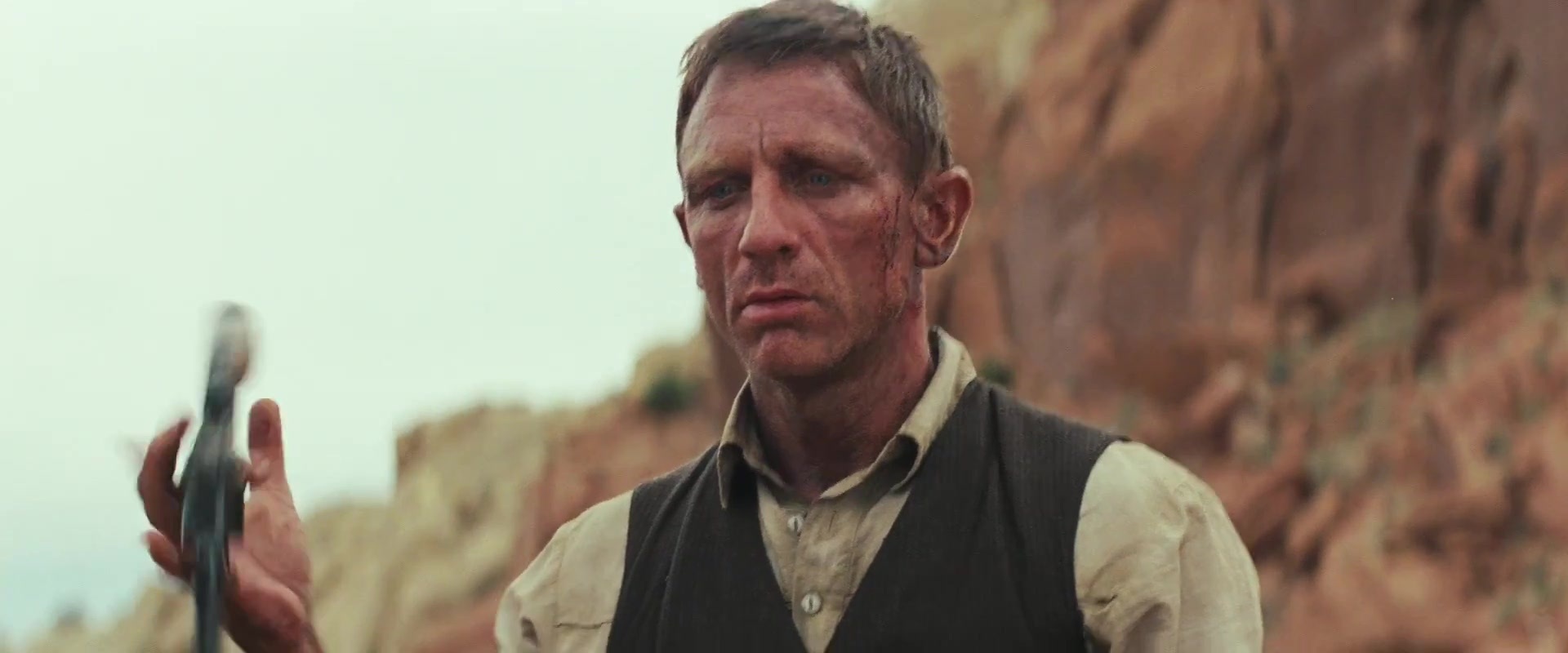
Loosely based on its comic source, it starts in familiar territory—a desert landscape, ancient river-beds long-since dried up and now sun-blasted bluffs and scrub.  Suddenly, a Man With No Name (Daniel Craig) lurches up into frame, sun-burned, bootless, bloodied with a wound in his side.**  He has no memory of who he is, where he is or why he's there (at one point a townie asks him "What DO you know?" "English" is the laconic reply). One odd thing—a thick manacle from wrist to forearm on his left armSmashing it with a rock would work with hand-cuffs, but this thing won't budge. He's set upon by riff-raff that he dispatches in a whirlwind of flying fists and gun-fire. So much for outfitting.  With newly acquired boots, shirt, vest and hat, he climbs on top of a pilfered horse and rides to a nearby town...with a loyal dog in tow. All the elements are in place.
A stranger in town (and everywhere, one assumes), he gets noticed and in trouble—mussing up the son (Paul Dano, really good) of the requisite town rich-guy-fascist (Harrison Ford, low and husky), and getting landed in the hoosegow by Sheriff John Taggart (Keith Carradine, whose Daddy appeared as a gambler in the granddaddy of Westerns, John Ford's Stagecoach). That's sounding like Howard Hawks' Rio Bravo, but about the time Ford's Colonel Dolarhyde (nice name for a rancher) arrives with some hired rough-necks to spring his boy, new arrivals appear in town—blue lights in the sky, which turn into flying ships—they recall fighter-jets in the daylightthat start blowing things up and (in a neat touch) lasso people and yanking them into the skyThe attack sets off The Stranger's fancy bracelet, which starts to "queep," pops up a sight, and knocks one of the ships out of the sky.

Suddenly, The Stranger gets a lot more interesting.
Because the invaders have been nicely particular about who they took—Dolarhyde's son, the Sheriff, the wife of the town's doc/bar-keep (Sam Rockwell, not used well enough, sadly), a posse is formed to find the kidnapees and at this point the movie turns decidedly conventional. It should. It's The Searchers, which begat Close Encounters of the Third Kind. And along the way, the posse manages to accumulate allies in a criminal gang, a tribe of Apaches (who are polite enough not to mention that "an invasion by strange aliens with weapons to take our resources" sounds vaguely familiar), and, for all I know, The Outlaw Josey Wales—who also accumulated an unlikely army that turned into family.  This is useful, because for the big battles with the Invaders, there needs to be a large number of red-shirts and red-bandanas to eliminate, so we don't lose the strays that make up the posse, which include a dog, the Sheriff's grand-son (Noah Ringer), and as Clancy Brown's Preacher (gotta have one of those, too) grouses, "We gotta dog and a kid, we might as well have a woman, too"   
That woman is Olivia Wilde, who spends most of the movie looking enigmatically sultry, while doing things that make you go "eh?" throughout the movie, beyond just the fact that as Craig gets more and more beat-up, her make-up never gets smudged. As welcome as Wilde's presence is in all this testosterone, her character is the most problematic, running inconsistently throughout the film—she's either "capable" or she isn't, and ultimately you realize that she's just a "device" that gets the screenwriters (a squad of them including the two that wrote Star Trek and the "Transformers" films—as opposed to the two who wrote the "Pirates of the Caribbean" movies) out of trouble. Mention should also be made of Adam Beach, who keeps getting better every movie, and Craig who does "the Eastwood thang" real good. Director Favreau (he of Iron Man fame, his chief skill seems to be impeccable casting), manages to direct it absolutely straight, with just enough of a hitch in the standard cliches to make things interesting, rather than well-trod.
Nothing is made of the irony of these new aliens making life difficult for "the natives," save for some terse nods of collaboration between members of the extended posse. That doesn't sadden me too much as most movies these days seem to want to beat you over the head with their "message," in case you don't get it. But, in so doing, Cowboys & Aliens manages to fulfill both the Western and Sci-Fi genre's abilities to put things in unique perspectives to throw a light onto our world. 

As I said, good idea.  A bit fun, too.

But, only a bit.


* As in The Great Train Robbery (1903) and A Trip to the Moon (1902). 

** It's not too unlike the beginning of Silverado where Paden (Kevin Kline) is found by Emmett (Scott Glenn), alone in the desert, robbed of everything but his skivvies.