Showing posts with label Rian Johnson. Show all posts

Friday, December 23, 2022

Glass Onion: A Knives Out Mystery

Is This Reality?
or
People Who Live in Glass Onions Shouldn't Throw Parties

When last we left renowned detective Benoit Blanc (Daniel Craig), he was solving the suspiciously unsuspicious death at the head of the Thrombey clan. In that mystery, one of the biggest puzzles was why he was there in the first place. Oh, he'd been hired, alright, he just didn't know by whom. It was just one of the intricate mysteries at the center of Catherine Wheel of Cutlery that defined that family and was—unofficially and unadmittably—its family crest.

Now, in Glass Onion (unnecessarily sub-titled "A Knives Out Mystery"*), he's inserted into a similar situation; he finds himself an uninvited guest to an improbable clique-gathering of rich-niks on an exclusive Greek island, at the behest of tech-billionaire Miles Bron (Edward Norton), who has sent mystery boxes to his clutching clutch of friends (whom he dubs "The Disruptors") that, when solved, offers an invitation to his Greek hideaway/headquarters for a weekend that promises a murder mystery and a prize to whoever solves his murder.
The guests are all old friends/associates with Miles: there's Lionel Toissant (Leslie Odom Jr.), a scientist working from Bron's company "Alpha"; there's Birdie Jay (Kate Hudson), former model, "influencer" and CEO of "Sweetypants" loungewear and her assistant Peg (Jessica Henwick)—charged with protecting the Birdie Jay "brand" due to her client's frequent faux pas; there's Duke Cody (Dave Bautista), a men's rights internet "influencer" and his girlfriend Whiskey (Madelyn Cline); there's Connecticut governor Claire Debella (Kathryn Hahn), who has been helped to office by Miles; and finally, there's Cassandra Brand (Janelle Monáe), who co-founded Alpha with Miles and who had been cut out of the company after clashing with him over a new energy fuel, "Klear."
As it's set in 2020 and there's a pandemic on, everyone is required to wear masks until spritzed with an oral COVID remedy. Once everybody's in place, everybody's happy to see each other, surprised to see Blanc, and shocked that Cassandra had "the balls" to attend. Bron is surprised to see Blanc, as well, but for a different reason—he never invited him. Who did? Along with the game that's about to be played, it is one more mystery. Everyone gets settled and gets acquainted, re- or otherwise. It becomes apparent that people are keeping secrets, and most are in some sort of debt to Bron. So, why these folks, why a murder mystery, and...why Blanc?
Why, indeed? But, to mention any more of the details will be to give away 70% of the movie. Why so much? Because you see events played out at least 2½ times. At one point, there is a cameo by Yo-Yo Ma (there are a ton of them**) where he explains what a fugue is, only to have writer-director Rian Johnson do a story version of the same concept in the very movie. Johnson is clearly having fun with the form (just as he did with the "Star Wars" universe, frustrating as it was for Orthodox Fans) and employs some of the hardest tropes in the genre in new and inventive ways. In fact, it rather reminded me of the way Robert Zemeckis capered within his Back to the Future movie in the Part II of the series (which was the one I enjoyed the most). Things are not always what they seem the first time around.
Johnson's co-conspirators in the thing are clearly enjoying themselves: Hudson has rarely been better, clearly enjoying going "all-out" in her performance, and the two actors who have the least screen-cred—Henwick and Cline—are given meaty roles to play, rather than after-thoughts. Norton is his subtly slick self. But, the stand-out (besides Craig's enjoying re-toying with the Blanc character) is Monáe, who has the toughest role, but pulls it off with what would appear to be the least amount of effort. It's part of the charm of the movie.
The other lovely thing about what Johnson is doing with the Blanc series is the sociological perspective. Just as Billy Wilder made movies that played with—and passed a sort of judgment on—the mores of their times, Johnson is making sly comments on worth and celebrity these days.
One doesn't have to make a large leap to figure out who the inspiration for Miles Bron is, but one could also make a case for a few other venture-capitalists who have a great idea but a better way to make other people pay for it. Once the money has rolled in, they can "exert influence" to buy secure the talent needed to make it work. If it doesn't work, you end up in court for fraud. If it does work, well, that was the intention, and if it works a little bit, you can spin it to say it was a complete success. This would be called "public relations."

As such, Blanc sticks out like a sore thumb in the crowd. He's not a "disrupter" (although he's better at it than anybody else on the island), but looks for truth within the bounds of "the System" among all the spinners, shakers, hangers-on, and wannabe's that surround him. Everybody talks a good game, but for Blanc it's no game. Lying is easy, but hard truths are...hard. Even when no one will admit to it. But, then, they have their reasons, and their reasons are that fame is fleeting if not buttressed with hard cash. Truth lasts.
Beneath it all, it's a fight for Truth—far beyond anything else that might be transitorially valuable. But, it's a hidden message hiding in plain sight among the cameos, trickery, feints, and revelations that Johnson delights in cramming into every frame with the hope of throwing you off the scent. My favorite example is the guy who lives on the island who wanders, drunken or high, into the frame and waves off with a "Just ignore me." But, should you? The character is named Derol, but I have a sneaking suspicion his real name might be "Red." As in the Herrings?

* Is that because no one would associate it without the allusion to Knives Out, or no one (at this point) is familiar enough with the character of Benoit Blanc? It's a mystery, itself. As such, that appendage is as irrelevant (and will be increasingly so) as the titles of the so-called "Thin Man" series.
 
**
Benoit Blanc on a Zoom call.
That would be Stephen Sondheim, Natasha Lyonne, Kareem Abdul-Jabbar and Angela Lansbury. 
 
This is just a distraction...and a nearly naked attempt to get clicks.


Wednesday, December 18, 2019

Knives Out

Thrombey-land
or
Ladies and Gentlemen Grieve in Different Ways

Mystery author Harlan Thrombey (Christopher Plumber) is celebrating his 85th birthday in a big way. His family is celebrating at the quirky family home for the old man and—as with most family-gatherings—there are issues and squabbles. They all involve money, because Thrombey has been quite a success.

The first clue to that is that he's 85 and living in his own home, as opposed to a facility no matter how healthy he is.

The family Thrombey has done very well for itself: daughter Linda (Jamie Lee Curtis) runs a real estate empire with her husband Richard (Don Johnson), but that was done with a considerable loan from Harlan—their son Hugh Ransom (Chris Evans) left the party early after a tiff; oldest son Walt (Michael Shannon) runs the successful Thrombey publishing empire, but is dissatisfied with the elder Thrombey's resistance to selling the filming rights—he's joined by his wife Donna (Riki Lindhome) and son Jacob (Jaeden Martell); daughter-in-law Joni (Toni Collette), widow of late son Neil, has a line of beauty products and her own self-help business and is paying for her daughter Meg (Katherine Langford) to go an ivy league college.

Then, there's "the help"—housekeeper Fran (Edi Patterson) views the family with a jaundiced eye and maintains her helping attitude with a hidden stash of dope; caretaker-nurse Marta (Ana de Armas) is well-regarded by the family (even if they can't remember her country of origin) and much favored by Harlan for her good heart and her proficiency with the game "Go." After the party, Harlan, after talking privately with all the family members, retires at 11:30.
When Fran brings up his coffee, she finds his bed unslept in and undisturbed. Continuing to his attic study, she finds it very much disturbed and Harlan dead from a slit throat, bled out, his dramatic knife/letter-opener still in his bloody hand. The police think it's suicide and they are in the process—in the form of Trooper Wagner (Noah Segan) and Lt. Elliott (Lakeith Stanfield)—of interviewing the family about the events of that evening, with one addition. He is Benoit Blanc (Daniel Craig, looking perpetually smug and utilizing the drawl of Shelby Foote), consulting detective of note (and "The New Yorker") who has been hired—by parties unknown—to determine if Harlan Trombley really did take his own life...or if it was done by the hand of another.
Like that double-conundrum, Knives Out is a multi-layered movie, not only in its plot, but in its timeline-juggling and presentation. There are complexities built on complexities: the mystery of Thrombey's death, which—at the beginning of the movie—is assumed to be one thing, which is called into question not once but twice for different motivations; the mystery of Benoit Blanc's benefactor as the detective is publicly seeking the truth of the first mystery, but privately is working on who hired him for the job.
He spends a lot of his time grilling the family members, not only looking for clues, but also for motivations about why he might be there. So he eyes the entire family like a smirking hawk, which, initially makes him an unwelcome guest and something of a detecting third wheel—he calms the family's fears by purring "My position here is purely ornamental."). But with the reading of Thrombey's newly-drafted will—"Think of it as a tax return by a community theater..."—the family gloms onto him to prove that Thrombey might actually have been killed, staged to look like a suicide, thus nullifying a will that would leave his family nothing.
And that's where things really get complicated. But, to say more would destroy the web of evidence, the suspicions and the dynamics going on amongst the suspected and suspecting family, as well as the timelines based on points of view that Johnson has intricately constructed like a jenga tower to tell a complicated story, while simultaneously building on it.
Now, the way Johnson has designed it, it puts some focus on the family members and the actors playing them. But, no one has more pressure put on them than the character of Thrombey's nurse, Marta Cabrera (de Armas). Of all the denizens of the Thrombey estate, she is the one closest to the old man, knowing him best and having his trust. She is also the most vulnerable—she's not family, but part of "the help." She has to be compliant and complacent, because her mother is an illegal immigrant and the Thrombey patronage keeps her employed and her mother safe. She fears any threat to that comfort, and the family, especially in the absence of the patriarch, is a hostile work-environment despite the smiles and the surface friendliness.
All the actors have a fine time chewing their respective scenery, but de Armas has the toughest role, playing someone "with a good heart" in a den of thieves while not looking like a victim but also looking competent. De Armas has to go through so many moods that swing back and forth like a pendulum, fading into the background, lest she betray something to the family. She must become simultaneously suspect and detective in order to protect herself and her family. It's a tough job, and de Armas pulls it off charmingly.
Knives Out carries out the time-honored game-plan of the mystery genre, but twists it in a gordian knot. to build audience expectations and then pulls the rug out from under them, staying ahead of the amateur sleuths who are trying to outguess the already-worked-out scenario. At the same time, it's a Christie-an exploration of the foibles and frailties of the upper crust, who are only too ready to break through and fall into the goo, and showing how far things can descend when greed is bad...not good.


Friday, December 15, 2017

Star Wars: Episode VIII The Last Jedi

Buying Time
or
"Everything You Just Said is Wrong."

"Darth Vader CAN'T be Luke Skywalker's father! Obi-Wan Kenobi said Darth Vader murdered Luke's father, so that would make Obi-Wan Kenobi a LIAR! Irvin Kershner has destroyed the Star Wars franchise!!" 
Said by absolutely no one...ever in 1980

The eighth episode of the linear Star Wars saga is out, written and directed by Rian Johnson this time, but it is the second of a traditional trilogy in this series, as are The Empire Strikes Back and Attack of the Clones, so, by design, it is darker, raising stakes and setting expectations for a third act, which will wrap up its story. 

But, it also has another function—it buys time, changing up some things, filling in some back-story, doing some adjustments, complications, and generally, teasing for a last act, where—if the past is any indication—they will cram in some necessary bit of information to careen to a conclusion that we should have seen coming if the second act didn't do some deflection away from it.

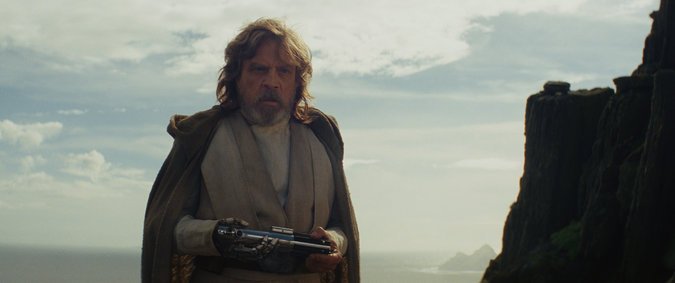
So...it is, once again, a dark time for the galaxy. If we were to believe The Force Awakens, a lunatic fringe of Imperial survivors led by Supreme Leader Snoke (Andy Serkis) is trying to gain control over the Galaxy from the Resistance, who brought Peace and Order to the Galaxy...at one time, at least. A new recruit, Rey (Daisy Ridley) who has an unnaturally strong connection to "The Force", spent the previous episode becoming embroiled in Rebel matters and, personally, set out to find the One Man who might bring things to a peaceful conclusion, the legendary Luke Skywalker (Mark Hamill). When we left the last movie, Rey was imploringly holding out Luke's light-saber to him.
But, wait...(there's going to be a lot of that, so get used to it). It seems things are not going so good in the Universe, after all. The rebellion of General Leia Organa (the late Carrie Fisher, who has a lot to do here and is extraordinarily good doing it) doesn't seem to be quite in the control we were led to believe. They are evacuating their rebel base, just at the point the First Order jumps out of hyper-space to stop them. General Hux (Domhnall Gleason) gives orders to fire on the base...and then gets a bit distracted. He's got the rebels dead to rights and when he has the opportunity to deliver a death blow, he doesn't. The Supreme Leader isn't very pleased and literally mops the floor with him. I couldn't blame him. A plot-point will come up later that might explain why they let the Good Guys jump to light-speed, but that might be too charitable. They had a chance to wipe them out, but they didn't (perhaps because if they did, as Hitchcock liked to say, "we wouldn't have a moooovie") Once the jump is made, we go back to where we left off.

The ocean planet of Ahch-To, with a convenient couple of islands on it. We reprise the scene where Rey gives Luke his light-saber. There's been a lot of internet speculation about what his first words would be. I won't spoil it. But his reaction is perfect.

Hamill's Luke Skywalker here is an interesting character, and, bless his heart, every time Hamill is on-screen, he makes the most of his time. I will try to be as spoiler-free here as possible, but Johnson gives you a reason why Luke would have run away...to this particular spot, and why he chooses to remain there at a time when worlds might be crumbling. A lot of echoing of sentiments about the Jedi Knights in the prequels is made and, frankly, I find them legitimate. I have no issues with anything Hamill or his character do in this film...although it will cause a fair amount of hysterically feverish pixels being tossed about on the internet. It is an interesting story arc for a character who usually has to be convinced to do the right—if toughest—thing.
But, back to the rebellion—the optical wipes are done quite well and done in the obvious manner that they should be, given the series' origins in "Buck Rogers" serials. There is much breast-beating done about the escape as Poe Dameron (Oscar Isaac, who loves doing this stuff, you can just tell) has used the opportunity to destroy one of the First Order's super-dreadnought ships, using possibly the silliest of the Rebel fleet's ship designs—bombers...in space. There's a lot of laser fire typically going on in these dog-fights, and no small share of individual ships blowing up. So, why oh why, would you create a ship-design with ready-to-blow-up bombs on it that you have to situate over the other ship (necessitating getting close to them) and then "dropping" them in gravity-less space. Oh, I know. X-wings make turns—one brakes and does a drop-behind maneuver, as well—TIE-fighters growl like baby tigers in soundless space, but...oh man, this is really dumb. Of course, given the fact that they're dumb ships with a dumb plan, they have a lot of casualties, and Poe is demoted by Leia from Commander to Captain for good reason. Off to the next convenient rebel base, they travel.
On Snokes' ship, the same thing is going on—the Supreme Commander dresses down Hux and brings in Kylo Ren (Adam Driver, who continues to be terrific in a tough, tough role), who, after being read the riot-act by Snokes ("...and TAKE OFF that ridiculous helmet!" he snarls) is given the task of pursuing the Rebels. This is accomplished by one of the two new wrinkles in "Star Wars" arcana—tracking the fleeing ships through hyper-space (that would take a LOT of signal strength, but wait, it gets better). The rebels are nearly out of fuel (fuel? Has anybody ever mentioned "fuel" in Star Wars before?) and jump back into real space...they have enough for a short jump, but that's about it. It's a good thing the First Order can't track them through...oh, wait, there they are. And for the second time, the Rebels are sitting ducks. What does the First order do? Kylo takes a bunch of TIE-fighters out and cut down their defenses and ships as much as possible. Then, after having done that...they stop.
Why do they stop? Hux starts to pick off transport ships one by one...whenever the mood strikes him, I guess. This gives a chance for Finn (John Boyega) and a new character, Rose Tico (Kelly Marie Tran), a chance to go gallivanting to the planet of Canto Bight to find a particular kind of "cracker" who can disable the tracking device on the lead First Order ship (they only have the one tracker installed, it seems). So, while Finn, Rose, and BB-8 go looking for that, Hux very...slowly...attacks the transports.
Now, with three fields of story going, the film starts to do some very judicious cross-cutting, as, having been stymied by her encounters with Luke, Rey begins to be contacted by Kylo Ren aaaallllllll the way across the Galaxy, enticing her to join the Dark Side of the Force. Just like tracking a ship through hyper-space, this must take a lot of energy, too. But, you've got to bridge the space- and story-gaps somehow, so...go with it. It gets interesting. But, it doesn't necessarily make things better. It does move the plot along—that's basically the first 45 minutes of the movie and it's 152 minutes long, making it the longest film in the series. As you can imagine, things get complicated.
And, at that point, I shut up. To say anything...ANY-thing else in particular will spoil what joys any Star Wars fan (or any nuance any NON-Star Wars fan) will enjoy in watching this movie. It is the second part of a Star Wars trilogy. New characters will appear—particularly Laura Dern's Vice Admiral Holdo and Benicio del Toro's rapscallion DJ (I wish there was more of him in the movie)—and because it is supposed to be a bit darker than the other entries, some characters will not make it through the movie. Some...like DJ...will just disappear. On the other hand, there are some interesting call-backs from past films, which will soften some of the blows for the die-hards.
A friend admitted recently that they'd never seen "a Star Wars." Well, this one is no place to jump in. It is, legitimately, it's own story—it has a beginning, middle and end with no cliff-hanger other than the whole thread of how everything gets resolved. But, this one has so much back-story, I can't recommend this as a good starting point. You'd get lost without, at least, seeing VII: The Force Awakens, and then, the first trilogy and the prequels, in that order. But, that's a lot of studying to do for something that's supposed to be entertainment. I've had job training that lasted less than that would take.

Snoke gets in your eyes...
 
The other thing (for die-hard's) is that whatever you're expecting—and more importantly, if you THINK you know what's going on—you're wrong. Enormous things happen in this, and some aspects, questions, origins...will simply be dropped without resolution or a tidy explanation. This will frustrate some. Not me. I took rather a perverse joy in it. Hey..."Sith" happens. As the character DJ says at one point, "Good guys. Bad guys. Made-up words."
I like that. But, I'm still having problems with the villains. I think they're not much of a threat. They're not as vicious as they should be—the whole movie teeters on the fact that they just don't go in blasting everything and bloody end the rebel threat. I don't find them credibly motivated. And Kylo Ren?  Driver pulls it off, but he has to be the most un-readably vague villain that there is. He is constantly in conflict, wanting to be like his grand-pappy Vader, but always spouting about "forgetting the past, destroying it." Dude. Has anybody played back what you're saying to you? What do you want, Kylo? What's the game-plan? Hell, what's the end-game? What are you trying to accomplish? I hope Episode IX tells us that he's suffering from a midi-chlorian overdose and prescribed some Alderaan Adderall. He may be the most pitiable bad-guy since Wile E. Coyote.
So...good? Bad? I dunno, is there an "ambivalent" side to the Force? The Last Jedi is clearly better than The Force Awakens. It takes chances. It takes chances that will upset people (ya know, like the prequels). It goes places people won't expect...to a purpose I don't think the producers have figured out yet. But, I hope the philosophy is in the same vein as this film, not going the safe route despite the lapses it took to get there. One must keep in mind that Star Wars was made to be a "gee-whiz" "Buck Rogers" adventure story with grit and texture. One mustn't take it too seriously. Up, you must grow...ye-ees.

Friday, October 20, 2017

The Brothers Bloom

Written at the time of film's release on DVD. That's why there's no mention that Johnson subsequently made Looper, and has been working on the latest Star Wars film, The Last Jedi.

The Brothers Bloom (Rian Johnson, 2008) This is one of those ones that "got away" when I first started writing a movie blog; I'd wanted to see this in the theaters and it disappeared, just like your betting money, so quickly that there wasn't a chance. to make good on it. 

Johnson had been the enfant terrible behind the enfant terrible noir-film Brick, (which was a nicely designed but ultimately precious/pretentious conceit—a detective movie set in a high school—taking the hierarchies of the "clique society" inherent in those teen years into a level of the absurd), but there was enough there to anticipate what he was going to do next. The last thing you'd expect would be this reality-twisting con-game movie at equal times ebullient and dark, densely written and skippily edited that tips its hat to the Tarantino era with all its style, but none of its sloppy excesses (and fewer call-backs to earlier films—this isn't a film conceived from watching videos during your down-time at a video store).
And the other thing: it's a double-love story...about people who can't, don't or won't tell the truth and being able to express that love and make it stick, or accept that love and believe it. Something to do with trust, really.
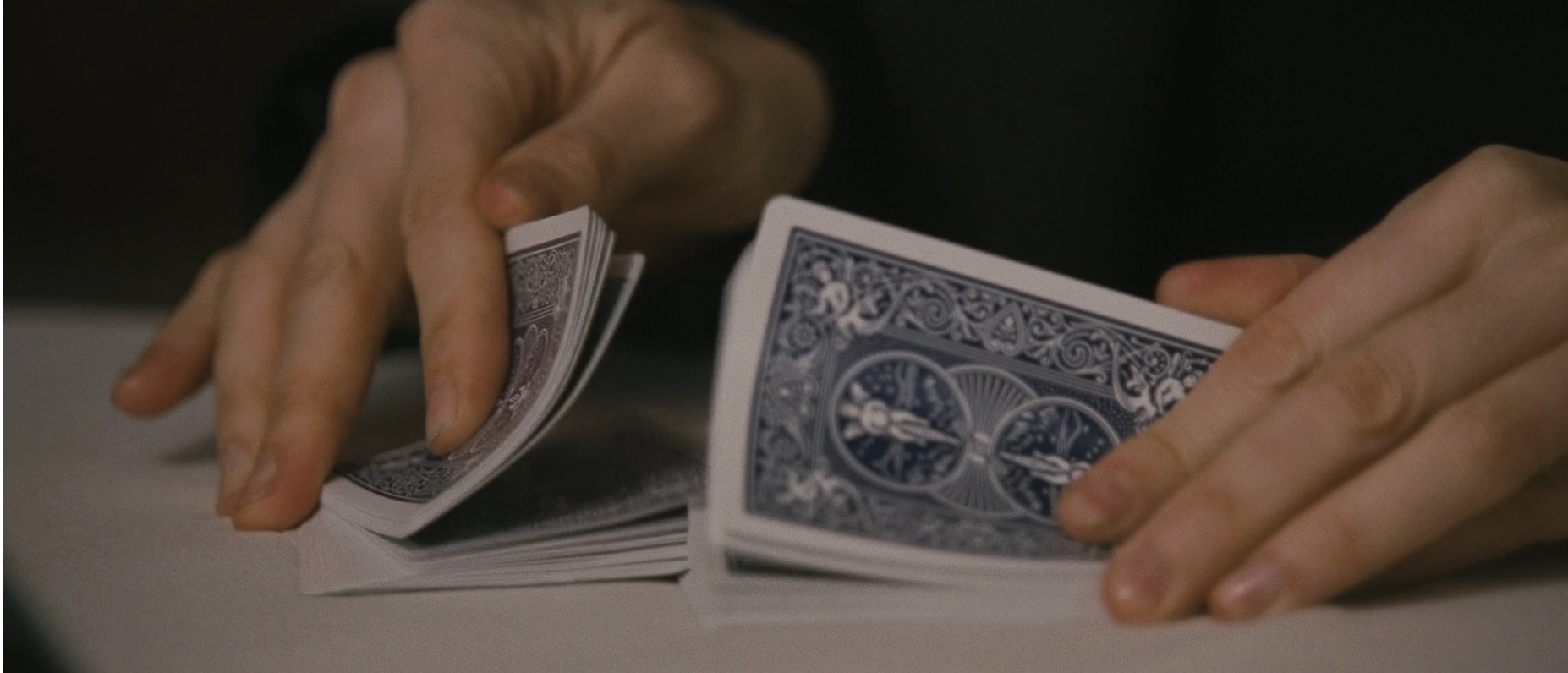
No, no. Don't get worried. It's also a lot of fun, especially in its puppyish wise-acre first hour that moves at such an unsustainable pace of quirk that the second-half doesn't have a chance to match it. That half-way down-shift initially feels like a let-down (and some unfortunate back-story editing robs the movie of some Peckinpavian resonance), but Johnson has to reveal the con at some point and the visceral let-down is inevitable. The motto of the movie (and The Brothers Bloom) is "the perfect con is when everyone gets exactly what they want." Johnson manages to pull that off...and quite brilliantly.
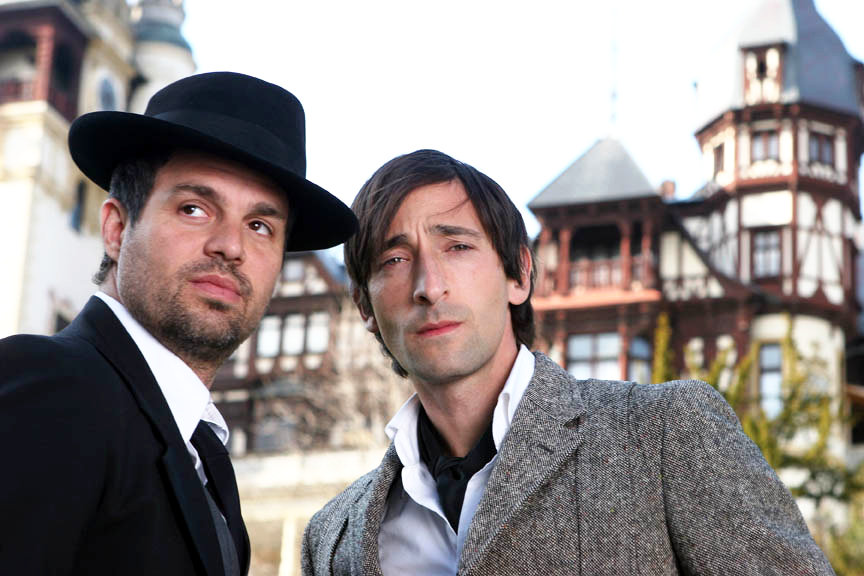
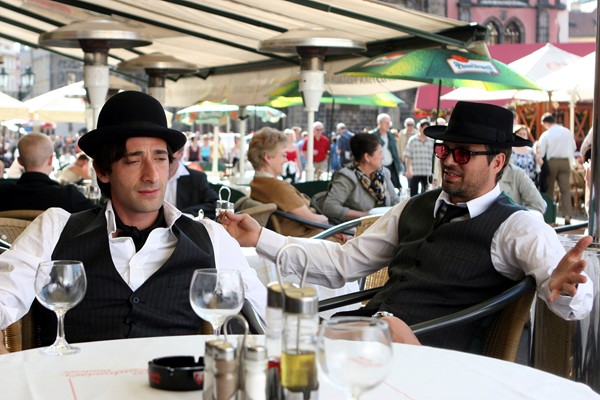
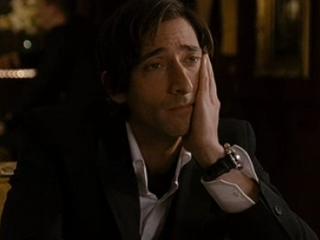
He's got great players to do it with. Adrien Brody and Mark Ruffalo play the brothers (Brody's Bloom, and Ruffalo's his older brother Stephen), two orphan con-men locked in the game that informs and colors their lives. Their partner in crime is the mostly mute Bang Bang (the clever Rinko Kikuchi), and there's a network of con-men they tap into (but never really trust) including The Curator (Robbie Coltrane) and Diamond Dog (Maximilian Schell)—a lot of Oscars in this cast—but the focus of the last of a series of Last Big Cons is Penelope Stamp (Rachel Weisz) an eccentric millionaire, isolated in her youth by a misdiagnosed allergy (to everything), and with whom Bloom becomes her first true friend. Weisz's peculiar choices in performance nicely buoy Brody's sad-sack (which he has perfected) and both Ruffalo and Kikuchi play off each other and the other actors with a kind of thrilling certainty of the world and their place in it (and ability to change it). Johnson's multi-plane action in frames (especially in the first half) approach the deft timing of a Warner Brothers cartoon
It's different, breaks the mold, keeps you guessing and stays with you until you make that last jump—that all movies are a con. And the best ones are the ones where people get exactly what they want. Yes.

Saturday, September 19, 2015

Brick (2006)

Brick (Rian Johnson, 2006) One can see why the writer-director of this "high school noir" wanted to do this: the societal stratification of high school resembles the noir tiers of authority and outlaws, be they penny-ante, or high rollers. But, instead of the mooks and frails, we have the sosh's, the jocks, the drama queens, the brains, etc. Instead of the mean streets of the city, there are the sterile hallways and cold, hard walkways of the courtyards of high school (specifically, San Clemente High School--located in Richard Nixon's Elba). There's the police, but also the school administration (Richard "Shaft" Roundtree plays the vice-principal, bless him). Then there are the crimes--against society and the obligatory ones of the heart. And there's the melodrama, at its sulphurously volcanic peak in noir and high-school; everybody has their blood up and the rocket-fuel of pulsing testosterone and estrogen becomes toxic and explosive. It's amazing that anyone gets out of high school alive, let alone graduates with honors. They're the lucky few.
So, one can see why they'd do it. And there's the advantage that film noir's are traditionally the down-side of the studio system. They weren't expected to be "prestige," in fact, the cheaper, the better. So, if there's a bit of amateurishness, that's part of the charm--as with high school theatrics. Brick benefits from that, too. These are teen actor's. We're not expecting them to be too good, although there are some pleasures in the performances.
But, the amateurishness hurts. This is one of the first English language films I've had to watch with subtitles "on." Two reasons for that: the tough-as-nails patter from all parties is more exotic (and phony) than the teen-speak of Juno, and it's delivered at break-neck speed with little inflection by soft-palette actors who haven't learned to e-nun-ci-ate. You can get lost pretty quickly in all the muttered asides and rolled together phrases. One section of early, extremely important dialogue is phone-filtered on top of being delivered by a semi-hysterical character and it's undecipherable without a libretto. The lone exception is "The Pin," played by grown-up kid actor Lukas Haas with a laser-like intensity, and the costuming of Barnabas Collins.
Fortunately, Johnson has enough visual pyrotechnics to lean on, but just as he's borrowed elements of the script from Hammett, his visual style is cribbed from, of all people, Leone--all negative space and extreme proximity's. One is propelled by the occasional good idea or a visual joke that thrusts into his frame. Every punch is a hay maker. No clue is left without a tilted close-up. Johnson couldn't be more obviously visual, while being tone-deaf with the sound.
In the end, with the pro's and the con-artists, one begins to see it as the one thing it shouldn't be--precious. The effect is a bit like all those kids playing gangsters shooting marshmallow bullets in Alan Parker's Bugsy Malone. The dialogue wants to impress you with its toughness, but ultimately its out of the mouth of babes, with the visual sense of Danny DeVito, rather than Dassin or Hawks or Mann. In the words of Bogart's Philip Marlowe, "The cheaper the hood, the gaudier the patter." Or as P.I. Milton Arbogast (before he climbs the stairway to heaven), "If it ain't gellin', it ain't aspic." And this ain't gellin.'