Showing posts with label Jane Lynch. Show all posts

Tuesday, April 2, 2024

The Three Stooges (2012)

It's a little late for April Fool's Day, but here's a legit review of the Farrelly Bros' take on "The Three Stooges" (Legit'!)

Written at the time of the film's dropping like an anvil on the head ("Why, I oughta....")

Going Through a Series of Stooges
or
A Reboot Right in the Keister

Last week, a Catholic bishop made headlines by comparing President Obama to Hitler (one suspects for the mandate that birth control—a Catholic "no-no"—be provided as part of health care, instead of only God being allowed to service the reproductive equipment) and beating his breast over "the culture war against the Catholic Church."  

"Why, I oughta..."

Two things: Any recent problems the Papists have had lately, they've brought on themselves (and frankly, some of those priests should be practicing birth control);* and, it's funny that he's invoking Hitler now, when his Church took a virtual vow of silence on Der Fuerher during the Second World War, during what was a real flesh-and-blood religious war and not some fantasy "culture war."  That argument does not hold holy water, which one is starting to suspect is made up of crocodile tears.
But...wait.  After seeing
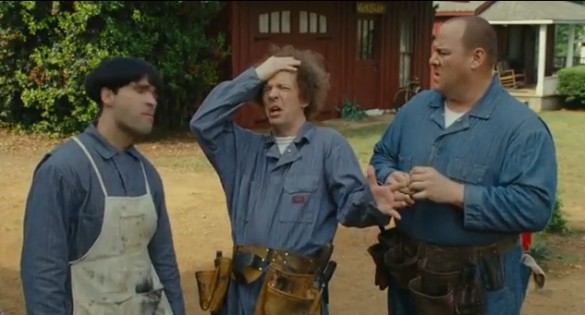
The Three Stooges,** one might concede the bishop a point or two...right in the eye-balls. The plot concerns the new version of the Stooges ("Moe"=Chris Diamantopoulos
, "Larry"=Sean Hayes, "Curly"=Will Sasso) trying to raise money for the orphanage they grew up in (shades of The Blues Brothers). The boys are left there as infants and grow up to be complete idiots (while the nuns age not a day***).
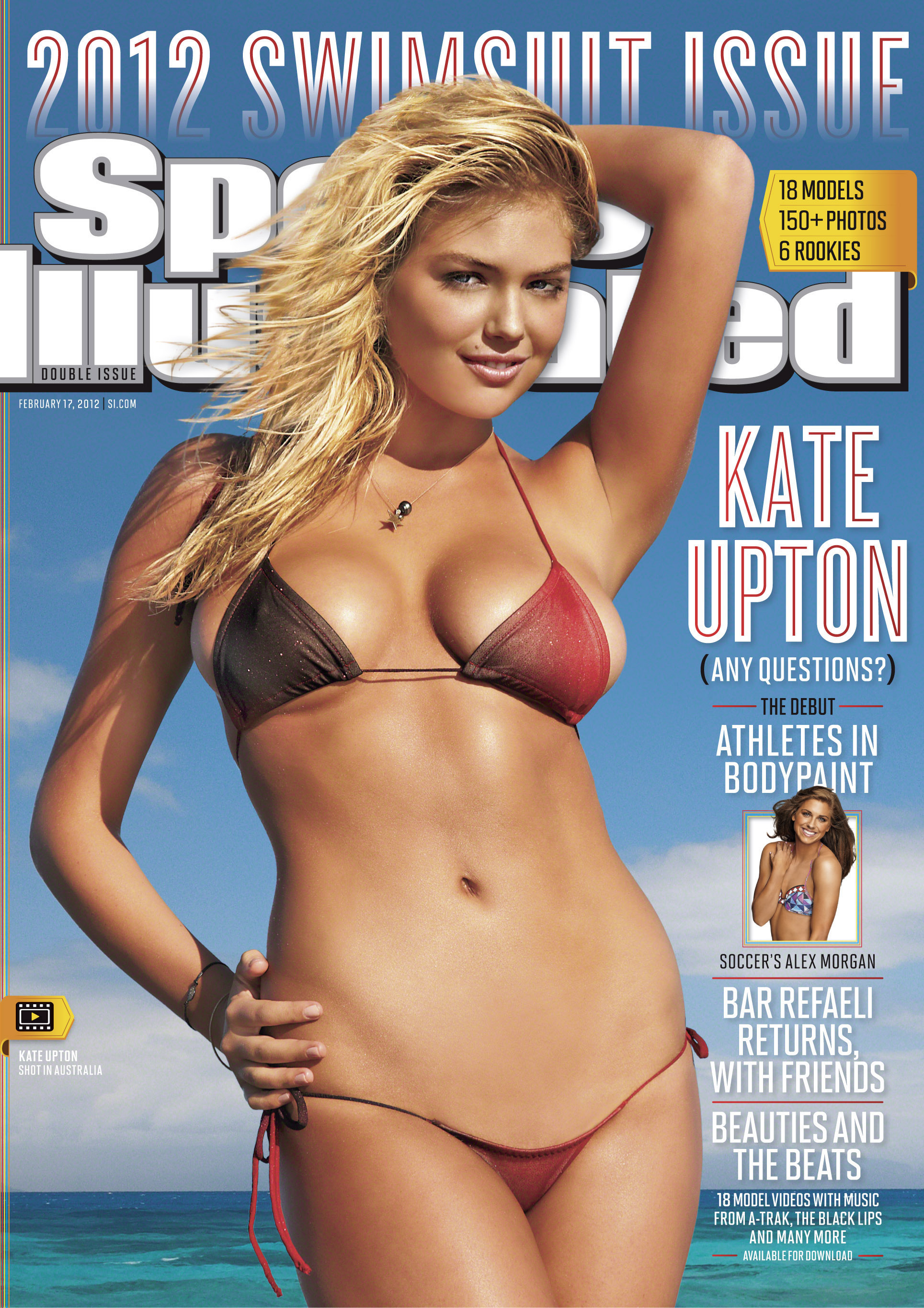
The nuns include Jane Lynch (unfortunately, dialed down from her potential), Jennifer Hudson, Kate Upton (Sports Illustrated's latest bikini cover-girl), and...Larry David (as Sister Mary-Mengele). It's a small shock to see David in the role, but apt, as he (she?) gets the lion's share of the abuse from the boys (and after years of cringing at David's antics on "Curb Your Enthusiasm" a little cathartic), but once the plot gets going, the hi- and lo-jinks get spread out for all sorts of guest stars, including Stephen Collins, Sofia Vergara, and the cast of "Jersey Shore" (also particularly satisfying, when "Moe" briefly joins and abuses the cast). The film is divided into three episodes that eventually come together at the end. It works, and surprisingly well, as the Farrelly brothers are fans enough not to mess with what worked in the past (and, of course, made them fans).
"Nng-yaaangh-yangghn!"
This director team is hit or miss for me. They can "work" (as in the anarchic There's Something About Mary) or not (Dumb and Dumber, where I didn't laugh once and kept checking my watch). But, this one clicks along at a good pace, generated by the facile performances of Hayes, Fasso and Diamantopoulos. The brothers are very aware that this one will be mostly for kids—their other PG-rated film was Osmosis Jones—and there's even a post-script (by Faux-Farrelly's) warning youngsters "don't try this at home" and showing how eye-pokes are done and the rubber hammers props. So, this is a diluted version of what they could have done with it, and one can only imagine how much further they could take it.
"Nng-yaaagh-yangghn!"
But then, one wonders what would have happened if the original casting had gone through: Jim Carrey as "Curly," Sean Penn as "Larry," and Benicio Del Toro as "Moe." All fell through for one reason or another. "Creative differences," maybe. Gee. Ya think? With those three involved, things might have been a bit more socially-oriented—having The Stooges involved in the banking industry, or maybe involved with the initial Hurricane Katrina response. But, I'd like to think that a great comedic vehicle ripe with with possibilities would be the one place they might naturally fit in—Congress. "Soitanly!"
"Helloooooo"
         "Helloooooo" 
                        "Helloooooo"
The original Larry Fine, Moe Howard, and Curly Howard (Rest in Pieces)

* I'm a recovering Catholic, by the way, take that for what you will.
**  Should we be calling it "Three Stooges 2.0?"  Or after the "Shemp" and "Curly Joe" years, is "Three Stooges 4.0" more accurate.  At what Stooge are we?)
*** This is a quibble and thinking WAY too hard for a Stooges movie—any Stooges movie—and that is one thing the Farrelly brothers do really well here: keep the comedy simple and stupid, on the order of the comedy era in which the originals wreaked havoc.  There's always a tendency in remakes and re-boots to complicate matters, as if to legitimize it in some way.  Not here.  You can't take this stuff seriously in any way, shape or form.  But, the sheer visceral joy of the Stooges is amped up slightly, matching the already precise vaudevillian timing of the first Stooges.

Tuesday, September 29, 2020

Julie & Julia

"Too Many Cooks Spoil the Froth"


Nora Ephron directed movies have the same half-circle trajectories as "Star Trek" films: you get a good one, the next one stinks. Whether by virtue or vice of over-confidence or coasting, it seems you can't have two good Nora Ephron movies back to back. For every Sleepless in Seattle, there's a Mixed Nuts and for every You've Got Mail there's a Bewitched.

That's if you're a normal person. For me, I have yet to see an Ephron effort that hasn't made my toes curl inward in their shoes. There's a slap-happy spunkiness to her movies that just make me want to plunge my fore-head into the seat-back in front of me. Her nadir came with her last movie: how in the Hell can somebody screw up
Bewitched? It wasn't due to the Kidman Komedy Kurse, but a clear case of a writer-director trying too hard, Bewitched showed the ruination of tailoring material to attract a star—Jim Carrey as Darren—and then not going back to Square One to re-tool it when they don't get him. Will Farrell could be an astonishingly good Darren, but in another movie, not so driven by the character as it was re-tooled. And her efforts to make it a one-off Bewitched just seemed pitifully neutered—here's a concept where the woman has all the power, and Ephron compromised it. I know a lot of women who were fans of the TV show could not believe how badly the movie botched the premise. They felt betrayed.
Fans of Julia Child and "The French Chef" might feel the same way, but at least the effort was made to make a better film. Julie & Julia is based on the book written by Julie Powell cribbed from her Salon.com blog, a breezy chatty thing done for the same reasons as the blog you're currently reading: to write. And the only way to improve your writing is by writing, and then writing more. I don't write about cooking (but I know people who do), and it is that discipline to produce and take stock and put it Out There that (supposedly) makes you better at it, whether it's writing or cooking or (non-committal generality). Sometimes, like Powell, you get an audience, but it doesn't matter: becoming a better (non-committal generality) is what matters. This is my way of giving kudos to Powell, who's gotten a lot of stick lately for a) not being a good cook—she blogged about cooking out of a recipe book (doy!) and b) being successful when there are a lot of food-bloggers out there who aren't (see a).*
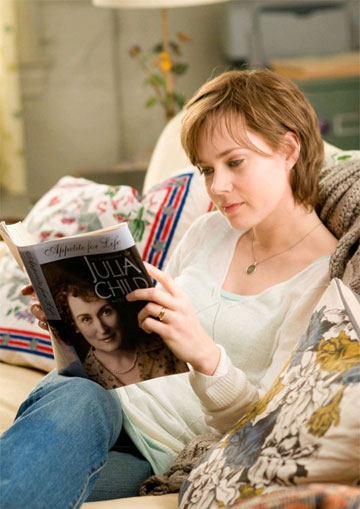
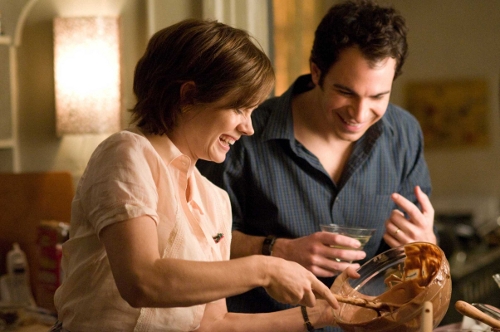
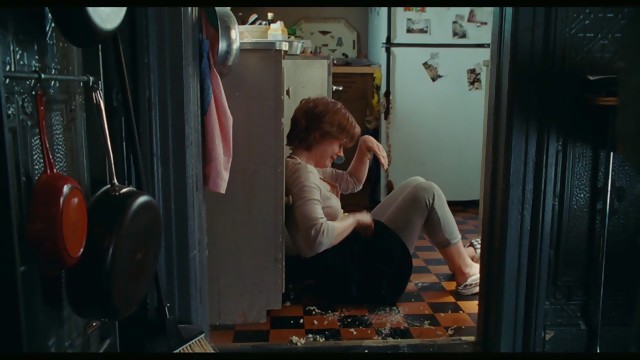
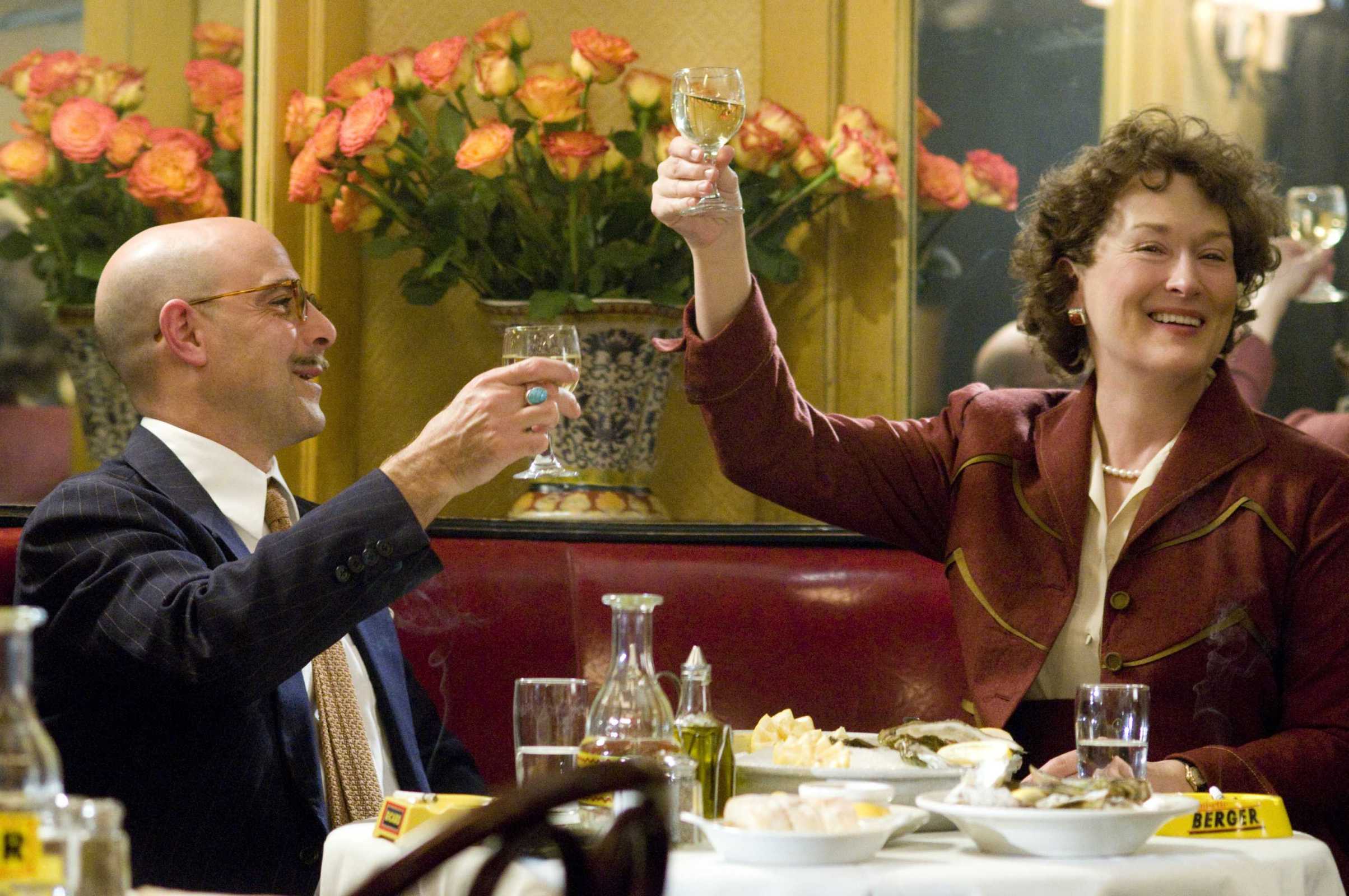
Having said that, Ephron made a stupendously wise choice to actually combine Powell's story with that of 1948 Parisian-based Julia Child (Meryl Streep) on a parallel course. Both women find themselves tethered and adrift: Julia, after working for the OSS, and married to diplomat/spy Paul Child (Stanley Tucci's best role in years) does not know what to do in Paris other than effuse, and Julie Powell (Amy Adams) finds herself in a bad Queens apartment,** at a bad job (at a post 9/11 Lower Manhattan management company), and with nothing satisfying in her life—her dream of writing a distant memory. JC decides to take cooking classes—in a class entirely of men, while JP decides that since she finds solace in cooking she's going to spend a year following Child's recipes and writing about the experience. Ephron's film then follows the two women through their various experiences until reaching their final triumphs—both of which involve being published.

Good enough. Enticing enough, actually. But, truth to tell, despite the best efforts of the impeccable Amy Adams (trooper that she is—she's perfected a mono-syllabic babble in moments of confusion), the movie just stops being interesting every time we jump to the present day story, probably because that story goes through the Ephron story-grinder—get a goal, have your effervescent highs, have your debilitating lows, but everything works out in the end (Cue Uplifting "Standard" Song).

The
Julia Child sections fare much better because Child was doing something a bit revolutionary and she was a fascinating personality and is played wonderfully well by Meryl Streep. But it's like banging the oven door on the soufflé every time we move away from the past because like a good balloon, you can't take your eyes off something that defiantly floats. That Child has interesting people to play off of—Tucci's husband and, in what might be the acting scene of the year, Streep bouncing off the brilliant Jane Lynch playing her sister—while Adams struggles in relative self-involved*** isolation, might be part of the problem.
But, truth be told, just as Julie falls in love with Julia the person, the audience does, too, and the movie falls victim to its own story; when the person keeps stating over and over what a great person "blank" is, you tend to believe it, even over the person who's stating it. And Streep's Child is far more child-like than the real person, finding the charm in everybody and everything, head-strong and a foot taller than everybody else in the vicinity (they did some careful casting and set design for this), crowing with delight and bouncing in triumph, you can't help but love her...and admire, once yet again, how Streep can take ordinary reactions and make them extraordinary.
You can still see Julia Child on TV. There's a new regurgitation by PBS called "Dishing with Julia" which features celebrity chefs watching old episodes of "The French Chef" and making comments—none of which approach critical. The most recent one had Top Chef Carla Hall observing Child slapping bread dough around on a cutting board and doing a hilarious imitation (they all do, actually) with every slap: "THIS isn't precious! THIS isn't precious!"

* Not to belabor the point, but look, she did it for self-improvement—that she made a success of it and is surfing her high tide well is just, well...gravy. Or just desserts.

** That I think New Yorkers might kill for.

*** Ephron hammers the "self-involved" blogger bit a might hard considering the number of bloggers and Facebookers and Twitterers in her audience (so says this self-involved blogger).

Thursday, May 23, 2019

Paul (2011)

Paul (Greg Mottola, 2011) The team of Simon Pegg and Nick Frost are an acquired taste...at least for me. Some of their stuff is iffy, marginal, borderline—good ideas stretched thin. 

Then, you get something like Paul, which I was late to, but managed to catch on cable and was ready to dismiss until it started to layer in concepts and in-jokes and do something that the two were spotty on when teamed with the brilliant Edgar Wright as their director-co-scriptwriter.

It has a lot of depth. It's a deep-dish dive into American obsession with pop-culture as witnessed by two guys across the pond who should be shaking their heads at the madness, but instead embrace it with the sense of wonder that used to be generated by such things before they got over-merchandised in the marketplace. It's also a neat little throw-back to the older films that inspired the writers
Two nerdy Brit's, Graeme Willy (Pegg) and Clive Gollings (Frost), are on a U.S. pilgrimage to the San Diego Comic-Con, driving an RV through the stark landscapes of the Southwest U.S., home of test-sites, nuclear landmarks, and fabled numbered Area's of Interest in UFO mythology. They have to deal with the denizens of the area, and one particular stranger with whom they have a close encounter of a vehicular accident kind.
This is Paul (voiced by Seth Rogen), an extraterrestrial whose most recent home has been Area 51, where he has been kept under house arrest and study, advising the government on advanced technology and, in return, being kept safe, even ensuring that alien information is leaked through back-channels, just in case his brethren return to find him.
It's a comedic version of E.T. with the lost voyager—but instead of being found by a kid in the suburbs, he's found by the government agencies that want to keep him under wraps. But Paul has outlived his usefulness as a live subject; the reason he's made his escape is that he has been due for vivisection. So, despite the qualms of Clive, the two take on the little alien as a passenger, taking a side-route to San Diego to get Paul to his designated meeting place with his people.
There are, of course, complications. Paul is being sought by government agents in the form of FBI Special Agent Zoyl (Jason Bateman), who is under orders from "The Big Guy"—his female boss communicating over the radio—to track down Paul and return him to Area 51 for disposal. When he is unable to make much progress (given his disappearance from the car that he stole in his escape), she adds to other FBI agents, Haggard (Bill Hader) and O'Reilly (Joe Lo Truglio)—who are a bit hapless—to assist, although the three seem to be under different assignments, working at cross-purposes. 
And if things weren't complicated enough, an overnight stay at a trailer park gains them another passenger, Ruth Buggs (Kristen Wiig), the one-eyed daughter of Moses Buggs (the wonderful John Carroll Lynch), the Christian fundamentalist owner of the park—she encounters Paul and the vagabonds have no choice but to take her with them, which worsens the stakes against them and adds one more dangerous element to the many people trying to track them down. Father Moses is determined to track the heathen down and shoot 'em and get his kidnapped daughter back, just like John Wayne in The Searchers or Melinda Dillon in Close Encounters.
It also adds a little nuance to that as he's completely religious and any evidence of there being extra-terrestrial life or hint that we might not have the full undivided attention of God's eye would completely toast his wafer, so to speak. But, he doesn't know about Paul. All he knows is that nerds stole his little girl and he's gonna get her back just as sure as the turnin' o' the Earth. That daughter Ruth is a bit more open to the idea of e.t.'s and wants to help him escape makes her a valuable ally (if risky) and she is rewarded for that by Paul giving her a new eye to replace the one that doesn't work.

Believe it or not, they resist playing "Amazing Grace" in the background of that scene.
There's enough laughs and something akin to warmth in the film to keep one intrigued and it manages to pay off expectations and keep surprising with what turns up and the film resolves itself. And with players like Pegg, Frost, Hader and Wiig on-board, the material will end up being served in the most creative ways possible.
Director Edgar Wright was not along for this fun little journey. In his stead, the director is Greg Mottola, who made Superbad and Adventureland, but, more importantly in my view, he was the director of the pilot for Aaron Sorkin's brilliant HBO series "The Newsroom"—one of those "perfect" examples of really good television wedded to smart ideas. Mottola did amazing work on that, juggling multiple story-lines and planes of view without "losing" any of the viewers. His work on Paul is more sedate, but there is a reverence to making sure that tribute is paid to past touchstones to make sure they have a maximum pay-off.

Plus, it's just funny as hell.


Thanks to Donavan for the suggestion

Saturday, December 8, 2018

Ralph Breaks the Internet

Pulling the Ol' Plugola
or
Life Among the Block-Heads

It's surprising how you can not want something until you need it.

For instance, "Lounge Seating." My first experience of it was at an early proponent of it, and the layout was haphazard and piece-meal—a flat floor with a bunch of barcaloungers underneath the screen. I found it uncomfortable and distracting...(or maybe it was because I was watching Baz Luhrmann's version of The Great Gatsby). Not even the new experience of being able to raise my feet —without interfering with the seat of the audience-member in front of me—into a semi-reclining position could dissuade me that this was not a step forward in the movie-going experience. Anyway, it was my first introduction to the trend and I found it lacking. But, then my thinking is that you go to the movies to see movies, not to eat popcorn (how can you eat popcorn when you're scribbling notes?). Ever since, I've curled my lip at the idea of "luxury seating" the way a dog curls its lip when it considers a raccoon.
But, I've now come around the other side of the debate after having watched Ralph Breaks the Internet, Disney's sequel to Wreck-It Ralph. "Lounge Seating" was a god-send, and a salvation. I knew I was in for it, when the super-quad-surround sound of the theater was prominently scrunched to the left side of the hall (to the point where the dialog out of the front speakers could be legible only if you stuck your finger...or a Milk-Dud, raisinet, rolled up Red Vine?...in your left ear) to the point where the dust from the vibrating plaster walls on that side were covering up the "row letters" on the aisle carpet.
There are Pop-Up's, Pop-Up's everywhere...
From what I was able to discern, Ralph and Venellope (voiced, as before, by John C. Reilly and Sarah Silverman) have become inseparable pals when they're not at the day-jobs as video-game characters in the copies of "Fix-It Felix" and "Sugar Crush" inhabiting the video arcade of the "Family Fun Center" of Mr. Litwak (voiced by Ed O'Neill). Ralph couldn't be happier, but Venellope is starting to get tired of the routine, the same-old, same-old of the three tracks that "Sugar Crush" provides—ya know, sort of like watching a lot of Tom Cruise movies (is this the one where he rides a motorcycle?...oh, right, he does that in ALL of them).
Then, disaster strikes. The steering wheel used by players to drive the "Sugar Crush" cars breaks—Ralph is indirectly involved this time—leaving Venellope "gameless." What to do, what to do. Well, as Litwak has installed a wi-fi router into Fun Center, it's only a matter of time before Ralph and Venellope travel to the Land of the Internet to see if they can find a replacement steering-wheel and get things going again. How they get to the Internet is a tortured path-way that made me think that somebody just applied the pop-psych landscapes of Inside Out and just applied it to dial-up.
The opportunities for satire are as seemingly endless as a YouTube conspiracy video, but given permission and copyright issues inherent in using those company names, the satire is as tough as a NERF™-ball. Ebay, YouTube, Amazon are all mentioned, but Google is confined to a character named Mr. KnowsMore (voiced by Alan Tudyk) who does searches around the Internet, like a kiosk lady at a mall—why they didn't just call him "BING"* would take enough lawyer's briefs to create its own cease and desist order.
Through the search process, Ralph and Venellope find that they can bid on one of these "Sugar Crush" steering-wheels over at Ebay, but when they get there, they find themselves bidding against another user—all the avatars of real-world users are represented by bi-ped's with block-heads, which gives you an idea of how YOU rate in this movie—which they out-bid with a winning sum of $27,001. Their brief joy at getting it is extinguished when they go to check-out, and find that they don't have any of these dollar-things (being as they're just video-game characters who don't get out much) and are told they have to come up with the cash in 24 hours or they will lose the item.
They go about securing the funds in two ways: from one of the annoying pop-up sellers that zap in everywhere—this one named J.P. Spamley (voiced by Bill Hader), Ralph and Venellope learn they can earn money by playing video-games (imagine!), and their assignment for more than enough to claim the steering wheel is finding an easter-egg in the form of the top prize of a GTA video-clone called "Slaughter Race," the car belonging to the character Shank (voiced by Gal Gadot). Their efforts to get the car has unintended consequences—Shank hooks them up with a viral video channel called BuzzTube...and Venellope develops an interest in wanting to be one of the Fast and Furious in "Slaughter Race."
Ralph's appearance on BuzzTube brings him to the attention of Yesss (voiced by Taraji P. Henson) who uses him to increase traffic to the site, while he gets a pay-out for the number of "like's." Venellope helps out by doing her own pop-up selling, which lands her in...wait.

Let's stop there.
Sooooo...the barcaloungers, back to them. Why my obsession with them? It was around this point in the movie where I found myself sliding down my seat as if I was being pummeled into the very naugahyde fabric of it, from my upright position until I was practically prone. Not sure why; it could have been a number of things. Maybe it was that Venellope ends up at the Disney web-site, and I started to feel like I was being sucked into a corporate version of a black hole where mergered properties start to fold in on themselves, creating a sickening disorientation, like a meta-coma (I laughed when I saw the Disney site being called "Oh My Disney," thinking it might be a satirical jab of "OMG" where "God"="Disney." But, no, the Disney website is—in reality—"Oh My Disney"). When its acquisitions are trotted out—Pixar, Marvel, Star Wars, Muppets, but not Fox (too soon for product to be produced, it seems), I sank a little further by the sheer heavy gravity that was being displayed.
And then, a bit of salvation—Venellope meets the Disney princesses (and the filmmakers put up the funds for the original voice-artists—the extant ones) and it is as funny and bitchy and irreverent as one would want and the movie gets a nice shot of counter-marketing to off-set the rest of the film's celebration of its own acquisitiveness. The film will, of course, continue on with its life-lessons, its action packed resolution (complete with a creature that seemed like a nightmare out of World War Z) that is the de rigueur denouement of these things, but the highlight of the film is the left-field Princess placement.
And one knows—one just knows—that Disney is thinking of how they can capitalize on it with their own stand-alone movie.

Yeah, spoil it, why doncha?


* As Stephen Colbert once said: "Bing—what you use when you want to 'Google' something."

Tuesday, December 4, 2018

Wreck-It Ralph

Written at the time of the film's unleashing....

Who Framed Wreck-It Ralph?
or 
Being Two-Bit in an 8-Bit World

It's not that I didn't "like" Wreck-it Ralph.  I did.  I just wasn't moved by it, nor did I care one bit about any of it—not the movie, not the characters—any of it.

Oh, there's a lot to admire: the animation is amazing, albeit to a limited world inside a video game (it can't be too complicated in its design as it's supposed to reflect the limited world-view of a flat 8-bit world refracted in 3-dimensions); the expansions and contractions of those worlds are quite cleverly done—the expansions of those environments being of the commingling of those worlds before the lights turn on in the video arcade, the characters commuting in a Grand Central Station hub to their various scenarios, and the contractions being in the limited animation movements of some of the characters. The voice-acting is fine, headed by John C. Reilly, Sarah Silverman, Jane Lynch, Alan Tudyk, and Jack McBrayer (of "30Rock"). The cameos by various amusement game characters are amusing—the Pac-man ghosts, Sonic, Qbertwhich gives the whole thing a tinge of Who Framed Roger Rabbit,* Disney Animation has done a great job of it under the tutelage of Pixar's Jon Lasseter.
But, as great as it is, it's hardly inspired, the central conceit being all those video game characters have lives and concerns when no one's looking, which is the idea behind the "Toy Story" franchise. But, instead of that series forming a concept of the toys banding together to get along in The Big Toy-Box, the issues of the segregated video game characters are decidedly trivial and territorial. They inhabit an 8-bit world, but their concerns are decidedly two-bit, as in the story's central story-line. "Wreck-it Ralph" is the villain of the game "Fix-it Felix"—inspired by "Donkey Kong" but not (Mario, remember?) and he's dissatisfied with his life as a villain. He wants to be a hero, but is never given a chance and his intended role keeps him ostracized in the "Felix" community. He's shunned, gets no respect, and isn't even invited to parties. His "villain support group" provides no comfort. So, Ralph decides to expand his horizons (if video games have horizons) and starts visiting other games, like a WOW game with a butch commander in curvy leather (Lynch, of course), then navigates to another game "Sugar Rush" (no doubt coming to a Game Stop near you) where perky princesses race in a candyland world (and one of the racers is voiced by Silverman, not of course).  
There are some wonderful things that could be done here as far as the migration of traditional characters in non-traditional environments, but what's here doesn't have a lot of imagination as far as plot, the complications or the resolution. Ultimately, it's a bright, pretty snooze-fest (I felt the need to feed myself quarters to keep from nodding off). But ultimately I just wanted to move on, feeling like I was losing a life—the only one I have!—just waiting for the blessed relief of "Game Over."


The game-screen of "Fix-It-Felix" and its inspiration "Donkey Kong"©

* ...although you wonder where some other characters are, like Prince of Persia, Mario, Halo, and then you remember "Oh, yeah, they have their own movie franchises" (mostly inactive) and their places are "suggested" by other characters.