Pulling the Ol' Plugola
or Life Among the Block-Heads
It's surprising how you can not want something until you need it. For instance, "Lounge Seating." My first experience of it was at an early proponent of it, and the layout was haphazard and piece-meal—a flat floor with a bunch of barcaloungers underneath the screen. I found it uncomfortable and distracting...(or maybe it was because I was watching Baz Luhrmann's version of The Great Gatsby). Not even the new experience of being able to raise my feet —without interfering with the seat of the audience-member in front of me—into a semi-reclining position could dissuade me that this was not a step forward in the movie-going experience. Anyway, it was my first introduction to the trend and I found it lacking. But, then my thinking is that you go to the movies to see movies, not to eat popcorn (how can you eat popcorn when you're scribbling notes?). Ever since, I've curled my lip at the idea of "luxury seating" the way a dog curls its lip when it considers a raccoon.
But, I've now come around the other side of the debate after having watchedRalph Breaks the Internet, Disney's sequel to Wreck-It Ralph. "Lounge Seating" was a god-send, and a salvation. I knew I was in for it, when the super-quad-surround sound of the theater was prominently scrunched to the left side of the hall (to the point where the dialog out of the front speakers could be legible only if you stuck your finger...or a Milk-Dud, raisinet, rolled up Red Vine?...in your left ear) to the point where the dust from the vibrating plaster walls on that side were covering up the "row letters" on the aisle carpet.
There are Pop-Up's, Pop-Up's everywhere...
From what I was able to discern, Ralph and Venellope (voiced, as before, by John C. Reilly and Sarah Silverman) have become inseparable pals when they're not at the day-jobs as video-game characters in the copies of "Fix-It Felix" and "Sugar Crush" inhabiting the video arcade of the "Family Fun Center" of Mr. Litwak (voiced by Ed O'Neill). Ralph couldn't be happier, but Venellope is starting to get tired of the routine, the same-old, same-old of the three tracks that "Sugar Crush" provides—ya know, sort of like watching a lot of Tom Cruise movies (is this the one where he rides a motorcycle?...oh, right, he does that in ALL of them).
Then, disaster strikes. The steering wheel used by players to drive the "Sugar Crush" cars breaks—Ralph is indirectly involved this time—leaving Venellope "gameless." What to do, what to do. Well, as Litwak has installed a wi-fi router into Fun Center, it's only a matter of time before Ralph and Venellope travel to the Land of the Internet to see if they can find a replacement steering-wheel and get things going again. How they get to the Internet is a tortured path-way that made me think that somebody just applied the pop-psych landscapes of Inside Out and just applied it to dial-up.
The opportunities for satire are as seemingly endless as a YouTube conspiracy video, but given permission and copyright issues inherent in using those company names, the satire is as tough as a NERF™-ball. Ebay, YouTube, Amazon are all mentioned, but Google is confined to a character named Mr. KnowsMore (voiced by Alan Tudyk) who does searches around the Internet, like a kiosk lady at a mall—why they didn't just call him "BING™"*would take enough lawyer's briefs to create its own cease and desist order.
Through the search process, Ralph and Venellope find that they can bid on one of these "Sugar Crush" steering-wheels over at Ebay, but when they get there, they find themselves bidding against another user—all the avatars of real-world users are represented by bi-ped's with block-heads, which gives you an idea of how YOU rate in this movie—which they out-bid with a winning sum of $27,001. Their brief joy at getting it is extinguished when they go to check-out, and find that they don't have any of these dollar-things (being as they're just video-game characters who don't get out much) and are told they have to come up with the cash in 24 hours or they will lose the item.
They go about securing the funds in two ways: from one of the annoying pop-up sellers that zap in everywhere—this one named J.P. Spamley (voiced by Bill Hader), Ralph and Venellope learn they can earn money by playing video-games (imagine!), and their assignment for more than enough to claim the steering wheel is finding an easter-egg in the form of the top prize of a GTA video-clone called "Slaughter Race," the car belonging to the character Shank (voiced by Gal Gadot). Their efforts to get the car has unintended consequences—Shank hooks them up with a viral video channel called BuzzTube...and Venellope develops an interest in wanting to be one of the Fast and Furious in "Slaughter Race."
Ralph's appearance on BuzzTube brings him to the attention of Yesss (voiced by Taraji P. Henson) who uses him to increase traffic to the site, while he gets a pay-out for the number of "like's." Venellope helps out by doing her own pop-up selling, which lands her in...wait.
Let's stop there.
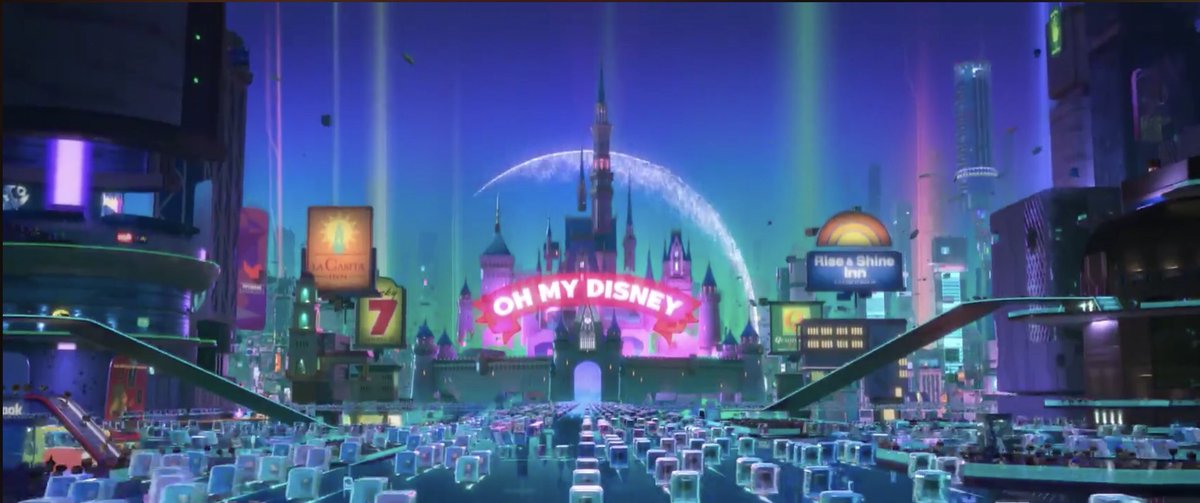
Sooooo...the barcaloungers, back to them. Why my obsession with them? It was around this point in the movie where I found myself sliding down my seat as if I was being pummeled into the very naugahyde fabric of it, from my upright position until I was practically prone. Not sure why; it could have been a number of things. Maybe it was that Venellope ends up at the Disney web-site, and I started to feel like I was being sucked into a corporate version of a black hole where mergered properties start to fold in on themselves, creating a sickening disorientation, like a meta-coma (I laughed when I saw the Disney site being called "Oh My Disney™," thinking it might be a satirical jab of "OMG" where "God"="Disney." But, no, the Disney website is—in reality—"Oh My Disney"). When its acquisitions are trotted out—Pixar, Marvel, Star Wars, Muppets, but not Fox (too soon for product to be produced, it seems), I sank a little further by the sheer heavy gravity that was being displayed.
And then, a bit of salvation—Venellope meets the Disney princesses™ (and the filmmakers put up the funds for the original voice-artists—the extant ones) and it is as funny and bitchy and irreverent as one would want and the movie gets a nice shot of counter-marketing to off-set the rest of the film's celebration of its own acquisitiveness. The film will, of course, continue on with its life-lessons, its action packed resolution (complete with a creature that seemed like a nightmare out of World War Z) that is the de rigueur denouement of these things, but the highlight of the film is the left-field Princess placement.
And one knows—one just knows—that Disney is thinking of how they can capitalize on it with their own stand-alone movie. Yeah, spoil it, why doncha?
* As Stephen Colbert once said: "Bing—what you use when you want to 'Google' something."
I Had a Great Title For This Review, But I Forgot What It Was... or WWDD?
They did it again. Pixar's sequel to Finding Nemo, Finding Doryis such a good movie as to defy any objections. It's one of those rare movies (although not so rare when considering Pixar's output) where I can simply say "just go." Don't let anything, external or internal, keep you from seeing this in the best possible theater experience. It's that good. In fact, if you liked Finding Nemo, you may be surprised to discover that its sequel joins that rare list of films that is better than its predecessor. But, how does it improve? It takes one of the more problematic of the earlier characters, focuses on it/him/her and provides value to a character that was, basically, comedy relief. At the same time, it teaches family-friendly, inclusive life-lessons that won't raise the blood pressure of either autocratic or laissez-faire parents, be they conservative or liberal. while keeping the whole thing entertaining, without needlessly villifying anybody, and having no scary moments that will necessitate the "hands-over-the-eyes" routine.*
The humor will not go over most kids' heads, but the ironic stuff might(irony being something that kids don't appreciate, as it's usually creates something that bursts their little bubble Universe—irony makes kids frown without knowing whether to laugh or cry). Finding Nemo, at the time of its release, was one of those Pixar bench-marks producing an artistic leap in how the physical world was represented digitally (late-comers to it might wonder what the fuss was about, considering the leaps they've made over the years). Finding Dory is as impressive in its depiction of the underwater world as The Good Dinosaur is showing the surface-world. But, its characterizations are far more sophisticated (and entertaining), while using a poignant story about memory and loss with the forgetful blue tang (voiced...memorably...by Ellen DeGeneres).
We go forward by going back: baby Dory (Sloane Murray) is being taught by her parents Jenny (Diane Keaton) and Charlie (Eugene Levy) how to introduce herself—"Hi, I'm Dory and I have short term memory loss." Dory's memory-stick is faulty and the parents (voiced by two of the best actors for portraying neurosis) worry about their little juvenile, warning her of the dangers of the deep (watch out for the undertow, don't stray too far from home) and hoping that some of it will make its way into her memory. But, they can only hope, because Dory can't stay focused or still enough for things to sink in. In the meantime, they do the best they can, hoping that it's enough.
We're back in Finding Nemo territory here, which was, basically, a movie about parenting. Yes, it was about finding yourself and taking chances and being more than you think you're capable of, but it was mostly about parenting, about loving something more than yourself that you would do all those things you wouldn't do otherwise. That Dory is a "special needs" child makes the movie even more poignant. The parents can only do what they can. It is up to the child to apply the lessons learned. But, what if they can't remember the lessons?
Because it's a movie (rather than a short subject), of course Dory gets caught up in the undertow and is separated from her parents and left in the open ocean to say to every fish that passes "Hi, I'm Dory and I suffer from short-term memory loss. Have you seen my parents?" Of course, they haven't. But there are a lot of fish in the sea. And a year later, she encounters Marlin (Albert Brooks) who has also lost something, his son Nemo, and the movie flips to the ending with, that movie having been done thirteen years ago, Marlin and Nemo re-united, and Dory nearby, her own quest unfulfilled (not that she remembers).
But, images keep snapping into her mind. She talks in her sleep. One day, accompanying Nemo on a field-trip, she remembers something about "the undertow," and she associates it with her parents, and, together with Marlin and Nemo, she sets off to try and find a mysterious place she mentions after being knocked out by a migrating school of manta-rays—"The Jewel of Moro Bay, California."
In one of the few call-backs in the film (something that encourages me that a sequel has its own soul), the three catch the California current with Crush and his brood of migrating turtles and make their way to the U.S.'s West Coast, where an encounter with a squid manages to place them right where they want to be.
One of the neat things about Finding Dory is that it has a nice subliminal visual scheme to it. As the clowns and tang get closer to California, the ocean surface is littered with garbage from a Volkwagen beetle (which looks like it dropped out of Cars) and a sunken tanker of containers—at one point, Dory is swimming around with a plastic six-pack ring, which complicates her life for awhile.
And there are lots of new characters—Hank the camouflaging octopus (Ed O'Neill) who has a missing leg ("that would make you a septopus!"), Destiny the near-sighted shark (Kaitlin Olsen) and Bailey the beluga (Ty Burrell) with faulty echo-location, as well as sunning seals Fluke (Idris Elba—brilliant) and Rudder (Dominic West). If you're sensing a pattern in this, it's that "The Jewel" has a lot of damaged oceanographic life, where Dory fits right in.
And yet this doesn't dawn on you until late in the picture. Most of the sea-folk in the larger two-thirds of the movie are parked in a handicapped space, but, when left to their own devices, are just as capable, or even more so, than their blithely-"together" water-buddies. This realization colors the reactions of the schools of fishes that ignore, snub, or scuttle away from Dory's clueless pleas about her parents. It's a story about the invisibility of the handicapped, invisibly woven through an adventure story about the formation of relationships and its strengths...and in the words (improbably, but true) of Warren Beatty "the sanctity of family."
Because it's one thing for Marlin and Nemo to be in jeopardy and for us to feel for their plight. It is quite another for Dory and Hank and Destiny and Bailey to have their own survival systems and networks and feel that everything is going to be okay. Yes, there are tight spots. Yes, there are moments of indecision and desperation. But, the second-guessing and neurosis of Finding Nemo is refreshingly absent. No one needs convincing here (except for Marlin...again)—everybody is heroically zen-Yoda "Do or do not. There is no try." The pay-off is a goofy, ludicrously over-the-top chase sequence capped by a hilariously extended slow-mo denouement with a musical accompaniment that is both entirely inappropriate and dazzlingly perfect.
It's why I find Finding Dory a better film than Finding Nemo. Yes, the former has Marlin learning a lesson about overcoming his fears to find his son. All well and good. But, Finding Dory goes the extra step. It teaches to be fearless, despite adversity, despite handicaps, despite...anything. I like that message for being a life-lesson, rather than an answer to a problem. Yes, fine, don't be so neurotic is a good enough lesson to start. But "just keep swimming" is both a good philosophy and a good course of action.
Do not leave early at the "the end" credit because the movie has a nice end-note that continues issues from the film, but also from Finding Nemo.
Also, go early enough that you see Alan Barillaro's pitch-perfect short piper, which is amazing in its visual story-telling, mind-boggling in its photo-realistic animation, and admirable in its refusal to anthropomorphize its subjects.
*I missed roughly 20% of To Kill a Mockingbird when I was 7, thanks to that move. Thanks, Mom!