Showing posts with label Jeffrey Tambor. Show all posts

Thursday, May 23, 2019

Paul (2011)

Paul (Greg Mottola, 2011) The team of Simon Pegg and Nick Frost are an acquired taste...at least for me. Some of their stuff is iffy, marginal, borderline—good ideas stretched thin. 

Then, you get something like Paul, which I was late to, but managed to catch on cable and was ready to dismiss until it started to layer in concepts and in-jokes and do something that the two were spotty on when teamed with the brilliant Edgar Wright as their director-co-scriptwriter.

It has a lot of depth. It's a deep-dish dive into American obsession with pop-culture as witnessed by two guys across the pond who should be shaking their heads at the madness, but instead embrace it with the sense of wonder that used to be generated by such things before they got over-merchandised in the marketplace. It's also a neat little throw-back to the older films that inspired the writers
Two nerdy Brit's, Graeme Willy (Pegg) and Clive Gollings (Frost), are on a U.S. pilgrimage to the San Diego Comic-Con, driving an RV through the stark landscapes of the Southwest U.S., home of test-sites, nuclear landmarks, and fabled numbered Area's of Interest in UFO mythology. They have to deal with the denizens of the area, and one particular stranger with whom they have a close encounter of a vehicular accident kind.
This is Paul (voiced by Seth Rogen), an extraterrestrial whose most recent home has been Area 51, where he has been kept under house arrest and study, advising the government on advanced technology and, in return, being kept safe, even ensuring that alien information is leaked through back-channels, just in case his brethren return to find him.
It's a comedic version of E.T. with the lost voyager—but instead of being found by a kid in the suburbs, he's found by the government agencies that want to keep him under wraps. But Paul has outlived his usefulness as a live subject; the reason he's made his escape is that he has been due for vivisection. So, despite the qualms of Clive, the two take on the little alien as a passenger, taking a side-route to San Diego to get Paul to his designated meeting place with his people.
There are, of course, complications. Paul is being sought by government agents in the form of FBI Special Agent Zoyl (Jason Bateman), who is under orders from "The Big Guy"—his female boss communicating over the radio—to track down Paul and return him to Area 51 for disposal. When he is unable to make much progress (given his disappearance from the car that he stole in his escape), she adds to other FBI agents, Haggard (Bill Hader) and O'Reilly (Joe Lo Truglio)—who are a bit hapless—to assist, although the three seem to be under different assignments, working at cross-purposes. 
And if things weren't complicated enough, an overnight stay at a trailer park gains them another passenger, Ruth Buggs (Kristen Wiig), the one-eyed daughter of Moses Buggs (the wonderful John Carroll Lynch), the Christian fundamentalist owner of the park—she encounters Paul and the vagabonds have no choice but to take her with them, which worsens the stakes against them and adds one more dangerous element to the many people trying to track them down. Father Moses is determined to track the heathen down and shoot 'em and get his kidnapped daughter back, just like John Wayne in The Searchers or Melinda Dillon in Close Encounters.
It also adds a little nuance to that as he's completely religious and any evidence of there being extra-terrestrial life or hint that we might not have the full undivided attention of God's eye would completely toast his wafer, so to speak. But, he doesn't know about Paul. All he knows is that nerds stole his little girl and he's gonna get her back just as sure as the turnin' o' the Earth. That daughter Ruth is a bit more open to the idea of e.t.'s and wants to help him escape makes her a valuable ally (if risky) and she is rewarded for that by Paul giving her a new eye to replace the one that doesn't work.

Believe it or not, they resist playing "Amazing Grace" in the background of that scene.
There's enough laughs and something akin to warmth in the film to keep one intrigued and it manages to pay off expectations and keep surprising with what turns up and the film resolves itself. And with players like Pegg, Frost, Hader and Wiig on-board, the material will end up being served in the most creative ways possible.
Director Edgar Wright was not along for this fun little journey. In his stead, the director is Greg Mottola, who made Superbad and Adventureland, but, more importantly in my view, he was the director of the pilot for Aaron Sorkin's brilliant HBO series "The Newsroom"—one of those "perfect" examples of really good television wedded to smart ideas. Mottola did amazing work on that, juggling multiple story-lines and planes of view without "losing" any of the viewers. His work on Paul is more sedate, but there is a reverence to making sure that tribute is paid to past touchstones to make sure they have a maximum pay-off.

Plus, it's just funny as hell.


Thanks to Donavan for the suggestion

Tuesday, April 16, 2019

Hellboy II: The Golden Army

Written at the time of the film's release...

Hellboy in a Handbasket
or
"Now, see, I love this song. And I can't smile, or cry. I think I have no tear ducts."

"It is said that at the dawn of time, man, beast, and all magical beings lived together under Aeglin, the Father Tree. But man had been created with a hole in his heart, a hole that no possession, power, or knowledge could fill. And in his infinite greed, man dreamed of expanding his dominion over the entire earth. The blood of many an elf, ogre, and goblin was spilled in their war with man, and King Balor, the one-armed king of Elfland, watched the slaughter in dread and despair. But one day, the master of the goblin blacksmiths offered to build the king a golden mechanical army, seventy times seventy soldiers, that would never know hunger, and could not be stopped. Prince Nuada begged his father to agree. "Build me this army," the king said. And so, a magical crown was forged that would allow those of royal blood to command the Golden Army, if unchallenged. "I am King Balor, leader of the Golden Army. Is there anyone who disputes my right?" And in his throne room, no one challenged his word."

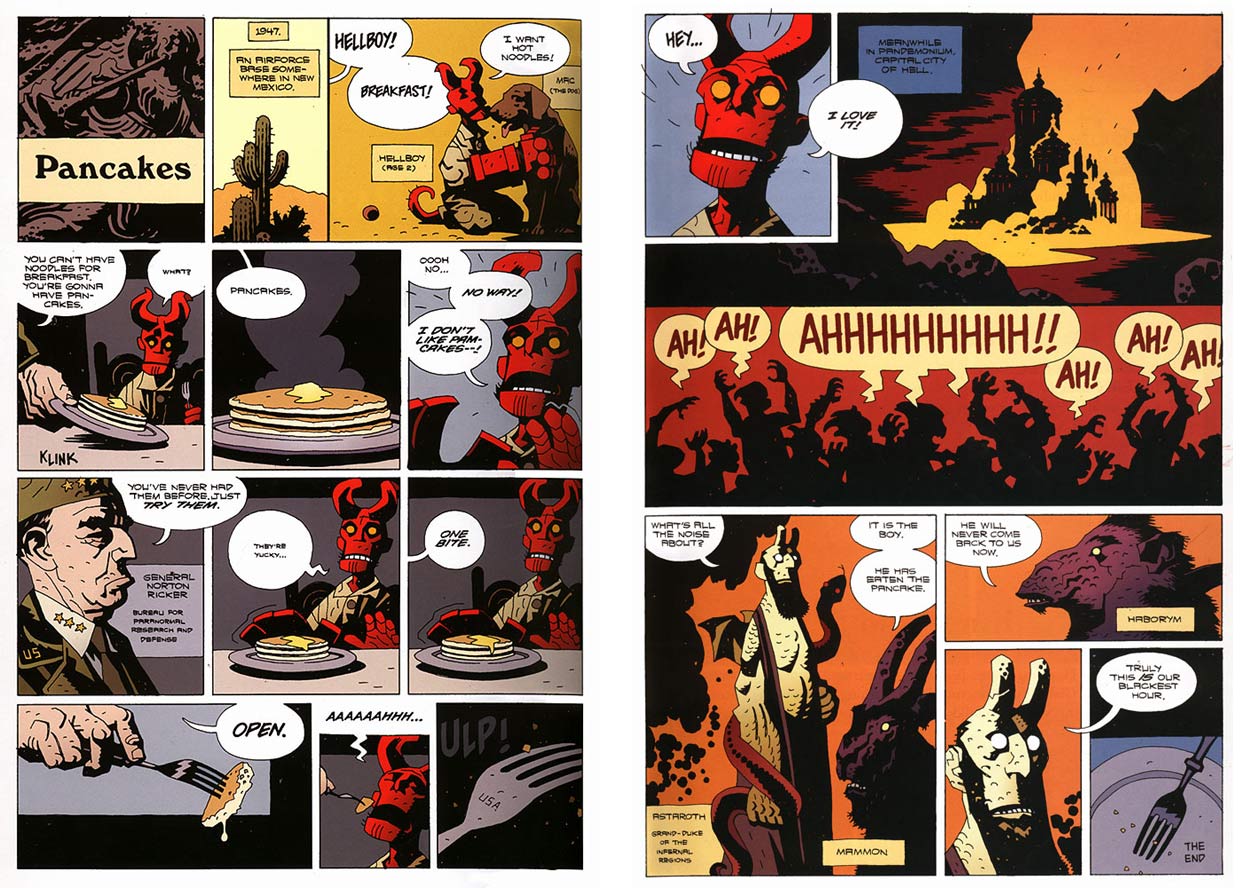
I'm a big fan of Mike Mignola's "Hellboy" comics. His blocky, basic-black approach to illustrating accentuating the shadows, and his austere story-telling that takes six or seven atmospheric issues to tell a 20 minute story, tickle me. And the character is a hoot--a demon's son who is brought to this plane by Allied interference with a Nazi plot to bring a fighting demon to Earth, has grown up to be a cigar-chomping, booze-swilling jamoke who battles paranormal evil--while not buying the über-seriousness of its practitioners, and who, in moments of extreme duress (like having the ground crumble underneath you), utters a basic, "Aw, crap!"
When Mignola and director Guillermo del Toro brought "Hellboy" to the screen for Columbia Pictures, they did a fine job. First, they selected Ron Perlman, who's never griped about doing a role with a lot of make-up, to play the title character. I had quibbles with the movie--it felt like those early Marvel shows that stream-lined the comics creations to make them go down a bit easier with the public. "Hellboy" provided a lot of comic-book action--I was happy just to hear the character say "Aw, crap!" (which he did three times, perhaps gilding the lily), but they inserted a token white guy (Rupert Evans) for "audience-identification purposes," and created a rather conventional "beauty and the beast" story arc* between Hellboy and "fire-starter" hot-chick Liz Sherman (Selma Blair)--completely unnecessary, I thought, and further diluted Mignola's concept, making The Right Hand of Doom a big softy inside.
Four years later in this Universal release, "Red" and the rest of the BPRD gang are back (except for the token--he's supposedly been shipped off to Antarctica), and what made the first movie good, makes this one fun to watch at times, as well--Mignola's design sense, brought to steam-punk life by del Toro's artists (Agent Johann Kraus is introduced in this one--he's basically a bubble-headed suit filled with the spirit of a medium, but del Toro turns him into a clattering, hissing contraption), and the occassional bursts of action that don't go on for too long and manage to have a ferocious poetry to them. Particularly gleeful is an opening segment with Young Hellboy and some back-story that is intriguingly and imaginatively presented. Plus, once in the third act there's a surprising Mignola-like occurrence of out-sized proportions when our heroes get to Ireland for the Big Stand-off.

Danny Elfman provides the schizy score; sometimes it's big-band jazzy for a call to action, and sometimes it's just tub-thumping to get the adrenaline up. That, and a jokey walk-through of the BPRD HQ call to mind "Men in Black" territory.
And that love story between HB and Liz--it's more complicated than before and not much fun at all and, frankly, drags this movie down to the basement with chains. Then, gill-head Abe Sapien (Doug Jones is back, with his own voice) falls in love with a nether-world princess, and before long Abe and HB are getting tanked on Tecate (pretty obscure product placement there) and singing along to Barry Manilow (so help me, it's true!). Even Kraus turns misty. I found my demon-sized smile disappearing the farther along the movie went. Occasionally an intricate set-piece would boost my spirits**, but by the end any good feelings I had for this movie had gone to Hell.
I'll stick to the comics.

Number of times "Aw, crap!" was said: 4

"Wilhelm" Moment: Right before Hellboy falls onto the police car


* I'm still mystified as to why this was necessary as it never appeared in the source material, and Perlman had already been down this road before. Perhaps it's something to attract the ladies. I don't know, but it's completely counter to the original character, and he's quirky and funny enough that this added business dilutes the whole concept.

** The end-set-piece--on a completely illogical stage composed of Mignola-out-sized tech-head gears that seems to be something ripped out of a Disney stage-show--is a fine piece of quick denouement. Then the exit music is Manilow agan...GAAH! It might take an exorcism of Hellboy proportions to get it out of my head.

Thursday, April 19, 2018

The Death of Stalin

Dr. Strangebedfellows: or How I Learned to Stop Worrying and Bury the Politburo
or
"How Can You Run and Plot at the Same Time?"

"The Death of Stalin is aimed at inciting hatred and enmity, violating the dignity of the Russian (Soviet) people, promoting ethnic and social inferiority, which points to the movie’s extremist nature. We are confident that the movie was made to distort our country’s past so that the thought of the 1950s Soviet Union makes people feel only terror and disgust."
Petition from the Russian Cultural Ministry

"[a] western plot to destabilise Russia by causing rifts in society"
Public Council of the Russian Ministry of Culture


Oh, those poor Russkies.  They finagle our elections, annex territories, disrupt social media, and conspire with tyrants, while bagging as many rubles for themselves in their so-called "everybody-is-equal" political system. 

But, criticize them and they bleat like sheep.


Never mind that the director has been making fun of the British and Americans with his past work—like In the Loop and "Veep"—that no doubt cheers them and think are a laugh riot. But, turn the same satirical eye against them and it's a plot to "destabilise" Russia. As if they needed any help doing that themselves.

In a rather reflective "coalition of the willing" The Death of Stalin combines French, British and American forces; it started as a french comic book, and is a combination of Brit and Yank talents to bring it to the screen. Maybe the Culture Ministry feels that's a little too much attacking from the same forces. Satire does raise hackles. However, the satire of In the Loop and "Veep" produced an echoing silence (tacit approval?) while The Death of Stalin creates howls of protest and conspiracy concerns. What's good for the goose is not always good for the self-satisfied gander. 


So, what's causing the fuss? The Death of Stalin looks at the scrambling done by the prominent members of the Politburo following Stalin's death by a cerebral hemorrhage on March 5, 1953.
The events begin when Stalin (Adrian McLoughlin) requests a recording of a performance he'd heard on Radio Moscow that night. Unfortunately, when the live concert was broadcast, a recording was not made—but one does not disappoint Stalin (one might get shot). So, a second impromptu concert is staged, paying off the piano soloist (Olga Kurylenko), to repeat the performance and rousting a replacement conductor from his bed, after the original one suffers a debilitating accident while fainting at the prospect of any potential consequences. The pianist includes a note with the recording, deriding the Premier, whose reaction (either from the note or the poor rushed recording) prompts his stroke. The guards outside his door hear him collapse, but, having orders not to disturb his sleep under penalty of death, do nothing but hold their post.
The next morning, the dacha housemaid enters the room and finds Stalin unconscious on the floor. Phone calls are made—not to any "good" doctors as many of them have been purged—but to the senior officials under Stalin. They include Georgy Malenkox (Jeffrey Tambor)—who has been rumored to be replaced (and killed) in Stalin's plans, Lavrenti Beria (Simon Russell Beale), the security director of the secret police, the NKVD, and Moscow Party Leader Nikita Krushchev (Steve Buscemi), who is awakened by the news and is so exercised about the event that he arrives at the dacha in pants and pajamas. Beria manages to get there first, finds the body and searches for the key to Stalin's files and manages to smuggle some out. Before Krushchev and Lazar Kaganovich (Dermot Crowley) can arrive, Beria convinces Malenkov that he should be the next Premier, knowing that he's weak and easily influenced. When Krushchev and Kaganovich enter the room, Beria and Krushchev begin to butt heads over who can out-blackmail the other to gain a stronger footing.
But, one should never count their hens. When Stalin is moved by the four (with the help of Anastas Mikoyan (Paul Whitehouse) and Nikolai Buganin (Paul Chahidi) to his bed and examined by the best doctors not currently in prison or a gulag, it looks like the Premier might make a recovery, and the group returns to the fawning postures that (of course) they hope for a full recovery and everything will stay just the same—until Stalin actually dies and they return to dividing the spoils. No sooner do Beria and Krushchev curry favor with Stalin's daughter Svetlana (Andrea Riseborough) while marginalizing his drunken son Vasily (Rupert Friend) and leave the premier's quarters, that the NKVD move in and evacuate the building, take over all the possessions and furnishings and murder any witnesses.
Once Vyacheslav Molotov (Michael Palin) is brought on board (Beria has released his wife from prison where she was imprisoned for supposedly being anti-Stalinist), the group can start having rather tentative meetings and votes on how to proceed—everyone eyes each other to see how the other will vote, hands tentatively half-raised before committing—and is decided that Comrade Krushchev should be kept busy planning the late Premier's funeral...where the personal positioning for power can really move into full swing.
The political fandango is based (advisedly) on true events, with comedic license for interpolations. To see the power elite of Moscow at their most insecure, even while the stakes are life-changing is a hilarious dance of desperation that shows how petty and craven the instincts of those in power can be displayed (even before Twitter). That's what satire does—expose the frailties, whether in people, in systems, in governments, and how the best-laid plans have beach-like foundations. It's a release valve for the toxic stress involved in the absurdities of flawed circumstances. But, the only way to see the humor of it is to admit the flaws. To not do so runs the risks of making the same mistakes over and over...which really is the height of both tragedy, as well as comedy, comrade.


Saturday, November 5, 2016

The Accountant

Attention-Deficit
or
Settling All Accounts

Gavin O'Connor's a busy director these days. His last film, the little-seen Natalie Portman Western, Jane Got a Gun was released a mere nine months ago.*

But, he is probably best known for the Disney-financed film of the 1980 "Miracle on the Ice," Miracle, as well as the 2011 Tom Hardy MMA film Warrior (television watchers may know him for directing the pilot of the popular TV series "The Americans").

His credentials for working fast and efficiently and with no flab associated with his movies is well-known.


The Accountant (like Jane Got a Gun) was on the 2011 "Blacklist" of well-regarded un-made scripts for that year. An original screenplay, it followed the action market with a twisted tale of revenge and detection.
Its hook? "The Accountant" is a mercenary on two fronts—he cooks the books of cartels while also pursuing "bad-guys" who have done "bad things," and he's autistic. He runs a little tax business out of Small-Town, Illinois, where he helps folks pull through on their taxes and he does some consulting work on the side. He's well-known for being "nothing short of supernatural" with accounting and he's often in demand for moving funds, finding depreciations, and making money disappear and magically reappear. He gets his work-referrals from a closed-loop system that advises and watches over him and when he mentions doing something contrary responds with "heavy sigh." 

Right now, he's supplementing his income tracing irregularities for a high-tech prosthetics firm called Living Robotics that is looking to go public, but a junior accountant (Anna Kendrick) has found some irregularities in the ledgers and the Accountant (going by the name of Chris Wolff), played by Ben Affleck, meets with the corporate heads (Jean Smart, Andy Umberger and John Lithgow)—one lovely exchange has Wolf being told he'll get ten years worth of records to examine: "How long have you been CFO?" "Fifteen years" "Then, I'll need your records for the past fifteen years..." While he starts preparing for the audit, things are happening in Washington D.C.
Marybeth Medina (Cynthia Addai-Robinson, she's TV's version of Suicide Squad's Amanda Waller on "Arrow") is called into the office of the head of financial crimes division (J.K. Simmons) at the Treasury Department. "Do you like puzzles, Agent Medina?" he asks her and proceeds to give her a doozy. The Treasury head, Ray King, has all sorts of surveillance photos of various cartels meeting in plain sight, but the one thing they have in common is one man, never in clear view, but identifiable by stature and dress which is similar between all snaps. King has a file on Medina showing that she lied about a past criminal record on her Fed application—a felony offense. Her puzzle is to identify the man in the photos and she has two weeks to do it. At the end of the two weeks, she either has the answer and keeps her job, or is charged with that felony.
In the meantime, Wolff splits his time between at LRI and his business, and his modest suburban home and a bay in a public storage facility where he keeps an air-stream trailer—his home-away-from home. There, he conditions himself with loud music and irritating lights, while he does some rudimentary calisthenics. That trailer is a combined fortress of solitude, arsenal and bank, where he keeps his collateral in the form of collectibles (paintings and vintage comic-books, mostly), gold bars and easily-available cash. His front is the house, very wired and camera'd, and we learn a little bit about his background through flashbacks.
He's diagnosed as autistic with sensitivity to light and noise, but totally driven. A tour of a school for the condition is attractive to his parents, who have another son, Braxton, but his father, an Army lifer, puts the kibosh on the idea, intending, instead, to instill discipline into the child's world, rather than closeting him away in a school. The child will have to learn his way, make his choices about his path, and he must do it in the real-world, not protected—if anything, he will have to learn to fight and be self-sufficient.
Back at LRI, he starts work. The junior accountant who found the discrepancies, Dana Cummings, has stayed up all night gathering the doc-boxes and PNL statements and Wolff dismisses her help and expertise without so much as a "thank you." He then pulls out his dry-erase markers—there are a lot of them—and begins work in a conference room on the white-board at one end of the room. 
Pretty soon, the calculations are filling up the white-board and the markers are being tossed into the waste-basket as they go dry. Wolff works through the night and the white-board, eventually using the windows of the conference room to continue the calculations. He doesn't stop, but by the beginning of the next business day, every window has been filled and by the time Cummings walks in, Wolff, displaying more emotion than he has throughout the entire movie is able to go over the calculations, showing that eventually $61 million went missing from Living Robotics—he hasn't figured out how and by whom, but he will not get a chance to, as the CEO's sister walks in, asks for his progress, and dismisses him, telling him his work is done.
It isn't, though...not to Wolff's satisfaction. It sets him off his routine, which manifests itself in little miscalculations and annoying little errors. What he doesn't know—besides the investigation going on about him across the country—is that there is a player on the other side, an assassin (Jon Bernthal), an outlier, who's been making his way through the LRI economic infrastructure. It was this assassin who convinced the LRI CFO to commit suicide in order to prevent the hit-man from killing him...and then killing his family. Money may not trickle down, but blood does. And when the assassin targets Wolff and the lowly Dana Cummings, he goes into a more aggressive stance...to settle accounts. 
The Accountant is a good little actioner, a bit unique, smart in not-obvious places, and obvious in some usual places. A lot of good actors, doing good, in not often inspired work. It keeps you engaged by jumping back and forth in time in order to give you some back-story and some education, and the action is done efficiently, and gun-nuts will appreciate the hardware. It's well-done, and has half a brain in its head. The last twenty minutes seem a bit rote, but still manages to toss in a twist or two.

Recommended.

* It was filmed in 2013 and been held up from release for various issues, including legal. O'Connor replaced director Lynne Ramsey after financial issues with the producer, caused her to walk out on the project.