Showing posts with label Ron Perlman. Show all posts

Saturday, December 17, 2022

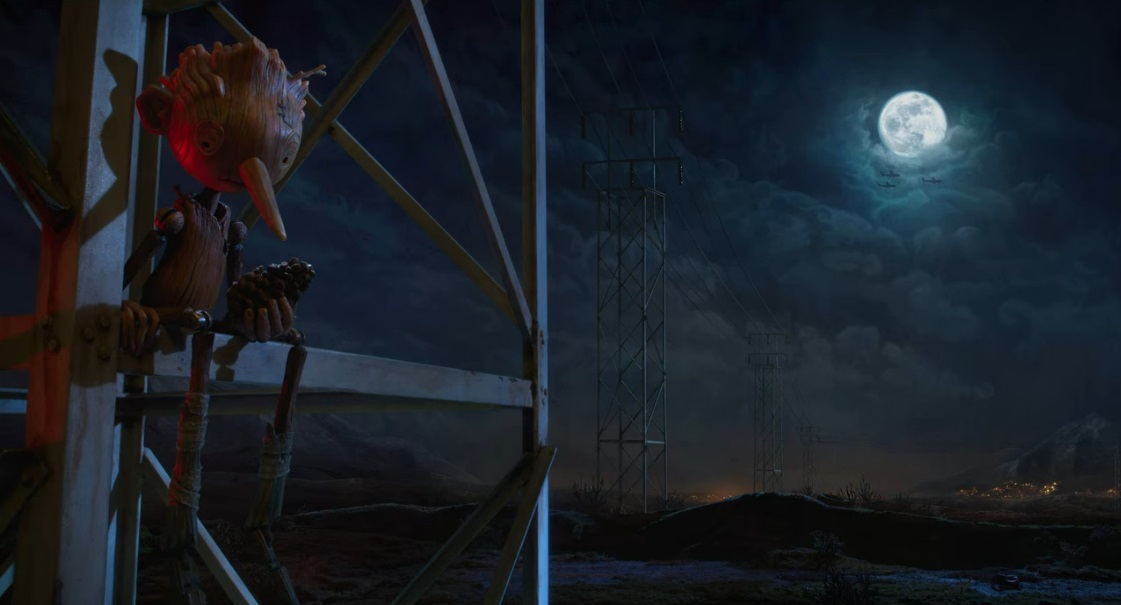
Guillermo del Toro's Pinocchio

Re-Tooling Pinocchio
or
"All Good Things Require Patience"

Good Lord, we're certainly in a nostalgia craze right now, but then self-isolation will do that to you. Spielberg did Fabelmans, Mendes does Empire of Light, and now del Toro makes a film that was inspired by an early childhood movie memory of his youth, his own version of Pinocchio. I can't fault him; I loved that movie as a child—and was obsessed with it, too. But, that was Disney's Pinocchio made in 1940. It's of a different time and a different sensibility.
 
Guillermo Del Toro's Pinocchio is quite another creature entirely. For one thing, it's set in the fascist Italy of the 1930's. And the puppet is a puppet, never losing his bark (as it were) and without the embedded wish of being a real boy. He's real enough and high on, if not life, anthropomorphism. But, he's a block of wood, cut from a tree, without the benefit of paint or clothes as per the Disney version (and the recent Robert Zemeckis adaptation on Disney+). 

And this version isn't 2D animation or CGI as with those. This is stop-motion animation, that pain-staking movie-making done (as with most animation) frame by frame. I've always had a soft spot for this type of work, be it from its earliest days of King Kong, through the mesmerizing work of Ray Harryhausen to the improvements of "go-motion" developed by the wizards like Phil Tippett for the Star Wars films. To think of these guys, with their little play-sets, moving their figures inch by perceptible inch, bearing in mind the incremental differences in perceptible motion and speed!) to create the illusion of life on film reveals not only the imagination but the science and mechanics of making moving pictures. We won't even talking about the commitment of walking to a studio knowing you'll probably only get a minute of film done (if you're lucky) every day.
So, hats off to
Mark Gustafson, who co-directed this—while del Toro was off directing live features, promoting them, winning Oscars, getting married and supervising his vision of what "his" Pinocchio story should be. Gustafson's work is incredible...and convincing. You get lost in this world and its creatures, all with their individual quirks and personalities (they move differently—by design, Gustafson's design). Those are determined by del Toro, they are brought to life by Gustafson's steadfast and steady work.
You know the story. Simplified, the story goes like this; Gepetto is a wood-carver/toy-maker who makes a humanoid marionette with the wish that it might be a real boy. Supernatural powers animate the puppet and, after the usual chaos that an energized blunt instrument can inflict, Gepetto insists that the thing go to school to be socialized, forgetting that society sees Pinocchio as a puppet walking around without strings and thus, something exploitable. Pinocchio gets gathered like kindling and tied up in a traveling show. Much searching occurs until getting swallowed by a whale, at which point, Pinoke proves his worth saving everybody and is rewarded.
But, it's the details. Disney's version leaned on the "wants to be a 'real' boy" wish, starlet-pretty fairies, anthropomorphized animals, and an emphasis on good behavior (while, curiously, demonstrating smoking, drinking, gambling, and vandalism) tent-poled with a lot of classic songs that perpetually show up in modern culture as well as hawking trips to Disneyland. The lesson to it all is "Always Let Your Conscience Be Your Guide," which implies that the conscience leads to good behavior that is accepted by society, the church, and the family. And that "being a real boy" is the sine qua non of life.
 
As they say at "CinemaSins": "That's speciest!"
Del Toro tells a different story, while keeping the nuts and bolts holding the thing together. It's set in the 1930's during fascist Italy (as we've said), and Gepetto (
David Bradley) makes his figure after his beloved son, Carlo, is killed in a bombing. Despairing (and drinking) he builds it from the tree that has grown out of his son's grave. Wood spirits (in the form of a slightly angelic figure—voiced by Tilda Swinton) show up and grant life to the figure and appoint resident cricket Sebastian J. Cricket (Ewan McGregor playing Obi-Wan for Disney a-gain!) as his guide and tutor.
The sight of Pinocchio (Gregory Mann) gallivanting cluelessly and curiously around his work-shop filled with sharp objects understandably freaks out the hung-over Gepetto. And his instincts are to curb his enthusiasms or, failing that, lock him in the closet to minimize the damage he causes. It's easiest to do the latter, ironically when he's going to church) But, Pinocchio cannot be contained and he follows his "Papa" to the humble chapel adorned with a crucifix built by Gepetto.
But, the parishioners are aghast! What unholy thing has desecrated this House of God? It's an abomination and (not only that, says the town's fascist leader, Podesta-voiced by "del Toro regular" Ron Perlman) he's a "dissident. An independent thinker, I'd say." All because Pinocchio looks at the wooden Christ on the cross (also built by his "Papa") and wonder "How come they like him and not me?" Poor Pinocchio. He's a beginning student asking post-grad questions.
Time to send him to school, but he's easily distracted by an offer from the unscrupulous Count Volpe (
Christoph Waltz) to join his circus and become a performer in his traveling puppet act. Soon, Pinocchio is quite the attraction, attracting the attention of a desperate Gepetto and the fascist Podesta—who wants to gain favor with Il Duce, Benito Mussolino (Tom Kenny), who fancies puppets as much as he fancies being the ultimate puppeteer. Dictators always have that fantasy, whether they rule a puppet government or not.
This is all delightful, even if its satire is heavy-handed (fascists deserve no less) at times, and its humor is periodically ghastly (it is del Toro, after all), but it caroms along at a brisk pace, occasionally interrupted by songs (composed by the always inventive
Alexandre Desplat, with lyrics by del Toro and Roeban Katz) that are sometimes interrupted themselves by some boisterous activity that ends them in mid-note.
And it adheres to the "Always Let Your Conscience Be Your Guide" maxim in a way that works in a complicated way where Society may not always be in the right. I like that. Like the movie itself, its heart is is exactly the right place where it should be, even if there is no heart in evidence.
 
This is a Pinocchio I can admire, no strings attached.

Saturday, December 25, 2021

Don't Look Up (2021)

Deep Impact on a Shallow Planet
or
The Dinosaurs Couldn't Say 'Told Ya So..."
 
A recent article in The Atlantic says that there are 21 million Americans who have no relationship to reality, wanting to re-instate Donald Trump as President of the United States, citing sheisters, Alzheimic Air Force Generals, and bad math to support their contentions. There's a bunch of Gen Z's who think birds are fake (they should get together with the folks who worry about chem-trails—there must be a connection because they're both in the AIR!) And we've always had Flat-Earthers because they've never been in a plane and figured out why the shortest distance to get to anywhere is not over the pole.
 
But, ask a farmer about global warming and they get serious.  Or a gardener. They've seen the time-shifts. They've seen annuals sprout too early. Crops lose their "window" and you compensate by shifting the planting earlier, risking the prospect of freezing. They know. You can't count on the Earth anymore. You can't count on anything...except maybe on one hand the number of friends you have that actually might be sane.
 
It used to be "If You Don't Stand For Something, You'll Fall for Anything." Now, with the internet the harder you stand, you'll fall even harder.
So, with that little sanctimony out of the way...what's the scoop on Don't Look Up, Adam McKay's look at "problem-solving" in a modern "connected" world?
 
McKay's conceit is to look at the "climate change" debate in a metaphorical way—what if we knew an "extinction-level" sized body was going to hit the Earth and we couldn't depend on our leaders, political or business, to save us for any reason?
Michigan State doctoral candidate Kate Dibiasky (Jennifer Lawrence) is spending a quiet night at an observatory studying trace gasses in dead galaxies for Astronomy Professor Dr. Randall Mindy (Leonardo DiCaprio) when she sees something weird on the screen. It's a comet...and it's moving. Mindy is called and he and his grad students celebrate what will be the Dibiasky Comet, and start working the orbital path...when Mindy starts to get nervous and tells all the other students to go home. Except for Kate. She sees what he saw: that the comet is heading for Earth. It's 5-6 km long and it will hit Earth in 6 months and 14 days. Call it 26 weeks.
They call NASA, who conference calls them in with Dr. Teddy Oglethorpe (
Rob Morgan) of the Planetary Defense Coordination Office. The link says it's real. And shit just got real; Oglethorpe mutters "that's a big boy" and then goes quiet when he realizes it signals "an extinction-level event." And while NASA advises caution, Oglethorpe orders a plane to bring Mindy and Dibiasky to the White House to tell the President. Dibiasky sees the Oval Office through an open door and grabs Mindy: "Are we really about to tell the President of the United States that we have just over six months until humankind—basically every species—is completely extinct?" Getting a shaky affirmative, she promptly throws up in an executive waste-basket. 
They're kept waiting for seven hours because the Executive Branch is in crisis mode: their nominee for Supreme Court justice has been revealed to be a pervert. Coming back the next day, they're given 20 minutes to explain what's going on and it doesn't go well: Mindy is nervously hyperventilating and that's off-putting to the coke-head Chief of Staff (
Jonah Hill), who got the job because he's the President's son. The President (Meryl Streep) is a hot mess, unable to focus on the potential disaster for need of a smoke, and saying that the timing of this "is atrocious" (mid-terms). She cuts to the chase: "What's the 'ask' here?" "Save us" is the reply. The decision is made to have "her people" look into it and "Sit tight and assess."
The three scientists can't believe it—they only have six months—so, they decide to take it to the press, the Washington Herald, who sets up a segment on it at the end of "The Daily Rip" (hosted by shiny anchors played by
Tyler Perry and Cate Blanchett) after a segment on the disasterous Supreme Court pick and then on the break-up of two "important" pop stars (Ariana Grande and Scott Mescudi). Warned that they don't have "media training" Dibiasky and Mindy have trouble negotiating the happy banter of the hosts until Dibiasky cracks and melts down on-camera: "Are we not being clear? Maybe the destruction of the entire planet isn't supposed to be FUN! Maybe it's supposed to be terrifying." The hosts are affronted. That's just bad form. And bad television. Dibiasky becomes a snarky meme, and interest in the Herald's story on the internet drops like a comet from the sky. So, they stop covering it.
But, because they've gone on national TV with national secrets Dibiasky and Mindy are arrested by the FBI, and the White House has to scramble. President Orlean goes on television in an elaborately staged event on a naval vessel to announce an emergency spending bill to launch a space mission to try and blow up the comet—a space mission that is manned by a single astronaut (
Ron Perlman) because "Washington needs a hero." All well and good until a cell-phone/tech pioneer, Peter Isherwell (Mark Rylance), is told by his team that the comet is a source of Earth-depleted minerals that are critical for making cell-phones. The mission is scrubbed—he's a big donor to the President's campaign—and another mission is planned to break up the comet and have it's pieces fall into the Pacific so they can be recovered and resourced.
One sees the point: nobody is going to do anything about it while there's time enough for people to figure out a way to make money from it, because that's the only "killing" they're concerned about. If there was a way to take carbon out of the atmosphere that wasn't deemed fiscally expensive and would make a fortune, we'd be worrying, instead, that there was too much ice at the poles, rather than selling our waterfront property. Don't Look Up merely converts that to the disaster scenario of Armageddon—at times the movie looks like Michael Bay's "this would look great in a car commercial" style of film-making—or Deep Impact.
The satire veers all over the place, sometimes sharp (of course people wouldn't believe it until they saw it with their own eyes, and, of course, a television chat show would cock up such news and, of course, a screaming fit on-air is going to be dismissed and the stuff of internet jokes) and heavy-handed (the political stuff is baldly aimed at the last administration, with the difference being that the Orlean team look a bit more competent and decisive). It falls somewhere between Hitchhiker's Guide to the Galaxy smart and Tropic Thunder dumb without ever achieving Dr. Strangelove brilliance. One grimly concedes McKay's aiming for the fences but he sometimes gets distracted by his own gee-wizardry and sarcastic weltschmerz to score a home-run.
Some of it is performance issues: Perry and Blanchett are rather one-note, but that seems appropriate for chat hosts. Hill's performance is as obnoxious as it's supposed to be, but Streep wears her tweet-hurt a bit too far, although it is reminiscent of Sarah Palin-subtlety. DiCaprio tries to achieve his Wolf of Wall Street comedic heights at times and falls short, but impresses in his dramatic scenes. Lawrence is terrific as the audience stand-in for expressing incomprehension and Rob Morgan stays out of comedy territory completely and frequently becomes a life-raft of reason. Best of all is Mark Rylance, who makes his tech entrepreneur suggestive but not an imitation, with just the right touch of Asperger's, child-like wonder, and child-like malice.
The reviews for Don't Look Up have been horrible, accusing McKay of condescension and being supercilious—social critics usually are—and there's a whiff of that here. But, there's also an earnestness that his heart is in the right place, if slightly broken, railing like a mad prophet to an ignoring, apathetic crowd. Despite the brickbats, I found myself enjoying it much more than I suspected I would, recognizing its weaknesses but appreciating the strengths.  
Now, about the message. Maybe by clothing "climate change" in a more direct disaster scenario is too subtle. There is a scene in the last season of "The Newsroom" ("Main Justice" Season 3 Episode 3) where there's an interview with a scientist from the EPA who has been prevented from issuing an alarming report about the environment (involving CO2 levels measured in Hawaii), and when asked to sum up the findings replies "a person has already been born who will die due to catastrophic failure of the planet" The anchor is taken aback and tries to walk it back to a less alarming conclusion, "Let's see if we can find a better spin...people are starting their weekends."
 
There isn't one. The only counter-argument is denial and that's just deflection and a stall to action. And we're doomed anyway. It's funny and it's a gut-punch. A sick joke that punches right in the nose.
 
On the much grander scale of things—pale blue dot-wise—cosmic catastrophes happen all the time—we just haven't heard about it since we haven't gotten television from there (yet)...because it's a messy Universe, despite all the space. We postulate the supernovas, the gravity collisions, but cannot grasp the implications, like imagining what happens to an ant colony when developing condo's. But, think of it in the "if Helen Keller fell down in a forest, would she make a sound" kind of way: "What if there was a cataclysmic event, and nobody did anything about it?"
 
The cosmic punch-line is "They deserved their fate."


Friday, December 24, 2021

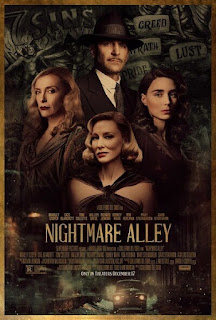
Nightmare Alley (2021)

The Smartest Man in the Room
or
"...It's All Geek To Me"
 
We meet Stanton Carlisle (Bradley Cooper) in the middle of committing a crime; in a soon-to-be-abandoned house, he drags a body to a waiting hole in the floor-boards, strikes a match—we see a gas-can on the floor behind him—and sets the room and the clapboard structure on fire. Then he simply walks away, next stop...anywhere, U.S.A.
 
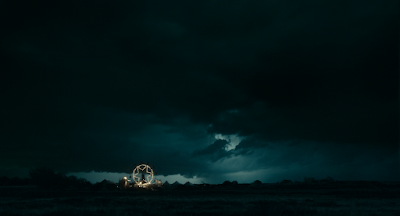
It's a bus-ride to where he's going. And he gets off at the designated restaurant, but he moves on to the glowing lights of a carnival, drawn to it like a moth to a flame. He moves over to a structure blanketed with "'Odd'-i-torium" and he goes in; for a quarter, he can see "The Geek" described by carny boss Clem Hoatley (Willem Dafoe) as a "supreme oddity—is he man of beast?" And as the slack-jawed crowd of curious gawkers gathers around a small arena, "The Geek," mangy and disheveled, is let out of his cage and thrown a live chicken which he bites in the neck and tears its head off. Repulsed, Stan leaves but is followed by Hoatley: "What's your pitch, pal? You on the low?" 
Within ten minutes Carlisle is hired as a roustabout, and one of his jobs is to round up the geek when he escapes his cage. Stan is sent in through the demonically-themed fun-house, it's signs warning of damnation and sees the geek, cowering. Ignoring Hoatley's advice, he tries to entice the man on his own and ends up getting concussed by a brick. Before any more damage can be done, he's found, the geek trussed up and Hoatley, fearing repercussions, offers him a steady job with the carnival. At night, he dreams dreams of flames, but in the morning, he helps fold up the tent and move on with the show—they're meeting up with another troupe down the road.
The spot they stop is a lot with an already-established carnival and across the dirt road is the house of Madame Zeena (Toni Collette) and her husband, Pete (David Strathairn), a once very successful mentalist act, gone on to hard times because of Zeena's philandering and Pete taking to drink. There is still talent in the older gentleman, but his will is broken, but he sees talent in the young man who's come to the house with the newly-arrived vagandonds and wants a bath. Zeena sees something in him, too, and seduces him—not that it takes much—and reads his fortune with her Tarot cards and it's ominous. Carlisle doesn't believe in such nonsense, not believing in fate, but only in the weakness he notices in others. He thinks he'll do very well.
If you've seen the 1947 version, you'll recognize a lot of what's going on as gone before. Watching this version of Nightmare Alley, though, evokes the same feeling one had when watching Martin Scorsese's version of Cape Fear after having seen the original.  It's the same story, but in another location, one steeped in the obsessions of the director. Where the first story was done to get the material down, the new one is richer, more grandiose, and more nuanced. No one's worried about time or hurrying the scene along. There is so much detail that to have it go any faster would be to miss something. The screenplay—by director Guillermo del Toro and his wife Kim Morgan—author of the "Sunset Gun" blog—is based on the original novel by William Lindsay Gresham, not on the original's screenplay by Howard Hawks scribe Jules Furthman. As such, it's a bit more "on the nose" and spells things out, announcing its themes and intentions so that no one misses the point. Rather than hurting the movie, it only gives it more depth, as the story can take the weight.
The casting is top-notch in the way the original couldn't be—there everyone was attractive—and populated by character actors of great depth. Cooper is Tyrone Power handsome, but he has a boyish "something" that makes him attractive—a kid in a man's body. Rooney Mara plays Molly, who is far more waif-like, but still evokes an inner strength and del Toro veteran Ron Perlman plays her guardian, Bruno, the carnival strong-man. Collette and Strathairn are both studies in washed-up talent, resigned to their fates but capable of showing glimpses of their glory days, and as Dr. Lilith Ritter, a fellow con artist as psychiatrist, Cate Blanchett risks parody by playing a creature of constantly challenging seduction, as if Lauren Bacall was playing a villain. 
This is something of a first for del Toro, who leaves behind the monsters' realm (temporarily, I assume), even while keeping one separated foot planted firmly in the grotesque. It's not his usual genre, as it's not a horror movie (and hewing closer to noir), but it flirts with it, the way that Carlisle will flirt with the mystical and the spiritual when he thinks using mentalist tricks isn't enough of a high-stakes racket for him. Because it's not enough to play tricks on people, to "read" them and use it against them, convince them that you have a power that they don't have. It's an endlessly escalating mind-game for both players. But, the hubris that results can make the fall from great heights higher than it appears. 

And Carlisle is just a beginner. He's not a mind-reader. He's a weakness-reader. A need-reader. It would have been better if he'd learned the tarot, so he could learn the future, but even when he's told what it is, even when it's spelled out in so much detail, he doesn't believe it. And maybe that has something to do with control. The future isn't written; he has no way to sway it. No way to read it, like the past on a man's face. And he's as much a paying customer—a rube—as anybody else is when it comes to Fate.
And that just doesn't cut it for the smartest man in the room, the man who knows everything about everybody. 
 
Except himself. Except that he's not as smart as he thinks he is.
 
It's a cautionary tale, as so much of film noir is. And it's one people should listen to.
 

Saturday, October 12, 2019

Cronos 1993

Cronos (Guillermo del Toro, 1993) Okay, Cronos is not Citizen Kane. Nothing is. But, for the feature film directorial debut of a new film-maker, it is very, very impressive. That the film-maker's previous film, a short called Geometria, looks as amateurish as can be. But, Cronos is lush, complex, and fascinating to watch. That it is also a vampire movie (of a sorts) makes it a curiosity. That it is the product of Guillermo del Toro, and one of his original works (rather than an adaptation) makes it quite essential to watch.  

It begins with a prelude, setting a historical, supernatural context to its modern story of greed and selfishness.


"In 1536, fleeing from the Inquisition, the alchemist Humberto Oganelli disembarked in Veracruz, Mexico. Appointed official watchmaker to the viceroy, Oganelli was determined to perfect an invention which would provide him with the key to eternal life. He was to name it the Cronos device. Four hundred years later, one night in 1937, part of a wall in a building collapsed. Amongst the victims was a man of strange skin, the color of marble in moonlight, his chest mortally pierced. His last words: Sua tempore. This was the alchemist. The authorities located the residence of the dead man. What they found there was never fully revealed to the public. After a brief investigation, the mansion and its contents were sold at public auction. Never on any list or inventory was the Cronos device mentioned. As far as anyone knew, it never existed."

Nor did anyone know that a bizarre, grisly tableau was found in the mansion: a man hung like a rack of meat, his body drained of blood that was contained in bowls on the floor. But, one man knows the story. Industrialist-millionaire Dieter de la Guardia (Claudio Brook) is dying and has been acquiring statues of archangels that have been rumored to contain the Cronos device that for so many centuries had kept Oganelli alive. Confined to a private hospital room in his complex, de la Guardia dispatches his ruthless American nephew Angel (Ron Perlman) to hunt down any archangel statue he can find that might have come from the Organelli ruins in order to prolong his life. Despite desiring his inheritance does his bidding, if only to maintain the lifestyle he feels he deserves—and for a nose-job operation he craves.
Which brings Angel to the humble antique shop of Jesus Gris (Federico Luppi), a humble religious man who has just been sent a parcel containing an archangel statue for dispensation. Angel throws his weight around the antiguery and tries to wheedle the statue from Snr. Gris, but the parcel has only just arrived and he won't let it go until he's examined it and tried to determine its worth. Angel leaves reluctantly, but threatens to be back.

Examining it, Gris realizes that the statue is hollow and opening its base finds an ornate gold watch-like device, which fascinates both him and his mute granddaughter Aurora (Tamara Shanath). It is very old and piques his curiosity and he becomes determined to find out its secrets. In the meantime, Angel comes back and acquires the statue, thinking he's now obtained the Cronos device.
Alone in his shop, Gris examines the mechanism for the device and engages a fob on it. Six mechanical legs pop out of it, making it resemble a scarab. All well and good, but the old man is surprised when the legs suddenly clamp down on his hand painfully. Then, to his horror, the mechanism unfolds a large needle out of its pattern and jams it into his flesh. Unbeknownst to him—but revealed to the viewer—inside the Cronos, living among its gear-works is a pulsing grub-like creature which injects Gris with a liquid that weakens him. He is tended to by his mistress Mercedes (Margarita Isabel), who worries about the wound but tends to it, removing a stinger, and bandages it.
That night, Jesus can't sleep. Thirsty and feverish, he can't slack his thirst with water. He's drawn to the Cronos and engages it again and, despite the pain, feels better. He goes back to bed, but in the morning, the light is blinding and he draws the curtains. But, looking in the mirror, he appears younger, some of his wrinkles having disappeared. Inspired, he shaves off his mustache, and Mercedes is surprised at how more youthful he appears. He moves better, too, and is more energized. 
But, going to his shop, he finds it vandalized. The Cronos not being found in the archangel statue, de la Guardia has stepped up efforts and doing so less circumspectly. Jesus is brought to the millionaire and feigns ignorance, but de la Guardia gives him a history of the device and of his own worsening condition. Jesus is determined to not let the Cronos go, but the efforts to get them escalate, even as Jesus begins to be stronger to survive them. He even survives Angel locking him in the trunk of a car and tossing it off a cliff. Although appearing to be dead, Jesus survives, but his skin has begun to peel off, exposing a paler, shinier skin underneath. And, as he's discovered before the murder attempt, he has developed a taste for human blood.
Although at times grisly and a bit perverse at times, Cronos fascinates. Del Toro turns the old vampire story on its pointed ear by taking the victimization out of it and any faux-romantic niceties that have perfumed the animalism of it for decades. Oh, there is blood-letting and an instance of neck-sucking, but the violence by the particulars has more to do with common greed and selfishness than with any acquiring of blood. In fact, a lot of blood here goes to waste. It would make a vampire fangs rattle in fear.
But, the artistry with which its done is so far ahead of what others have, that one could see that del Toro would be a unique film-maker with a future that he seems to be living up to.

Tuesday, April 16, 2019

Hellboy II: The Golden Army

Written at the time of the film's release...

Hellboy in a Handbasket
or
"Now, see, I love this song. And I can't smile, or cry. I think I have no tear ducts."

"It is said that at the dawn of time, man, beast, and all magical beings lived together under Aeglin, the Father Tree. But man had been created with a hole in his heart, a hole that no possession, power, or knowledge could fill. And in his infinite greed, man dreamed of expanding his dominion over the entire earth. The blood of many an elf, ogre, and goblin was spilled in their war with man, and King Balor, the one-armed king of Elfland, watched the slaughter in dread and despair. But one day, the master of the goblin blacksmiths offered to build the king a golden mechanical army, seventy times seventy soldiers, that would never know hunger, and could not be stopped. Prince Nuada begged his father to agree. "Build me this army," the king said. And so, a magical crown was forged that would allow those of royal blood to command the Golden Army, if unchallenged. "I am King Balor, leader of the Golden Army. Is there anyone who disputes my right?" And in his throne room, no one challenged his word."

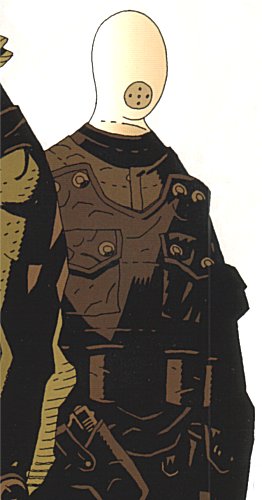
I'm a big fan of Mike Mignola's "Hellboy" comics. His blocky, basic-black approach to illustrating accentuating the shadows, and his austere story-telling that takes six or seven atmospheric issues to tell a 20 minute story, tickle me. And the character is a hoot--a demon's son who is brought to this plane by Allied interference with a Nazi plot to bring a fighting demon to Earth, has grown up to be a cigar-chomping, booze-swilling jamoke who battles paranormal evil--while not buying the über-seriousness of its practitioners, and who, in moments of extreme duress (like having the ground crumble underneath you), utters a basic, "Aw, crap!"
When Mignola and director Guillermo del Toro brought "Hellboy" to the screen for Columbia Pictures, they did a fine job. First, they selected Ron Perlman, who's never griped about doing a role with a lot of make-up, to play the title character. I had quibbles with the movie--it felt like those early Marvel shows that stream-lined the comics creations to make them go down a bit easier with the public. "Hellboy" provided a lot of comic-book action--I was happy just to hear the character say "Aw, crap!" (which he did three times, perhaps gilding the lily), but they inserted a token white guy (Rupert Evans) for "audience-identification purposes," and created a rather conventional "beauty and the beast" story arc* between Hellboy and "fire-starter" hot-chick Liz Sherman (Selma Blair)--completely unnecessary, I thought, and further diluted Mignola's concept, making The Right Hand of Doom a big softy inside.
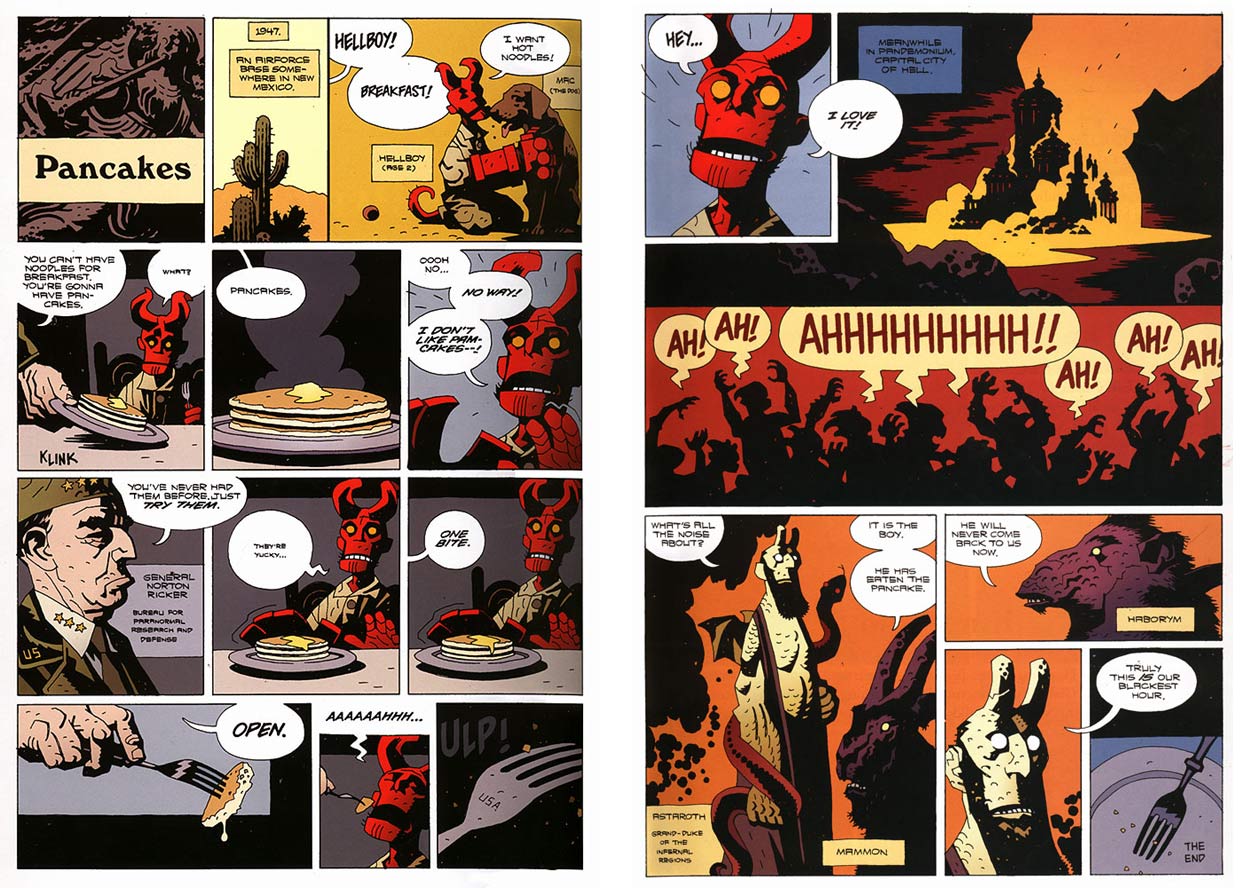
Four years later in this Universal release, "Red" and the rest of the BPRD gang are back (except for the token--he's supposedly been shipped off to Antarctica), and what made the first movie good, makes this one fun to watch at times, as well--Mignola's design sense, brought to steam-punk life by del Toro's artists (Agent Johann Kraus is introduced in this one--he's basically a bubble-headed suit filled with the spirit of a medium, but del Toro turns him into a clattering, hissing contraption), and the occassional bursts of action that don't go on for too long and manage to have a ferocious poetry to them. Particularly gleeful is an opening segment with Young Hellboy and some back-story that is intriguingly and imaginatively presented. Plus, once in the third act there's a surprising Mignola-like occurrence of out-sized proportions when our heroes get to Ireland for the Big Stand-off.

Danny Elfman provides the schizy score; sometimes it's big-band jazzy for a call to action, and sometimes it's just tub-thumping to get the adrenaline up. That, and a jokey walk-through of the BPRD HQ call to mind "Men in Black" territory.
And that love story between HB and Liz--it's more complicated than before and not much fun at all and, frankly, drags this movie down to the basement with chains. Then, gill-head Abe Sapien (Doug Jones is back, with his own voice) falls in love with a nether-world princess, and before long Abe and HB are getting tanked on Tecate (pretty obscure product placement there) and singing along to Barry Manilow (so help me, it's true!). Even Kraus turns misty. I found my demon-sized smile disappearing the farther along the movie went. Occasionally an intricate set-piece would boost my spirits**, but by the end any good feelings I had for this movie had gone to Hell.
I'll stick to the comics.

Number of times "Aw, crap!" was said: 4

"Wilhelm" Moment: Right before Hellboy falls onto the police car


* I'm still mystified as to why this was necessary as it never appeared in the source material, and Perlman had already been down this road before. Perhaps it's something to attract the ladies. I don't know, but it's completely counter to the original character, and he's quirky and funny enough that this added business dilutes the whole concept.

** The end-set-piece--on a completely illogical stage composed of Mignola-out-sized tech-head gears that seems to be something ripped out of a Disney stage-show--is a fine piece of quick denouement. Then the exit music is Manilow agan...GAAH! It might take an exorcism of Hellboy proportions to get it out of my head.