Showing posts with label Chris Messina. Show all posts

Thursday, November 7, 2024

Juror #2

A Rainy Night in Georgia
or
Juris-Imprudence (So, Help Us, God)
 
If I recall (having seen every episode) Clint Eastwood never appeared on the old "Perry Mason" TV show—one of the few elder statesmen-actors still working not to do so (and he was working for that show's network at the time). He seems to be making up for that with Juror #2, a courtroom drama with enough twists and turns to make Perry trip while hulking out of his chair at the defense table (come to think of it they rarely had juries on the "Mason" show—budget, you know).
 
James Michael Sythe (Gabriel Basso) is being tried for the brutal murder of his girlfriend, Kendall (Francesca Eastwood). They'd been seen fighting at a local watering-hole on a dark-and-stormy night and the politically-inclined District Attorney (Toni Collette) makes the case that Sythe was seen following after the victim as she was walking home in the torrential down-pour. Her body was found the next morning in a culvert under a bridge dead from blunt-force trauma. His attorney (Chris Messina) argues nobody saw the murder (even if a lot of people saw the fight at the bar). No murder weapon was found and Sythe maintains his innocence. One of the jurors, a retired copy (J.K. Simmons), says "He shoulda took the plea deal." 
But, one guy on the jury, Justin Kemp (
Nicholas Hoult), expectant father and reluctant jurist, isn't so sure. Once on the jury and hearing the details of the case, he starts having flash-backs of a night a year ago, when he was at the same bar the night that argument happened, but his wife had just lost twins, and he was thinking of having a drink, despite being in AA for four years sober. He remembers driving down the same road where the girl was killed and, distracted by his phone, took his eyes off the road and he hit something. Hit something hard. But, getting out of his car and looking around, he saw nothing, and, supposing he'd hit a deer and it ran off, he got back in his car and drove home.
Now, sitting in court, hearing the particulars, he's not so sure. Maybe it was this girl, Kendall, that he hit with his car. Day after day he sits in the courtroom hearing testimony from investigators and expert witnesses all leading to the suspicion that it was Sythe who did it deliberately. The trouble is: nobody saw him do it. It's all circumstantial and speculation. And the more Kemp hears, the more he thinks he might be the guilty party and the guy he's going to sit in judgment of is innocent.
What would you do, dear reader? I'd like to think that you'd do the right thing and turn yourself in and let an innocent man go free. But, my reading of "the times" (and the lack of civics classes in public education) tells me that nobody admits to doing anything wrong if nobody knows about it. Let sleeping dogs lie. Nobody's getting hurt. It wasn't my fault. I needed the money. I had a rotten childhood. In today's environment, George Washington would have hid the axe. Honesty's for suckers and losers. Kemp's excuse is he has a family with a baby due any minute, he can't do that to them.
But, what about Kendall? Her aggrieved family? What about the schlub who's being railroaded by the cops and the judicial system and may go to prison for life for something he didn't do? Is that justice? Kemp goes to his AA sponsor—a lawyer (Kiefer Sutherland)—who tells him vehicular man-slaugher will get him 30 years to life if he admits what he did, but maybe, just maybe, the jury will find the guy innocent and the problem will just...go away. And when closing arguments are over and the case goes to the jury, it is near-unanimous that Sythe should go to prison—except for one juror, Kemp. And he begins a methodical, near desperate process to convince the fellow jurists that Sythe is not guilty...within a reasonable doubt. And he's the perfect man for the job...as he may be the guilty party.
It sounds like an upside-down version of 12 Angry Men—the television-play and movie where one jury-member tries to convince his determined fellow jurists that the person they're supposed to judge is not guilty (and for a while it goes down that path)—but, there are complications and points of jurisprudence that threaten to up-end the entire trial. But, what none of the members of the court see is that they've got the wrong guy (sure, they've got the most likely guy), but what they don't see is the responsible party is right under their noses, and he is completely irresponsible to do what is expected of him—to do the right thing. Justice really is blind here, as Eastwood keeps visually reinforcing again and again and again.
It's a different movie, one that Eastwood's fans might not cotton to as it features nobody to root for, and the protagonist is dishonest, vulnerable, self-interested and...the worst sin of all, has self-doubts. Usually in Eastwood's film of choice, they're stalwart in the face of implacable enemies and chart a straight course towards what is a resolution or usually revenge. Sure, there have been vulnerable Eastwood protagonists, flawed Eastwood protagonists, even Clint veered off the straight and narrow in things like Bronco Billy and Tightrope. But, to have self-doubt come into play, I think you'd have to go all the way back to...Breezy. And not only self-doubt. In another age, at another time, one could see Kemp as a villain, a slightly sociopathic one with a narcissistic tunnel-vision that prevents him from seeing anything beyond his own situation. He's at least a coward, and a selfish one at that. Let another man rot in jail for something he did? What a lying skank.
But, that, the movie is saying is the point. At one point, the judge in the case tells the jurors "this process, as flawed as it is, is still the best way of finding justice." But, is it? In a world of people of good faith and strength of character, it very well may be. But, it is dependent on honesty and the penalty of the law. If everybody is lying on the stand, without the fear of perjuring themselves, the system ("flawed as it is") is worthless. Anybody not doing their job rightly, be they police, lawyers, judges, or witnesses threatens to derail any pretense of achieving "justice." And in a worthless system, where justice may actually be derailed, everybody is at risk. You only have to look at the work of the Innocence Project to see the results of a process that doesn't care about truth or innocence but only in the "feeling" that it's good enough or to make things seem done (hence the dependency on plea-deals). People fall through the cracks in such a system and then become lost in it. And some die in it. You can't seek to rid Society of corruption with a means that, in itself, is corrupt.
 
Eastwood hasn't done anything like this before—although Mystic River comes close—basing his movie around "the bad guy" (if we want to be simplistic about it), however self-serving the character's rationalizations for doing so. And he's aided immeasurable by the one thing Eastwood has always excelled at: casting. Everybody in this is playing top of their game, but none so much as the seemingly ubiquitous Nicholas Hoult. Hoult has an open face like a young Tom Cruise (back when he could play vulnerable) but the eyes are haunted and tentative like they're already seeing what's about to happen...and dreading it. And there's just enough doughy softness to him that you might end up caring about what happens to the guy, even though the moral quagmire the movie negotiates makes you want to see him get his "just desserts."
 
I was going to end this review with a rant about the Warner Brothers studio only releasing this one to 50 theaters (the reason being that Eastwood's last feature Cry Macho under-performed at the box office which rankled the WB CEO and made him wished he'd never financed it, despite Eastwood earning Warner a couple billion dollars easily from his output). Eastwood made this movie at the age of 93 (which is astonishing) and there is "talk" about his retiring—I doubt he will—so it seemed a churlish way to put one of your big earners out to pasture. But, evidently, the film is making enough money in the U.S. (and Eastwood's films always do well in Europe) that the studio is increasing the number of venues and extending its limited run in existing theaters by a week.
 
So, no rant. Merely a grumbling acknowledgment through my teeth that the theater situation is "not as bad as it could've been." And a grim smile while saying you should try to find a theater nearby that's showing it and see for yourself. This is a good one. And it might be the last chance you get.
"Courtesy Warner Brothers" Yeah, I suppose...

Thursday, May 30, 2024

Vicky Christina Barcelona

Written at the time of the film's release...

"Juan is the Loneliest Number That You'll Ever Do"

or
"To Javier and Javier Not"


Vicky Christina Barcelona (Woody Allen, 2008) The latest film in what will, no doubt, be called Woody Allen's "Scarlett" period, Vicky Christina Barcelona was shot almost totally in Spain, and benefits from the change of location. It's a large part of what drives the plot and the two women who vacation in Spain for different purposes.

Vicky (Christina Hall) is studying Catalan architecture (particularly Gaudi), and spends the time in Spain as a prelude to getting married to staid, reliable Doug (Chris Messina). Christina (Scarlett Johansson) has just written and directed an 18 minute film starring herself, and broken up with the latest in a series of men in impetuous affairs. She has no business in Spain, but goes to spend time with Vicky and get away. Vicky values the safe and dependable. Christina is searching, "certain only of what she doesn't want," as explained by a ubiquitous Narrator (Christopher Welch), whose constant comments make the film feel less a visual experience than a story with pictures.
While in Spain, the two women are approached by darkly handsome artist Juan Antonio (
Javier Bardem) who offers to fly the women to the town of Oviedo for the weekend to view the Gaudi works, drink wine, and make love. Vicky thinks Juan is a creep. Christina is intrigued, but both women end up going, Vicky to protect her impetuous friend.
Juan is soulful, attentive, but it is obvious he is in love with his ex-wife Maria Elena (
Penelope Cruz), despite the fact a) they couldn't make it work, and b) she stabbed him in a rage. ("Oh, that..." she says dismissively when it's brought up).
Things get complicated, but never enough for the Narrator to be lost for words or explanations, and when Maria Elena shows up again in Juan Antonio's life, the movie turns, at equal turns poetic, and dangerous. Despite the mannered ways that Allen's films can frequently turn out, this group of actors is particularly well-suited to working outside of Allen's tic's and rhythms. The closest any of the characters come to the Allen neurotic persona (a staple in Allen's films, either played by Allen or a stand-in) is Vicky, but she's much more sure of herself, if not her situation.
Bardem is sadly relaxed in the film, but Penelope Cruz is a force of nature, this generation's
Sophia Loren. After being stuck in some unmemorable films with some straight-jacketed performances, the last few years and films have displayed a bravura presence, and she runs a gamut of emotions in this one to full effect. It's a tough role to pull off--she's held up as an icon until she appears, and when she shows up later in the film, arriving bedraggled from the hospital after a suicide attempt, Cruz more than fills the bill, with her extremes of behavior never seeming contrived or phony.
And Johansson has rarely been better represented on-screen—one close-up in particular of Christina listening to Juan Antonio explaining his love for his ex-wife fairly burns on the screen with resentment.
 
It may ultimately prove to be a minor Allen film, but as a change of pace and an expansion of style it couldn't be more successful.

Sunday, February 4, 2024

I.S.S.

Saturday is traditionally "Take Out the Trash" Day...

"Houston...YOU'VE Got a Problem!"
or
Chekhov's Environmental Control System

I.S.S., of course, stands for International Space Station, that dragonfly-like polyglot of modules—Soviet and American—that were first launched into space in 1998 for construction and was first occupied by people in November 2000. It has been circling up there for 24 years, perpetually crewed—273 individuals from 21 countries—performing observations and doing micro-gravity experiments in "astrobiology, astronomy, physical sciences, materials science, space weather, meteorology, and human research, including space medicine and the life sciences" (according to its Wikipedia page). The darned thing even has a blog. Several documentaries and one fictional film have even been shot in it (I'm sure it's streaming "somewhere"). Five space agencies are involved: Russian, American, Japanese, European, and Canadian all getting along just fine circling the Earth perpetually, quite separate from life on Earth, which has struggled to survive with changing global conditions, wars—civil and not, famine, disease (at times reaching global pandemic levels), changes of governments and coastlines, earthquakes, volcanoes, and an increasing experimenting with autocracy and xenophobia, despite the fact that everyone came from somewhere and migration has been going on for a very long time. Space may be a hostile environment, but it seems positively utopian next to the pale blue dot its circling.
The new movie by Gabriela Cowperthwaite, I.S.S., tries to be as many things as the station, itself. A thriller (paranoid variety), a bottle movie, a "what if?" scenario, a cautionary tale, and a sociological statement of sorts. It pretty much "screws the pooch" (as the astronauts say) on every level, although it does try hard. But, "trying hard" usually just means your booster's going to explode on the pad.
It's the first time up in space for former Marine and NASA astronaut Dr. Kira Foster (
Ariana DeBose—I like her), who is traveling to the ISS for an extended time and she's being counseled by her pilot Christian Campbell (John Gallagher Jr.)—because evidently they don't have training anymore for astronauts. The trip is quick in movie-terms—she gets launched and, all of a sudden, the station is out the window. She advises that the Russians traditionally knock three times before opening the hatch, and this is the one instance where the information they give you doesn't telegraph something's going to happen later in the movie, because they never do it again.
She meets the astro- and cosmo-nauts already there: Commander Gordon Barrett (
Chris Messina), Weronika Vetrov (Masha Mashkova), Nicholai Pulov (Costa Ronin), and Alexey Pulov (Pilou Asbæk). Everybody gets along perfectly fine; Barrett and Vetrov, more than fine, as it's floating around that they're sharing equipment (wink, wink). The veterans show Dr. Foster the ropes—and, apparently, the wires that make everything look like they're in a micro-gravity environment. If one is being charitable, one could say that everybody tries very hard to create the illusion, gently swaying as if they're on a boat in gently-choppy waves, but once one gets used to the fact that everybody looks like there's gravity weighing them down, you just go with it, because there are other issues on board that command greater attention.
Like learning where "the cupola" is. That's the part of the station that provides a lovely panoramic view of the Earth (and is, apparently one of the most popular places on the real space station). Oh, and did anybody mention the station has an "altitude problem" where the station is getting low enough in orbit that the atmospheric drag will start decaying their trajectory around the Earth enough that the whole thing is going to start flaming back down to Earth. Somebody should look into that. Oh, well...let's wait to hear from the ground about it before we do something.* It's a long mission...what's your hurry?
The answer comes soon enough. Foster is Earth-gazing one day and sees a flash just off the Yucatan peninsula. Then, another. Then, more. The flashes starting to spread. "Hey guys? Could you come here please?" she yells back to the crew. They look in horror as the flashes start to spread...and there's no explanation from Earth. All contact with Mission Control, Russian or American, has gone dead.**
Well, that ain't good. The Russian and American teams hover over their radios sending out hails, but nothing's coming back (Hey, I've got an idea...how about firing your boosters and pushing yourselves higher in orbit, so you don't go crashing and burning back down to Earth...ya know, just to give yourselves something to do to pass the time....yeah, no, they don't do that.) Both crews speculate idly, wonder what could happen, and stop talking to each other. Because if their communications systems are dead, why not stop talking at all? Things and people get suspicious and just a little paranoid while awaiting word from Mother Earth.
And, of course, things don't get better. What they get from Mission Control is short and terse: "An act of war has occurred between U.S. and Soviet militaries. All Americans abort all orders and experiments. Priority is to take over I.S.S...by any means necessary." And the Soviets are behaving oddly. They have a problem with their communications antenna—frankly, at that point, who doesn't—and it will require a space-walk to fix it. Barrett volunteers. Nobody else does. But, he decides to go anyway. "Massive lack of protocol," Foster tells him. But, he goes, anyway.
By this point, I had given up. I went to see I.S.S. because I'm a space-nerd. And, it's an interesting premise—what if you're in space and everything goes to shit back on Earth? George Clooney made an interesting, haunting version of this with The Midnight Sky. But, I.S.S. has no such ambitions. It's a ship of recycled parts—The Thing (but without "The Thing"), Alien (but without the Alien), and Solaris for the psychological elements of the paranoia, isolation, and conflict that close quarters can produce in humans. But, that's about it. It's an interesting premise—what do you do when you're the survivors of a war but your continued survival is limited? It's the space-age version of a refugee situation. Do you start fresh, or retain your memories and your grudges and try to regain the past? Interesting questions.
None of which are even approached by I.S.S. It takes the stupid route—let the actions be decided by the blindly militant or the short-sighted paranoids. War breaks out on the space station and any negotiation is disrupted by one of those two types. One might as well be back on Earth if they're going to take that route. There's no forward thinking (as one expects in speculative fiction) only the backwards thinking that produces wars in the first place. Thanks, but I can see that at home.
Still, there were a couple of moments that provoked something approaching interest. At one point, during his space-walk, the commander unbuckles his life-line because he can't reach his next hand-hold and I audibly sneered "you idiot!" (it's okay, I was the only one in the theater), knowing full well that any script that would have something that stupid happen would follow it up with said idiot being bumped off the station. No spoiler alert necessary; the whole movie is a spoiler alert.
But, this is how bad it got, and how low the bar became. At some later point, there is some tension about a knife in the kitchen. And the paranoid character slams the knife petulantly onto the kitchen table-top. Where it LAYS there (in micro-gravity, remember). It doesn't float. It lays there. And I gave the movie-props (what little I could) for not giving us an insert shot displaying some label like "MAGNO-KNIFE©" to explain why it's not floating around in zero-g. That's doing some complicated mental charity that the movie doesn't deserve, but at that point I was desperate to come up with anything good to think about the thing.
 
It's that bad.
They won't be showing I.S.S. on "movie night" aboard the real I.S.S.
Evidently, things get a bit sullen when the Russians are "the bad guys" in the movies. 
(Actually, given the quality of I.S.S., they should consider themselves lucky)

* Um. To put it simply...why? Why wait? The booster rockets they need to get them higher in orbit...are ON THE SPACE STATION. They can't do it themselves? Sure, it's always best to check with Mom and Dad back on Earth, but...if it's an issue, why not DO something about it? "He who hesitates" and all that.
 
** I've talked about the micro-g simulation attempts, but how are the other special effects? Depending on the shot—and there are several crews involved—they can be quite lovely, or Marooned-level terrible. It was actually surprising the discrepancies from shot to shot. The budget, by the way, was comparatively miniscule—$13.8 million (which is about what Star Wars cost in 1977). Godzilla Minus One has a budget just below $15 million.

Tuesday, September 29, 2020

Julie & Julia

"Too Many Cooks Spoil the Froth"


Nora Ephron directed movies have the same half-circle trajectories as "Star Trek" films: you get a good one, the next one stinks. Whether by virtue or vice of over-confidence or coasting, it seems you can't have two good Nora Ephron movies back to back. For every Sleepless in Seattle, there's a Mixed Nuts and for every You've Got Mail there's a Bewitched.

That's if you're a normal person. For me, I have yet to see an Ephron effort that hasn't made my toes curl inward in their shoes. There's a slap-happy spunkiness to her movies that just make me want to plunge my fore-head into the seat-back in front of me. Her nadir came with her last movie: how in the Hell can somebody screw up
Bewitched? It wasn't due to the Kidman Komedy Kurse, but a clear case of a writer-director trying too hard, Bewitched showed the ruination of tailoring material to attract a star—Jim Carrey as Darren—and then not going back to Square One to re-tool it when they don't get him. Will Farrell could be an astonishingly good Darren, but in another movie, not so driven by the character as it was re-tooled. And her efforts to make it a one-off Bewitched just seemed pitifully neutered—here's a concept where the woman has all the power, and Ephron compromised it. I know a lot of women who were fans of the TV show could not believe how badly the movie botched the premise. They felt betrayed.
Fans of Julia Child and "The French Chef" might feel the same way, but at least the effort was made to make a better film. Julie & Julia is based on the book written by Julie Powell cribbed from her Salon.com blog, a breezy chatty thing done for the same reasons as the blog you're currently reading: to write. And the only way to improve your writing is by writing, and then writing more. I don't write about cooking (but I know people who do), and it is that discipline to produce and take stock and put it Out There that (supposedly) makes you better at it, whether it's writing or cooking or (non-committal generality). Sometimes, like Powell, you get an audience, but it doesn't matter: becoming a better (non-committal generality) is what matters. This is my way of giving kudos to Powell, who's gotten a lot of stick lately for a) not being a good cook—she blogged about cooking out of a recipe book (doy!) and b) being successful when there are a lot of food-bloggers out there who aren't (see a).*
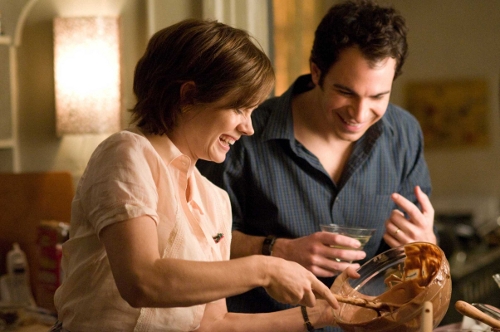
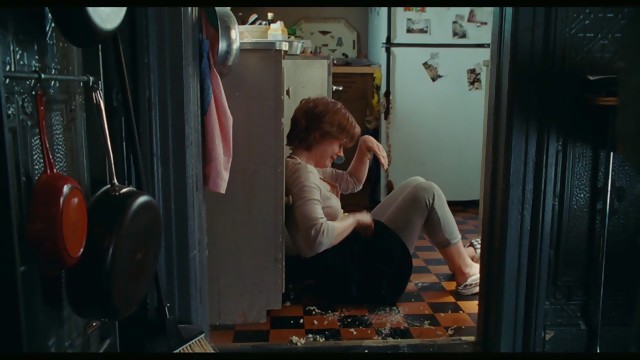
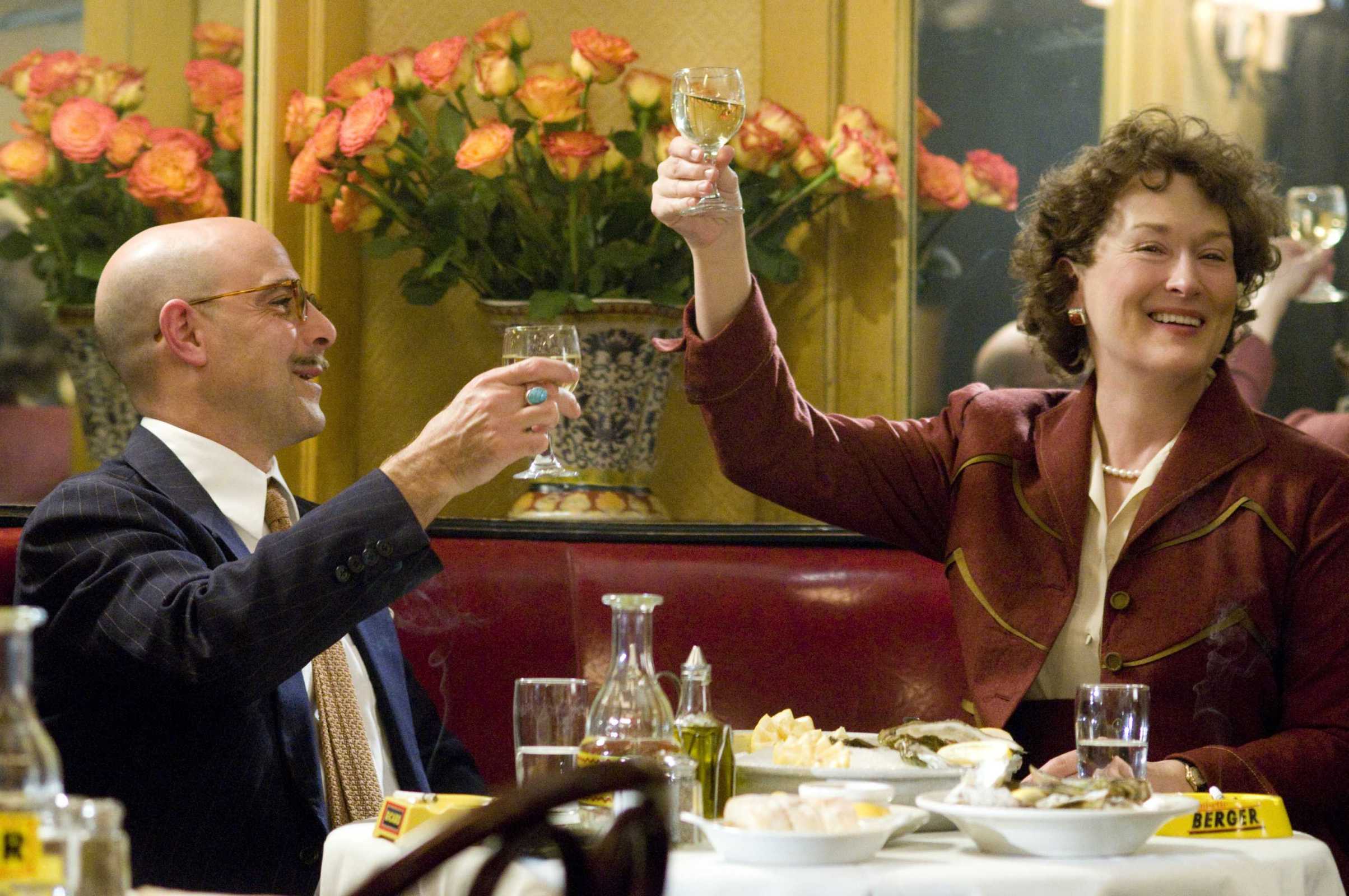
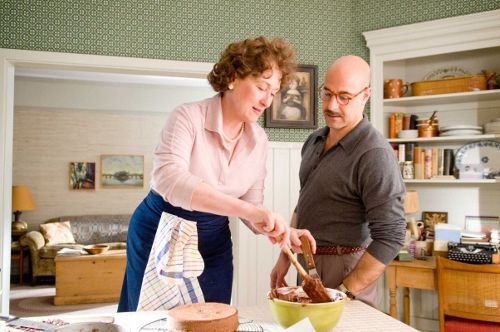
Having said that, Ephron made a stupendously wise choice to actually combine Powell's story with that of 1948 Parisian-based Julia Child (Meryl Streep) on a parallel course. Both women find themselves tethered and adrift: Julia, after working for the OSS, and married to diplomat/spy Paul Child (Stanley Tucci's best role in years) does not know what to do in Paris other than effuse, and Julie Powell (Amy Adams) finds herself in a bad Queens apartment,** at a bad job (at a post 9/11 Lower Manhattan management company), and with nothing satisfying in her life—her dream of writing a distant memory. JC decides to take cooking classes—in a class entirely of men, while JP decides that since she finds solace in cooking she's going to spend a year following Child's recipes and writing about the experience. Ephron's film then follows the two women through their various experiences until reaching their final triumphs—both of which involve being published.
Good enough. Enticing enough, actually. But, truth to tell, despite the best efforts of the impeccable Amy Adams (trooper that she is—she's perfected a mono-syllabic babble in moments of confusion), the movie just stops being interesting every time we jump to the present day story, probably because that story goes through the Ephron story-grinder—get a goal, have your effervescent highs, have your debilitating lows, but everything works out in the end (Cue Uplifting "Standard" Song).

The
Julia Child sections fare much better because Child was doing something a bit revolutionary and she was a fascinating personality and is played wonderfully well by Meryl Streep. But it's like banging the oven door on the soufflé every time we move away from the past because like a good balloon, you can't take your eyes off something that defiantly floats. That Child has interesting people to play off of—Tucci's husband and, in what might be the acting scene of the year, Streep bouncing off the brilliant Jane Lynch playing her sister—while Adams struggles in relative self-involved*** isolation, might be part of the problem.
But, truth be told, just as Julie falls in love with Julia the person, the audience does, too, and the movie falls victim to its own story; when the person keeps stating over and over what a great person "blank" is, you tend to believe it, even over the person who's stating it. And Streep's Child is far more child-like than the real person, finding the charm in everybody and everything, head-strong and a foot taller than everybody else in the vicinity (they did some careful casting and set design for this), crowing with delight and bouncing in triumph, you can't help but love her...and admire, once yet again, how Streep can take ordinary reactions and make them extraordinary.
You can still see Julia Child on TV. There's a new regurgitation by PBS called "Dishing with Julia" which features celebrity chefs watching old episodes of "The French Chef" and making comments—none of which approach critical. The most recent one had Top Chef Carla Hall observing Child slapping bread dough around on a cutting board and doing a hilarious imitation (they all do, actually) with every slap: "THIS isn't precious! THIS isn't precious!"

* Not to belabor the point, but look, she did it for self-improvement—that she made a success of it and is surfing her high tide well is just, well...gravy. Or just desserts.

** That I think New Yorkers might kill for.

*** Ephron hammers the "self-involved" blogger bit a might hard considering the number of bloggers and Facebookers and Twitterers in her audience (so says this self-involved blogger).

Thursday, February 13, 2020

Birds of Prey (And The Fantabulous Emancipation Of One Harley Quinn)

Revvin' Up Yer Ol' Harley
or
Pow! BAM! ZAP! Biff!  Plop!

Suicide Squad is destined to be remembered as not "one of the good" DCEU movies, probably because the film-makers were a bit confused about what kind of comic-book movie people wanted to see—the geniuses at Warner Brothers figured that Christopher Nolan's Batman movies worked so well that the movies should be dark, take themselves seriously and never wink at the audience. No primary colors, only leather costumes, and "deconstructed" to show how superheroes would be operating in the "real world."

The answer, apparently, is "not very well."

But, the most unlikely of the movies—the ones that were delayed as potential box-office poison (Wonder Woman) or an industry joke (Aquaman)—showed that "grim n' gritty" won't make a comic book movie respectable. Working very hard to make a good comic book movie entertaining does.
What everybody remembers from Suicide Squad (and probably the reason they went in the first place) was the character of Harley Quinn. The character was introduced in the "Batman: The Animated Series" cartoon in 1992 and, frankly, one of the few "recent" additions to the Batman "Rogues Gallery" to have stuck around to become popular. A lot of actresses could have played Quinn and done well with it, so it actually didn't have to be the latest "it" girl, Margot Robbie. But, Robbie is smart enough to know that her character work will supply longevity and she is "player" enough to push a Harley Quinn movie through development, even before a Squad sequel could be made.
The result—Birds of Prey (and the Fantabulous Emancipation of One Harley Quinn)* The title suggests something larky, a suggestion that isn't quite fulfilled unless Robbie's Harley is on the screen. Without that character's giddy sociopathy, the film would be just an unpleasant gangster movie, no matter how many bright primary colors are thrown into the mix. The movie is all her, and, sure, there are more of the DC female vigilante's thrown into the mix, but they're there to have the main character have someone to bounce off, like Margaret Dumont to Groucho Marx and the female empowerment story isn't strong enough unless Quinn's anarchy is there to light the fuse while hap-hazardly threatening to stamp it out.
The film gets off to a roaring start by doing the most important thing right off the bludgeoning bat—blowing up the most toxic relationship in all of comics. Harley Quinn may be a favorite of fan-boys, but there's always been something icky about the character—her complete and total devotion to being a doormat for The Joker (who does not appear, as Jared Leto who had the role in Suicide Squad was unavailable and Joaquin Phoenix is too busy picking up trophies**). Harley plays unreliable narrator to an animated story of her life—for those who came in late—and explains that she and the Joker have had an unamicable break-up that *good news* she has managed to survive! Despite her past skills as a psychologist—and because she is bat-shit crazy—she finds a dive apartment above a Gotham City Chinese restaurant, chops off her hair, drinks heavily, and joins the roller derby to work off some of the aggression that she can't shake by throwing knives at a picture of the Joker hanging on her wall. 
She gets a pet, a hyena she calls "Bruce," (a Superman-sized wink on that), moons over the "perfect egg sandwich", and hits the bars at night, particularly The Black Mask Club, run by the gangster Roman Sionis (Ewan McGregor). Even though she's a perpetual train-wreck in the place, Sionis turns a blind eye because she's the Joker's squeeze and that affords her a certain amount of protection, even when she cripples Sionis' driver. But, pretty soon pride wins out and she announces the break-up to the world by driving an oil tanker truck into "their place," the Ace Chemical Factory, which explodes in a celebratory light-show.
This alerts the Gotham City Police that Harley is fair game for arrest for (well) a lot of property damage, and Detective Renee Montoya (Rosie Perez) of the GCPD is determined to bring her in, despite the presence of a serial killer, dubbed "The Crossbow Killer," who has been winnowing out a lot of Gotham's underworld. 
Plus, there's Sionis, who is trying to find something called "the Bertinelli diamond" which has etched in its facets the codes to all the accounts of the Bertinelli crime family, who were wiped out in an assassination years before. Sionis is after the diamond and uses his henchman Victor Szasz (Chris Messina—the character also appeared in Batman Begins) to extract information from sources by cutting their faces off (yeah, not so much fun, huh?)
Cut (very poor choice of words) to the McGuffin—it is that Bertinelli diamond and everybody wants it. Sionis wants it and he wants Harley to get it. "The Crossbow Killer" wants it. Montoya wants it and she wants Sionis' new driver Dinah Lance (Jurnee Smollett-Bell)—who performs at his club as a singer with a special octave range—to tell her where it is. Szasz used to have it but it was pick-pocketed by a street-urchin named Cassandra Cain (Ella Jay Basco) who Harley takes pity on and takes under her wing. It is complicated, and it isn't helped by the fact that Harley is the film's narrator and...she skips parts and has to rewind to fill those parts in.
On top of that, the film has to have some sort of action every ten minutes or so, and fortunately director Cathy Yan manages to perform the plate-spinning act of keeping the film active with all that exposition and back-story—and the back and forth story-telling actually keeps it from flagging. She's also good at action, even when it's a group-fight among quite a few number of people. There is the temptation, given that the last fight takes place in a Burton-esque fun-house called "The Booby-Trap"*** and with a color-palette suggestive of Schumacher's Batman and Robin that Yan might be harkening back to the old "Batman"-TV series—only with better stunts and no OOF! graphics.
The acting is across the map: Robbie and McGregor are putting as much theatricality into it as they can, verging on going over the top. Rosie Perez is playing it straight and bad-ass. Smollett-Bell's Lance/Canary feels a little restrained when her character's conflicted, but once she becomes a part of the "Birds" group of Montoya/Canary/Huntress, she's great. The most interesting performance is by Mary Elizabeth Winstead, who is usually terrific, but her playing of the character "The Huntress" is in a style I'd call full-on-Tig Notaro (not that there's anything wrong with that—Notaro is a personal favorite), but, admittedly, the character she plays is...a bit bizarre—not in the comic-book world, but definitely a bit grimmer than everybody else. Combine her with Robbie's odd-ball and the others semi-playing it straight, there was really nowhere for her to go—the character is underwritten, despite having a 'presence" in the film—except to take the kinda straight/kinda "weird" approach that she does.
So, it's not the sure-fire "Hey, yer gonna have a GREAT time" kind of movie all the Robbie-promotion promises—it's just that it's is the most enjoyable and exploitable part of it. One is tempted to say that all the best parts are in the trailer, but that simply isn't true. It's merely that the "sizzle" aspect is all centered on one character, and unless one wanted to do a Comedy of Errors in Gotham City type of movie (which, actually, might not be a bad idea, given the grimness of the place, historically), there's going to be the risk of a burn-out factor and the risk of the character of Harley Quinn out-wearing her welcome if something isn't counter-balancing her. There's got to be a little arsenic in the sugar bowl or you might as well start budgeting for the BIFF! POW! ZAM! graphics that have been what the comics industry has been trying to get away from for decades.


* Owing to poor opening weekend receipts the title has subsequently been alternately displayed as Harley Quinn: Birds of Prey (maybe because some folks might think Harley Quinn's not in it).

** Can you imagine the disconnect if you paired Robbie's Harley Quinn with Joaquin Phoenix's Joker? The idea makes one's skin crawl, so we'll just assume that his Joker lives in alternate dimension, on Earth-Scorsese.

*** Some examples of production design: