Showing posts with label Benedict Cumberbatch. Show all posts

Friday, February 16, 2024

War Horse

Written at the time of the film's release...

"The Lives That Pass Through a Horse"
or
"Come On, Joey! Come On!"

The one-two punch of two Spielberg movies opening within a week of each is almost an embarrassment of riches, and in going from Tintin to War Horse it's a journey from the ridiculous to the sublime. We've seen what happens when Spielberg tries to make a Kubrick film (A.I.: Artificial Intelligence), a David Lean film (Empire of the Sun) or cut up like Hitchcock (Jaws), but what happens when he makes a John Ford film?

The answer is War Horse, based on the 1982 children's book by Michael Morpurgo, which was subsequently staged as a play adapted by Nick Stafford at London's National theater. Somewhere on this journey, Spielberg got wind of it, and the tale of World War I told from a horse's point of view became Spielberg's second Christmas release. Horse movies have all the sentimental elements of fables, which is why children love them, but the circumstances of this one have little to do with childhood concerns, but have more to do with kinship between man and beast in an unsentimental, often brutal world of adults. 
It has all the elements of Ford:
the Irish flavor as it begins in Devon, with the Narracott family acquiring a noble, unbreakable horse for plowing their hard-scrabble field; the horse—named Joeylearning to trust its first master, young Albert (Jeremy Irvine); the family being threatened with eviction by an uncaring bank (personified by David Thewlis' examiner); the "it takes a village" atmosphere that Ford engendered in his films (and not necessarily to come together in a common purpose, so much as to comment and gossip on it); the low comedy relief of animals—Spielberg makes goofy use of a particularly belligerent farm-goose and Ford favored horses that acted against training and merely acted like horses. Even the town of Devon looks precisely like the 20th Century Fox back-lot recreation of the Welsh mining town in Ford's How Green Was My Valley.

But tough economics trumps sentimentality here
and the horse is sold into service in WWI to keep the family going, and The Great War passes the horse from hand to surviving hand, some gentle, some harsh as the battles change the landscapes and fortunes of those in the European theater.
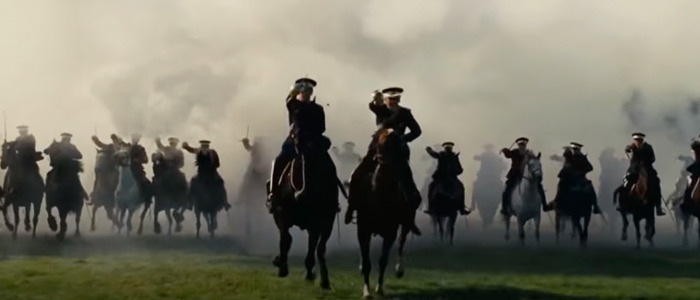
The war goes from planned charges to muddy trench warfare, Spielberg opens it up with a spirited run where, Joey, alone and ownerless for the first time in the film, makes a desperate gallop for freedom (something possibly learned by a former caretaker), through, over and past the soldiers huddled in the trenches and ironically ending his gallop in the middle of No Man's Land, where warring parties must watch and wonder at the sight between them that has nothing to do with the concerns of Man.

But, where War Horse most resembles Ford's work is pictorially—Spielberg sticks to close shots for moments of drama, but when he opens up, it calls to mind advice that the old Commander gave the young director when he was still dreaming of making movies (see video below). He's definitely paying attention to the horizon in this one, and the film,
especially in its final moments, seems to come from a different era, one more rich in design and purpose.

In its color, both in sentiment and photographically, War Horse hearkens back to another period of cinema, one that was simpler and more direct, but it never betrays anything less than sophistication of subject matter and maturity of purpose, while still maintaining a high level of entertainment value. At this point in his career, Spielberg is presenting a master class in film-making, evoking the past when it suits him, but maintaining a personal growth that seems to never flag.

Friday, October 6, 2023

Roald Dahl Short Stories by Wes Anderson

Wes Anderson (as we've been saying repeatedly with every new film of his) has a child-like glee and sensibility to his film-making. They are informed by, suggest, and embrace the point-of-view of a child, his films frequently featuring children, reflecting nostalgia for pop-culture touchstones be they arcane film-making techniques like stop-motion animation, or technologies like 45 record-players, or memories like TV specials that actually were special. More and more his movies take place in carefully constructed stages that act like complicated play-sets, cantilevering and hoisting and changing backgrounds like a grade-school auditorium stage that has practiced Union stage-hands. Or the invisible hands of a child re-arranging a doll-house.

That he should turn his attention to the short stories of Roald Dahl isn't so surprising—he'd already adapted Fantastic Mr. Fox in stop-motion animation. And Dahl's adult sense of what children like fits comfortably in his director's chair—funny, frightening, surrealistic, but an eye that wanders towards and reveres goodness, even in the face of challenges. An embracing of the wonder of it all. A raised eyebrow at the foibles of his characters, a wisdom that encompasses but that can also be disappointed. The slight touch of cynicism that reassures children they're not being bull-shitted.
So, I was looking forward to "The Wonderful Story of Henry Sugar" that he was adapting for Netflix.* But when it dropped, imagine my delight that he included three other stories, all with the mechanical precision of place, a child's sense of play, and a complete disdain for the fourth wall. Filmed in studio, they follow the same tack as his set transitions in The French Dispatch and Asteroid City, where the actors stay stagnant while the surroundings change around them. All of the actors read the text/perform the text as if they were narrating their own story with asides, glanced at notes of action, and acknowledgment of the audience in the telling of the tale. He'd done this for brief swatches of other films, but here, it is the film. In their brio and multi-media stage-craft, they have the same delightful effect as Orson Welles' presentation "for the tube" for Desilu Studios called The Fountain of Youth.
As one can see from the video above, Welles did very little that was cinematic or had any depth of field, but made his story for the square TV tube of low resolution, fitting the presentation to the strengths—and weaknesses—of the medium. Anderson does the same thing, making his short stories for a medium that can be either a computer screen or (god forbid!) a phone app. Of course, one could miss little details—like Benedict Cumberbatch twitching his mouth in "Poison" or that a "Missing" poster in "The Rat Catcher" has a drawing of Owen Wilson—but, seeing it on a larger monitor than an Android does yield benefits.
 
The cast is limited in number: Benedict Cumberbatch, Ralph FiennesBen Kingsley, Dev PatelRichard Ayoade, and Rupert Friend (who take roles in more than one of the stories and, as in "The Wonderful Story of Henry Sugar," more than one role in the piece) as well as a clutch of extras and "stagehands" who fill out the illusion and dispense with unnecessary "business," respectively. 

Here are the stories:

The Wonderful Story of Henry Sugar The longest of the shorts—at 29 minutes—it's a nesting doll of stories. A writer (Dahl, from the look of things, played by Fiennes) tells the tale of Henry Sugar (Cumberbatch) of whom the writer says “Men like Henry Sugar are to be found drifting like seaweed all over the world. They can be seen especially in London, New York, Paris, Nassau, Montego Bay, Cannes, and San Tropez. They are not particularly bad men, but they are not good men either. They are of no particular importance; they’re simply part of the decoration.” 
 
Sugar is a gambler of no great success until he comes across a slim volume in the library of an acquaintance. The title is "A Report on Imdad Khan: The Man Who Can See Without His Eyes by Z.Z. Chatterjee, December, 1935, Calcutta." Reading it, he discovers a strange story, a case study by a doctor (Patel) who met a man with a singular talent—with his eyes completely covered, this Imdad Khan (Kingsley) is able to discern objects quite clearly, navigating without aid of sight, either by foot or by bicycle, in his act he can thread a needle while his head is covered by a large metal drum. After the act, the doctor, Chatterjee asks Khan how he acquired such skills and the old man tells him his story.
Khan tells the story of how, at the age of 17, he encountered a yogi who could, during his concentrations, levitate in the air by a foot/foot-and-a-half. The yogi, miffed that his private hut has been found, and regretting it, teaches the young Khan his secret, a gradual practice of concentration that allowed the mind to focus
on a single thought until he was able to perceive with more than just his senses. After decades of practicing, Khan realizes that he can read cards from the back, navigate without the use of his eyes, read maps and even whole books in this method. "Well, well, well" says Henry as he reads the account. He has focused on only one aspect of the tale: the man had become able to read cards.
Henry rushes back to his London flat with one purpose on his mind—to use Imrad Khan's methods until he is able to read the backs of cards. He never leaves the flat—except for food and drink—and after 3 years, 3 months he is able to realize his goal to his satisfaction, which is to be able to read the back of a card within 5 seconds flat. Once he does that, he heads to the casino.
Once there, Sugar buys £10,000 worth of chips and goes to the blackjack table. When he is dealt a 19, Sugar flabbergasts the dealer by drawing on his cards. You don't draw on 19. You stick. Only eight cards of the standard 52 can be dealt which will not "bust" your hand—aces and twos. But, Sugar draws anyway—knowing what card will be next in the dealer's shoe—and receives a 2. He has 21. Although he has won, he's done so in such a way as to attract attention and he must change his strategy and his way of thinking.
 
How does it end? That would be telling.
 
But, the journey is thrilling. It's not done "in real time"—in one single delirious take—but it sure feels like it as it zips along from one happenstance to another. The pressure is really on the actors to get it precisely right while also keeping a pace about 50% faster than "reading along." At this, Cumberbatch (very much Cumberbatch!), Kingsley and Patel are quite adept, and it is only a few minutes after it is over that one considers the amount of time it must have taken to rehearse the damn thing! All of the shorts are like that—fast, breezy, precise—and it is only after the things are over that one starts to think about what they've just seen.

The Swan
"Some people," says the writer (Fiennes, again) "when they have taken too much and have been driven beyond the point of endurance, simply crumble and collapse and give up. Others however, though they are not many, who will for some reason always be unconquerable. You meet them in time of war and also in time of peace. They have an indomitable spirit. And nothing, neither pain, nor torture, nor threat of death will cause them to give up. Little Peter Watson was one of these."
 
Little Peter Watson is played by two actors (three actually, if you count the animated one): Asa Jennings (standing mute and play-acting) and Rupert Friend, who plays the older Peter recounting the tale and recreating (quite deftly) the voices of all the dramatis personnae: they are Peter, an avid bird-watcher and Ernie and Raymond, "dangerous, crazy, stupid boys," in possession of a rifle, given to Ernie on his birthday. The bullies proceed to shoot birds with their firearm and then turn their attention to a woodpecker that young Peter is spying at through binoculars, and, once the woodpecker has flown away due to their loud voices, they begin to threaten young Peter.
None of their dastardly behavior towards the boy—including tying him to a railroad track—is depicted at the boy, which would have been unsettling, but by Friend, who, by playing the older Peter assures us that he will survive, but also gives us the boy's inner thoughts which are resolute and determined. It's a story of the principled against the thuggish and provides a touch of surrealism that is a substitute for hope.

Poison
This one has been filmed twice before: as an episode of "Roald Dahl's Tales of the Unexpected" and as an episode of the original "Alfred Hitchcock Presents" directed by The Master himself. Anderson switches from Academy ratio box format to widescreen—the better to photograph the prone Cumberbatch who plays Harry Pope, an unfortunate man who is having an unfortunate night not getting to sleep. He is found by his associate Woods (Patel) prone in bed and speaking in a panicked whisper. When Woods creeps—at Pope's urgent instruction—to Pope's bed, the scared, sweating man informs him that a krait has slithered into his bed and is sleeping on his stomach. He's been laying there for hours daring not to move lest the deadly snake bite him and he'll be dead in seconds. Through clenched teeth, Harry implores his associate to get a doctor and Woods calls up Dr. Ganderbai (Kingsley) in the middle of the night to come to the bungalow to try to help his friend before it can become too late.
Woods and Ganderbai discuss what they can possibly do to help poor Harry. They dare not move him, the bed, the sheet covering him or anything to get to the snake. All they can do is give Harry the anti-venom first in the hope that if he DOES get bit he might survive, but the chances of that are about 50%. Together they devise a risky way to extricate the krait from Harry's body before it can attack him.
Two things of note: if you take a look at the bit of Hitchcock's version below, you'll see that there's a sub-text—in the adaptation by Casey Robinson—that Harry is a lush, and that Woods is a bit of a sadist, something that Anderson leaves out. This version does leave in Harry's innate racism. The pace of the thing is like the others—very quick and very precise—but Anderson puts in a few stretches of silence and held shots to ramp up the tension.
Here's a bit of Hitchcock's version from Season 4 (Episode 1) of "Alfred Hitchcock Presents"
 
The Rat Catcher
A "rodent operative" (Fiennes) is called when the Cubbage petrol station starts noticing a problem with the vermin. The station owner, Claud (Friend) answers the "rat-man's" questions, all of which are noted by the editor (Ayoade) of the local "News of the Day," which is located next door to the station (and presumably has the same problem).
 
It is obvious that the rat-man knows his profession, has much history with it,  and, in particular, knows rats...and very well. He takes great pride in his work, dismissing any amateur speculation, respect for his nemeses and for their ways and habits. He is like a military general analyzing the maneuvers of an enemy combatant. "You got to be clever on this job, cleverer than a rat and that's sayin' sumfin'" he says, through the two oversized upper teeth in the front of his mouth. If the old saying about what you become when you hunt dragons, is true, the rat-man has almost become what he has spent years hunting.
"You gotta know rats on this job"
But, the rat-man's fool-proof method of disposing of rats doesn't yield any positive (or one should say deadly) results. There are no rat bodies to dispose of and the rat-man is despondent. More than that, his pride is hurt and to puff it up again, he digs a little deeper into rat-lore and his history with rats until he takes it a bit too far...a move that turns the townspeople against him, let alone that he hasn't solved the rat-problem.
"The Rat Catcher" is mischievous, creepy, and just a little...no it's a lot twisted...with a lovely little performance by Fiennes, and some of the stop-motion animation that Anderson has employed in other movies thrown in for ratty measure. And like all of the shorts in this collection, Anderson ends it with a little Dahl factoid that gives context.
They're all lovely. And I think Dahl would have been proud.
 
 * It turns out Anderson wasn't entirely happy with the prospect, but when he was approached, the properties had already been sold to Netflix by the Dahl Estate.

Thursday, May 12, 2022

Dr. Strange and the Multiverse of Madness

The Mother of All Evil
or
Night of the Walking Stranges
 
Dr. Strange (Benedict Cumberbatch) is not having a good night. In another of those loopy dimensions he goes into every so often that tumble and disorient you, he is trying to get to a mysterious glowing pedestal that will solve all of their problems. 
 
They? Yeah, he has with him a 'tween (Xochitl Gomez) in a star-patched jeans jacket, who supposedly has powers but currently is just having issues keeping her feet. They are being pursued by some "thing" or other (standard Marvel description: "it sure is BIG!") and Strange is hanging on by his pony-tail (he has a pony-tail?) in the fight and makes the decision to sacrifice the kid's powers in order to tray and get them out of it. Woops, bad move. It doesn't work and Strange is killed and the kid gets thrown into another Universe and it looks like the movie, Dr. Strange and the Multiverse of Madness, is over before it even gets started.
 
Damn "in media res," anyway! 
No, sorry. It was all just a terrible dream. Yeah. He's a wizard. They don't just have "dreams." Something's going on, and it's not until the good doctor attends the wedding of former flame Dr. Christine Palmer (
Rachel McAdams), which is a real nightmare for him, that he begins to think there might be something more to this. Christine cuts him down a peg or two by telling him "You always have to be the one with the knife" (which will have some significance later on), and then the reception is crashed by a one-eyed octopus causing a ruckus out in the streets of NYC.
Strange and the Earth's Sorcerer Supreme Wong (
Benedict Wong) do battle with the thing and dang if the focus of cycloptopus is the 'tween in a star-patched jeans jacket whose name is America Chavez—this creates a synaptic issue whenever someone says "We've got to save America" and I think we're about to see some canvassing of neighborhoods. A post-octopicide talk with America reveals that she's from another part of the multi-verse, another dimensional version of our space-time, and her super-power is that she can travel between those dimensions, with, she confesses, little control about where she ends up—GPS being on the fritz or something. Strange deja vu's that this was the kid from his dream and they find the body of the other-dimensional Strange and the strange doctor concludes that "dreams are merely windows into our multi-versal selves." Before they can question whether that has been peer-reviewed, they discover markings on the calamari shards of the creature, which are recognized as rune markings and Strange decides to visit another Marvel mage, Wanda Maximus (Elizabeth Olsen), former Avenger, who has been going through her own crises on "Wandavision."
At this point, the exposition should stop or it'll turn as spoilery as Strange's spell in Spider-man: No Way Home. Leave it that things get complicated and that the opening to other Earths and other existences provide motivations, certainly to issues that remain unresolved, and complications. To its credit, the movie does a good enough job of expositioning that you don't feel you HAVE to have seen "Wandavision" or subscribe to Disney+. We get to meet a couple of other distinctive Strange's, another Wanda, a planet that has their own sort of Avengers called The Illuminati (which contains some giddiness-inducing fan-service of what comprises that group and who they are portrayed by—just don't get attached), and there's a marvelously done scene—reminiscent of Spider-man: Into the Spider-verse—that has Strange and America portaling through meta-verse after meta-verse that is marvelously creative for the 45 seconds or so that it lasts.
The best thing about the movie, though, is that director Sam Raimi is back. No, he didn't do the first one—
did that—but Raimi did the first three live-action Spider-man movies and basically wrote the template for the Marvel movies, which they would do well to study if they want to make films of innovation and energy. 
It's apparent very early in the film that his style is missed—his movies, be they action or horror, always had a delirious edge to them that would invoke responses of either horror or humor, a cinematic glee embedded in their mise en scène and montage. It's an added zhuzh to the proceedings, just a propulsive nudge with a wink, a comedic snap, that other Marvel movies just don't have. It's at once an acknowledgment of the goofiness behind the super-hero concept (and that we should take it SO seriously), while also trying to push the peril and make it visceral (so that we DO take it seriously).
It's a hold-over from Raimi's origins in horror (as is a cameo from
Bruce Campbell!) where the purpose is to make the "horrible" entertaining, but not so entertaining that you dismiss the darkness and the threat that the film-maker means to describe. You can have the "giggle", but it's better that you have it after a jolt, the directorial "gotcha" rewarded by the communal admission that the audience is vulnerable ("yeah I'm only human—you got me") and can be won over. 
Every movie—every theater-piece—is like that. It's a battle to win over the audience. And one can do that either by playing it safe with fan-service (and this movie is guilty of that, certainly) or by challenging—not placating—the audience in order to win its respect. Raimi is still very much of that old school (oh, he'd hate that term!) and after his box-office disappointments with Spider-Man 3 and Oz The Great and Powerful, he hasn't had a feature film made and released for 9 years. And as much as I trashed those movies, I have to say, it's good to have him back.
For all the plot contrivances, and the attempts to gin up emotional drama, DrS&MOM (oh, that's funny...) is a good ride where you don't think about those things while you're being manipulated so well. It helps that Elizabeth Olsen is a scary-good actor and that there's a good cast of great thesp's lending support all along the way.
 
It's a big improvement over the first one.
"Eyes will pop out of your brain...when you're Strange"

Saturday, February 5, 2022

The Current War: Director's Cut

Written (really) at the time of the film's eventual release.

Saturday is traditionally "Take Out the Trash" Day...


AC/DC
or
Bringing It All to Light

The Current War was produced in 2017 and finally released—to theaters—in late 2019 (after premiering with a different cut at the Toronto International Film Festival in September, 2017). The script had been acquired by The Weinstein Company (after appearing on the legendary store-house of interesting but unproduced screenplays "The Blacklist"), and filmed, executive produced by Martin Scorsese and Steve Zaillian

Then, people finally paid attention to Harvey Weinstein's behavior, and the film, which had a lukewarm reception at the festival, was shelved and sold in the midst of TWC's implosion. Pulling strings with his final cut contract, director Alfonso Gomez-Rejon ordered re-shoots and did some trimming before the film was finally released to theaters in 2019.
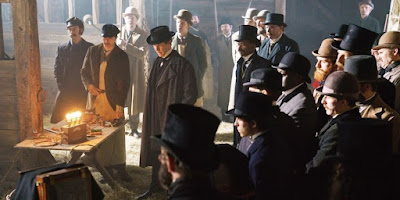
In what might be called its thesis statement, the film begins with top-hatted businessmen walking in the dark through the woods to a clearing, at which point they are blinded by a circle of light that appears magically before them, composed of many singular light bulbs piercing the darkness. From the center of the array walks Thomas Edison (Benedict Cumberbatch) who greets them with "I hope you brought your check-books." He'll need it. For Edison's plan isn't merely the use of light-bulbs, but the invention of something that no one has heard of—the electrical grid. Edison's Big Idea is to create a network of generators—that he'll own—generating direct current to cities and neighborhoods. But, given DC's limited range he's going to have to make a lot of them.
There's money to be made. And where there's money to be made, there is competition. George Westinghouse (Michael Shannon) wants to partner with Edison, but when his overtures are rebuffed, Westinghouse decides to find an alternate system. Alternating Current will travel over greater distances and given its on-again/off-again transmission could be safer and probably cheaper. The two go head-to-head trying to convince local governments to flip the switch, but they're reluctant with two systems in competition.
With the arrival of Nikola Tesla (
Nicholas Hoult) to his employ, Edison thinks he might have an inside track, but Tesla is a mercurial sort and soon bridles at Edison's single-mindedness and leaves, feeling his work is being ignored. He tries to develop his own system, but eventually joins forces with Westinghouse, who has taken his battle to the public.
As every politician knows, the best way to persuade people is with fear. Westinghouse starts a smear campaign claiming that DC is dangerous and should not be allowed in homes. Edison starts to say the same thing about AC and, to prove his point, submits a proposal for a method of execution that is far more humane—the electric chair (despite professing that he would never be a part of weapon development or something destructive to mankind).  When the first use of it sets the prisoner on fire, his reputation is damaged.
The movie sure looks interesting. The director—who's done a lot of second unit work on a lot of good movies—has a slightly cock-eyed way of framing that takes it out of the "vaunted past" look of period films and makes it a bit more surreal. But, despite a terrific cast and some sparks of nice writing, the film doesn't rise above being a more expensive version of one of those "The Inventions That Made America" episodes (but without the teasing before commercials and re-running of footage you've already seen afterwards).
And with all its talk of greatness consisting of what you leave behind, there is more than a little pissing on a live-wire when it shows the blight of a skyline cross-hatched with electrical lines. But, then I don't think the Grid is what it's celebrating: the most moving sequence is when Edison shows off a new invention—a machine that shows hundreds of individual photographs of his late wife that appears to make her move and live again. You spend two hours talking electricity, but ultimately it's about the birth of motion pictures.
 
No wonder Scorsese put his name on it.


Friday, December 31, 2021

The Power of the Dog

Gloves Off
or
"Well, Well...I Wonder What Little Lady Made This?"
 
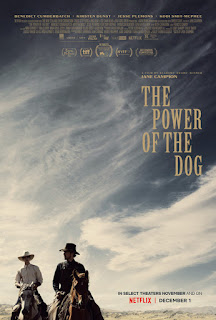
Jane Campion knows her Westerns. You can tell that with an opening shot of The Power of the Dog, tracking along the windows inside a house, the interior black, but the outside bright with sunlight, focusing on the outsider walking along parallel to the side of the house, but not a part of it, echoing John Ford and echoing The Searchers, but in her own way.
 
Like Ford, she will play with light and shadow in her western, even depending on it for a visual motif that will form a sub-text in the film, and she will pay particular attention to landscapes that separate people and must be conquered if anything resembling civilization is to take root in that wilderness. Ford's westerns were all about that and the land he photographed was itself a character in that/those stories, not merely a back-drop, not location-for-location's sake. 
 
But, that's what she takes from Ford and goes her own, entirely different way, leaving him and the dream of civilization in the dust. For Campion, the world-building of westerns is as much a myth as the westerns themselves. Civilization is about what people decide to agree on, and if the point of rugged individualists is to play by their rules, there won't be much agreement. Or very little civil.
The man in the window is Phil Burbank (
Benedict Cumberbatch), who, with his brother George (Jesse Plemons) is part of a well-to-do family with a cattle ranch in 1925 Montana. Both brothers—"Romulus and Remus" Phil calls them—are college educated with George knowing the law and Phil the classics of English literature. But, the two couldn't be more different, from each other and their educations. Phil is rough in speech and manner and does most of the work around the ranch, while George is sensitive and does the paper-work. Where Phil is coarse and brutal, George is quiet and empathetic.
They've been working the ranch for a long time, with George leavening the coarseness and conflicts the acerbic Phil causes in whatever he does. At the end of their cattle drive, the crew stops into an inn run by Rose Gordon (
Kirsten Dunst) for drinks and chow. They're served by Rose's son Peter (Kodi Smit-McPhee), who is slight, effeminate, and shy. Peter becomes an easy target for Phil's malice, making fun of everything the boy does, including using the artistic center-pieces that Peter has meticulously created to light his cigarette. Rose breaks down over this and George tries to apologize, since Phil wouldn't think of it, nor would he were it suggested to him.
But, this starts a series of events that drives a wedge between Phil and George, starting with the gentler brother marrying the Gordon woman—Phil considers her (as he says to her face) "a cheap schemer" only after the family money, and once she sells the inn and moves to the Burbank ranch-house, he begins a campaign of intimidation and hostility towards her that drives her to drink—a habit that she had previously disdained. George has paid for Peter to go away to college, but when he comes back, he finds his mother a wreck, and an open hostility against him from the cowboys working the ranch.
Campion breaks with Ford in the portrayal of women as revered stabilizers in the wilds of the West—Rose doesn't have the strength to take command and be the influence that Ford's women are in the isolation of the prairie—and Phil's cunning brute is too entrenched in his "man's world" view to allow any sort of control out of his grasp. The presence of a woman is just too intrusive to his staked-out territory.
But it's more complicated than that. And to say anything more would be to take away some complexities and motivations that might spoil the bumps and shocks that the movie has in store and could ruin its journey for audiences. Let's just say this: Campion has made a Western in locale (and borrowed some tropes from the genre), but she has other influences as well, taken from psychological thrillers and even thrown a shade of Hitchcock, making The Power of the Dog a definite hyphenate. It starts out as one thing—which may make some reconsider if they want to watch something that dark—and eventually changes into something else—something much darker.
But, one cannot parse just how beautiful The Power of the Dog is. Campion, working with cinematographer
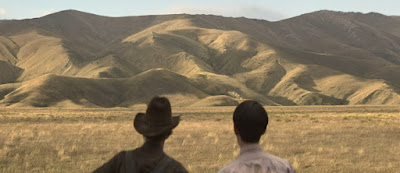
Ari Wegner, has created images of vistas and landscapes that at times take the breath away, sometimes mimicking iconic shots from previous Westerns, at times taking their cue (as in the shot above) from the paintings of Frederic Remington—as previous directors had done. Sometimes you just want to hold on an image before it inevitably movies on, wondering at how it managed to be lit by a single match, or how it captures the troubling disquiet of twilight.
It's a good watch, that will inspire questions and cast a refraction on past examples of the Western—whether the winning of the West wasn't as much a loss, and whether in bringing European culture to the frontier, we didn't drag along something horrible in the process, something that only seemed tame, in our taming of the frontier.