Showing posts with label Rachel McAdams. Show all posts

Wednesday, September 11, 2024

The Lucky Ones (2008)

A review of one of the films from the post 9-11 environment, written at the time of the film's release.
 
The Lucky Ones (Neil Burger, 2008) Every war, every "police action," seems to have its "re-patriation" film. World War 1 had The Razor's Edge, 2—The Best Years of Our Lives, Vietnam—Coming Home. The Lucky Ones involves returning troops in the ongoing Iraq War, different from their cinematic (and real) fellow troops in that they're not coming home. They're on a 30 day leave before going back as part of the "stop-loss" program. So, this takes place as more of an interruption to their service. What happens when the environment is not so regimented, or as dangerous. The three come back from the war altered, and all have specific goals in mind, all of which change when they actually touch boots to ground in the States.

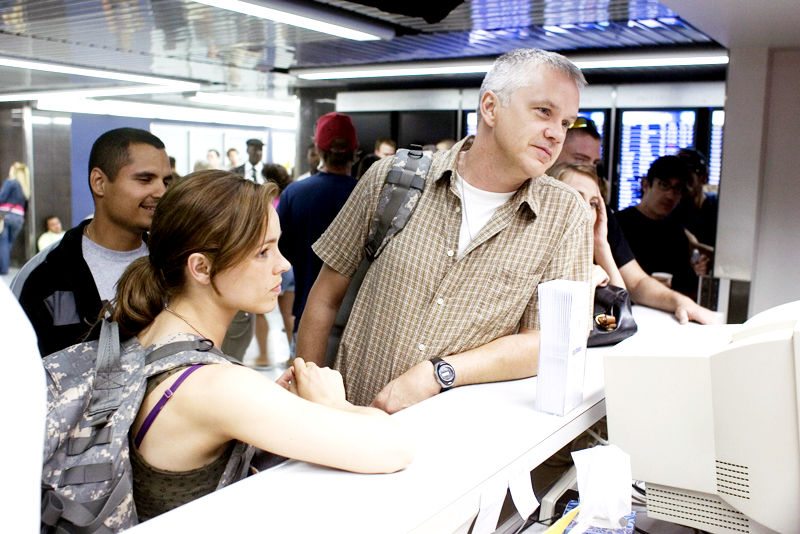
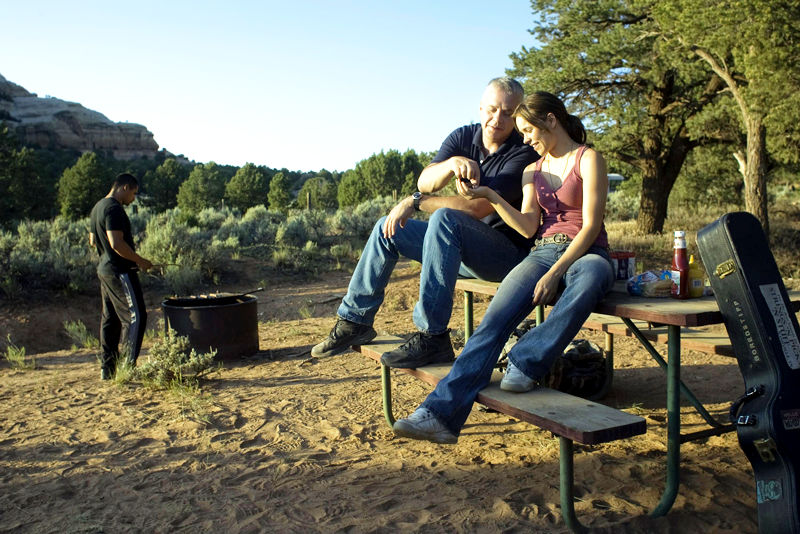
It follows three vets—Cheaver (Tim Robbins), an older sergeant just off his third and last tour, T.K. (Michael Peña), wounded, but gung-ho about going back, and Colee (Rachel McAdams), a neophyte coming back with a mission and a hole in her leg. They're all damaged: Cheaver is psychologically out-of-whack; T.K.'s purpose is to get back to his fiancee to see if "his equipment" still works after being wounded; Colee wants to find the family of the guy she hooked up with there and return his guitar to them. Meeting on the flight state-side, they decide to pool resources to get where they're heading. But, like any road-trip, there are detours, changes of plan, and the occasional loss of bearings. Stability is not to be found at home for any of them, and the trip only reinforces the perception that their fellow soldiers are the only ones who've "got their back."
Some of the episodes reach a bit, while some feel natural, and mostly the film avoids easy answers—less than it avoids mention of the war, except for a brief opening scene. The Lucky Ones is less concerned with Iraq, than it is with the soldier's plight, caught in the demilitarized zone of not fitting in either here or there.
Putting them on the road—in transit—reflects that sense of rootlessness (as most road-movies do) that these perpetual soldiers must have that is unique to this era's soldiers. The film never really tackles that subject head-on, as it almost has a duty to do, instead relying on the various "missions" and destinations to define the characters. Ultimately, the film has nowhere to go once those stories are used up, and the film ends on a logical melancholy note.

Where it shines is in the performances. As with the war, Burger and his co-writer
Dirk Wittenborn are quiet about the soldiers, presenting them as rather independent pawns in a much bigger game, their choices on the road sometimes unconventional, and not S.O.P.  But McAdams, Pena, and especially Robbins (this is some of his subtlest work in the past decade and nice to see), breathe a likable humanity into their characters, buffering the moments of manipulation and contrivance. You like these guys and want them to succeed, even if they are a bit unreadable—enough so that some of their choices surprise, even deep into the movie. That The Lucky Ones manages to do that is no small accomplishment.

Friday, April 28, 2023

Midnight in Paris

Written at the time of the film's release...

"Gertrude Stein Punched Me in the Mouth"
or
"L'époque est toujours plus belle de l'autre côté du pont Einstein-Rosen"

I first came to Chicago in the twenties, and that was to see a fight. Ernest Hemingway was with me and we both stayed at Jack Dempsey's training camp. Hemingway had just finished two short stories about prize fighting, and while Gertrude Stein and I both thought they were decent, we agreed they still needed much work. I kidded Hemingway about his forthcoming novel and we laughed a lot and had fun and then we put on some boxing gloves and he broke my nose.
 "A Twenties Memory" by Woody Allen
Copyright © 1966-1971 by Woody Allen

I've been waiting for Woody Allen to make this film since before he asked to Play It Again, Sam (or even What's Up, Tiger Lily?). 

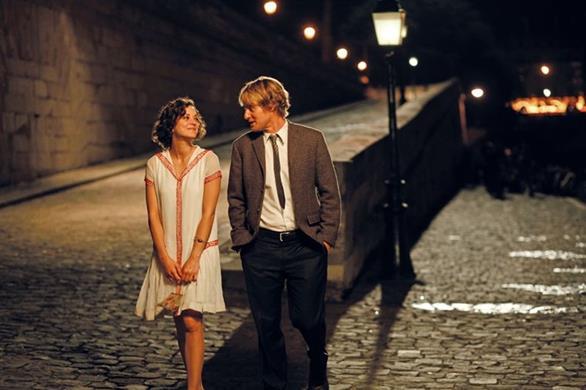
Based on a routine from his stand-up days,* which he later expanded for a piece in "The New Yorker" (see above), Midnight in Paris follows Gil (Owen Wilson) a self-absorbed, neurotically anxious writer of Hollywood fluff ("Wonderful, but forgettable...sounds like something I wrote"), who is obsessed with death,** as he travels to Paris from Pasadena with fiancee Inez (Rachel McAdams, but it could just as well have been Elizabeth Banks) and her conservative family. Gil is working on a novel, long in the gestation, and is distracted by the vapid shallowness that he is about to marry into. Paris is shops, restaurants, museums and snootiness, and to escape the jejeune de vivre, he takes a late-night walk through the streets of Paris and is approached by a vintage taxi.
Entering the cab for Gil is a magical moment for him, on the same plane-breaking as when Tom Baxter (or is it Gil Shepherd) walks off the screen in The Purple Rose of Cairo. He is instantly transported to 1920's Paris and becomes lost in "The Lost Generation" (without the benefit of having survived World War I), meeting Cole Porter (Yves Heck), Ernest Hemingway (Corey Stoll), Zelda (Alison Pill) and Scott Fitzgerald (Tom Hiddleston), all the heroes of his favorite literary era and time, the 1920's. He's enchanted...and as his novel is about that period of time...inspired. He goes back to Inez, gob-smacked, unable to explain where he's been all night, but "alibi's" his adventures as a dream (as they are, certainly in the aspirational sense). He tries to bring Inez to the party, but the magic doesn't work—she's as unthrilled with Gil's stories as he is with her wine-tasting adventures with acquaintance Paul (Michael Sheen).
She leaves. And the taxi arrives, bearing Gil and Hemingway to the apartment of Gertrude Stein (Kathy Bates) and Alice B. Toklas (Thérèse Bourou-Rubinsztein), who are playing judgemental hosts to Pablo Picasso (Marcial Di Fonzo Bo) and his enchanting mistress Adriana (Marion Cotillard). Gil gives his novel to Stein and Hemingway to critique, but he is drawn to Adriana, making her way through the 20's as best she can.
So, the two planes of existence for Gil are set up: his modern-day drudgery on the cusp of a marriage of inconvenience; and his fantasy past, where his dreams are reality and reality can make dreams. You know where this is going.
It doesn't matter, though. This is a "feel-good" Woody Allen picture—the kind people like—where the messages are still telegraphed the way they are in "obvious" Allen movies, the coincidences just a little too convenient, but so full of incident, grace and nuance (and quite a bit of humor) that it goes down well (as Allen groused throughout Stardust Memories, audiences "like his earlier, funnier [movies]"). That Gil is such a sunny presence in the past (and as played by Wilson, he has a guileless charm that doesn't sacrifice intelligence—he's the way you'd imagine Jimmy Stewart would play Woody Allen), even his kvetching is charming and not harsh.  It doesn't matter that you be a history buff and "get" all the references,*** (and we meet Luis Bunuel, Man Ray, Salvadore Dali [Adrien Brody], and on a side-trip, Toulouse Lautrec, Gaugin and Degas).
Of course, Gil is enchanted; he is an era when his heroes are still at the stage he is, becoming themselves, with their best work still ahead of them. His age of magic is their everyday life. The interesting lesson of the film (and what makes it special and wise) is that the knife cuts both ways. The "lesson" is both sour and sweet, but not hope-crushing—a little bit of salt in the creamy fluff.
 
And no, nobody punches Gil in the nose—but you can't help noticing that Wilson's is a little broken.

*  I mentioned before that I was in Europe. It's not the first time that I was in Europe, I was in Europe many years ago with Ernest Hemingway. Hemingway had just written his first novel, and Gertrude Stein and I read it, and we said that is was a good novel, but not a great one, and that it needed some work, but it could be a fine book. And we laughed over it. Hemingway punched me in the mouth.

That winter Picasso lived on the Rue d'Barque, and he had just painted a picture of a naked dental hygienist in the middle of the Gobi Desert. Gertrude Stein said it was a good picture, but not a great one, and I said it could be a fine picture. We laughed over it and Hemingway punched me in the mouth.

Francis Scott and Zelda Fitzgerald came home from their wild New Years Eve party. It was April. Scott had just written "Great Expectations," and Gertrude Stein and I read it, and we said it was a good book, but there was no need to have written it, 'cause Charles Dickens had already written it. We laughed over it, and Hemingway punched me in the mouth.

That winter we went to Spain to see Manolete fight, and he was... looked to me eighteen, and Gertrude Stein said no, he was nineteen, but that he only looked eighteen, and I said sometimes a boy of eighteen will look nineteen, whereas other times a nineteen year old can easily look eighteen. That's the way it is with a true Spaniard. We laughed over that and Gertrude Stein punched me in the mouth.


** Yes, this is the Woody Allen character.  His films never fall too far from the analyst's couch.

*** I certainly didn't—I had to do some referencing for the line: "That was Djuna Barnes (I was dancing with)?  No wonder she wanted to lead."

Thursday, May 19, 2022

Morning Glory (2010)

Roger Michell died last year at the age of 65, before his latest film The Duke was released. It is out now and I recommend seeing it, especially in a theater, where it will do the most good. Michell's most popular film is probably Notting Hill, but he also made The Mother and Enduring Love (for you Daniel Craig fans), and Hyde Park on Hudson (with Bill Murray as Franklin Roosevelt). To sum up, he made movies that are usually placed in "art-houses" where films of a limited budget and less than frivolous subject matter, unsullied by hyperbolic press and saturation campaigns go to die...and merit consideration during Awards Season, where sometimes their fortunes are favored, but mostly forgotten. And he was darned good at it. 
 
This was written at the time of the film's release.
 
"You're Gon-na Make it After Alllll"*
or
"Will Someone Tell Me Why I Logged Off 'BangingGrannies.com' For This?"

Talk about quick turn-around. Plucky news-producer Becky Fuller (Rachel McAdams) has just rebounded from being fired from her New Jersey TV station to being hired to produce an in-the-ratings-dumper morning news-klatsch in New York City. The stipulation from boss Jerry Barnes (Jeff Goldblum, whose height advantage over McAdams is used to very good advantage) is that she has to turn the ratings around on the clunker or the venerable TV-institution called "DayBreak" will be cancelled.

But who wants to work in an institution?
The place is a televised mad-house. Goofy weatherman, clueless reporters,
a perv' anchor (he delivers the second headline above), and the Nurse Ratched of the place is the veteran house-mother-anchor (Diane Keaton) who views Becky as just one more producer for a show that's "a revolving door for cretinous morons." She's seen 'em come and go, while she's been "pulling the train up the hill (...with my TEETH!)" for fourteen years. "DayBreak" needs to be fixed.

Becky starts to shake things up, and her first job is to find an anchor a little less orange.
She goes the credibility route and seeks out Mike Pomeroy (Harrison Ford, who hasn't done this much mugging since Return of the Jedi**), a veteran news-man (he lunches with Chris Matthews, Bob Schieffer, and Morley Safer), grumpily living out his golden parachute contract, and has no desire to lower his standards working on a show with "half an audience who've lost the remote, and the other half are waiting for the nurse to turn them over." 
Warned that he is "the third-worst person in the world...after
Kim Jong-Il and Angela Lansbury" by the movie's obligatory boy-friend (Patrick Wilson...slumming***), Becky finds a loop-hole in his contract and forces the pro to "lower his standards," but raise the bar on passive-aggressive behavior (he refuses to "banter, from the Latin word for 'gibber like a moron'")...as if the show needed any more of that. Pretty soon, every surface at the station has Becky-forehead-sized dents from her beating herself into them—that and her seeming incapacity to open doors are the two consistent jokes of which no opportunity is passed.

It's got the TV-industry cynicism down, but raised to the bitchy level of the fashion industry (the writer, Aline Brosh McKenna, also wrote The Devil Wears Prada, ...and 27 Dresses , and Laws of Attraction, and Three to Tango...so this is the first movie of hers I haven't actively avoided...although I did see Prada, and admired it). Director Roger Michell can do rom-com fine (Notting Hill), but he's capable of doing better stuff, and he keeps everything lively and semi-sunny, despite the rampant cruelty tossed around like so much unnecessary paper-shuffling on a news-desk. But, he can't do much with the cliched material, from the "meet cute" to the "slo-mo run through new York." 

Morning Glory is okay, but it breaks no boundaries (or news, for all that), it's another "working girl" comedy in the revolving door of them.

* Cue the hat-throw. Give credit where credit is due: I didn't notice this was basically "The Mary Tyler Moore Show" (and a two-hour stretch of the half-hour pilot, at that) until Ford's crusty news vet says to the young producer "You have a repellent moxie" in the same way that Ed Asner's Lou Grant said "You've got spunk....I HATE spunk!"  Where's Betty White when you need her?

** ...which makes me think something is wrong.  Ford is the master of the subtle slow-burn comic performance, but this one is at a hard-boil. His lines delivered in a husky, phlegmatic drone, you start to wonder if Ford—like his character—just isn't happy to be there (y'know, like his narration in BladeRunner?). Then, he manages to take what should have been the movie's worst scene, and make it shine, giving it depth, resonance and heart...while still not betraying his character. Nice work.

*** Yeah, but on the other hand, I've felt so sorry for so many good actresses playing "the girlfriend" over the years, this is one for equal opportunity. 

Thursday, May 12, 2022

Dr. Strange and the Multiverse of Madness

The Mother of All Evil
or
Night of the Walking Stranges
 
Dr. Strange (Benedict Cumberbatch) is not having a good night. In another of those loopy dimensions he goes into every so often that tumble and disorient you, he is trying to get to a mysterious glowing pedestal that will solve all of their problems. 
 
They? Yeah, he has with him a 'tween (Xochitl Gomez) in a star-patched jeans jacket, who supposedly has powers but currently is just having issues keeping her feet. They are being pursued by some "thing" or other (standard Marvel description: "it sure is BIG!") and Strange is hanging on by his pony-tail (he has a pony-tail?) in the fight and makes the decision to sacrifice the kid's powers in order to tray and get them out of it. Woops, bad move. It doesn't work and Strange is killed and the kid gets thrown into another Universe and it looks like the movie, Dr. Strange and the Multiverse of Madness, is over before it even gets started.
 
Damn "in media res," anyway! 
No, sorry. It was all just a terrible dream. Yeah. He's a wizard. They don't just have "dreams." Something's going on, and it's not until the good doctor attends the wedding of former flame Dr. Christine Palmer (
Rachel McAdams), which is a real nightmare for him, that he begins to think there might be something more to this. Christine cuts him down a peg or two by telling him "You always have to be the one with the knife" (which will have some significance later on), and then the reception is crashed by a one-eyed octopus causing a ruckus out in the streets of NYC.
Strange and the Earth's Sorcerer Supreme Wong (
Benedict Wong) do battle with the thing and dang if the focus of cycloptopus is the 'tween in a star-patched jeans jacket whose name is America Chavez—this creates a synaptic issue whenever someone says "We've got to save America" and I think we're about to see some canvassing of neighborhoods. A post-octopicide talk with America reveals that she's from another part of the multi-verse, another dimensional version of our space-time, and her super-power is that she can travel between those dimensions, with, she confesses, little control about where she ends up—GPS being on the fritz or something. Strange deja vu's that this was the kid from his dream and they find the body of the other-dimensional Strange and the strange doctor concludes that "dreams are merely windows into our multi-versal selves." Before they can question whether that has been peer-reviewed, they discover markings on the calamari shards of the creature, which are recognized as rune markings and Strange decides to visit another Marvel mage, Wanda Maximus (Elizabeth Olsen), former Avenger, who has been going through her own crises on "Wandavision."
At this point, the exposition should stop or it'll turn as spoilery as Strange's spell in Spider-man: No Way Home. Leave it that things get complicated and that the opening to other Earths and other existences provide motivations, certainly to issues that remain unresolved, and complications. To its credit, the movie does a good enough job of expositioning that you don't feel you HAVE to have seen "Wandavision" or subscribe to Disney+. We get to meet a couple of other distinctive Strange's, another Wanda, a planet that has their own sort of Avengers called The Illuminati (which contains some giddiness-inducing fan-service of what comprises that group and who they are portrayed by—just don't get attached), and there's a marvelously done scene—reminiscent of Spider-man: Into the Spider-verse—that has Strange and America portaling through meta-verse after meta-verse that is marvelously creative for the 45 seconds or so that it lasts.
The best thing about the movie, though, is that director Sam Raimi is back. No, he didn't do the first one—
did that—but Raimi did the first three live-action Spider-man movies and basically wrote the template for the Marvel movies, which they would do well to study if they want to make films of innovation and energy. 
It's apparent very early in the film that his style is missed—his movies, be they action or horror, always had a delirious edge to them that would invoke responses of either horror or humor, a cinematic glee embedded in their mise en scène and montage. It's an added zhuzh to the proceedings, just a propulsive nudge with a wink, a comedic snap, that other Marvel movies just don't have. It's at once an acknowledgment of the goofiness behind the super-hero concept (and that we should take it SO seriously), while also trying to push the peril and make it visceral (so that we DO take it seriously).
It's a hold-over from Raimi's origins in horror (as is a cameo from
Bruce Campbell!) where the purpose is to make the "horrible" entertaining, but not so entertaining that you dismiss the darkness and the threat that the film-maker means to describe. You can have the "giggle", but it's better that you have it after a jolt, the directorial "gotcha" rewarded by the communal admission that the audience is vulnerable ("yeah I'm only human—you got me") and can be won over. 
Every movie—every theater-piece—is like that. It's a battle to win over the audience. And one can do that either by playing it safe with fan-service (and this movie is guilty of that, certainly) or by challenging—not placating—the audience in order to win its respect. Raimi is still very much of that old school (oh, he'd hate that term!) and after his box-office disappointments with Spider-Man 3 and Oz The Great and Powerful, he hasn't had a feature film made and released for 9 years. And as much as I trashed those movies, I have to say, it's good to have him back.
For all the plot contrivances, and the attempts to gin up emotional drama, DrS&MOM (oh, that's funny...) is a good ride where you don't think about those things while you're being manipulated so well. It helps that Elizabeth Olsen is a scary-good actor and that there's a good cast of great thesp's lending support all along the way.
 
It's a big improvement over the first one.
"Eyes will pop out of your brain...when you're Strange"

Thursday, February 25, 2021

Sherlock Holmes: A Game of Shadows

Written at the time of the film's release...

Bullet-Time
or
"Forewarned is Fore-armed (and Don't Call Me 'Shirley')"

"'Well, well,' said he, at last. 'It seems a pity, but I have done what I could. I know every move of your game. You can do nothing before Monday. It has been a duel between you and me, Mr. Holmes. You hope to place me in the dock. I tell you that I will never stand in the dock. You hope to beat me. I tell you that you will never beat me. If you are clever enough to bring destruction upon me, rest assured that I shall do as much to you.'

"'You have paid me several compliments, Mr. Moriarty,' said I. 'Let me pay you one in return when I say that if I were assured of the former eventuality I would, in the interests of the public, cheerfully accept the latter.'
"The Final Problem" Sir Arthur Conan Doyle

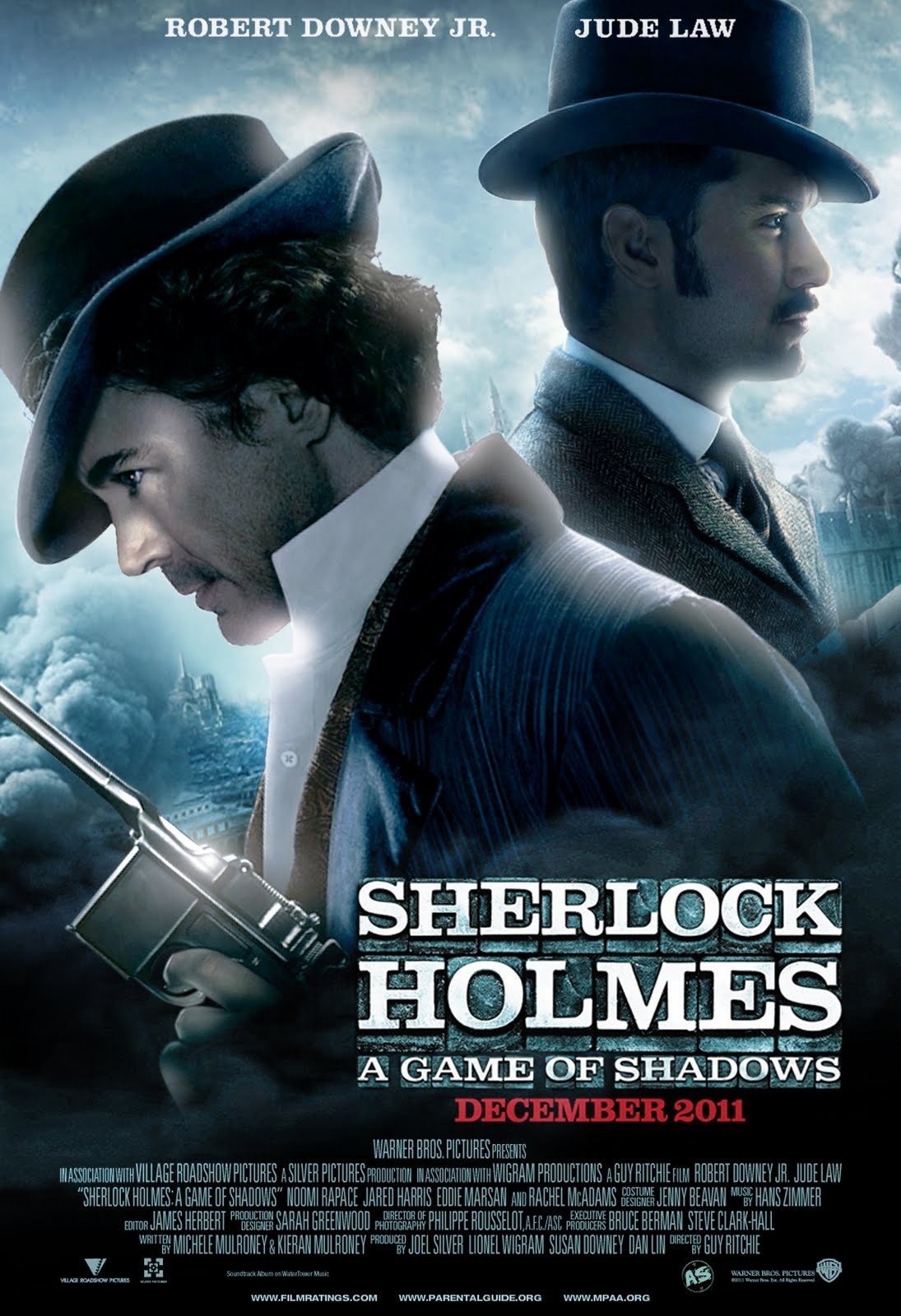
Sherlock Holmes: A Game of Shadows is the inevitable (and one should say quick-on-its-heels) follow-up to Guy Ritchie's Sherlock Holmes, and as an adaptation of Conan Doyle's "The Final Problem," It has as much source-relationship as the later Bond films have to Fleming—the bare-bones structure is there, but it's pumped, plumped, and trumped-up to fulfill the needs of action, humor and modern audience identification.
Really, "The Final Problem" is enough, we don't need the world-conquering machinations of Professor Moriarty (The Napoleon of Crime, the Scourge of London, and Holmes' best match) to make him a worthy adversary. He merely needs to be omnipresent by means of his web of chicanery, rather than an omniscient history-maker. In fact, Conan Doyle's Moriarty would rather his bad work went undetected, as opposed to this movie's version producing a shattering World War. Here, in the words of Robert Downey Jr.'s Holmes, the plot is "so overt, it's covert," involving twins who aren't twins, TB, the Romany, anarchists, darts for various purposes, intricate explosive devices and not-so-intricate shell-firing ones, countries that can't be named ("although they speak French and German"), and the prospect of "war on an industrial scale."

20/20 hindsight always looks like genius when set in the past.
Actually, it's pretty clever how the doom-laden inevitability of "The Final Problem" is translated into the fore-shadowing of the war-torn 20th Century (the screen-writers are the wife-husband team Michele Mulroney and Kieran Mulroney*), and its focus on large artillery and semi-automatic "machine-pistols" has a nice hard edge as opposed to the original film's emphasis on the psuedo-occult. 
But, director Ritchie seems to have lost of his edge somewhat, as the fight-sequences (and there are many) are nicely fore-shadowed with flash-cut Holmsian cognitive pre-functioning, but when the fisticuffs and baritsu moves start flying, the action is hard to follow, even when the action is slowed to a crawl—there is far too much ramp-editing and Matrix-y "bullet-time" FX in the film for no good purpose other than to slow down the practical and digital effects and give us the illusion of "wow, that was close." (Thanks, we assume that fire-fights and shellings are dangerous things). However fast the editor can manipulate images, one still gets the impression of the film being a bit too "fussy" for its own good, delaying information or simply obfuscating it for a later time, giving one the impression that one is seeing a lot of the movie twice. Efficient, it ain't, even if the titular character is supposed to be the height of it.
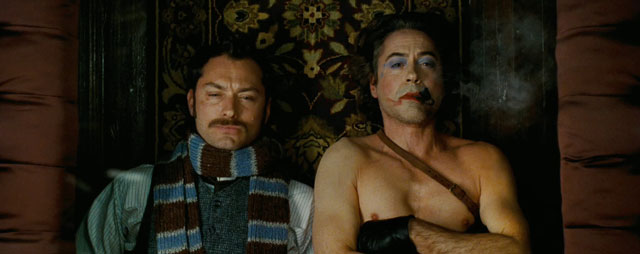
Also, although the first of Downey's adventurings could be seen as being a nicely nuanced (if scruffy) interpretation of The Great Detective, here the character is allowed to go a little more broad, dressing in comedic drag ("I admit, it's not my best disguise") and another, which is actually taken from The Pink Panther series (mind you, Steve Martin's "Pink Panther" series), the comedy is played up and not necessarily in character, and Holmes is seen to be practically infallible—even his getting seriously hurt is all part of his plan.
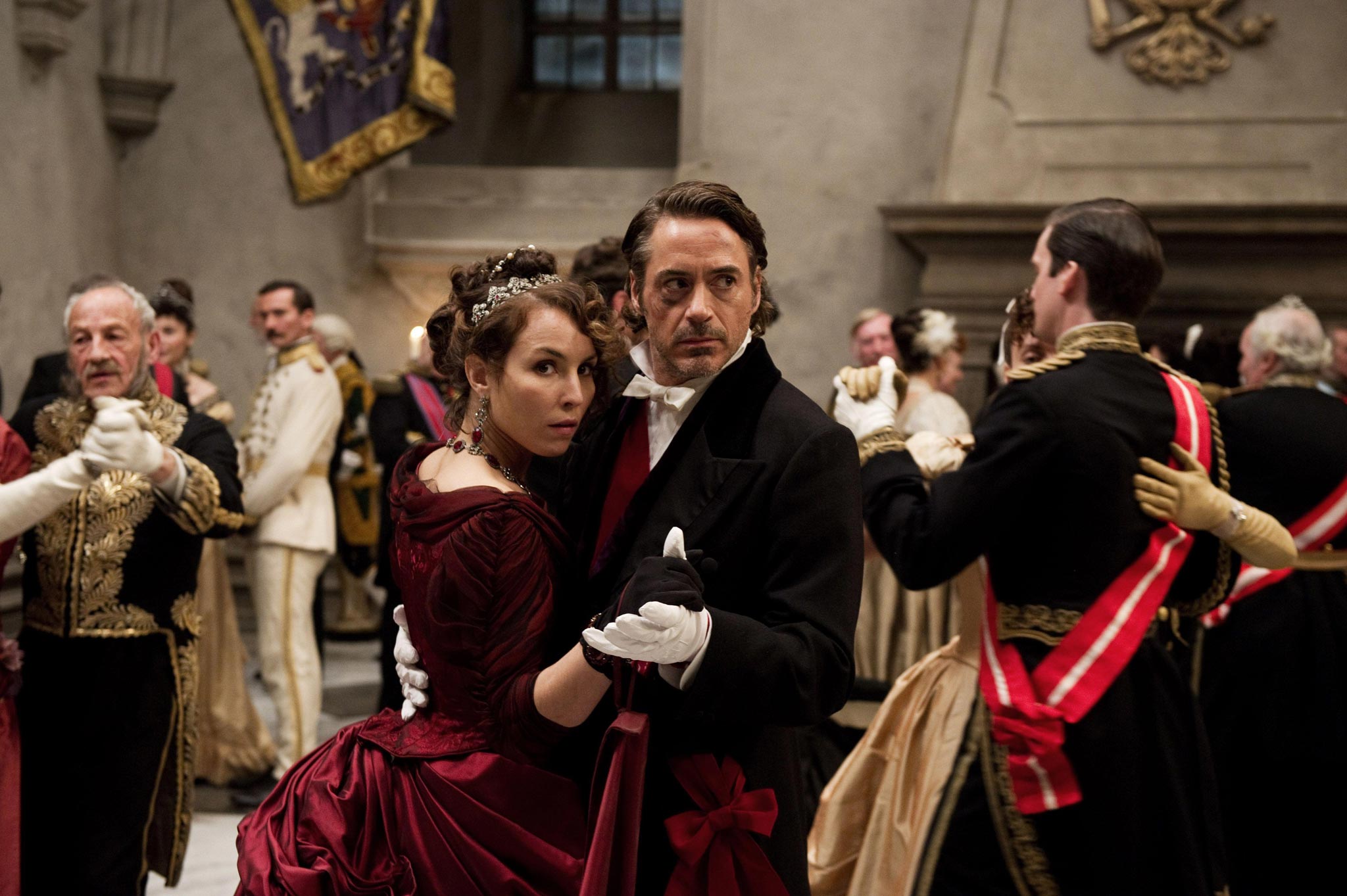
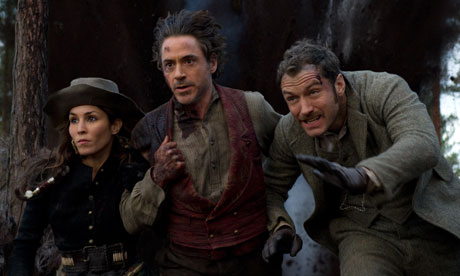
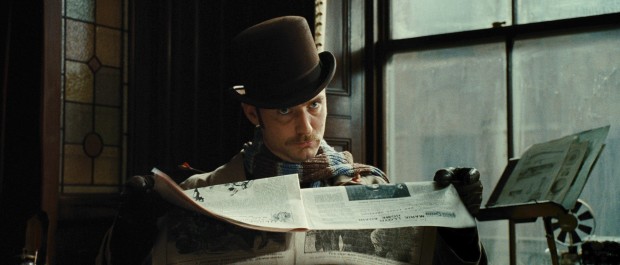
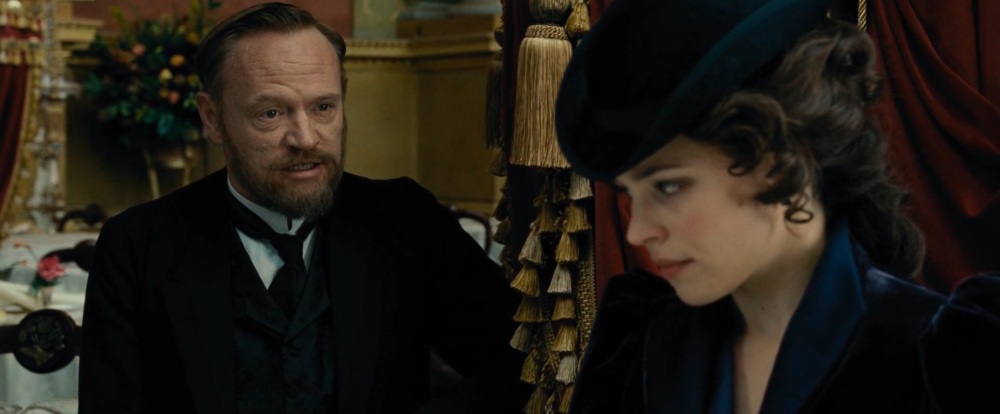
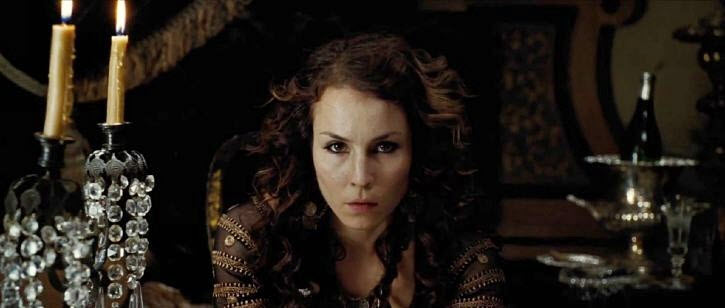
Downey, Jr. is great at playing this, even if it's a more absurd version of Holmes, and Jude Law again plays Dr. Watson (now with a severe limp and who is only now about to be married to Mary Morston, again played by Kelly Reilly) and it's one of Law's best performances, quick as Downey and capable of the slowest of "burns." Law's role is expanded somewhat and he makes the most of it. The two are joined (briefly) by Rachel McAdams, reprising her role as "the woman" Irene Adler, but is soon replaced by Noomi Rapace's gypsy princess Simza. Aiding and abetting is Stephen Fry, as Holmes' smarter, drier brother Mycroft (it might actually be considered type-casting), with Jared Harris as the coolest of Moriarty's (Brad Pitt was initially considered for the role), as well as being one of the youngest.
As fun as it is, one can't help but look at it as a step down—the filmmakers are getting further afield of the Holmes characterization, and it's only a matter of time before the Downey, Jr. version is locked into buffoonery and slapstick, and it comes perilously close to teetering off the edge here. As it is, this plot is more reminiscent of the Basil Rathbone films set during WWII—entertaining if anachronistic fluff.
Paget's Strand Magazine illustration of the first of two Holmes-Moriarty encounters.


* Kieran is the brother of Dermot Mulroney, husband of Michele, and you may best remember him from "Seinfeld" as the fellow who gets bent out of shape at a funeral reception when he see George Costanza double-dipping a chip.

Wednesday, February 24, 2021

Sherlock Holmes (2009)

Written at the time of the film's release...before the "Benedict Cumberbatch" version of a modern-day "Sherlock" (in case you were looking for clues about why I wasn't mentioning it).

"The Lord, The Woman, the Ginger Midget and the Parisian Giant" 

or 
"The Peripatetic Plot of the Madonna's Husband"

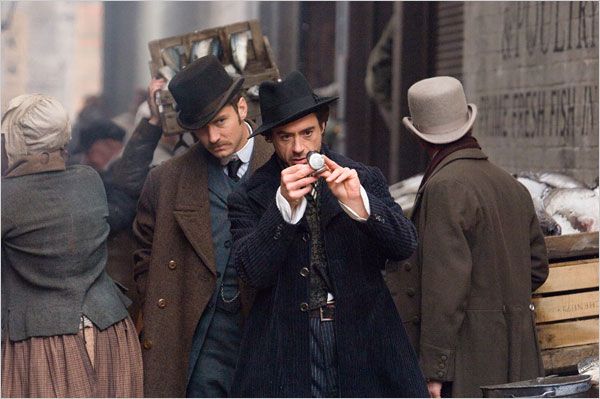
I had been looking forward to the new Sherlock Holmes with anticipation and dread. I'm a fan, though hardly a "Baker Street Irregular," and Robert Downey Jr. is always worth watching—even when he's not, able to suck nuance out of even claustrophobic camera set-ups and able to project a fiendish intelligence out of every role. Fans of the Great Victorian Detective, I've liked several incarnations—particularly Jeremy Brett's encyclopedic and eccentric interpretation, and suffered through the attempts to get another Holmes series started. Brett left a long shadow—one that not even a good choice like Rupert Everett could dispel.* And clues in the trailer led one to deduce that they would try and make Holmes more of an action figure than Conan Doyle might have intended—more like a Bourne-again Holmes than the amateur pugilist of the books. 
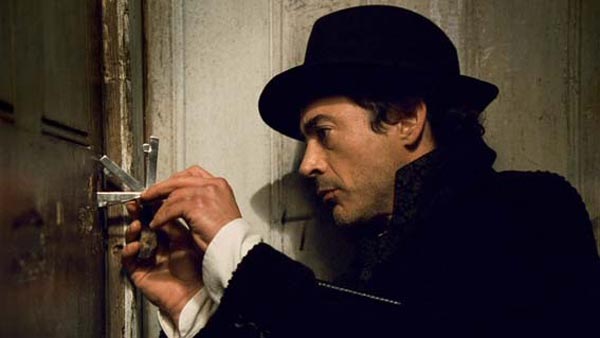
There are elements of that here, but done cunningly by writers Michael Robert Johnson, Anthony Peckham, and Simon Kinberg; Holmes, ever the synthesizer of information-bits diagnoses his battles first using his observations of his opponents, then carries them off with judicious speed, making note of their potential recovery time, both physical and psychological. Neat touch that, as is a nice summing up of Holmes' misanthropic characteristics—sitting at a restaurant table awaiting Watson (Jude Law,** as good as Law has ever been) and his intended, Mary Morstan (Kelly Reilly),*** Holmes observes every argument, every petty theft, every peculiarity of his fellow diners—without his mind disciplined in pursuit, the vagaries of the world must drive him mad. Both Robert Stephens and Brett maintained that the difficulty in playing Holmes is that there is no center to him—a brain with no heart. Bur even an unbridled intellect must react to the world, and in Downey, jnr. there is quicksilver in those reactions. 
The game that is afoot is one that will challenge Holmes to his core in a battle of facts and logic against magic and the dark forces.**** When we first see Holmes and Watson in action, they disrupt a ritual sacrifice by the fiendish Lord Blackwell (Mark Strong), who is already responsible for three murders before the fourth is disrupted. Sentenced to hang, Blackwell informs Holmes he will rise from the dead to usher in a new destiny for England. Holmes is skeptical, but intrigued, especially after Blackwell is hanged, declared dead (by Watson), then escapes his coffin. At a time in History, when engineering marvels such as London Bridge are being accomplished, it seems more imperative than ever for Holmes to dispel the superstitious. 
Disrupting his concentration is a visit by the one woman who has out-foxed Holmes, Irene Adler (Rachel McAdams, far too contemporary an actress for the part—one expects her to huff and say "whatever..." at any moment), in the story "A Scandal in Bohemia." Adler is an adventuress, to be sure, but she is almost a secret agent here, more in line with the fictional series of stories that been built up around her by Carole Nelson Douglas. 
There is far less drawing-room discussion and far more darting about and cane-dashing than in previous incarnations. The humor is amped up considerably, and the effects of injury down-played, but for all that it's a good representation of Holmes, adrenalized and puffed up as it is. Guy Ritchie shows that he has evolved from mumbling street-thug films to something with more than empty panache. His breathlessly paced opening half of the film stumbles somewhat with an extended fight with a Parisian giant, but manages to regain its footing with some genuinely well-done sequences that manages to clue the audience in to eke out its suspense. There has been some criticism of late that Ritchie doesn't have the depth or focus to pull off a big-budget film, although he's been angling for them for years. "Sherlock Holmes" is his defiant reply. 
And not only are Law and Ritchie showing their best games here—composer Hans Zimmer, long an adherent of the generically grinding over-the-top symphonic score (he supervised all three "Pirates of the Caribbean" scores, which, frankly, are hard to tell apart), his work for "Sherlock Holmes" is folk-song based, with clever rhythms and instrumentation—kudos to orchestrator Kevin Kaska—that keeps the period alive amidst the clutter of the art direction.

* Although I'd like to see Ralph Fiennes, or better, Daniel Day-Lewis, try. 

** Law appeared in the Granada version of Doyle's "The Adventure of Shoscombe Old Place."
*** Although why Watson feels the need for Holmes to meet her in the first place is rather odd. She did, after all, hire him in "The Sign of Four."
**** Conan Doyle's stories focused on matters that challenged the societal structures of Victorian England and elaborate plots of thievery, and rarely dealt with the occult, although some of the modern stories—like Young Sherlock Holmes (1985), which also featured an occult presence, as it was produced by Steven Spielberg, not long after Indiana Jones and the Temple of Doom, have featured Holmes against more supernatural threats. There was always that element to Doyle—such as the monstrous "Hound of the Baskervilles"—but they were usually explained away in bursts of Holmesian fact-checking.
Shamelessly going for search-engine hits...