Showing posts with label Guy Ritchie. Show all posts

Friday, April 26, 2024

The Ministry of Ungentlemanly Warfare

"Boys Own"
or
"I Have Good News and I Have Bad News"

The Second World War makes for fascinating history and fascinating reading. The convergence of warfare, technology, and the dark arts of espionage fairly boggles the mind that so much was going on in the background while foot-soldiers and pilots and sailors were slugging it out on the battlefields. The Allies would do anything to gain an advantage. Whether it was Operation Mincemeat, or Operation Crossbow, or Operation Anthropoid or "The Ladies" at Bletchley Park or Alan Turing's "computing machine" or the spies and conspirators at "Camp X", so much was done behind the scenes of "the lines" to disrupt enemy operations or lead them astray that soon the conspirators got caught up in their own chicanery. When secrets were discovered of enemy bombing runs, the information could not be used to save lives lest the enemy discover the Allies' advantage. One cannot calculate the lives that were lost...and needlessly...in order to preserve that most transitory of things, military secrets.
 
They make for good reading,* but Hollywood never seems to think that they'd make good stories unless they're blown up (and real good) to cartoonish proportions. That Operation Crossbow film is a good example of that.
Gus March-Phillips in the hirsute form of Henry Cavill

And so is
The Ministry of Ungentlemanly Warfare, Guy Ritchie's new film, which tells the story (sort of) of "Operation Postmaster" an "unofficial" British operation to disrupt the supply chain to German U-boats (or anything else) by dispatching ships that the Special Operations Executive suspected were running arms for the Germans. It was a short operation—roughly 30 minutes—where what was called The Small Scale Raiding Force, under the command of Gus March Phillips, hijacked three ships from the Spanish harbor of Fernando Po in Spanish Guinea, while the ships' officers were being thrown a party ashore (by an SOE agent). The SSRF delivered the ships to the Navy a few days later.
Lassen, March-Phillips and Hayes update a German war-ship on the floppy state of its captain.
Well, that sounds exciting enough, but the screenwriters aren't happy with that, so they invented rescues, subterfuges, feints, a honey trap, and various bloody attacks to complicate the story and make it more of an episode of "Mission: Impossible" than what actually happened, no matter the "Based on a True Story" card that starts the film. The filmmakers take it too far and not far enough—the actors hardly resemble their real-life counterparts and their fighting skills are far more athletic and balletic than the training required of what was called a "butcher and bolt" unit. And although much play is made of the crew being "'A'-Team" "mad," the SSRF has been more described as amphetamine-popping sociopaths (all in a good cause, of course).
In the movie, that's Ian Fleming in the middle and Gubbins on the right.
(Fleming wasn't even in this branch, although he did do some spy-work)

So, don't believe what you see—it's not a true story in the way its being portrayed—and I'll shut up about the discrepancies and just talk about what's there on-screen, although don't be surprised by a pervasive grumbling tone.
It seems that England is having difficulties with German U-boats patrolling the Atlantic, disrupting shipping lines and destroying relief efforts sent from the United States—which is still reluctant about entering the war with troops, despite Germany goose-stepping all the way to France. For Prime Minister Winston Churchill (
Rory Kinnear, unrecognizable in make-up), this is infuriating: even if America did send troops, there's a good possibility that the troop transports would be sunk, and any aggressive action is opposed by His Majesty's Government and by the British Navy. Churchill decides to take covert action through the SOE—"Hitler is not playing by the rules and so neither are we"—to take out any boats they can find at sea and try to disrupt the German's supply lines to the U-boats.
SOE's head Brigadier Colin Gubbins (Cary Elwes), with help from his adjutant Ian Fleming (Freddie Fox) spring Gustavus March-Phillips (Henry Cavill) out of irons and tells him of their plans to sink the Duchessa d'Aosta, an Italian merchant ship docked at the port of Santa Isabel on the Spanish island of Fernando Po that reconnaissance has determined is a supply ship for the German U-boats. March-Phillips is informed that two SOE agents, the already established-in-Fernando Po Heron (Babs Olusanmokun, who has become a favorite of mine since playing the ship's doctor on "Star Trek: Strange New Worlds") and Marjorie Stewart (Eiza González, who I'm glad is there even though Marjorie Stewart had no part of the mission) are already on their way to Fernando Po by train to lay the ground-work for their operation.
March-Phillips, while taking the time to mooch booze, cigars and Fleming's lighter, is understandably skeptical ("We both know I'm not very popular with this current administration) and he warns that the troops he wants to gather for the mission are a bit unorthodox ("You won't like them...they're all mad"), and is reassured that he has discretion as the job doesn't officially exist (nor will it ever exist, seeing as they're going to be attacking a Spanish port and Spain is being obstinately neutral in the war as its Prime Minister, Franco, is obstinately a fascist).
One of his proposed team, the master planner of his outfit, Geoffrey Appleyard (Alex Pettyfer) is a prisoner of the Nazis, and March-Phillips and his crew—Anders Lassen (Alan Ritchson, streaming's "Reacher"), Henry Hayes** (Hero Fiennes Tiffin), and explosives expert Freddy Alvarez (Henry Golding)—do a side-trip rescue on the way, using their Brixham fishing trawler, Maid of Honour, as their transport.
That's a lot of set-up exposition, but one of the strengths of Richie's direction—and of the screen-writers—is that it all gets taken care of quickly, amusingly, and lets you know who's who and what's what before settling into the details and taking care of the action, which is fast, brutal, and probably far beyond what the actual team doing the mission did. Oh, they were perfectly capable of filleting a man with a knife—as happens frequently in the movie—but, the action is just too choreographed to be in any way realistic. Efficient and fast, certainly, but, once a jugular is slit, why keep stabbing?
There's also an air of pushing the "aren't we crazy" throughout, an inherent smugness that carries on throughout the movie. Usually, Cavill is the most visible culprit of this in whatever he plays, and, yes, in the film's first 45 minutes, he succumbs to that—Florence Pugh's line "What a poser..." kept coming to mind—but, eventually he settles down, stops grand-standing, and towards the end, is a welcoming commanding presence and then, towards the end, exquisitely delivers a good James Bond-ish line: "Marjorie! Over-dressed and under-dressed at the same time...as usual."
An aside: Here's an issue that irked me—The "James Bond" angle. Sure, they uncomfortably shoe-horned Ian Fleming (Bond's creator) into the narrative, then capped the movie by saying that Cavill's character, March-Phillips, was Fleming's inspiration for Bond, but I've heard others, including William Stephenson, were Fleming's model—there has been so much speculation and it's usually based solely on trying to make some correspondent's subject matter more important (or at least "buzz-worthy") than it would be without it. Fleming saw a lot of spy-craft during the war, but I think he got his main inspiration by looking in the mirror and fantasizing.
It's a good adventure flick with the added bonus that SOME of it is true, and, surprisingly, in some of the details that they don't make a point of, but it's a bit of over-kill on many levels. War is butchery, after all, and there's quite a bit of evisceration in this film. At one point, in taking over the ships, Ritchson's Anders goes through picking off crew-men, starting with bow and arrows (his specialty), then knives, then an axe, all done with a blood-thirsty glee. "Good times". But, maybe that wouldn't have been as entertaining as what the "mad" "crazy" "sociopathic" members of the SSRF really did when the took over those ships in 1942.

Those crew-men that didn't put up a fight they took prisoner, 29 in all, and turned them over to the British Navy.
The Small Scale Raiding Force—No. 62 Commando
 
Top: Maj. Gustavus March-Phillips, Geoffrey Appleyard,  Graham Hayes, Anders Lassen
Bottom: Marjorie Stewart, Major Colin 'M' Gubbins
The Target


* One of my most enjoyable times reading one of these histories is "The Man Called Intrepid" by William Stevenson, published in 1976, about William Stephenson. It's fascinating reading, but some of its validity has been called into question.
 
** The man's name was actually Graham Hayes, and can't think of a logical reason why they might have changed it.
Thursday, February 25, 2021

Sherlock Holmes: A Game of Shadows

Written at the time of the film's release...

Bullet-Time
or
"Forewarned is Fore-armed (and Don't Call Me 'Shirley')"

"'Well, well,' said he, at last. 'It seems a pity, but I have done what I could. I know every move of your game. You can do nothing before Monday. It has been a duel between you and me, Mr. Holmes. You hope to place me in the dock. I tell you that I will never stand in the dock. You hope to beat me. I tell you that you will never beat me. If you are clever enough to bring destruction upon me, rest assured that I shall do as much to you.'

"'You have paid me several compliments, Mr. Moriarty,' said I. 'Let me pay you one in return when I say that if I were assured of the former eventuality I would, in the interests of the public, cheerfully accept the latter.'
"The Final Problem" Sir Arthur Conan Doyle

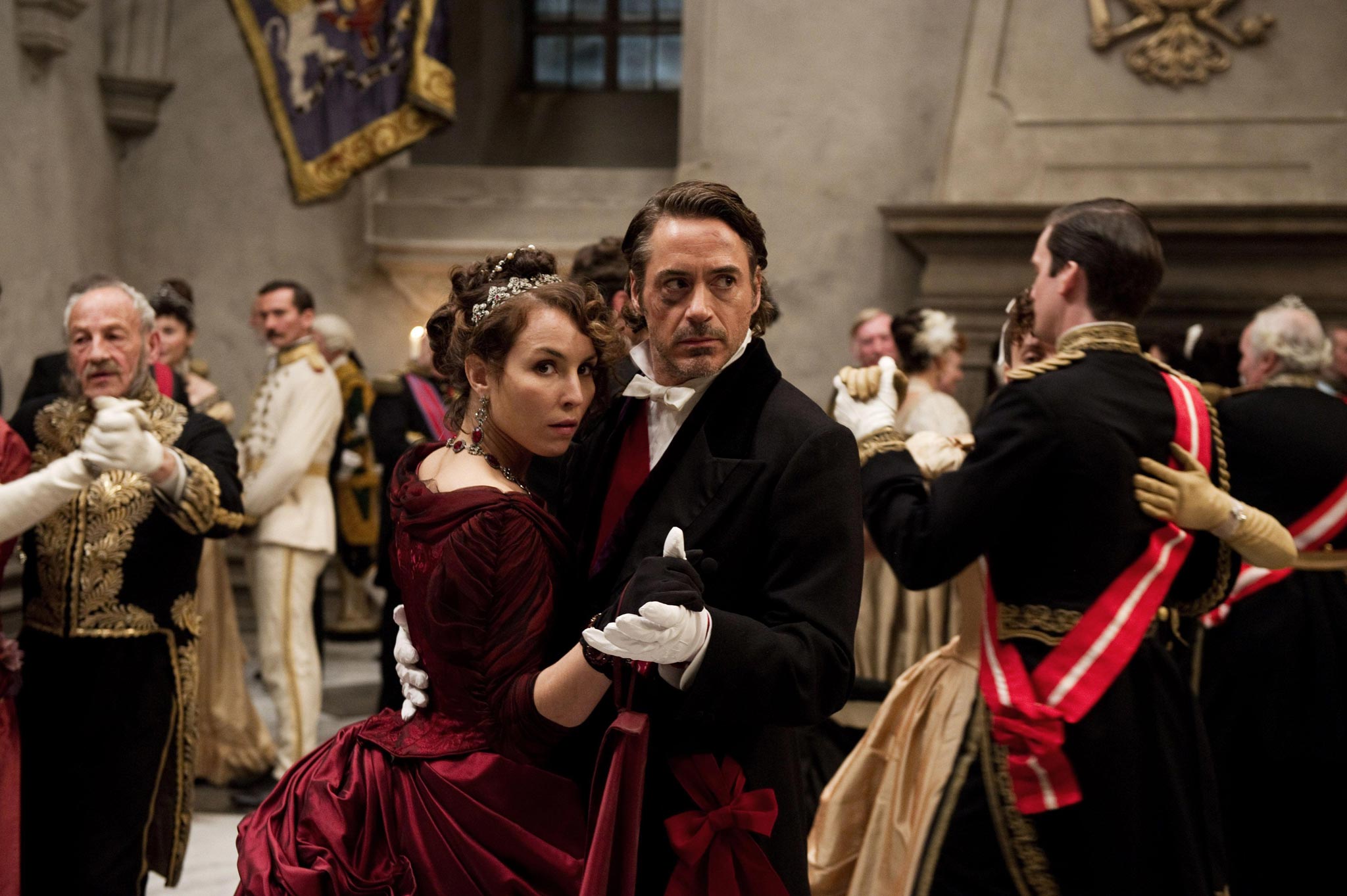
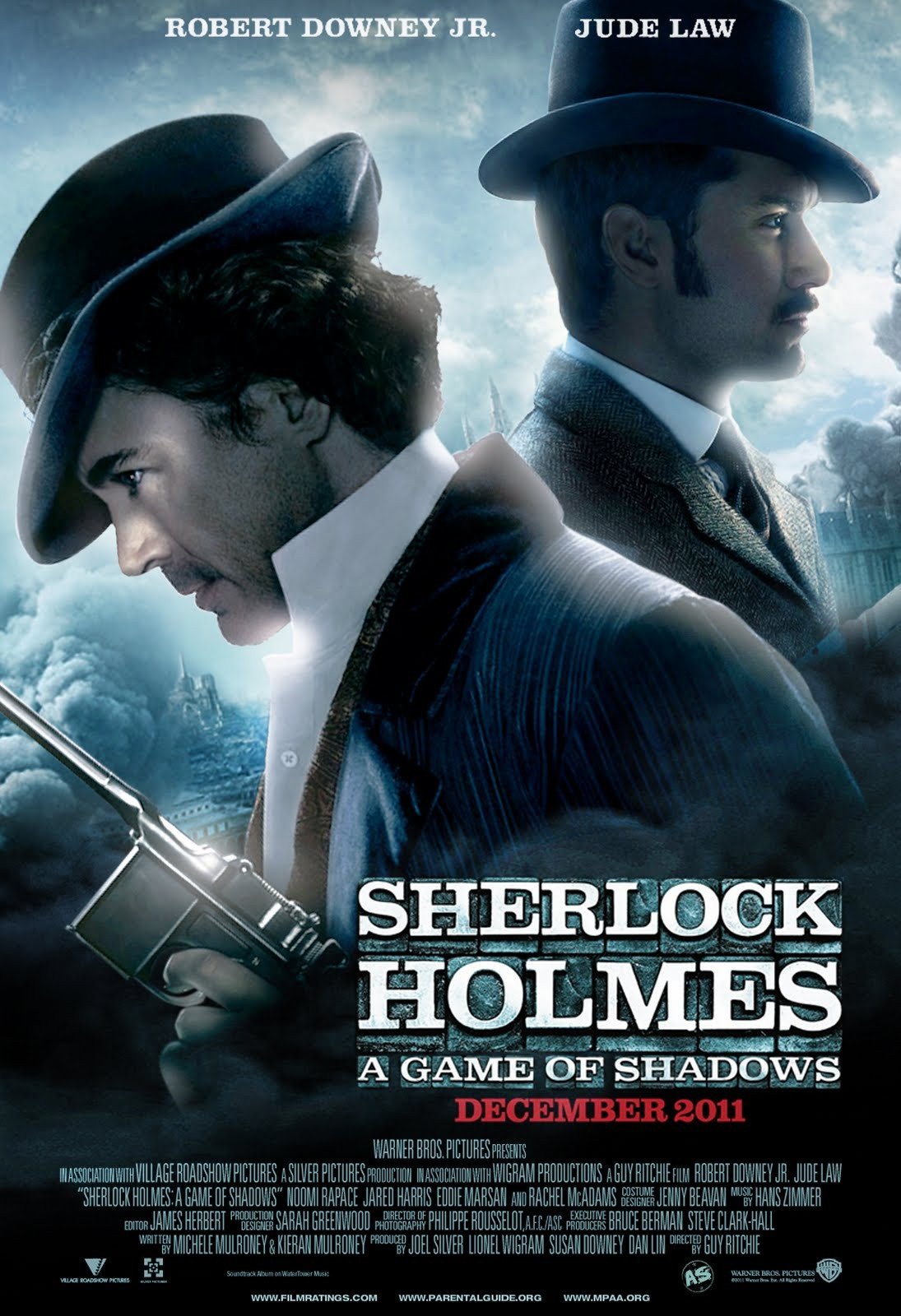
Sherlock Holmes: A Game of Shadows is the inevitable (and one should say quick-on-its-heels) follow-up to Guy Ritchie's Sherlock Holmes, and as an adaptation of Conan Doyle's "The Final Problem," It has as much source-relationship as the later Bond films have to Fleming—the bare-bones structure is there, but it's pumped, plumped, and trumped-up to fulfill the needs of action, humor and modern audience identification.
Really, "The Final Problem" is enough, we don't need the world-conquering machinations of Professor Moriarty (The Napoleon of Crime, the Scourge of London, and Holmes' best match) to make him a worthy adversary. He merely needs to be omnipresent by means of his web of chicanery, rather than an omniscient history-maker. In fact, Conan Doyle's Moriarty would rather his bad work went undetected, as opposed to this movie's version producing a shattering World War. Here, in the words of Robert Downey Jr.'s Holmes, the plot is "so overt, it's covert," involving twins who aren't twins, TB, the Romany, anarchists, darts for various purposes, intricate explosive devices and not-so-intricate shell-firing ones, countries that can't be named ("although they speak French and German"), and the prospect of "war on an industrial scale."

20/20 hindsight always looks like genius when set in the past.
Actually, it's pretty clever how the doom-laden inevitability of "The Final Problem" is translated into the fore-shadowing of the war-torn 20th Century (the screen-writers are the wife-husband team Michele Mulroney and Kieran Mulroney*), and its focus on large artillery and semi-automatic "machine-pistols" has a nice hard edge as opposed to the original film's emphasis on the psuedo-occult. 
But, director Ritchie seems to have lost of his edge somewhat, as the fight-sequences (and there are many) are nicely fore-shadowed with flash-cut Holmsian cognitive pre-functioning, but when the fisticuffs and baritsu moves start flying, the action is hard to follow, even when the action is slowed to a crawl—there is far too much ramp-editing and Matrix-y "bullet-time" FX in the film for no good purpose other than to slow down the practical and digital effects and give us the illusion of "wow, that was close." (Thanks, we assume that fire-fights and shellings are dangerous things). However fast the editor can manipulate images, one still gets the impression of the film being a bit too "fussy" for its own good, delaying information or simply obfuscating it for a later time, giving one the impression that one is seeing a lot of the movie twice. Efficient, it ain't, even if the titular character is supposed to be the height of it.
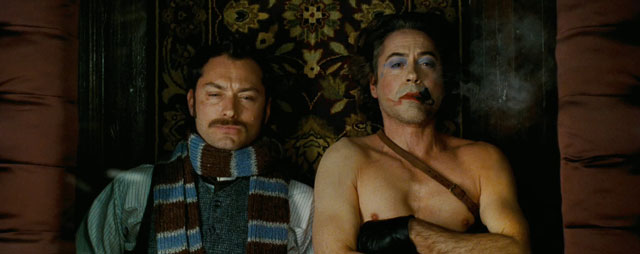
Also, although the first of Downey's adventurings could be seen as being a nicely nuanced (if scruffy) interpretation of The Great Detective, here the character is allowed to go a little more broad, dressing in comedic drag ("I admit, it's not my best disguise") and another, which is actually taken from The Pink Panther series (mind you, Steve Martin's "Pink Panther" series), the comedy is played up and not necessarily in character, and Holmes is seen to be practically infallibleeven his getting seriously hurt is all part of his plan.
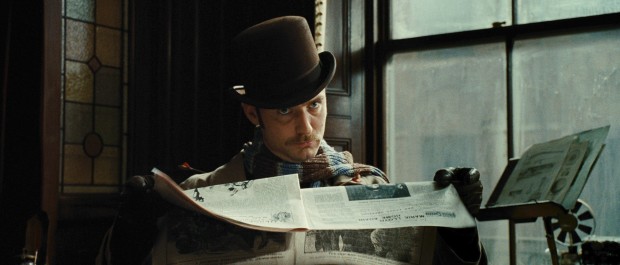
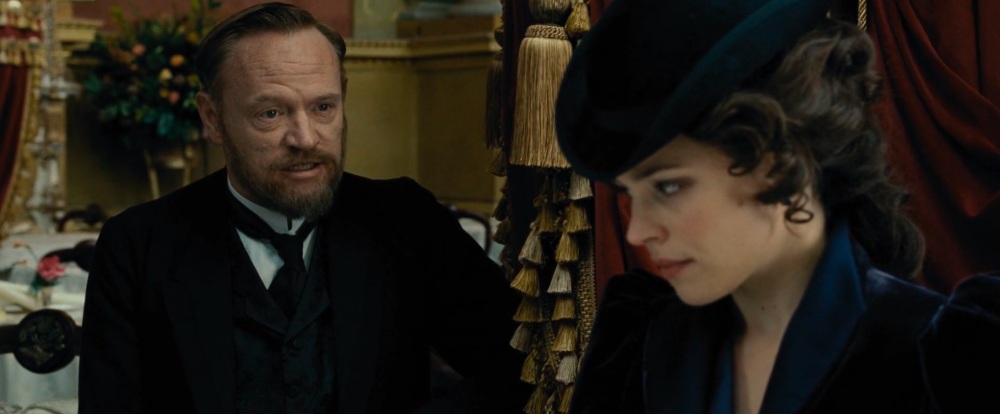
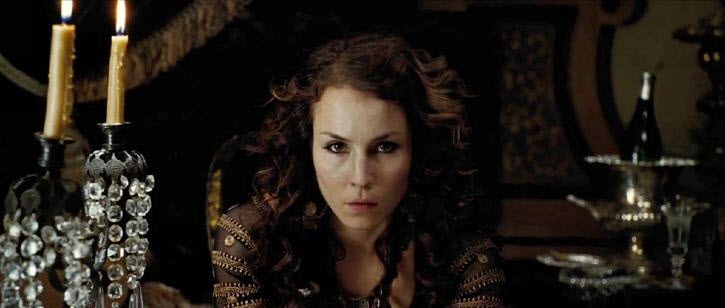
Downey, Jr. is great at playing this, even if it's a more absurd version of Holmes, and Jude Law again plays Dr. Watson (now with a severe limp and who is only now about to be married to Mary Morston, again played by Kelly Reilly) and it's one of Law's best performances, quick as Downey and capable of the slowest of "burns." Law's role is expanded somewhat and he makes the most of itThe two are joined (briefly) by Rachel McAdams, reprising her role as "the woman" Irene Adler, but is soon replaced by Noomi Rapace's gypsy princess Simza. Aiding and abetting is Stephen Fry, as Holmes' smarter, drier brother Mycroft (it might actually be considered type-casting), with Jared Harris as the coolest of Moriarty's (Brad Pitt was initially considered for the role), as well as being one of the youngest.
As fun as it is, one can't help but look at it as a step down—the filmmakers are getting further afield of the Holmes characterization, and it's only a matter of time before the Downey, Jr. version is locked into buffoonery and slapstick, and it comes perilously close to teetering off the edge here. As it is, this plot is more reminiscent of the Basil Rathbone films set during WWII—entertaining if anachronistic fluff.
Paget's Strand Magazine illustration of the first of two Holmes-Moriarty encounters.


* Kieran is the brother of Dermot Mulroney, husband of Michele, and you may best remember him from "Seinfeld" as the fellow who gets bent out of shape at a funeral reception when he see George Costanza double-dipping a chip.

Wednesday, February 24, 2021

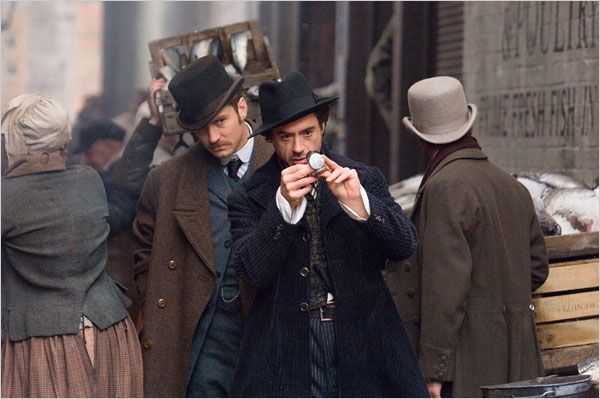
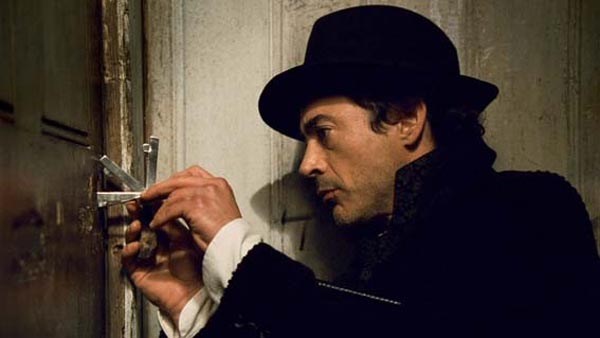
Sherlock Holmes (2009)

Written at the time of the film's release...before the "Benedict Cumberbatch" version of a modern-day "Sherlock" (in case you were looking for clues about why I wasn't mentioning it).

"The Lord, The Woman, the Ginger Midget and the Parisian Giant" 

or 
"The Peripatetic Plot of the Madonna's Husband"

I had been looking forward to the new Sherlock Holmes with anticipation and dread. I'm a fan, though hardly a "Baker Street Irregular," and Robert Downey Jr. is always worth watching—even when he's not, able to suck nuance out of even claustrophobic camera set-ups and able to project a fiendish intelligence out of every role. Fans of the Great Victorian Detective, I've liked several incarnations—particularly Jeremy Brett's encyclopedic and eccentric interpretation, and suffered through the attempts to get another Holmes series started. Brett left a long shadow—one that not even a good choice like Rupert Everett could dispel.* And clues in the trailer led one to deduce that they would try and make Holmes more of an action figure than Conan Doyle might have intended—more like a Bourne-again Holmes than the amateur pugilist of the books. 
There are elements of that here, but done cunningly by writers Michael Robert Johnson, Anthony Peckham, and Simon Kinberg; Holmes, ever the synthesizer of information-bits diagnoses his battles first using his observations of his opponents, then carries them off with judicious speed, making note of their potential recovery time, both physical and psychological. Neat touch that, as is a nice summing up of Holmes' misanthropic characteristics—sitting at a restaurant table awaiting Watson (Jude Law,** as good as Law has ever been) and his intended, Mary Morstan (Kelly Reilly),*** Holmes observes every argument, every petty theft, every peculiarity of his fellow diners—without his mind disciplined in pursuit, the vagaries of the world must drive him mad. Both Robert Stephens and Brett maintained that the difficulty in playing Holmes is that there is no center to him—a brain with no heart. Bur even an unbridled intellect must react to the world, and in Downey, jnr. there is quicksilver in those reactions
The game that is afoot is one that will challenge Holmes to his core in a battle of facts and logic against magic and the dark forces.**** When we first see Holmes and Watson in action, they disrupt a ritual sacrifice by the fiendish Lord Blackwell (Mark Strong), who is already responsible for three murders before the fourth is disrupted. Sentenced to hang, Blackwell informs Holmes he will rise from the dead to usher in a new destiny for England. Holmes is skeptical, but intrigued, especially after Blackwell is hanged, declared dead (by Watson), then escapes his coffin. At a time in History, when engineering marvels such as London Bridge are being accomplished, it seems more imperative than ever for Holmes to dispel the superstitious
Disrupting his concentration is a visit by the one woman who has out-foxed Holmes, Irene Adler (Rachel McAdams, far too contemporary an actress for the part—one expects her to huff and say "whatever..." at any moment), in the story "A Scandal in Bohemia." Adler is an adventuress, to be sure, but she is almost a secret agent here, more in line with the fictional series of stories that been built up around her by Carole Nelson Douglas
There is far less drawing-room discussion and far more darting about and cane-dashing than in previous incarnations. The humor is amped up considerably, and the effects of injury down-played, but for all that it's a good representation of Holmes, adrenalized and puffed up as it is. Guy Ritchie shows that he has evolved from mumbling street-thug films to something with more than empty panache. His breathlessly paced opening half of the film stumbles somewhat with an extended fight with a Parisian giant, but manages to regain its footing with some genuinely well-done sequences that manages to clue the audience in to eke out its suspense. There has been some criticism of late that Ritchie doesn't have the depth or focus to pull off a big-budget film, although he's been angling for them for years. "Sherlock Holmes" is his defiant reply. 
And not only are Law and Ritchie showing their best games here—composer Hans Zimmer, long an adherent of the generically grinding over-the-top symphonic score (he supervised all three "Pirates of the Caribbean" scores, which, frankly, are hard to tell apart), his work for "Sherlock Holmes" is folk-song based, with clever rhythms and instrumentation—kudos to orchestrator Kevin Kaska—that keeps the period alive amidst the clutter of the art direction.

* Although I'd like to see Ralph Fiennes, or better, Daniel Day-Lewis, try. 

** Law appeared in the Granada version of Doyle's "The Adventure of Shoscombe Old Place."
*** Although why Watson feels the need for Holmes to meet her in the first place is rather odd. She did, after all, hire him in "The Sign of Four."
**** Conan Doyle's stories focused on matters that challenged the societal structures of Victorian England and elaborate plots of thievery, and rarely dealt with the occult, although some of the modern stories—like Young Sherlock Holmes (1985), which also featured an occult presence, as it was produced by Steven Spielberg, not long after Indiana Jones and the Temple of Doom, have featured Holmes against more supernatural threats. There was always that element to Doyle—such as the monstrous "Hound of the Baskervilles"—but they were usually explained away in bursts of Holmesian fact-checking.
Shamelessly going for search-engine hits...

Tuesday, May 28, 2019

Aladdin (2019)

The Fresh Prince of Bel-Arabia
or
A Whole Re-Cycled World

Disney's live-action remake of Aladdin is a tough sell. Oh, don't misunderstand; it's a good movie—one might even say it's the best of Disney's kamikaze efforts to flesh out their revered animated classics—the art they established and are best known for—maybe in their fiscal attempt to find a tent-pole franchise (as if the parent company doesn't have enough of those) to crank out every couple of years, rather than roll the digital dice and counting on their new film to be as hot as Frozen.*

It's just that the 1992 animation version was so highly regarded—after they'd made their company best, Beauty and the Beast—as it was the last of the Menken-Ashman collaborations (the duo that revived the Disney animation brand in the 1980's under the Jeffrey Katzenberg regime) and it had the audacity to cast Robin Williams and the brio to match his improvisational pace with cell-drawings (principally by the gifted Eric Goldberg), and pulled it off with a manic energy that was simply breath-taking. It showed Disney wasn't the stodgy old cartoon company—they still took chances and aimed for the stars, not the fences.
Now, they're just happy to make return-trips. That's okay, if you want to start the development and generating cash, but it doesn't have the risk of charting new territory or any kind of innovation. Or risk.
Grumble aside, this cartoon-made-flesh does as good a job creating a similarly pleasing experience as its ink variety, and generating a similar amount of controversy as the original faced when it opened. Toss the bitching—they're tempests in an oil lamp; the studio has kept out Howard Ashman's original controversial lyrics and bent over backwards to have the "proper" ethnic casting (although the actress playing Princess Jasmine, Naomi Scott, is half-Indian if you want to make your picket sign accurate—she's great in the part, by the way, "despite" that fact) and beefed up the Princess' character and back-story, so the character is even more plucky than she was and less of a character for males to rescue.
Aladdin (played by Mena Massoud) is a parentless "street-rat", surviving on the streets of Agrabah near the Jordan River, by stealing anything he can get his thieving hands on. But, he's not such a bad sort, as he'll lift some food from the market and split it with his monkey Abu (voiced by Frank Welker again), then split it again with street urchins (1992 version) or a family (2019 version). There's a nice compression of the first film as Aladdin has an introductory song ("One Jump Ahead"), then meets Agrabah's Princess Jasmine (Scott), who is wandering the city-streets mingling with the people. Aladdin is immediately smitten and the princess introduces herself to him as "Dalia," the princess' handmaiden, to avoid detection. That song now serves as the song accompanying Aladdin and the princess running from the Royal Guard when she takes some bread to give to hungry kids. 
Aladdin takes "Daliah" to his make-shift home, where they start to get to know each other—other than the fact she's actually the princess—when she makes her excuses to leave because she sees over at the palace that there is a large cortege arriving, bearing another suitor for her. Her father, the Sultan (Navid Negahban) wants to marry her off, but, by decree, only royalty will be considered for the job. So, she begs off to meet the latest creep to try and woo her...leaving Aladdin with half-steeped tea and, to his shock, the princess' bracelet—given to her by her mother—which has been stolen by Abu. Bad monkey. No banana.
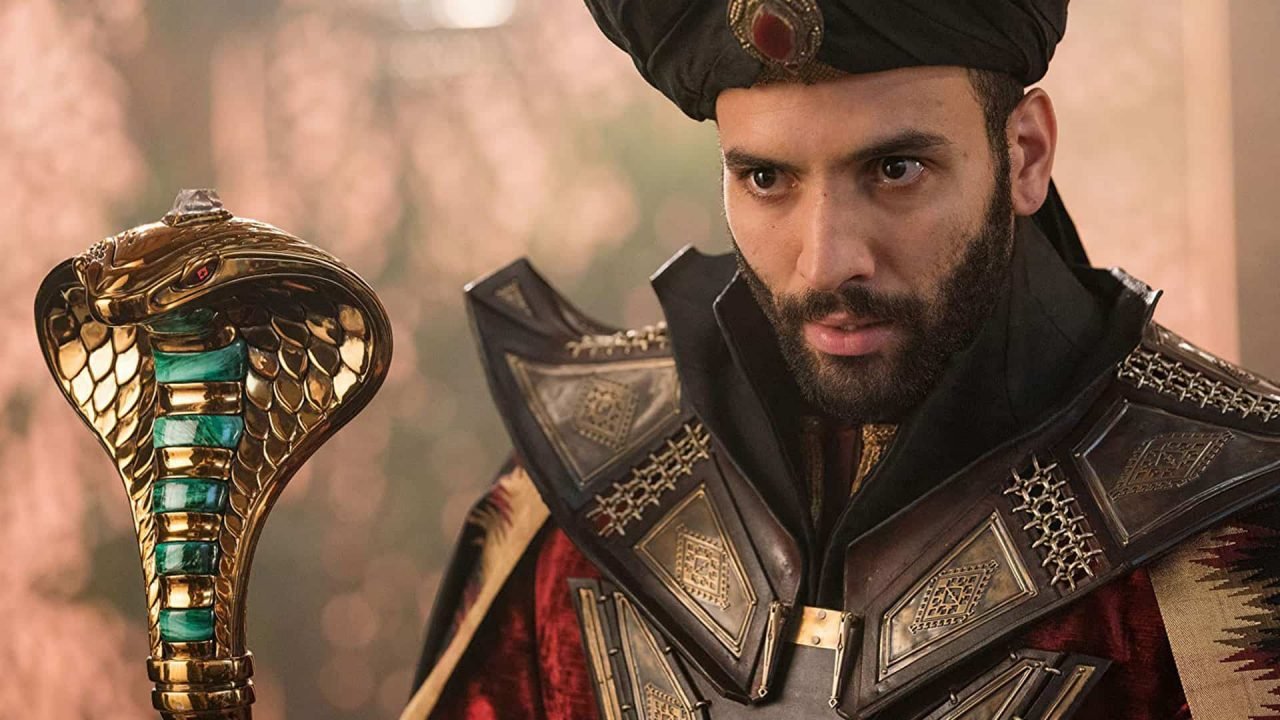
Meanwhile, back at the palace, the Royal Vizier, Jafar (Marwan Kenzari) has other plots-threads to plot. In an attempt to gain more power (he hates being "second best," poor boy), he has been using thieves to try and wrest the Magic Lamp that lies buried in the Cave of Wonders far from Agrabah. He's had little success as the Cave keeps chomping down on his thieves, while telling him that the only one who can enter must be "a diamond in the rough." In other words, bright, but not multi-faceted.
Aladdin, discovering that Abu has "Daliah's" bracelet, makes his own excuse to sneak into the palace to return it to her...and bring her tea. Still thinking she's "Daliah"—the real Daliah (Nasim Pedrad, who's delightful) tries to pretend she's the princess and sort of doesn't—Aladdin promises that he will try and see her again, but that becomes unlikely as he is arrested by the Royal Guard.
He is taken by the Guard to the Cave of Wonders, where Jafar tells him that the woman he met was not the handmaiden, but the actual princess. He instructs him to retrieve the lamp, and Jafar will make him a rich enough man to impress the princess—but don't take anything else...or he will be killed, either by the cave or by Jafar. Abu, however, is too dazzled by the many jewels in the cave (or it merely thinks "Hey, the kid will get killed, not me") so he takes a really big red ruby just as Aladdin grabs the lamp.

The cave, of course, is not happy, so decides to...cave. But, not before Aladdin, in trying to get Jafar his prize, discovers what a heel the Vizier is, and only manages to survive by the interventions of Abu and a Magic Flying Carpet—which (I neglected to mention) Aladdin had rescued in the cave. 
Oh. And Abu steals the lamp back from Jafar. Cut to the jinn, they rub the lamp, genie appears and it's Will Smith and not Robin Williams...

...which, as it turns out, is not a bad thing. Bless Will Smith, who knew...just knew...that everybody was going to compare him to Williams** and he would always come up short. And he took the job, anyway. And, surprise, he makes it his own. He's great in this. Lines are similar, but Smith brings his own charm to it and his own spin and he's a lot of fun. Check out the video below of the first minute of "Prince Ali"—it's a pinch slower (just ever so slightly), but he sells the thing for all it's worth...and (here's a plus), you can understand the lyrics without having to go to the internet. 
Yes, he definitely is contemporary (and I didn't hear you complaining when Williams had his period accurate William F. Buckley imitation come out of the genie), but then, Disney has never been too concerned with any flavor of the times other than the audience's. Smith isn't doing stand-up—he's bringing the most out of the material using his particular gifts and they are considerable. This is not an either/or situation. Both interpretations can exist without replacing one or the other. Both are applaudable; Williams created one of the greatest vocal performances in cartoons (on a par with Mel Blanc) and Smith has done as much with his as is humanly possible.
Now, Robin Williams is the stand-out of the 92 version; everybody else in it is competent  and gets the job done. This version, there's more pressure on the actors because they have no help from animators enhancing their performances. They gotta do all the work themselves, and they live up to it. Massoud's Aladdin is less of a bland Tom Cruise stand-in and he does a lovely job of playing amusingly painful discomfort—and more than one time I thought "was he dubbed by Hayden Christensen?" as he stammered through a line. Vast improvement.
And I found Negahban's performance as Jafar fascinating. He's not the angular Basil Rathbone type as the cartoon, but a seething one with large dead eyes that burn through the screen and an expressiveness that is subtle and slightly quirky. It's a performance that reminded me of the intensity of the young Christopher Lee, who could mime evil with only the slightest hint of acting. When he unloads and takes it to "11" in the final act, it's a lovely bit of CGI-chewing. 
And Scott is a real find, capable of the comedy but with a serene grace that, well, basically explodes when called on to belt out a song—and director Ritchie loves taking advantage of that by giving her...not one...but two moments in the movie where she swings into the camera and pegs the VU-meter, that might cause some to rock back in their theater-seats. I would advise audience members to watch out for their knees whenever she has a solo. Could be painful.
If one wonders why the movie has expanded to two hours from the ninety minutes of the original, chalk it up to the slightly slower pacing of real life from animation...and the dancing. There are a few extended dance sequences that pad the pace a bit.

One other quibble: the whole "Tell Her the Truth" lesson on which the movie is based—that Aladdin should come clean about not being a prince and just be himself to impress the princess. Oh, yes, hear, hear. Honesty is the best policy. But, the devil on my shoulder would like him to cap his confession with a "That's who I am...'Daliah!'" Okay, a bit churlish, I know, discretion being the better part of valor...but at least they have that one thing in common.
But, on the whole, a good show, actually worthy of the effort, and Ritchie shows himself very deft at spectacle, even using more of an eye-popping palette of colors than the desaturated look he favored in his last few films. And he makes the thing move like crazy, approaching the zip of animation, which gives it far more energy and verve than the last few Disney films that tried to move beyond the animation table. It doesn't replace the animated version. But it certainly becomes it.

* Makes me wonder why they don't just make a movie called "Cash-Cow" and admit it.

** Compounded by the fact that Williams is dead, and everybody—now that he's gone—has a case of the "guilt's" because they didn't appreciate him nearly enough when he was alive. Cue the Joni Mitchell song.