Showing posts with label 2004. Show all posts

Thursday, April 24, 2025

Millions

Written, initially, when it was released on video. And recently expanded because it's so darned good and everybody needs a good movie every once in awhile...

Millions (Danny Boyle, 2004) "The French have said au revoir to the franc, the Germans have said auf wiedersehen to the mark, and the Portuguese have said...whatever to their thing."
 
"Now, it's our turn to say good-bye to sterling. This Christmas, we are going to get the euro. Good-bye, old pounds. Everyone says we're going to miss you."
 
It's 2002, and with the establishment of the European Union, the country-specific currency in the days of conflicting exchange rates was being replaced by the euro in 12 of the member states (although it's now in 20 of the 27 EU countries) as of the first of that year, all in the name of solidarity and globalization. Such a radical shift is the sort of thing to make great stories of, and this little parable (of a sorts) is a remarkable example of making a great story out of cultural change (and not just the monetary kind).
Director Danny Boyle begins Millions with a sun-dappled intro to a child's world, and a visit to the site of a new housing development, where our hero Damian (
Alex Etel) and his brother Anthony (Lewis McGibbon) imagine the building of their soon-to-be new home in fantastical stop-motion animation set to John Murphy's cooing Elfmanesque score.* One is instantly charmed, not only by the fairy-tale way in which the story is introduced, but also by the promise of what is to come. Anything is possible.
But, the sequence is interspersed with shots of impossibly propulsive trains, indicating—along with the house-building sequence that, in this child's world, things can move pretty fast.
Once, they've moved into their new home named appropriately "Serendipity" ("Surprisingly spacious with attractive views!" enthuses Anthony), it's off to school with them, where Anthony is better able to adapt than Damian who when he's asked if he has any heroes rattles off the names of saints (with whom he's obsessed) enthusiastically detailing their grisly fates to the horror of his fellow students (whose heroes are footballers).
But, their lives change when Damian imagines an audience with Clare of Assisi (1194 to 1253 and the patron saint of television...no, really) in his hermitage made of moving boxes taped together to form an ornate structure and its interrupted by the construction being crushed by a flying Nike bag filled with pound notes—£229,520 to be precise—which Damian assumes (naturally) that it came from God. His brother, Anthony, is far less deistic and thinks—maybe—it came from a passing train, but doesn't question it enough to see the opportunities implied. The kids stash the loot, vow to not tell their Dad, and Anthony begins to use it to gain friends at their new school to form a "posse."
But, Damian has other ideas (of course). Since the funds came from God, he starts to distribute it the way his idols, the saints, would. His first act is to buy a bunch of pigeons and release them, as per St. Francis (who dutifully shows up to give his approval and suggest that Damian use the money to help the poor). With aid from St. Nicholas, he leaves stuffs a lot of pound notes into the mail-slot of some neighboring Mormon missionaries (they needed a dish-washer and a microwave), the Ugandan Martyrs persuade Damian to give to a Christian charity that will provide wells to African villages (that one is so obvious and un-anonymous it gets him in trouble with his whole family and exposes the fact that he has the loot), then St. Peter comes by for a visit and tells him maybe he should slow down a little as miracles aren't always what they seem.
Damian with St. Francis (note the halo)
 
Meanwhile, there's all this money with a certifiable expiration date and two boys have to figure out how to use it while it's still valuable. Anthony starts to tour real estate "for investment opportunity." Damian comes to realize that even though giving to the poor is a really good idea "it's really hard" to do. Plus things get...complicated once Da knows there's all this money and then, there's the business of some guy nosing around the neighborhood looking like he's lost something really valuable. And Doyle maintains his penchant for keeping things visually fascinating and telling a story in unconventional ways, but still conveying what he absolutely means.
Millions is one of those ones I missed in the theater, and one I deeply regret for having missed it. It's a little gem of a movie Boyle made between his zombie-film 28 Days Later (which will be getting a sequel this year) and his sci-fi film Sunshine but sweeter than his usual fare, although—Doyle being Doyle—it does flirt with some dark material involving child jeopardy, but it ultimately has its sacred heart in the right place.
At one point St. Peter tells Damian: "Something that looks like a miracle turns out to be dead simple." Millions isn't dead simple, but it is something of a miracle.
 
It's a highly charming movie, while avoiding the usual cute kid cliches, and maintaining a quite sophisticated tone of drama and off-the-wall comedy. That was a trick even Disney found hard to pull off.** It gets a very high recommendation from me. 

* I was delighted to see that the score was performed by the Seattle Symphony Orchestra and The Northwest Boychoir and recorded at Studio X of my old stomping ground Bad Animals and recorded by old comrade Reed Ruddy. Nifty!
 
** This being what they are, and the film being originally produced by Fox Searchlight, it is now the property of The House of Mouse. 
Everybody watches "Who Wants to be a Millionaire" which is some sort of career-foreshadowing.

Friday, September 8, 2023

Farenheit 9/11

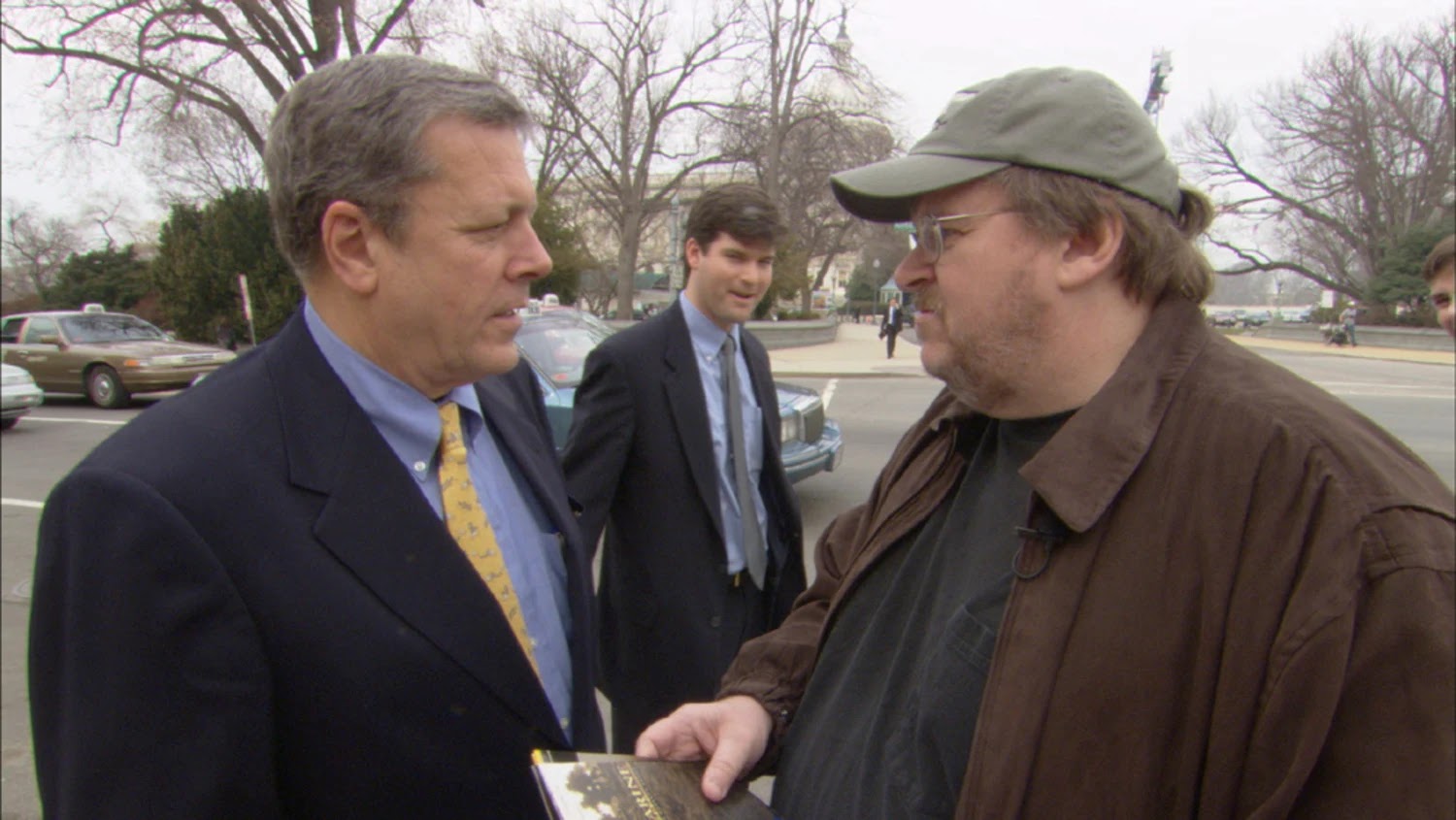
Farenheit 9/11 (Michael Moore, 2004) "Everyone’s getting along just fine backstage, the Teamsters are helping Michael Moore into the trunk of his limo,” cracked Steve Martin after Moore won Best Documentary at the 2002 Oscars (for Bowling for Columbine) and used his speech (accompanied by all the Documentary nominees) as a passionate speech against the Iraq War. The "Shame on you, Mr. Bush" speech was then expanded into this film, which debuted before the 2004 election, but didn't seem to make a dent in Bush's re-election over the swift-boated John Kerry.

It might have been the tone. Rather than educate or inform, Moore's documentary was a bit of a rant, although delivered in a calm, soothing, particularly patronizing tone. For all the juxtaposition of images—of Donald Rumsfeld complimenting the precision of aerial strikes while an Iraqi child's head is being sewn up, President George Bush making a "kill the terrorists" comment to the Press, and then (without an edit, mind you) returning to his golf game ("Now watch this drive"), the excruciating class-room reading of "My Pet Goat" after being informed that "America is under attack" (Moore's narration muses: "Was he thinking, "I've been hanging out with the wrong crowd. Which one of them screwed me? Was it the man my daddy's friends delivered a lot of weapons to? Was it that group of religious fundamentalists who visited my state when I was governor? Or was it the Saudis? Damn, it was them. Better blame it on [Saddam Hussein]")
Moore's narration hammers the point home, but comes off as snarky and maybe a little too calculating for a moment rife with unanswered questions and the burden of responsibility that must have weighed heavily on the President. He might also have thought of his personal safety—"they can't find me in a school-house"—of who in D.C. was in charge, and if the attacks were limited to New York. Or he might have just been contemplating the unbelievability of it (as we all did), even though at that moment there was a memo on Condoleeza Rice's desk—one of several, maybe—warning of an attack but not sure when.
Questions linger as History moves forward: the whisking away of Bin Laden's family members out of the States on the last flights out before the air-travel embargo (Why them? How did it happen so fast, and who had the foreknowledge that Bin Laden, specifically, was behind it that the families needed to be evacuated? Where are they now?); the rush to Afghanistan to upend the tentative stranglehold of the Taliban who were providing training camps to Al Qaida (Understandable, given the intel and lack of cooperation coming out of the place); the wholly unnecessary push to Iraq to depose Saddam Hussein on trumped-up WMD suspicions (there have been no repercussions for that or the cherry-picked evidence); the decision to support Pakistan (ignoring the democratically-voting India, who was already an ally) when that country seemed unable and unwilling to control its borders, and were ultimately revealed to be harboring Bin Laden. Whose decision was that? Is that where Bin Laden's family fled to—or back to Saudi Arabia—did we know this? Is this why—at one point—Bush stated that finding Bin Laden was no longer his highest priority? One can spout maxims like "keep your friends close but your enemies closer" but at what point do you admit your alliances are stabbing you in the back?
The images that stick, though, are the war profiteers who saw a great opportunity for making big bucks once the soldiers who'd fought and bled to clear the area and make it safe for the carpet-baggers to exploit. What's happened to those investors? What's happening now in Iraq? Are the lights on? Is there potable water? Is there any evidence of the U.S. doing any good besides the scars and rubble?
In this election year, we're being asked: Are we better off? Shouldn't we also be asking—are they? Do we just make a mess and have no moral obligation to cleaning it up? And if anybody has profited from this, at the expense of the lives of our soldiers, why aren't they in jail?
But, back to Farenheit 9/11: the less important issue is should Moore's work be considered under the category of documentary. To be sure, there is no objectivity in documentaries—every shot, every edit is informed and influenced by some editorial perspective—but Moore's output is more in the line of illustrated advocacy, starting with a point of view and the content cherry-picked (that term again) to enforce that point (rather than letting the content drive the conclusions). Moore's staged interviews and stunts are all strategically geared to his theses. At that point, his films are no longer documents, but propaganda. So what, you say? It's an important distinction if you're searching for truth—to be informed—rather than being told what to think.

Wednesday, April 12, 2023

A Very Long Engagement

Written at the time of the film's release in 2004. There have been a lot of movies about WWI since then. Now, you know what they were watching when preparing their movies.
 
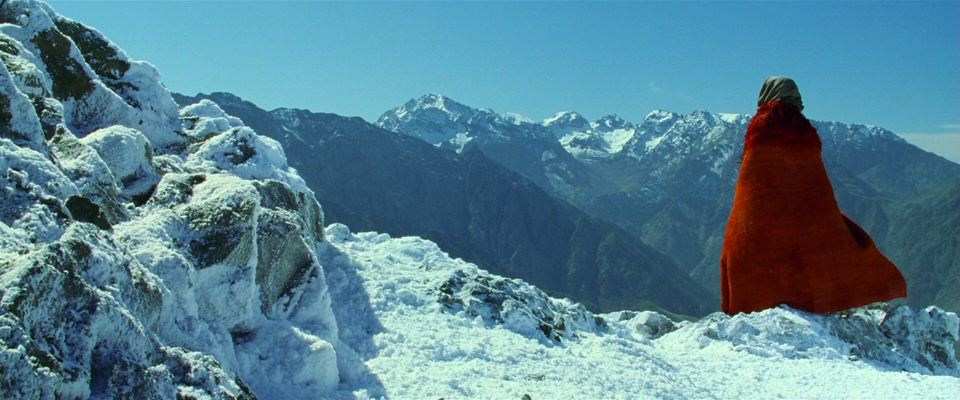
A Very Long Engagement (aka "Un long dimanche de fiançailles") (Jean-Pierre Jeunet, 2004) Epic war film, reuniting Jeunut with his Amelie star Audrey Tautou, that tells the story of one woman's search for her lost lover who went to WWI and never came back. The film is full of story and incident (and Jeunet's wind-up mechanism way of telling a story) that it makes the 134 minute film feel a lot longer.The film starts as a story told in flash-back of five soldiers who were court-martialed for self-mutilation (shooting themselves in the hand by various means) in order to get themselves out of the war and the hellish existence in the trenches on the front line. One of them is the Manech (Gaspar Ulliel), lover of Mathilde (Tautou), whose fantasies and re-imaginings of the circumstances of the war make up the bulk of the film's realisation. By various means, she begins to piece together the story of her lover's court-martial and punishment (he and the others found guilty are thrown out of the trenches into "no-man's land" to fend for themselves), which are told "Rashoman"-like from different angles and perspectives.
The war-scenes are appropriately grisly, Jeunet displays his usual penchant for things grotesque--there's a murder of a rotund general by a prostitute that's particularly...interesting--that are part and parcel of his films, and there's the tendency to turn his films into little Rube Golberg-esque mechanisms, that can become tedious as much as they can delight (He always has to thrown in "the mechanism of sex" joke somewhere, too).*
Still, as distracting as his eye for the unusual shot can be, there are moments of "gee-whizzery" and CG-wizardry that are pretty wondrous, and stay in the head long after the details of the movie fade. Jeunet is a master of bending reality to meet his artistic goals, whether lighting and dressing an area to its maximum potential, or employing digital tricks to make it conform to his vision or the past's.

Examples of some of the amazing frames of A Very Long Engagement, some courtesy of Evan Richards and his wonderful blog "Cinematography, Etc.**
A make-shift field hospital set in a dirigible hangar is engulfed in flames
when a bomb sets off the contained hydrogen.
A sinister night meeting is made even more so in Jeuneut's composition
--as the one must come down to the other's level.
Going a long way for a visual pun-a farmer is met by gendarmes to join the war-effort,
and the wind from their car sweeps aside the tall grass leading to their wagon. "Draft," indeed.
Jeuneut makes incredible use of depth-of-field here, as Mathilde seeks out the wife of one of 
the condemned in a market-place (Yes, that is Jodie Foster, whose french is impeccable)
A Luhrmann-esque "post-card" shot told in lettered flash-back.
A CGI recreation of WWI-period Nice, France. Quite Nice, in fact
The crippled Mathilde must stand on her rickety wheelchair to reach for war records.
"MMM"--the initials "Manech's marrying Mathilde" --is a constant icon throughout the film. 
Here, Jeuneut cranes up from the carved initials to Mathilde's obvious bliss.
The shot will continue further up to include an albatross-symbol of tenacity.
The young Mathilde fantasizes that her new boy-friend will save her from falling from the lighthouse. 
The next scene will have them embracing as they gaze from the light in a mock-Hollywood shot.
Jeuneut makes the stair-way leading to the light-house lamp a literal "golden spiral".
From the impossibly soaring crane-move preceding it, it's obviously a set, 
but the breathtaking sun-set looks quite real, even if it is computer-enhanced.
Jeuneut makes Mathilde's family's home warm and earthy by accentuating the color palette of the scene.
The Fog of War--Jeuneut drains the color out of a stark battlefield to shades of gray.
A hospital is drained to a sepia tint, not unlike the jaundiced color of old medicine bottles.
The lighthouse stirs to life

Ultimately, it is such a polyglot of a movie that one can't help feel it might split any potential audience. Those wanting a purely romantic film will be put off by the war scenes and the occasional blunt sexuality, as well as the prolonged sense of hopelessness the film radiates. Those interested in the mystery aspect will be frustrated by the lack of momentum in the progress of acquiring facts and the diverging stories leading to blind alleys. What spurred me on was seeing the amazing scenes like the preceding ones, and seeing a new one around every splice.

It's an amazing film, if not everyone's cup of tea.

* It occurs to me that in the unlikely event Steven Spielberg ever wants to hand over the reins of the "Indiana Jones" films to another director Jeunet would be the perfect choice. ***
 
** Sadly, no longer a part of the Inter-webs. But, credit where it is due.
 
** Uh, yeah. He didn't.

Friday, March 25, 2022

Don't HATE HATE HATE Me Because I Like Crash (2004)

Here's another "Best Picture" article from the archives. It's a bit different in that I was addressing the response to Crash—the 2004 film and not david Cronenberg's controversial 1996 film—and the backlash to it winning its "Best Picture" Oscar. Being as it's something I've written in the past, I made a sweep for dead links and was disturbed that writings I had sighted in this have since gone dead, particularly those by critic Jim Emerson that I addressed. I wish they were here. Emerson's a fine writer and critic and his lack of representation, particularly on the rogerebert.com site (which began at the Chicago Sun-Times website) is a crying shame (it should be noted that Ebert hailed Crash as the best film of that year, but I don't think that has anything to do with any of this, but more that the Sun-Times was clearing out articles from the defunct Ebert site to make room on their servers). Anyway, I wish there was something I could do about that, and, sadly, I can't. These articles are just not available anymore. I think that's a great loss. I did find this, though.
 
Mike Lippert of the much-read movie blog "You Talking to Me?" (MIA since 2013) is having a blog-a-thon—one of those community drum-circles, where we pound on a theme and and listen to the echoes it creates. I don't participate very often in these, but when something inspires a surge in heart-beats, I plunge in. This time, the theme is "Justify Your Shitty Taste:" find a movie that has been given short-shrift and explain why you like it—defend yourself and your contrary opinion. Well, I had a piece in the hopper that I wrote years ago to a film that has had its share of acclaim—even winning Best Picture at the Oscars—but meets with such condescending sneers every time it gets mentioned in "movie circles" that I've always felt the need to defend it—up to a point...and then I give up. There's only so many times you can hit your head against a brick wall without doing damage to your own exquisite taste (that was written with sarcasm, btw). Here, from the depths of my ignorance (and my ever-growing "Draft" pile) is my justification of Crash.

Hello, my name is James Wilson, and I like Crash (Paul Haggis, 2004).
 
(Audience response: "Hi, James Wilson")
 
It's really funny...really funny, to the point of out-loud chuckles...the extreme reactions Crash gets from its many, many detractors—there's even a web-site that compares other Best-Picture winners to whether they're "worse than Crash". When Jim Emerson mentioned it as one of his least favorite movies (he has, in the past, listed it as one of his "sociopathic barbarities")* in a recent blog post, the comments section went up in arms with lemming-like ferocity. "I HATE HATE HATE Crash!" yelled (caps indicative) one of the comments.**

I don't. I like it. With the same rictus smile that I appreciate other cynical films.  And the more extreme the reaction to it, the more I smile, because it only drives home the film's point further, and exposes it as true.
Now, some (but only some) of the hatred of Crash comes from folks who consider Crash the usurper that took the "Best Picture" Oscar from *sigh* Brokeback Mountain (as if the Oscars are ever truly the indicator of quality). Now, I didn't mind Brokeback--there was much to admire--the stunning cinematography, Larry McMurtry and Diana Ossana's cruel, no-holds-barred/no-feelings-spared screenplay, and Heath Ledger's performance—someone finally captured the essence of the archetypal head-strong, mumbling western dude (and the guy was Australian, fer cryin' out loud!). Plus, there was something altogether shattering about his memorial to his lost love, in lieu of grave-stone. But, there was nothing in Brokeback Mountain that hasn't been done in every sudsy straight soap of the last eighty years. Nathan Lee of the Village Voice put it far better than I: Ann Proulx's bitter post-Oscar diatribe has a lot of empty fire to it, but, c'mon, honey, you were borrowing Faulkner's pen and you know it. And for anyone who thinks gay cowboys are revolutionary, skip right over the Village People and Jon Voigt for a moment and go directly to Red River. Howard Hawks knew it. Lenny Bruce knew it. Montgomery Clift, no doubt, knew it. "Cultural watershed?" Only if you weren't paying attention.
But Crash is the better movie. Crash is the subtler movie, believe it or not. Crash deserved that Best Picture Oscar, because it pulled off a great trick: it pissed off a lot of people, only proving its point.

Let me just say one thing about Crash: It's not "about" racism.

Yes, yes, I know, racism is all over the thing, morally repugnant, down and dirty, pig-ignorant racism. From all sides, and all races. And if racism was all it was about, yeah, some of the hatred for the film might have a point, because all the movie does is say "racism exists, and there's nothing you can do about it," which doesn't make it the Feel-Good Movie of the Year. If it was only about racism, then it would truly be committing that great movie sin "exemplifying what it rails against" like, say, Rollerball that says violence is a terrible thing and then rubs your nose in it for two hours. Or an "anti-war" movie that relishes its battle sequences. If it were so, 'twas a grievous fault.

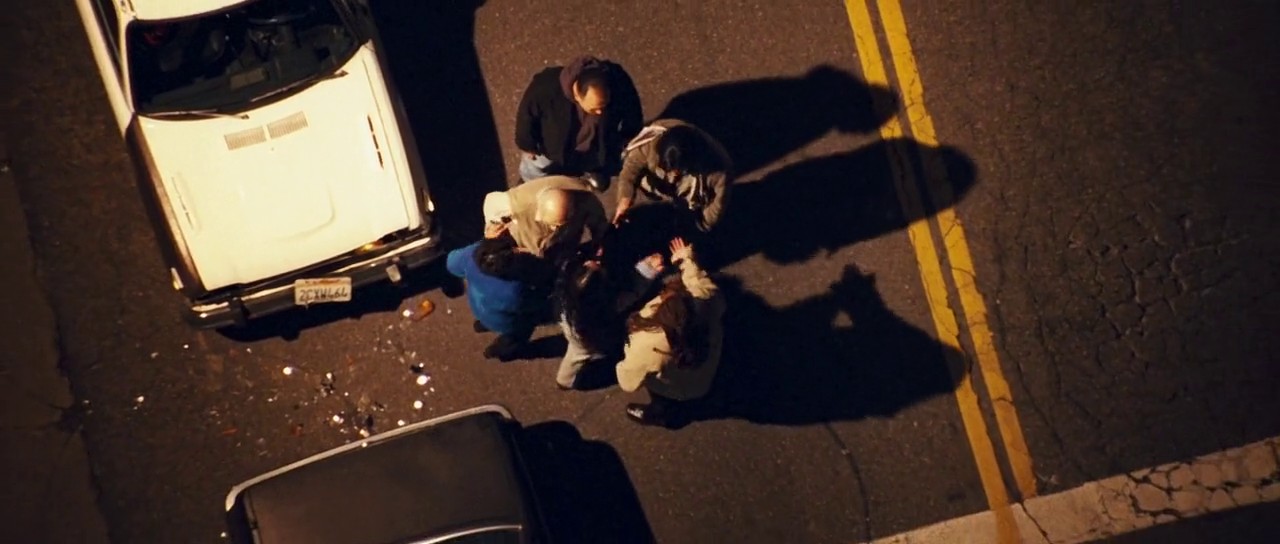
But Crash is not just about racism. Racism is a symptom in it, but it's not the "end-all, be-all." Myopia is. The denizens of Crash are all folks (with very few significant exceptions) who've got it all figured out. Entrenched in their lives, in their jobs, in their bureaucracies, they think they've seen it all and they act appropriately. We've seen their type in movies before. Like Bogart's Richard Blaine in Casablanca who "sticks (his) neck out for nobody." Or Jack Nicholson's J.J. Gittes in Chinatown,*** who when asked what he did as a cop down there replies "as little as possible." They're not people of color, they're all gray, walking around with blinders on (which is why the movie's called Crash and not, say, Clash.) They all know "the score" and so they've stopped thinking. They live their cloistered, blindered lives in the grids of L.A. in their own little boxes of assumptions and none of them will try to see beyond them. They are numb to the world, and the cultural clashes are battles over turf, amplified rhetoric and action so (as Don Cheadle—who also produced the film—playing Detective Graham Waters says in the opening line of dialogue) "they can feel something."
Except...except. Haggis has been accused of manipulation (and like, duh, all movies are manipulative, hate to break it to you) but the most egregious examples are the pretty obvious incident of the "invisible cloak." I think every viewer above a third grade education knew what was coming--the kid was going to get "whacked" with her invisible cloak, because, hey, we're all cynics, and the movie has been pretty cynical up to that point--actually the characters IN the movie have been pretty cynical. But not the kid. In an altruistic, completely naive and childlike way, the kid goes beyond what any of the adults would do and makes a sacrifice to save her father. We all assume that to her doom, and Haggis milks the anguish, and delays the inevitable reveal. The kid's not dead. Why? Because the daughter of the angry shop-keeper has also thought outside the box, and bought her old man blank cartridges. Both those individuals have gone beyond the "I stick my neck out for nobody" syndrome, and the synchronicity has pulled off a miracle, or at least, prevented a tragedy, brought on by short-sightedness.
Myopia is all over the movie--even when racism isn't. Because there's more than racism going on. It's blacks against whites, whites against blacks, cops against civilians, politicians against the cops, the bureaucrats against the trench-fighters, upper class against lower class, and the reciprocal vice-versa. Myopia is ever-present, and everybody stops thinking when they reach their assumptions...and look no further. The insurance worker thinks the guy on the line is a dead-beat, the guy on the line thinks she's a bitchy negro. They both have drawn lines in the sand and will go no further. Matt Dillon's bad cop just assumes all the minorities are scum, so he treats them accordingly. Ryan Phillippe's good cop takes the high road and assumes he'll never act like that in any given circumstances. They're both short-sighted fools. And they won't consider any other possibility. They're two sides of the same coin.

For me, Crash plays like a post-modern film-noir, where the world is crummy, people are tarnished (whether they're rich or poor), but there is no "slumming angel" (as
Ross McDonald put it) to try and make things temporarily right—all the characters in Crash have that ability if they choose, if they will, and there is no hand-holding narrator or Stage Manager bringing perspective, merely the dispassionate view from on high. The good that people do are mere slats of light in an all-enveloping darkness, not unlike the the noir's traditional backdrop, the venetian blind, or as the de-focused headlights in the film's credit sequence.

Another criticism: Too many coincidences in Crash? Yep, but that's to be expected with an ensemble cast in a limited area whether it's La Ronde, or Grand Hotel, or even...the acclaimed Babel where the coincidences are hemispheres apart (those butterflies are mighty powerful!). But Crash isn't like any of these films. The one I compare it to, both in tenor and reaction is The Rules of the Game,
Jean Renoir's condemnation of pre-WWII French society going to its ruin in selfishness and self-involvement. French folk hated The Rules of the Game, too. In fact, riots broke out in theaters, and to try and save his investment Renoir kept cutting it and cutting it to try to assuage the angry mob. As a result, after the war when the hysteria died down, it was difficult to find an unexpurgated version of The Rules of the Game until...1958. The tyranny of the mob had done its damage and its only by the luck and a little hard work that a longer copy of this classic exists. Fortunately Crash hasn't had to go that far. Maybe people are just more passive-aggressive these days, content to HATE HATE HATE in the relative anonymity of a bogus screen-name. Maybe that's progress?

So, if I'm in a crowd of people and Crash comes up, and folks get angry about it because it's "about" racism but doesn't "do" anything about it (I suppose a cameo by Rodney King might help...?), I don't say anything. It won't do any good. Folks have already made up their minds about Crash and if I try to point out they might be wrong and consider that possibility...no, no, that won't happen. Their thoughts stop at "racism" and go no further, thus proving the movie's point all over again, and proving, once again, why it's such a good film.


Ultimately it's a tough and pointless duty to watch a film with blinders on.  It's no way to see a film, and it's no way to lead a life...as Crash, for all its flaws, so ably demonstrates.
 
Afterward (2022): If anything the last 17 years have only cemented my feeling that Crash was important and is important. I've read the criticisms—I don't agree that the whites are inspired to become better persons (I think they'll all stay racist —even Matt Dillon's story after pulling Thandiwe**** Newton out of a burning car) as a result of the movie's stories. I think after "The End" title of Crash everybody is going to continue to be racist and myopic for the same reason everybody really is racist and myopic—they don't know any better and it's easier. It's why I don't believe we're in a "post-Racial" period (as so many "glass-half-full" believers seem to think). The slew of African-American deaths at the hands of police, the resulting "Black Lives Matter" demonstrations, the resulting paranoia about and demonizing of the "Black Lives Matter" demonstrations, the emboldening of hate-groups, of white supremacists, the January 6th insurrection, the hysterical terror of some groups that whites will be a minority in the U.S. by 2045, the "faux" CRT uproar—CRT has only appeared in college-level classes and parents should be more worried about calculus being taught K-12—right on up to the recent Supreme Court hearings just goes to prove that lines are drawn and they're drawn in indelible ink. If anything we're worse. And more myopic. And bolder about being proud of it.***** The bubbles we've created around ourselves have only grown thicker with the Internet. And the only way we're going to get out of our protective bubbles is by accident. And (as Major Kong says in Dr. Strangelove) "that goes for every last one of ya, regardless of your race, color, or creed."

And I've given up on Darwin as there's no evidence that the bad die faster.

Oh. And whether I think Brokeback Mountain should have won over Crash? Nope. And I'll use the words of saloon-keeper Richard Blaine as a reason: "The problems of two little people don't amount to a hill of beans in this crazy world."

In fact, if it was up to me, I would have vastly preferred Munich or Good Night, and Good Luck.


* ...which is a far cry from what he wrote in 2006: "As restrictive as the rules of this cycle may be, Crash still manages to be an unusually mechanical instance of it. With numbing predictability, every positive character is revealed to have a negative side (the good, tolerant cop, played by Ryan Phillippe, commits an impulsive, racially-triggered murder), while every negative character is revealed to have his or her positive (the racist cop, played by Matt Dillon, risks his life to save a black woman trapped in a wrecked car). Just about everyone is an instinctive racist, and just about everyone is a victim of racism, who learns his or her lesson when the tables are turned. Haggis piles up the coincidences that bring his characters together without shame or the slightest restraint; he seems to feel that by emphasizing the contrivances of his plotting, he is in fact revealing a hidden pattern, a secret will, that organizes the world. Turning bad writing into a metaphysical principle is indeed an accomplishment, and one that might well deserve an award – though Best Picture of 2005 is going a bit too far." 

From this to "sociopathic barbarity" is quite the change of opinion.  The above is reasoned analysis.  The latter is just hectoring screed.  Hating Crash became easier and more comfortable, then ratcheted up to the extreme.  Now, what was Crash saying again?

Emerson does this at times—I'll be shocked if there is ever a Christopher Nolan film that he will praise, rather than merely dismiss it, and he condemned Clint Eastwood's Flags of Our Fathers (without even seeing it) merely because Haggis had a hand in the screenplay—to his credit, after actually seeing it, he praised it.  This may sound like bashing the man, but Emerson's is a great voice in film criticism, and I love reading his output, whether I agree with it or not.  His is an essential voice in the understanding of the mechanics of how film can touch the eye and the brain and move the heart.  If he ever stops writing, I will mourn that day.

** Which reminds me of the George Clooney retort to the web-site that said he was "GAY GAY GAY:" "Two GAY's, maybe, but the third's a little extreme."

*** Chinatown also makes a point of using prejudice, not just racial, but class prejudice, as a distinctive example of reactive, rather than thinking, behavior.

**** That's not a typo and, yes, you remember it as "Thandie," but she's gone back to the original Zimbabwe spelling because...hey, why not...and you can only assuage Hollywood's simplifications for so long. 

***** I read a slug the other day they there's some Republican buzz about bringing back miscegenation laws. What the hell?

Wednesday, March 10, 2021

Alexander

Written at the time of the film's release...

Alexander
 (Oliver Stone, 2004) In the two-way race getting the story of Alexander the Great to the screen between Baz Luhrmann and Oliver Stone, the latter got there first, having worked on a screen-play since 1989. Luhrmann's announcement of an "Alexander" project was probably just the thing Stone's film needed to get off the ground, and his thorough planning shows (historical inaccuracies aside): this is one of Stone's deftest film--a combination of his macho liberal ethics and his pre-disposition to turn everything into braying Myth. 

Here he's dealing with Gods and Titans and men who reach beyond their grasp, and if one thinks this one has a political agenda talking about a King wanting to chase his Persian prey into the mountains, you're only scanning the surface for easy targets.*

Stone's going for epic statements here of dreamers and the pains they inflict on Society** and a pretty good tying up of some major themes in several of his films without descending into his fall-back of the "Good and Bad Fathers of our Soul." Oh, there is familial stress going on constantly with two of the more watchable stars as Alexander's warring father and mother King Phillip and Olympias (Val Kilmer and Angelina Jolie***). Their battles for the betterment of Alexander (Colin Farrell) make up the intrigue that Stone keeps flashing back to once Alexander reaches Babylon and established his first Alexandria city-state. But the main focus is Alexander and his battles from Ireland**** Macedonia to Persia to India, each one given their own specific vantage point. The desert combat in Persia is given a neat over-view by a mythic hawk, the latest in a long line of familiars haunting Stone protagonists. The India battle is an epic jungle gore-fest between man and beast that turns into a red nightmare, but is affectionately begun with an old-time movie iris-out.
The film is so full of "rules of thumb," you begin to wonder if there's not a training manual with the thing ("A commander never gives an order he wouldn't carry out himself," "Don't surrender your reason to passion," "Moderation in all things" and the film's mantra "Fortune favors the bold"), and as gritty as Stone makes it (and there's a lot of blood-spatter flying through the battle scenes), it has the pristine quality of those Hollywood sword-and-sandal epics where even the Persian city of Babylon seems immaculately free of dust. Stone seemed inspired by the look of The Lord of the Rings and its way around a vast story-line, but seems to favor his Myths well-scrubbed.
Still, it's an epic that was filmed in 93 days, despite far-flung locations and looks miraculous despite the tight schedule. For all the things that could conceivably have gone wrong, Stone's Cecil B. DeMille styled dream project managed a lot of things right.

* Stone's W. biography would show up at the end of 2008, looking rushed and a little wasted and without much to say. You can't satirize a political satire, and the joke ceased being funny a long time ago.
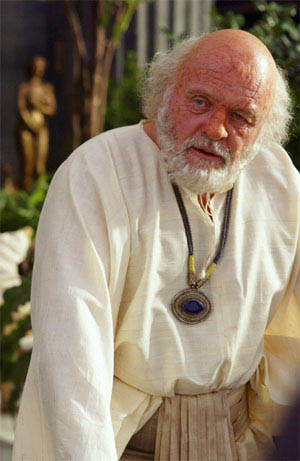
** In an odd post-mortem, Alexander's kinsman Ptolemy (Anthony Hopkins) supposes that Societies are inspired by dreamers and then exhausted by them to the point of wishing them failure, if not death. That's an interesting thought coming from Mr. Conspiracy Theory. Stone's also one of those liberals who likes to include all of us to enjoy his guilt—"It's all out faults." Hey, speak for yourself, mac!
*** Stone is particularly praise-worthy of his actors on the commentary track of this film and with good cause--Farrell shows off the promise that his over-hyped career has only suggested, Kilmer is as boisterously good as he's been in years, and Jolie again shows why she's one of the most commanding actors on the screen these days. She has a line reading ("Loves. Loves!") that wheels between conflicting emotions with such quick-silver speed that it nearly whips your head around. One would be tempted to see that she's the latter day Ava Gardner if not for one thing—she's a better actor than Gardner. Stone loves a touch of madness in his actors. Jolie is his perfect match.
**** Farrell doesn't disguise his Irish accent, and the kid who plays him (very well) in the early sections of the movie does a fair register of Farrell's brogue. But most of the actors have Irish accents that at times is distracting, but somehow seems fitting for the folk-tale blarney with which Stone tells the story. You go with it, as it feels right. Kilmer's accent is American. Jolie's is faux-Greek.