Farenheit 9/11 (Michael Moore, 2004) "Everyone’s getting along just fine backstage, the Teamsters are helping Michael Moore into the trunk of his limo,” cracked Steve Martin after Moore won Best Documentary at the 2002 Oscars (for Bowling for Columbine) and used his speech (accompanied by all the Documentary nominees) as a passionate speech against the Iraq War. The "Shame on you, Mr. Bush" speech was then expanded into this film, which debuted before the 2004 election, but didn't seem to make a dent in Bush's re-election over the swift-boated John Kerry.
It might have been the tone. Rather than educate or inform, Moore's documentary was a bit of a rant, although delivered in a calm, soothing, particularly patronizing tone. For all the juxtaposition of images—of Donald Rumsfeld complimenting the precision of aerial strikes while an Iraqi child's head is being sewn up, President George Bush making a "kill the terrorists" comment to the Press, and then (without an edit, mind you) returning to his golf game ("Now watch this drive"), the excruciating class-room reading of "My Pet Goat" after being informed that "America is under attack" (Moore's narration muses: "Was he thinking, "I've been hanging out with the wrong crowd. Which one of them screwed me? Was it the man my daddy's friends delivered a lot of weapons to? Was it that group of religious fundamentalists who visited my state when I was governor? Or was it the Saudis? Damn, it was them. Better blame it on [Saddam Hussein]")
Transitioning out of Valentine's Month (there's one I didn't get to...maybe next year...or I'll just spring it on you) to films of a particular persuasion that gave me lingering doubts.
This was written at the time of the film's release as will become readily apparent—Obama wasn't elected last year and the things that precipitated the bail-out are probably far, far out of people's memory. After all, people's 401K's are flush with money—as long as Wall Street keeps vigorously washing its hands...of everything.
"I Am in Awe of Propaganda"
Those are the words of a Flint, Michigan Catholic priest in Michael Moore's Capitalism: A Love Story, talking about the influence of free market advertising and its ability to cow, coerce and walk away straight-faced after convincing you that the long-term fleecing you've agreed to is a good thing. It has usurped the "Do Unto Others As You'd Have Them Do Unto You" religious teachings he espouses far more than any "Russian Revolution" could. The capitalist religion espouses "Do Unto Others Before They Do Unto You."
You can't drill a dry hole or pick an empty pocket.
Religion plays a large part in Moore's latest screed as those priests (and their bishop) must take the side of the flock rather than the shepherd leading them to the slaughterhouse for rendering. The business tactics designed to entice and lure home-owners into a better deal by re-financing, then hedge-funding those deals as a separate money-generating entity leaves the sheep without faith, with little hope and depending on charity. The talk-show pundits would castigate these folks for making "poor life choices" (even while hawking such deals on the air).

To continue the religious-based theme, Moore is preaching to the choir. The entire nation witnessed the results of the collapsing house of cards the banks were dealing, and an election-facing legislature was brow-beaten with the same heavy-handed scare tactics to act...or else...that had been used falsely in the build-up to the Iraq war. The results of the many trillion dollar bail-out? M.O.S. or S.O.S., depending on your definition. At this point in time, the banks are taking the tax-payers' money, displaying a new stinginess with loans and rewarding their C.E.O.'s and auditors with the same lavish bonuses and bene's collected during the good times, while suddenly balking at the re-institution of checks and balances that got us into this mess in the first place.
The mind reels at the arrogance, the impudence and downright thuggery. "But it's what the market will bear," comes the cry. "But barely" is the response.

Moore saw the election of Obama last year and took hope. Not in Obama; his Treasury is part of the same Goldman Sachs cabal of the Clinton-Bush years that created the mess. The hope is in the grass-roots effort to elect him. The boots on the ground (and the pitch-forks and torches in the fists) that might stop the electorate from being used as pawns in a massive chess game where the top 1% wage-earners of the United States increase their holdings at the expense of...everything.
Moore begins his film with old footage of a talking head warning the faint of heart or "prone to upset" to take their children and leave the theater. The next is an educational film from the Encyclopedia Britannica (taking advantage of the old Roman sets at Cinecitta) to tell about "The Fall of Rome," which they ascribe to a "disparity (between rich and poor) and the irresponsibility of its leaders."
Makes the 1950's seem like rabble-rousing, I'm sure.

The Titles are done over security footage of bank-robbers and by the end of the film, it only feels like retribution ("Do Unto Others..."). Those already with a Moore-sized chip on your shoulder (and that MUST be painful), will be grousingly suspicious that Moore takes on Democrats and liberals as well as Republicans and conservatives in this one, tracing the current crisis to the G-S infiltration of the Clinton White House, and skewering Christopher Dodd and Barney Frank for their complicity in the swindle (as if that would convince anyone to see Moore differently).

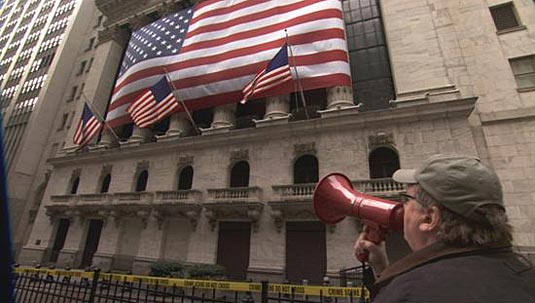
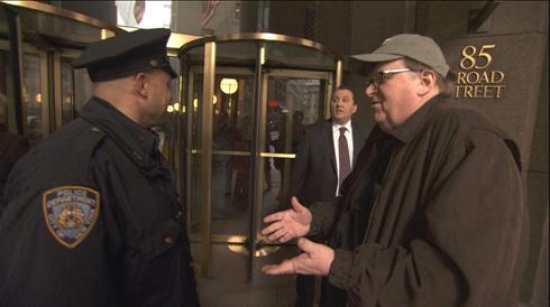
It is at its best documenting the struggles of middle-class families deluged with debt, whether from medical bills (ahem!) or from changed conditions of their sold mortgages, and saves its most venom explaining the practices of corporations in treating their employees as "Meat or Pets"* by secretly taking out life insurance policies on them (whether the employees have it themselves or not), benefiting from their deaths—a practice known in the Insurance Industry by the "add-insult-to-injury" term "dead peasants" policies. The film is snarkily entertaining though the director spends far too much time in front of the camera (the pointless debates with security guards gets old mightily fast), and he leaves in a jab at himself as he stands outside Goldman Sachs looking for financial advice. "Don't make any more movies!" comes a reply from one of the Masters of the Universe.**
More bad advice. Just what we need.
* Moore's original title for "Roger and Me" (1989).
** Tom Wolfe's bromide for stocks and commodities traders in "Bonfire of the Vanities."
 Farenheit 9/11 (Michael Moore, 2004) "Everyone’s getting along just fine backstage, the Teamsters are helping Michael Moore into the trunk of his limo,” cracked Steve Martin after Moore won Best Documentary at the 2002 Oscars (for Bowling for Columbine) and used his speech (accompanied by all the Documentary nominees) as a passionate speech against the Iraq War. The "Shame on you, Mr. Bush" speech was then expanded into this film, which debuted before the 2004 election, but didn't seem to make a dent in Bush's re-election over the swift-boated John Kerry.