Showing posts with label Ben Foster. Show all posts

Tuesday, April 21, 2020

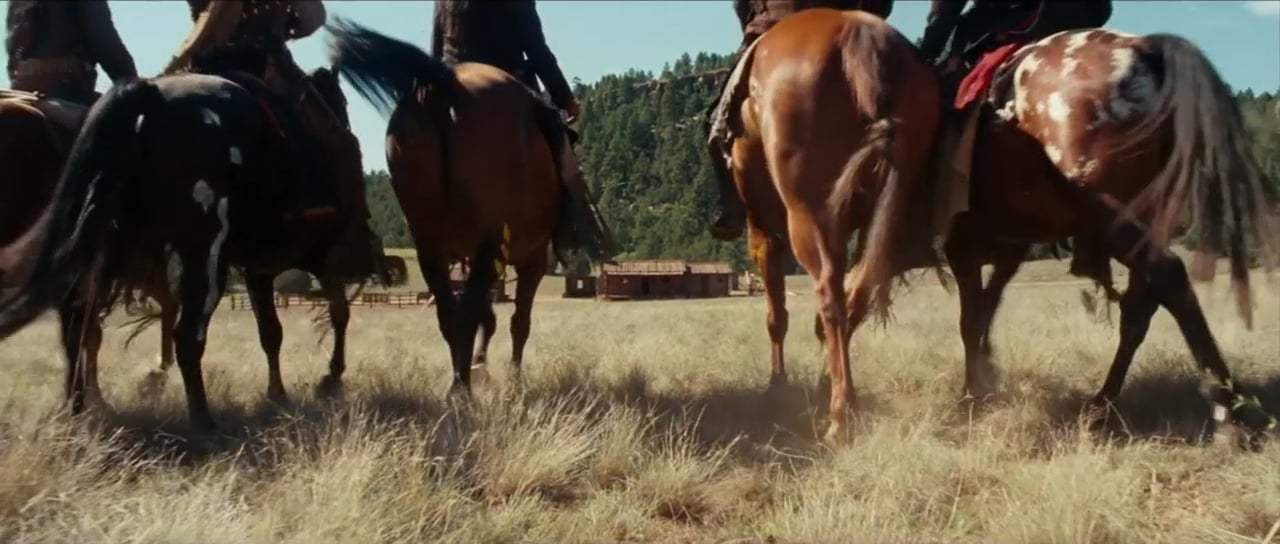
The "3:10 to Yuma" Shoot-Out

Written at the time of the remake's release.


"Thar' Ain't Room in this Genre for Both of Us"

It's a truly fascinating experience to revisit Delmer Daves' strange little 1957 "oater" 3:10 to Yuma, and look at what James Mangold (Walk The Line) has done with it 50 years later. The original was a tight little psychological western based on an Elmore Leonard ("Get Shorty," "Out of Sight," "Hombre," "The Friends of Eddie Coyle") short story, but, as with his latter urban capers, character informs action. And it provided Van Heflin and Glenn Ford two of the finest roles of their careers. Ford, never the most inspired of actors, does wonders with the role of rogue-bandit Ben Wade, who's just as handy with his words as a gun, and is just as dangerous hand-cuffed and guarded as he is on the loose. No one is safe in his sphere and he rules a band of outlaws on sheer force of personality. 
Ford ekes out every subtlety, every nuance of his clever dialog and makes it look easy as taking a nap. His is a villain that never admits he's not in control of the situation. He's evenly matched by Van Heflin, looking haggard and down-trodden as a desert-farmer, who takes on a prisoner-transfer to save his farm, and maybe a touch of glory. Such a man is constantly in threat of temptation from the devil, and it's only his cussed stubbornness that makes him see through a job when other men give up. Heflin has the less fun role, but gives it his all, and is rewarded by a Divine Intervention that is announced by a choir of angels (who are backing Frankie Laine singing the inevitable Title Song).
So, 50 years on, what can Mangold bring to the material? Well, not much really. It's puffed up with some more action and the dialogue is retained (at least in spirit) a surprising amount of the time (original screenplay writer Hallstead Welles gets the lead screenplay credit). What new things are added are informed by earlier instances in the original and made explicit, some times thuddingly, and everything is tamped down in a nihilistic amoral rasp as is expected of a western post-Leone/Eastwood (but with none of the wit or stylism). 
More explosions (Two, instead of the none in the first), one in an unnecessary story-detour through a railroad camp. The one opportunity the modern makers had--that of fleshing out the denouement in terms of character, they manage to make even more false, by pumping up the action and circumstances, straining credibility to the snapping point. Russell Crowe's Ben Wade has the same dialogue, but none of the swagger, and enough skills that one wonders just what he's doing staying around the whole movie. Christian Bale's Dan Evans has the same motivations as the original, but his circumstances are worse, and to make his family connection explicit and situations more dire, his son sneaks along on the expedition. Still, its pretty obvious how much Mangold loves the original, seeing how much is retained, but the expansion of the story works against it, and we are left with what's good in the new one...being the old one.
But there are things missing, too. Besides the more colorful straight-ahead performances of Ford and Heflin, there is a marvelous one by the fine character-actor Richard Jaeckel, who makes Wade's lieutenant, Charlie Prince, a craftily-goofy rooster of a character. Ben Foster's performance has some of the characteristics, but is a stone-cold psycho (no doubt written that way) and pales by comparison.

And then there's that Frankie Laine song...

It's the 1957 version. The 2007 version goes to Boot Hill.


Thursday, February 8, 2018

Hostiles (2017)

Outpost Traumatic Stress Disorder
or
"'Deserves' Got Nothing to Do With It"

Donald E. Stewart died in 1999 after a career as a screenwriter (you may remember his scripts for The Hunt for Red October, Patriot Games, A Clear and Present Danger, and Missing). Now, this is curious: he left a "manuscript" for a project for what was to be Hostiles in the 1980's and Scott Cooper (who directed Black Mass, Crazy Heart, and Out of the Furnace) took up the mantle of the film, seeing it through to completion last year.

Hostiles is in theaters now and the promotion of it, the ads on television of it, has led to a lot of questions on my part—it's a Western (a rarity these days) but what type of "Western" is it going to be? Is it going to be myth or truth? Is it going be clean or messy? Tragedy or triumph? Is it Nation-building or genocide? Is it going to hearken back to Westerns of the past or plow new ground? What sort of animal is this "Western" going to be?

It's opening quote by D.H.Lawrence doesn't help much, except in retrospect: "The essential American soul is hard, isolate, stoic, and a killer. It has never yet melted."

Yep.

We're told it's 1892 in New Mexico and in a valley of scrub squats a naked farmhouse. Riders approach. Wesley Quaid (Scott Shepherd) is working when he sees the five horses appear over a ridge, his wife Rosalie (Rosamund Pike) is teaching adverbs to her daughters ("how where and when"), with the baby asleep in the next room, when Wesley busts in and tells her to run to the woods like they'd planned and don't look back. But, she can't. Wesley shoots, but almost immediately he is shot full of arrows and scalped. Running with the baby in her arms, she is horrified that her daughters are picked off with rifle-fire, but she still runs and hides. The Comanche raiders can't find her, but they set fire to the house. The baby is dead in her arms from a bullet that didn't reach her. 

Captain Joseph Blocker (Christian Bale) returns to Fort Berringer, New Mexico, after capturing an Apache family that has escaped. He and Master Sergeant Tommy Metz (Rory Cochrane) share a bottle and reminisce about their long campaigns fighting the South and then the Plains Indians; Metz has been relieved of his guns due to "melancholia" ("There's no such thing" says Blocker) and confesses he's going to retire, but the Army, as it always does, has other plans.

Berringer's commander, Biggs, (Stephen Lang) has orders—"a cause celehbray"—from President Harrison: one of the fort's prisoners, a Cheyenne Chief named Yellow Hawk (Wes Studi), is dying of the cancer and Biggs wants Blocker—and no one else—to escort him and his family back to "The Valley of the Bear" in Montana so he can die in his homeland. Blocker is adamantly opposed to the idea and refuses, to the point of insubordination. As a conveniently expository reporter for Harper's Weekly informs us, Blocker has probably scalped more men than Sitting Bull "himself," and while Blocker acknowledges that it is not his place to disagree, he will not carry out the orders and would just as soon cut the throats of every member of the family. Biggs tells him to sleep on it; he leaves in the morning.

After a night straight out of a Terrence Malick movie where Blocker walks out to the prairie with a thunderstorm in the distance and screams his protests about it, he gears up and takes a squad with him: Metz (of course); buffalo soldier Corp. Henry Woodson (Jonathan Majors); a rookie out of West Point, Lt. Rudy Kidder (Jesse Plemons); and a Pvt. Phillipe Dejardin (Timothee Chalamet), who everybody calls "Frenchie." Once out of sight of the fort, Blocker stops the party saying "the fuckin' parade's over," takes out two Bowie knives and orders Yellow Hawk to dismount, offering him one of the knives. The Chief scrutinizes the Captain "I do not fear death" he says in Cheyenne, and Blocker orders the two Cheyenne males to be chained up for the rest of journey to Montana.
They don't get too far until they find the Quaid farm, still smoking, the dead unburied, and Mrs. Quaid sitting in the burned out husk of her home, still holding her dead infant, with her daughters tucked neatly into bed. She demands that they not be disturbed, and Blocker, with a career of dealing with tragedies like this, places the emphasis on comfort rather than pushing the realities of the tragedy on someone still in shock. Even the offer of burial of the loved ones is dropped...immediately...when the woman, in her grief, demands she do the job herself. She digs and digs why the soldiers stand by, finally pawing in the dirt (much like Blocker raked the ground in the "Malick segment") until assistance is gently offered and she acquiesces, allowing for a service to be performed just after the sun has dropped below sight.
This hasn't gone unnoticed by Yellow Hawk and his party. The old chief goes to Blocker and requests that he and his son be unchained to better assist in any defense against the Comanche renegades. He is entirely practical and sees danger for all parties "They are snake people," he tells Blocker in Cheyenne. "They do not discriminate." The words weigh on the captain but he will not relent. The chief may make sense, but not enough to soften his caution. For him, it comes down to deeds, not words. It is only after an encounter with the Comanche that leaves Woodson wounded and Dejardin dead (and three of the Comanche dead, one by Yellow Hawk running over him with his horse and another by his son, Black Hawk (Adam Beach) strangling him with the very chains that bind him does he relent. The Captain can be practical, too.  
He's also different than most Western heroes. You know the type. Most of them are fierce subscribers to the idea of "Manifest Destiny," (as in "there's a wilderness to be tamed and, by God, I'm the one to do it"*). The wilderness is one thing, but the indigenous peoples living on it before them is quite another. Most of the time, we just get the settlers' view of things, but about 50 years after movies were created (and "the Western" along with it, scarce decades after the real thing happened), we started to get a thread of the viewpoint of the First Peoples' point-of-view which can be summed up as "there goes the neighborhood" or more contemporaneously "who let all these foreigners in here?" The making of the nation was pretty much boiled down to a governmental experiment combined with a continental race war. But, it really wasn't until John Ford made The Searchers in 1955 that we got to see the racial aspects of the Western, and it was write large when its top-billed star—John Wayne—played the character of Ethan Edwards, a complete and total (and unrepentant) racist.**
Your initial impression of Captain Joseph Blocker leads you to think he runs along the same lines—and director Cooper nudges the cine-philes in that direction by opening with a similar family massacre and a shot from the interior of the house that frames Nature in a doorway in the same manner that The Searchers did in its initial images. But, Blocker does not see things as merely black or white, but more of a shade of mordant gray. He's not a strict racist, per se (and his tearful leave-taking of Corporal Woodson is meant to dispel the notion), he just hates Indians—at least his experience as a soldier has taught him that that should be his first line of defense. He's seen too much death, and, in turn, caused too much of it to think that any business with Natives is not a good business. And it comes to him as naturally as putting on his uniform.***
And, as if to prove the point, Cooper takes it a step further; at a Colorado outpost along the way (where Woodson can be doctored) and Mrs. Quaid might take her leave, Blocker and his troop are given another task—escort Sgt. Charles Willis (Ben Foster) to Montana to be hanged for murder. He's given a couple more guards, and, despite the offer of sanctuary, Mrs. Quaid opts to continue to ride with the troop to Montana. And it is this portion where most of the reviews of Hostiles has been a might unfriendly.
Some of the accusations against Hostiles comes to its length at just this point—some folks think you don't need the Willis character, but I see it as a bit of reinforcement to shore up what might be a too-easy character arc for Blocker if it did not exist. Willis provides him a chance to look in a dark mirror, and see what might transpire of a man who goes down a wrong path. Willis—who once served with Blocker, and was at Wounded Knee with him—has taken his military experience and gone off the rails, murdering civilians, crimes for which he has been convicted and is on his way to be punished for. It may pad the movie a bit, but it does allow the alternative side to be heard from; Willis and Blocker are not the same man, but their paths are marked by similar times and occurrences, the accumulation of which have created the men they've become. Blocker could let those instances influence his choices, let the past influence the future, holding the names of the men killed under his command as a shield...or an excuse. His prisoner is the bad angel tempting him from the path he appears to be taking—made manifest (in all senses of the term) with his own destiny hanging in the outcome.
As you might be able to guess, I love Westerns. It's one of the two genres (besides science-fiction) that puts a mirror to our current age, speaking to us from the past (or the future), from the "when" about the present, about us and where we are today—about the "why" and the "how". Somehow, putting us in another frame of time puts us in another frame of mind, as well. The locale is different, but we can still recognize the human condition while it teaches us from a different perspective than the familiar, if we choose to recognize it.
Hostiles is of an age, 'way past the films of John Ford (although it pays homage to The Searchers), which dared to even bring up the matter of race in movies that were considered just "cowboys 'n injuns," to consider the Western as myth—and, as such, makes more than a passing reference to Eastwood's Unforgiven (even cribbing a line from it) and bringing a certain spin on the same director's The Outlaw Josey Wales—in how the battle to build a Nation exposes the best and worst of our natures, and, if we survive it, how, after the last echoes of gunfire fade, we choose to continue the journey—by looking back or looking forward? Do we continue it by building or by retrenching? Do we look to our bloody past or look to an uncertain future? Where is there security in either?  
Hostiles has a preference, obviously, but, in its penultimate sequence it still challenges those assumptions, by putting another challenge—another dark mirror—in the way of civilization...of nation-building. The choices are elemental, the ramifications complex, but it comes down to choosing sides...and what side you're on.
Like I said, I love Westerns, and I like them best when they're challenging. And Hostiles is one of the most challenging of the breed.


* See also: "a man's gotta do what a man's gotta do."

** If you could get past the fact that the character was played by traditional Western hero, John Wayne (which a lot of people couldn't). Some people see him as a hero without noticing that the one GOOD thing he does goes entirely AGAINST his previous intentions and inclinations...and that the movie basically shuns the character and bars him from civilization.

*** Christian Bale has a funny little character "tic" when his character is thinking—he rubs his scalp at the line of his hair...as if he's valuing it and saying good-bye to it for the last time if he thinks wrong. 

Tuesday, August 23, 2016

Ain't Them Bodies Saints

Written at the time of the film's release

Dear Ruth
or
"Goin' a direction that ain't been invented yet."

David Lowery's independent study of love on the run, Ain't Them Bodies Saints, is a romantic's view of criminal activity in the same spurting vein as Bonnie and Clyde, Badlands, and Thieves Like Us, where the romantic glow of need and obsession have a tendency to blind a body from the rest of the world and what's considered normal.
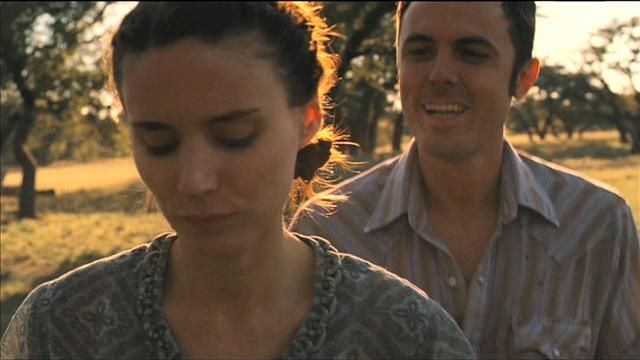
Ruth Guthrie (Rooney Mara) and Bob Muldoon (Casey Affleck) are young and in love, and Bob's in the employ of Skerritt (Keith Carradine), who runs a hardware store in town, but a has a nice little underground thievery ring keeping it afloat. Bob and Freddy (Kentucker Audley—what a great name) do the deeds, then run back to the abandoned farm that was their grandfather's before it went bust to hide out and wait for Skerritt's pay out. But, when we first meet them, Ruth and Bob are young, in love, spatting, she's pregnant and practical, and he's a moony-goony kid with nothing going for him in the long term. 
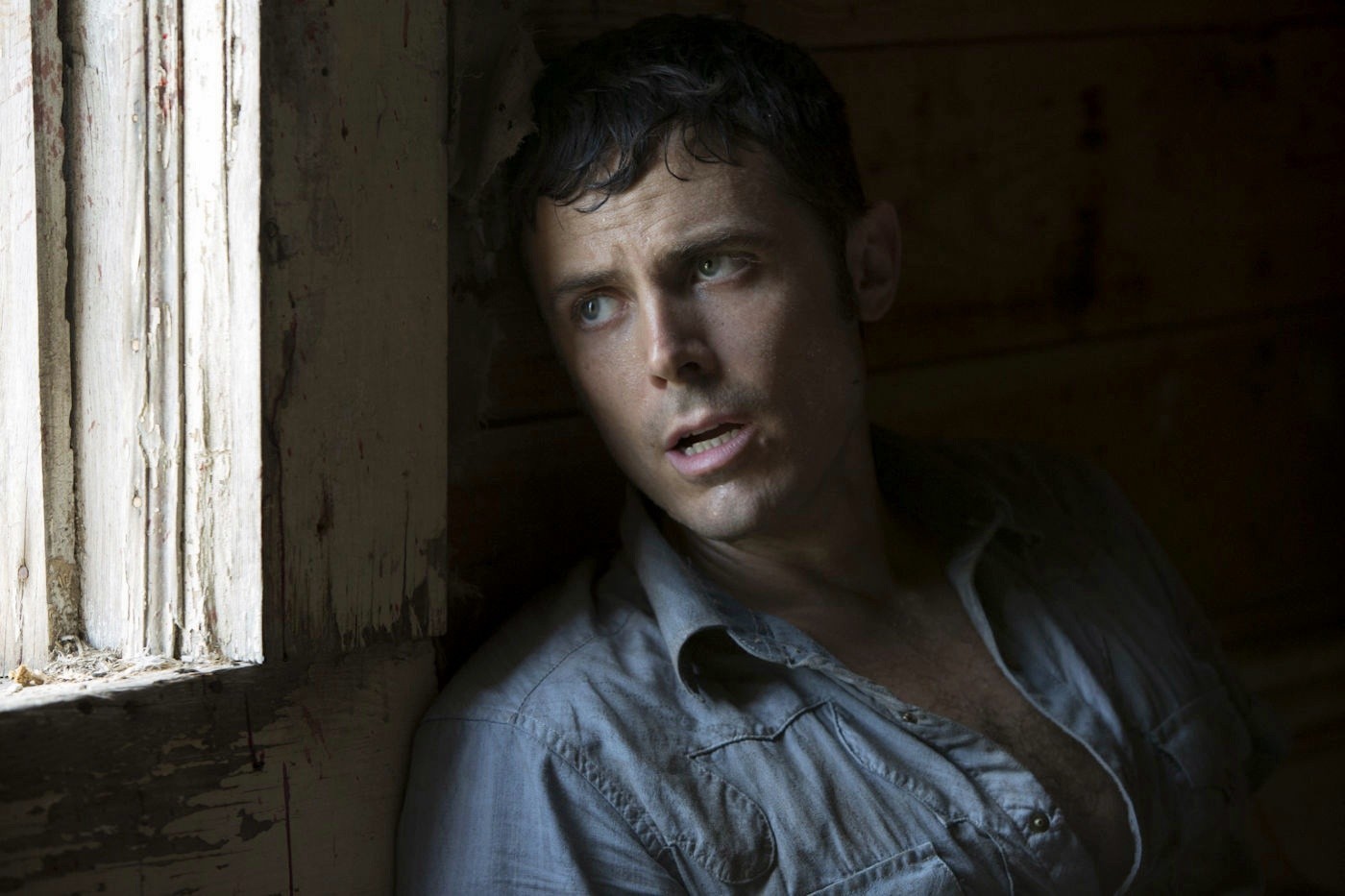
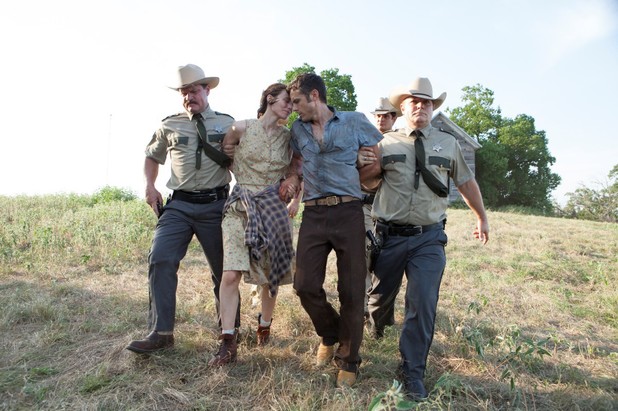
Except for the prison sentence. The cops get wind of where the outlaws are hiding, and it looks like it's going to be one of those barn-burners where everyone gets killed. Freddy dies first, then Ruth shoots Officer Patrick Wheeler (Ben Foster), and Bob devises that he'll say he shot Wheeler, so that Ruth can go free, he'll take the prison stretch, and he'll come back to his family when his time is up.

Best laid plans.
Ruth has her child, a girl, which Bob finds out about in prison, but he's not the the practical one—he's the impulsive one—and before long he's on the run with five other prisoners, presumably to get back with his family. The police and Skerritt are both on high alert, figuring that they know that Bob's headed in their direction.  But a lot has changed. Skerritt proves he has a conscience by setting up Ruth and her child in a place (across the street from him, so one wonders if the reason is totally altruistic or simplified reconnaissance). And Wheeler starts calling on Ruth, ostensibly to see if she knows anything about Bob's whereabouts, but also because he finds he starts to have feelings for her, not knowing that she's the one who shot him, and not knowing that she knows.
Four people, with an awful lot of shared history, but none of them know very much about the others. But all are in an agitated state of anticipation and uncertainty and trying to take pains to head off what could be disaster. Doesn't sound like much. story-wise, but it is far from mundane, and all four leads have a way of maintaining masks of dis-information, while acting as if everything's normal, really.  And that's something of a small miracle.
Where Lowery excels, though, is (with cinematographer Bradford Young) in creating beautiful images—again, out of pretty mundane things—and letting those images tell the story (it has to, the reason being that the dialogue is useless, except to let you know that everybody's lying and/or hiding something) and that's a considerable challenge for someone's first feature. Those issues also complicate the acting, but between Affleck, Mara, and Foster, you have three excellent actors who acquit themselves at playing "opaque." Keith Carradine (who starred in Thieves Like Us, by the way), though excellent, is a little more obvious in his intentions, although he's an actor who can apply both comedy and drama masks to his face.
It's an interesting study and makes one wonder what other subtle things Lowery is capable of pulling off.

Wednesday, March 5, 2014

Lone Survivor

And I Only Am Escaped Alone to Tell Thee
or
I Died With My Brothers—With a Full F**king Heart


Lone Survivor is "based on a true story"—that of the Navy Seal team involved in Operation Red Wings to capture Taliban leader Ahmad Shah, which ended disastrously for the participants—but it feels more like a testament.

It's directed by Peter Berg, who is at his best in the realm of psuedo-documentary, his roving camera acting as a fly-on-the-wall, catching the telling detail, the private moment, the feeling of a collective, like his 2004 film (and to a certain extent, subsequent TV-series) Friday Night Lights, or The Kingdom. His recent forays into A-list projects (like Hancock and the "film-of-the-board-game" Battleship) have been less successful, despite using his same camera-scheme to give them a lived-in feeling.


Lone Survivor, however, is a return to his strengths. Not burdened with a sprawling story-line or too many characters, Berg has focused his story-telling abilities and stays on the four men on the mission and their commitment to each other and their task. He's helped immeasurably by the four actors playing the small scouting task force: Taylor Kitsch (Gambit from X-Men Origins: Wolverine, the TV version of "Friday Night Lights," the lead in John Carter); Emile Hersch (Into the Wild, Milk, Speed Racer); Ben Foster (3:10 to Yuma, The Messenger, Ain't Them Bodies Saints); and Mark Wahlberg
. Each one of these actors has carried movies—big movies—on their shoulders, and each one treats their roles, supporting or not, as a starring role. Wahlberg (who, as he's moved from actor to actor-producer and gotten astoundingly better as the former in the last few years) is top-lined, but fades into the mix with an understated performance that gives the film a great ensemble balance.
Kitsch as Lt. Murphy, Wahlberg as Luttrell, Foster as Axelson, and Hirsch as Dietz
"Ensemble" is the point. Berg starts Lone Survivor with "found footage" of Navy seal training—brutal, berating, limit-pushing—training that shows the individual what they're capable of, shows the squad what they can expect from each other, building the "trench camaraderie" without the deployment. The seals are pushed to the edge, brought back, and their very existence and presence is testament to their abilities to survive in extreme situations. The fact they're going through it together bonds them, as Wahlberg's opening narration states firmly. The film ends with footage of the real men who were lost—home movies and the like—showing the individuals now that we know them apart from the squad, and it's poignant, stirring, and heart-breaking.

In between is the story of the mission and how an act of conscience in extreme conditions can cost. There's been some fabrication of the story—the Taliban were not in a numbers position to attack the village, as shown—but the facts are basically there. On a reconnaissance mission, four Navy Seals are having difficulty contacting their base. They're found out by passing shepherds whom they tie and discuss what's to be done; it's not a democracy but everybody weighs in—kill the villagers and continue then mission, or let them go and try and contact the base, as the mission has been "compromised." "Rules of engagement" figure heavily in the discussion, but it comes down to rather than kill the villagers, let them go and scrub the mission, and get the hell out of there.

That would be in a perfect world, but it's Afghanistan. Soon the hills are alive with Taliban fighters and the four must engage and get out, while constantly being pushed down the terrain. Berg shoots this close-quartered and fast with the stuttered lens/editing that's been so effective since Saving Private Ryan. And it's here that the sound department kicks in with heightened effects, as well. It never feels like a video-game depiction, but with an overall perspective that lets you know where the four are in relation to each other, and fleeting glimpses of enemy positions. It's harrowing. And then, things go up a notch when the four have to desperately drop off mountain terrain with no forethought to what awaits below...not once, but twice. The imagery and especially the sounds of those sequence are painful—Lone Survivor received one Oscar nomination (for sound) and it is truly deserving of it (but, it was a little disappointing to not see a clip from this film in any of the broadcast's "heroes" montages). The sequences are visceral, painful to watch, and gut-wrenching.


And that's where Berg's strength lies as a director in a film like this—he keeps the work centered on the soldiers—this is not effect for effect's sake, it's part of character, woven throughout the film. By the end you wonder at the dedication and gut-level heroism of the people we, as a nation, throw into battle, and one can't help leaving the film, admiring..and mourning.
Matthew Axelson (far left); Danny Deitz (center left);
Marcus Luttrell (center right); Lt. Michael Murphy (far right)