Showing posts with label Jake Gyllenhall. Show all posts

Wednesday, May 19, 2021

End of Watch

Written at the time of the film's release...long before the Derek Chauvin conviction, but long after the Rodney King footage. Police work is a tough job that I'd be quite incapable of. And it's made tougher by the fact that they've become the "catch-all" solution to all of Society's problems. There's got to be a better way...for them and for us. I stand by the police. But, I don't stand by, blindly, ignoring the fact that they've become a symptom of a system doing as little as possible...and leaving it for someone else to fix.

Cops, the Home Movie
or
"...More Capers in One Deployment Than Most Cops Will See Their Entire Career."

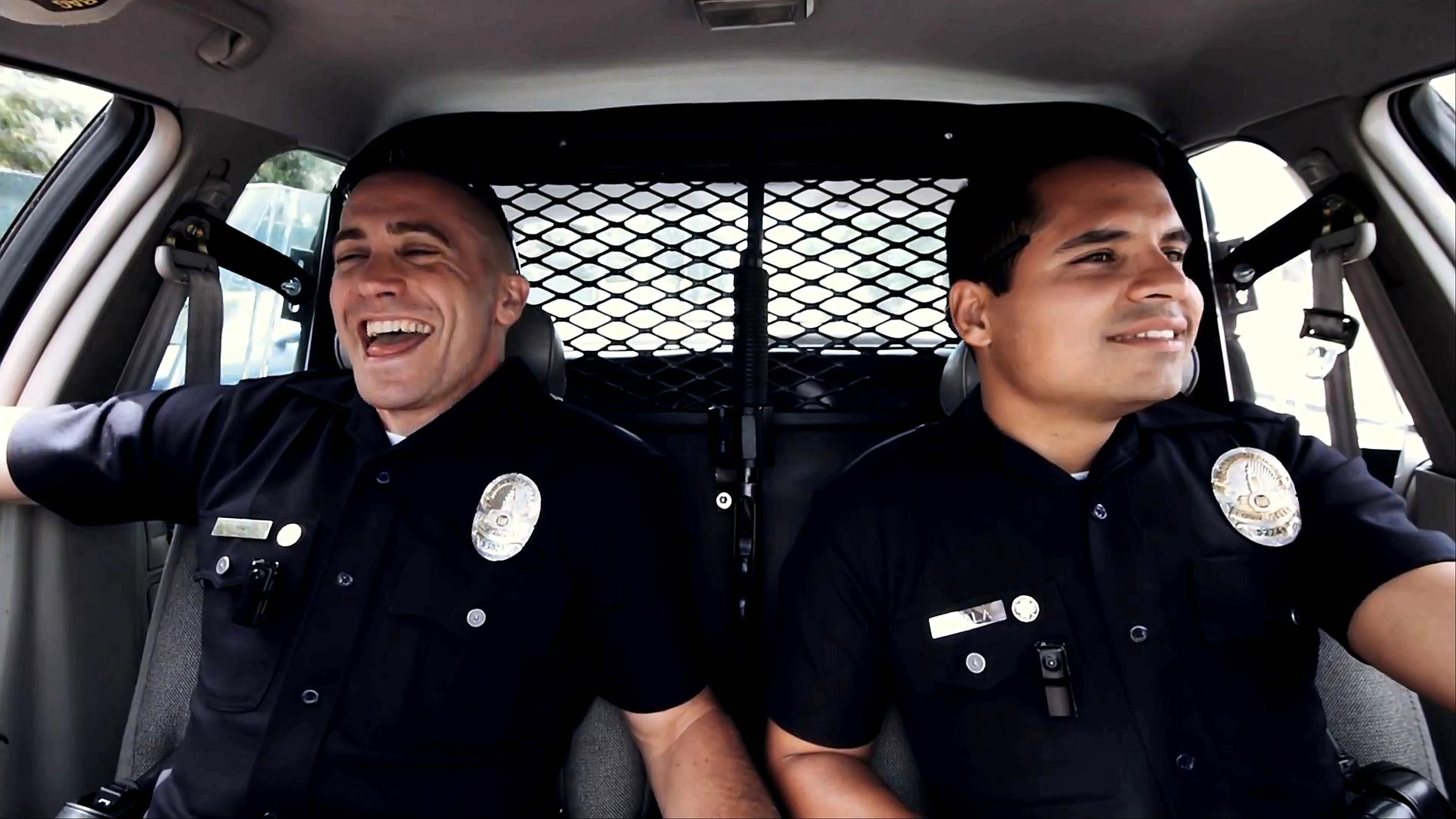
It's a war out there "once upon a time in South Central." And Officer Brian Taylor (Jake Gyllenhaal) is the front-line reporter documenting the whole thing "for a project."  He's carrying a camera—not that he really needs it, the dashboard cam will pick up everything needed for an investigation. But that camera can only look forward—it's myopic. It can't see around you, it can't check the perimeter. And it can't look into your soul. It can look at your back, but it can't have it.

It starts with one of those dash-cam chases, so familiar to "reality" chase shows. No overlayed sound, save for Gyllenhall's narration, said in a monotone as if he was giving you your Miranda.  


I am the police and I am here to arrest you. You have broken the law. I did not write the law. I may even disagree with the law. But I will enforce it. No matter how you plead, cajole, beg or attempt to stir my sympathy, nothing you do will stop me from putting you in a steel cage with gray bars. If you run away, I will chase you. If you fight me, I will fight back. If you shoot at me, I will shoot back. By law I am unable to walk away. I am a consequence. I am the unpaid bill. I am fate with a badge and a gun. Behind my badge is a heart like yours. I bleed, I think, I love, and yes, I can be killed. And although I am but one man, I have thousands of brothers and sisters who would die for me and I for them. We stand watch together. The thin-blue-line, protecting the prey from the predators, the good from the bad. We are the police.*
And with that, the law of the film is laid down. The dash-cam goes away and the camera goes into cinema verité, the camera pointing from inside Taylor's locker as he goes through basic introductions—himself, his partner Mike Zavalla (Michael Peña, never better), his equipment (and a conversation from Rio Bravo pops into one's head: "That all you got?" "That's what I got."), and the beginning of the look inside—the harsh joshing, the tensions, the coolness and coldness and camaraderie of the corps. Joseph Wambaugh had an apt phrase for them in his book (and subsequent film), "The New Centurions." But Rome was never like this.
The turf in South Central is tough and hard-scrabble. Poverty is on display on every street corner, and behind the boarded-up windows of the houses in various states of disrepute are secrets for the outside world not to know, but will see the light of day once the front door is kicked in. The war is in the streets, but inside cook the warning signs that something is about to explode, the stakes rising, the limits of human degradation dropping, the calibers of the weapons increasing, the risks increasing and the only good side of it being that they're not increasing exponentially.
It's a tough film, directed and written by the guy who wrote
Training Day and the original The Fast and the Furious, David Ayer, who has a knack for keeping things on the down-trodden path no matter who's behind the camera or what the subject matter is. It's not a film for continuity buffs, who will be driven crazy if they think "Okay, who's taking that shot?" with every change of perspective. Very quickly, the strictures of the snatch-and-grabbed shot are forgotten to gain perspective. The film would have been a pretentious (and claustrophobic) confusion if the conceit was maintained throughout, (I can see the review headline now: "The Blair Watch Project"), but as it is, breathes enough air into it while maintaining a feeling of impromptu recording—keeping the spirit of the law, rather than the letter of it. That, along with the ad-libbed spark of the dialogue gives it an edgy immediacy that, again, "seems" right, while never fully escaping the feeling of planned manipulation (not that it ever could). Game try, though. And manages to show the life—long stretches of tedium punctuated by moments of terror—that one imagines the life to be, even though blown up with steroids to fulfill the needs for melodrama and tension.
* But, what it doesn't say is "We are also responsible, culpable, and...accountable."

Thursday, July 11, 2019

Spider-Man: Far From Home

Spider-Man's European Vacation
or
Spider-Man, Spider-Man
Visiting Europe (Not Amsterdam)
London, Prague and "The Boot"
Too Much Gadgetry in His Suit
Mon Dieu!
Qu'Est-ce Que C'est, Spider-Homme.
(Wherever There's a Baguette/
Aunt May's Too Young to Nag Yet)
Stay Sticky, Spider-Maaaaaaan!)*

Upfront: I liked Spider-Man: Far From Home more than I liked Spider-Man: Homecoming, but I'm not sure that will be the way of the mob. The central premise is "people will believe anything" and it spends more time than a White House spokesman proving that very point. I think folks will believe that less than the ability to wipe out half a Universe with a snap of your fingers. ("Yeah, man, but...ya know..."Stones.")

Spider-Man: Far From Home acknowledges the events of The Avengers movies (Infinity War and Endgame) right off the bat—even before the Marvel Studios Logo—everyone is calling it "The Blip" and it has caused all sorts of embarrassing havoc in the world. For example, Peter Parker's Aunt May (Marisa Tomei) re-appeared in her apartment after it rented out to someone else—embarrassing—the courts, insurance companies, and homeowners associations must be swamped. Reappearing students at Peter's high school have found that five years have elapsed (but not their three-picture deals) and a lot of their friends have graduated and moved on—and the absent students had to take their mid-terms again (I'm surprised the admins remembered, but at least the kids who returned didn't need a note to explain their absenteeism).
Anyway, they acknowledge it (but avoid the complexities), as well as the deaths of The Vision, Black Widow, Captain America (heh) and, of course, Iron Man Tony Stark. Especially Tony Stark. And Peter Parker (Tom Holland), only recently pulled back together, is feeling that death, and it's tearing him apart. It was Stark who recruited him for the Avengers, it was Stark who built his suits, and it is Stark that the public wants Spider-Man to live up to—they're looking for another Iron Man and they assume it will be Spider-Man.** But, as Peter tells Stark majordomo "Happy" Hogan (Jon Favreau, in between Disney jungle movies) he doesn't think he can live up to the Legacy. "Nobody expects you to live up to Tony Stark," Hogan counsels. "Even he couldn't live up to it." As a parting gift, Happy bequeaths some last Stark tech—a pair of glasses with interactive gizmo's, access to all sorts of Stark Industries technology, and its AI interface, EDITH. "Tony loved acronyms," says Hogan. "It stands for "Even Dead, I'm The Hero." 

Best line of the movie.
Samuel L. Jackson's reprise of "Bitch, please....." from Kong: Skull Island is the second.
So, while Peter feels the great power/great responsibility weight of the Legacy, his class is preparing for a science field-trip in Europe. Why Europe? Because 77% of Americans believe in angels, that's why. For Peter, this is of high importance, not so much for the science stuff, but for...yaknow...personal stuff. No longer enamored of Liz Toomes (Laura Harrier from Homecoming and, one should mention, BlackKklansman), he's more interested in Michelle "M.J." Jones (Zendaya), pretty, blunt ("You look pretty." "And therefore, I have value?"), and oddly dark—he wants to let her know that he likes her and he plans to make La Grande Gesture by telling her on top of the Eiffel Tower. But, he has a rival for MJ's affections in Brad (Remi Hii) who, after the blip, has aged five years and turned into something of a hunk. So, Spidey's attentions are focused on that.
Un-focusing are the constant calls from Nick Fury (Samuel L. Jackson) of S.H.I.E.L.D., who, with Agent Hill (Cobie Smulders) is trying to web-sling Peter into helping out with what seem to be a global crisis of elemental monsters—earth, air, water, and fire—which are popping up all over the world causing considerable damage. But, where these things are coming from, and why, are a mystery. But, they have a good idea. And it comes from an unlikely source—a previous victim, whose own Earth has been destroyed by the elementals.
His name is Quentin Beck (Jake Gyllenhaal, more on him later) who has traveled to this Earth (616, in case you want to update your Facebook profile) from his own (Earth-833)—if it existed. His Earth was destroyed by the Fire elemental that was allowed to get out of control and consume his world. How, Beck, whom Parker dubs "Mysterio," got here, no one knows—presumably the same way the "things" got here, by subtracting 217, turn right at Mars. Fury wants Spider-Man to team up with Mysterio, who seems to have a knack with his magical Dr. Strange-ish powers, to try to stop the threat, but Parker is reluctant—he's not Iron Man and not sure he could do anything to stop something so huge. But, Fury is insistent, and he has a contingency plan.
He uses the considerable resources of S.H.I.E.L.D to re-route the school science trip to wherever they think the elementals will appear, which although it may be a bit abrupt to the group, but it comes with upgrades, so nobody's complaining. Well, except for Parker who bleats to best-friend Ned, "Nick Fury has hijacked our summer vacation!!" Yes, he has. But, he hasn't done it alone.
That's the plot and the main gist of the important elements (no pun intended). The film-makers flesh it out with the side-characters, and a hint of intrigue that doesn't feel too threatening in its implications. It's wise that they come down to Earth after the cosmic implications of The Avengers movies—although they flirt with the Marvel version of the Multi-verse, only to let it go...leave that to Into the Spider-verse. Also, the threat, though having elements of the supernatural, boils down to that most Earth-bound of villains, the Disgruntled Employee. But, the threat part is mere window-dressing. It's a bit dull—what we've come to expect.
The best part of Spider-Man: Far From Home is not the super-heroics (aside from a very creative "dream" sequence); it's the kids. The messy, fussy, hormonal, and slightly desperate mood-yanks of teen-ager-dom are neatly, comically, played out, especially of kids in unfamiliar surroundings and disorienting circumstances. The throwing of semi-confident kids into non-comfort zones and their ability to cope—or not—is well thought out and played. And the tentative, nervous romantic pairing of Zendaya and Holland makes for the most enjoyable Spider-couple in any of the versions of Spider-Man brought to the screen.
There are elements that bothered me—the CGI of the Mysterio fights with the Elementals are some of the dodgier special effects I've seen in the Marvel movies...and the characterization of Nick Fury seemed...off to me. Now, maybe I'm being too much of a Marvel-zombie saying this, but...could this have been done deliberately? It's not a good strategy because I found it a bit disorienting, but given the way the film plays out, one could make the case that they was intentional. Still, it makes my Spider-sense tingle.
And Jake Gyllenhaal? I've seen Gyllenhaal do great things, even in "iffy" movies. But, here, he's terrible and it might be the biggest character mis-fire since Ben Kingsley's The Mandarin in Iron Man Three (or Paul Giamatti's Rhino in The Amazing Spider-Man 2). One could imagine someone doing some great things with the role, but Gyllenhaal's portrayal has no depth, and little consistency from scene to scene. It might have been the script, but I suspect the actor was thinking how he'd ever live down the costume, rather than looking at the character with a solid through-line.
Anyway, good times most of the time. Definitely stay for the End-Credits scenes, one of which brings back a beloved Spider-Man character, and the other which made me even more suspicious those things that bothered me were deliberate.
Made me go "Hmmmm."
"Stay sticky...except with Aunt May"

* Alternate Lyrics:
Takes His Class on a Trip/
Awfully Vague about "The Blip"/
Oh, Snap! There Went the Spider-Man
** Uh, why? It's not like Hawkeye can become Thor, or The Hulk become Black Widow...I mean, these heroes do what they can based on their skill-sets, people. 
a) I still find it funny that so much emphasis is put on Iron Man—he was a Tier 2 super-hero at Marvel, the movie series wasn't great, but it's only Robert Downey Jr.'s portrayal that kick-started the Marvel Studios success story. Downey was the corner-stone and BVP utility actor for the studio, which is why he's being lionized.
b) Why Spider-Man? Does everybody know the link between the two heroes? The public didn't know. We know, because we've seen the movies...Oh, it's okay, Marvel. Keep collecting your zillions.

Friday, August 31, 2018

Source Code

Written at the time of the film's release...

"This Train is Bound for Glory, This Train"
or
"Getting to Heaven By Way of Hell"

Captain Colter Stevens (Jake Gyllenhaal) wakes up, disoriented on a trainHe was on a mission in Afghanistan just a moment ago...now he's on a train heading for Chicago, and the pretty girl (Michelle Monaghansitting across from him is calling him "Sean."

What the..?

The world is rushing by, full of commuter-sounds and commuter-problems, but all he knows is that he's not where he should be, and that the face staring back at him from a bathroom mirror isn't his.
"Don't worry," says the pretty girl, Christina. "Everything is going to be alright."
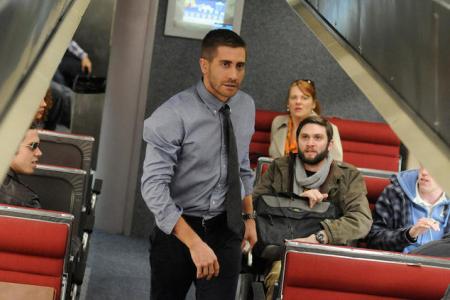
And then, the train explodes.
Famous last words.

Duncan Jones' (a clever enough director after two films that we can stop saying he's David Bowie's kid) last film was the under-performing Moon, featuring a tour de force performance by Sam Rockwell, and a sensibility that borrowed its uneasy creepiness from other sci-fi pics like 2001: A Space Odyssey. What was nice about Moon was that it was science fiction for adults, touching on themes and concepts that point out what role exactly man will play in Space, whether its comfortable or not. In Source Code, Jones and his clever scriptwriter Ben Ripley explore the same issues in the guise of a science-fiction time-travel movie that has, at its core—its own source code, if you will—the guarantee that the train is going to blow up every few minutes...like a movie serial gone very, very wrong. And it is Stevens' mission, as he is military, to keep catching that train for the critical eight minutes before the explosion to try and find the bomb, stop it (low priority), but, more importantly, find out who did it—for that terrorist attack is merely a distraction for emergency crews to turn their attention away from a much bigger threat. Stevens must survey the passengers on the train to determine how the bomb was detonated...and who did it.
Each eight minutes gives him more clues, narrowing his focus and his mission, but at the same time, he's starting to have feelings for the girl sitting across from himHe wants to save her, and maybe the other strangers on the train.
But, like any broken-hearted suitor, he's living in the past. They're already dead. And time is running out for Chicago. His mission specialists (Vera Farmigadoing a lot of subtle work with so little—and Jeffrey Wrightdoing too much, as he is wont to do when searching for a character) are tasked to keep him on point: "Out here, the clocks only move in one direction."

"Out here?" Where is he?
"Star Trek: The Next Generation" had an ingenious episode "Cause and Effect" (written by Brannon Braga and directed by Jonathan Frakes), where the U.S.S. Enterprise-D was caught in a time-loop, but its crew didn't know it. We'd watch them go through a series of events, there'd be an emergency and the ship blew up. Cut to commercial.  Back to the story, everything would reset, we'd watch the crew go through the same scenario, but with an increasing sense of deja-vu. The ship would blow up. Back to commercial. We'd run through the same incidents over and over, until Picard and co. realize that..."oh, we're caught in a time-loop, and we're doing the same things over and over, how do we stop?" It takes a few Enterprises blowing to smithereens before they figure out how to keep it from happening again. It was 60 minutes of Boom, Rinse and Repeat.
As I said, clever.* Like Groundhog Day with one hell of a punch-line. But here, the stakes are higher. Stevens doesn't know anyone on that train, but in his plunging again and again into that future-Hell, he gets to know them, as they go from suspects to victims, while managing to piss off each and every one of them along the way. The deeper he goes, the more he empathizes with their plight and wants to change a History already set in smoke and flame. Even if in a small way.
Source Code manages to be many genres in its perpetual loop of pieces of time: Science-fiction, disaster, action, detective, love story, and finally, inspirational, in showing how we, mere meat and electricity, can escape any trap that science, however well-intentioned, springs on us.
The best of science-fiction, despite the abilities of its clockwork mechanisms and theories to explain How Things Work, take those trappings of the soon-to-be, and tests the mettle of the beings caught in the gears. The most inspiring of science fiction always throws in the element of humanity that rises above by taking a leap of faith in nothing that approximates theory. Inspiration makes science. Wishing makes it so. Humanity makes both. And there's no formula, no theorem, no artificial intelligence to replace that one organic spark, the living breathing pilot light in the testing furnace of technology.


And the belief that everything is going to be alright.
The official poster for Source Code just sucks (and even the one I used above doesn't do the job).
But Olly Moss designed one (for the SXSW double bill with Jones' Moon) and it's quite timely.


* Jones is all too aware of the source code for this movie.  One of my favorite bits in the film is who plays Stevens' father in voice-over.  Of course, it has to be him.  And it's a terrific performance, even if we never see him.

Tuesday, August 9, 2016

End of Watch

Cops, the Home Movie
or
"...More Capers in One Deployment Than Most Cops Will See Their Entire Career."

It's a war out there "once upon a time in South Central."  And Officer Brian Taylor (Jake Gyllenhaal) is the front-line reporter documenting the whole thing "for a project."  He's carrying a camera—not that he really needs it, the dashboard cam will pick up everything needed for an investigation.  But that camera can only look forward—it's myopic.  It can't see around you, it can't check the perimeter.  And it can't look into your soul.  It can look at your back, but it can't have it.

It starts with one of those dash-cam chases, so familiar to "reality" chase shows.  No overlayed sound, save for Gyllenhall's narration, said in a monotone as if he was giving you your Miranda.  


I am the police and I am here to arrest you.  You have broken the law.  I did not write the law.  I may even disagree with the law.  But I will enforce it.  No matter how you plead, cajole, beg or attempt to stir my sympathy, nothing you do will stop me from putting you in a steel cage with gray bars.  If you run away, I will chase you.  If you fight me, I will fight back.  If you shoot at me, I will shoot back.  By law I am unable to walk away.  I am a consequence.  I am the unpaid bill.  I am fate with a badge and a gun.  Behind my badge is a heart like yours. I bleed, I think, I love, and yes, I can be killed. And although I am but one man, I have thousands of brothers and sisters who would die for me and I for them.  We stand watch together.  The thin-blue-line, protecting the prey from the predators, the good from the bad. We are the police.

And with that, the law of the film is layed down.  The dash-cam goes away and the camera goes into cinema verité, the camera pointing from inside Taylor's locker as he goes through basic introductions—himself, his partner Mike Zavalla (Michael Peña, never better), his equipment (and a conversation from Rio Bravo pops into one's head: "That all you got?"  "That's what I got."), and the beginning of the look inside—the harsh joshing, the tensions, the coolness and coldness and camaraderie of the corps. Joseph Wambaugh had an apt phrase for them in his book (and subsequent film), "The New Centurions."  But Rome was never like this.

The turf in South Central is tough and hard-scrabble.  Poverty is on display on every street corner, and behind the boarded-up windows of the houses in various states of disrepute are secrets for the outside world not to know, but will see the light of day once the front door is kicked in.  The war is in the streets, but inside cook the warning signs that something is about to explode, the stakes rising, the limits of human degradation dropping, the calibers of the weapons increasing, the risks increasing and the only good side of it being that they're not increasing exponentially.


It's a tough film, directed and written by the guy who wrote Training Day and the original The Fast and the Furious, David Ayer, who has a knack for keeping things on the down-trodden path no matter who's behind the camera or what the subject matter is.  It's not a film for continuity buffs, who will be driven crazy if they think "Okay, who's taking that shot?" with every change of perspective.  Very quickly, the strictures of the snatch-and-grabbed shot are forgotten to gain perspective.  The film would have been a pretentious (and claustrophobic) confusion if the conceit was maintained throughout, (I can see the review headline now: "The Blair Watch Project"), but as it is, breathes enough air into it while maintaining a feeling of impromptu recording—keeping the spirit of the law, rather than the letter of it.  That, along with the ad-libbed spark of the dialogue gives it an edgy immediacy that, again, "seems" right, while never fully escaping the feeling of planned manipulation (not that it ever could).  Game try, though.  And manages to show the life—long stretches of tedium punctuated by moments of terror—that one imagines the life to be, even though blown up with steroids to fulfill the needs for melodrama and tension.