Showing posts with label Duncan Jones. Show all posts

Saturday, July 20, 2019

Moon

Written at the time of the film's release...


"Hello, I Must Be Going"
or
"Travel To Find Yourself..."

Charlie Duke lived for a couple of days on the Moon. In two documentaries,* he's repeated the story of the vivid dream that he had while feverish during a training exercise
.He and his Captain, John Young, were driving in their Boeing-built moon-buggy to an area that did not seem familiar, at least it didn't look like the geography of the place they'd been prepared for. They kept driving, and came across tracks. Tire tracks that stood out on the virgin lunar soil like they had fluorescent yellow stripes painted down them. Somebody had been here before. 
And so we got excited, told Houston, and they said 'Well, follow the tracks.' You could tell by the tread marks that the vehicle was going to the east. So we turned right, to the east. And towards the eastern end of the valley we come upon this car, as we come over the ridge and there's this car which looked very similar to the Lunar Rover and there was two figures in it. So we radioed that we'd found this car, and we start to describe it, and they start to get excited, we're excited. So we turned the car, pointed and turned the TV on, and I ran over to the passenger side and I pulled up the visor and I was looking at myself. But it wasn't like a nightmare - it wasn't like you were dead - whoever it was looked like me but it wasn't me, I'm in this dream and I'm ok, and it wasn't like a premonition. I didn't wake up, it's just me.
He told no one about that dream until after he came back from the Moon.
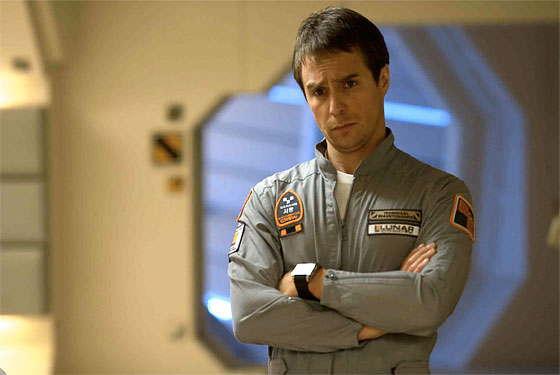
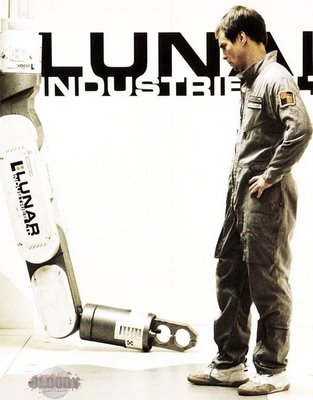
There's a similar thing going on in the new Duncan Jones sci-fi movie Moon (it seems like we've been inundated with sci-fi films the last few years, but we really haven't—they've been dumbed down fantasies and super-hero flicks). Sam Bell (Sam Rockwell) is an employee for Lunar Industries, finishing up a lonely three-year stint on the far side of the Moon, supervising and fixing up the robotic rock harvesters providing the Earth with "safe, clean" Helium 3 for energy—by this time (never specified) 70% of the USA's energy comes from Helium 3.
He gets taped messages from Earth from his wife and 3 year old child. He gets occasional updates from Headquarters, he works on his whittled miniature village, gets on the treadmill, and watches old episodes of "Bewitched."  And there's a helpful robot named "Gerty" (voice by Kevin Spacey, channeling the late Douglas "Hal" Rain), that can see to his medical needs, give him updates and generally "make sure" he's safe. He also has a handy cup-holder, and a little emoticon-generator to show Sam his "mood."

Something goes wrong (something always has to go worng!) with one of the harvesters, and Sam goes out to investigate. Lately, he's been hallucinating, seeing people at the Sarang Moon Base and he's supposedly the only bi-ped on the planetoid. One of those hallucinations distracts him and he ends up smashing his vehicle into the side of the harvester, injuring himself in the process.
He wakes up in the infirmary—Gerty solicitously telling him that he needs to take it easy and that he's in no condition to resume his duties, and indeed, he's having trouble walking and remembering what happened to get him there, and he's surprisingly short-tempered. Not only that, Gerty's telling him he can't go outside...at all...he's in no shape to do anything right now, and Earth is sending out repair crews to fix the harvester. But that's not good enough for Sam, so he devises a leak to some system or other, so he HAS to go outside to check the source.

Once he gets out there...well, that would be telling.

Jones sets up a nifty little mystery that could have twenty different sci-fi solutions to it (they've all been dramatized at one time or another on "The Twilight Zone"), and keeps you guessing until all becomes clear. But as with any good science fiction story, it's the implications that are most interesting, and they're delved into, and expanded in a brief audio coda at the film's end. Jones also finds a neat way to set the stage beyond the dull "It was a Dark and Stormy Future" graphics scrawl to explain how "things are different." 
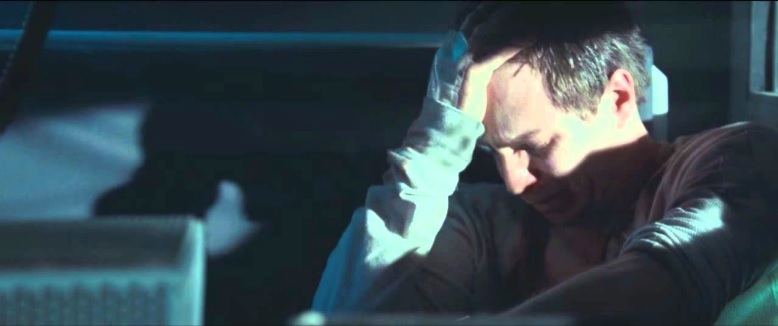
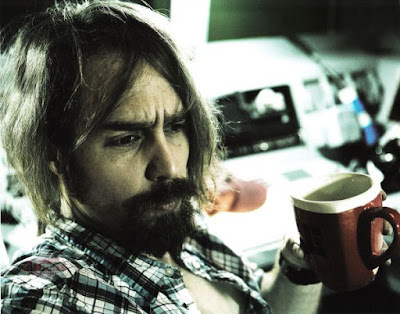
And he has an able ally in Sam Rockwell, who is becoming one of our most gifted film actors. Here he has to do double duty as actor and re-actor (Spacey was recorded at another time, so Rockwell had to react to, basically, nothing) and he manages to do it—as he always does—in the most low-keyed, least grand-standing way possible. His own performance manages to stave off early speculation of "wot's hoppenin'" and with the sophistication of film-goers to the tricks of film-makers, that's a rare commodity. Almost as rare as moon-rocks.
Those who come to these for special effects jollies will see a return to old-school model effects (good ones!) and the very little amount of CGI (mostly in the realm of photo-manipulation). The sets are industrial-functional with a bit of future-pre-fab thrown in.
It's a good film, B-level science fiction, nicely thought out and carried out with sophistication, but nothing to radio Mission Control about.


* For All Mankind and In The Shadow of the Moon (in the out-takes)—each has a different perspective, and are both highly recommended. It's hard to believe, it's the 50th Anniversary of the first lunar landing.

Friday, August 31, 2018

Source Code

Written at the time of the film's release...

"This Train is Bound for Glory, This Train"
or
"Getting to Heaven By Way of Hell"

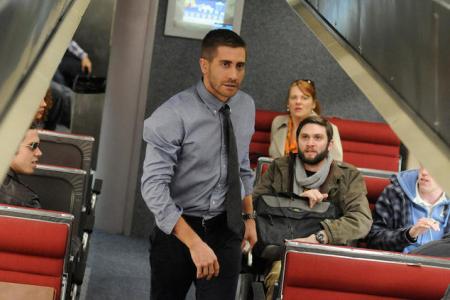
Captain Colter Stevens (Jake Gyllenhaal) wakes up, disoriented on a trainHe was on a mission in Afghanistan just a moment ago...now he's on a train heading for Chicago, and the pretty girl (Michelle Monaghansitting across from him is calling him "Sean."

What the..?

The world is rushing by, full of commuter-sounds and commuter-problems, but all he knows is that he's not where he should be, and that the face staring back at him from a bathroom mirror isn't his.
"Don't worry," says the pretty girl, Christina. "Everything is going to be alright."

And then, the train explodes.
Famous last words.

Duncan Jones' (a clever enough director after two films that we can stop saying he's David Bowie's kid) last film was the under-performing Moon, featuring a tour de force performance by Sam Rockwell, and a sensibility that borrowed its uneasy creepiness from other sci-fi pics like 2001: A Space Odyssey. What was nice about Moon was that it was science fiction for adults, touching on themes and concepts that point out what role exactly man will play in Space, whether its comfortable or not. In Source Code, Jones and his clever scriptwriter Ben Ripley explore the same issues in the guise of a science-fiction time-travel movie that has, at its core—its own source code, if you will—the guarantee that the train is going to blow up every few minutes...like a movie serial gone very, very wrong. And it is Stevens' mission, as he is military, to keep catching that train for the critical eight minutes before the explosion to try and find the bomb, stop it (low priority), but, more importantly, find out who did it—for that terrorist attack is merely a distraction for emergency crews to turn their attention away from a much bigger threat. Stevens must survey the passengers on the train to determine how the bomb was detonated...and who did it.
Each eight minutes gives him more clues, narrowing his focus and his mission, but at the same time, he's starting to have feelings for the girl sitting across from himHe wants to save her, and maybe the other strangers on the train.
But, like any broken-hearted suitor, he's living in the past. They're already dead. And time is running out for Chicago. His mission specialists (Vera Farmigadoing a lot of subtle work with so little—and Jeffrey Wrightdoing too much, as he is wont to do when searching for a character) are tasked to keep him on point: "Out here, the clocks only move in one direction."

"Out here?" Where is he?
"Star Trek: The Next Generation" had an ingenious episode "Cause and Effect" (written by Brannon Braga and directed by Jonathan Frakes), where the U.S.S. Enterprise-D was caught in a time-loop, but its crew didn't know it. We'd watch them go through a series of events, there'd be an emergency and the ship blew up. Cut to commercial.  Back to the story, everything would reset, we'd watch the crew go through the same scenario, but with an increasing sense of deja-vu. The ship would blow up. Back to commercial. We'd run through the same incidents over and over, until Picard and co. realize that..."oh, we're caught in a time-loop, and we're doing the same things over and over, how do we stop?" It takes a few Enterprises blowing to smithereens before they figure out how to keep it from happening again. It was 60 minutes of Boom, Rinse and Repeat.
As I said, clever.* Like Groundhog Day with one hell of a punch-line. But here, the stakes are higher. Stevens doesn't know anyone on that train, but in his plunging again and again into that future-Hell, he gets to know them, as they go from suspects to victims, while managing to piss off each and every one of them along the way. The deeper he goes, the more he empathizes with their plight and wants to change a History already set in smoke and flame. Even if in a small way.
Source Code manages to be many genres in its perpetual loop of pieces of time: Science-fiction, disaster, action, detective, love story, and finally, inspirational, in showing how we, mere meat and electricity, can escape any trap that science, however well-intentioned, springs on us.
The best of science-fiction, despite the abilities of its clockwork mechanisms and theories to explain How Things Work, take those trappings of the soon-to-be, and tests the mettle of the beings caught in the gears. The most inspiring of science fiction always throws in the element of humanity that rises above by taking a leap of faith in nothing that approximates theory. Inspiration makes science. Wishing makes it so. Humanity makes both. And there's no formula, no theorem, no artificial intelligence to replace that one organic spark, the living breathing pilot light in the testing furnace of technology.


And the belief that everything is going to be alright.
The official poster for Source Code just sucks (and even the one I used above doesn't do the job).
But Olly Moss designed one (for the SXSW double bill with Jones' Moon) and it's quite timely.


* Jones is all too aware of the source code for this movie.  One of my favorite bits in the film is who plays Stevens' father in voice-over.  Of course, it has to be him.  And it's a terrific performance, even if we never see him.