Showing posts with label Paul Rhys. Show all posts

Friday, December 22, 2023

Napoleon (2023)

Napoleon Blown Apart
or
Ridley Scott Tells Complaining Historians To "Get a Life" (Presumably One With Just the Highlights)
 
I'd been vacillating whether to see Ridley Scott's film of Napoleon (was it really originally called "Kitbag"?)—did I want to see the 2 hour 38 minute version in the theaters, or did I want to subscribe to Apple television and watch Scott's already-made "Director's Cut" which is more than 4 hours long?* 
 
I tend to favor "Director's Cuts" because a lot of movies cut to theater-length are sometimes near-incomprehensible once the connecting tissue of themes and sub-plots get eliminated for time. But then, some "Director Cuts" are just plain indulgent. A movie's "first cut" is always a disaster (Martin Scorsese has said “If you don't get physically ill seeing your first rough cut then something's wrong."), but films are supposed to find their shape and their rhythm during the editing process and sometimes the more brutal the better.
There's a "Hollywood story" where director Robert Rossen wasn't happy with the length of his film All the King's Men (and neither was the studio), so he merely took "the center" of each scene and cut 100 feet from the front of it and 100 feet from the back and released it like that. The film went from a length of 250 minutes to 109, and won the 1950 Best Picture Oscar (and was nominated for the editing).
The decision for me was seconds long in the thinking—all this other stuff was back-story—I went with the theatrical version (I could always look at the longer one) and Scott is usually pretty good at getting the gist of the story he wanted to tell in the shorter running times. And his films at the shorter length tend to be "snappier" and less padded and one doesn't get the sense that one is missing anything. With a subject like Napoleon Bonaparte (played by
Joaquin Phoenix), though, there is bound to be omissions, whole swaths of them. Scott's film follows Bonaparte from the French Revolution in France in 1789 until his death in 1821.
Toulon
The highlights are his witnessing of the death of Marie Antoinette (didn't happen) during the Revolution, his Siege of Toulon, his controversial quelling of a civilian rebellion in 1795, his campaign against Egypt in 1798, his taking control of France in a coup in 1799, his coronation as Emperor in 1804, and a bit of the Napoleonic Wars, particularly the Battle of Austerlitz, and his ill-fated Invasion of Russia in 1812, leading to his exile in Elba, his subsequent return to France, the Battle of Waterloo, and his final exile on St. Helena. That's a lot of territory and politics to cover with a big gap in places before his becoming Emperor and during the Napoleonic Wars, although those battles listed are given quite a bit of depth.
Swirling around all of this is Napoleon's obsessive marriage to
Joséphine de Beauharnais (played in the film by Vanessa Kirby), whom he meets at a Survivor's Ball after the Reign of Terror—her first husband was guillotined and she was in prison during it—and begins an affair that informs and influences some of Napoleon's decisions (yes to some, no to others the movie would have you think). Those scenes have less fire-power, but they're still battles of wills as they bicker and bite over who has control over the other, Joséphine's indiscretions (and Napoleon's, too), her inability to provide him a male heir leading to their marriage annulment and his subsequent political marriage to the Austrian Emperor's daughter, Marie Louise. (It's rather amazing that Scott's film is only 2½ hours long! Abel Gance's "definitive" cut of his Napoleon film ran for nearly 9½ hours and only got up to the marriage of Joséphine!)
Performances are good throughout, the standouts are Kirby and 
Rupert Everett's Duke of Wellington. The big pressure, of course, is on Phoenix, as Napoleon has always had a Sphinx-like quality to him, and what we know of him is his accomplishments, his many portraits, flattering and unflattering depending on the nationality of the painter, and his letters to Joséphine (many of which are quoted in voice-over in the film). Phoenix manages to keep his Napoleon as unknowable after the film as before—imperious in matters of State and war, but almost petulantly child-like in moments of lust or humiliation, very much in command backed by great numbers, but a bit panicky when having to act solo. There is the whiff of "keeping up appearances" when given to a grandiose equating of his fortunes with those of France, but, there are times in the private chambers when Phoenix can't overcome some lame dialog ("Destiny has brought me here. Destiny has brought me this lamb-chop.")
Some of Scott's more arresting shots are based on period paintings.
Phoenix could have been a cardboard cut-out for all Scott cares during the battle sequences. They're staged brilliantly with the emphasis on numbers and the only identifiable character is Napoleon, whether he's catching a cat-nap on his feet before a battle or deciding the fate of many with just the drop of an arm. Scott has had lots of research to draw on, and one sees the way they unfold without any coaching about tactics. The Austerlitz battle is particularly impressive. Scouts signal by lights the positions of the enemy, which Napoleon enables to come to a seemingly sleep encampment. Then once his enemies are deep within their territory, he unleashes camouflaged infantry from the hills, provoking a retreat. But, the battle isn't over. The cannon are uncovered and fired deep into their own camp, forcing the troops into another direction...onto a frozen lake, allowing Bonaparte to unleash cannon-fire that either kills troops or breaks the ice, sending them to a watery frozen grave with no escape. Brutal.
The trap of Austerlitz
I'm always a little suspicious going into a Ridley Scott movie (violating a rule to enter a theater without prejudices). There are a lot of good ones and there are some quite bad ones. All are made with an attention to detail and artistic zeal—if I haven't written it, I've thought it: he's a better art director than a director, which is a little harsh—but, the quite good ones are those where the stakes might be a little lower than the "buzz"-generating ones. In one year, he made two movies—The Last Duel and House of Gucci—the first was quite good, but was little-seen, while Gucci was a self-generating publicity machine that was a mess. And one can go through his entire output and look at the ones that were triumphs (whether humble or not) and audacious failures, quite the checkered career. But, they always looked good. That much is consistent.
Moscow burns, but not by him.
And I tend towards saying Napoleon is good, despite its eccentricities. The battle sequences are amazing whether channeling the battle approaches of Kubrick, Welles, or Jackson, and some will be impressed with how Scott really goes for re-creating famous Napoleon tableaux into living, breathing set-pieces. But, I like it for following the Kubrick model** for considering Napoleon—the same theme that informed a lot of Kubrick's work: no matter how smart or able a human being might be, they can be undone by their own faults. Successful people can be destroyed by their very nature. Geniuses can be very stupid.
 "Well...shall we vote?" No recounts necessary.
It's a comedy. Not a very funny one, but certainly an ironic one. There is some black comedy to be had with such a person as publicly arrogant and as privately sniveling as Napoleon could be, whose ambitions were the world, but could be cowed in the bedroom. Scott follows that model to a fleur-de-lis. It is said that Scott considered making the Kubrick script, but passed on it for "creative differences", and made something of his own. But, it still has the spine and the thesis of the unmade Napoleon film at its core, and something of the French 2002 mini-series in its portrait recreations.
If I have a quibble it would be with the last scene, presumably showing Napoleon's death at St. Helena. Dramatically, it doesn't work, although it does work visually—Napoleon seen from behind, eating a mid-day meal, merely falls over out of frame. It's almost absurd. But, it does make a point: this powerful man, a former emperor of a great and powerful nation, who once had the world playing defense against his every move merely disappears, and the scene goes on—life goes on—as if he never existed. It visually makes the point that death makes us all equal, even irrelevant. Still, it's a bit underwhelming.
An underwhelming death for such a world-shaking individual. Irony, again. And then, Scott and his screen-writer (
David Scarpa) tally up the deaths from his battles and campaigns. Three million. Three million souls. We know very little about them—their numbers are just too great—but they all have something in common. They were all people whose deaths were the results of the actions of one man, a man of consummate ambition, with his own vision of what the world should be, not satisfied with his own borders or the extent of his domain. They were caught up in the gears of one man's machinations.
And when given the first opportunity, when his reach exceeded his grasp, the world found a way to deal with him that was far less costly in political capital, and the various monetary denominations he would waste, and the blood that he would spill. They sent him away, exiled him, found a little rock that he could rule over, and when he escaped from that, they found a farther-away little rock with no rule at all and left him there to rot. After all, better him than them.
Waterloo
What else could they do with such a man? His punishment and possible execution would have caused too much unrest, and might have even made him a martyr to his supporters. No, the best punishment was to get him out of their sight and out of his spheres of influence. For such a man of power, the worst thing they could do was take his power away. Napoleon was just one man who so destabilized the world that he was just too dangerous to the peace and tranquility to not be exiled to a place where he could do no harm. The world would be better off without him and there would maybe be better things to think about and act on. The world might actually be improved, rather than merely re-shaped to suit a man's ego. 
Wellington and  Napoleon 
St. Helena is still out there, and I'm sure it has some vacancies.

Got anybody in mind?
Napoleon and Joséphine
* I still find it unfair that George Lucas has perpetually been criticized for tinkering with his movies (usually because the special effects looked sub-par on better TV's, or because he wanted to add things that he didn't originally have the budget for). But, Scott's been doing it for years and years and years, and because he always had to shred his movies to get them to an acceptable run-time in theaters...or because he was dithering with them long after the fact. See also Oliver Stone, Francis Ford Coppola, and Zack Snyder.
 
** Stanley Kubrick worked on a screenplay on the life of Napoleon for some ten years. He did extensive research, logistics, costume tests, location scouting, and had a full screenplay ready to shoot.*** He'd just had two successful films with Dr. Strangelove and 2001: A Space Odyssey and negotiating with M-G-M to finance it. They rejected it. The reason? The financial failure of the film Waterloo. Kubrick abandoned the idea, but it influenced his next two films: he made A Clockwork Orange to use the new wireless audio technology in audio, and to really make an independent film with a minimum crew, and Barry Lyndon with the idea of trying to achieve painterly compositions photographically, simulating the pace of the 18th century, and staging large artillery battles. Steven Spielberg is executive producing a mini-series for HBO, and (as of this writing) it's still on track, with Cary Joji Fukunaga directing. We'll see if the project gets derailed again by a rival production (as it was the first time). However, if one checks out their movie history, there's usually some "take" on Napoleon every decade or so. 

*** The screenplay sits on my home-screen half-read, but a deluxe box-set of the script and all the pre-production material can be purchased.

Wednesday, October 17, 2018

Chaplin

Chaplin (Richard Attenborough, 1983) Elephantine, lugubrious bio-pic of the man underneath "The Little Tramp," Charles Spencer Chaplin. If more bio-pics were this ill-serving, it would be good reason to avoid the limelight altogether. Years after sweeping the Oscar-race with his ever-so-respectful biography of Gandhi* (starring Ben Kingsley), director Attenborough took on his famous countryman's auto-biography and varnished it with the same extra coats of shellac (with broad strokes) that made a still-life out of his film of A Chorus Line.

Charles Chaplin is a more-than-worthy subject for a sweeping biography that covers a huge amount of history in both the times of the U.S. and England, but also of the film industry. Chaplin was one of the rare few film-makers to make it out of the silent era alive and functioning, amassing a great fortune, becoming beloved world-wide—his Tramp character was recognized world-wide, with even more reach than Mickey Mouse—and treading the then-virgin territory of film star-dom with all its glamor, responsibilities...and pit-falls. Only thing, part of the problem was too many virgins. A clown-comedian who made his living, first by exposing the pomposity of authority, and then—as the Tramp—actively fighting it, he ran afoul of the authorities who didn't take too kindly to his irreverent side, little noting that the Tramp's triumphs were a balm for a restless public, sublimating dissatisfaction in a permanent trap on-screen, keeping it from spilling into reality. They should have thanked him. But instead, the authoritarians, be they Nazi's or J. Edgar Hoover, fought him. And Chaplin had enough hubris and pomposity himself, to think that the public would always rally to his side.

Now, that's a story. One that Chaplin would appreciate, if he wasn't living it. But, instead, Chaplin saw himself as he always saw himself—the hero. You could say of Chaplin what Alice Roosevelt Longworth said of her President-father Theodore: "He wanted to be the bride at every wedding, and the corpse at every funeral." Chaplin loved being the Clown and the center of attention, but he also wanted to be taken very seriously, as he saw himself. Quite the dichotomy. That Chaplin couldn't embrace his own pretentiousness as part of the act was what turned his reel-comedy into real-tragedy.
But don't drop any tears for Chaplin. He lived an extraordinary life...of his own creation. Well, feel bad for him for this movie, perhaps.
The problems start with the screenplay. The timeline uses his films as the spine of it, set up by little incidents that inspired them. A more fitting strategy for a film-symposium than a movie, especially a movie about a comedian: Nothing kills a joke faster than having to explain it. The films are the high-lights; they are punctuated by explorations of Chaplin's relationships with the women in his life, starting with his Mother (eerily played by Geraldine Chaplin, the person's real grand-daughter!), then his lost loves, whether by his own design or by his inability to maintain a love greater than his own. This is interrupted by the lamest of devices—going over the autobiography with his ghost-writer (Anthony Hopkins), in a kind of literary psychiatric session. They amount to repeated episodes of the aging Chaplin clinging to his fantasies and the writer calling "Bull-shit," once literally.
This may be a convenient way to film in the blanks, but it also splinters the narrative force. Are we to believe Charlie, the biographer, or what we see with our own eyes being represented? And as the subject is a film-maker, it's a bit like falling down a rabbit-hole of fun-house mirrors. Who do you trust? The end-result is taking none of it very seriously, as Attenborough can't resist speeding up some episodes in a representation of silent film techniques. Nothing is real. A little contrary for a biography.
Then, the tone is so heavy. Starting with a title sequence of Chaplin taking off his "Tramp" make-up (exposing the real man, get it?) to a melancholy score by John Barry, that would be more suited for a funeral, the film never gives up the tone of self-important tragedy that ultimately swamps the movie and any good feelings that one might have for Chaplin, the man, his work or the movie.
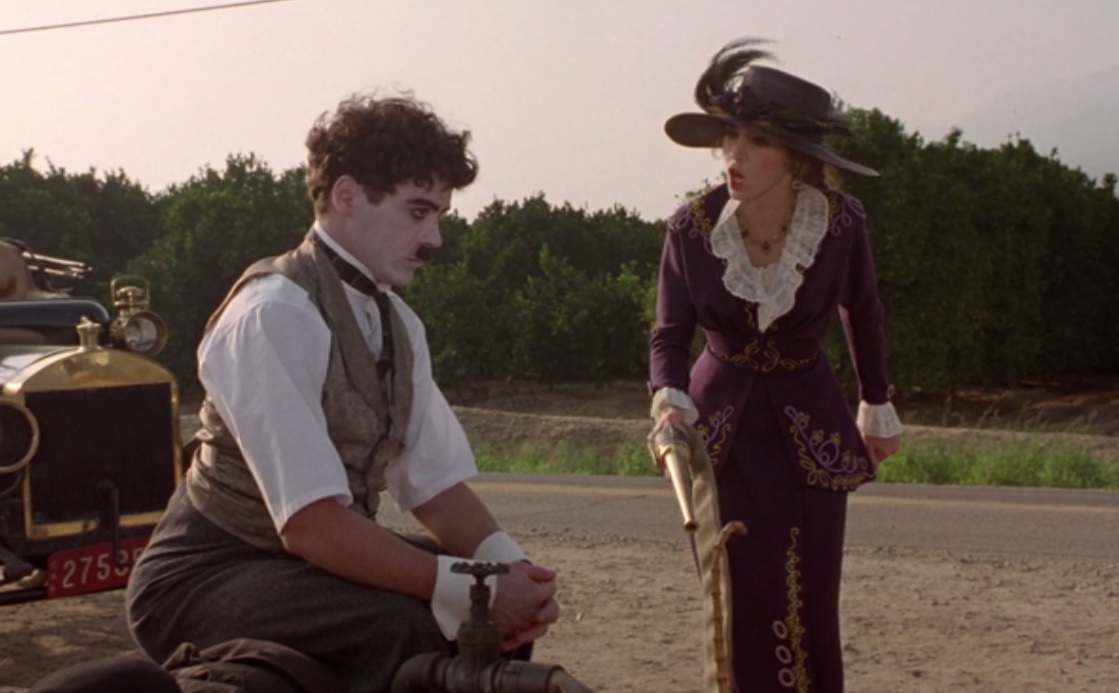
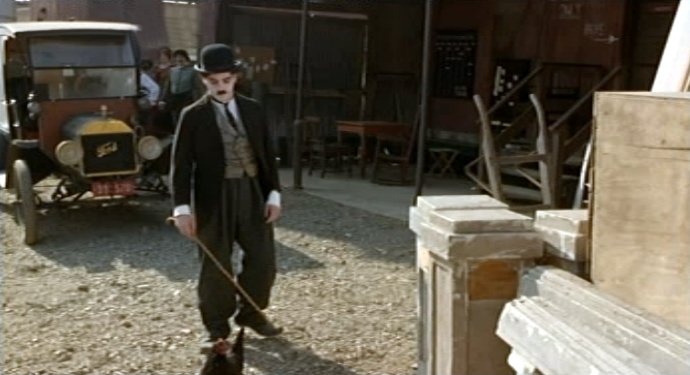
But, every dark cloud has a silver lining. In the case of Chaplin, it is its star, Robert Downey, Jr. Downey was a once-removed member of "The Brat Pack," the coterie of young actors who buzzed through Hollywood in the late 70's and 80's, appearing in ensemble pieces by John Hughes and other directors. Appearances in his father's films, a couple of featured roles and a disastrous stint on "Saturday Night Live" offer no hint of the disciplined, exemplary work he brings to the title role, eerily evoking the lookespecially the smile of Chaplinand, most amazingly, pulling off the physical comedyChaplin's particularly physical comedythe role required. He was honored with his first Oscar nomination (losing to Al Pacino's first Oscar win for Scent of a Woman.), but, after Chaplin, Downey's performances would turn more physical, quick-silvered and nuanced, paving the way for a universal respect for his craft that even an errant personal life couldn't derail. Downey's evocation is the one reason to watch Chaplin, rather than, say, reading about him...or better yet, watching the man's films.
The immigrant looks upon the Promised Land: Robert Downey Jr. as Charlie Chaplin 
looks at a strip of this new medium, film, left on the cutting room floor. 
Of course, the footage is of him.


* Gandhi beat out E.T., the Extra-Terrestrial for Best Picture that year. I understand the Academy's hesitancy to give the statue for an alien combination of Shane and Lassie, but no amount of prestige attached to a project can replace a film's status years after the fact. This one was a mistake. And short-sighted, replacing typical Awards reverence for "prestige," rather than popularity or endurance.