Showing posts with label Melissa Leo. Show all posts

Tuesday, December 24, 2024

Everybody's Fine

Written at the time of the film's release...

"Everybody's Fine. But the Film? N'yeah, Not So Much!
"
 
Widower Frank Goode (Robert De Niro) has a big family reunion planned when all the kids at the last minute cancel. Assuming, as do we, that they're just avoiding seeing "the old man," he packs his bags, his keys and his pills, and buses and trains across the country to drop in, unannounced, on each and every one of them, with a mystery note. He doesn't fly, you see, as he's suffering from pulmonary fibrosis, which he's acquired from his job of weather-coating phone-cable with PCB's. It is the very nature of this movie to let no plot-detail go underutilized in this bubble-world of a movie, so, of course, that becomes important later.

When visiting each kid, he realizes that they're leading somewhat less successful lives than they and his late wife had led him to believe. And he's determined to get everybody back together for a big get-together at Christmas. It sounds like the excellent Christmas "ABC Movie of the Week," "The Gathering," in which a dying Edward Asner attempts to have one last Christmas with all his estranged adult kids before he goes to the Great Gift Return in the Sky. But this is actually based on an Italian film by Cinema Paradiso director Giuseppe Tornatore called Stanno Tutti Bene (or "Everybody's Fine") and de-cultured, simplified, sweetened and topped by an ineffectual Paul McCartney song by Kirk Jones (who made Waking Ned Devine and Nanny McPhee and should know better).
I haven't seen the original (shame on me,
I loved ...Paradiso*), but I know it wasn't as slick and as simple-minded as this version. For example, it hinges on the false premise that nobody ever talks in this family...ever.
The entire movie could have been solved in an hour by
Dr. Phil. Everybody keeps secrets, sure. But usually not very well. How long did these kids think they could keep their charades going, especially with the major life-changes they entail? The machinations that daughter Rosie (Drew Barrymore) has to go through are herculean and more than a little uncredible for what she's hiding, and also speak of a lack of feeling that the rest of her performance belies.
Added to that, the plot device of inflating your importance to your parents has been used in every sit-com ever conceived—but pulling it off on an elaborate movie budget tends to make the concept explode like shrapnel. It's especially frustrating, after seeing a mature film for adults like
Up in the Air to see froth like this, designed for the eye-candy-and-blue-hair crowd, where no opportunity for closure goes unachieved with an unsubtle slam.

The cast in uniformly great, however. De Niro (man, he looks plasticized in that poster—they airbrushed out all his wrinkles to attract a younger crowd?) schlumpfs around the country, asking, ironically, "Are you not talking to ME?" and still manages to find simple, interesting ways to be "a joe." The kids are played by Barrymore,
Kate Beckinsale and Sam Rockwelll
**, who all do fine jobs given the paucity of material, though Rockwell looks particularly frustrated with his role.

Who could blame him? This isn't a film. It's a "project," gussied up with an all-star cast of available talent who have nothing in common other than they wanted to work with De Niro; a constuct that looks good on the surface, but has no underlying thought to it that would make it legitimate in its own right, and plausible as a story. It's
Meet the Fockers done as drama, a collection of parts that don't fit for a coherent film, much less as a representation of real life. Everybody involved should be sentenced to a year of working in theater where they might stumble on some actual characters to play and thoughts to express. Their aspirations are too low, and need to be adjusted.

* That's another thing: there's no way De Niro could have had these three kids without marrying three different wives. Nobody looks like they belong in the same family. It looked good on paper on the Miramax ledger-sheet, I'm sure, but it looks like sham on the screen.

Wednesday, June 26, 2024

The Fighter (2010)

Written at the time of the film's release...

"Put Back What You Use"
or
"I-Yi-Yi-Yi-Yi'm Not Your Stepping-Stone"

The family that preys together, stays together.  For the extended family of boxer Micky Ward (Mark Wahlberg), the preying is mostly internal although they have the illusion that they're getting the best of everybody else.

Micky is the younger brother (step-brother, actually) of Dickie Eklund (Christian Bale), former up-and-coming boxer, who had one glory moment: knocking down Sugar Ray Leonard in a match some years before. Now, he's a part-time trainer for his half-brother and a full-time crack addict. HBO is making a documentary about Dickie, who, despite his years and habits, still thinks he's on the comeback trail. But the pipe keeps him missing training sessions with Micky, leaving the heavy lifting to his trainer (Mickey O'Keefe playing himself). While the boys' lioness of a mother (Melissa Leo) manages Micky and enables Dickie, it leads to some bad decisions on matches for Ward, leaving him battered and disillusioned.
The higher-ups at the sports networks have Ward pegged as a "stepping-stone," the fall-guy they use to advance other fighters in the winning circle to boost ratings, and that reputation follows him around his home-town of Lowell, Massachusettes. Ward's on a downward spiral,
and any outside help is treated with suspicion. "You can't trust that guy. He ain't family." says Dickie, lounging in the limo his brother's money rented, sucking a beer.


Yeah. About that...
Perspective is all in
The Fighter.  And the boxing motif is the perfect setting. Micky is caged by his relations with his family, but every time he tries to strike out on his own, he gets attacked by Mom (playing the suffering card), step-brother hangs back and then takes his licks, and a coven of sisters and half-sisters are a unified greek-chorus of mom-ditto-speak. All you need to make this a match is a soft canvas to fall on, so Micky's a fighter always on the defensive. It's no reason he doesn't say much, but the eyes are far away, looking for a way out, looking for an opportunity to make a move, looking for anything.

"Your fahther looks at my ass, too, but at least he tawks ta me," says Charlene (Amy Adams, while not looking at him), the "bah-girl" Micky keeps staring at. Micky's so down for the count, he thinks even she's out of his league. And she might be, but she keeps showing up in his corner, alarmed at the punishment he's taking. When she questions it, Micky tells her everybody's not concerned. "Who's 'everybody?'" she asks. "My mother, my brother," he replies.

Yeah. About that...
The Fighter
is a mostly true story. Ward is a better, tougher fighter than the movie wants to give credit for (the underdog status makes for a better story, I'm sure, but the dismissive commentary on the soundtrack during the fight sequences is the real thing...taken from the actual broadcasts...Ward was considered an underdog), and Dickie DID do all those things,
but his timing was a bit better in real life. One wants to say that the best character arc in the movie is Dickie's, but that would be falling into the appreciation trap the movie sets up.

Because Micky's is the best character arc, although it seems a very simple Rocky-like success story on the surface. It's the approach that Micky takes with the forces in his life that are tearing each other apart which is the most interesting aspect of the story. Micky has been wronged by his family, but he won't discount their worth, or their place in his life, even over the objections of his new supporters—they have to find a way of dealing with each other and their conflicts, with or without him.
For a fighter to take the stance that he does, reaching compromise with the warring factions in his life—to stand up and take control, risking everything from everybody—is a complete negation to what he does for a living and how he was raised.
*
The acting kudos are going to go to
Bale (who is incredible, not to slight him) and Leo and Adams (who has two great scenes involving an intercom, and throws some nice punches in a chick-fight), but Wahlberg is the champ in this movie, with the tougher part (he trained for this through his last six roles), which he does almost purely physically.
Micky is a man of few words, and not too many moods, but Wahlberg, restrained and less showy, does all of it with body language and does the difficult fight scenes, as well—in the latter taking a lot of body-blows that are not hidden with oblique camera angles or trickery.
Wahlberg has worked with director
David O. Russell before—in fact it was Russell's war pic Three Kings that first showed how good an actor "Markey-Mark" could be. Russell keeps the movie on edge with quick cutting and an improvised feel, even managing to make the final fight scenes nerve-rattling, despite the suspicion that one is going to see a typical boxing picture ending. But, his assurance with good material, performed by such a dedicated cast, manages to keep the movie on its feet, even at the final bell.

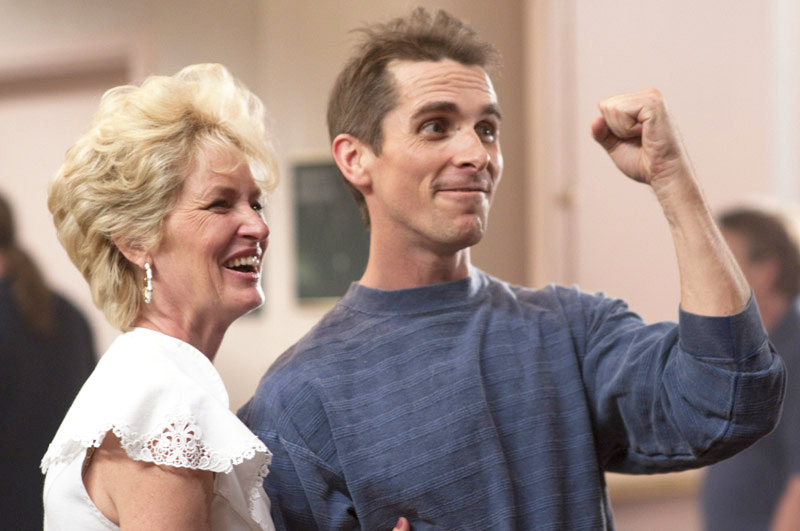
Micky and Dickie at the time of the events of the film

* The real-life Ward did much the same thing, often befriending his opponents, including Arturo Gatti, the fellow he boxed in his last three epic fights, often described as the greatest in the sport.  Ward was a dedicated, fearsome fighter, but admired his opposites in the ring, and their talents.  The two fighters, who put each other in the hospital, continue to be good friends.  I find that amazing...and admirable.

Tuesday, July 13, 2021

Oblivion

Written at the time of the film's release...

Finding Oneself in the Future

or
Scavenging the Sci-Fi Landscape

The new Tom Cruise vehicle Oblivion (written and directed by Joseph Kosinski from his "unpublished" graphic novel* and whose previous film was Tron: Legacy) is a science fiction tale that borrows very liberally from the last 30 years of movie sci-fi to the point where you swear you've seen the movie before. 

You have, but which one depends on the reel of the film you're watching.  

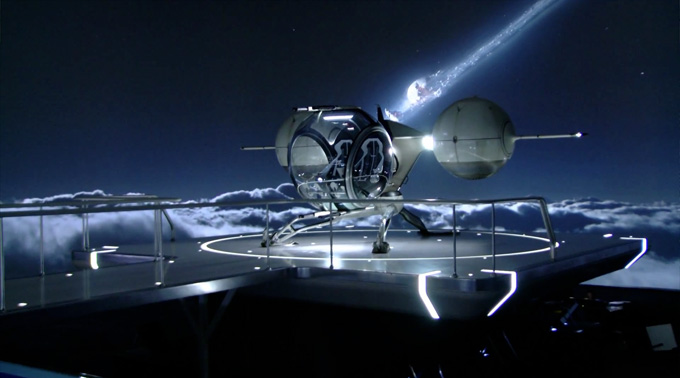
The year is 2077.** Earth has just survived a long, devastating war with an alien race that, in its final act to "poison the well" destroyed Earth's moon, creating dire ecological conditions for the planet, wiping out civilization and leaving its coasts under hundreds of feet of silt from tsunamis and tidal devastation. Folks have moved to the moon Titan, off the rings of Saturn, the last remaining humans being Jack Harper (Cruise) and Vicca (Andrea Riseborough), a mated team of tech-mechanic and monitor whose job it is to keep the giant moisture evaporators running Titanville or wherever and keep them up and running from complications, both natural and unnatural. The natural being wear and tear and the unnatural the last vestiges of the die-hard combatants—Scavengers—who are still trying to tear apart the fragile mining of Earth's resources to defeat the human race. Jack monkey-wrenches and Vicca runs data, all under the watchful work-schedule of Sally (Melissa Leo) who oversees their efforts from a large rectangular control station in orbit around Earth, called the Tet.***
So far, so hum-drum. Yes, there's a lot of background that Cruise has to spew in the first ten minutes, but basically he's playing another working class stiff doing a dirty job in the future.


Jack and Vicca are a happy-in-love working team, awaiting the day when they can get off this rock and join civilization on Titan. Jack, bothered by dreams of the observation deck on the Empire State Building and a smiling beauty (Olga Kurylenko) in the New York crowd, gets in his dragonfly of a jetcraft, repairing busted defender drones, and keeping a wary eye on "scav's."  
Cruise's futuristic mechanic keeps an eye on those moisture-vaporators
That's just the set-up.  Things, as they are wont to do, "get complicated" and to say how would start a cascading spoiler effect that will ruin the movie. I can't even talk about influences without giving away key pieces of information that will kill the "reveals" (even if one does see some of this stuff coming from light-years away), so let's just say that you'll spend the same amount of time playing "name that reference" in post-screening mode, as you do actually watching the movie. (Would one call that deja-viewing?  And shouldn't a science fiction movie be looking forward, rather than backwards?****
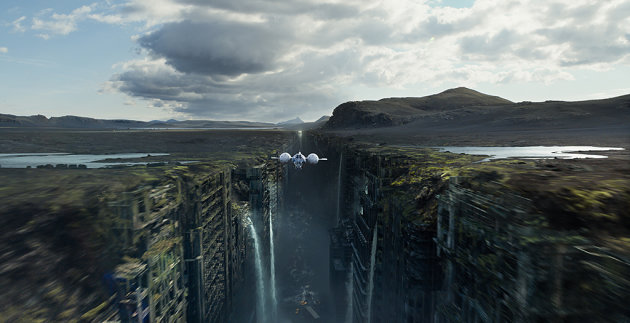
One key sequence echoes Planet of the Apes. Jack's patrol sector is the former northeast coast of the U.S. (and we get a respectful nod at the decimated Statue of Liberty), but only that section, as there's a radioactive "border" he can't cross. He is told at one point to go explore beyond his limitations and into the radiation zone if he wants answers. One could easily hear Dr. Zaius echo the words "You won't like what you find..." in the background. This leads to the biggest revelation of the film, but, instead of answers, it just leads to more questions, which the film goes into warp-drive trying to explain, not very successfully, as plot-holes and logic disconnects begin to eat away at the movie like nano-viruses.
And science-fiction movies usually have a message for us livers-in-the-now, either cautionary or revelatory.  Oblivion fails there by having as its message that we are replaceable cogs in the wheel of society's meat-grinder. That message was delivered by Fritz Lang's Metropolis way back in the silent era of movies in 1927. Here we are in the 21st Century (when we should all be wearing jet-packs) and that's all we get...besides the obligatory shoot-outs and chase sequences? If there's a message there it's along the lines of "Take out the recycling."

*—"well, then, it doesn't really count, does it?"—

** The film is extraordinarily exposition-heavy in the beginning in a long narration spoken by Cruise.  So much so, that one wonders why they didn't just make a movie of the events spoken of in the exposition. The reason why makes up the plot of the movie and reveals the Cruise character to be the most unreliable of narrators.

*** Amusingly, the first sign we get of the orbiting Tet is a glimpse of it, traversing the globe on the new logo for Universal Studios at the film's beginning.

**** And, appropriately, into the future. One of the previews preceding Oblivion is for Elysium, the new film by District 9's Neil Blomkamp, where the 1%ers have moved to an idyllic space station, while the rest including cyborg-ish freedom fighter Matt Damon robo-cops attitude against the machinery of the uber-klass. The two movies could be book-ends for each other.  Think of the double-bill (and the headline): "Oblivion /Elysium/ Expatriatic/ Tedium"

Friday, February 19, 2021

Flight

Written at the time of the film's touch-down...
 
Flying Inverted
or
Cracking the Whip


It's been years since Robert Zemeckis made a live-action film (the last being Cast Away, all the way back in 2000, the time being taken up with his three motion capture animated films) and this one, Flight, is an interesting choice, quite unlike anything the director has done, but falling in line with his other films about people being left up in the air about fundamental choices in their lives.  

Captain Whip Whittaker (Denzel Washington) is a pilot on cruise-control. Unfortunately, it's a path that will ultimately crash and burn. An alcoholic and coke-head, he'll do a layover with a stew (in this instance, Nadine Velazquez), get wasted, and then to get himself #1 on the runway will do a line, so he can do the "pilot walk" to the cabin—all confidence and casualness for the launching of "souls" into the wild-blue yonder.

Even before he takes off, Whip is flying. But his nonchalance and bon homie gets him through, even through a difficult take-off through low turbulence. He pushes the plane, but clears the clouds early and restores order to the flight, then settles back to cadge some booze samples, smuggle them into his orange juice and catch some sleep. He wakes up just in time for a crisis: the plane bangs, then goes into a steep dive that terrifies the passengers and crew (and me) and merely gives Whip a much needed shot of adrenaline. The only way he can take the plane from pile-driving into the ground is to bank it until he's flying upside down, then skimming the Earth until he can find a clear place to land, then cork-screw right side up and ditching for a landing.
Six people die, two on the crew.  Whittaker wakes up in the hospital with torn ligaments in his knees, lacerations around his eye and no idea how he got there.  First visitor is the pilot's union rep (Bruce Greenwood), then the NTSB who are all "just the facts" and deferential. Next is Whip's "connection" (John Goodman), a Dr. Feelgood who waltzes in (to the tune of the Stones' "Sympathy for the Devil;" Whip's is "Feelin' Alright"), tells Whip he's a hero, that reporters are hunting him, and criticizes the doctors' choice in pain-killers: "Amateur night!" All Whip can think about is getting out, but it's not as simple as that. He's under investigation for the crash (his simple response is "it was a broken plane"), has been lawyered up with an attorney (Don Cheadle) who doesn't like him, thinks he's a creep, but is going to do his job, and on top of it all, Whittaker must deal with a pissed-off ex-wife and a son who doesn't know him, and has no intentions to.
In the hospital, he meets Nicole (Kelly Reilly, you'll remember her as Dr. Watson's wife in the Robert Downey, Jr. Sherlock Holmes movies), who's recovering from an overdose and not in a good way.  Whip is attracted—she's female and weak, which seem to be all that's required—and he whisks her away to his family's small farm and failed crop-dusting business in rural Georgia.  He's already ditched all the alcohol, but after a couple days, he's back in the bag, drinking himself into oblivion while Nicole goes to AA meetings.  Whip visits, too, but when things get personal, he takes off.
Washington is brilliant in all of this, showing both the pilot's strengths and pitiful weaknesses. His scenes of bleary drunkenness feel real and incomprehensible, and one watches his constant crashing after attempts to bring himself up are painful to watch. The balance of the film is Whip's cart-wheeling from sober to sloshed, his best instincts superseded by his addictions—a man in constant denial, addicted to lying (and pulling himself out of a crisis) and risk-taking as much as to the hooch. It's a rough ride to be a part of and even observe, Whittaker constantly pulling himself out of his dives, then going into another tailspin, and you just know the only time he'll level off is when he crashes.  The parallels between flight and addiction are obvious (how far can you push yourself before everything breaks and if you survive, how much further can you push?) and audiences who gripe about all the action being in the first 20 minutes, may not realize that they're watching a parallel course throughout the rest of the movie, only far more personal, and maybe (hopefully) not as relatable.  
It is a tough, emotional roller-coaster to be a part of, but everything is of a piece. At one point, Cheadle's lawyer puts it succinctly: "Death demands responsibility," and responsibility is one thing Whittaker has never known. The old Irwin Allen disaster movie posters used to scream "Who Will Survive?" The same applies here, even if the audience-grabbing disaster only occurs at the beginning, and we white-knuckle it to see who'll surface from the rubble. This is a smart, troubling, painful movie to watch. But, you can't turn away, either in horror or fascination.

Whip Whittaker's sobering flight is just the first leg on the itinerary.

Saturday, October 3, 2020

Red State

Oh, look, it's October. "Guess I should be paying attention to horror films."

Written at the time of the film's release. Saturday is "Take Out the Trash" Day.

Red State (Kevin Smith, 2011) You could actually call this an indie cult film, independently financed with an auction to distribute at Sundance (which Smith harpooned to distribute himself), only running in major markets to qualify for unlikely Oscar nominations (Michael Parks, maybe; John Goodman, possibly but not likely), then quietly announced "special showings" throughout the country, presumably because the subject matter—about a homicidal religious cult, making the "cult film" literal—is so "hot" that moving, circus-like, from town to town for a limited time will discourage the "crazies" (of whatever stripe) from making the scene, making A Scene and picketing theaters.*

Needn't have bothered, really. Any media coverage would have actually helped this film, even if it doesn't really deserve it. It's Smith stepping out of his comfort zone (and just about everybody's) making a horror film about a religious cult that attracts lustful men on a web-site, doping them, and killing them for their homosexual tendencies that are targeting America (and the world—cited examples being African AIDS, Thailand tsunamis, and Sin City hurricanes) for rapturous Armageddon.
Forget the fact that these guys are hetero's looking to score, but, now you're getting all logical on us.

The Five Points Trinity Church, led by Abin Cooper (Michael Parks, doing the Smith-riffing like it was exploding out of his head and having fine, venal fun with it) is so bent on destruction and self-destruction there's no reasoning with them or the cache of automatic weapons kept in a vast catacomb-like basement, required for your "gotta-have-'em" horror film chases. They're all wild-eyed zealots, none more creepy than daughter Sarah (last year's Oscar winner Melissa Leo, going a bit over-the-top), who's the boy-bait for the serial-sacrifices.
An evening's services (with communal execution) goes a bit south, and when a deputy is killed (oops), the ATF is called out in the reduced form of Joe Keenan (Goodman, who's lost a lot of weight) and ASAC Brooks (Kevin Pollak, a natural to be in a Smith movie, I think), who roll their eyes with memories of Waco backlash in mind. They don't want to be there. They know there will be no negotiation, the best they can do is keep the carnage down, which is not what the Church is interested in (nor, frankly, is the audience). And as interesting as a dialogue-crazy Smith directed hostage-negotiation might be, this is designed for horror audiences, so things go to hell quickly.
So, there's enough real-world identification with David Koresh and Fred Phelps** for Smith to get on his soap-box (and he does with a particularly annoying teacher character at the beginning of the film, who would no doubt lose her job for saying what she does in the film), but he's a little restrained in the wise-ass department here (other than coming up with the idea in the first place and he doesn't mention Star Wars once). He takes his template from Night of the Living Dead with the church members as both zombies AND barricaded potential victims, with a cascading story-line that starts with predators turning into victims, and their persecutors in turn turning into victims.***

Shooting on the pure-video Red camera system (maybe that's where title comes from?), the film can go just about anywhere and attach itself to anything on the run, which Smith, who also edited, hacks and slashes to cut out the transitional fat and keep the film moving unpretentiously fast. Should have cut a little faster and a bit more, as Smith uses the low-dig' horror format to make up for his short-comings as a shot-planner, but still keeps "the precious words" of his script intact. Too bad. There's a few things that could have easily gone in the out-takes bin that were redundant or not helpful. And then, just when things start turning really interesting, Smith pulls the rug out on the film, never venturing past its "potential." But it seems to me if you're going to be a barn-burner, you might as well burn it to the ground, rather than having the bucket-brigade near by to douse it half-way through.
Which is sad to me. Smith's career as the slacker's "geek-fantasy-movie-maker" still suffers from the poor execution of good ideas. A not terribly good film-maker, he still has potential as a superb script-writer. Problem is, he fancies himself a troubadour, a singer-songwriter, even though he can't carry a tune. Another director might be able to take a Smith script and hone it, polish it, and adjust it, so there are no slow spots, has a good sense of pace, and some actual composition to the frame, all things that Smith seems incapable of doing. He has a filmmaker's brio, but no taste and no judgement (especially where his own work is concerned).

His best film is the early-in-the-going Chasing Amy, but sadly, like Silent Bob and the protagonist in that film he's been incapable of doing anything better, in effect, ever since he's been chasing Chasing Amy. Still, if Billy Wilder's counter-maxim of "You're only as good as your BEST film, not your last" is to be embraced, so, too, is the career of Kevin Smith, just so we can have that one film added to the library of great films.

* Actually, Smith, whose humor has never kept him out of a fight (he joined a Catholic protest picket of his own film, Dogma) showed it to the daughter of Fred Phelps' daughter when he took it to Kansas City. Phelps brought her under-age kids, and Smith warned her that the film was "R"-rated and pretty raw. Didn't matter. But, predictably, she walked out 20 minutes in, saying the film was "filth." Um, yeah, wasn't that what Smith was saying?

** The Waco references are for the Koresh family, which was merely Messiah-based and collected weapons like lost souls with triggers, but Phelps (which is composed—if one can use that term—largely by members of his family, and is mentioned in the film, so no one can say that they're being directly targeted), the guy who protests at funerals for slain American soldiers, is so extreme—and media-whorish—that Jerry Falwell called him outright "a first class nut," and the Ku Klux Klan has participated in counter-pickets, declaring Phelps' church "hatemongers." And you know how much the KKK hates that!

*** Smith's original idea would have taken the idea even further to a Higher Plain, that actually would have been pretty neat to see.  But, it would have required expensive special effects for a film done on a shoe-string (the entire effects budget was $5k). And it gives Smith a chance to have that all important tag that wraps up his film in one good line: "People just do the strangest things when they believe they're entitled. But they do even stranger things when they just plain believe."

Thursday, October 20, 2016

Heroes and Villains, Part 2: Snowden

"When one is young it seems so very easy to distinguish between right and wrong. But as one gets older it becomes more difficult, the villains and the heroes get all mixed up." 
 Rene Mathis, Quantum of Solace 

The wisdom of the mob plays tricks with reality. You see it a lot, especially as age gives you longevity and experience. You remember incidents that time glosses over in pertinent detail. On the other hand, the demands of the "24 hour news cycle" creates an urgency for happenstance when the "tube" needs to be filled, often with speculation and mis-information that gets refuted later with the clarity of time. Information and time yin and yang separating truth from fiction—but not everybody gets the message. And depending on when the hearing happens, people tend to hear something and believe it, even if it gets refuted. People believe what it is easier to believe...or merely what they want, never mind the facts.

Over the next couple of days, recent movies about individuals who are judged by single acts, and whether they are heroes or villains, depends on your point of view in the audience.

Epic Shelter
or
...a Very Frustrating Individual

It's always difficult to say that an Oliver Stone film is "based on a true story." Every subject he makes a film about goes through "The Stone Filter," injecting his views, his "Daddy issues," his prejudices, whether they're called for or not. It's tough to separate the man from his movies, like Howard Hawks or John Ford (but even those film veterans changed over time). Stone is stuck in his mind-set and screenplay-template, and he will tailor the facts to meet his own expectations. Film-makers do this all the time, compressing characters into one, juggling time, and even inventing incidents and people to help drive home a dramatic point. But Stone is egregious about it and unapologetic. He is an auteur, and so, rather than serve the story or the material, he serves himself. And so, his films, be they fiction or non-fiction, biography or fantasy, whatever genre they're in, feel much the same.

Snowden, his latest, follows the same pattern,* showing the transformation of the young tech-savvy, politically-conservative** veteran (played by Joseph Gordon-Levitt) to eventual whistle-blower, after serving time in the military to timing servers in the CIA, working on intricate hacking scenarios and data collection, but running afoul of inter-agency politics and becoming paranoid and disenchanted with the breadth and depth of intelligence gathering and interpretation.
Stone starts the film in Tokyo, where Snowden has flown from his job in Hawaii after smuggling NSA files using a rigged Rubick's cube (wonder how high that is on the TSA lists these days). Snowden is in limbo. He's taken files, but that activity has not yet been discovered, and that won't happen until the contents have been published. To accomplish this, he needs documentation and verification. He meets documentary film-maker Laura Poitras (Melissa Leo), who will eventually make the film Citizenfour and Guardian reporter Glenn Greenwald (Zachary Quinto). Once they're informed, it's a race against time. He'll be tracked, investigated and hunted. There will be no room for error.

In the down-time waiting for confirmations before transmitting the files, he goes into his back-story negotiating his military service, discharge for injuries, his entree into the CIA. Why any of this back-story involves meeting his eventual girlfriend (Shailene Woodley), it's tough to say, but I'm sure it serves some journalistic function and might demonstrate some level of sacrifice for going into hiding. 

During the course of the story, we meet some influences: Professor Hank Forrester (Nicolas Cage), who, himself, has worked in the intelligence community and found the experience dispiriting and demoralizing. At the CIA, he meets another mentor, Corbin O'Brian  (Rhys Ifans, a wonderfully creepy performance without much effort), who, impressed with Snowden's skills, champions his course through intelligence. For Stone's by-the-book story-telling, the protagonist must choose between two opposed father-figures, each serving a role as angel or devil on the protagonist's shoulders. Lately, Stone has gotten subtler in his dependence on the "Daddy" trope—he even managed to undersell the huge one in W. But, in his early films, like Platoon and Wall Street, those conflicts form the very basis of the films. In such scenario's, you need to have the conflicting world-views in order for the guy in the middle to reach his own path, and Stone returns to the formula to tell Snowden's story. It isn't enough that he's frightened by the cavalier way his fellow intel-minders collect data. Any back-door, any un-shaded camera, anything can give them access into people's private lives. Snowden goes from disenchanted to paranoid, beginning to cover his laptop's camera aperture with tape, questioning motivations for the details, while also beginning to question "The Big Picture."
The special effects crew get their cameo's.
Pretty soon, he begins to magically morph with Stone's world-view: the intel-gathering is not, as it's portrayed, "to fight the terrorists," it's to protect "the Military-Industrial Complex," Stone's multi-tentacled monster (not that he's wrong, particularly, it's just that everything in his "non-fiction" films usually circle around to involving the preservation of the MIC as a conspiracy and underlying motivation for almost everything). He does pound on it as much as he has previously, but the man can't make a movie without a mention of it.
Back in Tokyo, the trio are joined by The Guardian's Ewen McAskill (Tom Wilkinson) and the four send the data to The Guardian's offices, where the managing editor (Joely Richardson) is being ultra-careful in deciding to publish. Greenwald finally loses it under the pressure and threatens other avenues of dissemination, post-scripted with a mention of The Guardian's reluctance. They get assurance that it will be published at a certain time and plans are made to book Snowden out of the hotel and to the next "undisclosed location."
"My name's O'Brien...oh, sorry...it's spelled O'Brian....what year is this?"
Stone bounces back and forth in time-lines using casual conversation as a segue, some of which works, some of which is merely contrivance, and he hauls out some special effects to represent "Internet-land," probably for those who can't grasp the concept of connectivity—which might approach absolute zero. He touches on Snowden's health issues perfunctorily, dabbles with "the girlfriend" issue, but, mostly, it seems  the warring fathers aspect is what he's concentrating on, expanding the two characters' importance beyond what they would appear...for two characters that are actually fictional. Just what part of this movie are we supposed to believe? And if we're being led down the Stone path, it would be nice to believe in something. The Tokyo sequences recall Citizenfour and the flashbacks could all be fever-dream or epilepsy-haze, but we're not given any indication that it might be anything less than rock-solid reality. 
Dramatization
So...hero or villain? Stone provides no perspective other than his own. Oh, there's a moment of negativity, but it's mostly from topical higher-up's like Clinton and Trump ("...they used to execute people like this...")—in other words, no perspective. And one's opinions will be informed by whatever political leanings one might have—whether they see Snowden as a hero for exposing domestic surveillance among cell-carriers*** or a villain for showing how extensive the data collection techniques are (in which case you might think him a hero for having something to do with hacking the DNC). The choice is in ourselves...and, like most controversial figures, he is judged for that one act in a lifetime (in much the same way as the protagonist of Sully). 
Reality


* Stone was reportedly reluctant to take on another contemporary subject, wanting to make a film about Martin Luther King. He took the project on after the King movie fell behind and after meeting with Snowden in Moscow.

** Just HOW conservative Snowden is/was, Stone keeps a little nebulous. During his first date with his soon-to-be girlfriend, she makes a crack about the government under Bush, and Stone has him say "I just don't like people bashing our government." Okay. It fits the "Stone Filter" that Snowden have a hero's journey from one extreme to another, ala Born on the Fourth of July, or JFK, while keeping an idealism that fuels both ends of the spectrum. 

*** I've always loved Steven Colbert's analysis: "Of course, they're checking personal phone records looking for terrorists. If you've ever called Verizon Wireless for customer service, pretty soon you're GOING to become a terrorist!"