Showing posts with label Pedro Pascal. Show all posts

Thursday, October 3, 2024

The Wild Robot

"If I Could Talk to the Animals"
or
"What Do You See When You Look at Him?" 
"Crushing Responsibility"
 
Watching movies is always subjective. Your favorite movie may be someone else's bane (I don't plan or participate in "Movie Nights"). And one becomes selective. I'm particularly selective when it comes to animated features—I grew up watching Disney and Looney Tunes (the best!) and the output of Hanna-Barbera (limited animation and derivative plots), but also recognized those elements that were excellent where others left a lot to be desired—the Jay Ward output had really limited animation but the writing was clever and often brilliant). 

I'll hold off watching the Troll movies, or the Sing! movies or anything else that looks like it might push my negative buttons (the one that goes "Eject" for example) because I'm older in years and I'm at the point where I don't want to waste the fleeting hours I have left to me.*
 
So, yeah, I'm picky, as are you. I will not MISS a new Pixar Studios release and SEE it in a theater—I don't care how big your flat-screen is, it can't do justice to Coco—and I will usually see a new Disney feature because the early Pixar brain-trust is involved with those. With everything else, I'm choosy.
The Wild Robot was an easy "go". Based on Peter Brown's children's book, it tells the story of a utility robot, a model of the Rozzum series (this one's #7134 and voiced by Lupita Nyong'o, who is both precise and subtle), who, after a freighter capsizes in a typhoon, is washed up on an uninhabited island, more or less intact, and switched on accidentally by curious otters and proceeds to perform its duties—which is to help, solve a problem, and complete a task. Simple. Like a robot! But a robot in a forest does not compute. It's digital and everything on the island is so...organic! The animal-life is scared of this chrome trespasser and they just want to run and hide, despite the Rozzum's constant inquiries "Do you need...assistance?"
But, if there's anything about the Rozzum, is that it can learn—emulating a crab climbing a cliff saved it from being smashed by a large wave—and so, it sits and goes into "Learning Mode" until it is able to decipher the squeaks and grunts and chirps the animals make and understand it as communication tools, and the first thing they ask is "Are you here to kill us?" "Negative," it replies, but seeing the futility of trying to help these animals, Rozz decides to activate its homing retrieval beacon, but it attacked by the bear, Thorn (
Mark Hamill), who breaks it. No retrieval, no "phone home."
Speaking of breaking, Rozzum's initial clumsiness leads to disasters several minor instances and one major familial one. It falls into a nest, destroying the family, with the exception of one egg. As the rest of the family is beyond repair, "Roz" takes the one egg and, seeing as there's a life-form inside, decides to keep it safe—a herculean task as there's a hungry fox named Fink (
Pedro Pascal), who just happens to be peckish for an omelette. After the two come to a self-beneficial truce, Fink, in his own conniving way, helps Rozzum to understand what it is she is protecting, and once the egg has hatched a gosling—that imprints itself on Roz—instructs Roz on what goslings (and some foxes) can eat.
Now, there's already a lot of story there, and this Wild Robot is made up of a lot of recycled material: the "fish-out-of-water" trope, the Chuck Jones cartoon "8-Ball Bunny" ("Oooo! I'm dyyyyyin'!"), E.T.:the Extra-terrestrial, Wall•E, Noah's Ark—that will come later—and several other bits and pieces snatched from other media and cultures. But, there's another one that it takes a final page from and that's Bambi—like that movie, The Wild Robot acknowledges death and that "nature is red in tooth and claw." There is a pecking order on this little island and the small things get eaten by larger things and there is the risk that a character you might like won't last too long.
This makes the care of the newly-hatched gosling—Rozzum labels it "Brightbill" (played by
Boone Storm and Kit Connor, at different stages of development)—that much more imperative. Roz has no idea how to raise a gosling and complete the task, so Fink suggests a neighbor opossum named Pinktail (Catherine O'Hara), who has plenty of off-spring, thank you, for some mothering advice. This comes down to three skill-sets: keeping the gosling fed, teaching it how to swim, and teaching it how to fly before the geese on the island make their winter migration off the island.
Food's not a problem, Fink is good at finding food—especially food that Brightbill can't eat (so, more for Fink) and Roz builds a shelter out of stones to make an enclosure to ensure its charge's safety. Teaching it to swim and teaching it to fly are other matters in terms of complexity. Oh, Roz can pull up facts on buoyancy rates and aerodynamics, but it's not the same. This little runt is going to need some extra-mentoring if it is ever going to leave the nest that Roz has constructed.
All this with the added story-rule that there are predators and there are prey and Brightbill is a tasty little morsel of a nugget. And as one gets to meet other creatures, like 
Matt Berry's grumpy beaver, Ving Rhames' falcon, or Bill Nighy's old goose, you realize that not every living thing on the island gets along. As someone says in Nature, "kindness is not a survival skill." All Roz wants to do is complete the task, as is its protocol. But, motherhood is just not in the programming.
So, there's a lot of basics familiar from other sources, but, the trick is trying to do it better and make it unique despite the provenance. That is something The Wild Robot does very well, taking the story places that the others hadn't and giving you fresh insights, while also charming the heck out of you. That seems to be the Dreamworks Animation trick—taking familiar things but making them seem bright and shiny again. They do that in the story...and in the artistic side of things, as well.
Where the Pixar pixelators seem to have the goal of making things look as photo-realistic as possible, Dreamworks goes another direction. I noticed it with their Puss-in-Boots: The Last Wish, a push against the reality of things and, instead, making things more impressionistic. It might be that it helps reduce the render-time of complicated images, but one can safely say that the complexity of images isn't sacrificed—there's a scene with a tree that explodes into a kaleidoscope of butterflies that is simply breath-taking to behold. The result, especially in the animation, is to give it a story-telling schmere that only increases the wonderment of what you're watching.
That is some amazing creativity on display, and between that and the directions that the story takes (and despite a jolting action-oriented third act), The Wild Robot is one of those great animation products that deserve to be considered a classic, going beyond its programming to become something very special.
 
It's the easiest "go/no go" decision you could make at the movies this year.

* I just finished reading "Opposable Thumbs," a not-bad book by Matt Singer about the history of "Siskel & Ebert at the Movies" in all its incarnations, and as much as those guys LOVED movies and LOVED reviewing movies, they got to a point where they said "if you think the movie's garbage, get up and leave! Life is too short and too precious to waste."

Wednesday, February 28, 2024

Drive-Away Dolls

"Personal Effects"
or
"We Didn't Deserve...this Commodification."

It's been a few years since the Coen Brothers, Joel and Ethan, made a film—the last one was the western anthology The Ballad of Buster Scruggs (and Other Tales of the Western Frontier) back in 2018. That was for Netflix, and one wondered if they were tired of the business grind of securing funding and distribution deals developing theater-ready product. Buster Scruggs was episodic and eclectic, and it felt a bit like the Coen Brothers' version of The White Album, showing their strengths, but also their divisions, which seemed invisible in their one movie-one story efforts. 
 
The Wisdom of the Tribe (although one hates to credit any Entertainment Press with "wisdom") had always been that Ethan wrote and Joel directed, but the two contributed to each others' jobs so much that there was no clear demarcation line about who did what. They even shared editing duties (using the name "Roderick Jaynes" as a mutual nom de tranche).

So, it was a bit sad to hear that they were going to have a trial separation; one doesn't take this talk too seriously—how many times has Soderbergh quit and how many "last films" has Quentin Tarantino made? But, it seemed like the Coens meant it. Joel made a stark version of The Tragedy of MacBeth--that emphasized stagey minimal sets and maximum shadows, the better to appreciate the performances, especially of Denzel Washington and his wife, Frances McDormand. For his part, Ethan Coen hunkered down with his wife Tricia Cooke to produce a documentary, Jerry Lee Lewis: Trouble in Mind.* Now, they've made a film of a script the two had been writing since 1999, Ethan directing and Tricia editing.
Drive-Away Dolls—or as its titled in the movie, Henry James' Drive-Away Dykes—is basically, a road movie with serio-comic violence. It tells the tale of a Mutt-and-Jeff lesbian duo—uptight, repressed Marian (Geraldine Viswanathan) and free-spirit Jamie (Margaret Qualley)—who take a break from their normal lives and relationship break-ups and the up-coming turn of the millennium ("Y Not 2k?") to go birding in Tallahassee. That's the original idea, although Jamie road-maps it out to visit every dyke bar en route. Then, there's the mode of transportation: they use a drive-away service, which gives them a car for a one-way trip as long as they deliver it to the destination on time.
Sounds great. But, the guy at the service gives them the wrong car. After they drive off, "Chief" (Colman Domingo) shows up with two goons, Arliss (Joey Slotnick) and Flint (C.J. Wilson) looking for it, and upon hearing that it's gone telephones his boss for instructions. Those turn out to be "beat up the service guy and find those girls," which would be easy if Jamie hadn't mapped out such a circuitous route from Philadelphia to Florida. So, while Arliss and Flint begin investigating several wild goose chases (and coming out the worse for it), Jamie and Marian take their meandering time and, inevitably, don't show up at the agreed-drop-off point on-time.
Perhaps if they knew what was in the trunk of the car they're driving they'd be a little more responsible (well, Marian, anyway), but a blow-out along the way forces them to look for a spare and what do they find?
Well, I ain't sayin' (so no spoilers here), but it's a member in the long line of McGuffins and Whats-its in movies from Kiss Me Deadly, Repo Man and Pulp Fiction (well, the last two filching it directly from Kiss Me Deadly) and we've already seen one guy (
Pedro Pascal) get killed for it in a prologue at the beginning of the film. And it's what Arliss and Flint and Chief and the guy on the other end of the phone are after and they'll do anything to get it back. Thus, intrigue, threat of danger, and mystery.
But, really, not really. Just from my description you can tell that Drive-Away Dolls hallmarks quite a few Coen Brothers traits—the contrasty duos (but without Steve Buscemi, this time!), the ginned-up danger, the what's-it-all-mean empty space that's supposed to be wrapped up tidily at the end. Except for the lesbian angle, it's a little bit rote, and more-than-a-bit familiar while still striving be be out-RAGE-ous...think along the lines of past Coens like Burn After Reading or Intolerable Cruelty, or even The Ladykillers, where there's something about it that just doesn't gel, although you know they're throwing everything but Joel's kitchen sink at it.
And that may be the issue. There's a formality to Joel Coen's direction that just isn't here—a rigor amidst the dishevelment—that cements things into a cohesive package that feels of a piece. Brother Ethan just ratchets up the lampoonery as if he was trying to goose the material with false energy. Compound it with Cooke's editing whimsy with some graphic transitions that are a bit too Tarantino-cute on top of it all. It doesn't pay off. And there's maybe a couple flash-backs too many, although the out-of-left-field psychedelic sequences (with cameos by Miley Cyrus) associated with the contraband aluminum suitcase ultimately seem more essential the more one thinks about it.
It sure tries hard (and the actors, which also include 
Beanie Feldstein and Matt Damon, give above and beyond, with Qualley and Viswanathan the stand-outs as the fast-talking and the dead-panning hub around which everyone revolves) but Drive-Away Dolls, even with its pedal to the metal, never quite achieves the anarchic spirit it so desperately wants to convey.
The word is that the Brothers are re-uniting to make a horror movie. I get shivers just thinking about it.

* I've seen it, but won't write about it much. It consists of archival footage of Lewis performances and interviews, edited by Cooke in a fairly tight summation of his life and career. But, interestingly, it has little editorial point of view, other to note at the end that Lewis lived longer than his musical  peers, two of his kids, and a couple of his seven ex-wives...and that, he was a self-taught piano player...even re-teaching himself after a 2019 stroke. Amazing, given his instinctual, visceral keyboarding.

Wednesday, September 13, 2023

The Adjustment Bureau

"I Guess The Lord Must Be in New York City"
or
"Dicking Around with People's Lives..."

The stories of Philip K. Dick have provided all sorts of story-fodder for the movies for both good or ill: Blade Runner, Total Recall, Minority Report, Paycheck, A Scanner Darkly, Next, and Impostor.
 
They feature the sort of high-concept story-spine that easily translates into genre-bending sci-fi/fantasy films that are the easiest thing to translate to the screen short of a superhero property. Just put a slight spin on a story concept—a police force that stops crimes before they happen, spies and detectives who are mentally undercover, a guy who can see into the future, but just eight minutes out—all odd concepts that illuminate the character dilemma in a way that a straight story might not highlight. You don't have to be a genius to "get" what the movie says. And the inevitable SFX look great on trailers.
So, here's
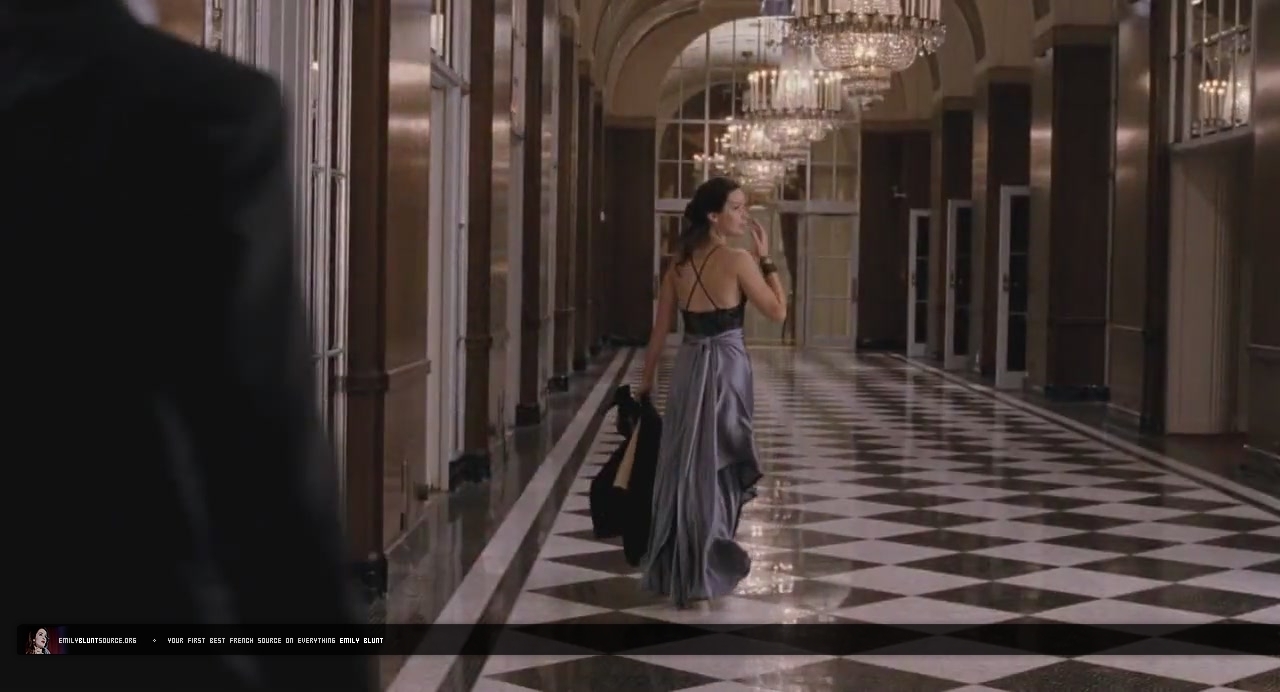
The Adjustment Bureau, a paranoid conspiracist's validation of all things manipulated. Young senatorial candidate David Norris (Matt Damon) is about to lose an election big-time, due to some ill-considered party-decisions earlier in his life. In the men's room of the Waldorf, he practices his contrite, yet defiant acceptance speech, only to find that he is being overheard by Elise Sellas (Emily Blunt), who is evading hotel security after crashing a wedding upstairs.  It's a "meet-cute" as the two banter about Norris' loser-status and Elise becomes intrigued enough to plant a lip-lock on him. His campaign manager (the always welcome Michael Kelly) walks in just in time to catch this and bust it up to get Norris to the ballroom to admit defeat. I'd've fired him on the spot.

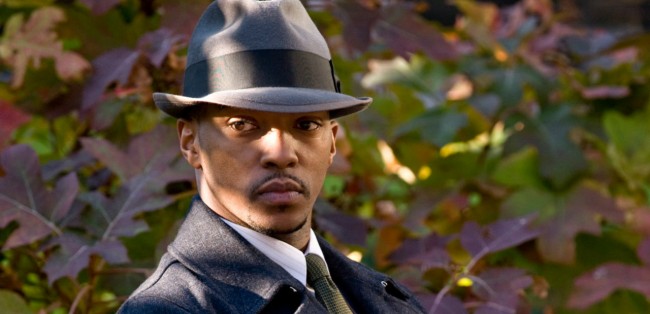
It's some time later and Norris is working for an investment capital firm with his manager. He's running a little late, so he doesn't notice a team of angular men in business suits and fedoras are shadowing him. One in particular—Harry (Anthony Mackie)—has an assignment: Norris must spill coffee on his shirt by 9:05 am, not any later. It's his job, says Agent Richardson (John Slattery), so don't screw it up. 

But, if he didn't, there wouldn't be a movie.
There's no use crying over un-spilled coffee, but as a result, the rest of the movie is the Team attempting to solve the mess the non-mess creates: Norris is able to catch his bus on-time,
where he once again encounters Elise, and gets to work just in time to see the Pre-Destinators (my term) sweeping the office, the personnel frozen, and key players receiving a "mind-wipe." Norris catches on quickly, and tries to evade the invaders, only to find them around every office corner, calmly telling him that, really, he should take it easy and cooperate and "this" will all go a lot easier.

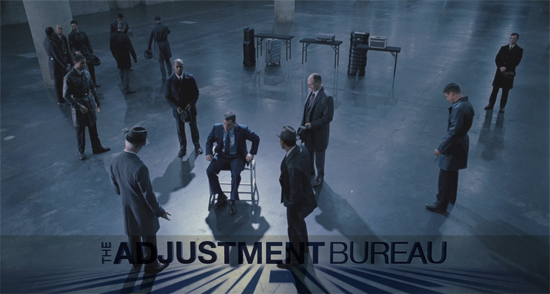
He wakes up in an empty warehouse
, with his pursuers deigning to tell him the truth about things: "You've just seen behind the curtain you never knew existed."  They're a team of agents who manipulate events among humankind—a kind of Uber-illuminati ('"sometimes it's chance, sometimes it's us
")—at the behest of "The Chairman." They lay down the law: He can't have a relationship with Elise, which David objects to ("Your entire world just changed and you're thinking about a woman?") as it's not in "the plan," and if he tells anybody about what he's seen, they'll make everyone think he's crazy, and "reset" him, leaving him basically lobotomized.
* 
Norris is too much a free-thinker
to obey the "button-down men of Fate" and the rest of the movie entails him "changing the curtains," as it were. It's very clever and director George Nolfi, (who wrote the screenplay for the similarly time-trippy Timeline, had fun adapting his screenplay "Honor Among Thieves" into what would become Ocean's Twelve, and was one of the team who wrote—and re-wrote—The Bourne Ultimatum) ingeniously keeps things moving at a good clip, while also staying one jump ahead of the story-complications inherent in the plot...while also doing enough cinematic sleight-of-hand to keep the Doubting Thomases in the audience from falling into plot-holes. He gets good performances out of everyone—allowing enough ad-libbing in the scenario to make it seem real and fresh, sort of a real-life version of the film's conceit of re-writing History in pencil before the Cosmic Ink dries. It's fast, fun, and fresh and avoids pretentiousness or taking itself too damn seriously. It is only after a little Time has passed that it feels a bit slight, but who could have anticipated that?

One thing is for sure:
I gotta get me one of them hats!

* At that point I flashed on former CBS news-anchor Dan Rather walking down a New York Street and being attacked by men and all they said was "What's the frequency, Kenneth?"  Everybody acted like Rather had had "a spell," but I wonder if his attackers were wearing hats.

Thursday, May 5, 2022

The Unbearable Weight of Massive Talent

The Insufferable Height of Perpetual Narcissism
or 
Putting the "Meh" Back in "Meta"
 
I like "meta" in movies, when the Hollywood fantasy machine suddenly turns transparent, and something walks into frame that reminds you that "it's just a movie." The painted back-drop rolls out of frame to show the less-than-inspiring back-lot and makes the point that everything is calculated to make you believe in the situation portrayed and not that everything is "designed" to reinforce the falsehood. "Pay no attention to the man behind the curtain" shouts Oz. Or the gaffer. Or the boom-operator. Or the perpetual green-screen. We want you to see what we want you to see. 
 
As Johnny Carson once joked "I can't believe 'Survivor' because I know that just off-camera there's a camera-grip eating a cruller."
 
But, it's a nice little joke to sometimes see the cruller. To see reality sneak in and wink. Like all the celebrity cameos in The Player. Like Julia Roberts (playing Tess Ocean in Oceans Twelve) trying to pretend to be movie-star Julia Roberts to pull off a scam (until Bruce Willis shows up and wonders why she can't remember their kids' play-dates).* Or when John Malkovich plays himself—or an actor named John Malkovich—in Being John Malkovich. Or, as in another Charlie Kaufman-penned screenplay, Adaptation., which is about the struggles of a screenplay-writer trying to write an "unfilmable" movie. Which starred Nicolas Cage.
Tom Gormicon's film The Unbearable Weight of Massive Talent is one shallow dive into the madness of the "meta"-verse while being a love-letter to the star appeal of Nicolas Cage, its star. The film is plastered and puttied with references and clips of past Cage films and roles as it builds up the character of Nick Cage—not Nicolas, notice—an actor of many iconic roles, beloved by a fan-base, but struggling with finding parts to pay off his massive debts, stemming from a recent (fictional, mind you) divorce.**
The problem is that "Nick"—fictional Nick—is an actor of intense sensibilities who has a tendency to go "all in" in his roles and that can be discouraging to directors who are looking for stable and not mercurial. Nick is a star ("of course, I don't have to do a 'read'") but hovering below the A-list ("Of COURSE, I'll do a 'read'!"), who has had a good run but now is in the doldrums of his career, discouraged by all the film-makers wanting "to go another direction." For a self-involved narcissist like Nick, this is a situation he cannot process and he endlessly obsesses over the unfathomable consideration that he might not be in demand. In another Cage-career reference, he debates with an Adaption.-like twin of his former self, Nicky (
Nicolas Kim Coppola, Cage's birth name), who has all the insufferable grand-standing of...young Nicolas Cage. Nicky wants Nick to remember that he's not an actor, he's a *STAR* and the id/ego clashes between the two are the best parts of the movie (and though my view of the film is marginal, kudo's to real-life actor Nicolas Cage for being so brutally satiric in doing a brilliant imitation of himself!)
With a sizable hotel bill mounting up and no prospects, he decides to take an offer from his agent, Richard Fink (
Neil Patrick Harris) to appear at a millionaire's birthday party for a sizable fee, despite his artistic ambivalence to the idea ("I'm not a trained seal!"). The millionaire is Javi Gutierrez (Pedro Pascal, at his puppy-dog best), who has made his fortune in olive oil (sounds familiar...), but under surveillance by the CIA in the form of agents Tiffany Haddish and Ike Barinholtz who suspect Javi of being a drug kingpin and the mastermind behind the kidnapping of a local politician's daughter.
Javi is, in fact, a massive fan of Cage's—maybe more so than Cage, himself) and, after some initial truculence on the actor's part, they bond over movies ("Paddington 2—it made me want to be a better man"), their mutual love for Nick Cage, and the possibility to collaborate on a screenplay. But, soon, Nick is in conflict as he's approached by the CIA agents to help their kidnapping investigation by being their inside man at Javi's compound, a task that he's thoroughly incapable of handling. No amount of "nouveau shamanic" acting can prepare him for "spy-craft, subterfuge, what-have-you."
The first blush of the movie and its premise is enjoyable, sometimes even brave, but pretty soon the movie is too meta for it's own good—especially when it starts to follow the two main characters' screenplay breakdown of "character driven opening—typical Hollywood blockbuster—we need to clear our heads and work on the third act." Boy-Howdy! That third act consists of a deliberately (but not amusingly) clumsy action chase that culminates in Cage suddenly proving competent—at gun-point—even while suffering from a vicious knife wound in his leg. What starts out as a mildly interesting little satire of narcissism and fan adulation finally succumbs to a by-the-numbers plot that would only energize a rom-com...or the vehicle for a flavor of the month comedic actor graduating from television.
Oh, the potential was there. And every once in a while there's a glimmer that either the writers or the director were waking up to the idea that this could lead up to something interesting...but the movie finally succumbs to formula and wasted potential, like an actor "settling" for a project, finally showing that it doesn't even have the courage to have anything less than an "everybody's happy" ending. Paddington 2 took more chances. You think massive talent has unbearable weight, consider that there's no heavier burden than a great potential.
One has to review the movie that's there, though, not its possibilities or its potential, so leave any worthless suggestions in the "might've been" section of the blog (there isn't one). But, one story intrigues me—that Nicolas Cage (the real one) liked the script but kept turning it down, and once he agreed, really wanted to play the "Javi" part.
 
Another reason that Nicolas Cage should keep working.

* On television, two of the best "meta" shows were "It's Gary Shandling Show" where Gary Shandling played himself in a sit-com or the blisteringly satirical high-wire act of "The Colbert Report" where Stephen Colbert played a windy blow-hard news reporter named Stephen Colbert.
 
 ** Cage in real life is in his fifth marriage. The ex-wife he's talking about in the movie is a fictional make-up artist he met while making Captain Corelli's Madolin, which is a real movie Cage made in 2001. Yeah, I know, it's confusing, but just keep in mind that the real-life Nicolas Cage is playing a fictional actor named Nick Cage, who looks, sounds and acts like Nicolas Cage and starred in all of Nicolas Cage's films. Got it?

Thursday, February 11, 2021

Wonder Woman 1984

For the
Wonder Woman Who Has Everything
or 
"Cheetahs Never Prosper" (Despite Magical Thinking)

In 1985, DC Comics published a "Superman Annual" (#11), that contained a "Superman" story that was much beloved of comic fans called "For the Man Who Has Everything." It was commissioned by Editor Julius Schwartz and the rumor is, he merely wanted the artist Dave Gibbons to draw it and Gibbons had the choice of who to write it.

He chose Alan Moore, who had been writing comics in Britain in 1984 and had achieved acclaim for his work cross-pollinating the "Swamp Thing" comic series and allowing its fortunes to bloom. Moore would go on to write "Watchmen" for DC Comics and "Batman: The Killing Joke" (two of the most critically acclaimed stories in the DC history) when he was allowed to play with "all the toys" in the DC Multi-verse cast-list, but for this "Superman" one-off he wrote a melancholy and savage story of Superman on his birthday being "gifted" by a villain with a present ("The Black Mercy," a telepathic, parasitic alien plant*) that granted whomever it latched on to their heart's desire, lulling them into defenselessness—in Kal-el's case, it is a mental fantasy that Krypton never exploded and that he has grown up on his home planet with his original parents—only to find that, in his fantasies, an un-cracked Krypton is not all it is cracked up to be.
Director Patty Jenkins, who directed the first sublime WW movie, and scenarists Geoff Johns and David Callaham—he had a hand in writing The Expendables, the latest Godzilla, and Zombieland: Double Tap (which does not inspire confidence)—have "homaged" that story for Wonder Woman 1984, which finds Princess Diana of Themyscira (Gal Gadot, MVP) working for the Smithsonian in Washington, D.C. as Diana Prince and surreptitiously super-heroing as the Amazin' Amazon—we've been told in Batman v. Superman that she's one of the "secret meta-humans" operating under the radar and hasn't been seen since WWI. Not that she hasn't been busy—there are moments (but they are moments) when she takes pains to make sure there's no record of her being there, but they are weak attempts...and one jewelry-heist bust-up is so out-in-the-open that the only way people wouldn't remember it would be unless there was a post-robbery visit by the Men in Black.
The movie proper starts with the by-now accepted Princess Diana foreshadowing voice-over as she recalls her youth in Themyscira: "Some days, my childhood feels so very far away. And others, I can almost see it: the magical land of my youth, like a beautiful dream of when the whole world felt like a promise...and the lessons that lay ahead, yet unseen. Looking back, I wish I'd listened, wish I'd watched more closely and understood. But sometimes, you can't see what you're learning until you come out the other side." 
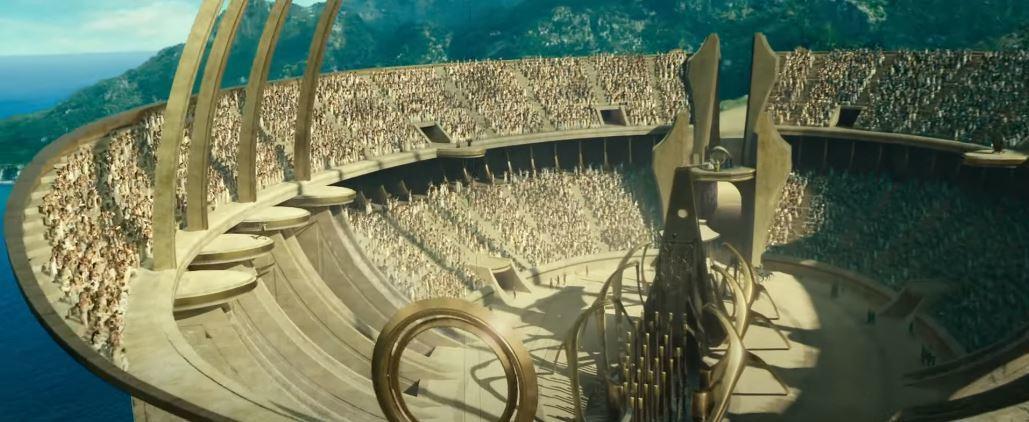
The Themyscira scenes from both Wonder Woman and Justice League are fondly remembered, but here it's limited to a Themysciran version of "The Titan Games" and Quidditch rolled into one. The ten year-old Princess Diana (Lilly Aspell, also back) is competing against women twice her age and when she gets in trouble, takes a short-cut and is prevented from completing the course by Antiope (Robin Wright), much to her consternation: "You took the short path. That is the truth...The true hero is not born from lies, but patience, diligence and the courage to face the truth."

Okay, then, roll credits.
Zip ahead to 1984 and that mall-heist, the tone of which is rather winky, feeling a bit in tone like those fights in the "Batman" TV-series—or even the "Wonder Woman" TV-series—for all the threatening the bad-guys do, they're by turns mean or comical. It doesn't help that Jenkins piles on the "strange" sartorial splendors of the 1980's here, as it tends to undercut any feeling of menace—it's preceded by some street-action life-saving that reminded one of the Richard Lester-directed "Superman" films. A lot of little girls are shown getting inspired by a strong kick-ass woman, even though the impression is supposed to be fleeting. I mean, Diana tiara-smashes a lot of incriminating security cameras, but she stops to smile and wink at the little girls? It's also where the first brain-disconnect moment occurs: the bad guys rob the mall-jewelry store because there are ancient artifacts being smuggled there on the black market. Really? In a mall? A high traffic area mall?
Anyway, it's always good to see Gadot playing Wonder Woman. She's the best thing in the picture and although the movie doesn't live up to expectations, she's never less than fully committed and pulls off a lot of janky scenes just by her persuasiveness. That's a great component of the "Wonder Woman" persona, even if the movie sometimes forgets what she's all about.
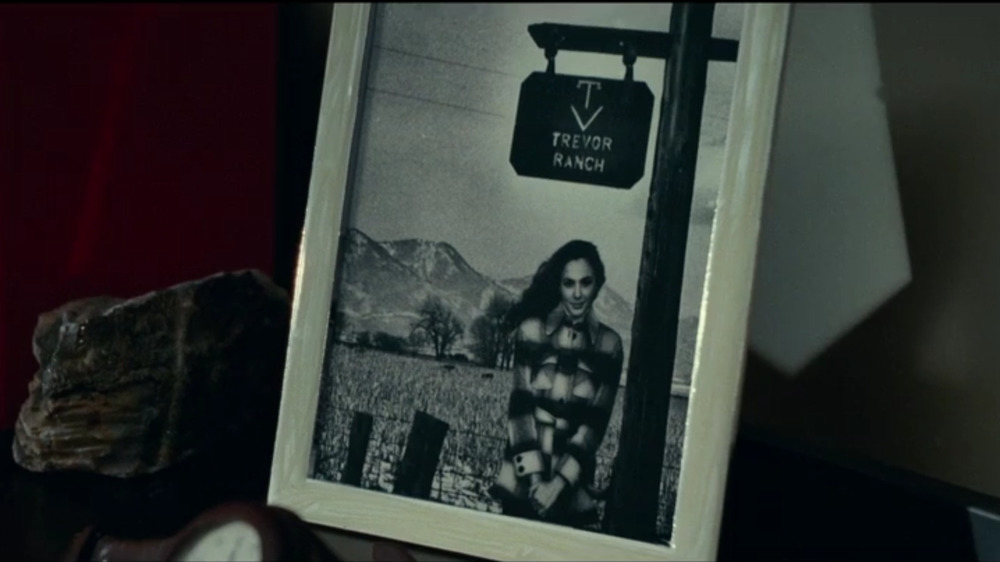
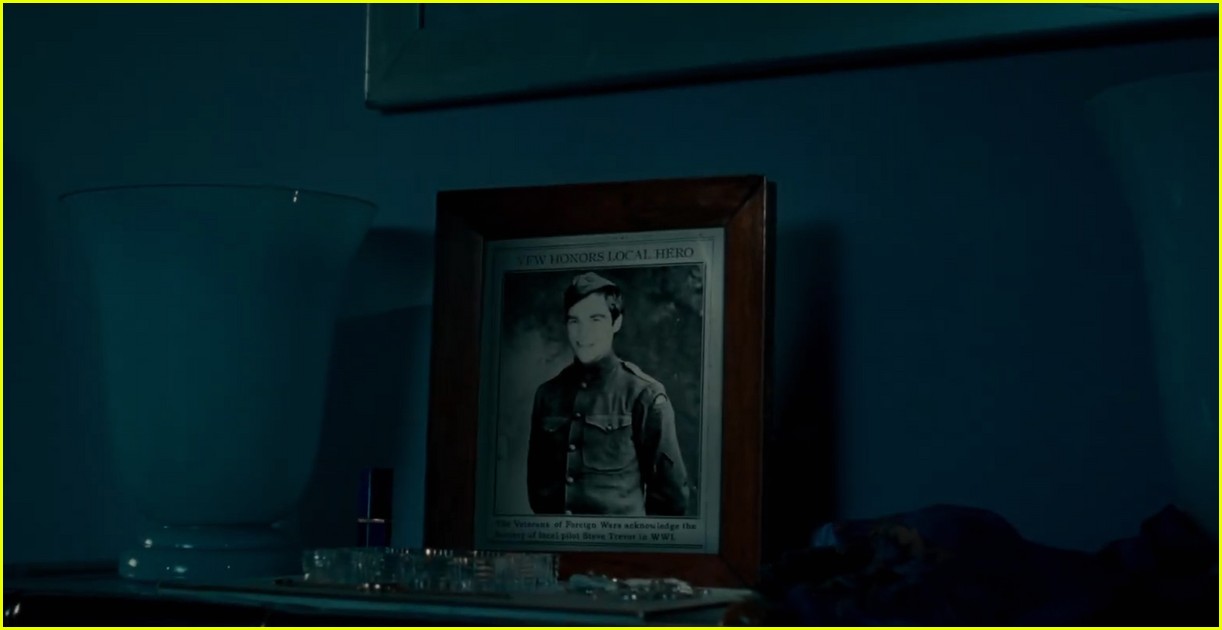
We're given a glimpse of her post-World War I life, literally snap-shots—she lives at the Watergate hotel and scattered throughout are photos: Diana at the double wedding of WWI team-mates Charlie and Sameer, Diana on a New York ferry with an aged Etta Candy, Diana with The Chief comforting a woman at a liberated concentration camp...Diana in plaid flannel visiting Trevor Ranch. Pictures of Steve (Chris Pine). Many pictures of Steve (Chris Pine). That answers some questions—and shows that Diana wasn't just ignoring the ravages of WWII—and instills a certain nostalgic factor.
That mall-robbery sets up the story: among the antiquities housed in the backroom of the jewelry shop is something called "the Dreamstone"—there's one in the comics but it has a different history involving stories from "Justice League of America" and Neil Gaiman's "Sandman"—and everything gets carted away to the Smithsonian for study by their new hire Barbara Minerva (Kristen Wiig), a multi-doctorate but whose low self-esteem makes her nearly invisible to her co-workers...unless they see her as a door-mat. 
Except Diana. The two have a mutual interest in the Dreamstone, but neither realize its importance: It's base has a Latin phrase carved into it—"Place upon the object held but one great wish"—and it gives the bearer it's heart's specific desire...but at a cost not known to the stone-wisher. Diana wishes that Steve Trevor was back. Barbara wants to be more like Diana. 
But, there's another man who covets the Dreamstone and that would be Maxwell Lorenzano (Pedro Pascal), who has changed his name to "Maxwell Lord"** and become a fixture on TV for his company Black Gold Cooperative, hawking the public with the idea that, sure, "Life is good. But it can be better! Why shouldn't it be? All you have to do is want it." Max has bought up a bunch of oil properties that have come up dry holes—and is in debt up to his well-coiffed hair to one Simon Stagg (Oliver Cotton), who up to this point has bankrolled his schemes. But, those debts are catching up to him. Desperate for a solution, he charms and seduces Barbara into getting his hands on the stone and does what every good entrepreneur does—eliminating the middle man by wishing the stone to convey its powers to him directly, so anyone who touches him making a wish will have it granted and, in reward, bestowing him with...something. Certainly power of some kind.
Now, granted, what will stick in people's minds is gonna be that Max Lord is supposed to be Donald Trump in disguise. That will be the people who are "woke" enough to Trump's S.O.P. or those in the Trump Camp who are feeling like Hollywood is picking on Their Savior. Well, Citizen Kane is all about William Randolph Hearst...except it isn't. Similarities, sure, but differences, too. The 1980's has gone down in History as the "Greed" Decade, so any entrepreneur, empowerment coach (Tony Robbins, hello), or televangelist would fit the bill. Jenkins has gone on record that Gordon Gekko—of Wall Street (1987) fame—is a model, but George W. Bush could be, as well, given the oil tactics. Besides, this Maxwell Lord has self-image problems and wants to look like a "winner" to his son. Trump doesn't care what others think about him. All he cares about is maintaining his own self-image. Maxwell Lord is just like his comics character, a snake-oil salesman running a ponzi scheme.

But, he is successful enough with this stone that pretty soon he's a billionaire, has all sorts of mineral rights in the Middle East, has the U.S. and Russia hemorrhaging nuclear missiles and firing at each other, and—via an orbiting communication system—has the entire world making wishes that are destroying the world in an apocalypse of entitlement and self-absorption.
Wait, wait, wait. Which of the screenwriters thought this was a good idea? The scenario would include so many conflicting wishes that literally nothing would work—people's wishes would cancel each other out, negate others, and end up not making anybody's wishes come true. Forget any "monkey's paw" "be careful what you wish for" homilies, the scenario is just blinkerdly stupid, reminding me of the world-"Super-Computer" idea of Superman III or the Riddler's tapping into everybody's brain-waves "Box" in Batman Forever. The idea is "big" enough to sell a Warners Exec, but dumb enough to have no discernable logic to it other than as a polemic against mass-greed.
Oh, along the same lines: Diana's wish is to get Steve Trevor back.*** I can't think of any reason beyond contractual obligation to do that. Wouldn't she wish for world peace? At least an end to war? Isn't that why she's in "Man's World"? How about a little sexual equality—there are enough leering jag-off's in this film to inspire that. How about wishing to go back to Themyscira? See Hyppolyta for a little pep-talk, maybe—a refresher course on the Games competition? A speech is given to Diana: "I give and give and give and all I ask is for this one thing..." Gadot sells it, but I lost a little respect for the character in that one exchange. And Trevor's soul has to inhabit another guy's body to do it? That's a little creepy. But, then selfishness, at other's expense, is what the movie's all about.
If they'd limited it to Barbara Minerva, whose wish turns her into a being as strong as Diana (by decreasing Diana's power), and then into the sub-human Cheetah, then we could have had The Big Lesson, but not the confusion, or the lame "Kumbayah" at the end of it
But, also, the whole movie is about Magical Thinking...even in regards the film itself. If you build it, the audience will come. They may come, but they may not come to buy. There's another significant Latin phrase, not written on the base of any stone that says "Caveat Emptor." And the movie is full of Magical Thinking: Diana and Steve steal a jet-plane from the Smithsonian to go to the Mid-East—the jet is fueled up? Enough to fly that far? And Steve can fly it when the last thing he flew was bi-planes? Diana suddenly can turn things invisible (thus, bringing into the movie WW's Invisible Jet, which she shouldn't need as she's supposed to be able to fly)? Steve's rather vague notion of flying teaches her to do that? I'm all for ideology and visualization, and you can even have "The Secret," but I've seen too many Roadrunner cartoons to teach me that wishing doesn't make it so.
It is such a disappointment. But, then, second films in a series tend to lag. Oh, it has its moments. Gadot, of course, is splendid and her scenes with Pine are excellently played, especially when their roles are reversed from the first film and Diana have to show him the ropes of life in 1984 (I just wish they hadn't been written), and both Kristen Wiig and Pedro Pascal do terrific work selling their material, as weak and ill-considered as it is. And the movie LOOKS terrific, even if Jenkins seems to have abandoned her wide-screen sensibilities to make this movie look like it was shot to avoid being panned-and-scanned on a square TV (the way directors compensated in the old days before HD TV's). Definitely a big step down.
There is a visual thematic thread throughout Wonder Woman 84 that is used again and again and it's a bit of a distraction—that video "fritz" effect that sometimes transitions scenes, introduces titles, and generally breaks up the picture. I don't know what it's doing there. To show the ever-presence of media in the 1980's? A way for Warner Brothers to unite the latter DCEU movies with obtrusive graphics? Cynically, I see it as a metaphor. You don't get those "glitch" kinds of defects unless there are flaws in the material. There's an abundance of them in WW84.
Stick around for the mid-credits scene for a cameo—not a preview—that will, however, make you smile...another nod to nostalgia. I just wish they hadn't made me nostalgic for the last movie. (See that about wishes?...doesn't work.)
"We can do better..." Yes, you can.

* Fans of the
"Supergirl" TV-series will notice that the same plot and device was used in the Season 1 13th episode "For the Girl Who Has Everything."

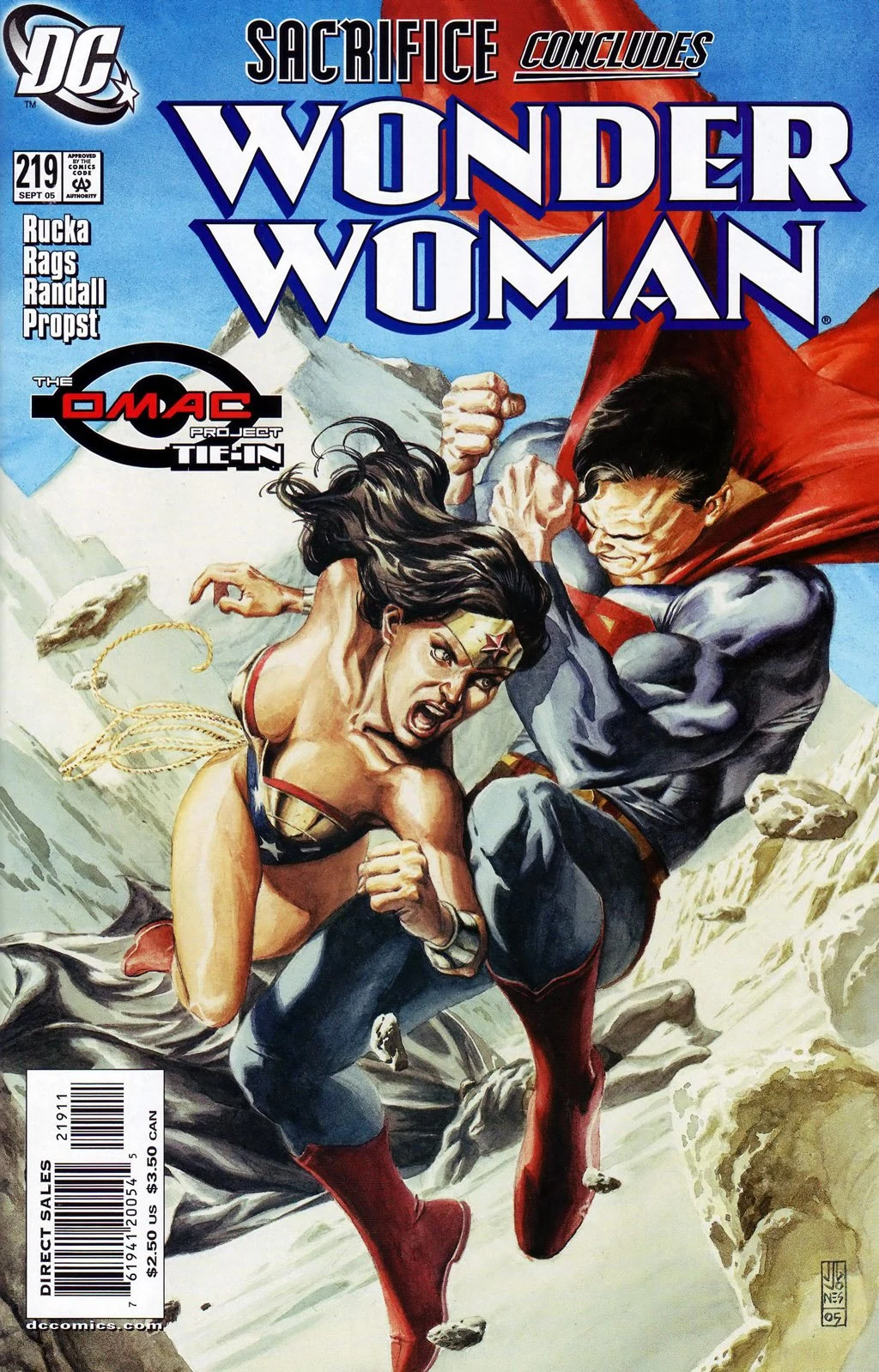
** The choice of Maxwell Lord as the villain of the piece is interesting for his history in the DCU. In the DC comics, Max was an entrepreneur/con-man who brought together an incarnation of the Justice League called Justice League International, which did not operate on U.S. soil (it included Wonder Woman in its original line-up, but due to her being used for her own book and to avoid any character dis-connect, she was never seen in the JLI). In one of the big "event" storylines for their publishing year—called "The Omac Project"—Lord uses an ability to telepathically control others to make the DC super-heroes look bad in the eyes of the press and public (in Wonder Woman Issue 219). When he takes over Superman, Wonder Woman narrowly defeats S-man by knocking him out, and Lord tells her, when bound by her lasso, that once Superman comes to, he'll just control him again. WW asks him how she can prevent that and Lord says, simply, "Kill me." So, she snaps his neck. *Krk!* Not something the comics-Superman or Batman would do, but then, WW is an Amazon warrior. It was still controversial among fan-boys. Lord's neck is saved, in many ways, in WW 1984.

*** I LIKE Chris Pine. He's a terrific actor. Plus, he and Gadot riff off of each other like nobody's business, and they do so in this movie. They're terrific together. But, he wasn't necessary. And there were better ideas that could be explored for that wish trope.  As good as he is—as good as THEY are—I hope they don't bring Steve Trevor back in the future. As they used to say on Themyscira, a woman needs a man like a fish needs a bicycle and Wonder Woman doesn't need a bicycle, either. Or an invisible jet. The woman can fly on her own.