Showing posts with label Michael Kelly. Show all posts

Wednesday, September 13, 2023

The Adjustment Bureau

"I Guess The Lord Must Be in New York City"
or
"Dicking Around with People's Lives..."

The stories of Philip K. Dick have provided all sorts of story-fodder for the movies for both good or ill: Blade Runner, Total Recall, Minority Report, Paycheck, A Scanner Darkly, Next, and Impostor.
 
They feature the sort of high-concept story-spine that easily translates into genre-bending sci-fi/fantasy films that are the easiest thing to translate to the screen short of a superhero property. Just put a slight spin on a story concept—a police force that stops crimes before they happen, spies and detectives who are mentally undercover, a guy who can see into the future, but just eight minutes out—all odd concepts that illuminate the character dilemma in a way that a straight story might not highlight. You don't have to be a genius to "get" what the movie says. And the inevitable SFX look great on trailers.
So, here's
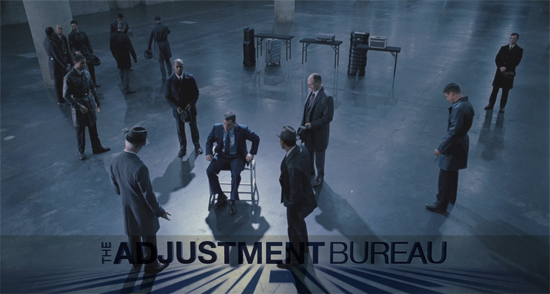
The Adjustment Bureau, a paranoid conspiracist's validation of all things manipulated. Young senatorial candidate David Norris (Matt Damon) is about to lose an election big-time, due to some ill-considered party-decisions earlier in his life. In the men's room of the Waldorf, he practices his contrite, yet defiant acceptance speech, only to find that he is being overheard by Elise Sellas (Emily Blunt), who is evading hotel security after crashing a wedding upstairsIt's a "meet-cute" as the two banter about Norris' loser-status and Elise becomes intrigued enough to plant a lip-lock on him. His campaign manager (the always welcome Michael Kelly) walks in just in time to catch this and bust it up to get Norris to the ballroom to admit defeat. I'd've fired him on the spot.

It's some time later and Norris is working for an investment capital firm with his manager. He's running a little late, so he doesn't notice a team of angular men in business suits and fedoras are shadowing him. One in particular—Harry (Anthony Mackie)—has an assignment: Norris must spill coffee on his shirt by 9:05 am, not any later. It's his job, says Agent Richardson (John Slattery), so don't screw it up. 

But, if he didn't, there wouldn't be a movie.
There's no use crying over un-spilled coffee, but as a result, the rest of the movie is the Team attempting to solve the mess the non-mess creates: Norris is able to catch his bus on-time,
where he once again encounters Elise, and gets to work just in time to see the Pre-Destinators (my term) sweeping the office, the personnel frozen, and key players receiving a "mind-wipe." Norris catches on quickly, and tries to evade the invaders, only to find them around every office corner, calmly telling him that, really, he should take it easy and cooperate and "this" will all go a lot easier.

He wakes up in an empty warehouse
, with his pursuers deigning to tell him the truth about things: "You've just seen behind the curtain you never knew existed."  They're a team of agents who manipulate events among humankind—a kind of Uber-illuminati ('"sometimes it's chance, sometimes it's us
")—at the behest of "The Chairman." They lay down the law: He can't have a relationship with Elise, which David objects to ("Your entire world just changed and you're thinking about a woman?") as it's not in "the plan," and if he tells anybody about what he's seen, they'll make everyone think he's crazy, and "reset" him, leaving him basically lobotomized.
* 
Norris is too much a free-thinker
to obey the "button-down men of Fate" and the rest of the movie entails him "changing the curtains," as it were. It's very clever and director George Nolfi, (who wrote the screenplay for the similarly time-trippy Timeline, had fun adapting his screenplay "Honor Among Thieves" into what would become Ocean's Twelve, and was one of the team who wrote—and re-wrote—The Bourne Ultimatum) ingeniously keeps things moving at a good clip, while also staying one jump ahead of the story-complications inherent in the plot...while also doing enough cinematic sleight-of-hand to keep the Doubting Thomases in the audience from falling into plot-holes. He gets good performances out of everyone—allowing enough ad-libbing in the scenario to make it seem real and fresh, sort of a real-life version of the film's conceit of re-writing History in pencil before the Cosmic Ink dries. It's fast, fun, and fresh and avoids pretentiousness or taking itself too damn seriously. It is only after a little Time has passed that it feels a bit slight, but who could have anticipated that?

One thing is for sure:
I gotta get me one of them hats!

* At that point I flashed on former CBS news-anchor Dan Rather walking down a New York Street and being attacked by men and all they said was "What's the frequency, Kenneth?"  Everybody acted like Rather had had "a spell," but I wonder if his attackers were wearing hats.

Friday, January 18, 2019

Fair Game

Written at the time of the film's release....

"Playing the Plame Game"
or
"The Problems of Two Little People Don't Amount to a Hill of Yellow-Cake in this Crazy World."

Those of us in the United States know the story: Ramp-up to the Iraq war; alleged yellow-cake uranium sales from Niger to Iraq; aluminum tubes thought to be nuclear weapons partsambassador Joe Wilson's editorial calling fraud on those suspicions; shock and awe tactics by the White House leaking information to the press, publicly exposing Wilson's wife as a CIA agent; the furor that created; the investigation; the prosecution and resignation of a key Bush administration official; the President's commuting of his fine and prison term. That's the headlines.

But, the nice thing about Doug Liman's film about the case, Fair Game, is that he immediately makes it personal. Using the same gritty techniques used in The Bourne Identity and Go (he is also the director of photography on this one, as he was making Go), he takes us to hot-spots of the world, the cold corridors of power, and the warm cozy homes of the participants, finding the nuances of life and feeling. We watch as Plame (Naomi Watts), posing as a chemical consultant, travels to Kuala Lampur to talk business, effectively dodging a trap with hockey trivia, then, when things get dicey, turns the table on her contact.  Plame's cool friendly exterior turns icy when she looks her hostage in the eye and says calmly "If you help us, we can help you. And I promise you one thing: you have no idea what we can do."

Truer words. And she has no idea how true those words are.
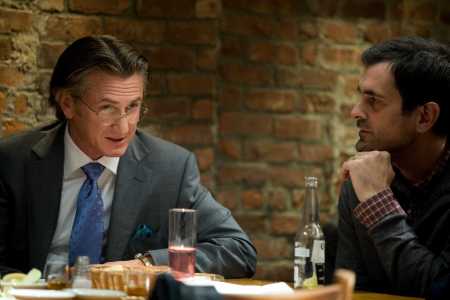
Plame knows stuff. She knows a lot of stuff*. A prized CIA investigator, she regularly travels to the Middle East coercing, cajoling and charming nuclear scientists and terrorist contacts, making promises, making contacts, hovering in the peripheries, returning home to domesticity with her husband, former ambassador Joe Wilson (a nicely rumpled Sean Penn), currently trying to turn his connections into a consulting business. Because of his knowledge on Niger, the CIA asks him to investigate the yellow-cake sale for their investigation for the Vice-President's office...the logistics of which would have been impossible to pull off unseen. Plame, on the other hand, has all the facts that the Bush operatives don't have (or won't acknowledge) about those aluminum tubes that, it turns out, are completely unsuitable for bomb-building.
But that doesn't stop the Administration from using both fraudulent claims as pretexts for invading Iraq to stop a non-existent nuclear program—selling the war is easier if the motivation is fear. Both Plame and Wilson (and their colleagues) watch in horror as the invasion occurs under false pretenses (and Wilson, having met, and been threatened by Saddam Hussein, is no apologist calling him "a monster"). Wilson calls "bull-shit" on the White House, and, fearing "a trust issue," the President's advisers start to spin the story in the Press, starting by leaking that Plame is a CIA officer. Suddenly, this spy, with enemies around the world and friends out of the loop at home, is besieged with questions and the protective bubble she has lived in is popped. Considered toxic by her colleagues in the CIA, she loses her clearances and her job, the phone rings off the hook with confused friends and death-threats and just-plain crazies. The stories start to spin out of control, with Wilson fighting back, but Plame trying to retreat back to an anonymity she will never have again, and a truth that has become irrelevant in the fire-fight at home.
The emphasis on the home situations of Wilson and Plame (and their two children) is what makes this personal political thriller so interesting**: he fights his battles out in the open, but she works in the shadows—when the couple must fight the same battle against their oppressors, the divergent styles splinter the two of them apart. Watts and Penn have worked together before (21 Grams and The Assassination of Richard Nixon), so they're old hands at making a relationship look believable, both, in turn, have moments of weakness and vulnerability, alternating with a fierceness in strength which they share, but rarely at the same time.*** That internal squabble inside the larger fight makes up the heart and soul of Fair Game, Liman and his camera catching moments of temperament between two "inside" outsiders at war at home.

* One of the amusing things about Plame's book on the subject (that shares the same name as the movie) was the redacting of so much of it; Plame was still bound to pass her book's galley to the CIA for review to prevent the dissemination of sensitive state secrets. So much of the book was blacked out that Plame published the censored document as is, and a relative not tied to the CIA explained the deleted segments—using completely public documents—in the Appendix.  The credits for the movie black out many of the names of the characters. Heh.

** And somewhat akin to Liman's earlier fanciful, fictional spy film Mr. & Mrs. Smith... 

*** They're just the marquee names in a great cast, including Bruce McGill—always fine—as Plame's boss, Michael Kelly—who I've been watching since Eastwood's Changeling—as one of Plame's colleagues, a very subtle Polly Holliday (remember "Flo?") as Plame's mother and Sam Shepard, who has a very short, but very significant, cameo as Plame's Air Force father.

2019 update: