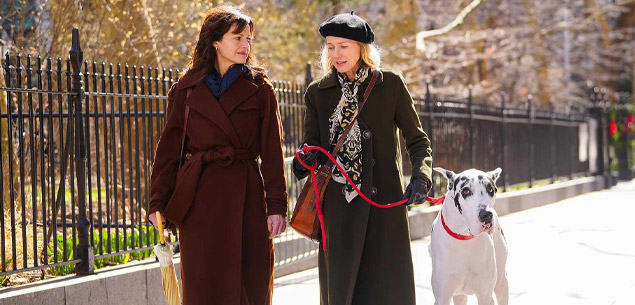
As soon as it's over, you want to watchThe Friendagain. It's that good, with a literate script, masterful performances (from everybody, not just Naomi Watts and Bill Murray...or the dog, Bing), New York as a background, an intricately selected soundtrack, and the least anthropomorphic animal performance I've seen in a long time.
And, it's a "dog" movie.
I hate "dog" movies, usually. You know why. The dog always seems to die at the end, usually in the dramatic interest of teaching the film's protagonist a life-lesson of great import. Like "life is a gift" or "appreciate what you've got when you've got it." Blah-de-blah-de-blah. I'm cynical of the form because I hate to cry in theaters and beating me with a dead dog turns me into a blubbering wreck and I hate to throw away all the soggy popcorn. The one time I didn't was when John Wick's dog was murdered and that it inspired him to come out of assassination retirement (which I giggled at, finding it perversely ludicrous).
But, this one I rushed to see because, well, Naomi Watts and Bill Murray are in it and their taste in parts alone should sell it, some laudatory words online were mentioned, and it's based on a Booker prize-winning novel by Sigrid Nunez. All indications were for some good breeding of a project that was low-key and mildly amusing. I wasn't prepared for a great movie, but I got it in spades.
It starts with a moment of inspiration, which we're not privy to: successful author-teacher Walter Mitchell (Murray) is out on his morning "Two Bridges" jog when he sees something that delights him, but we cut away before we see what has animated him so. We see him at a dinner party where he is holding court, volubly telling the story of his discovery. By the next scene, he is dead—by his own hand, they say*—and the survivors are left wondering how such a thing could happen. What would the world be without Walter? There were so many projects in the air, so many things left undone, and he'd just met his grown daughter whom he—or any of his wives, past or present—never knew existed.
But, hardest hit seems to be Iris (Watts), ostensibly his best friend. Walter was her mentor (currently she's working on a book of his correspondence) and she, in turn, is mentoring his new/old daughter, collaborating on the book. Progress on it has been slow but, now, work on it—like Walter—has come to a screeching halt.
Walter's widow (Noma Dumezweni) has asked Iris to come see her and she has a request. Well, more of a bequest—Walter had asked that if anything happened to him that Iris should take care of his dog, Apollo, the creature that he encountered on that morning run.
"Apollo" is a 150 lb. Great Dane and Iris weighs quite a bit less and is only half-again taller. Plus, Iris' apartment is, what they call in New York, a "studio" but it could be a "prewar", but anywhere else it would be called "cramped" and if you were selling it you'd mention "simplicity" and "ease of maintenance". In no way would it be considered a kennel, and—besides—it's in a "No Pets Allowed" building. Iris is not keen on the idea and her "go-to" is to avoid the Super as long as she can and find a place to "re-home" Apollo. But, in the meantime, she picks up the dog at its temporary kennel to take to what she hopes is its temporary home in her apartment only to find that the brute jumps on her bed and spreads out, despite her protests. His forlorn look prompts Iris' neighbor to remark "There's a PONY on your bed! A SAD pony!"
A sad pony to be sure, but also the elephant in the room. Apollo is just too big to fit into her apartment without obstructing Iris' every movement. She capitulated by pulling an air mattress out of her closet and sleeping on the floor, Apollo's sad eyes never leaving her through the night. But, the two are bonded, despite the separate bed-places in that they're both grieving—she for her mentor, he for his master. One's a human, one's a dog; she's a loner, he's a pack animal, so they're both approaching each other from separate corners. And with all the inconvenience this big white ghost causes in her life, some accommodation needs to be reached, some compromise between these two living beings who've been left behind.
And, ultimately, value.
The Friend, unlike so many "dog movies", is what the AARP magazine likes to call "Movies for Grownups". The emotions are complicated and recognizable, and maybe over some folks' heads. But, a New Yorker will recognize the panic of possibly losing a rent-controlled apartment; an older person will recognize the paralysis of grief; a real dog-owner will understand the inconvenience of pet-ownership** ...beyond the dog-movie-cliché antics of four-legged tornado-damage to the feng shui. There are no easy-laugh slobber jokes. This one is about loss, responsibility, and mutual need. And a bit about survivor's guilt. And the usual "taking care of others is more fulfilling than taking care of yourself." And Watts and Murray are brilliant in this.
It's so good and funny and wise that you immediately want to see it again. Or, better yet, read the book to get all the good stuff they couldn't make room for. Sometimes, that's the best part.
* I suppose with the mention of it, I should give the number of the Suicide and Crisis Hotline—If you or a loved one are having emotional distress or thoughts of suicide, call 988 to connect with a lifeline specialist for support.—but DOGE only knows if it still exists. From what I've been able to access online, it does.
** The other day something popped up in my news-feed that still makes me laugh: "Nobody has ever said 'What this house needs is a box-full of shit. Let's get a cat!'"
The Painted Veil(John Curran, 2006) Maugham's tough. A restrained writer of underlying passions and the complications of class and personality, he has had little luck in adaptations for the screen, which when separated from the civility of his tone, tend to look all the more melodramatic.
Filmmakers have combated this in a number of ways when adapting works by Maugham. They either are as dry as dust, the juice sucked right out of them (The Razor's Edge, 1947), or played to hysterics, overcompensating for the former (The Razor's Edge, 1987...with a "jokey" Bill Murray performance), or just the basic idea used and the rest transmuted to some other end (Hitchcock's Secret Agent).
However, we're gradually catching up to him. With time, his themes have seen better, more fulfilling adaptations, but Maugham needs a director like Elia Kazan, who wasn't afraid to walk the fine line of good/bad taste. "The Painted Veil" has been lensed twice before--once with Garbo in 1937, and, as The Seventh Sin (more box-officey title) with Bill Travers and Elanor Parker in 1957. Both films emphasized the soap-ish, melodramatic aspects of the story, but this one is a huge improvement.*
It's obviously a labor of love, because it cost $17 million to produce and it looks like three times that much, at least. Filmed mostly in China, The Painted Veil tells the story of a spiteful marriage between a cold physician (Norton), and a spoiled society girl (Watts), who must adapt to a life of sacrifice and want in the Far East, and in the process both find their priorities shift and their expectations shattered.
It's one of Maugham's "too little, too late" stories, but I've rarely seen one better acted (the cast includes Naomi Watts, Edward Norton--sacrificing salaries as producers--Liev Schrieber, Toby Jones, and Dame Diana Rigg) or realized so well. This may be the best movie deal in years from a production and audience stand-point.
The F.B.I. (Love) Story or "What Determines a Man's Legacy is Sometimes That Which Isn't Seen"
J. Edgar Hoover ruled the Federal Bureau of Investigation for 45 years under the Department of Justice. Over the course of his tenure, he made the FBI his personal weapon in defending the nation from threats as he saw them, even as they changed form—from Bolshevik radicals to hayseed bootleggers and bank robbers to Communists to Civil Rights Activists to his very bosses. He did this unsubtly and unequivocally with press-trumpeted raids and whispered-about secret files that, if it didn't make him (as the phrase goes) "the most powerful man in the country," he was certainly the most feared. It was always assumed that Hoover had "the goods" on everyone, and guaranteed his long-held government post with weapons in manila files.
When he died (in office), Hoover's mug had the well-known face of a haggard bulldog—keeping secrets is something that can age you rapidly—and keeping secrets is something Hoover did best. Not only those of others, but his own. Rumors swirled about the nature of his relationship with FBI Associate Director Clyde Tolson—that they were secretly gay lovers rather than "gentleman cops," that Hoover was a cross-dresser, and that the reason Hoover didn't pursue the gangsters of La Cosa Nostra in the '40's and '50's was because of compromising photographs in the hands of Meyer Lansky. Nothing has ever been confirmed. It's all just rumor, the smirking kind that the powerful get (but there's never any proof).
Which is why news of a Hoover bio-pic, written by Dustin Lance Black and directed by Clint Eastwood seemed so intriguing. Eastwood isn't afraid to take chances, turning cliches on their ear and Black's clear-eyed script for Milk garnered an Oscar. Their filmJ. Edgarpromised "red meat," of the kind that could be delightfully and salaciously chewed.
And the two men have taken chances...but not with the result you would think. Rather than being a rant or skreed, J. Edgar is actually a sympathetic look at the FBI director and his peccadilloes and shortcomings. There's nothing hysterical (save for one fist-fight that breaks out between Leonardo DiCaprio's Hoover and Armie Hammer's Tolson) in script or direction, but it offers a look at a severely closeted man who had to be in the times he lived and with the mantle he carried. Ambitious, yes. Paranoid, certainly. Vain and glory-hunting, without a doubt. Hoover craved the spotlight and his role in being "Head G-Man,"while at the same time operating in the shadows, single-mindedly hoarding the secrets of others, while keeping his own is the height of ironies. At the same time that he espoused the Bureau ethic for red-blooded American males as agents, one wonders if it is done for appearances' sake, a beard that would mask his own leanings while also serving as a "hiding-in-plain-sight" revelation of his own taste in men.
Black and Eastwood conduct the story-telling in flashback, as Hoover in his latter years, decides to set the record straight, dictating his memoirs to an amusingly rotating number of agent-stenographers who disappear as soon as a point is questioned, or a weakness revealed. The story is a white-wash, reflecting the man's "official" view of the Bureau's history in a mix of incident and myth. At many times, J.Edgar is a bit reminiscent of Citizen Kane, with its fracturing point-of-view, shifting perspective, and ironic commentary on some of the incidents.*
It also shares Kane's sense of the unattainable summation of a life. C.F. Kane's had little to do with "Rosebud," just as Hoover's gay leanings was a small part of his whole story. It began with a controlling mother (Judi Dench), determined to keep young John Edgar from becoming a drunk like his father. Groomed to become "the most powerful man in the country," Mother Hoover controls her son's life to make him the image of the perfect son, diction lessons to force past a stammer, impeccable grooming, and the enforcement of all of her prejudices. And the nullification of any behavior less than manly. He is made in the image of his Mother's "perfect son," even though that image may be completely counter to reality. It sets him on a lifelong course of fighting her battles, never really being his own man, as much as posing in the presentation he wanted to project. A performance. An act. Myth and lies.
It is a story soaked in ironies: the man who kept secrets on everybody, but the biggest being his own; the investigator who saw no harm in exposing other's private lives, while keeping an iron grip on his own; the policeman who targeted and made war on many enemies, the primary one being himself. Black and Eastwood present a case for sympathy, even empathy, for a man who shaped, and was shaped, by his times, who rose through the ranks of power in society, to not be shunned by it, and who searched for verifiable fact while living in denial, and closeted by the bureau of his own making.
Hoover and Tolson at their regular table at The Stork Club.
* Not to mention that DiCaprio's "old-man" make-up makes him look more like the aged Charles Foster Kane than the jowly Hoover (still, it's better than the never convincing make-up that Hammer sports as an aging Tolson), and the shots of Hoover witnessing the Inaugural parades of Franklin Roosevelt and Richard Nixon are shot from the same angle as the "newsreel" shot of Kane in a balcony appearance with Adolph Hitler.
It was made (reportedly) by RKO Studios in an attempt to make money (duh!)—the same kind of money that was made with a nasty little film called Ingagi—a psuedo-documentary exploiting interactions between gorillas and female humans. Producers Ernest B. Schoedsack and Merian C. Cooper had already made a couple of jungle pictures, and, having been impressed with the work of animator Willis O'Brien on the 1925 version of The Lost World, as well as a cancelled RKO project called Creation, crafted a story about a giant gorilla on a prehistoric island.
O'Brien has said that the idea came from a dream that he had about a gorilla terrorizing New York City. He called it his "giant terror gorilla picture."
Cooper's dream would become King Kong, and the movie, unlike its titular character, would prove to be immortal...and, whatever its origins as an exploitation picture, it's story of Beauty and the Beast still haunts, and audiences found themselves sympathizing with its most threatening character.
King Kong concept sketches by Byron Crabbe and Mario Larrinaga.
And the prophet said: "And lo, the beast looked upon the face of beauty.
And it stayed its hand from killing. And from that day, it was as one
dead."
Old Arabian Proverb
Producer Carl Denham (Robert Armstrong) is spending the night before his biggest risk looking for a girl. All the talent-hacks in town are coming up goose-eggs because Denham is so secretive about a project that entails a long ocean voyage on a ship full of sailors! No flapper will touch it. But Denham knows what it's all about, even if he's a little vague in the details when he enthuses "It's money and adventure and fame! It's the thrill of a lifetime and a long sea voyage that starts at 6:00 tomorrow morning!" And it's strictly business. Monkey business.
How could Ann Darrow (Fay Wray) resist?She's unemployed, starving, and about to be nicked to the cops for stealing an apple when Denham comes to her rescue with his last-minute offer to join the crew of the Venture to travel towards Indonesia to work on one of his "animal pictures."
But, Denham is keeping one more (rather large) secret: he's trying to find the mysterious "Skull Island" not found on any charts, whose inhabitants live on a spit of land protected from the rest of the island by a huge wall, behind which is a rumored creature—"a native superstition, a god or a spirit or something" known as "Kong." Denham describes Kong as something "neither beast nor man. Something monstrous. All-powerful. Still living. Still holding that island in a grip of deadly fear." He means to get it—whatever it is—on film. For "money, adventure and fame."
Upon reaching Skull Island, a shore party ventures out, attracted by drums in the distance which leads to a ritual where a frightened native woman is being "dressed" for sacrifice while the tribe do an elaborate dance. Denham attempts to film the rite, but the tribe-leader sees the crew and and everything stops as he approaches them, warning them off the Island. But, then, he sees Ann, who is called the "golden woman.""Yeah, blonds are scarce around here,"drawls Denham. The chief makes an offer—he will trade six tribes-women for Ann, which is refused—most effusively by First Mate Jack Driscoll (Bruce Cabot), who has taken a romantic interest in her—and the crew goes back to the ship to await developments and plan a way to film Kong in secret. The Skull Islanders have other plans—sneaking up to the Venture to kidnap Ann under cloak of darkness. When she's discovered missing, a large Venture contingent is deployed to rescue her...but she has already been taken by Kong.
Probably a good thing, too. While her search-party is decimated by all sorts of prehistoric creatures, Ann survives attacks by T-Rex's, giant snakes and pterodactyls only at the behest of Kong. When she is rescued—by Jack Driscoll—a plan is hatched to take Kong back to New York, where....you know the rest.
King Kong was released in 1933, in the "Pre-Code" era of films, before the Hays Code called the cops on the party, so the original version of Kong is a lot more risqué than the version I first saw in the 1960's—after the Hays Code was put in effect, a lot of the things were taken out of the original King Kong, when it was periodically re-released to theaters. These included a brontosaurus attack on the rescue party, some particularly violent shots of villagers being crushed between Kong's teeth or squished underfoot, two shots in the New York sequence where Kong bites a passer-by and pulls a woman he thought was Ann Darrow out of her apartment and drops her onto the street below. There is also the scene where Kong starts to peel away Ann's clothing and sniffs his fingers—considering there were pre-production artist's conceptions of both shots indicates that it was important to the film-makers. But, after the prudish Hays Code was installed, these disappeared from prints of the film. Their removal toned down the violence and the viciousness of Kong the character, and their excisions probably went a long way in making the character in the movie beloved by audienes. What started as Cooper's "giant terror gorilla" became a creature of tragedy—a displaced king whose obsession brings about his downfall. The remakes—by people moved by the original—made sure that they infused their Kongs with the same empathetic qualities. He'll rip your arms off, sure, but you gotta feel for the guy.
*
There is another sequence, although it might be considered "legendary" as it didn't make it to the 1933 release, that was cut by RKO and Cooper himself for being too violent and "stopping the show cold" and that is the part showing what happens to the sailors after Kong dislodges them from a log spanning a chasm (a sequence recreated in both remakes). It's called the "spider pit" sequence and only one image from it survives.**When Peter Jackson remade the film in 2005, he took pains to do his own version of the scene...and—as a lark—made his own simulated 1933 version of the sequence for his own amusement.
One thing that struck me upon first seeing King Kong was the cleverness with which the film-makers tied together the Skull Island and New York sequences. Kong doesn't have much trouble negotiating the Big Apple as it has challenges he's already faced—the island's snake becomes an el-train, a pterodactyl a bi-plane, and his high perch on Skull Island? The Empire State Building takes a bit more climbing, but what better place for a "King" to establish high ground? It was noticed by those making the remakes and the same strategy was employed—in the case of the 1976 remake, telegraphing it a bit too much.
But even today, with the "miracles" of CGI (it's just animation, isn't it?), one still has to be impressed with the work of Willis O'Brien, whose team did all the special effects work for the creatures (a lot of the bi-planes and people as well) back in 1932, when making movies was still relatively new and finding its way. These things are basically puppets, but O'Brien infused them with personality...a random T-rex scratches itself before spotting a victim...Kong plays with that same T-rex's broken jaw after snapping it dead...the way Kong cocks his head in interest...or draws back a wounded hand, quizzically. The blinks. There's character considered and infused with those frame-by-frame movements. One should consider that, as time-consuming as the process is, done one frame at a time, to do something extra with it takes a certain kind of love and commitment...and artistry. It's that element that inspired key players in the remakes, so that, even if the movies themselves didn't quite live up to the original, Kong sure did. One must, after all, take a knee and pay homage to the King.
Concept art for King Kong (1976) by Mentor Huebner and Carlo Rambaldi (center)
King Kong(John Guillermin, 1976)After some legal wrangling between Universal Studios and producer Dino DeLaurentiis about who had the screen rights to King Kong (forestalling the possibility of two competing Kong films in one year), production was started on DeLaurentiis' version with an aim to make a full-scale Kong (by creature-maker Carlo Rambaldi) and to improve on the original—they wanted to get to Kong earlier in the movie, for instance (which didn't happen), setting it in the modern era—DeLaurentiis was obsessed with having Kong scale the World Trade Center—and to be lighter in tone, hiring Lorenzo Semple Jr. to write the screenplay. After an attempt to get Roman Polanski to direct, DeLaurentiis hired John Guillermin, who'd just come off co-directing The Towering Inferno. Guillermin insisted that he wanted a separate mechanical arm for some scenes, and thought that relying on a full-scale Kong was impractical...and dangerous. So, a more practical solution was put forward. Put a man in a suit (not unlike what Toho Studios did with King Kong vs. Godzilla).
But, not just any man. DeLaurentiis hired Rick Baker, an up-and-coming make-up artist who'd been obsessed with Kong since he was a kid. Baker had been trying to perfect the perfect ape-suit after working with John Landis on Schlock, and soon after his work assisting make-up master Dick Smith on The Exorcist and striking out on his own on "The Autobiography of Miss Jane Pittman"—for which he won an Emmy for Cicely Tyson's old-age make-up—Baker, was contacted to try and link the majority of the Kong scenes with the armature and the out-sized—but limited-in-movement—Kong that was being constructed for the scene of his New York unveiling. Working with Rambaldi, Baker perfected head-masks that would allow for different expressions, and even be able to appear that it was exhaling blasts of air. And Baker performed as Kong in all the suit-scenes; those are Baker's eyes behind the mask. While less an effects marvel than Willis O'Brien pulled off with the 1933 original, Baker's portrayal of Kong at least managed to stay true to the spirit of the original.
It's about the only thing that did. Semple's script did transfer the story to the modern day and was considerably lighter in tone...perhaps too much. Instead of a producing team looking for a mythical legend, the crew, under the hap-hazard guidance of Fred Wilson (Charles Grodin), a marketing executive from Petrox Chemical, is looking for an untapped source of oil in the Indian Ocean (the film was made during the 1970's energy "crisis"), using the giant tanker, The Petrox Explorer, captained by Ross (John Randolph), with First Mate Carnahan (Ed Lauter) and Petrox's mineral geologist Fred Bagley (Rene Auberjonois). Unbeknownst to them, the alliterative Princeton primate paleontologist Jack Prescott (Jeff Bridges) has stowed away on board the Explorer to warn them about about their destination and of historical records from both 1605 and 1749 that made references to "a great beast." He's snuck onboard to warn the Petrox execs are interfering with the habitat of a unique species.
Suspecting Prescott's a spy for a rival oil company, Wilson has him locked up, but on way to the brig, Prescott spies a life-raft floating in the Indian Ocean with a single occupant, a young blond woman in fancy dress. That would be Dwan (Jessica Lange)—"You know, like 'Dawn', except that I switched two letters to make it more memorable"—who was onboard a luxury yacht that exploded in flames, with her the only survivor ("You see, Harry was showing this film that I refused to watch - and
that's why I was up on deck by myself when the yacht exploded. Did you
ever meet anyone before whose life was saved by 'Deep Throat'?")
With wit like that, it's going to be a long voyage.
And it is. If anything, it takes longer to reach the island and make Kong's entrance than in the first film, plus one has to suffer through some rather implausible situations and unintentionally laughable dialogue. The script attempts to be relevant with its references to the oil dilemma, student protests, even California talking points—"You know, we're going to be great friends," says Dwan to Kong at one point. "I'm a Libra. What sign are
you? No wait, don't tell me. I bet you're an Aries. Aren't you? Of
course you are. I just knew it. That's just wonderful." It's not. And then there's "Sometimes I get too physical. It's a sign of insecurity, you know, like, like when you knock down trees." And characters might have been reckless in the original, but they weren't flat-out evil-crazy like Fred Wilson. "Fred Wilson is "crazy" is he?" he gloats at one point. "Wait'll those candy-asses in New York hear
about this one! Wait'll I put the screws to them! I'll grind them..." Fred's not psychic, but any 10 year old in the audience can deduce what his fate will be later in the movie. I'd call it foreshadowing, but I think it was more an attempt at creating irony for the clueless Wilson.
"You God damn chauvinist pig ape! What are you waiting for? You wanna eat
me?
Then go ahead! Do it! Go ahead and eat me! Go ahead! Choke on me!"
King Kong is a simple story—Gorilla Meets Girl...—but, the original took pains to make it more than that with a story with nuance that didn't telegraph it with cute script-writing, but with a quick pace and straight-forward direction and without the need to produce a laugh-line every exchange. The original meant to thrill. The '76 Kong seems content to plant butts in seats and not have them walk out.
Guillermin makes sure we "get it" by showing Kong's POV
—superimposing Skull Mountain over the WTC. Thanks.
The actors are game. Certainly Jessica Lange is and she had the toughest job. She was dismissed when King Kong came out for the character's ditziness (although one must concede that she actually was one of the few characters with a conscience), but that can be laid at the feet of the screenwriter rather than the actress dealing with the material. Lange has gone on to win just about every major acting award there is, and if she had put out an audio-book she might be a full EGOT by now. Her career has been a triumph despite King Kong.
As far as the other leads go, Jeff Bridges is committed to the role of Jack Prescott, but that lends itself more to the physical tasks he has to undertake and a perpetual "sense of wonder" stare for the rest of the film. There's not much real acting to do other than not embarrass himself. Charles Grodin as the oil executive, however, might have been mis-cast. Grodin is an intelligent actor who communicates that intelligence easily. But, playing an egotistical jerk makes him over-do just about everything in the film. One can't wait for him to meet his fate, which also is overplayed.
Rick Baker's in the first shot;
Rambaldi's stiff-armed full-size Kong is in the second.
As far as the special effects are concerned, it's a mixed bag. Baker gives a fine performance in the suit, but the miniatures around him usually aren't, making the jungle look decidedly set-bound. The green-screen work is sometimes good, like that shot of Lange beating up Kong above, but others involving green-screen, (although it looks like blue-screen) is sometimes a bit shoddy; fur is always a problem with that process. As far as Rambaldi's "life-size" Kong, it's a disaster—stiff, hulking like a mannequin, it is oddly disjointed in the elbows and arms—the hydraulics probably couldn't handle the weight of the props, and they made do with as little footage of it as possible. Rambaldi, of course, was the genius behind "E.T."
Blue-screen issues...
I'm sure there are those that think fondly of the '76 version of Kong, but I'm not one of them. It has its moments but they're recycled from the original, with a less classic, more contemporary sensibility, with a shorter shelf-life, and cheaper, not in budget, but in sensibility. But, it does have some nice things, like its use of an oil tanker instead of a tramp ship, which makes a much better transport for Kong, kept caged in the ship's voluminous hold.
I still remember a shot--Guillermin could have a good eye for an arresting composition--of Dwan descending into the hold to pacify Kong, whose pounding on the walls of the tanker interior is threatening to disrupt the integrity of the ship. As she clambers up a provided rope-ladder, she looks back at the hopeless Kong, for once a small figure in his environment.
That has some resonance, but it's a moment, a quick shot that something more to do with just putting things on the screen and more with providing some emotional depth, in a movie that has darned few of them.
Morton Huebner concept for imprisoned Kong and poster concepts by Frank Frazetta (center)
and John Berkey (right and below)
Concept art for Peter Jackson's King Kong (from WETA)
King Kong(Peter Jackson, 2005)Peter Jackson had been obsessed with King Kong since he saw the film at nine years old and cried at Kong's fall from the Empire State Building. It inspired him to become a film-maker and said in interviews throughout the years that it was his favorite film. Universal offered him the chance to do a remake in 1996, and he and scripter Fran Walsh began working on an original screenplay and actually did six months of pre-production work, but worries about similar competing remakes—of Godzilla, Planet of the Apes and Mighty Joe Young—brought the film down to Earth, and Jackson went on to make his Lord of the Rings trilogy. Following the successes of The Fellowship of the Ring and The Two Towers, Universal revived the idea in 2003, and Jackson agreed to do a direct remake after finishing his duties on The Return of the King. Walsh and Jackson (and co-writer Philippa Boyens) decided to take as their starting point the original 1933 script, including sequences that had been abandoned along the way—such as the fate of the sailors knocked off the log by Kong, as well as characters from the original novelization of the first film's script. Jackson accepted the assignment because he couldn't live with himself if somebody else made the movie. If he was going to do it, he was going to make it honoring the 1933 film that so moved him as a child.
The original film clocked in at a taught 1 hour 40 minutes (not including the recently added Overture). Jackson's version—following the same story-line with the same characters—runs at a dense 3 hours 7 minutes, almost twice as long. That's a big difference. What happened to cause it?
Jackson's devotion to the original, actually. His challenge to himself to make the "Ultimate" King Kong led him to make stories for sailors who were listed as "Fifth Crewman" in the 1933 version, which, back in the day, was trying to just be a fast and lean jungle movie. But, if he was going to make it "right," characters had to be fleshed out, motivations intensified, sequences that might have been rushed to hold down the budget could now be luxuriated over and details finessed. Plus, with CGI, there were few technical limitations to what he could show—instead of an animated puppet, it's animated pixels with an aim to photo-realism and Kong could be as big as wanted and be able to do anything imaginable in any sort of condition.
First, how to portray Kong. Jackson didn't want a man-in-a-suit, when he could make a giant gorilla from scratch, but he knew that it was something that needed to be performed to be effective. He hired his "go-to" actor Andy Serkis, who had used a motion-capture suit to portray Gollum in the Lord of the Rings series to perform the same function, only as Kong, and the results are magical. Serkis studied the movements of gorillas in zoos and in the wild in Rwanda and was able to take the "human being" out of Kong with an extraordinary mimed performance.
Then, Jackson gave Kong a particular personality, one reflected by a not-typical face. Jackson's Kong is weather-beaten, and a little beat-up. His face is scarred and one eye has a tendency to squint. His jaw is slightly unhinged, as if it'd been broken and he's even got one lower canine tooth worn down to the nub.
Call him "Battle-Damage Kong."
Serkis' extraordinary performance as Kong;
He's matched here by a "trooper" performance by Naomi Watts
I guess "personality" takes time. The 1933 humans are "types", but Jackson's team tries to flesh them out and make them individuals, rather than merely the dinosaur-fodder they're eventually going to become. And sequences that were kept simple to be rendered as quickly as possible, now are elaborately conceived and last just long enough to skirt any dragging . Kong doesn't fight one pterodactyl here, he fights a swarm of them. And he punches up a clutch of dinosaurs, not just one. The crew isn't chased by one brontosaurus but by an entire stampede. And the missing "spider-pit" sequence? Jackson devotes eight cringy minutes to it. Cut out of the 1933 movie, only the cultists would really miss it—like Butch says "the fall'll probably kill ya!" But, no, we have to watch them get chewed, too.
There's a lot of devotion to period detail. And the actors are given plenty of business to do. But, the miracle of the movie—besides Serkis—is Naomi Watts playing Ann Darrow. Not a screaming wreck, but not a push-over, either, Watts' Darrow is a plucky entertainer who refuses to "die" on-stage, subverting the tradition of previous Ann's to wait to be rescued. She has to have some gumption in order to be able to walk around New York without visible means of support, and she's determined to wile her way out of danger and into Kong's good graces without being helpless about it...or having her clothes taken off.
The only performance that doesn't quite work—but not for lack of trying—is Jack Black's Carl Denham. Modeled after Orson Welles—rather than Robert Armstrong's barking performance in 1933—Black doesn't have the charm or gravitas it takes to be truly overbearing in an entertaining manner, but is merely irritating. There is too much insecurity, not enough bluff and bluster (even the wrong-headed theatricality of it) to give any sense that he owns every room...or jungle...that he walks into. That would have been nice...and potentially more comic.
But, the Darrow-Kong dynamic works, and works without having to resort to words, merely by the performances of the players—one of whom isn't even there! Even if it's only imagined in the 1933 version, Jackson, his screenwriters and Watts and Serkis manage to wring as much tragedy out of the already-well known situation to tug at one's heart-strings. That's something that CGI just can't represent...or fake. It's where the Jackson version works gang-busters, even if it's a bit over-the-top.
But, then, King Kong always was.
Jackson's version of Kong's escape from the theater owes a lot to the 1933 version
as seen through a Spielberg lens. One has to admit that it is rollicking.
Mike Skuta does a masterful job of comparing the 1933 and 2005 versions.
*
The concept drawing for this sequence.
**
The only artifact of the "spider-pit" sequence is the photo above
And the artist conception below
Frank Frazetta gives equal time and an appropriately placed logo


 "Apollo" is a 150 lb. Great Dane and Iris weighs quite a bit less and is only half-again taller. Plus, Iris' apartment is, what they call in New York, a "studio" but it could be a "prewar", but anywhere else it would be called "cramped" and if you were selling it you'd mention "simplicity" and "ease of maintenance". In no way would it be considered a kennel, and—besides—it's in a "No Pets Allowed" building. Iris is not keen on the idea and her "go-to" is to avoid the Super as long as she can and find a place to "re-home" Apollo. But, in the meantime, she picks up the dog at its temporary kennel to take to what she hopes is its temporary home in her apartment only to find that the brute jumps on her bed and spreads out, despite her protests. His forlorn look prompts Iris' neighbor to remark "There's a PONY on your bed! A SAD pony!"
 A sad pony to be sure, but also the elephant in the room. Apollo is just too big to fit into her apartment without obstructing Iris' every movement. She capitulated by pulling an air mattress out of her closet and sleeping on the floor, Apollo's sad eyes never leaving her through the night. But, the two are bonded, despite the separate bed-places in that they're both grieving—she for her mentor, he for his master. One's a human, one's a dog; she's a loner, he's a pack animal, so they're both approaching each other from separate corners. And with all the inconvenience this big white ghost causes in her life, some accommodation needs to be reached, some compromise between these two living beings who've been left behind.


+Rene+Auberjonois+Jessica+Lange+Charles+Grodin+Ed+Lauter.jpeg)