or
Every Spider-Thing Everywhere All at Once
At the end of Spider-Man: Across the Spider-verse, I imagined a camera floating up to the theater-rafters, while I looked heavenward, my hands gripped into fists and screaming: "Noooooooooooo!"
It didn't come out of nowhere. During the last 45 minutes of the film (it's 2 hours, 20 minutes), I felt a mild panic coming on; the movie didn't feel like it was rounding third and starting to wrap things up—if anything, it was getting MORE complicated without any impending resolution. The reason? There isn't one. The movie ends with a terrible situation for hero Miles Morales (Shameik Moore), who's left beside himself, and the formation of a new Spider-group to save the day—led by Gwen Stacy (Hailee Steinfeld)—and another group—led by Spider-man 2099 (Oscar Isaac) hunting him with the intent to...well, I don't know what their intent is, but the very presence of Miles Morales and the events from the previous film put everything (and I mean everything) in danger.
Then there's a "To Be Continued" graphic.

DAMN!
My absolute love for the previous film, Spider-Man: Into the Spider-verse, is readily apparent to anyone who read that review. I still maintain that it's the best Spider-Man movie brought to the screen*, and (unfortunately) I still do.


So, what is the tangled web of Across the Spider-verse? It starts out with a challenging thesis statement: "Let's do things differently this time. So differently." It's Gwen Stacy, the Spider-Woman/Ghost-Spider/Spider-Gwen of alternate Earth-65, contemplating her back-story of her gifted life being over-turned by being bitten by a radio-active spider giving her spider-powers, shouldering "great responsibility," vilified by the press and the police (one of whom is her father) and how her crime-fighting career led to the death of her best friend, the brilliant student Peter Parker (Earth-65's Peter Parker). Parallel universes have pretty narrow parallels. While fighting an alternate-Universe version of the Vulture at her New York's Guggenheim Museum, she is aided by two other spider-heroes: Miquel O'Hara (Isaac)—Spider-man 2099 of Earth-928 and Jessica Drew (Issa Rae), the Spider-woman of Earth-616. O'Hara is in charge of an elite corps, the "Spider-society" whose mandate is to keep a stable multi-verse. With me so far? Good, let's go to Earth-1610. Earth-1610 is where "The Ultimate" Spider-man, Miles Morales, lives. It's been a year since the events of Into the Spider-verse, and the experience has changed him. He's an established Spider-man in his New York—even the police (including Miles' father) like him. He is the epitome of a friendly, neighborhood Spider-man, but his folks—despite his high grades at school—think he's a bit of a flake and are worried about him and his future. For example, he's late for everything, his attendance in class is kind of spotty despite the high grades, and they're really thinking about whether he should move home rather than applying for that big fancy New Jersey college to learn about particle physics. They want him to be more "grounded"—and he does get grounded in ever-increasing amounts throughout the movie.


And speaking of "spotty" there's a weird new super-villain in town. He's Dr. Jonathon Ohnn (Jason Schwartzman), who got caught up in the big particle accelerator/collider explosion of Into the Spider-verse and has turned into a being who can create holes—or "spots"—in space in order to transport himself to other locations on Earth-1610. Spidey encounters him trying to transport an ATM from a convenience store while on his way to his college evaluation with his folks and leads Miles on a "holey" confusing and disorienting fight throughout New York-1610 before making one trip to many and transporting him self to a "void"—let's call it "The Holy Sea" like in Yellow Submarine—where he plots his escape by using another collider to increase his powers across space...and other dimensions. Such a being can be quite a disruption to the fabric of time and space, so the "Spider-Society" recruits Spider-Gwen to travel to Earth-1610 to track this "Spot" guy and capture him before he can do any significant damage. Gwen (rather unwisely) shirks her duties as "spot-remover" to set up some automatic detector-gizmo, and instead goes to see the neighborhood Spider-man, whom she knows is "friendly." As Miles and Gwen have feelings for each other that haven't been awkwardly expressed yet, it's a "best of/worst of both worlds" parallel universe situation.
 Well, Gwen's negligence causes an emergency and Jessica Drew contacts her to get her spider-self to Earth-50101—and the island of Mumbattan—where Spider-man Pavitr Prabhakar (Karan Soni) and the Spider-Punk Hobie Brown (Daniel Kaluuya) have their hands full while The Spot successfully increases his powers with that Earth's particle accelerator. Unbeknownst to Gwen, Miles hitches a ride on her dimensional transport.
 So, how are you doing so far? Head hurt a little? Getting a little tough to tell Spider-person from Spider-person and Earth from Earth? Okay, I'm going easy on you, because here's where it gets really difficult to parse: Miles' transport-hitching causes an anomaly, as he saves an important personage who would have died if he wasn't there, and that created something called a "Canon Alert" (which I found hysterical) over at Earth-928 with the "Spider-League".
  Miles disrupted a key event that's supposed to happen to every Spider-man—a personal loss that will define their character—and poor Spider-India is set on a parallel track that is essential for every Spider-man story (and apparently they can't just go rogue and kill Pavitr's Aunt Maalai (or whatever) in order to set the trajectory right. This is not good, and it gets worse...and more complicated.





But, I'll spare you, and not spoil anything else. Believe me, there are a load of surprises in Across the Spider-verse from cameos and funny details to just the whole concept of the thing that takes a lot of Into the Spider-verse and re-weaves its web into something quite beyond the standard Spider-fare...although I do suspect that Miles is going to have a "Spider-man No More" moment (but against his will this time). I mean...it's "canon!"

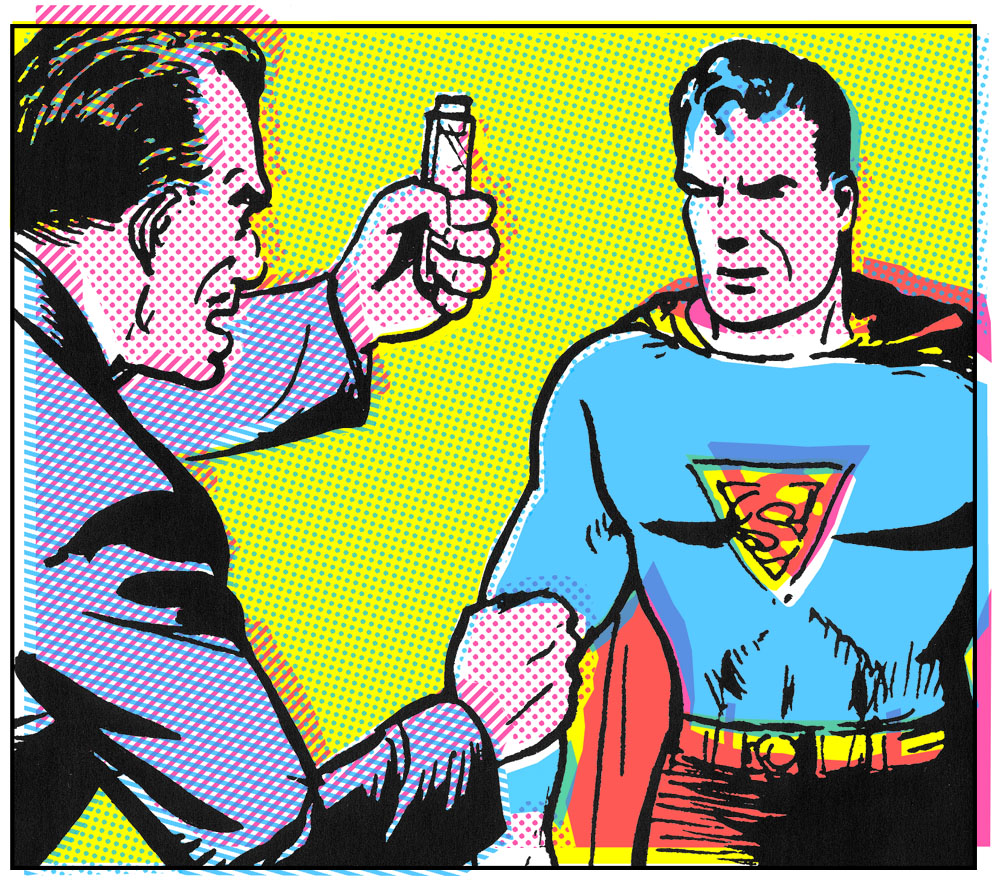
That whole "Canon Alert" concept is just mind-bogglingly funny (even if it's treated so seriously). There are certain comic-book stories and ideas that creators just don't touch because they are "canon"—Krypton exploded (you can't bring it back), Bruce Wayne's parents were shot in an alley (you can't say "just a flesh wound"), and Uncle Ben and Gwen Stacy have to die...and stay dead. Oh, they can be "cloned" (when the comic publishers get desperate), but you can't have Peter Parker (or what-Spider-ever) wake up one day, hold his aching head and go "it was all just a horrible dream" and go have a breakfast of Uncle Ben's converted rice. After all, these things take place in Manhattan, not "Dallas."
 But, as you can tell, this thing is complicated. In fact, it's so complicated, it's almost an assault, and when you add in the creators' visual dynamism, their tendency to throw a joke into every dead space, and general pace of the thing, your brain could approach synaptic anarchy. It might have to contain a warning—not the "flashing lights" one, but the "do not see while pregnant" "may cause seizures" "do not see if allergic to spiders" warnings on TV (or movie, for that matter) pharmaceutical commercials.
 I'm just saying that the experience is in-to-the-tense, and not for the faint of heart or the faint of sight. It is a certainty that one is going to miss a lot on the first viewing in a theater, and although it sounds heretical for me to say, I think that both Across the Spider-verse and its predecessor are more intended (by their creators) for repeat-viewing by disc or streaming than in the theater (although one can't discount the level of detail that can one can appreciate in the massive viewing experience**). I say that reluctantly, as I think the theater experience for watching a film can't be topped, despite noisy neighbors, restless kids, and rattling food-wrappers.***
 So...I say "go." Guardedly. Just don't come back in the comments section blaming me for the migraine or PTS-ADHD or the adrenal jitters—or your "spidey-sense" on over-tingle—as a result of seeing this (my reaction was to crave a hamburger). Blame it on the tangled web woven by Spider-Man: Across the Spider-verse.


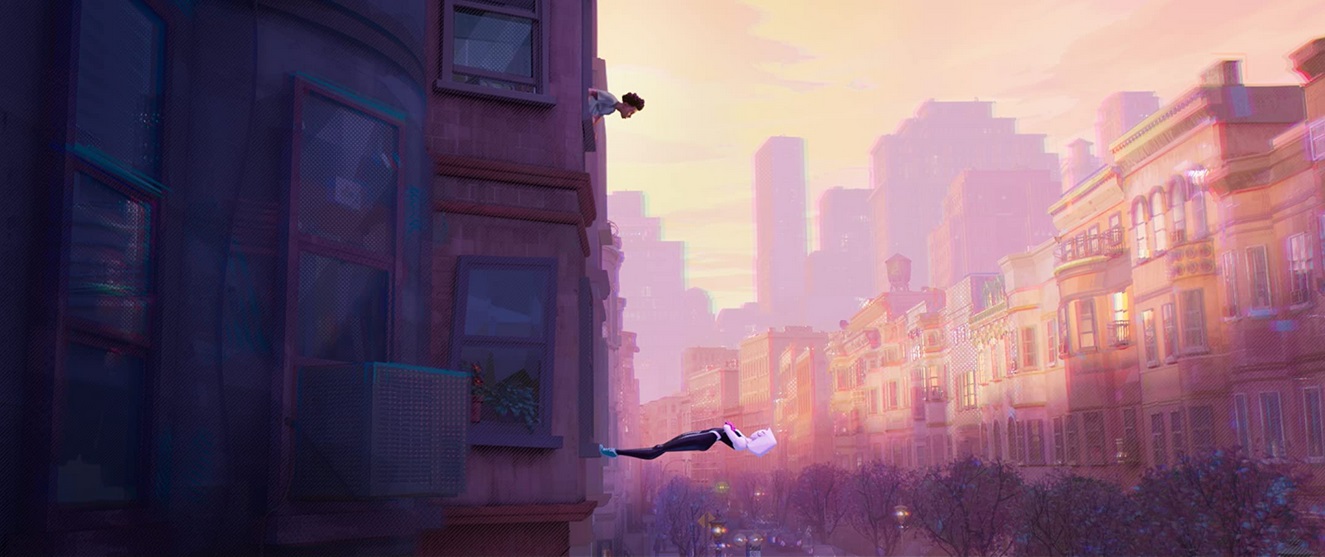
As usual, with these animated sorts of things, I just have to share some frames from the film
that just stuck out at me as particularly beautiful and that I didn't have room for in the text.


*...and one of the best super-hero movies ever.
** I saw it in XD, which was impressive, especially if one is appreciating things like the weave in Miles' Spidey-mask, or the half-tone shading of colors simulating the look of old comic-books.
*** Oh. And Maria Menounos. She really annoys me.