Thursday, September 11, 2025
United 93
Greengrass' ingenious attempt to recreate the events on 9-11 leading up to and during that horrific flight (in real time, one might add) crackles and pops with a cinema verité energy that makes the most mundane of the circumstances take on an ironic heft. We all know how the story went—only if merely how it ends—and it makes all the participants victims and their every action and utterance weighted with irony, their moments, being finite, that much more important. The dawning realization that their rudimentary transport had become part of an organized plot to turn their flight into a weapon of targeted destruction is both horrific and inspiring, moving fast through the stages of grief, they decide to make the best of the situation in which they suspected they would not survive, and acted unselfishly to at least stop any further loss of life wherever they were heading, and, maybe, doubtfully, save their own. In an unfolding world of uncertainty, they acted for the greater good.
It's an amazing story—civilians becoming warriors, victims not settling for that role. And Greengrass' version is done without stars, no grand-standing, just the director's insistence on verisimilitude and energy, not amping the story with false heroics, but only the genuine ones, and enhanced by its own choice not to editorialize.
Tuesday, April 6, 2021
News of the World
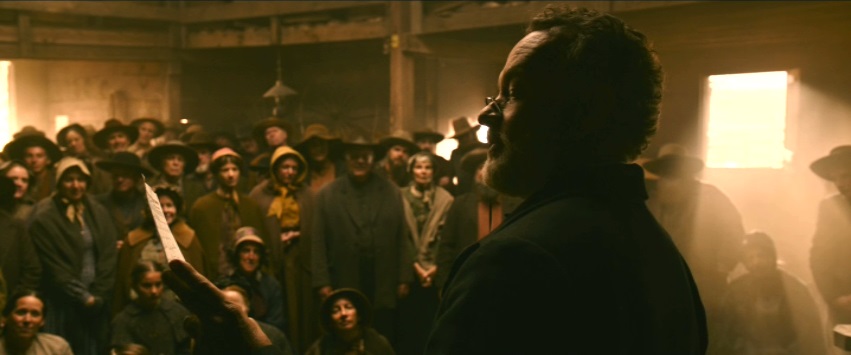
Only in the wagon-wreck is there any semblance of the Greengrass shaky-cam, cuisinart-editing that we've come to associate with his Bourne films or past work. The camera is still a might' restless, but, generally, the film provides good screen-capture material without the customary blurring that usually comes with Greengrass. It's not leisurely, by any means, and the editing still cuts away just before you expect it to, which provides a fair amount of subliminal tension, even if you're wondering just how long this trip is going to be without a bathroom break.
But—as in a lot of Westerns—it's the journey that's important. There's more to Kidd's traveling than news-gathering. He's avoiding something, going back to San Antonio, where he left his wife to go off to war. He hasn't been back since, and the extended travel gives us time to slowly come to terms with Kidd and to Johanna and their shared slice of life and journey. They're both untethered souls—Kidd with his memories and Johanna, twice-orphaned and belonging nowhere, form a bond of necessity and circumstance.
Tuesday, May 5, 2020
The Bourne Ultimatum
Bourne ...Again?I read "The Bourne Identity" decades ago, back when there was still a "Carlos, the Jackal" wandering the Earth, discriminately causing focused havoc and then disappearing. No one had seen him. He had never been photographed, and his reputation as an international terrorist (back in the day, when it had an odd, ghoulish glamour to it) was known world-wide. I bought the book for the "Carlos" angle, and dove into it eagerly.
I hated it. One of the dullest "thrillers" I've ever read, it seemed like it would never end. I wanted to have amnesia just to forget it after finally making it to the last page. It was made into a Richard Chamberlain mini-series which I never saw, and then into a film back in 2002. At the time of its premiere, there was no feeling that it would amount to anything, after all, it starred Matt Damon as Bourne, and his last couple of movies tanked quickly. There'd been a ton of re-shoots and the opening delayed for six months. All bad signs.
So, when I finally caught up with it, I was surprised to find it a good, credible thriller. How? Tony Gilroy's screenplay threw out the book, and kept the "amnesiac assassin" part. Doug Liman's direction kept the thing moving, the fights were spectacular, and even the tired concepts like a car chase through Paris were done with a great deal of panache. It also had a great supporting cast with Famka Potente, Brian Cox, Chris Cooper, Julia Stiles and Clive Owen. Paul Greengrass followed up with an equally spectacular version of The Bourne Supremacy and he's the man in charge of "Ultimatum."
As an exercise in montage, it's absolutely amazing. I rarely saw a shot held for more than five seconds. Greengrass has such a command of what he's shooting and is such a whiz supervising the cut, that you get just enough information to propel you forward--no more, no less--but you never lose a sense of where things are, and the danger the protagonists appear to be in (as opposed to, say, Michael Bay who cuts just as much but never with the discipline of story-telling that Greengrass does). Case in point: there's a long, protracted fight (of course, one of several) in a Tangier apartment. At one point, it heads into the kitchen most of it done in an overhead shot, presumably to hide the stunt-doubles. Now I was watching pretty closely, but, as is inevitable in the kitchen, a knife becomes involved, but I never saw it. I only HEARD it.
Just enough information to advance the plot. It is fascinating to watch.
But despite that, one has to confess that The Bourne Ultimatum has little to differentiate it from The Bourne Supremacy, or The Bourne Identity, other than there are key plot-points, like "The Story Begins" or "A friend is killed." This one picks up immediately where Supremacy ends. Some personal details are cleared up, but it's basically "run to Moscow/London/Tangier/New York and avoid detection/fight/chase." All cleverly done, mind you...but it's barely different from what we've seen before. There is a resolution of sorts, which distinguishes this entry, but that's about it. And, amusingly, the whole thing wraps up with a circular story-telling logic that puts us right back to square one.
"It's over when we've won!" bromides David Strathairn's anti-terrorism "deep cover" head*
With all the room for a sequel that this movie provides, I guess we haven't won yet.
------------------------------------------------------------------------------
Now, to be perfectly silly, here is the chance that the Producers had to have a hit song by changing the title to "Bourne 3." My lyrics for the Main Title song are as follows (to the tune of "Born Free")
Bourne "3"
As "3" as a trio
With fights of such brio,
Bourne "3," just like "1" and "2"
Bourne "3"
The Bourne Ul-ti-ma-tum
Not hard to cre-ate 'em
Just change the cars and locales
Bourne "3"
'cuz trilogies make dough!
The box-sets are in the store
in time for number "4!"
Bourne "3"
The last one that I'll see
It just don't intrigue me
Un-less it's freeeee!
* It's another great cast with Joan Allen and Julia Stiles returning--Greengrass makes maximum use of Stiles' lack of expressiveness--Scott Glenn, and Albert Finney, and a seemingly endless supply of stunt actors who look convincing carrying a gun.
Wednesday, December 19, 2018
Five Came Back
He has expanded his reach and, under Spielberg's "Amblin" shingle directed a 3 hour distillation of Mark Harris' extraordinarily well-researched book "Five Came Back," detailing the war-time careers of five Hollywood filmmakers who volunteered into the Army Signal Corps for the purposes of documenting the war, creating propaganda films for the public and educational films for the troops, with all the professionalism and artistry that they had to bear. The purpose was to "sell" the war and counter the propaganda efforts of the Axis powers, who were creating a new form with the use of film.
![]() |
| Guillermo del Toro takes on Frank Capra |
![]() |
| Francis Ford Coppola talks about John Huston |
![]() |
| Paul Greengrass' subject is John Ford. |
![]() |
| Lawrence Kasdan goes over the service of George Stevens. |
They emerged changed down to their souls and their outlook on life and their art.
![]() |
| Spielberg says he watches Wyler's The Best Years of Our Lives every year. |
Wednesday, May 11, 2016
Captain Philips
Shakin' the Cam/Rockin' the Boat
or
"Everything's Going to Be Okay"
Paul Greengrass, who has succeeded in bringing a visceral documentary feel to even his fiction films (The Bourne Supremacy/Ultimatum, The Green Zone) is back in "Based on a True Story" territory with Captain Phillips, which is about the 2009 cargo ship taken over by Somali pirates, which, in the course of events, resulted in its titular captain being taken hostage for ransom.
Currently, some of the crew of the hijacked cargo ship are in the midst of a multi-million dollar lawsuit with the Maersk line over the events and "in the press" are disparaging the movie's events and the character of Phillips ("anonymously" for legal reasons—as most heroes would do it) now that the movie is released. Their peril was stopped hours after it began. At that point, their safety was assured and the drama stopped. Phillips was stuck in a lifeboat with the pirates for a few days more, and faced an untenable situation that only seemed to worsen as the hours went on.*
Anyway, a lot of bad-mouthing about Phillips being portrayed as a hero in this situation. He's not (although the resulting PR feeding-frenzy-makers like to bandy the word "hero" about at the slightest positive act). He's a victim, more passive than aggressive, trying to survive the situation as much as possible. That much is clear. Earlier this week, we'd did a review about truth and fiction and the compromises film-makers make to save time, money and confusion. We're not willing to go over the same territory twice in one week.
So, how's the movie?
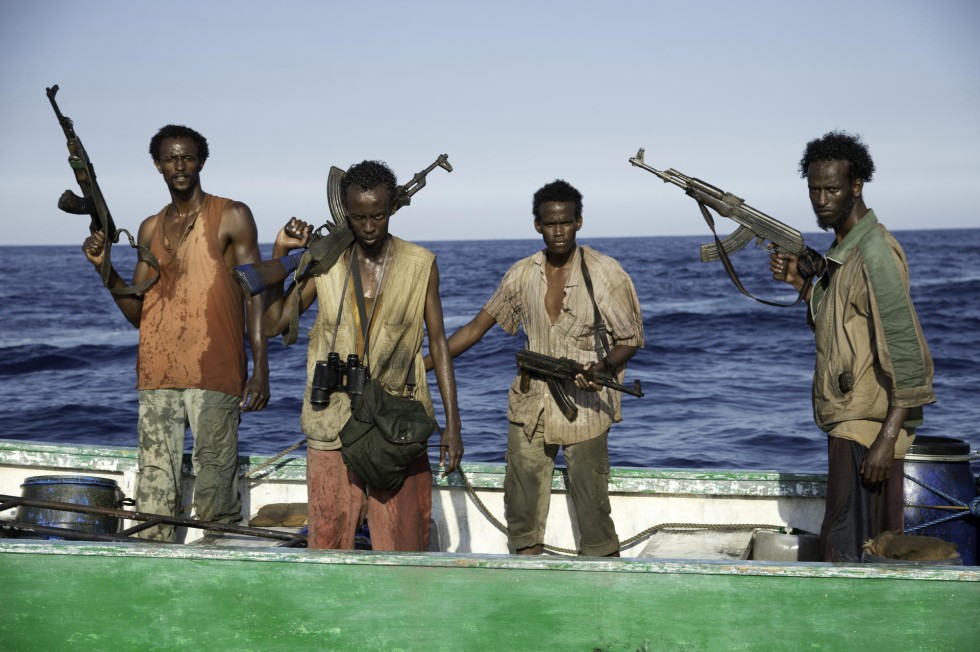
It's quite good, in that edge-of-your-seat uneasiness way. The drama—and melodrama—comes from the "unknown" factors and the "wild card" desperation of the pirates themselves (they're portrayed as excitable, drug-addled** child-men with no other options), simmering at the boiling-point that only intensifies when the scene shifts from the vast cargo ship to the tiny lifeboat that Phillips and the hijackers occupy for the next few days, while the ship's crewmen, the shipping company, and the Navy get their respective acts together. Those expecting a quick-cutting flying fist-fest ala "Bourne" are going to slunk away with pouty-mouths—there ain't that much action here, and when the film gets really good, there's no room for any. No, most of the movie is a waiting game, everybody waiting for an opportunity to make a killing, one way or another. And if something doesn't go anybody's way, there's an escalation of a few seconds until things calm down, then there's a lag where we're waiting for something to go wrong again, and it does...so that the film is an emotional roller-coaster ride for the audience (other than the evidence that Capt. Rich Phillips has his picture all over the place seeming very much alive).
| Barkhad Abdi as the de facto leader of the pirates. Nominated for a Best Supporting Actor, I'd like to see more of this guy. |

So much of the film depends on the presence of Hanks in the starring role; we spend the most time with him and the actors portraying the Somali's, who have the same sense of menace throughout (although some pains are made to make sure that Barkhad Abdi's ring-leader, Muse, is set apart from the others—the others come down to "the driver," "the injured kid," and "the wild-eyed crazy one").
It recalls a story about the marketing of Apollo 13, which originally had a poster of the perilous situation—the spacecraft leaking oxygen going around the dark side of the Moon—but fearing for their investment, the producers opted for one that had Tom Hanks front and center in a claustrophobic layout. The reason for this being that audiences might not care for the situation depicted in the earlier poster, but if there's a poster where Tom Hanks is worried that he's in trouble, that might bring a sympathetic audience in, hoping that the popular actor would attract a crowd. And so the actor-specific poster (despite an all-star cast) was substituted. One wonders if it might be the same reason that Executive Producer Kevin Spacey is not portraying Phillips; maybe folks wouldn't worry about Spacey so much, but Hanks' every-man persona might make a monetary difference at the box office.
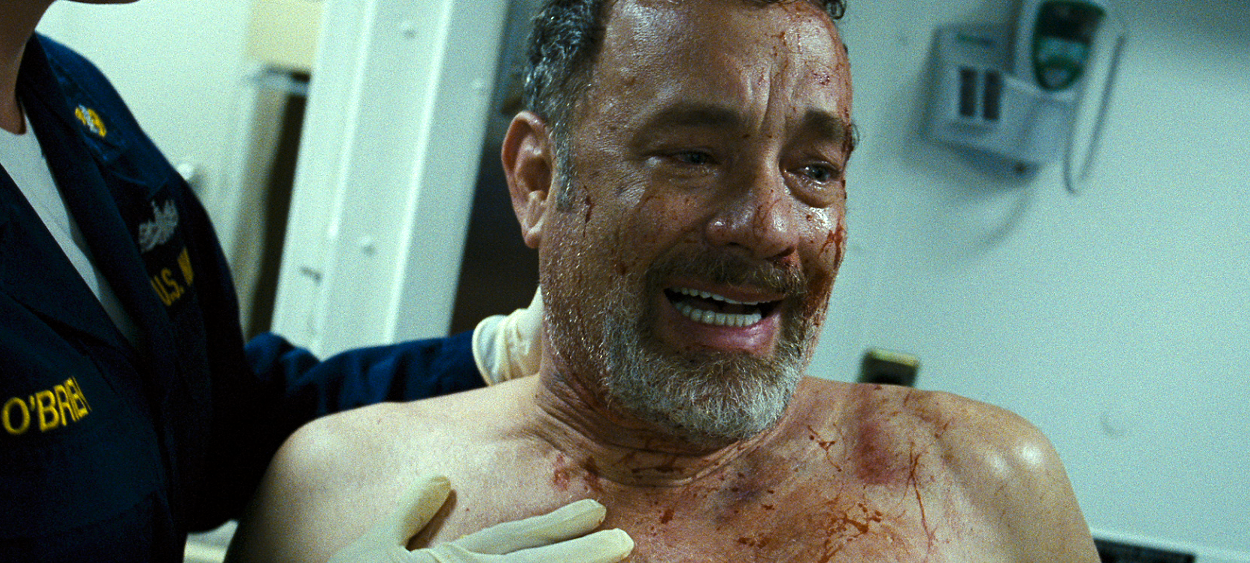
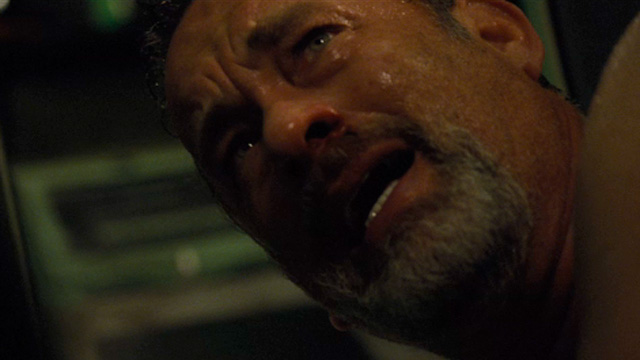
In any case, Hanks does a fairly good job at maintaining a veneer of calm while an undercurrent of panic roils through him. But where he really shines—to the point where it's amazing to see—is the way he projects the character's shock at the end of the film, and one has to applaud Hanks for displaying a total break-down without once making us recall his crying for a volleyball.*** Despite his reputation as a male version of America's sweetheart, he is a good enough actor to still surprise and move, over one's objections.
** In the film, they're constantly chewing khat.
*** That would be his loony-toons turn in Cast Away. If I had a nickel...