Written at the time of the film's release...
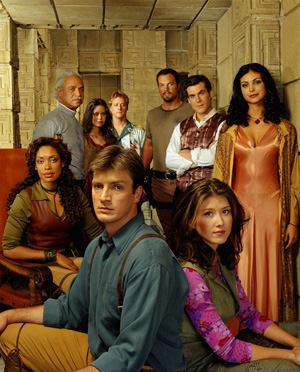
Serenity (Joss Whedon, 2005) Enjoyable, if violent, genre-bendin' space-farin' Western spinning off from the one season wonder "Firefly." But Serenity (that's the name of the ship) passes the crucial test of movies that make the leap from small to big screen—you don't need to have seen the series to "get" the concept and enjoy the film (probably because the concepts are so familiar). Sharply written and directed by series creator Whedon, and played by the regular cast, it boasts an intensely underplaying Chiwetel Ejiofor as a government operative who ritualistically silences outliers.
And outliers are exactly what the crew of the "Firefly"-class "Serenity" is comprised of; pirates, soldiers of fortune, outlaws, the scrappy veterans of the Galaxy's last civil war, who bounce from system to system dodging government entanglements and making a living by lying, cheating and stealing. Plus, they do good while doing bad.
The conceit of staging a Western in the infinitely wide-open spaces isn't new. "Star Trek" was sold to NBC as being "Wagon Train to the Stars"--not exactly true, but the suits got the point, "Star Wars" used Han Solo as a space cowboy ala Hondo (which Chewbacca as his faithful dog...or horse), and the "Wars" rip-off Battle Beyond the Stars was "The Magnificent 7 in Space." There isn't that much of a light-speed leap from horse-opera to space-opera. After all, the umbrella-genres of westerns and sci-fi can encompass all sorts of story-themes from Shakespeare to cleverly disguised issues of the day.
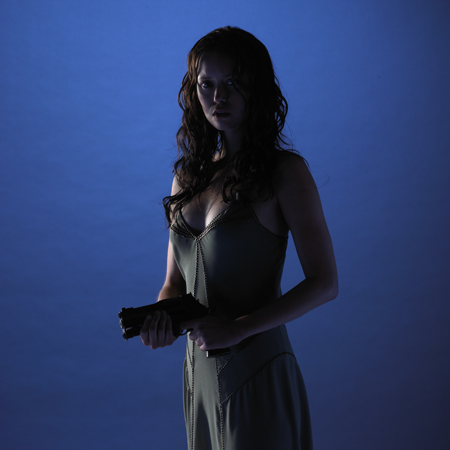
The plot for Serenity back-tracks a bit* to catch movie-goers up with the story of fugitives River Tam (Summer Glau) and her doctor-brother Simon (Sean Maher) and then resolves the conflicts their paid passage aboard Captain Mal Reynolds' (Nathan Fillion) ship of fools has created, and turns River from loose cannon on deck to a reliable asset. Along the way the crew stumbles on a gone-wrong planet-wide government experiment being kept under wraps. And since they're being pursued by "the op," anyway, they "aim to misbehave."
The characters are broadly drawn, easily discerned, and everyone is given significant plot-time (with the exception of Morena Baccarin's space-zen-hooker Inara, whose role was edited for time). Though not a success at the box office, it did spur interest in the series and kicked its box-set collection into hyper-drive. Though Whedon constantly discounts it, the crew of "Serenity" may fly again.
2020 aside: I'd still like to see it, as the film inspired a deep-dive into the TV series for me, although getting Fillion back would be a task—not to mention writer-director Whedon. And, given how everybody's aged a bit, it's going to have to surmount the "Star Trek movie-issue" of providing a sufficient reason for everybody getting back together, assuming that characters have gone separate ways and forged bonds elsewhere. Still, it was Whedon working on something he WANTED to work on and that usually entails his best work. I think a lot of it has to do with that I became a fan after it died...All that there was had already been done. And it was finite.
Maybe it's best to move on.
* In a film-starting series of illusions that nest together like Matryoshka dolls.
Showing posts with label Joss Whedon. Show all posts
Tuesday, July 14, 2020
Serenity
Labels:
2005,
Adam Baldwin,
Alan Tudyk,
Chiwetel Ejiofor,
Gina Torres,
Jewel Staite,
Joss Whedon,
Morena Baccarin,
Nathan Fillion,
Ron Glass,
S,
Sci-Fi,
Sean Maher,
Summer Glau,
TV Remake
Saturday, May 30, 2020
Notes on the DCEU
I'm going to be recording a podcast discussing the DC Extended Universe films later today and I thought I'd do a gut-check on current thoughts about them that have differed from my views in the offered posts...it's a way of putting things into perspective and eliminating free-ranging thoughts that aren't pertinent—the panel is going over five films and detours and dead-ends won't help much.To review, here are the posts of the five films in question:
Man of Steel:
https://bloggingbycinemalight.blogspot.com/2016/03/man-of-steel.html
Batman v Superman: Dawn of Justice:https://bloggingbycinemalight.blogspot.com/2016/03/batman-v-superman-dawn-of-justice.html
Wonder Woman:
https://bloggingbycinemalight.blogspot.com/2017/06/wonder-woman.html
Justice League:
https://bloggingbycinemalight.blogspot.com/2017/11/justice-league.html
Aquaman:
https://bloggingbycinemalight.blogspot.com/2019/01/aquaman.html
1) There are films missing: Suicide Squad, Shazam!, Birds of Prey. There is a shared Universe aspect to these...Ben Affleck's Batman and Ezra Miller's Flash appear in Suicide Squad, and Henry Cavill's SUIT appears in Shazam! but these films are back-channel/alleyways to the main streets of the other films...the way Guardians of the Galaxy appeared when its trailer plunked down in the middle of the Marvel run of movies.*
Also, there are other films missing: Christopher Nolan's "Batman" films—it was Nolan's success with these that steered Warner Brothers to expand their DC Comics properties and drag them out of development hell, and they pegged Nolan to spear-head Man of Steel as executive producer. He was part of the decision-making team that hired Zack Snyder to direct and helm the project and oversee the accelerated the roll-out of the DCEU.
The biggest difference between the Marvel and DCEU game-plan is that DC had no executive overlord like Marvel's Kevin Feige to master-plan the films and the hired-hand directors must do battle with the Warner Brothers studio over all strategic matters. There once was a time when Warner Brothers would champion the films of directors like Stanley Kubrick and Robert Altman and so many others—the priority was the films. Now, it's the bottom line.The money has always been important, of course. Everything about a film, especially its budget, is concerned with making that money back and extend it to profit. But, these superhero movies are considered less than movies: the goal is not to tell a good story or make a good film, but to make as much money as possible. They are properties, but more than that, they are considered "tent-poles" on which studios depend for their very existence lest they fold. That's a lot of weight to be put on a pole.
The emphasis should be on making one good movie, rather than a series of them. Don't count super-chickens before they're hatched; make a good one and then you have the right to make any further ones. But, not until. There's a story about Sean Connery: Christopher Reeve called him (when he was cast as Superman for the 1978 Richard Donner film) and asked the man who was James Bond how to avoid being typecast and Connery's reply was apt: "First, be good enough that you DO get typecast, then worry about it..."
Studios should heed the advice.
2) The reviews were written of their time; If the movies had premiered in a media-vacuum, there might have been less time spent on the reactions, assumptions, speculations...and outright mendacity upon (and even before) the films' releases. My reviews are a bit too much a push-back against all that noise; better to stick to the subject than the echo, of course. Perhaps I'm giving the two "Batman" films too much credit—I do think they took admirable chances—and the display of the fallibility of Batman (exploiting his cynical cautionary nature) is a good choice, but at the expense of the Superman-dark emphasis, which might have been a fatal flaw in Batman V Superman. Snyder's Superman is so morose and misunderstood, one doesn't feel tragedy at his death, merely a deepening depression—we never see "the big blue boy-scout," only Superman under siege and doubting, never sure of his purpose and offer inspiration. We only see Batman's view (exacerbated by Lex Luthor's machinations) and that is not a pleasant movie-going experience. At least Justice League allowed a glimpse of "that" Superman to offer the contrast, but by that time the murk of the DC Universe is so pervasive that it's almost jarring.
3) It was announced this week that the mythical "Snyder-cut" (or "A Snyder-cut") of Justice League will be made available on HBO MAX next year. One wonders exactly if it's necessary or what it will entail. Some effects work needs to be completed, evidently, and this version is reportedly 4 hours long...whether it is the originally conceived two-part film or merely a really long part one, one can only speculate (and there's quite enough of that going on). One suspects it will be a mixture of good and bad, not unlike the "Donner-cut" of Superman II, but at least one would be able to see the original intention, rather than the make-shift corporate compromise Warner Brothers sanctioned.
Wednesday, November 22, 2017
Justice League
or
"Well, I'm All About Truth. But, I'm Also a Big Fan of Justice."
I'll try to stay on point here; my instinct in writing here is to explore the way "the voice of the mob" is so inconsistent when it comes to addressing what is actually IN the movie Justice League. What might have charmed before is now criticized, skewing to some different perspective in the space of one film's production history. I've read some reviews and just shake my head (there's a romantic scene between Batman and Wonder Woman? Where? The main villain is unknown is a complaint—and everybody knew all about Surtur from Thor: Ragnarok? Would they have preferred Starro the Conquerer, the space-starfish, or Kanjar Ro whom everybody is aware of*) What am I seeing that they are not? What are their prejudices, their already-made assumptions that I walked in without? One of Roger Ebert's most-used quotes in his writings was Robert Warshow's: "A man goes to the movies. A critic must be honest enough to admit that he is that man." Reading some of the reviews (after ACTUALLY seeing the movie) I'm suspecting a lot of hidden agendas and preconceived notions that made it into print. I'm suspecting dishonesty. Frankly, I'm not surprised. And disappointed. But, not in the movie...
Oh, yeah...there's a movie.
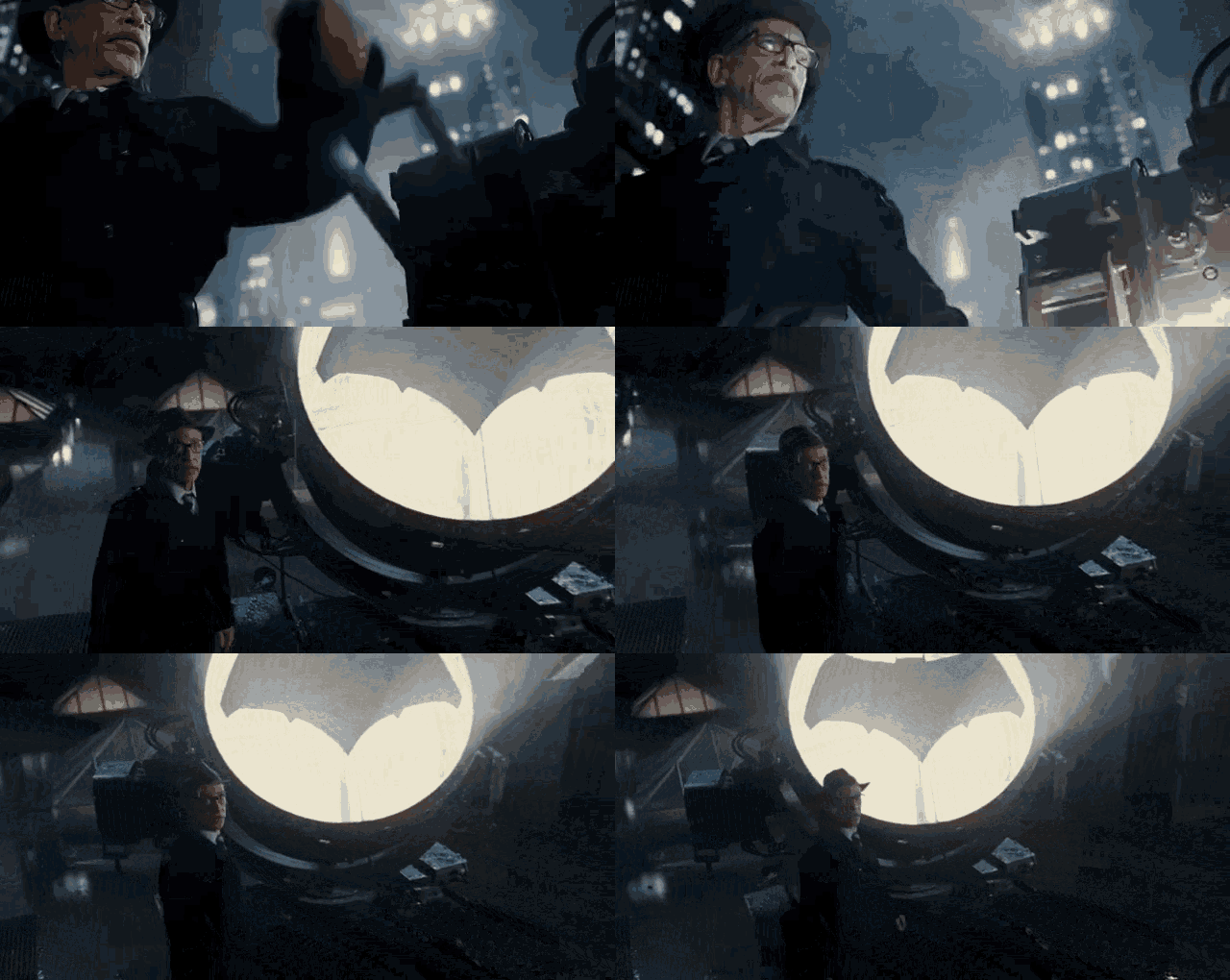
Justice League is short for a super-hero flick, especially for a team super-hero flick—just a minute shy of two hours.** For a film of the golden age it's a bit longish, but those films were a lot more 'tight" and thought out than today's multi-media extravaganzas with long lists of writers and several special effects studios involved, all trying to cram as much material into a movie as they can. There have been some changes in the scenario—what was planned as two films have been scoped down to one, which*** will streamline the first as a stand-alone film and do some shorter films, in the meantime, just to give the series some flexibility). It gives the first movie some "air" to flesh out new characters (three major ones are introduced, with some star-filled back-story) and keep things fairly simple. After all, we're just getting used to Ben Affleck as "The Batman," Jeremy irons as Alfred, and now we have J.K. Simmons as Commissioner Gordon.
All that business makes the movie start out a little messy, fluidity-wise. We have five super-people to visit and try to understand (there is a pre-credits sequence and an eloquent Main Title set to a Leonard Cohen tune, but we'll get to that): Batman is doing his usual thing terrorizing Gotham criminals on rooftops. but seems to have a hidden agenda here—using a mug's fear to attract a Parademon-one of Jack Kirby's Fourth World flying minions—which takes him on a night-flight he doesn't quite expect***; Wonder Woman takes down a group of zealous terrorists trying to blow up a bank; Wayne goes up north to investigate the story of a man named Arthur Curry (Jason Momoa) who helps a fishing town get through its tough winters; Barry Allen (Ezra Miller) goes to prison to visit his father (Billy Crudup), accused of killing his mother, in prison; and, Silas Stone (Joe Morton) a researcher at S.T.A.R. Labs, after accepting a co-worker's condolences for the death of his son, Victor (Ray Fisher), goes home to his apartment to find that his son—3/5 of his body replaced with an alien cybernetic technology—now has jets in his heels that allows him to hover. "Couldn't do that last night" says Victor. Things are changing.
Superman (Henry Cavill) is dead. The world mourns (because you don't know what you've got 'til it's gone). Lois Lane (Amy Adams) is working on fluff pieces at The Daily Planet. Ma Kent (Diane Lane) has moved from the Kent farm as it's been foreclosed. Batman is having nightmares that the world may be ending and has started trying to recruit a team of super-heroes to take the place of Superman, feeling guilty about the role he played in his death. "You're out of your mind, Bruce Wayne," says Arthur Curry when he rejects his offer.
"Doesn't mean I'm wrong," he counters.
If this all sounds like "The Fellowship of the Mother-Boxes" you would be right. But, whatever it seems like, Steppenwolf now has one of the three gizmo's and Queen Hippolyta (Connie Nielsen) uses a long-forgotten signal to alert the world of Man about the theft. But, it's not men who will understand the message, it will be her daughter, Diana. Meanwhile Curry (or Aquaman, if you'd rather) goes back to Atlantis just in time to see Steppenwolf take on Atlantean guards and Mera (Amber Heard—impressive until she talks) to grab the second Mother-Box. The two events are enough to amp up Bruce and Diana's recruiting efforts to form the Fellowship...er, Justice League, as they bring in Barry Allen's "Flash" and Vic Stone's "Cyborg" ("We're the two accidents," says Allen) into the fold.
But, it isn't enough. When the four barely escape being drowned by Gotham Harbor only due to a save by Aquaman, Batman comes up with a hair-brain scheme; just like Luthor brought Zod back to life and the mother-box brought Vic back to human form he wants to use it to bring Superman back from the dead. This is an idea that horrifies Wonder Woman, causing the two to start taking shots at each other culminating in Diana slamming Batman into a wall. But, it...could...work. "I was doing calculations while you were being an asshole," says Cyborg, and it quickly becomes apparent that his character is going to be a combination of a deus ex machina and a swiss army knife.
They do bring back Superman, and the Last Son of Krypton ain't too happy about it. In fact, he's so pissed he takes on the four super's, holding them at bay, knocking them all cold, leaving him to take a particularly good grip on Batman's throat and asking him "do you bleed?" He will, but not before he's confronted by another of Batman's ingenious counter-moves, this one far more empathetic than kryptonite vapors and piercing sonics.
![]() |
| "Oh, crap...he's not happy..." |
Still, the movie is better than reviews and the prevalent click-snark would have you believe. The performances are great. There's been some grousing about Affleck's Bruce Wayne being a bit of a drag. Well, no shit. That's the character, the same one that was praised to the skies in Batman v. Superman, which was all of one movie ago (How soon we forget). How fickle we are. Gail Gadot, of course, steals every scene she's in, and that in itself is some sort of super-power beyond human ken. Jason Momoa has the unenviable task of playing Aquaman—the perpetual DC super-hero joke—but, darn, if he doesn't make it work, even if the character is less regally "The King of the Seas" and more WWE bad-ass. Ezra Miller is all hyper-kinetic neuroticism as Barry Allen and I wouldn't have thought that it would "play", if he wasn't so effective doing it. And Ray Fisher's Vic Stone could have been the piece's "gloomy gus" if the character's steel-enforced pluck didn't come shining through.
So much of the criticisms are for what's not there—no black Super-suit (that was just internet speculation with no real basis in fact) or any other of the rumors that were mere fan-boy wish-lists, and no romance between Diana and Bruce—EW's Dana Schwartz (callin' you out for this bullshit) reported that a woman near-by in her screening theater moaned an anticipatory "oh no" for a scene when Wonder Woman "goes to dress Batman's wounds." Uh...no. She pulled his arm back into its socket. This was emblematic of "sexual chemistry" in her "tweet's". I don't know what "sexual chemistry" you have with your sports-therapist, but wrenching pain ain't normal. And, either a visit to the optometrist or a psychiatrist is in order before your next movie review (and I wouldn't go agreeing with random idiots, either). The quality of click-bait seems to be declining precipitously.
![]() |
| "oh no"....Yeah. No. |
Finally, after three movies, "they" got Superman right. In Justice League, Bruce Wayne opines that Superman "was a beacon." I'm not sure how he knows this as, in the previous movie, Wayne spent his time horrified at the destruction the character caused in his wake (it's interesting to me that Snyder spends a lot of time in his follow-up's explaining the upsetting things in his past movies), and actively trying to stop and/or kill him. What 'beacon" is he speaking of? Not the gloomy, depressed outsider-alien of Man of Steel and Batman v. Superman. The "scary monster" dark-Superman that has been unfortunately fashionable and seemingly relevant of late? Maybe he's thinking of a nostalgic view of Superman—you know, Christopher Reeve's Superman, the one who fights for "truth, justice and the American way." Zack Snyder (and Christopher Nolan, let us not forget, who started these things and is still executive producer on Justice League) has never shown us "that" Superman, the inspiring one. Until now. When "that" Superman shows up late in the film, and Henry Cavill (honest to God) inhabits him like it's the easiest thing in the world, it is a breath of fresh air, a tonic, like a weight has been taken off the film and the DC Cinematic Universe. That's the guy we want to see. The guy who can make Vic Stone laugh despite the pain. The guy who can call "The Flash" "slow-poke" and spur him on. The inspiring one. The beacon. The one that has been sorely missed. Justice League gets that so right.
And it's about bloody time.
* sarcasm alert.
** Marvel's films and the DC films of Warner Brothers have been clocking in at 2 1/2 hours—the extended cut of Batman v. Superman ran close to 3 hours. Interestingly, Snyder's longer film "feels" less long than the cut version. This happens. I remember seeing a 2 1/2 chronological cut of Once Upon a Time in America (Paramount Studio interference) that seemed interminable, but Sergio Leone's 3 1/2 version never gave a sense of time passing...it breezed along, despite being an hour longer.
*** I suspect, with no evidence to back it up, that the makers were going to bring in Darkseid—the big bad "New God" in the DC Universe, created by Jack Kirby, for the second film but have backed off on the idea.
*** And here's an odd thing that I'll leave out of the upcoming "Things That Bother Me" section: After his little "Superman and Lois" flight through the Gotham night with the Parademon, some guy comes up to him and says "what was that?" and Batman goes into a long explanation to him. Is this some stranger? But my assumption was it's the robber that Batman bat-lassoed before.This guy's a criminal, right? What's Batman doing "just" talking to him—shouldn't he be arresting him? If it's some random stranger on some random rooftop the Parademon dropped him onto, shouldn't the guy's first words be—"W'oh! Do you know who you are? You're The Batman! I thought you were a myth! Are you? I can't believe I'm talking to the Batman. Can I take a selfie?" This is one of those elements of sloppy film-making that either Snyder committed, or was created due to the re-shoot editing process (which, one would assume, is supposed to ELIMINATE such things).
**** Here's any interesting test for critics—name some other Jack Kirby characters. You'll basically be describing the vast output of the last few Marvel movies. The guy was "everywhere."
Tuesday, April 26, 2016
Much Ado About Nothing (2013)
"...a Giddy Thing."
or
The Party @ Joss' House
Joss Whedon is a fine writer and a great director. His output in movies is slim (in TV, of course, it's prodigious)—Serenity, Dr. Horrible's Sing-along Blog, and Marvel's The Avengers, meaning he's got range and he's no slouch—but there's a high-standard operating there whether budget is low or high, and there's an artistic determination to make "pop" that matters. The story is that for a long time he's been staging readings of Shakespeare plays at his house with friends and acquaintances, just because he loves Shakespeare. That must have been the impetus to make this movie—Much Ado About Nothing—filmed in 14 days during the long arduous post-production of The Avengers.*
Must have seemed like a lark during so much Hulking pixilation.
The story's virtually unaltered from the text. It's just transformed to modern day at Joss' house, where a weekend long party is being thrown for...not so much returning soldiers, but captains of industry—hosted by Leonato (Clark Gregg) and daughter Hero (Jillian Morgese) and cousin Beatrice (Amy Acker). The chief guests are Don Pedro (Reed Diamond), Claudio (Fran Kranz), the Don's nefarious brother John (Sean Maher), and Benedick (Alexis Denisof). Now, this is one of Shakespeare's comedies, so pay attention: Benedick and Beatrice have history, which didn't go well and they're still equally bitter about it, protesting too much that they're both above it all. Claudio becomes entranced with Hero, and is wooed on his behalf by Don Pedro. Things get complicated with two household conspiracies: Don John conspires to way-lay the lightning-fast nuptials of Hero and Claudio, and seemingly the entire party has it in to throw the two grousers, Benedick and Beatrice, together. Both plans work all too well, splintering one and making the other a matter of necessity. In the meantime, the local constabulary, led by Dogberry (Nathan Fillion) are working overtime, trying to discover what all the skulking and whispering is about.
The play may be the thing, but it is in Whedon's presentation that it shines. It is something of a revelation to see how well the early scenes play when everybody is a little bit liquored up, and the performances are surprisingly smooth, belying the pigeon-holing that these mostly television actors have had to suffer, when they can do deftly handle the meatier material—Acker, particularly, is amazingly versatile, and is the clear stand-out in the performances—you could actually believe she thinks in blank-verse—and is nearly note-perfect making the words her own. And Fillion plays his relatively small part in a cagily puffed-up manner the way you'd think William Shatner would (seriously or no) in order to squeeze every drop of comedy out of it. In fact, everybody's good, as there's only a couple minor roles that seem a little dodgy, but not for want of trying. Whedon is very adept at throwing in puckishly physical comedy into the background at a moment's notice to make the play three-dimensional, and sometimes laugh-out-loud hilarious.
Interestingly, if Whedon made this as a detox from The Avengers, it had the same effect here; after suffering through so many over-blown-up and bloated blockbusters, it was a delight to see this quick, brisk little film, with few pretensions and very high gains. It's really something, well worth seeing, and one looks forward to another party at Joss' house.
or
The Party @ Joss' House
Joss Whedon is a fine writer and a great director. His output in movies is slim (in TV, of course, it's prodigious)—Serenity, Dr. Horrible's Sing-along Blog, and Marvel's The Avengers, meaning he's got range and he's no slouch—but there's a high-standard operating there whether budget is low or high, and there's an artistic determination to make "pop" that matters. The story is that for a long time he's been staging readings of Shakespeare plays at his house with friends and acquaintances, just because he loves Shakespeare. That must have been the impetus to make this movie—Much Ado About Nothing—filmed in 14 days during the long arduous post-production of The Avengers.*
Must have seemed like a lark during so much Hulking pixilation.
The story's virtually unaltered from the text. It's just transformed to modern day at Joss' house, where a weekend long party is being thrown for...not so much returning soldiers, but captains of industry—hosted by Leonato (Clark Gregg) and daughter Hero (Jillian Morgese) and cousin Beatrice (Amy Acker). The chief guests are Don Pedro (Reed Diamond), Claudio (Fran Kranz), the Don's nefarious brother John (Sean Maher), and Benedick (Alexis Denisof). Now, this is one of Shakespeare's comedies, so pay attention: Benedick and Beatrice have history, which didn't go well and they're still equally bitter about it, protesting too much that they're both above it all. Claudio becomes entranced with Hero, and is wooed on his behalf by Don Pedro. Things get complicated with two household conspiracies: Don John conspires to way-lay the lightning-fast nuptials of Hero and Claudio, and seemingly the entire party has it in to throw the two grousers, Benedick and Beatrice, together. Both plans work all too well, splintering one and making the other a matter of necessity. In the meantime, the local constabulary, led by Dogberry (Nathan Fillion) are working overtime, trying to discover what all the skulking and whispering is about.
The play may be the thing, but it is in Whedon's presentation that it shines. It is something of a revelation to see how well the early scenes play when everybody is a little bit liquored up, and the performances are surprisingly smooth, belying the pigeon-holing that these mostly television actors have had to suffer, when they can do deftly handle the meatier material—Acker, particularly, is amazingly versatile, and is the clear stand-out in the performances—you could actually believe she thinks in blank-verse—and is nearly note-perfect making the words her own. And Fillion plays his relatively small part in a cagily puffed-up manner the way you'd think William Shatner would (seriously or no) in order to squeeze every drop of comedy out of it. In fact, everybody's good, as there's only a couple minor roles that seem a little dodgy, but not for want of trying. Whedon is very adept at throwing in puckishly physical comedy into the background at a moment's notice to make the play three-dimensional, and sometimes laugh-out-loud hilarious.
* Danny Boyle took the opportunity of down-time planning the British Olympics to make Trance. A few years ago, Robert Zemeckis took the delay-time for Tom Hanks to lose weight for Cast Away to make What Lies Beneath, and Barry Levinson took advantage of down time on Sphere to make Wag the Dog.
Tuesday, May 5, 2015
Avengers: Age of Ultron
"Is That the Best You Can Do?"
or
Considering Sokovia's Impact on the World
The Avengers was a big deal. Two years in the teasing and planning, it was a construct of cross-character integration of the main-stays of the Marvel Movie Universe—its greatest hits of sorts—that pulled disparate elements together while celebrating the differences in its players. It found moments where those contrasts could function as story and team-building. It was a minor miracle of a movie becoming greater than its separate elements. It's writer-director, Joss Whedon, made few if any missteps in that first film and seemed to do no wrong. He became the "go-to" guy in the "Marvel Movie Universe."
And it made billions of dollars. So, anticipation was high for the inevitable second movie bringing together the team that gives their all to stop threats that have already happened—The Avengers.
That second one, Avengers: Age of Ultron, is bigger, with more characters (bringing in some of the supporting tier from the franchises to bring some color—literally—to the group—sad to say, I've been blind to the fact that all The Avengers are white, white, white) and expanding the star-factor with (roll-call!) Robert Downey Jr., Chris's Evans and Hemsworth, Mark Ruffalo, Scarlett Johansson, Jeremy Renner, Samuel L. Jackson, Cobie Smulders, along with Don Cheadle (use this man, please!), Idris Elba (ditto!), Anthony Mackie, Stellan SkarskgÃ¥rd, Julie Delpy (cameo), Elizabeth Olsen and Aaron Taylor-Johnson, Paul Bettany, Hayley Atwell (cameo), Linda Cardellini, Andy Serkis (in the flesh, this time) and that's without mentioning tons of extras and floods of CGI characters—mostly doing the stunts for the leads—who briefly morph with the pixelated ones in close-ups (and some of the effects work is a bit dodgy) to let us know they showed up on stage at some point.
There are 21 special effects houses involved in it, two composers (Brian Tyler and Danny Elfman) for the wall-to-wall music, locations spanning the U.S. (urban and rural), South's Africa and Korea, Italy, Bangladesh and England. There are all manner of vehicles, and more action sequences that feel like free-for-all's with the occasional tag-team effort.
It's bigger, certainly. But not better. The emphasis is on action (which people like and have come to expect) and less on the character interactions (which is frankly tougher to pull off because they require imagination and not the kind that can be engineered on a drawing board), which made the first one sparkle. The villain of this one, an attempt at A.I. defense called Ultron (portrayed via motion-capture by James Spader) has little appeal—a malevolent attitude, certainly, but little wit (which made Tom Hiddleston's Loki a fun villain) and the movie suffers from the lack of anti-charm.
or
Considering Sokovia's Impact on the World
The Avengers was a big deal. Two years in the teasing and planning, it was a construct of cross-character integration of the main-stays of the Marvel Movie Universe—its greatest hits of sorts—that pulled disparate elements together while celebrating the differences in its players. It found moments where those contrasts could function as story and team-building. It was a minor miracle of a movie becoming greater than its separate elements. It's writer-director, Joss Whedon, made few if any missteps in that first film and seemed to do no wrong. He became the "go-to" guy in the "Marvel Movie Universe."
And it made billions of dollars. So, anticipation was high for the inevitable second movie bringing together the team that gives their all to stop threats that have already happened—The Avengers.
That second one, Avengers: Age of Ultron, is bigger, with more characters (bringing in some of the supporting tier from the franchises to bring some color—literally—to the group—sad to say, I've been blind to the fact that all The Avengers are white, white, white) and expanding the star-factor with (roll-call!) Robert Downey Jr., Chris's Evans and Hemsworth, Mark Ruffalo, Scarlett Johansson, Jeremy Renner, Samuel L. Jackson, Cobie Smulders, along with Don Cheadle (use this man, please!), Idris Elba (ditto!), Anthony Mackie, Stellan SkarskgÃ¥rd, Julie Delpy (cameo), Elizabeth Olsen and Aaron Taylor-Johnson, Paul Bettany, Hayley Atwell (cameo), Linda Cardellini, Andy Serkis (in the flesh, this time) and that's without mentioning tons of extras and floods of CGI characters—mostly doing the stunts for the leads—who briefly morph with the pixelated ones in close-ups (and some of the effects work is a bit dodgy) to let us know they showed up on stage at some point.
![]() |
| There's a lot of this... |
![]() |
| And a lot of this... |
Far, far too much of this...
His plot is to bring peace to the world...but through extinction, and his manner of doing so is an elaborate natural disaster that will poison the planet to wipe out humanity in the same way dinosaurs were rubbed out. For an artificial intelligence, Ultron is not very bright—what good is peace if there's nothing around to enjoy it, and (by the way) no sustainable grid with which to recharge. Maybe Ultron needed more time in sleep mode to calculate his plan to the last decimal.
![]() |
| Not enough of this... |
![]() |
| Way too little of this... |
Too much of this...
The corps is still the corps: there's the big three—Cap, Iron Man and Thor—and (as they used to sing on "Gilligan's Island") "the rest"—Hulk, Black Widow and Hawkeye—with the remnants of S.H.I.E.L.D. (Nick Fury, Hill) as support, showing up in the nick (no pun intended) of time. With the decimation of S.H.I.E.L.D HQ in CA: Winter Soldier, the Avengers now have their own New York pad—apparently the former Stark Industries—that sticks out like a sore, easily targetable thumb on the skyline—it even has the Avengers logo on it to help even the dumbest of villains know where to aim. It's no wonder that one of these complexes gets destroyed every single movie.
![]() |
| I'm okay with this... "Is that all you've got?" he says, reading my mind. |
![]() |
| This, too much... |
![]() |
| And this... |
Maybe, it's just that first movie seemed so fresh because it was the first time seeing the "assembled" Avengers, and any follow-up was going to seem not as inspired and old-hat. Whatever the reason, this time, they're not assembling, they're dissembling—I'm not exactly sure what the point of it was, after all that, other than to make another bazillion bucks. The idea of that underwhelms me, as did the entire movie itself.
The whole film left me feeling like this:
And this...
* Here's an asterisk without any sort of link to the main body of the text—don't strain yourself looking for it. Also, don't stay throughout the credits expecting one last little tease. There isn't one. The brief appearance of Thanos (Josh Brolin) is all there is.
![]() |
| My favorite part...because it was unexpected. |
Subscribe to:
Comments (Atom)