Showing posts with label Ray Fisher. Show all posts

Wednesday, September 15, 2021

Zack Snyder's Justice League

Zack Snyder's Justice League
(Zack Snyder, 2021) Buying the DVD of Zack Snyder's Justice League—his sanctioned "taking-back" of the Warner Brothers "studio-notes" theater version—cost as much as two months of HBOMax, and I must say, in comparison, it was a bargain. I have been reluctant to be swayed into buying into streaming services, maintaining that theaters will come back, and there are very few enticements for having them take money out of my accounts month after month, when the economic model necessitates other means of seeing them.
 
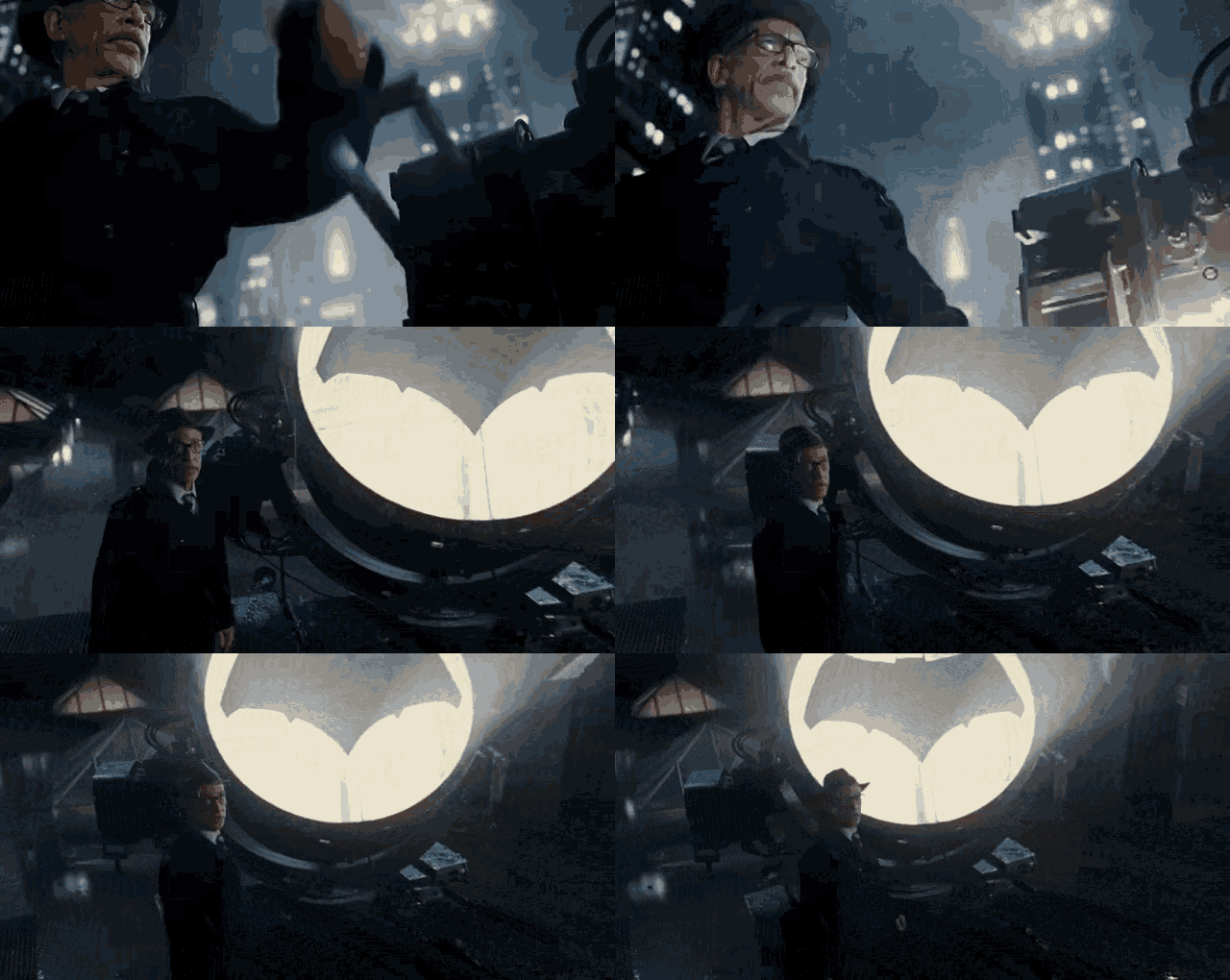
So...(I hear you ask) "is it better?" Yup. And by a wide margin. My initial review of the theatrical version of Justice League was somewhat laudatory—more concerned with knee-jerk backlash towards it—but, in seeing it again a couple times one could see the pacing issues, grating inconsistencies of tone, a certain desperation in the product to compress the content gracelessly and be winsomely attractive. "The Snyder Cut" takes more chances and takes a lot more time doing it. The Warner mandate to cut Snyder's intended two-part 4 1/2 hour opus into a single 2 hour film must have seemed an impossible feat to accomplish (and one must give kudo's to Joss Whedon for even attempting it and managing to meet their specs despite the ham-fisted result), especially when the evidence shows just how much of Snyder's film wasn't in the theatrical version (which we'll simply call "Josstice League"). The story is basically the same, but, good Lord, there are whole completely different versions of scenes throughout the thing, with nary a line repeated. There are bits and pieces in the story-line—the first Earth-war with Apokolips, the Gordon scenes, the confrontation at the "Superman memorial"—but for the most part the shot choices and dialogue are unique to this version. There are far fewer "oh, yeah..." moments than "that's new" moments. And, for me, there weren't any "I miss that" moments...at all.
The length is daunting, which is why I think it was never, ever intended to be one film (that and Snyder has a tendency to make super-hero films that are already prepping for sequels). Still, the overall experience of watching it feels much more organic than the cropped mess of the "Josstice League." Segments progress naturally—they "feel" right. And more importantly, the big action set-pieces—like the fight under the Gotham harbor—finally "work" in how they're shot and edited in sequence—they have geography and you see how things are playing out among all parties and how the stakes rise and fall as they intensify.
What's more, the film hinges on the characters given short-shrift in "Josstice League"—those being Jason Momoa's Aquaman, Ezra Miller's Flash, and especially Ray Fisher's Cyborg. Sure, there's plenty of scenes with Gal Gadot's Wonder Woman and a lot more with the Amazon's, a couple of tid-bits with Ben Affleck's Batman (with even more taken out), less haggling among the heroes, more of Alfred (Jeremy Irons), more of Joe Morton's Silas Stone and his co-hort at StarLabs, Ryan Choi (Ryan Zheng)—these are all improvements utilizing good actors—and you get representations from Jack Kirby's gallery of "Fourth World" villains (most prominently, Kirby's "Big Bad Guy" Darkseid), and a considerable "Steppenwolf" upgrade.
It's the three heroes-in-hiding from Batman v. Superman: Dawn of Justice, that get a lot more coverage and a bit more respect. Momoa's Aquaman has a lot more scenes with Mera (Amber Heard) and now, also Vulko (Willem Dafoe) and there's a bit of a continuity gaff in that here, nobody can talk underwater as in the Aquaman stand-alone film (they have to make air-bubbles to communicate). The Flash is given more background including a rescue of young Iris West (Kiersey Clemons) and the character's annoying geeking is toned down substantially and slightly matured. But, it's the story of Victor Stone/Cyborg that is the most expanded and the most from which the film benefits. Fisher is given much more chance to shine as he goes from bitter accident victim to reluctant super-paraplegic to confident team member.

But, it's not all roses. This version is rated "R" for a reason. There are a couple of prominent "f"-bombs* that may be earned but won't impress the parents of young superhero fans. And the level of carnage is greater with prominent blood spatters (that would have been digitally removed for theaters) and the final disposition of Steppenwolf by Wonder Woman (she is an sword-wielding Amazon, after all) that is far more MPAA-adverse than just letting the bad guy be dispatched by his own minions off-screen. Edgier, but not the way parents, censors (or even the Comics Code Authority) would like. One is always aware that in the movie-world, the film creators are always less concerned with body-counts than the comics-heroes (as dictated in the comics by parental watch-groups) would be.
This prompts the question for whom film-makers are making movies, even though, in this special case, Snyder has had the supported mandate to please himself. With the content far more unconstrained than the behavior displayed in the four-color versions, are they making it for themselves, for the fans, or for the studio? One would say the first, less the second, with the third being the cranky arbitrator between the two. Snyder makes them for himself—what he'd like to see—and for that imagined film audience that wants more realistic, mature versions of childhood heroes (ala the Christopher Nolan model—Nolan is still the exec. producer of this one)** It's interesting to think about, given the many hands involved.
So, I was pleased with what I saw, tarnished slightly by the fact that I'd seen a bastardized version before.*** But, what a difference it does make to have a singular vision, whatever issues one might have with it, rather than an elephant made by committee. In a subtle way the film makes that point, and one hopes that Warner learns it, and that Marvel takes the lesson as a cautionary tale.

 
* One was deliberately added by Snyder in his "new footage" shot for the Snyder version. If he doesn't have to fight over it with the studio, I suppose he said "why the fuck not?" So, Batman says it. And Cyborg says the other one at the height of his bitterness.
** Nolan has been working exclusively with Warner for almost two decades, but the recent rifts over the super-hero movies he and his wife have shepherded there (and the studio's insistence on simultaneous streaming) have had a consequence—Nolan's next film (involving J. Robert Oppenheimer) is being made with Universal. Warner wasn't even being negotiated with.
*** One curiosity I had was the way the theatrical version photographed Gadot's Wonder Woman—it's more sexualized, seeming to concentrate on her posterior than apparent when Snyder and director Patty Jenkins called the shots. And, yes, Snyder had no such prurience in his cut.

Batman gets Frank Miller's goofy Bat-tank.

Saturday, May 30, 2020

Notes on the DCEU

I'm going to be recording a podcast discussing the DC Extended Universe films later today and I thought I'd do a gut-check on current thoughts about them that have differed from my views in the offered posts...it's a way of putting things into perspective and eliminating free-ranging thoughts that aren't pertinent—the panel is going over five films and detours and dead-ends won't help much.

To review, here are the posts of the five films in question:


Man of Steel:
https://bloggingbycinemalight.blogspot.com/2016/03/man-of-steel.html
Batman v Superman: Dawn of Justice:
https://bloggingbycinemalight.blogspot.com/2016/03/batman-v-superman-dawn-of-justice.html
Wonder Woman
https://bloggingbycinemalight.blogspot.com/2017/06/wonder-woman.html
Justice League:
https://bloggingbycinemalight.blogspot.com/2017/11/justice-league.html
Aquaman:
https://bloggingbycinemalight.blogspot.com/2019/01/aquaman.html

1) There are films missing: Suicide Squad, Shazam!, Birds of Prey. There is a shared Universe aspect to these...Ben Affleck's Batman and Ezra Miller's Flash appear in Suicide Squad, and Henry Cavill's SUIT appears in Shazam! but these films are back-channel/alleyways to the main streets of the other films...the way Guardians of the Galaxy appeared when its trailer plunked down in the middle of the Marvel run of movies.*

Also, there are other films missing: Christopher Nolan's "Batman" films—it was Nolan's success with these that steered Warner Brothers to expand their DC Comics properties and drag them out of development hell, and they pegged Nolan to spear-head Man of Steel as executive producer. He was part of the decision-making team that hired Zack Snyder to direct and helm the project and oversee the accelerated the roll-out of the DCEU.

The biggest difference between the Marvel and DCEU game-plan is that DC had no executive overlord like Marvel's Kevin Feige to master-plan the films and the hired-hand directors must do battle with the Warner Brothers studio over all strategic matters. There once was a time when Warner Brothers would champion the films of directors like Stanley Kubrick and Robert Altman and so many others—the priority was the films. Now, it's the bottom line.

The money has always been important, of course. Everything about a film, especially its budget, is concerned with making that money back and extend it to profit. But, these superhero movies are considered less than movies: the goal is not to tell a good story or make a good film, but to make as much money as possible. They are properties, but more than that, they are considered "tent-poles" on which studios depend for their very existence lest they fold. That's a lot of weight to be put on a pole.

The emphasis should be on making one good movie, rather than a series of them. Don't count super-chickens before they're hatched; make a good one and then you have the right to make any further ones. But, not until. There's a story about Sean Connery: Christopher Reeve called him (when he was cast as Superman for the 1978 Richard Donner film) and asked the man who was James Bond how to avoid being typecast and Connery's reply was apt: "First, be good enough that you DO get typecast, then worry about it..."

Studios should heed the advice.

2) The reviews were written of their time; If the movies had premiered in a media-vacuum, there might have been less time spent on the reactions, assumptions, speculations...and outright mendacity upon (and even before) the films' releases. My reviews are a bit too much a push-back against all that noise; better to stick to the subject than the echo, of course. Perhaps I'm giving the two "Batman" films too much credit—I do think they took admirable chances—and the display of the fallibility of Batman (exploiting his cynical cautionary nature) is a good choice, but at the expense of the Superman-dark emphasis, which might have been a fatal flaw in Batman V Superman. Snyder's Superman is so morose and misunderstood, one doesn't feel tragedy at his death, merely a deepening depression—we never see "the big blue boy-scout," only Superman under siege and doubting, never sure of his purpose and offer inspiration. We only see Batman's view (exacerbated by Lex Luthor's machinations) and that is not a pleasant movie-going experience. At least Justice League allowed a glimpse of "that" Superman to offer the contrast, but by that time the murk of the DC Universe is so pervasive that it's almost jarring.  

3) It was announced this week that the mythical "Snyder-cut" (or "A Snyder-cut") of Justice League will be made available on HBO MAX next year. One wonders exactly if it's necessary or what it will entail. Some effects work needs to be completed, evidently, and this version is reportedly 4 hours long...whether it is the originally conceived two-part film or merely a really long part one, one can only speculate (and there's quite enough of that going on). One suspects it will be a mixture of good and bad, not unlike the "Donner-cut" of Superman II, but at least one would be able to see the original intention, rather than the make-shift corporate compromise Warner Brothers sanctioned. 


* And there is another one—2011's Green Lantern (plunked down between The Dark Knight and The Dark Knight Rises) pre-dating Man of Steel by a year. No one has mentioned 2019's Joker.


Wednesday, November 22, 2017

Justice League

Everybody Knows
or
"Well, I'm All About Truth. But, I'm Also a Big Fan of Justice."

I'll try to stay on point here; my instinct in writing here is to explore the way "the voice of the mob" is so inconsistent when it comes to addressing what is actually IN the movie Justice League. What might have charmed before is now criticized, skewing to some different perspective in the space of one film's production history. I've read some reviews and just shake my head (there's a romantic scene between Batman and Wonder Woman? Where? The main villain is unknown is a complaint—and everybody knew all about Surtur from Thor: Ragnarok? Would they have preferred Starro the Conquerer, the space-starfish, or Kanjar Ro whom everybody is aware of*) What am I seeing that they are not? What are their prejudices, their already-made assumptions that I walked in without? One of Roger Ebert's most-used quotes in his writings was Robert Warshow's: "A man goes to the movies. A critic must be honest enough to admit that he is that man." Reading some of the reviews (after ACTUALLY seeing the movie) I'm suspecting a lot of hidden agendas and preconceived notions that made it into print. I'm suspecting dishonesty. Frankly, I'm not surprised. And disappointed. But, not in the movie...

Oh, yeah...there's a movie.
Justice League is short for a super-hero flick, especially for a team super-hero flick—just a minute shy of two hours.** For a film of the golden age it's a bit longish, but those films were a lot more 'tight" and thought out than today's multi-media extravaganzas with long lists of writers and several special effects studios involved, all trying to cram as much material into a movie as they can. There have been some changes in the scenario—what was planned as two films have been scoped down to one, which*** will streamline the first as a stand-alone film and do some shorter films, in the meantime, just to give the series some flexibility). It gives the first movie some "air" to flesh out new characters (three major ones are introduced, with some star-filled back-story) and keep things fairly simple. After all, we're just getting used to Ben Affleck as "The Batman," Jeremy irons as Alfred, and now we have J.K. Simmons as Commissioner Gordon.
All that business makes the movie start out a little messy, fluidity-wise. We have five super-people to visit and try to understand (there is a pre-credits sequence and an eloquent Main Title set to a Leonard Cohen tune, but we'll get to that): Batman is doing his usual thing terrorizing Gotham criminals on rooftops. but seems to have a hidden agenda here—using a mug's fear to attract a Parademon-one of Jack Kirby's Fourth World flying minions—which takes him on a night-flight he doesn't quite expect***; Wonder Woman takes down a group of zealous terrorists trying to blow up a bank; Wayne goes up north to investigate the story of a man named Arthur Curry (Jason Momoa) who helps a fishing town get through its tough winters; Barry Allen (Ezra Miller) goes to prison to visit his father (Billy Crudup), accused of killing his mother, in prison; and, Silas Stone (Joe Morton) a researcher at S.T.A.R. Labs, after accepting a co-worker's condolences for the death of his son, Victor (Ray Fisher), goes home to his apartment to find that his son—3/5 of his body replaced with an alien cybernetic technology—now has jets in his heels that allows him to hover. "Couldn't do that last night" says Victor. Things are changing.
Superman (Henry Cavill) is dead. The world mourns (because you don't know what you've got 'til it's gone). Lois Lane (Amy Adams) is working on fluff pieces at The Daily Planet. Ma Kent (Diane Lane) has moved from the Kent farm as it's been foreclosed. Batman is having nightmares that the world may be ending and has started trying to recruit a team of super-heroes to take the place of Superman, feeling guilty about the role he played in his death. "You're out of your mind, Bruce Wayne," says Arthur Curry when he rejects his offer.

"Doesn't mean I'm wrong," he counters.
He's not wrong. Things are starting to accelerate. The alien-tech "mother-box" Silas used to save his son's life has attracted a predatory group of parademons and boom-tubing right behind them is the Fourth World assassin Steppenwolf (voiced by Ciaran Hinds). There are three of those "boxes" Wayne notices from the scribblings of Lex Luthor (Jesse Eisenberg—stay for the second of two inter-credit sequences), but what they import he has no idea. While he works to try and decipher them, Steppenwolf attacks Themyscira, Wonder Woman's home, and captures the box in their safe-keeping. We're given their story—seems there was an ancient war between the Gods and the New Gods for possession of the Earth in which the three boxes played a hand. There was a battle of the Amazons and the Atlanteans—Arthur Curry's ancestors—along with the ancient Gods and even a Green Lantern to prevent the invasion. Steppenwolf having been stopped, the boxes were separated for safe-keeping—one on Themyscira, one in Atlantis, one on Earth—to prevent such dimensional-breaches from happening again.
If this all sounds like "The Fellowship of the Mother-Boxes" you would be right. But, whatever it seems like, Steppenwolf now has one of the three gizmo's and Queen Hippolyta (Connie Nielsen) uses a long-forgotten signal to alert the world of Man about the theft. But, it's not men who will understand the message, it will be her daughter, Diana. Meanwhile Curry (or Aquaman, if you'd rather) goes back to Atlantis just in time to see Steppenwolf take on Atlantean guards and Mera (Amber Heard—impressive until she talks) to grab the second Mother-Box. The two events are enough to amp up Bruce and Diana's recruiting efforts to form the Fellowship...er, Justice League, as they bring in Barry Allen's "Flash" and Vic Stone's "Cyborg" ("We're the two accidents," says Allen) into the fold.
But, it isn't enough. When the four barely escape being drowned by Gotham Harbor only due to a save by Aquaman, Batman comes up with a hair-brain scheme; just like Luthor brought Zod back to life and the mother-box brought Vic back to human form he wants to use it to bring Superman back from the dead. This is an idea that horrifies Wonder Woman, causing the two to start taking shots at each other culminating in Diana slamming Batman into a wall. But, it...could...work. "I was doing calculations while you were being an asshole," says Cyborg, and it quickly becomes apparent that his character is going to be a combination of a deus ex machina and a swiss army knife.
They do bring back Superman, and the Last Son of Krypton ain't too happy about it. In fact, he's so pissed he takes on the four super's, holding them at bay, knocking them all cold, leaving him to take a particularly good grip on Batman's throat and asking him "do you bleed?" He will, but not before he's confronted by another of Batman's ingenious counter-moves, this one far more empathetic than kryptonite vapors and piercing sonics.
"Oh, crap...he's not happy..."
A lot of detail there, but I've gone into just the basic stuff. The rest of the move entails how the Justice 5 deal with Superman, and how the Justice 6 deal with Steppenwolf. It is hard to see where director Zack Snyder (who left the project in mid-post-production) and Joss Whedon (who replaced him after scripting some scenes—and I would guess he did the first prologue, the inter-credit scenes, and some resolution once they'd determined not to follow up with a "Darkseid Invades" scenario) begins. That's good. If Whedon did—tops—20% of the movie (as official, non-speculating sources say), then a lot of what makes Justice League successful is Snyder's work (working from Chris Terrio's script). There are his usual sequences of "moments" rather than dramatically flowing scenes, but fewer of them, and while that causes some confusion in some places, for the most part things flow pretty well, and then really get going once all the hero- and wool-gathering cease to be a concern. Plus, the tone lightens considerably with the hero-interactions with some nice interactions that get to the bone of what makes these super-heroes unique.
There are things that annoy me, slightly, but few. The opening sequences are clunky and, though I can see why, dramatically, the director would put us back into his gloomy Snyderverse—so that we can emerge from it at the end—it creates a dread that he's going to keep us there and audience-defenses go up resisting it...and the movie. And I can't say enough what a bad move it was to start with what the movie's first scene is: a camera-phone's footage of Superman that does absolutely no good and goes nowhere. It ends with Supes being asked "What do you love about the planet Earth?" and an awkward pause while he looks off into space. That this is the footage they brought Cavill back for is a waste, not helped by the fact the CGI to hide his mustache doesn't completely work. Facial hair changes the way one's mouth moves and it is readily apparent he's "had some work done." To start off with such a faulty sequence smacks of arrogance and more than a little hubris (it should be noted, however, that this is where the effects are the most egregious—despite some internet "experts'" opinion to the contrary—Henry Cavill, if you've ever watched Man of Steel, some angles expose that he just has an odd upper lip).
Still, the movie is better than reviews and the prevalent click-snark would have you believe. The performances are great. There's been some grousing about Affleck's Bruce Wayne being a bit of a drag. Well, no shit. That's the character, the same one that was praised to the skies in Batman v. Superman, which was all of one movie ago (How soon we forget). How fickle we are. Gail Gadot, of course, steals every scene she's in, and that in itself is some sort of super-power beyond human ken. Jason Momoa has the unenviable task of playing Aquaman—the perpetual DC super-hero joke—but, darn, if he doesn't make it work, even if the character is less regally "The King of the Seas" and more WWE bad-ass. Ezra Miller is all hyper-kinetic neuroticism as Barry Allen and I wouldn't have thought that it would "play", if he wasn't so effective doing it. And Ray Fisher's Vic Stone could have been the piece's "gloomy gus" if the character's steel-enforced pluck didn't come shining through. 
So much of the criticisms are for what's not there—no black Super-suit (that was just internet speculation with no real basis in fact) or any other of the rumors that were mere fan-boy wish-lists, and no romance between Diana and Bruce—EW's Dana Schwartz (callin' you out for this bullshit) reported that a woman near-by in her screening theater moaned an anticipatory "oh no" for a scene when Wonder Woman "goes to dress Batman's wounds." Uh...no. She pulled his arm back into its socket. This was emblematic of "sexual chemistry" in her "tweet's". I don't know what "sexual chemistry" you have with your sports-therapist, but wrenching pain ain't normal. And, either a visit to the optometrist or a psychiatrist is in order before your next movie review (and I wouldn't go agreeing with random idiots, either). The quality of click-bait seems to be declining precipitously.
"oh no"....Yeah. No. 
The villain of the thing, Steppenwolf, was criticized for being "unknown." I think most critics could count on one finger what Justice League villains are "knowable"—that being Lex Luthor (as he's appeared in the majority of "Superman" movies). After that, google comes into play. That Steppenwolf is one of Jack Kirby's lesser creations**** is true, he's part of the "New Gods" ensemble, filled with all sorts of odd creations from his DC work. But he's functional, and one should only go back "to the well" of using the same antagonist rarely. The CGI work on the character is remarkable, though—it's amazing how jaded we've come about how computer graphics really can create uncanny life-forms, although I though Steppenwolf more often looked like Hugh Jackman (I have yet to see a representation of the character on the internet—most pictures have been of toys or "fan-art", another reason to not believing "the bait" and actually seeing for one self.
But, I'm spending too much time on the negative, especially the capriciously negative. What did I really like?

Finally, after three movies, "they" got Superman right. In Justice League, Bruce Wayne opines that Superman "was a beacon." I'm not sure how he knows this as, in the previous movie, Wayne spent his time horrified at the destruction the character caused in his wake (it's interesting to me that Snyder spends a lot of time in his follow-up's explaining the upsetting things in his past movies), and actively trying to stop and/or kill him. What 'beacon" is he speaking of? Not the gloomy, depressed outsider-alien of Man of Steel and Batman v. Superman. The "scary monster" dark-Superman that has been unfortunately fashionable and seemingly relevant of late? Maybe he's thinking of a nostalgic view of Superman—you know, Christopher Reeve's Superman, the one who fights for "truth, justice and the American way." Zack Snyder (and Christopher Nolan, let us not forget, who started these things and is still executive producer on Justice League) has never shown us "that" Superman, the inspiring one. Until now. When "that" Superman shows up late in the film, and Henry Cavill (honest to God) inhabits him like it's the easiest thing in the world, it is a breath of fresh air, a tonic, like a weight has been taken off the film and the DC Cinematic Universe. That's the guy we want to see. The guy who can make Vic Stone laugh despite the pain. The guy who can call "The Flash" "slow-poke" and spur him on. The inspiring one. The beacon. The one that has been sorely missed. Justice League gets that so right.

And it's about bloody time.


* sarcasm alert.

** Marvel's films and the DC films of Warner Brothers have been clocking in at 2 1/2 hours—the extended cut of Batman v. Superman ran close to 3 hours. Interestingly, Snyder's longer film "feels" less long than the cut version. This happens. I remember seeing a 2 1/2 chronological cut of Once Upon a Time in America (Paramount Studio interference) that seemed interminable, but Sergio Leone's 3 1/2 version never gave a sense of time passing...it breezed along, despite being an hour longer.

*** I suspect, with no evidence to back it up, that the makers were going to bring in Darkseid—the big bad "New God" in the DC Universe, created by Jack Kirby, for the second film but have backed off on the idea.

*** And here's an odd thing that I'll leave out of the upcoming "Things That Bother Me" section: After his little "Superman and Lois" flight through the Gotham night with the Parademon, some guy comes up to him and says "what was that?" and Batman goes into a long explanation to him. Is this some stranger?  But my assumption was it's the robber that Batman bat-lassoed before.This guy's a criminal, right? What's Batman doing "just" talking to him—shouldn't he be arresting him? If it's some random stranger on some random rooftop the Parademon dropped him onto, shouldn't the guy's first words be—"W'oh! Do you know who you are? You're The Batman! I thought you were a myth! Are you? I can't believe I'm talking to the Batman. Can I take a selfie?" This is one of those elements of sloppy film-making that either Snyder committed, or was created due to the re-shoot editing process (which, one would assume, is supposed to ELIMINATE such things).

**** Here's any interesting test for critics—name some other Jack Kirby characters. You'll basically be describing the vast output of the last few Marvel movies. The guy was "everywhere."