Credits Where Credit Is Due
or
Black-marketing The Black List
You can't find a more dull subject for a movie than writers. The drama is always internal and only externalized by the image of fingers flying on keys in solitude. That's the writing.
Credits Where Credit Is Due
or
Black-marketing The Black List
You can't find a more dull subject for a movie than writers. The drama is always internal and only externalized by the image of fingers flying on keys in solitude. That's the writing.
The drudgery gets even worse with the inevitable re-writing and the editing and the second thoughts that threaten to snuff the spark of creativity before it can ever turn to flame. It is only those things, the outside influences that keep a writer from writing, that make for good drama, whether it's drink or love or psychological terror.
Or people that don't like their work. Or their politics. Or them.
A writer not writing is far more dramatic than a writer who is.
For Dalton Trumbo, the roadblocks are manifest, but inconsequential to his output—nothing can stop a writer who loves to write, really, and Trumbo loved writing, as it was an expression of his ego and his own activist zeal. Not even being called to testify before HUAC and going to prison for contempt of Congress, being black-listed by quelling studio-heads bowing to pressure from Hollywood's right wing, he still managed to keep writing through a variety of means and psuedonyms and winning Oscars while doing so—Oscars that would take years before the nom de guerre used could be expunged and his own name could be acknowledged as the source.
The subterfuge was that he was always an employable writer. It's just that no one could acknowledge they hired him to write, or they would be tarred with the same brush as a communist sympathiser. Lillian Hellman called it "Scoundreltime," where one hand did something while the public face lied about it. Trumbo was perfectly fine with playing that game and protecting those who stuck their necks out for him, as he had a family and he liked to eat.

Others were not so lucky. The stakes in the best of show business times are high and the opportunities slim, and producers are all "scared rabbits" (as the line goes in All About Eve) not willing to take a chance at minimizing their potential profits. And that's in the time of high confidence. In a time of fear, wagons will be circled and shutters drawn and phones unrung and unanswered, and in the product, there will always be the safest of happy endings, no matter how unlikely. It's a time of black and white, and anything gray is suspicious and untrustworthy.


Not that Trumbo—the real one, not the movie concoction—was comfortable in the gray zone, either. Even a casual glance at his work shows his screenplays were full of black/white-good/evil demarcations. Trumbo, the writer, couldn't help but make the antagonists of his heroes hissable with more than just bad intentions towards them. The prison guards in Papillon are sadistic, the nun who betrays him later in that movie is brittle and pharisaical. General Crassus in Spartacus is not only vain-glorious and opportunistic, but also bi-sexual (which was rather phobic for the liberal Trumbo, but even liberals in the 1950's could "protest too much" about masculinity). The real Trumbo wasn't afraid to stack the decks in his writing, rather than going a more subtler route. But that bluntness in thought and word could also create masterpieces like "Johnny Got His Gun" (which Trumbo himself directed for the screen in 1971), one of the most searing and uncompromising "anti-war" novels ever written.

In Jay Roach's Trumbo, Dalton Trumbo is portrayed with some of the warts and all—an affected, high-toned, pugnacious workaholic, with the air of high-minded authority (Bryan Cranston plays him with more than a bit of John Huston to him, probably to suggest that patrician attitude), loving of his family but will exploit them by bringing them in as workers in his script factory after he serves time in prison for "contempt of Congress" (which prompts a line another member of the Hollywood 10 employed) and finds himself blacklisted by the majority of Hollywood studios (who, in turn, are bullied by the Motion Picture Alliance for the Preservation of American Ideals to not hire communists, lest their own immigrant status be highlighted in the press).


 In a page right out of one of Trumbo's scripts, the Motion Picture Alliance is portrayed as a monolithic front, with far more power than they actually had. They used other people's power to intimidate. and they attacked through money and people's ability to earn it. All it would take to disarm them would be to simply stand up to them and defy them. Tellingly, the only one who does is one of its own members, John Wayne* (David James Elliott), and that's in a scene where he out-guffs Hedda Hopper (portrayed by Helen Mirren as if she were the Wicked Witch of West Hollywood) when she begins to threaten him for "going soft." That sounds a little "Hollywood" to me. But there's a lot of Hollywood in Trumbo, where, not unlike Hitchcock from a few years ago, they get the main story right, but they get the facts wrong.

The problems of several of the Hollywood Ten are heaped on the created character of Allen Hird (Louis C.K.), who is Trumbo's constant critic within "the Ten" ("You talk like a radical, but you live like a rich guy," Hird gripes at Trumbo after a group meeting discussing legal strategies. "The radical will lose," Trumbo parries back, "but the rich guy wins with the cunning of Satan"). Hird's story runs a parallel course to Trumbo's—conviction of contempt of Congress, imprisonment, no writing jobs, then becomes part of the writing mill that Trumbo creates for the King Brothers, a B-movie exploitation movie-maker that was the only studio that would employ them (It's been revealed that Trumbo wrote the classic Gun Crazy for the King Brothers in 1950). But even then, the fictional Hird can't help himself but try to throw in some left-leaning polemic in the basest of material. On top of that, he has issues in his private life and health issues that couldn't come at a worse time.
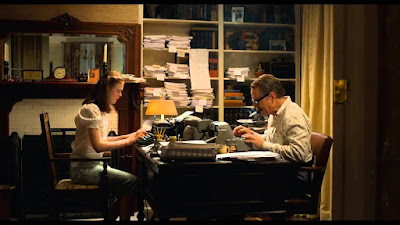
Trumbo, in the meantime, keeps writing. Obsessively, compulsively. Long into the night, and, when inspiration leaves, in his bathtub (a statue of him** writing in the bath was erected in Grand Junction, Colorado, not far from his hometown of Montrose), popping benzedrine, and making life strained at home. Still, despite being black-listed, he won two Oscars for his work, which were credited to "fronts" or psuedonyms—Roman Holiday and The Brave One—until there was a competition between Kirk Douglas and Otto Preminger over who would actually name him as their pictures' screen-writer (and get the credit for "breaking" the black-list). Even when Spartacus—Douglas' picture—came out, it was picketed by the American Legion, until John Kennedy finally made the issue of Trumbo's black-listing moot by crossing the picket lines to see the film while President. The only way to fight a conspiracy is another conspiracy, like a back-fire. The fact that Spartacus made a lot of money for Universal Pictures helped, too.

Trumbo is worthwhile in that it gets the story out, if not right. Performances are solid from the main characters (although I have problems with Cranston's affected performance) and John Goodman is a stand-out—again playing another Hollywood producer, as he did with The Artist and Argo—but the film does a bit of a disservice to the times, almost making those times a "Hollywood problem."
It wasn't. It just got more of the publicity, where a lot of the battles took place. There is no triumph in Trumbo—as close as it gets is an odd shot where his Spartacus credit is reflected in his glasses, which feels oddly unimportant in the scope of it all. But, there's no real sense of the over-arching tragedy as dissent was punished and the wildly hysterical was given credence. Maybe that's why it doesn't register much, emotionally or psychologically. It feels too much like today.


* And I'm not sure I'm even buying that one. Wayne was a righteous anti-communist, no doubt about it (and no doubt because he was one of the few male stars who sat out World War II in Hollywood—something his mentor, John Ford, never let him forget). He was proud of it. And he had a hand in destroying many a career in Hollywood during the 1950's. Conversely, once The Red Scare had passed, he held no grudges—blacklisted screenwriter Marguerite Roberts was sure Wayne would reject her script for True Grit, but he surprised her when he told the producers "Don't touch a word. It's perfect." But, Trumbo would have you believe that Wayne was the only person in Hollywood who stood up to Hedda Hopper. Not buying it. And I'm not buying how Edward G. Robinson (played by the ubiquitous Michael Stuhlbarg that doesn't suggest Robinson at all) is portrayed as naming names. He never did. And even though David James Eliott looks nothing like Wayne, he still has the voice and bearing perfectly, whereas Dean O' Gorman, who resembles Kirk Douglas, doesn't recall the actor at all.
**