Showing posts with label Tessa Thompson. Show all posts

Tuesday, July 12, 2022

Thor: Love and Thunder

Another Classic Thor Adventure
or
Maybe It's 1 Out of 4  (Are You Not Underwhelmed?!)

Taika Waititi performed something of a miracle with Thor: Ragnarok, taking the moribund Marvel "Thor" series and injecting it with some of the humor that Joss Whedon injected into the character for the Avengers series. One wonders why it was taken so seriously in the first place as Thor was always the twee-est of the Marvel super-heroes, usually sticking out like a sore thumb in group adventures, but serving a purpose as that publisher's "Superman" with powers and abilities far above those of the mortal men (and women) in their "Avengers" line-up. Thor wasn't a king, wasn't a scientist, wasn't even rich...he was an other-dimensional God, who you wondered why he spent so much time hanging around in New York, when there were bigger cosmic fish to fry with the lightning of the Gods.
 
In Thor: Love and Thunder (again directed by Waititi), we find Thor (Chris Hemsworth), post-Infinity War, has gone through a lot of changes—and not just in his ability to quip. Asgard has been destroyed, he has lost both his Father and Mother and his adopted brother Loki. His people have been scattered, but localized to a sanctuary on Earth under the governorship of ally Valkyrie (Tessa Thompson, who comes into her own as a comic actress), and he's been hanging out with the Guardians of the Galaxy (Chris Pratt, Dave Bautista, Karen Gillan—she has one line and gets a laugh out of it—Pom Klementieff, Sean Gunn, and Groot and Rocket all make cameo appearances for a very short time, Zoe Saldana out busy Avatar-ing) and getting back in shape after his "Fat Thor" Endgame depression.
That should make Hemsworth-bod fans happy, but Thor is not. He's doing a lot of meditating, getting his hero-mojo back, but still not himself balance-wise. Oh, he's still bloviating ("What a classic Thor adventure! Hurrah!" he says after a battle) and acting like the Big Asgardian on Campus, but he's overcompensating, treating the Guardians as if they were Minions, and being a few coulombs short of a full lightning blast. Oh, he's great at knocking down enemies like ten-pins, but there's usually some collateral damage.
Thor's disturbing lack of faith is reflected in his latest enemy, Gorr (
Christian Bale), who, after, the last remnants of his family dies on his barren planet—despite his pleas to his deity—finds said deity in an oasis, oblivious to his pain, and Gorr kills him with the Necrosword and vows to kill all gods. He targets New Asgard and the warrior Sif (Jaimie Alexander is back! Yay!) warns Thor of the attack and he and Korg (Taika Waititi) travel there with two screaming goats (don't ask) and the Bifrost-inducing Stormbreaker he's now carrying. They team up with Valkyrie to defeat Gorr and his shadow-creatures, but find they have a new ally. 
It's Jane Foster (
Natalie Portman), Thor's ex, who has assumed the role of Thor because...well, long story—and flashback—short...she has Mjolnir, Thor's old broken hammer, which is no longer broken (because Thor asked it to protect her—presumably when he wasn't using it) and it's power is keeping her alive despite her having Stage 4 cancer (we find all this out in a flashback that also involves Kat Dennings and Stellan SkarsgĂ„rd, despite them not showing up in the IMDB cast list!). They are able to defeat Gorr, but his dementors (sorry, wrong franchise, but same idea!) steal all the kids from New Asgard, leaving nothing but Old Asgardians to fret about the children at school-board meetings.
The two Thor's, Val and Korg decide to go to the home of the Gods, Omnipotence City—this is said with a straight face—to warn the Gods and try to recruit them to battle Gorr, and petition Zeus (
Russell Crowe, who is clearly having a great time and using a florid Greek accent) to help in the cause. But, as any philosophy student will tell you, Gods don't listen very good. Zeus knows all about the Necrosword and how powerful it is, but he totally dismisses any danger...he's Zeus, what's gonna happen to him?...but, does drop the plot-point that Gorr has to reach the special effect of Eternity before he can accomplish his goal. But, that'll never happen, so what's the big deal. Zeus clearly never read Chekhov.*
Because at the end, Gorr very easily does the impossible and finds his way to the special effect of Eternity where, seeing the sacrificial way that love can display itself, decides...to change his mind (in another example of so many times in this movie, where they should have thought of this first—but then, there wouldn't be a movie). There's not an awful lot of story here, just a lot of strategies and actions that don't work before a resolution is found...and found very conveniently.
It's hard to take it all seriously, when so much of it is spent being done with so much jocularity. It reminded me of (of all things) Star Trek V: The Final Frontier, which spent so much time trying to recreate the "funny" of Star Trek IV that characters were no longer acting like themselves in order to get the most transient of laughs. Laughs come out of character, rather going out of character to make them. As a result, despite the call-backs and fan-service and getting "the old gang back together" everybody recognizable is no longer acting recognizably. Not that the grave way everybody was acting in the first two "Thor" movies is desirable—it certainly wasn't to me!—but to go as far as this movie does to prod a laugh out of every conceivable situation, is just reaching too far.
And as much as I love what Taika Waititi does with movies, he should be discouraged from making sequels. His movies should take stale material and make them fresh, rather than repeat them and just make them stale again.
* "Remove everything that has no relevance to the story. If you say in the first chapter that there is a rifle hanging on the wall, in the second or third chapter it absolutely must go off. If it's not going to be fired, it shouldn't be hanging there."

Saturday, June 29, 2019

Men in Black International

MIBI. MIBI Not.
or
"...Some Next-Level Shit Going On"

The economics of the "Men in Black" series required some sort of re-boot; if they'd gone with previous stars, they'd have had to save on a cosmically scoped series by restricting their location work to Will Smith's voluminous trailer.

Besides, the series needed it. The "Men in Black" organization in the previous three films had a galaxy-wide perspective, but we never got to know anybody but the two leads, that film's chief antagonist, and the organization's leader, which it it feel like director Barry Sonnenfeld's perspective-warping visual-joke-tags. It was seriously about time to expand the series' event horizons and give it a little breadth. That they've done with Men in Black International by introducing a new recruit. Call her Molly (the charming Tessa Thompson), but she's agent M in MIB (Do they have only 26 agents?? Then they can't even get a decent group-rate insurance discount!), whose encounter with an alien (and the actions of the MIB organization during it) inspires her to become an agent with the super-secret agency as an adult. She's farmed out—by MIB head O (Emma Thompson, the only past cast to return—at least they're keeping the best)—to the foreign exchange to learn the ropes of alien wrangling and memory wiping.
O sends her to the London office where she meets former agent T (Liam Neeson) who has become the head of the department—he's now referred to as High-T (so precious).** He pairs her with Agent H (Chris Hemsworth), his former partner on a Paris mission to intercept and neutralize a group of aliens called "The Hive." H is well-regarded in the organization, but he is a kind of a Bondish Man in Black with a sloppy work ethic and walks around like he's coated in black teflon.  
The plot—such as it is—involves a version of the assassination of Archduke Ferdinand, who, with his dying exhalation entrusts M with a cosmic McGuffin that can be transformed into a powerful weapon capable of creating a Grand Canyon in any state without benefit of a a large river and millions of years. There could be details detailed that would expand the synopsis, but, they're exceptionally un-clever and we've seen them before. Aliens invade, assume human form, are looking for something with a power far greater than its tiny size would indicate, and...oh, yes, they're helped by an alien who has suffered at the hands of the invaders. This isn't writing, this is word-processing and the Ctrl, C, and V keys are getting a bit worn.
And that's it. This is going to be a very short review for a movie that doesn't deserve any more scrutiny, merely due to its lack of effort. Hemsworth and Thompson were delightful together in Thor: Ragnarok and they are not throughout this one, although Thompson tries mightily hard. They just don't seem to mesh, probably because Hemsworth's H isn't hamstrung and is allowed to lord it over the obviously more competent M, which rankles and flies in the face of what worked in the Marvel film. 
Or, it just might be that that film's director, Taiki Waititi, had a better sense of how to keep the two actors bouncing off each other, than this film's F. Gary Gray** does (although his work here is a fair imitation of Sonnenfeld's loopy roller-coaster ride that threatens to go off the rails at any second) and that seems to extend to the rest of the cast, including Rebecca Ferguson, who's great in the "Mission: Impossible" films, but is utterly charmless here.
Capitalizing on past glories in MIBI
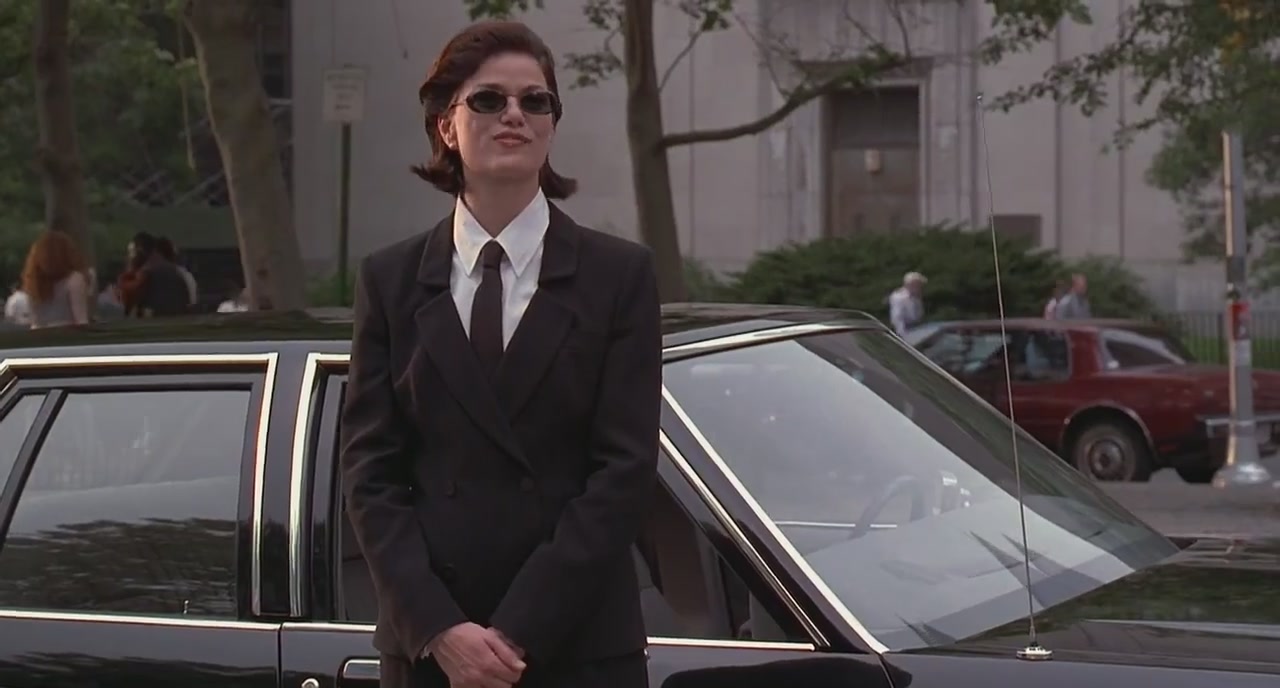
In a Universe of ideas and the expectation that science-fiction might go somewhere where no writer has gone before, why would anyone settle for this re-tread that doesn't even try hard to do something new or think a little differently. Geez, they couldn't even try to do a compare and contrast with the American version, the film being based in Europe and all? But, no, that might be doing something beyond anyone's scope, micro-or tele. Hey, guys, maybe bring back Linda Fiorentino's Agent L from the first movie? I mean...anything?

I don't think the franchise could stand another one like this: been there, zapped that.
Ya really didn't like it, huh?
* Hey, maybe they could do a cross-over with Taken, and this time, his daughter could be abducted by aliens—c'mon, it's as believable as the LAST one.

** Gray tried to leave the project, supposedly, as the film suffered from Studio "regime-Change" confusion, and its producer Walter Parkes re-wrote the script that Thompson and Hemsworth signed up for, and he even directed parts of it. Geez, maybe the next movie should have a race of incompetent aliens trying make sense of an invasion plot when their leader dies.
Just look here and let's forget it ever happened.

Tuesday, March 13, 2018

Annihlation (2018)

Morph and Mindy
or
Ch-Ch-Ch-Changes (Turn and Face the Strange) 

There are flashbacks within flashbacks in Alex Garland's adaptation of "Annihilation" (the first book of Jeff VanderMeer's "Southern Reach" trilogy), part of a school of speculative fiction dubbed "The New Weird" and is one of those novels considered "unfilmable"—mostly because the book is written as a first-person journal of an expedition and is short on details (names, for instance) to the point where VanderMeer didn't get around to fleshing out the characters, which garnered criticism for the casting due to its lack of specific ethnicity, the clues to which didn't occur until the second book was published.

It's also an experiment in making its readers do the hard work of imagining, the literary equivalent to radio's conceit of a "Theater of the Mind,"* where suggestion sparks completion in that venue, creating a wily co-conspiracy of writer and reader. This has its dangers because "fans" (especially these days) take a personal stake in these things and become vocal (or take to what is ironically called "social" media) if their "vision" is not represented—not that anybody knew what that vision might be. This puts Garland in a touchy situation as it his job to make concrete what has previously been merely "airy-fairy" to the point of being deliberately vague. Every director has to do this to a certain extent, and producers put up the money for the "vision" that will make a return on their investment.** The business dictates that the only "vision" that matters be tinted green.
Best, then, to start with the basics; the first scene is a "just the facts" de-briefing between the protagonist (Natalie Portman), here named Lena, and three guys in hazmat suits who have a lot of questions. "What did you eat?" "What?" "You had rations for two weeks. You were there for four months." "I don't remember eating..." "How long do you think you were in there?" "Days. Maybe weeks." "What happened to Josie Radek (Tessa Thompson)?" "I dunno..." "What happened to the others?" "I dunno..." "What DO you know?" 

Not much, evidently. But, we do know that she's the sole survivor. Call her Ishmael.
With the mystery properly whetted, we cut to a comet heading for the Earth from the comet's perspective. VenderMeer never gives a cause for what becomes known as "the Southern Reach," but here it's a comet that strikes an area of beach with a lighthouse on it, it's impact causing no damage...not yet, anyway.

Cut to a cell dividing. In a classroom, Portman's character is talking about the process, but not in clinical terms of interphase stages or chromatin condensation. She's talking philosophically, not telling her class anything they don't already know, making the point that it's a single organism in the Universe, poor thing. Lena has a lot on her mind and she rebuffs an attempt by a comrade (David Gyasi) to attend a get-together. We learn that her husband has been missing for a year with no explanation of why, where, how...nothing.
But, that night he (Oscar Isaac) shows up unannounced...and without a word of explanation. She badgers him with questions, but he can only look at her hollow-eyed and be vague about where he's been and what happened to him—he doesn't know. All he knows is he was outside their house and it looked familiar. He takes a drink of water, and begins spasming, coughing up blood. An ambulance is called, but before they can get to the hospital, they are overtaken by a clutch of anonymous vehicles and forced off the road. Lena is knocked out.
She awakes in a spare hospital room and greeted by Dr. Ventress (Jennifer Jason Leigh) with "You must be feeling dreadful." Yeah, but Ventress is evasive about anything that her husband is stabilized but his organs are shutting down and they don't know why. But, over the next few days, Ventress will open up: her husband, Kane, was part of a mission to investigate "Area X"—they're in a facility outside "X" right now—and he is the only person to have emerged from the evacuated area. Something has happened in "Area X," what, they don't know—Ventress murmurs something about "a religious event, an extraterrestrial event..." what, she doesn't know, exactly—but "Area X" has been around for a few years...and it's growing, having already taken over an earlier compound in the swampy area. She's sent a team in, contact was lost, but only Kane emerged, and Ventress wants to know what's inside what she calls "The Shimmer" and what happened to the other men—were they killed or did they kill each other?
She assembles a team of soldier-scientists: herself—she's a psychologist, Anya Thorenson (Gina Rodriguez) a paramedic, Cass Sheppard (Tuva Novotny) an anthropologist, and Josie Radek (Tessa Thompson) a physicist. She needs a biologist and as Lena has a job teaching that at Johns Hopkins, Ventress asks that she join the team. Lena accepts—she wants to know what happened to Kane—but she keeps that information from the other team-members. Ventress, agreeing with the decision, maintains her silence about it.
The five enter "The Shimmer" and it is disorienting. Compasses don't work, radio's get scrambled, the flora and fauna are weirdly exotic and not entirely knowable, plus they have a tendency to lose track of time. Nerves are high, but they're able to focus on the routine. At a dilapidated boat-house, Lena is able to take some samples of the exotic vegetation vining around the house, but as she starts to take a closer examination, Josie is pulled into the house and she starts screaming.
Lena and the others run into the house which has been partially submerged in the swamp and are able to get Josie out fast, but, guns drawn, they see a huge albino alligator emerge from the house sink into the swamp and then turn and attack the party. Lena distracts it by firing at it, but the thing lurches towards her and she determinedly fires round after round point blank into the creature before it finally dies. An examination of the creatures mouth shows that it's teeth are more like shark's teeth. The party starts to be a bit freaked out. The Shimmer has somehow mutated the plants and animals inside it, scrambling GPS and radio waves, but also the very DNA of the flora and fauna. If that's so, then what is it doing to them?
To talk about it any further will be to rob any brave, potential viewers of one of the very palpable things that makes Annihilation work—its ability to evoke unease. I could mention a couple things and get away with it, but the element of surprise—and the dread of surprise—in such an environment really sets the nerves on edge. The unseen and unknowable is more tension-inducing than the seen and given the icky eerie imaginings in that place which have the "what else could happen" creepiness of the original Alien set in a landscape that is just as enveloping and throbbingly tense as those of Deliverance, Southern Comfort, and Apocalypse Now and you have an exercise in dread that takes you right down to the cellular level.
"And then, people start dying." Maybe, they're the lucky ones. It becomes clear that "The Shimmer" is messing with their DNA, and as nerves and minds becomes strained and the survival odds get lower, the team decide to "bug out"—if they can make it, but their judgment of time and distance doesn't make the job any easier. For Lena, the key to it all is the lighthouse at the center of it, and she's determined to get there. If not to find answers, hopefully, to find a solution...maybe, a cure.
And that's where things get really interesting. Not explicable, perhaps, but very interesting. In fact, more questions are raised than are probably answered, but there is an all-purveying sense that things have changed...irrevocably and there's no "reset" button to go back to pre-"Shimmer" days. You hope for the best in the outcome, but you're never really sure what "best" might be. Once Annihilation "hits the beach" everything is done by suggestion and imagery just specific enough to keep the momentum going, but there's no narration or voice-over to explain what is going on and that may unnerve the already nervous. But, it gives you a definite sense of the "unknowable" while telling its story purely by what you see.
It's challenging, both for the viewer, but also for the writer-director. Garland's job in this is to make what was suggested in the concept concrete. He has done that, while preserving a sense of "the definite ambiguity" in the film. I remember my first experience of watching 2001: a Space Odyssey and not having a clue what was going on and running to Arthur C. Clarke's book to get the answers. Clarke provided them. VanderMeer, not so much. I think that readers of the book may be just as confounded as those without the CliffNotes (which could make some backlash—along the lines of the way fans of Stephen King's "The Shining" were put off by the changes made in Stanley Kubrick's film adaptation. 
It makes me wonder how audiences will react to something this challenging (but worth it). I tend to see movie audiences being really dumbed-down these days from having been force-fed solutions and explanations, while, at the same time, being capable of handling ambiguity and "woo-woo" concepts that might stagger the imagination. Annihilation says a lot of things about embracing change and adaptation, while also being a thinly-veiled comment on accepting the immutable, like, say, global disaster. While not a complete invitation to blind acceptance, Annihilation will appeal to folks who like their science fiction scrambled rather than over-easy.

* My favorite story of "Theater of the Mind" is when Rod Serling (speaking of speculative fiction) was asked whether he preferred writing for television or radio and he mentioned that if he wrote "there was a castle on the hill" for television it would go to the budget department, then to the production department, to the art department, to the drafters, to the carpenters and set-dressers and painters and finishers and scenic decoration and at the end of it he'd get one castle on one hill. "But if I write 'there was a castle on the hill' in a radio script, it costs nothing and I get a thousand castles on a thousand hills."

** Garland had final cut and a producer (Scott Rudin) powerful enough to guarantee it, which he did when Skydance Productions demanded that Natalie Portman's character be made more "sympathetic" and the final parts of the film made more...oh, what's the word?..."obvious" (Reports say that it was considered "too complicated" and "too intellectual") after an earlier test-screening did not produce the approval numbers that were hoped. Rudin scotched that idea, forcing Paramount to set up a distribution deal with Netflix in the international markets. Paramount kept the domestic market distribution.


Friday, November 17, 2017

Thor: Ragnarok

Goblins and Garden Parties
or
"Darling, You Have No Idea What is Possible"

The first couple of "Thor" films were extraordinarily dull things. It might have been because the first was directed by Kenneth Branagh, who wanted to make a Shakespearean myth rather than a comic book movie and art-designed the thing to a fair-thee-well and treated it SO seriously, that it wasn't until Joss Whedon's The Avengers that Chris Hemsworth's version of the character could display some personality besides being ontuse at the top of his lungs. Alan Taylor's Thor: The Dark World I can barely remember except for a lot of things going *thud* at the end—one of them being my patience.

The Avengers showed that the God of Thunder could be more than just a guy with a hammer, increasing both the possibilities and the personalities of Thor and his half-brother, Loki (Tom Hiddleston). The whole Odin story-line could be dispensed with, but the fact that Thor was the only one of Marvel's heroes being utilized who was world and dimension-spanning gave the MCU some scope (even if they didn't know how to use it just yet) and set the paths for Guardians of the Galaxy and Dr. Strange.

Thor: Ragnarok does a lot of things: there's a lot of cameos and guest-stars, brand new characters, and a minimum of returnees from the previous two films—Loki, Thor's father Odin (Anthony Hopkins), and Heimdall (Idris Elba); it introduces another family threat, who is primarily the focus of the story; once the film is finished, everything has changed and the elements that buttressed (and limited) the first two movies are gone and there is no "safe zone" anymore. "Significance" happens in Thor: Ragnarok, and it's a significance that can't be walked back in the next movie (of course, they could do that, but audiences would see it as a cheat and lazy film-making). And that's good; it certainly makes this "Thor" memorable...and that's a first in the trilogy.
We find Thor chained up in a prison in some cavernous expanse, suspended over a lava-bubbling landscape. How did he get there? Who cares? (although he does the requisite "Maverick" style "I suppose you're wondering..."). He is being held by the CGI beast Surtur (voiced by Clancy Brown--the other voice you hire if you can't get James Earl Jones), and it's an odd little back and forth except for the interruptions when Thor rotates at the end of his chain from looking directly at Surtur. "Oh! Wait a tick! Need to be facing you!" And they wait until Thor is in proper axis to look at Surtur while he simmers threateningly at him. That this little interruption happens is your first indication...other than the Marvel Studios logo sinking and melting into hot lava...that this one's going to be a little different; the filmmakers are not going to be hurtling pell-mell to the next ringing declaration or action set-piece. There are going to be Pythonesque "silly bits" when a situation gets a bit...absurd. Like being polite to a lava monster.
Anyway, that's the first bit. Then, Thor goes to his home in Asgard, finds out that Dad-Odin is missing and that Loki is behind it (really, there doesn't need to be much investigation), that Heimdall is not around and an Asgardian named Skurge (Karl Urban) is in his place on the Asgardian turn-stile letting people in. The guy isn't the best border-guard and would have Donald Trump tweeting out something ending in "sad." I won't spoil the details, but ultimately it's determined that Odin is exiled to Earth (Loki's fault...it's always Loki's fault), in the most demeaning of circumstances (he's treated like a human being).
Some such-and-such happens (with the help of Benedict Cumberbatch's Dr. Strange (thanks for stopping by and recycling the post-credits tag from your own movie, Doc)—and ultimately, there's a family dissemblation and a family reunion with the first child of Odin—Loki and Thor's half-sister Hela (Cate Blanchett—you may have seen Blanchett over-act before but you've never seen her relish in it, as she does here, reminding one a bit of Gloria Swanson in Sunset Boulevard) and before you know it, she's smashed Thor's hammer, Mjolnir (rest in pieces), and managed to make her way to Asgard, while kicking Loki and Thor out of the bifrost "rainbow connection" warp-tunnel that gets you there.
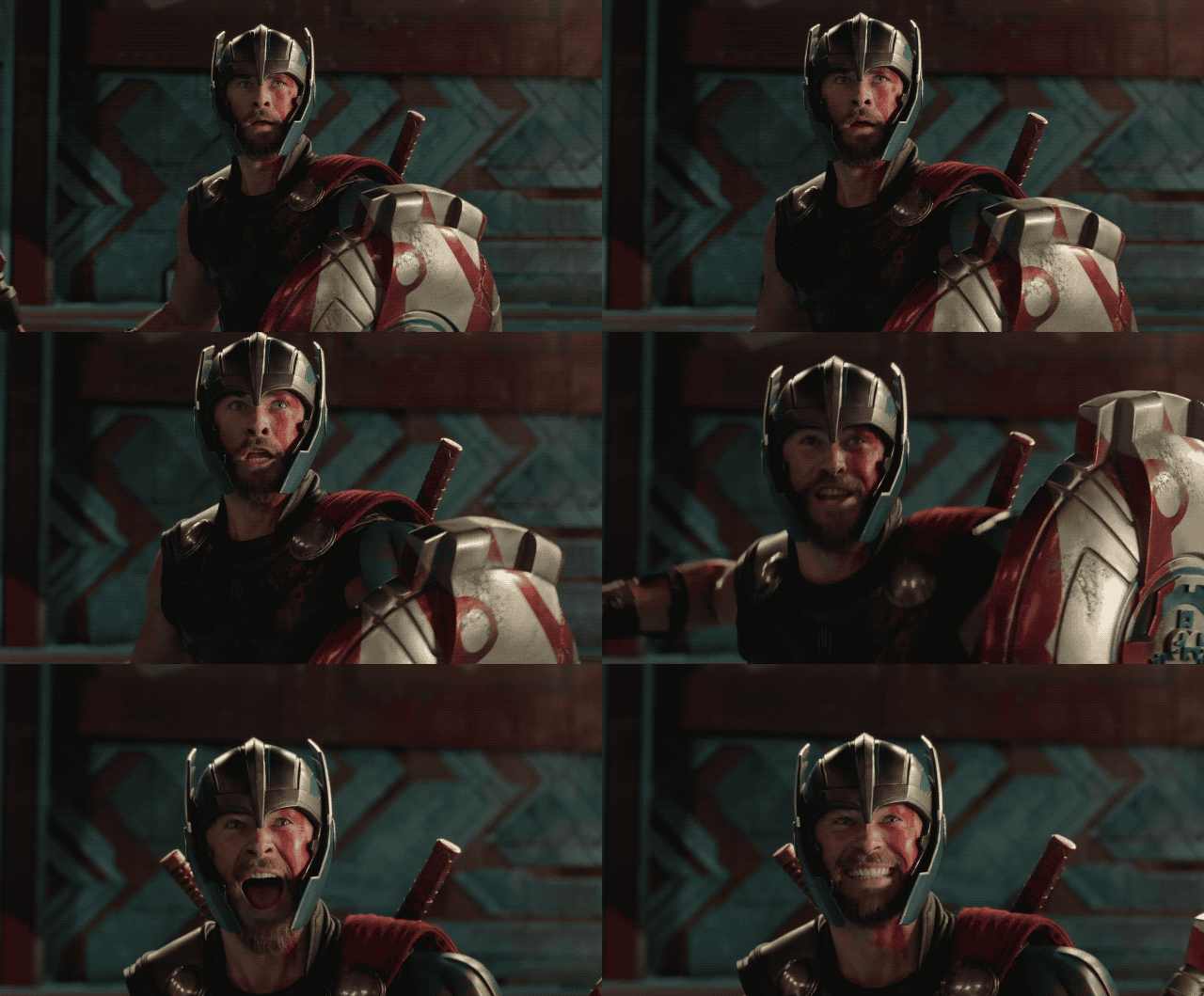
Loki we find out about later, but the hammer-less Thor ends up in a garbage planet (called Sakaar) and gets captured by Valkyrie (or Scrapper 142 as she's known—played by Tessa Thompson in a breakout role), where he's set up for gladiator duties by the planet's "Grand Master" (Jeff Goldblum, reminding you of why you like Jeff Goldblum) to fight the current champion of the gladiator games. Anyone who's seen even the first trailer knows who that turns out to be, and, frankly, it's a good move on Marvel's part to play with the animosity that was displayed between the two characters in a brief scene in The Avengers that lasted all of five seconds. To repeat: 
There is much brief rejoicing, not only on Thor's part, but also the audience's. This isn't the "stuffy mythology" Thor that has been displayed in his own solo movies; this is the potential that could be done with Thor if anybody in the first two movies wasn't so afraid of failure at the box-office. The breath of fresh air comes from New Zealand director Taika Waititi, who helmed What We Do in the Shadows and last year's bright, shining Hunt for the Wilderpeople. Waititi has a kiwi sensibility ("yeess"), but his film language is strong and he has a wonderful way with presenting the logically absurd into his work. If he wasn't doing Thor, he'd be doing wondrous things with Marvel properties like Ant-Man and Guardians of the Galaxy—and they could certainly have used him in the Dr. Strange feature if his expansion of the End Credits "tag" of that film is any indication.
Waititi embraces the odd and that's a far cry from what other film-makers do with the four-color world of super-heroes, usually tamping down the comic nature of the things and replacing it with leather costumes and sturm-and-drang. But, when you're dealing with in-fighting Norse gods and ADHD-CGI Hulk's, it might be best to keep your sense of humor, especially once these characters have gotten over the "tragedy" of being displaced and "gifted." Waititi also has a nice visceral sense—subtlety is not his strength—and he's happy letting super-heroes be super-heroes in extremis. So, a completely gladiator battle between Thor and Hulk goes into giddy excess, even repeating a couple of Avengers jokes for good measure.
It's fun. A lot of fun. But, Waititi CAN get carried away with the in-jokes—for instance, an Easter-Egg for Marvel junkies has the Gladiator arena exterior* decorated with the busts of past champions, including Beta-Ray Bill (who took over the "Thor" title for awhile) and Man-Thing (what the hell?). In another instance, Thor is being wheeled into the Grandmaster's tournament hall, he is given an audio tour of the place, all accompanied by "Pure Imagination" from Willy Wonka and the Chocolate Factory. It got a laugh out of me, but...really? Willy Wonka wasn't a success when it was released here...it made it out to Sakaar?
It pads things out a bit—ultimately, the whole idea comes down to getting the Hela out of Asgard and finding a way to get there to do that (they find a way as Sakaar, being a dumping ground for the universe has all sorts of portals through which refuse falls through—and the portal to get them back is called "The Devil's Anus"...really). And, ultimately, Thor finds out that in order to accomplish what he must, embracing the worst thing that could happen might not be a bad thing. Change happens, and the shorn, hammerless Thor must learn that power comes from within...literally.
Odd. Frequently silly. But, ultimately, Thor: Ragnarok is the best film of the trilogy for its own ability to see what hasn't worked in the previous films and embrace its own change. That it causes some destruction of its own history along the way is all for the good.

*


Tuesday, February 10, 2015

Selma

...Is Marching On
or
Uneasy Lies the Head That Wears a Crown

Selma begins with Dr. Martin Luther King (David Oyelowo) very uncomfortable dressing in tux and tails.  His wife Coretta (Carmen Ejogo) walks in, dressed to the nines, as he fusses, saying that he feels uncomfortable dressed for a formal occasion—all of his constituents will look at him in such finery and might lose faith that he could lead them in any sort of struggle, when their lives are so distant from such pomp.  It's not the clothes that make him uncomfortable. It's the whole setting, even if he is being awarded the 1964 Nobel Peace Prize.

Selma, the film of the Civil Rights peace marches of 1965, is revolutionary in many ways: looking at the politics of social change and how events spark and accelerate it (Lincoln touched on this, too);  it de-mythologizes King, showing the man—the passion for his cause, but also the conflicts that stymied his efforts, both personally and as a catalyst for change*; and it is shepherded, produced, co-written, and realized by a woman (we're not quite so enlightened where that isn't so commonplace it doesn't require mention...but we shall eventually overcome).
To the first point, there are as many minutes spent in "meetings" for strategizing as are spent in the streets actively carrying out the marches: King meets with the current-president, Lyndon Johnson (Tom Wilkinson) in a tense meeting in the Oval Office—King pushing for action over minority voting rights, where Southern officials actively are keeping African-Americans from voting, and thus having any sort of voice in politics or serving on juries; Johnson pushing back, concentrating on his War on Poverty goals, deflecting any voting legislation as being "too much too soon;"  both sides have confab's—the do-gooders, even the racists, all trying to find power in numbers.

But events propel things faster than Johnson, King, or anyone else can anticipate—the 16th Street Baptist Church in Birmingham, Alabama is bombed killing four children—and without enough blacks on the voting roles, the jury against the Klansman accused of the murders would be only comprised of whites. It is a crime that can not stand, but the chance of any unprejudiced justice is nil. And so King, after much deliberation with his lieutenants, decides that Selma, Alabama is where his Southern Christian Leadership Conference will stage demonstrations in the streets, marching for voting rights, something opposed by all the politicos in Alabama (including Governor George Wallace, played, rather sneeringly, by Tim Roth), Sheriff Jim Clark, and, also, ironically, the Student Nonviolent Coordinating Committee in Selma, who see King as something of a carpetbagger, wanting to move in and undermine their own efforts. With so many conflicts, so many factions—even in his own fragmented coalition—it is amazing that King was able to focus and keep his "eyes on the prize."
The film is top-notch.  Lee Daniels was attached to direct, but when he left to direct The Butler, director Ava Duverney took over, starting from scratch, doing a complete re-write of the script, and overseeing production...on a film that's larger in scope than the low-budget film she's done previously. At the same time, the film couldn't be more personal, framing the large events of the marches with intimacy...giving us a few precious moments with the children talking girlishly as they descend the church stairs before an explosion fills the screen, the carnage happening out of sight, or the candid conversations of various factions behind closed doors or in hushed tones, or the Kings sitting in silence listening to the embarrassing tape sent to Coretta by J. Edgar Hoover (Dylan Baker, not precisely convincing): "I know what you sound like, Martin.."
That is the real strength of Selma—not the big set-pieces, the marches, the recreation of "Bloody Sunday" (the 1965 version—type that into Google Search some time, and see how many of them there are), although they're handled very well. It's in showing the yin and yang of social change. Sure, it's a big thing to march in the streets, to stir up the blood and the thoughts, but social change really comes about in the changing of singular attitudes—one mind at a time.  It seems like too slow a process to those in turmoil, but the changing of minds does not happen one to one, arithmetically, but geometrically, multiplying as it goes. It's not the logic of an attitude that becomes aware of the need of change, it is the feeling of it when "that's the way it's always been done" falls away to "why is that the way it's always been done?"  When past is tossed away for a more humane future.  Time, and truth, don't just march on, civilization does, too, if sometimes at a maddeningly slow pace.

Keep the faith.

* What is fascinating to me about King (beyond his ability to motivate a crowd and stick to his non-violent ideals) and this presentation of him is the notion that his murder—martyrdom, if you will—deified the man. Now, he's a National Monument, a National Holiday, and quoted and referenced by everyone of every political ideology trying to score some political points, even those who would—if he had lived—be just as vociferously condemning him and trying to bring him down...if he had lived. It's as if his assassination let them off the hook for trying to destroy him. But his words—and, more importantly, his actions—continue to inspire, even when co-opted by those who would, most assuredly, have opposed the living, breathing activist. Too bad no one came to their senses when he was alive. History tends to do that.