The Last King of Scotland (Kevin Macdonald, 2006) Talk about lucky guys--at last year's Oscars, Peter Morgan was nominated for his screenplay for The Queen, and the two leading actors of his screenplays won both Best Performance Awards: Helen Mirren for The Queen, and Forrest Whitaker for this film. They both had great material to work with. Morgan's talents for breathing life and personality into history (catch his HBO film, "Longford," while you're at it) puts to shame the recent spate of "highlights-biographies" (Ali, Nixon, Man on the Moon, Chaplin, Ray) that are like filmed Cliff Notes. And Whittaker is amazing in the film ("How'd they get him?" K. asked when he was first on screen. No, it's not the real guy, it's Forrest Whittaker), projecting the half-baked soul of Idi Amin Dada. It's a Supporting-sized role, but so large does Whittaker's portrayal loom over the movie that he dwarfs everyone else, even James McAvoy's starring performance as cocky Scotts physician Nicholas Garrigan, who goes looking for some selfish adventures and winds up being The Devil's Internist in Uganda.
Showing posts with label David Oyelowo. Show all posts
Thursday, May 25, 2023
The Last King of Scotland
The Last King of Scotland (Kevin Macdonald, 2006) Talk about lucky guys--at last year's Oscars, Peter Morgan was nominated for his screenplay for The Queen, and the two leading actors of his screenplays won both Best Performance Awards: Helen Mirren for The Queen, and Forrest Whitaker for this film. They both had great material to work with. Morgan's talents for breathing life and personality into history (catch his HBO film, "Longford," while you're at it) puts to shame the recent spate of "highlights-biographies" (Ali, Nixon, Man on the Moon, Chaplin, Ray) that are like filmed Cliff Notes. And Whittaker is amazing in the film ("How'd they get him?" K. asked when he was first on screen. No, it's not the real guy, it's Forrest Whittaker), projecting the half-baked soul of Idi Amin Dada. It's a Supporting-sized role, but so large does Whittaker's portrayal loom over the movie that he dwarfs everyone else, even James McAvoy's starring performance as cocky Scotts physician Nicholas Garrigan, who goes looking for some selfish adventures and winds up being The Devil's Internist in Uganda.Thursday, September 22, 2022
See How They Run (2022)
or
"So Far, Soporific"
Remember the movie made of Agatha Christie's hit play, "The Mousetrap?" You don't? Well, it's no mystery—the reason why is one has never been made. Oh, there have been unofficial pastiches in foreign markets, but there has never been a filmed version of "The Mousetrap." Legal reasons: When Agatha Christie signed the deal to have it produced it was stipulated in her contract that a movie version wouldn't be made for at least six months after it closed.
And it's been running—at the St. Martin's Theater in London's West End—since October 6, 1952. There was an interruption starting in 2020 due to COVID, and it re-opened on May 17, 2021. It's 27,500th performance was staged on September 18, 2018. The estimation is that there have been 28,500. A running tally exists on a wooden counter in the theater's lobby. And so, because the play has never officially closed, there has never been a film of "The Mousetrap," and may never be.That back-story is the whole raison d'être for See How They Run, a Christie-like mystery pastiche centered around the play and the extraordinary circumstances that start when it celebrates its 100th performance. It is entirely fictional, although some of the actual names are not changed—for example "Dickie"—or Richard as he is better known as actor and director—Attenborough (played by Harris Dickinson) did appear in the first run of the play along with his wife, Sheila Sim (played by Pearl Chanda). And there was a film producer named John Woolf (played by Reece Shearsmith), who did indeed produce The African Queen and bought the movie-rights to "The Mousetrap," anticipating a film adaptation (which never materialized).
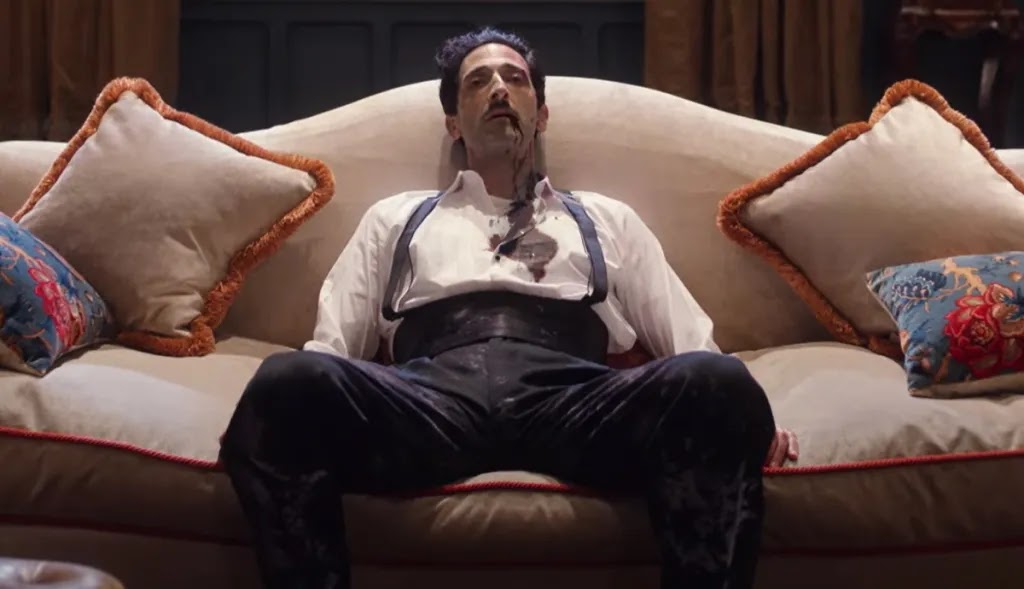
Well, on the night of the 100th performance, a celebration party takes place, at which the intended American director for the film-version, Leo Köpernick (Adrien Brody) gets drunk, makes an ass of himself and gets into a fight with (among others) Attenborough. But, he's such a louse that he makes enemies with anyone he makes eye-contact. No surprise, then, that he ends up murdered. Big surprise, though, that he's narrating the film (that is, if you haven't seen Sunset Boulevard—the neat thing about dead narrators is that they know everything, even if their opinions might be wrong).
The police show up: First, Constable Stalker (Saoirse Ronan), who's new and nervous and by-the-book—her own notebook with which she feverishly takes notes that she sometimes can't read; then Inspector Stoppard (Sam Rockwell) bumbles in—he's the rumpled DI in a mac, designed to be underestimated by the unsuspecting suspects: the show's producer (Ruth Wilson) and the disgruntled screenwriter (David Oyelowo) and their hangers-on, the Attenboroughs, and everyone who'd been offended by Köpernick—and that includes everyone.It appears like an open-and-shut case. Kopernick was clobbered by a ski and bludgeoned with a sewing machine in the costume room. But, who is the mysterious figure that is only fleetingly seen around the murder scene...and could be anyone? Well, that's hear-say. And it's only down to Stoppard and Stalker as Scotland Yard is over-taxed dealing with "the Rillington murders" (one of the little in-jokes that abound in the screenplay—Attenborough starred in a film about the case—that are there to tease but lead nowhere).
And that may be part of the issue I have with See How They Run. I enjoy mysteries, not necessarily the solving of them, but the cleverness of the solution—the kind that make you go back and read "that section" that you missed among the chaff of the rest of the story. And, for all its cleverness and jokiness about the form, the central mystery is not all that compelling...and neither are the investigators (despite being played by Ronan and Rockwell). There are so many red herrings—about affairs and ex-wives and duplicitous relationships—and dead-ends that by the time the solution comes out of the wings—oh, it's related to "The Mousetrap" but not relatable to anyone familiar with the play—that one is simply underwhelmed with how it's wrapped up...and in a way that has previously been excoriated earlier in the movie. And Brody's continued role as victim/narrator just makes you wish that murder was possible in the after-life.
There are clever touches—Stoppard's hobby is to make jigsaw puzzles—but even that's a dead end and is just a half-hearted way to give him some "character." Ultimately, I found it not clever in the spine and too clever in the details—when it should be the reverse. If one is going to make a comedy "whodunnit", it should not turn out to be a "whocares." Hoping that Glass Onion and The Menu turn out better.
Thursday, January 28, 2021
The Midnight Sky
It's Lonely Out in Space...
or
Our Future...Didn't Quite Turn Out That Way
Barbeau Observatory, located near the Arctic Circle, has been evacuated after a global nuclear catastrophe—everyone wanted to go home for the end. Except for Dr. Augustine Lofthouse (George Clooney). Someone has to stay at the observatory watching the night skies and maybe contacting the space missions still out there. And he's dying anyway. As one of the departing techs observes, given the situation, he'll probably outlive them all.
There is one ship out there that hasn't been evacuated and is still occupied and functioning—the ship Æther, which went out to the orbit of Jupiter to explore K-23, a moon of the gas-planet that seems to be—as they say on "Trek"—"Class M". It can sustain human life. They're supposedly on their way back, but nobody knows that because they've been out of contact for a long time. Augustine has a personal stake in the mission as it was his theoretical work that inspired it, and he's completing his life's work trying to reach them to tell them that it's no longer a reconnaissance trip and to go back. There's nothing to come home to.
Onboard ship, the crew—"Captain" David Oyelowo, Felicity Jones, Kyle Chandler, Tiffany Boone, and Demian Bichir—have successfully scouted the Jovian moon in question and it hits the "Goldilocks" sweet-spot of conditions: not too cold, not too hot, but "just right." Water is plentiful and vegetation abundant. The orange sky will take some getting used to, but the close proximity to Jupiter has its compensations and abundant landscape photo-ops.
The crew has been out of touch with Earth and that's caused some issues. Astronaut Sully (Jones) thinks there might be a glitch in their system somewhere, but the ship is complicated enough with artificially-generated gravity, supplies, greenhouses, and the like that trying to pin-point a fault would be harder than finding a hospitable planet in the Solar System. Now, on the leg home, they're spending a lot of time being nostalgic for Mother Earth and their families on it. A lot of time being spent in therapeutic holo-suites with family-memories. They don't know that anything is wrong on Earth or that there is nobody on Earth trying to contact them.
Now, the only one at the observatory, Augustine settles into a routine of taking pills, daily hemodialysis, the perfunctory meals (usually taken with scotch). Isolated and alone, he has a lot of time for there to be flash-backs, nightmares and mind-wanderings. So, he can be forgiven if, at breakfast, he finds a half-finished bowl of cereal sitting at the table. Maybe it's the aloneness, maybe it's the drinking, but obviously, the routine has slipped.
But, it's more than he's thinking. Wandering around the station, he finds a little girl (Caoilinn Springall)—curled up, sleeping, hiding. There had been some confusion during the evacuation...and then, this child. Another responsibility, which he is not ready to cope with. At first, he tells the deliberately mute child (whom he finds out is named "Iris") that she's on her own, that he can't handle the work AND take care of her. But, there's nowhere to send her. They are now stuck with each other, and she is now a constant presence ("Don't touch anything!" he frets while he's working "You know, there's no rule that says you have to TOUCH everything."). Eventually, she will be a comfort.
There are complications aboard the Æther: their trajectory from Jupiter is slightly off and they have to weigh whether to do course-correction burn or take a chance going through a route in space that hasn't been properly "mapped-out." Personally, I'd go for the course-correction because any deviancy from "true" will only increase the farther they go, but they vote to do nothing and risk it. How like "Earthlings". Oh, and Sully is pregnant with Captain Adwole's child. Everyone has a suggestion what to name it. Except for that off-kilter trajectory, everything is nominal.
Back on Earth, the atmosphere around Barbeau is becoming increasingly toxic and time is running out, so Augustine decides to travel to a weather station at Lake Hazen with a more powerful antenna in the off-chance that it'll be just enough to reach the Æther. He packs up his supplies, dialysis gear, and does the proper parent-thing of bundling up the girl for a snow-day, and they set off on a snowmobile to reach their destination.
At the Æther, there is another problem: a hitherto unknown cluster of ice-fragments is hurtling around the solar system in the asteroid belt and the ship runs smack-dab into it, causing a lot of damage to a couple of the ship's systems—radar and communications, mostly. They're going to need the communications, so they decide to "take a stroll around the block" and make repairs. Sully, Adwole, and Maya (Boone) suit up and crawl around the outside of the craft with their spare parts to DIY the broken systems.
At this point, you begin to realize time is running out on both sides of the solar system, despite there being very few people to do anything and a lot of space to do it in. In all that expanse—of space and snow-scape—the chances of connection, despite wonders of radio communication, are remote given the solitary beings 329 km apart. With all that geography, time becomes a precious commodity while also being a brutal deterrent. Nature, or the destruction of it, will make its course in its own time. It makes an interesting conundrum to ponder while everyone is trying to hurry things up...but can't.
The Midnight Sky is directed by Clooney and, given his access to so much material because of his demand, it's always interesting to ponder why he does the projects that he does. Perhaps his ever-increasing age (he's a "twinkly" 59 years) is making him consider that time is short and its one commodity that his earnings can't buy more of. But, this film—which looks great, and it's a pity that a film of this budget and scope isn't playing theaters (except in a limited Oscar-qualifying engagement), but is stuck in the limited dimensions of Netflix—has an interesting ability to stick in the head and make one consider the shortness of life amid the imponderable extent of cosmic time.
And, as a director on this one, Clooney is focusing on spectacle rather than letting the performances carry it. The landscapes are artfully presented. The framings are formal, often symmetrical, only to break the rule to go full-tilt Alfonso Cuarón during the space-walk (and even then he has a nice feel for perspective—you're rarely disoriented). There are long stretches without dialog, but the movie doesn't drag and there's a nice sense that there isn't a lot of unnecessary "explaining" that needs to be done for the audience's benefit.
It also takes the time to have little "grace-notes," little touches of a shot or two which speak volumes about the characters without having to talk about it. The performances are uniformly good, but, for me, Demian Bichir and Kyle Chandler get the kudo's for most elegant acting here, with Tiffany Boone providing the most comic touches and the most tragic. A bonus is another of those lovely scores by Alexander Desplat.
It's a good watch, but it's not "whizz-bang." The Midnight Sky is one of those proverbial "good" science fiction films whose brain-shelf-life goes beyond the ephemeral "what happened there?" of its "Twilight Zone" machinations and makes one consider the possibilities mythic, parental, and biological all in one melancholy little package*—a 21st Century version of On the Beach** for the Space Age.
* Melancholy in the same way that George Carlin broke down the hopefulness behind Earth Day: "EARTH day! The EARTH will be FINE. WE'RE the ones who're fucked!"
** At one point in the film, Kyle Chandler's family man on the Æther is watching that Stanley Kramer picture in his room.
Friday, June 12, 2020
Red Tails
Today—June 12th—is "Loving Day." If you don't know what that is, I have posts about it here and here.
Instead of repeating those, there's this, written at the time of the film's release.
Why We Fight
or
The Brother Gets It First*
Like Francis Ford Coppola's Tucker: The Man and His Dream (which he also financed), Red Tails is the movie that George Lucas has waited the longest to make. In development even before the "Star Wars" prequels, the story of the Tuskeegee Airmen has been on Lucas' mainframe for over 20 years. And as with most director "Dream Projects," this one had the potential to soar into great summits of excellence or tail-spin into an exercise of excess and pretentiousness.
Red Tails is neither one of those, but it does do some interesting things along the way. Respectful of the airmen, and "gung-ho" enough to end with "America The Beautiful" playing out over the End Titles, it does remind one, in spirit, of the old war films, that appeared during and immediately after the second world war,** tough, haggard, slightly cranky, and all-too-willing to bring up some risky aspects of the vet's experience that would be tossed under the rug of homilies that later "recruitment" war films would present.
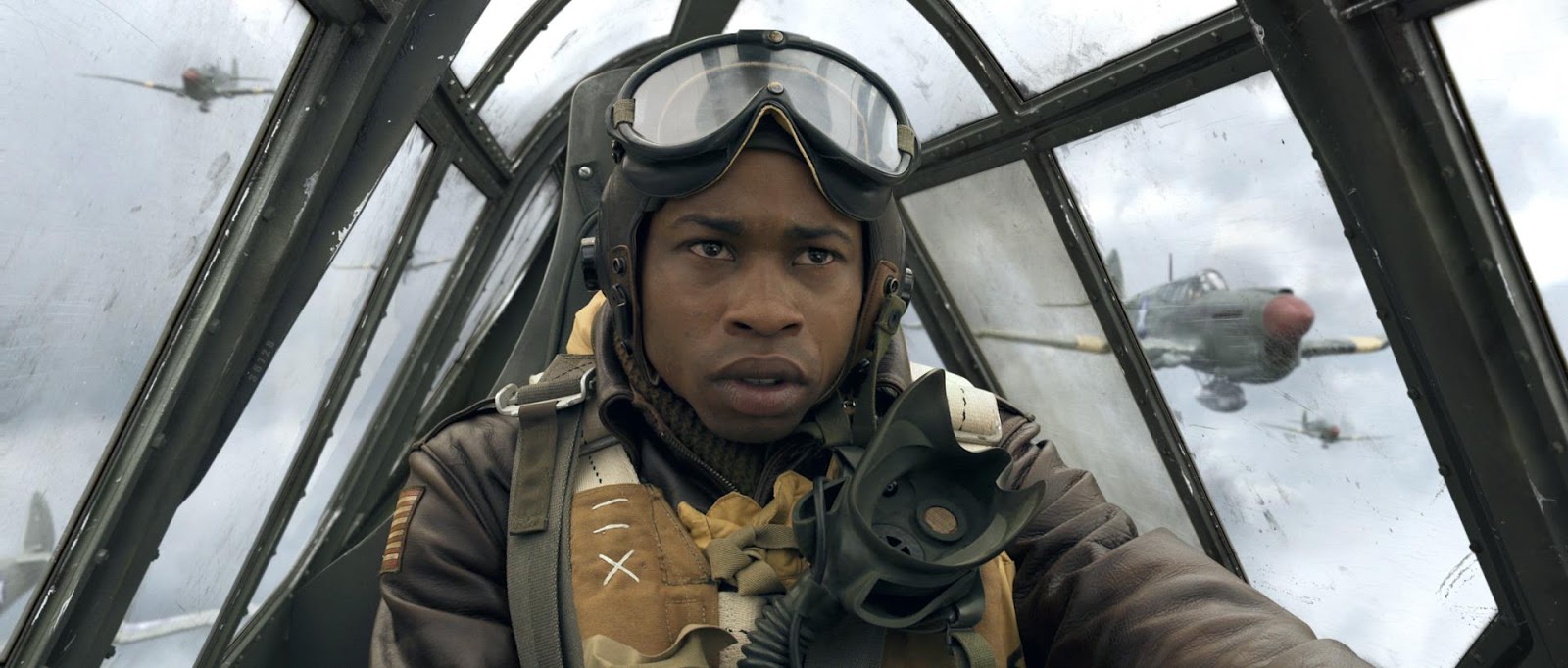
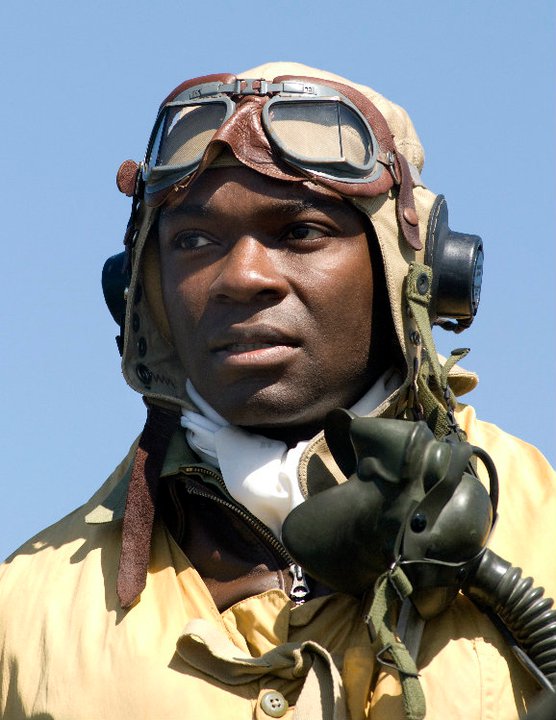
At the same time, it plays things a bit safe, dramatically, while, in subtle ways, taking chances that modern audiences—thank God—might not be aware of.*** It follows a typically diverse group of air-men with defining cliches—the "hot-shot" (David Oyelowo), the alcoholic (Nate Parker), "the kid" (Tristan Wilds) "the yokel" (Ne-Yo)—through their story-arcs, fighting on two fronts—against the Nazis and their own brass and fellow soldiers, who, if not wanting to shoot the pilots out of the sky, didn't want them in the air in the first place.
One good thing that sets Red Tails apart from the other "yes, they fought too" films is there's no "white-wash" element (as one finds in a good effort like Glory, where a forgotten story about the participation of black soldiers in the Civil War, has to feature Matthew Broderick and Cary Elwes over Denzel Washington, Morgan Freeman, and Andre Braugher). These guys in Red Tails are on their own. There's no angelic white-devil's advocate that has to make the condescending "these are men" speech and, if anything, here, the white guys are pushing back, making this film a lot more dramatic than your standard "liberal guilt" trip, where everybody's mind miraculously changes once "they're" "given a chance."**** The pressure never lets up on them and the only time they don't have to be on the defensive is in the air, fighting. Their inclusion in the war effort is a convenience to the military, taking pressure off the "other" guys, and nothing considered noble. That doesn't matter to the pilots, though, as long as they're free of Earthly bonds, fingers on the triggers and Nazi Aryans in their sights.
And the battle scenes—complex, nasty and dangerous as the dog-fights are— is where Red Tails excels. The same visceral energy of the Star Wars Death Star battles (which were pre-visualized with edited WWII dogfight footage) is here, but with a rougher edge, bumpier, and more of a sense of true danger than a battle in space could provide.
Why'd it take so long? Probably because Lucas wanted to do this one right (and also because studios were reluctant to finance a movie this black-centric), so he took the back-seat producer job, wrote the frame-work, hired John Ridley to write it and director Anthony Hemingway to film it, then doing some re-shoots (reportedly written with "Boondocks" creator Aaron McGruder) to do some dramatic streamlining.***** Usually, it works with Lucas projects, especially when the director is strong, like Spielberg; there's a dramatic frisson that happens when it's not a "one-man/one-vision" project—something that was missing from the "Star Wars" Prequels, which suffered from too many "yes-men"—and Lucasfilms always seem to be better when he has to compromise and think off the top of his head...or someone else's.
One still gets a sense, though, of pandering. The film Tuskeegee's don't need the "hey, these guys are good" comments that drop like leaden bombs throughout the film's second half. As an audience, we can see it, we don't need to have it reinforced by the white pilots they're escorting, especially considering those flight sequences are the best thing in the film. The energy, thrills and derring-do (with their frequent "Yahoo" moments) are far more emotionally satisfying and communicative of the pilots' excellence. Those sequences make Red Tails reach great heights, when everything else is trying to keep it grounded. They didn't play it safe. There's no good reason the film should.
* A variation of the "trope" "Black Dude Dies First," which is a truism in "easy" drama and always struck me as being seminally racist. In a war situation, with an all-black cast, it isn't true, and feels far less manipulative than in most war films. In this war film, people die because "war is dangerous and people die in war." It's random, unfair, and serves no purpose—not even dramatically. That was an important take-away from this particular war film.
** This was in the 1940's, kids.
*** It's a bit soapish, but there's a romance between "hot-shot" pilot "Lightning" and an Italian girl, where nothing (blissfully) is mentioned about race, making the sequence seem idyllic, but also not cluing modern audiences in to the fact that if the same events happened in the country the pilots were fighting for, he would have stood a good chance of going to prison or being lynched for it. It passes without comment or explanation, which might be dramatically risky, but sure feels good. Real progress is made when the un-usual becomes commonplace and antique words like "miscegenation" disappear like discarded, rusty tools. Racial prejudice is SO "last century."
**** Even so, there's still a little too much of it, done mostly in voice-over behind masks, as if in post-production after-thought. The screen-actions speak louder than any number of patronizing words.
***** Not sure where those sequences are—I'd only be speculating—but at one point "the kid" is shot down and put in a Nazi POW camp—the same camp that was the origination of the events and the film of The Great Escape. Amusingly, there is one sequence that looks shot-for-shot like a sequence from the John Sturges film with "the kid" in the role played by Steve McQueen! Heh.
Instead of repeating those, there's this, written at the time of the film's release.
Why We Fight
or
The Brother Gets It First*
Like Francis Ford Coppola's Tucker: The Man and His Dream (which he also financed), Red Tails is the movie that George Lucas has waited the longest to make. In development even before the "Star Wars" prequels, the story of the Tuskeegee Airmen has been on Lucas' mainframe for over 20 years. And as with most director "Dream Projects," this one had the potential to soar into great summits of excellence or tail-spin into an exercise of excess and pretentiousness.
Red Tails is neither one of those, but it does do some interesting things along the way. Respectful of the airmen, and "gung-ho" enough to end with "America The Beautiful" playing out over the End Titles, it does remind one, in spirit, of the old war films, that appeared during and immediately after the second world war,** tough, haggard, slightly cranky, and all-too-willing to bring up some risky aspects of the vet's experience that would be tossed under the rug of homilies that later "recruitment" war films would present.
At the same time, it plays things a bit safe, dramatically, while, in subtle ways, taking chances that modern audiences—thank God—might not be aware of.*** It follows a typically diverse group of air-men with defining cliches—the "hot-shot" (David Oyelowo), the alcoholic (Nate Parker), "the kid" (Tristan Wilds) "the yokel" (Ne-Yo)—through their story-arcs, fighting on two fronts—against the Nazis and their own brass and fellow soldiers, who, if not wanting to shoot the pilots out of the sky, didn't want them in the air in the first place.
One good thing that sets Red Tails apart from the other "yes, they fought too" films is there's no "white-wash" element (as one finds in a good effort like Glory, where a forgotten story about the participation of black soldiers in the Civil War, has to feature Matthew Broderick and Cary Elwes over Denzel Washington, Morgan Freeman, and Andre Braugher). These guys in Red Tails are on their own. There's no angelic white-devil's advocate that has to make the condescending "these are men" speech and, if anything, here, the white guys are pushing back, making this film a lot more dramatic than your standard "liberal guilt" trip, where everybody's mind miraculously changes once "they're" "given a chance."**** The pressure never lets up on them and the only time they don't have to be on the defensive is in the air, fighting. Their inclusion in the war effort is a convenience to the military, taking pressure off the "other" guys, and nothing considered noble. That doesn't matter to the pilots, though, as long as they're free of Earthly bonds, fingers on the triggers and Nazi Aryans in their sights.
And the battle scenes—complex, nasty and dangerous as the dog-fights are— is where Red Tails excels. The same visceral energy of the Star Wars Death Star battles (which were pre-visualized with edited WWII dogfight footage) is here, but with a rougher edge, bumpier, and more of a sense of true danger than a battle in space could provide.
Why'd it take so long? Probably because Lucas wanted to do this one right (and also because studios were reluctant to finance a movie this black-centric), so he took the back-seat producer job, wrote the frame-work, hired John Ridley to write it and director Anthony Hemingway to film it, then doing some re-shoots (reportedly written with "Boondocks" creator Aaron McGruder) to do some dramatic streamlining.***** Usually, it works with Lucas projects, especially when the director is strong, like Spielberg; there's a dramatic frisson that happens when it's not a "one-man/one-vision" project—something that was missing from the "Star Wars" Prequels, which suffered from too many "yes-men"—and Lucasfilms always seem to be better when he has to compromise and think off the top of his head...or someone else's.
One still gets a sense, though, of pandering. The film Tuskeegee's don't need the "hey, these guys are good" comments that drop like leaden bombs throughout the film's second half. As an audience, we can see it, we don't need to have it reinforced by the white pilots they're escorting, especially considering those flight sequences are the best thing in the film. The energy, thrills and derring-do (with their frequent "Yahoo" moments) are far more emotionally satisfying and communicative of the pilots' excellence. Those sequences make Red Tails reach great heights, when everything else is trying to keep it grounded. They didn't play it safe. There's no good reason the film should.
![]() |
| The first wave of Tuskegee pilots |
** This was in the 1940's, kids.
*** It's a bit soapish, but there's a romance between "hot-shot" pilot "Lightning" and an Italian girl, where nothing (blissfully) is mentioned about race, making the sequence seem idyllic, but also not cluing modern audiences in to the fact that if the same events happened in the country the pilots were fighting for, he would have stood a good chance of going to prison or being lynched for it. It passes without comment or explanation, which might be dramatically risky, but sure feels good. Real progress is made when the un-usual becomes commonplace and antique words like "miscegenation" disappear like discarded, rusty tools. Racial prejudice is SO "last century."
**** Even so, there's still a little too much of it, done mostly in voice-over behind masks, as if in post-production after-thought. The screen-actions speak louder than any number of patronizing words.
***** Not sure where those sequences are—I'd only be speculating—but at one point "the kid" is shot down and put in a Nazi POW camp—the same camp that was the origination of the events and the film of The Great Escape. Amusingly, there is one sequence that looks shot-for-shot like a sequence from the John Sturges film with "the kid" in the role played by Steve McQueen! Heh.
Tuesday, April 26, 2016
As You Like It (2006)
It is the quadri-centennial of William Shakespeare's death and the Bard is still going strong. Not marble, nor the gilded monuments of princes shall outlive his powerful rhymes. Oh, there will be set-backs. Al Pacino and Anthony Hopkins can't seem to get their respective productions of King Lear to be produced, but that's only because Ian McKellan cut such a wide swath through the role a couple years ago. But no, as long as Kenneth Branagh or Patrick Stewart draw breath, there will be a Shakespeare film made, and even if not under his name or title, he can be found as dependable source material—The Lion King is Hamlet, Forbidden Planet is The Tempest, Kurosawa made versions of MacBeth and King Lear in feudal Japan. Whether you believe Shakespeare wrote the plays or not—and scholars seem to be basing their theories on correspondence and bills (what, authors didn't consider their audience back then?) the entity that created the works in those folios was a dramatic genius, one who still enthralls, confounds, and moves in this step-step-step-step-step-step-generation and into the conceivable future.
This week, we'll look at a handful—a sampling—of Shakespeare films. Most of them will have to wait 'til we get that "Now I've Seen Everything: Orson Welles" piece done (and that's a film or two away). But, for now, we will brush off our Shakespeare...reviews.
As You Like It (Kenneth Branagh, 2006) Branagh's films run hot or cold--his Henry V and Hamlet and Dead Again being good, and over-heated messes like his version of Frankenstein and 2007's Sleuth being where he just can't manage the material, or, in an attempt to light them up a bit, he starts being a bit too fusty with them, bringing in a swooping camera amid histrionic performances. Those are the Branagh movies where you want to grab him by his ascot and say, "why don't we call it a night, let everyone get some sleep and think things over."
This week, we'll look at a handful—a sampling—of Shakespeare films. Most of them will have to wait 'til we get that "Now I've Seen Everything: Orson Welles" piece done (and that's a film or two away). But, for now, we will brush off our Shakespeare...reviews.
As You Like It (Kenneth Branagh, 2006) Branagh's films run hot or cold--his Henry V and Hamlet and Dead Again being good, and over-heated messes like his version of Frankenstein and 2007's Sleuth being where he just can't manage the material, or, in an attempt to light them up a bit, he starts being a bit too fusty with them, bringing in a swooping camera amid histrionic performances. Those are the Branagh movies where you want to grab him by his ascot and say, "why don't we call it a night, let everyone get some sleep and think things over."
Happily, As You Like It is not one of those over-baked Branagh's, but it feels a bit underdone as well, where the setting and the text don't seem to mesh as well as the director thought they might.
This Shakespeare comedy is set, by the director, in feudal Japan where a warlord sets another Duke and entourage out into the forest--a classical japanese garden--to talk over matters and wait until the complications abate and everyone can get married and live happily ever after in a nice frothy frolic, very much like his ending for Much Ado About Nothing. A lot of Branagh's past collaborators are here--Richard Briers, Adrian Lester, and Brian Blessed (playing both Dukes--and far less boisterously than one is accustomed to seeing him), Kevin Kline gets the "All the World's a Stage" speech, Alfred Molina plays Touchstone (looking like Brian Bolland's Mr. Mamoulian), and the lead of Rosalind is played by Opie's kid, Bryce Dallas Howard. Now, Howard has previously been cast in roles where she was merely meant to be frail or other-worldly, so to see her in full command and making As You Like It her own is something of a great triumph, acknowledged by Branagh by giving Howard the afterword, as she strolls through the trailers, bottled water in hand, and takes her bow, before going to her trailer.
Now that's updating Shakespeare.
This film never saw a release in America, but instead went directly to HBO, no doubt due to the poor performance of Branagh's Love's Labours Lost in theaters. Too bad. Branagh seems to be at his best adapting Shakespeare and breathing some life into it for modern audiences, and at his worst doing something else.
Saturday, February 14, 2015
A Most Violent Year
or
"You'll Never Do Anything Harder Than Looking Someone in the Eye and Telling Them the Truth." (And It's Hard to be a Saint in the City)
J.C. Chandor has made three films now, each one different in scope and breadth, but each challenging as to subject matter and presentation. He does not go the easy way—if any way, he goes the opposite of what might be expected from a film, genre-shaped or no. His first, Margin Call, dared to make drama out of the economic crisis, which it did as if it was the easiest thing in the world (it isn't, ask Oliver Stone) creating a boardroom drama as if it was a high-rise Game of Thrones. His second film, All is Lost, had one star, one actor—Robert Redford—and its survival-at-sea story was told with images and virtually no dialogue that systematically robbed its lone sailor of everything, including hope.
Now, it's back to business, as Chandor takes a look at the oil industry circa 1981 in New York, where the city is divided into turfs of heating oil customers that are treated like fiefdoms of the various oil companies, jealously protected and vehemently guarded—and where there's oil, there's usually fire.
A movie about an oil dealership. Sounds exciting, right? But Chandor always has an interesting spin on the most mundane of ordinary situations, be it crunching numbers, burying a beloved pet, or patching a hole in the side of a boat. His protagonist in A Most Violent Year is Abel Morales (Oscar Isaac, as far afield from his dour folkie of the Coen Brothers' Inside Llewyn Davis), the latino head of the Standard Heating Oil Company. Abel's as hands-on as they come, knowing the names of all his employees, salesmen, truck-drivers. He's worked his way up from hauling tankers to running the company; he knows every step of the way and mentors and coaches his workers based on his own singular success story moving up the ladder.
Now, he stands on the cusp of his biggest transaction—buying a defunct distribution center from Jewish garment workers so that he can take deliveries right off the Hudson River, without depending on trucking the fuel in. He has 30 days to close on the property, and has put up a considerable deposit, and if he can't come up with the rest of the cash the sellers will keep the deposit and entertain the competing offer of a rival company. The stakes are high and Abel could lose everything.
Of course, there are complications: Standard Oil is becoming a player in the city and the other oil companies are getting aggressive: his trucks are being hijacked, his drivers beat up and hospitalized, the tankers drained to the tune of $80,000 a tank; men with guns are casing his new upstate house; New York's assistant DA (David Oyelowo—appearing twice in one week here!) is investigating his company for corruption—probably because Standard is the least established and less contributing to political campaigns. Throughout that 30 day option window, the stakes will get higher and the violence will increase.
![]() |
| Jessica Chastain gives David Oyelowo an unfortunate gesture. |
Except by Abel, that is. Very early on, the visual of Abel in expensive suits, a camel-hair coat and the steady gaze with hooded eyes reminds of Al Pacino's Michael Corleone from the Godfather series. But, this is completely different. Michael was a corrupting influence in a normal world, even in the corrupt world of the Mafia. In Abel's world, the corruption is already in place and he's attempting to resist and change by example. And Chandor's philosophy is counter to Coppola's (and Marlon Brando's) who saw the Mafia as a metaphor for Big Business. Chandor sees Big Business using the same tactics as the Mafia—being interchangeable with them with turf wars, shakedowns, intimidations and criminal activity being condoned and encouraged for market share and territory. There is the constant temptation (especially when deadlines are looming, the banks aren't co-operating, and violence is escalating) of fighting fire-power with fire-power, of doing wrong until you get caught, that looms in front of Abel.
A Most Violent Year is very familiar, but in a different context. It is an anti-Godfather, where the world is no less cynical, no less hard or even criminal, but there is one man who, though surrounded by and acknowledging all of that, still finds a better path, walks it, talks it, and will not be deterred. It's a movie about something rather rare in modern drama: a hero.
Tuesday, February 10, 2015
Selma
...Is Marching On
or
Uneasy Lies the Head That Wears a Crown
Selma begins with Dr. Martin Luther King (David Oyelowo) very uncomfortable dressing in tux and tails. His wife Coretta (Carmen Ejogo) walks in, dressed to the nines, as he fusses, saying that he feels uncomfortable dressed for a formal occasion—all of his constituents will look at him in such finery and might lose faith that he could lead them in any sort of struggle, when their lives are so distant from such pomp. It's not the clothes that make him uncomfortable. It's the whole setting, even if he is being awarded the 1964 Nobel Peace Prize.
Selma, the film of the Civil Rights peace marches of 1965, is revolutionary in many ways: looking at the politics of social change and how events spark and accelerate it (Lincoln touched on this, too); it de-mythologizes King, showing the man—the passion for his cause, but also the conflicts that stymied his efforts, both personally and as a catalyst for change*; and it is shepherded, produced, co-written, and realized by a woman (we're not quite so enlightened where that isn't so commonplace it doesn't require mention...but we shall eventually overcome).
To the first point, there are as many minutes spent in "meetings" for strategizing as are spent in the streets actively carrying out the marches: King meets with the current-president, Lyndon Johnson (Tom Wilkinson) in a tense meeting in the Oval Office—King pushing for action over minority voting rights, where Southern officials actively are keeping African-Americans from voting, and thus having any sort of voice in politics or serving on juries; Johnson pushing back, concentrating on his War on Poverty goals, deflecting any voting legislation as being "too much too soon;" both sides have confab's—the do-gooders, even the racists, all trying to find power in numbers.
But events propel things faster than Johnson, King, or anyone else can anticipate—the 16th Street Baptist Church in Birmingham, Alabama is bombed killing four children—and without enough blacks on the voting roles, the jury against the Klansman accused of the murders would be only comprised of whites. It is a crime that can not stand, but the chance of any unprejudiced justice is nil. And so King, after much deliberation with his lieutenants, decides that Selma, Alabama is where his Southern Christian Leadership Conference will stage demonstrations in the streets, marching for voting rights, something opposed by all the politicos in Alabama (including Governor George Wallace, played, rather sneeringly, by Tim Roth), Sheriff Jim Clark, and, also, ironically, the Student Nonviolent Coordinating Committee in Selma, who see King as something of a carpetbagger, wanting to move in and undermine their own efforts. With so many conflicts, so many factions—even in his own fragmented coalition—it is amazing that King was able to focus and keep his "eyes on the prize."
The film is top-notch. Lee Daniels was attached to direct, but when he left to direct The Butler, director Ava Duverney took over, starting from scratch, doing a complete re-write of the script, and overseeing production...on a film that's larger in scope than the low-budget film she's done previously. At the same time, the film couldn't be more personal, framing the large events of the marches with intimacy...giving us a few precious moments with the children talking girlishly as they descend the church stairs before an explosion fills the screen, the carnage happening out of sight, or the candid conversations of various factions behind closed doors or in hushed tones, or the Kings sitting in silence listening to the embarrassing tape sent to Coretta by J. Edgar Hoover (Dylan Baker, not precisely convincing): "I know what you sound like, Martin.."
* What is fascinating to me about King (beyond his ability to motivate a crowd and stick to his non-violent ideals) and this presentation of him is the notion that his murder—martyrdom, if you will—deified the man. Now, he's a National Monument, a National Holiday, and quoted and referenced by everyone of every political ideology trying to score some political points, even those who would—if he had lived—be just as vociferously condemning him and trying to bring him down...if he had lived. It's as if his assassination let them off the hook for trying to destroy him. But his words—and, more importantly, his actions—continue to inspire, even when co-opted by those who would, most assuredly, have opposed the living, breathing activist. Too bad no one came to their senses when he was alive. History tends to do that.
or
Uneasy Lies the Head That Wears a Crown
Selma begins with Dr. Martin Luther King (David Oyelowo) very uncomfortable dressing in tux and tails. His wife Coretta (Carmen Ejogo) walks in, dressed to the nines, as he fusses, saying that he feels uncomfortable dressed for a formal occasion—all of his constituents will look at him in such finery and might lose faith that he could lead them in any sort of struggle, when their lives are so distant from such pomp. It's not the clothes that make him uncomfortable. It's the whole setting, even if he is being awarded the 1964 Nobel Peace Prize.
Selma, the film of the Civil Rights peace marches of 1965, is revolutionary in many ways: looking at the politics of social change and how events spark and accelerate it (Lincoln touched on this, too); it de-mythologizes King, showing the man—the passion for his cause, but also the conflicts that stymied his efforts, both personally and as a catalyst for change*; and it is shepherded, produced, co-written, and realized by a woman (we're not quite so enlightened where that isn't so commonplace it doesn't require mention...but we shall eventually overcome).
To the first point, there are as many minutes spent in "meetings" for strategizing as are spent in the streets actively carrying out the marches: King meets with the current-president, Lyndon Johnson (Tom Wilkinson) in a tense meeting in the Oval Office—King pushing for action over minority voting rights, where Southern officials actively are keeping African-Americans from voting, and thus having any sort of voice in politics or serving on juries; Johnson pushing back, concentrating on his War on Poverty goals, deflecting any voting legislation as being "too much too soon;" both sides have confab's—the do-gooders, even the racists, all trying to find power in numbers.
But events propel things faster than Johnson, King, or anyone else can anticipate—the 16th Street Baptist Church in Birmingham, Alabama is bombed killing four children—and without enough blacks on the voting roles, the jury against the Klansman accused of the murders would be only comprised of whites. It is a crime that can not stand, but the chance of any unprejudiced justice is nil. And so King, after much deliberation with his lieutenants, decides that Selma, Alabama is where his Southern Christian Leadership Conference will stage demonstrations in the streets, marching for voting rights, something opposed by all the politicos in Alabama (including Governor George Wallace, played, rather sneeringly, by Tim Roth), Sheriff Jim Clark, and, also, ironically, the Student Nonviolent Coordinating Committee in Selma, who see King as something of a carpetbagger, wanting to move in and undermine their own efforts. With so many conflicts, so many factions—even in his own fragmented coalition—it is amazing that King was able to focus and keep his "eyes on the prize."
The film is top-notch. Lee Daniels was attached to direct, but when he left to direct The Butler, director Ava Duverney took over, starting from scratch, doing a complete re-write of the script, and overseeing production...on a film that's larger in scope than the low-budget film she's done previously. At the same time, the film couldn't be more personal, framing the large events of the marches with intimacy...giving us a few precious moments with the children talking girlishly as they descend the church stairs before an explosion fills the screen, the carnage happening out of sight, or the candid conversations of various factions behind closed doors or in hushed tones, or the Kings sitting in silence listening to the embarrassing tape sent to Coretta by J. Edgar Hoover (Dylan Baker, not precisely convincing): "I know what you sound like, Martin.."
That is the real strength of Selma—not the big set-pieces, the marches, the recreation of "Bloody Sunday" (the 1965 version—type that into Google Search some time, and see how many of them there are), although they're handled very well. It's in showing the yin and yang of social change. Sure, it's a big thing to march in the streets, to stir up the blood and the thoughts, but social change really comes about in the changing of singular attitudes—one mind at a time. It seems like too slow a process to those in turmoil, but the changing of minds does not happen one to one, arithmetically, but geometrically, multiplying as it goes. It's not the logic of an attitude that becomes aware of the need of change, it is the feeling of it when "that's the way it's always been done" falls away to "why is that the way it's always been done?" When past is tossed away for a more humane future. Time, and truth, don't just march on, civilization does, too, if sometimes at a maddeningly slow pace.
Keep the faith.
* What is fascinating to me about King (beyond his ability to motivate a crowd and stick to his non-violent ideals) and this presentation of him is the notion that his murder—martyrdom, if you will—deified the man. Now, he's a National Monument, a National Holiday, and quoted and referenced by everyone of every political ideology trying to score some political points, even those who would—if he had lived—be just as vociferously condemning him and trying to bring him down...if he had lived. It's as if his assassination let them off the hook for trying to destroy him. But his words—and, more importantly, his actions—continue to inspire, even when co-opted by those who would, most assuredly, have opposed the living, breathing activist. Too bad no one came to their senses when he was alive. History tends to do that.
Subscribe to:
Posts (Atom)


.jpg)