Showing posts with label War Film. Show all posts

Saturday, January 7, 2023

All Quiet on the Western Front (2022)

Butterflies Not Included
or
"Germany Will Soon Be Empty" (The Ever-Diminishing Perspective)
 
"We are not youth any longer. We don't want to take the world by storm. We are fleeing from ourselves, from our life. We were eighteen and had begun to love life and the world; and we had to shoot it to pieces."
Im Westen nichts Neues "Nothing New in the West" 

Erich Maria Remarque's "All Quiet on the Western Front"—not an exact translation of the title, but it's stuck in the vernacular—created a sensation on its publication (in magazines form November 1928 and in book-form January 1929). Within a year, the author's fictionalization of his time during the first World War had been bought by Hollywood and made into an Oscar-winning film (for "Best Production") by Lewis Milestone. There was a TV version in 1979, directed by Delbert Mann, which won a Golden Globe for Best TV Movie—it was filmed in Czechoslovakia—and an Emmy Award for editing.
 
There was considerable buzz in the air around the Holidays in its being mentioned for Oscar nominations—and not just for Best Foreign Film. Frequent Twitterers mentioned it as a contender for the Best Picture short list.
Now Netflix has sponsored a new version of All Quiet on the Western Front
(I guess you need 40 years or so to pass before doing it again—as if we weren't reminded enough that war is hell). The story of "Paul"* (played by Felix Kammerer—who seems genetically predisposed to have a "Thousand Yard Stare") one of a number of young German students, spurred by the patriotic speeches of their professors to join the German Army and to fight. Their teachers and academics fill their heads with dreams of glory and burnished reputations in protecting the Fatherland (who were the aggressors, if memory serves). But, once they tramp out to the trenches at the front lines, they learn different. They're stuck in shit-holes, where they arbitrarily wait for their generals (safely ensconced away from the battles**) to launch attacks that will gain them mere yards of ground, only to have them taken back when the French attack later. The absolute futility of the First World War was in how both sides traded time in each other's trenches.
Director-writer Edward Berger has changed a few things (from the novel). He starts—as with most of the segments—with beautiful shots of the terrain, forests, the natural world. Picturesque contrasts with what will come after—the grays and browns of the trench area punctuated with barbed wire strung on fallen crucifixes. The trenches are ramshackle caves where the soldiers huddle with the rats and offer little protection from aerial attacks. It's like the graves are already dug for the soldiers—they just don't know it yet.
After the beauty shots, Berger cuts to an attack—prior to Paul and his chums being sent to the line. It goes badly. The dead are catalogued, with their dog-tags broken in half (that's how they keep count of the kills and who's "winning"), graves are dug, and their uniforms recycled. Bullet holes and rips are repaired and readied for the next batch of soldiers—Berger will do a call-back on that later. But, it makes the point. The lives of the German troops are just as recyclable as the equipment. When one dies, another is put in their place. They're literally cannon fodder, indistinguishable from another. For small patches of ground.
But, there's an added element here. Ever since Francis Ford Coppola's Apocalypse Now, there has been an artistic dichotomy to supposedly "anti-war" films.*** They're beautiful. Films like Stanley Kubrick's Full Metal Jacket. Sam Mendes' 1917. There's horrendous, ugly carnage, absolutely (all wars look the same from the inside), but there is also a directorly effort to make some shots as beautifully lit as possible. Michael Herr mentioned it—that dichotomy—after working with Kubrick on his Vietnam film. And Bergen is no exception. One of the things that bothered me about 1917 was how beautiful it looked (thanks to cinematographer Roger Deakins) and wondered if that was enticing to potential recruits, the way the Top Gun movies are. Is this the film-making equivalent of shooting yourself in the foot?
Another thing got to me about the film. There is something called "One Point Perspective" Kubrick used it a lot in The Shining and 2001. Wes Anderson's films are masterclasses on one-point perspective. Here, Berger uses it to the extreme. At one point, there's a sequence in a train station with a slightly off-axis that I thought, "Oh, he's not going to center the train in the shot. Good choice."
I had thought too early. Within a minute, Bergen had moved the camera until, like it was on a track or something, the camera hit the mark so that the train was perfectly centered. Perfectly. Centered.
But, it is an interesting choice. Both Kubrick and Mendes used that technique to make an almost vertiginous experience, sucking you into the screen...and the story (when you're not distracted by all that symmetry, of course).

Berger does some interesting things with the script, as well. A whole section where Paul goes home and is repulsed by his household's fascination for the war is reduced to a single line in a bivouac sequence. And as persistent as he is with the perspective issue, he isn't as dedicated to the book's reluctance to show anything beyond Paul's perspective. He inter-cuts the scenes at the front with the attempts by Matthias Erzberger (played by Daniel Brühl) to sign an armistice with the French, which as protracted and stilted as it is, still manages to convey some tension about the outcome of our singular hero.

It's an odd push-pull kind of dynamic that the film presents: the country that launched the war makes a film about it, not neglecting the bloody carnage or the irresponsibility of its generals, but making pains to show its humiliation in negotiating the armistice; showing the waste and destruction, but also including decorously-lit sequences that romanticize it; criticizing the war and its costs, while also making it romantic and poignant. One can acknowledge a film's worth, but also be deeply cynical about it, at the same time.

I can my reaction to it can be briefly summed up in that I watched it with English sub-titles—the film, as it should be, is in German—that are none too subtle. And at one point, had the foresight to clue me in to what I was not hearing.

* "Paul," by the way was Remarque's real middle name; he changed his pen-name to "Maria" to honor his mother.
 
** See Paths of Glory. No. Really. See Paths of Glory. 
 
 *** Notice I didn't mention Oliver Stone's Platoon? Can the lack of romantic lighting in that film be because Stone actually fought in the Vietnam War.

Friday, June 12, 2020

Red Tails

Today—June 12th—is "Loving Day." If you don't know what that is, I have posts about it here and here

Instead of repeating those, there's this, written at the time of the film's release.

Why We Fight
or
The Brother Gets It First*

Like Francis Ford Coppola's Tucker: The Man and His Dream (which he also financed), Red Tails is the movie that George Lucas has waited the longest to make. In development even before the "Star Wars" prequels, the story of the Tuskeegee Airmen has been on Lucas' mainframe for over 20 years. And as with most director "Dream Projects," this one had the potential to soar into great summits of excellence or tail-spin into an exercise of excess and pretentiousness.

Red Tails is neither one of those, but it does do some interesting things along the way. Respectful of the airmen, and "gung-ho" enough to end with "America The Beautiful" playing out over the End Titles, it does remind one, in spirit, of the old war films, that appeared during and immediately after the second world war,** tough, haggard, slightly cranky, and all-too-willing to bring up some risky aspects of the vet's experience that would be tossed under the rug of homilies that later "recruitment" war films would present. 
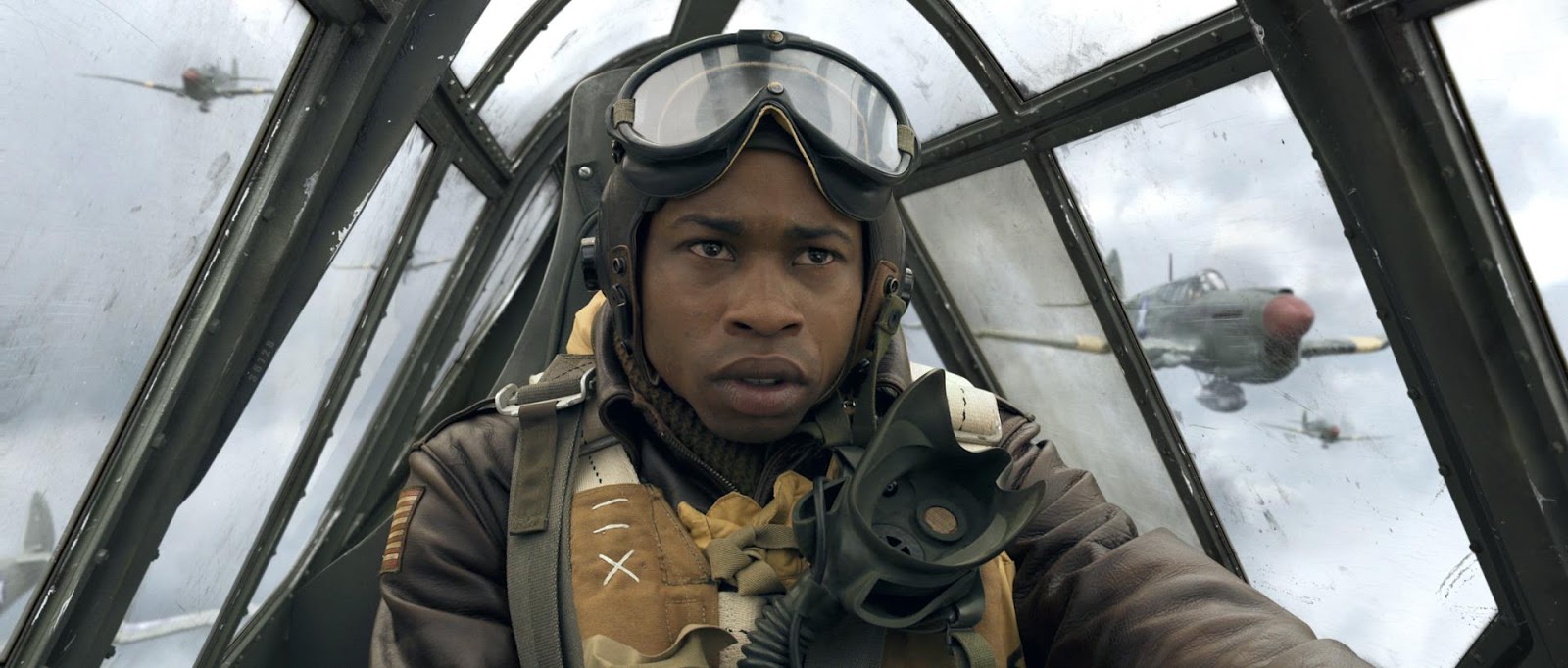
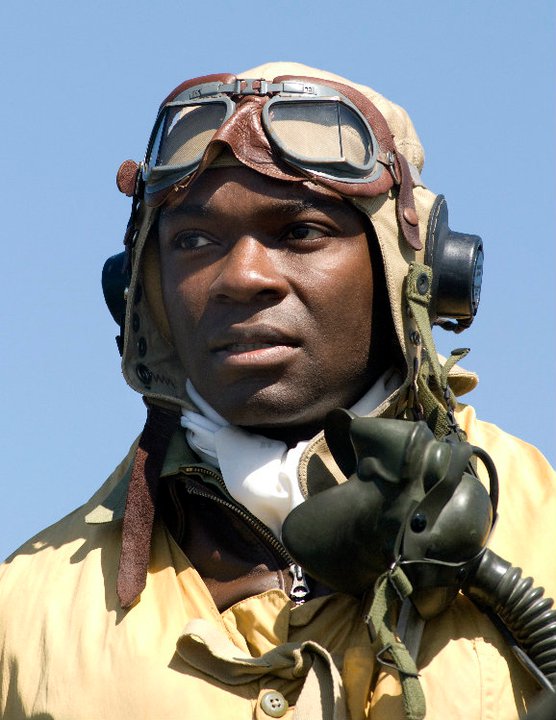
At the same time, it plays things a bit safe, dramatically, while, in subtle ways, taking chances that modern audiences—thank God—might not be aware of.***  It follows a typically diverse group of air-men with defining cliches—the "hot-shot" (David Oyelowo), the alcoholic (Nate Parker), "the kid" (Tristan Wilds"the yokel" (Ne-Yo)—through their story-arcs, fighting on two fronts—against the Nazis and their own brass and fellow soldiers, who, if not wanting to shoot the pilots out of the sky, didn't want them in the air in the first place.
One good thing that sets Red Tails apart from the other "yes, they fought too" films is there's no "white-wash" element (as one finds in a good effort like Glory, where a forgotten story about the participation of black soldiers in the Civil War, has to feature Matthew Broderick and Cary Elwes over Denzel Washington, Morgan Freeman, and Andre Braugher). These guys in Red Tails are on their own. There's no angelic white-devil's advocate that has to make the condescending "these are men" speech and, if anything, here, the white guys are pushing back, making this film a lot more dramatic than your standard "liberal guilt" trip, where everybody's mind miraculously changes once "they're" "given a chance."****  The pressure never lets up on them and the only time they don't have to be on the defensive is in the air, fighting. Their inclusion in the war effort is a convenience to the military, taking pressure off the "other" guys, and nothing considered noble. That doesn't matter to the pilots, though, as long as they're free of Earthly bonds, fingers on the triggers and Nazi Aryans in their sights.
And the battle scenescomplex, nasty and dangerous as the dog-fights are— is where Red Tails excels. The same visceral energy of the Star Wars Death Star battles (which were pre-visualized with edited WWII dogfight footage) is here, but with a rougher edge, bumpier, and more of a sense of true danger than a battle in space could provide.
Why'd it take so long? Probably because Lucas wanted to do this one right (and also because studios were reluctant to finance a movie this black-centric), so he took the back-seat producer job, wrote the frame-work, hired John Ridley to write it and director Anthony Hemingway to film it, then doing some re-shoots (reportedly written with "Boondocks" creator Aaron McGruder) to do some dramatic streamlining.*****  Usually, it works with Lucas projects, especially when the director is strong, like Spielberg; there's a dramatic frisson that happens when it's not a "one-man/one-vision" project—something that was missing from the "Star Wars" Prequels, which suffered from too many "yes-men"—and Lucasfilms always seem to be better when he has to compromise and think off the top of his head...or someone else's.
One still gets a sense, though, of pandering.  The film Tuskeegee's don't need the "hey, these guys are good" comments that drop like leaden bombs throughout the film's second half. As an audience, we can see it, we don't need to have it reinforced by the white pilots they're escorting, especially considering those flight sequences are the best thing in the film. The energy, thrills and derring-do (with their frequent "Yahoo" moments) are far more emotionally satisfying and communicative of the pilots' excellence. Those sequences make Red Tails reach great heights, when everything else is trying to keep it grounded. They didn't play it safe. There's no good reason the film should.
The first wave of Tuskegee pilots


* A variation of the "trope" "Black Dude Dies First," which is a truism in "easy" drama and always struck me as being seminally racist. In a war situation, with an all-black cast, it isn't true, and feels far less manipulative than in most war films.  In this war film, people die because "war is dangerous and people die in war." It's random, unfair, and serves no purpose—not even dramatically. That was an important take-away from this particular war film.

** This was in the 1940's, kids.


*** It's a bit soapish, but there's a romance between "hot-shot" pilot "Lightning" and an Italian girl, where nothing (blissfully) is mentioned about race, making the sequence seem idyllic, but also not cluing modern audiences in to the fact that if the same events happened in the country the pilots were fighting for, he would have stood a good chance of going to prison or being lynched for it. It passes without comment or explanation, which might be dramatically risky, but sure feels good. Real progress is made when the un-usual becomes commonplace and antique words like "miscegenation" disappear like discarded, rusty tools. Racial prejudice is SO "last century."

**** Even so, there's still a little too much of it, done mostly in voice-over behind masks, as if in post-production after-thought. The screen-actions speak louder than any number of patronizing words.

***** Not sure where those sequences are—I'd only be speculating—but at one point "the kid" is shot down and put in a Nazi POW camp—the same camp that was the origination of the events and the film of The Great Escape. Amusingly, there is one sequence that looks shot-for-shot like a sequence from the John Sturges film with "the kid" in the role played by Steve McQueen!  Heh.