Showing posts with label Michael B. Jordan. Show all posts

Friday, June 12, 2020

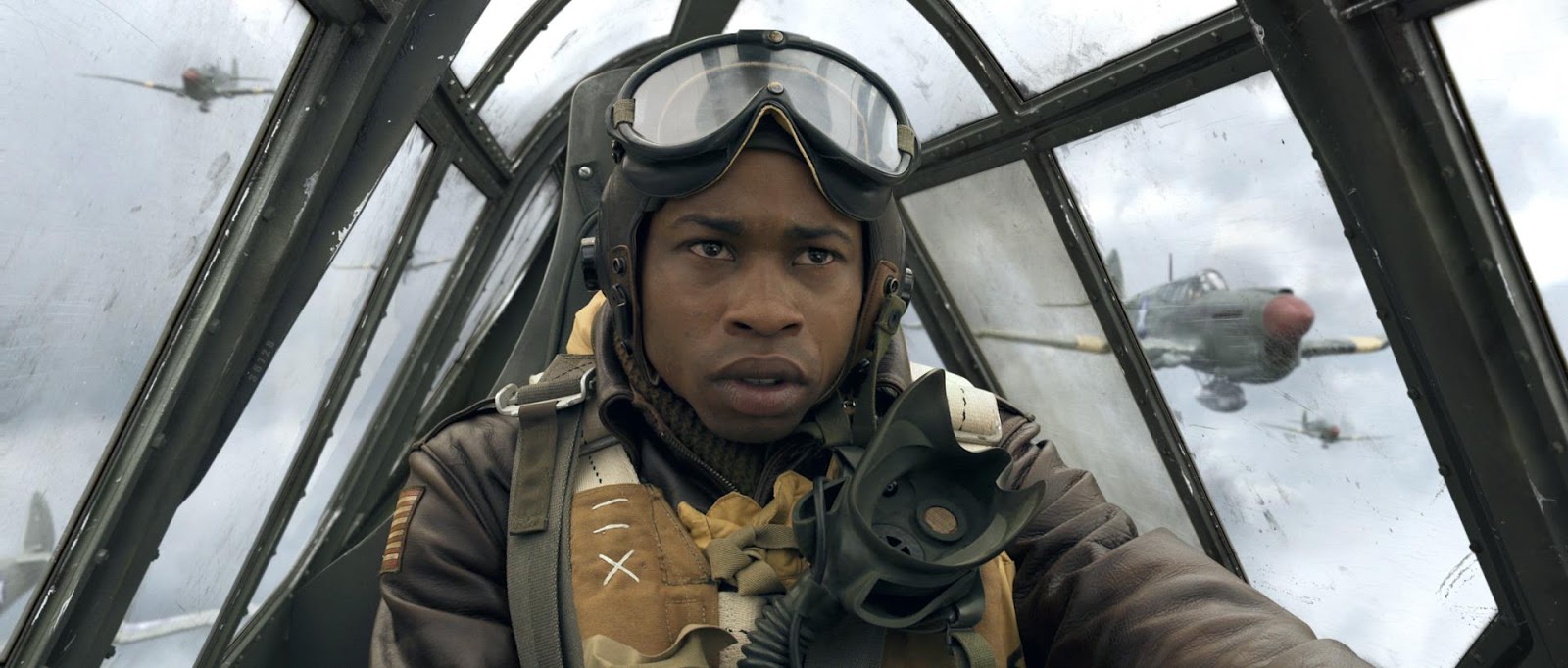
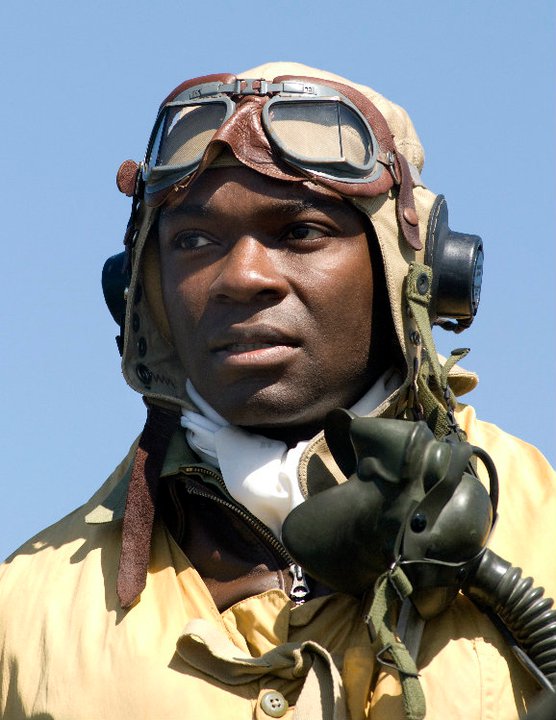
Red Tails

Today—June 12th—is "Loving Day." If you don't know what that is, I have posts about it here and here

Instead of repeating those, there's this, written at the time of the film's release.

Why We Fight
or
The Brother Gets It First*

Like Francis Ford Coppola's Tucker: The Man and His Dream (which he also financed), Red Tails is the movie that George Lucas has waited the longest to make. In development even before the "Star Wars" prequels, the story of the Tuskeegee Airmen has been on Lucas' mainframe for over 20 years. And as with most director "Dream Projects," this one had the potential to soar into great summits of excellence or tail-spin into an exercise of excess and pretentiousness.

Red Tails is neither one of those, but it does do some interesting things along the way. Respectful of the airmen, and "gung-ho" enough to end with "America The Beautiful" playing out over the End Titles, it does remind one, in spirit, of the old war films, that appeared during and immediately after the second world war,** tough, haggard, slightly cranky, and all-too-willing to bring up some risky aspects of the vet's experience that would be tossed under the rug of homilies that later "recruitment" war films would present. 
At the same time, it plays things a bit safe, dramatically, while, in subtle ways, taking chances that modern audiences—thank God—might not be aware of.***  It follows a typically diverse group of air-men with defining cliches—the "hot-shot" (David Oyelowo), the alcoholic (Nate Parker), "the kid" (Tristan Wilds"the yokel" (Ne-Yo)—through their story-arcs, fighting on two fronts—against the Nazis and their own brass and fellow soldiers, who, if not wanting to shoot the pilots out of the sky, didn't want them in the air in the first place.
One good thing that sets Red Tails apart from the other "yes, they fought too" films is there's no "white-wash" element (as one finds in a good effort like Glory, where a forgotten story about the participation of black soldiers in the Civil War, has to feature Matthew Broderick and Cary Elwes over Denzel Washington, Morgan Freeman, and Andre Braugher). These guys in Red Tails are on their own. There's no angelic white-devil's advocate that has to make the condescending "these are men" speech and, if anything, here, the white guys are pushing back, making this film a lot more dramatic than your standard "liberal guilt" trip, where everybody's mind miraculously changes once "they're" "given a chance."****  The pressure never lets up on them and the only time they don't have to be on the defensive is in the air, fighting. Their inclusion in the war effort is a convenience to the military, taking pressure off the "other" guys, and nothing considered noble. That doesn't matter to the pilots, though, as long as they're free of Earthly bonds, fingers on the triggers and Nazi Aryans in their sights.
And the battle scenescomplex, nasty and dangerous as the dog-fights are— is where Red Tails excels. The same visceral energy of the Star Wars Death Star battles (which were pre-visualized with edited WWII dogfight footage) is here, but with a rougher edge, bumpier, and more of a sense of true danger than a battle in space could provide.
Why'd it take so long? Probably because Lucas wanted to do this one right (and also because studios were reluctant to finance a movie this black-centric), so he took the back-seat producer job, wrote the frame-work, hired John Ridley to write it and director Anthony Hemingway to film it, then doing some re-shoots (reportedly written with "Boondocks" creator Aaron McGruder) to do some dramatic streamlining.*****  Usually, it works with Lucas projects, especially when the director is strong, like Spielberg; there's a dramatic frisson that happens when it's not a "one-man/one-vision" project—something that was missing from the "Star Wars" Prequels, which suffered from too many "yes-men"—and Lucasfilms always seem to be better when he has to compromise and think off the top of his head...or someone else's.
One still gets a sense, though, of pandering.  The film Tuskeegee's don't need the "hey, these guys are good" comments that drop like leaden bombs throughout the film's second half. As an audience, we can see it, we don't need to have it reinforced by the white pilots they're escorting, especially considering those flight sequences are the best thing in the film. The energy, thrills and derring-do (with their frequent "Yahoo" moments) are far more emotionally satisfying and communicative of the pilots' excellence. Those sequences make Red Tails reach great heights, when everything else is trying to keep it grounded. They didn't play it safe. There's no good reason the film should.
The first wave of Tuskegee pilots


* A variation of the "trope" "Black Dude Dies First," which is a truism in "easy" drama and always struck me as being seminally racist. In a war situation, with an all-black cast, it isn't true, and feels far less manipulative than in most war films.  In this war film, people die because "war is dangerous and people die in war." It's random, unfair, and serves no purpose—not even dramatically. That was an important take-away from this particular war film.

** This was in the 1940's, kids.


*** It's a bit soapish, but there's a romance between "hot-shot" pilot "Lightning" and an Italian girl, where nothing (blissfully) is mentioned about race, making the sequence seem idyllic, but also not cluing modern audiences in to the fact that if the same events happened in the country the pilots were fighting for, he would have stood a good chance of going to prison or being lynched for it. It passes without comment or explanation, which might be dramatically risky, but sure feels good. Real progress is made when the un-usual becomes commonplace and antique words like "miscegenation" disappear like discarded, rusty tools. Racial prejudice is SO "last century."

**** Even so, there's still a little too much of it, done mostly in voice-over behind masks, as if in post-production after-thought. The screen-actions speak louder than any number of patronizing words.

***** Not sure where those sequences are—I'd only be speculating—but at one point "the kid" is shot down and put in a Nazi POW camp—the same camp that was the origination of the events and the film of The Great Escape. Amusingly, there is one sequence that looks shot-for-shot like a sequence from the John Sturges film with "the kid" in the role played by Steve McQueen!  Heh.

Wednesday, February 28, 2018

Black Panther (2018)

Black Panther 1; Hamlet 2
or
It Takes a Wakandan Village

First off, let me express my prejudices; I am becoming increasingly disenchanted with super-hero movies. I find them to be a bit one-note and superficial and I really (really) am tired of the "revenge scenario" that seems to dominate super-hero movies, especially when it's the hero who seeks revenge. I'd rather my heroes be heroic. Is that too much to ask—to fit the job-title? And I'd rather that their aspirations be un-ironically for the good. Too often these superhero movies have toughened up their heroes, dressing them in leather and dimming the lights to make them "credible" in a live environment. Credibility isn't a bad thing, it's just that it has a tendency to muddy up the motivations of do-gooder's. I mean, if you want to do good, don't mope about it, or don't be so cavalier that you tend to come off like a jerk. I like humble heroes. I like them spreading the wealth. I like them having a good purpose and a good soul.

I love Black Panther. Oh, it has its issues—some dodgy CGI (don't they all...really?), very confusing early action sequences—you see director Ryan Coogler (Fruitvale Station, Creed) gain confidence and communicate arena-geography very quickly on a steep learning curve—a derivative story-line (but derivative in an interesting way), the usual things that make me hesitant going to "another" super-hero movie.
But, this one has a good heart. That may be because its story is a bit of a fairy-tale about a distant mystical land and the stuff of kings. There is a child-like wonder to it, its kingdom of Wakanda (located in Nigeria) has a fleshed-out, fully-formed quality to it that you don't get no matter how many times we've seen Asgard in the Thor movies, and the major characters all have a purpose and a clearly defined function that makes you care for each and every one of them. Nobody's an empty plot-device, nobody is marking time, this is a community on film all to the service of the story and (mostly) to the service of the newly-crowned King, T'Challa (Chadwick Boseman) who is taking the mantle for his slain father.*
Wakanda has been blessed (? cursed?) with a huge store of the Marvellian super-metal vibranium—deposited aeons ago by meteorite—and has kept it secret for its own gain, establishing itself as a technological power while keeping the knowledge of it "off the grid." To the world, Wakanda is a peaceful land of textiles and subsistence farming, while beneath an obscuring force-field, the five tribes of Wakanda maintain an alliance of wealth and power which is ruled by succession mitigated by the challenge of ritual combat, their leader taking on not only the mantle of King, but also that of The Black Panther, protector of Wakanda, who is given extraordinary powers by imbibing the broth of a native herb suffused with vibranium.
Except for the vibranium story (which is given a nice "Tell me a story" beginning with a reverberating end question), this is all pretty much communicated by plot and visual story-telling, which, frankly, is just plain wonderful film-making. We, the audience, learn as we go, even as our eyes are popping with incredible art-design and costuming, making the learning part and parcel of the whole experience. Coogler and his artisans have done such an effective job that one wonders if, when the inevitable sequels come out, that uniqueness will fade as it has with other Marvel films, and for a similar leap in imagination, Star Wars, but it's a bit premature to be worrying about that. One should be grateful for what's there that such a worry even exists.
The story proper begins in 1992 in an Oakland project. While the neighborhood kids are out playing B-ball with a basket made of a broken milk-crate, two men are approached by the guards of the King of Wakanda, T'chaka (Atwanda Kani—the son of the actor who plays the older, late King, John Kani). He greets one as his brother, N'jobu (Sterling K. Brown), but it is not a joyous reunion; N'jobu has been sent to America as a Wakandan spy—the nation's only way of keeping tabs on the outside world without betraying its advanced status. It seem N'jobu has been dealing with an international arms smuggler, Ulysses Klaue (Andy Serkis—and not just a CGI Andy Serkis—who's been hovering around the last couple Marvel team movies) to get weapons for giving the villain much prized vibranium. This, the King says, cannot be allowed. There is a family quarrel about this and N'jobu ends up dead for his duplicity. Hidden by a cloak of clouds and night, the Wakandans take off back to Africa, leaving the basketball players to look up in wonder.
That is the past. In present day, T'chaka's son, T'challa, is on his way back to his kingdom to claim the throne, ferried by his personal guard Okoye (Danai Gurira) of the Border Tribe and head of the elite Dora Milaje forces. But first, they must pick up T'challa's former love Nakia (Lupita Nyong'o) of the River Tribe, who is working undercover as a Wakandan spy, freeing kidnapped Wakandan women from a slaver group. All safe and sound, they enter the camouflaging force-field hiding the technologically advanced city from the eyes of the world and are greeted by T'Challa's mother Ramonda (Angela Bassett), his techno-whiz-kid-sister Shuri (Letitia Wright) and Zuri (Forest Whitaker), the tribe's spiritual leader. Amid much pomp, T'Challa is installed as King, but not before he is challenged for the position by M'Baku (Winston Duke) of the Jabari Mountain Tribe in a fight for supremacy against a de-powered Black Panther. In a fight to the death, T'Challa convinces the proud M'Baku to yield because "your people need you!"
Already, Black Panther has set itself apart from other "superhero flicks:" it's hero is a combatant, but he must continually prove his place as champion—he has a birth-right, sure, but he has to earn his stature, and he can lose it if he falls short—that sets him apart from the heroes-by-accident and privilege of most of the genre. And that "your people need you" cry has a charitable diplomatic streak that you don't find, either, amongst the "all of nothing" spandex-set. He also has a vast support-system surrounding him, guiding him in his actions, whether supportive or adversarial, to find a path that is most beneficial to all sides. This tests the new Wakandan leader to become the King that he might not otherwise be if left to his own devices.
T'Challa goes to "the spirit realm" to talk to panthers with "Kubrick" eyes.
He'll need it. His greatest challenge in this particular chapter will come from an incident in the past that will ultimately alter the course of the nation of Wakanda in the form of Killmonger** (Michael B. Jordan), who has sided with that Klaue guy to steal vibranium. Here's another thing I like about Black Panther—they do make room for the standard "revenge-story" trope that I find so tiresome in super-hero motivation. However, it is Killmonger who is in the "you shall be avenged" business, following Hamlet, The Lion King and Inigo Montoya to seek revenge for the slaying of his father to the obsessive point of caring about nothing else. That "bit" feels far much more comfortable as a villain motivation than for a hero and as bad a dude as Killmonger is, the film still manages to evoke some sympathy for the guy and his circumstances—an empathy that provides one of the best "grace" notes of the film and sets the movie far above the usual fare by making its "super-hero" a...well...an actual hero.
After so many years of these films, have film-makers actually started to get it right? There are very few really good super-hero films that are good as merely films, but I can count on one hand how many espouse some sort of selfless heroism—the first Christopher Reeve Superman, Captain America: The First Avenger, Wonder Woman...and this.*** And I will be so bold to say that of every superhero movie I've seen, this and that first one are the only ones I'd recommend for kids. It's the spirit of the thing. And their eyes will pop at the sight of it all. It's good imagination-stirring stuff.
Now, the challenge comes. The second films of the Marvel Studio series all take a large step downward in quality (with the exception of Captain America: The Winter Soldier). Black Panther is on such sure footing, one hopes that the second isn't a mis-step. Director Coogler is saying he'll be back for another and that gives me the most hope that it will be just as edifying—even if the visuals will not be as surprising—as this effort. Very worth seeing.
"I did not yield. And, as you can see, I am not dead.
The challenge continues."


* As seen in Captain America: Civil War —"Jaunty" Jim

**  I know, I know "Killmonger" (shudder), but, trust me, it could have been worse—in the comics, M'Baku is known as "Man-Ape."

*** Okay, I know YOUR favorite may not be there, but I'm talking about completely heroic movies that go right out and un-ironically espouse and show heroism and not make some crack about it. So, yeah, Dark Knight, sure, Winter Soldier and Civil War, okay, Ant-Man, Guardians of the Galaxy, The Avengers...then....

Thursday, September 3, 2015

Fantastic 4

"It's CLOBBERIN' Time!"
or 
"This Movie!...This Monster!"

The latest Marvel superhero movie to come out is the third attempt to make a viable tent-pole of one of the comics line's most venerable titles—the first to be published by Marvel, The Fantastic Four. Four friends who, on a space mission, are turned into super-heroes by a bombardment of radiation, the four—"Mr. Fantastic" (Reed Richards), who can stretch, "The Invisible Woman" (Sue Storm) who can turn invisible, "The Human Torch" (Sue's brother Johnny), who turns into a flying human fire-ball, and "The Thing" (Ben Grimm), who is turned into a super-strong rock-like bi-ped. Together, "they fight crime" (as the cliche goes), but for this relatively human team, the challenges were more cosmic and more mind-bending as they had to contend with threats from other galaxies and other dimensions (drawn from the seemingly endless imaginative ink-well of Jack "The King" Kirby), while, at the same time, serving up the mandatory Marvel "soap opera" quotient with Reed and Sue's love story, Johnny's hipster hot-head, and Grimm's impenetrable angst over being an unlovable freak. With its combination of mind-blowing themes and (*choke*) tear-duct-blowing melodrama, it became a big hit with teens and the college-crowd.
Reed, Sue, Johnny and Ben as rendered by Jack Kirby
It was self-trumpeted (a bit prematurely on the cover of issue #4) as "The World's Greatest Comic Magazine!" but the appeal of the FF couldn't be denied. Attempts were made in 1994 (under the producing of Roger Corman and is the ONLY film in his low-budget exploitation career that was NEVER released) and revived again in 2005 (with Jessica Alba, Michael Chiklis and a flaming Chris Evans, as well as the guy who got crushed by a container on the Golden Gate Bridge in San Andreas) in two films (Fantastic Four and Fantastic Four: Rise of the Silver Surfer) that were a bit premature in the new wave of CGI mounted comic-book films. Those two FF movies are consigned to "The Zero Zone," along with Ben Affleck's Daredevil movie.

The 90's FF (Hyde-White, Staab, Underwood and Smith) and the 00's FF (Alba, Gruffud, Evans and Chiklis)


But, it seems there must be a "Fantastic Four" movie attempted every decade from now on. The latest, Fantastic 4, is no improvement on the others. The cast is younger, more diverse (despite fan-boy grumbling—the most conservative of critics), the effects improved, and an attempt has been made to update the story and make it more hi-tech for the 21st century. That it ultimately fails leads one to question if it's one of those properties that just doesn't work in any other medium than the four-color comic. Or it makes one question if any other studio than one working in tandem with Marvel can produce anything decent. The director of this one, Josh Trank (who made the interesting Chronicle) has gone public, grousing that studio interference messed up his vision of Lee and Kirby's vision.
The origin story does need some updating, however, now that we're out of the 1960's of the Four's re-birth and into the 21st century. Instead of doing some experimental space-travel, the four and their co-worker Victor Von Doom (an eye-rolling name that, if anything needed to be changed, should have been a priority), instead, are exploring matter transference—a working "transporter" being a dream project of Richards' (in this case, Miles Teller) since he was a boy. At a science fair where he demonstrates a break-through, he's invited by Dr. Franklin Storm (Reg E. Cathey, in a performance that is quite...well, "restrained" would be a nice way of putting it) to join a team involving his son Johnny (Michael B. Jordan), adopted daughter Sue (Kate Mara), and banished upstart Von Doom (Toby Kebbel) to see the project through to completion. But before a NASA administrator (Tim Blake Nelson) can start trials, Reed, Johnny, Victor and Reed's boy-hood chum Ben Grimm (Jamie Bell—remember him as Tintin in Steven Spielberg's film?  Of course you don't—you won't remember him in this, either, as his part is mostly motion-capture) who's there for some inexplicable reason, decide they're going to test it on themselves first. The mission does not go well, affecting the travelers in variant and horrific ways—it also alters Sue Storm, who is left back at the control room for some reason, but suffers the consequences, anyway.
Sue, Johnny, Dr. Storm and "Vic" von Doom.
Von Doom is left on the "Zero Planet" (as it's called), while Reed's body is turned malleable, Johnny erupts in flames, Sue turns invisible, and Ben is changed into a rock-like monster. It is horrific for all, but the NASA suits see them as an opportunity for weaponization (after some experimentation), but Reed slithers out of his shackles and escapes the complex they're being held in against their will, vowing he will free the others and turn them back to normal. For those left behind, Reed is simply a turncoat and to the government he's a threat. This takes a good hour to set up and less than that to resolve, including a return to the Hell-Planet, where the four confront Von Doom who is constructing one of those Marvel movie things that throw off an energy stream that shoots up into the sky, but you have no idea why.*
A lot of it looks good—there's a subdued color palette and a tendency to dimly light things that give it the look of a good old fashioned horror movie, which when you have people disappearing, disfigured and on fire isn't much of a stretch (hey, I just described everybody's powers in one sentence!). But, there is an awful lot wrong with it. One could nit-pick over dialogue and acting and failures in logic and potential throughout this movie. But, simply put, there are four key errors in this Fantastic 4 that makes it unique among bad super-hero movies.
1.  Consider the Source: The Fantastic 4 are superheroes at their most puerile, designed to impose a family structure on disaffected little boys. They are instantly recognizable as Mom and Dad (Reed and Sue) and the bickering kids (Ben and Johnny). Whatever conflicts they go through (and they go through a lot internally and externally), the family dynamic pulls them through. That's one thing that's consistent about the Fantastic Four and part of its basic DNA. In this film, however, "family" is given lip service. The group is quarantined after the accident and restrained by the NASA industrialists and the four turn into factions—Johnny and Sue against Ben and everybody against Reed, "the turncoat," who has escaped and seemingly abandoned the other three. Nobody trusts anybody and its every man and woman for themselves until Dr. Doom (Bwa-ha-HA!) serves as an over-arching threat that unites them. Up until the last few minutes of the film, they're not even a team at all and are actually pissed at each other. This is so fundamentally opposed to the appeal of the original concept, it may be the biggest mistake of the film. If you're going to make a superhero film about a creation that's 55 years old, at least realize what it is that's made it last so long.
2. Did You Know That You're My Hero?: That's the thing about super-heroes. They are us but better. Smarter, faster, stronger, and certainly more altruistic to the point where the whole genre might be considered science-fiction, given the proclivities of the populace. They train themselves to make use of their gifts in the service of others, and if something should befall them—a spider-bite, a lightning strike, or a birthright—they seek its use for the betterment of their neighbors. Sure, the Fantastic Four may have turned into embodiments of the four elements: Earth, Air, Fire and..Rubber, but rather than grieving, drinking and saying "how do I fix this?" they use their new handicaps, and in that very tendency they are heroes. That's not what you get here. You don't get heroes, you get victims. The explosion of the transporter makes everybody helpless and easy prey for the militarists hoping to exploit the four by "helping" them. And Reed is so beset by guilt, he wants to "fix it."** So he runs away to become a super-genius Ted Kaczynski in the woods. The victimization of the Fantastic Four here aligns them with most of the other Marvel heroes—and not just the Marvels, but others of the sub-genus—making the origins part and parcel of the cause they fight for. But that was never the Fantastic Four in the comics. There was not too much brooding to be done over their conditions (except for Ben), not when there were whatzit's to invent and cosmic crises to insert themselves into. The 4, for the most part, accepted what happened and moved on, making the most of the situation.  It would be nice to see more of that.
3. Sometimes Origin Stories Don't Matter: The origin of The Fantastic Four is completely unremarkable and gives no purpose to their being—an accident that changes them and inspires them to make lemonade out of lemons. In the comics, they are all gifted in some way (even Ben Grimm is a test-pilot, which is why he's on board the doomed space-ship) and their instincts are to use those gifts for some greater purpose. That origin does not make a mission—to find the person responsible, to prevent the same thing from happening to others or such. And yet the "How-They-Came-To-Be" story is trotted out like that's the thing to do. Unfortunately, that story (which provides no "hook" to a franchise) takes up more than half the movie, time that could have been better spent on anything else. Like story or character or "Something Big." It would have been far better to start in media res—assume the group simply is and concentrate on something world-shaking that they have to overcome. As it is, the movie is extraordinarily lop-sided, the majority of it being Origin Story followed by 15 Minutes of Action, and rather negligible action at that. Really, all they do at the end is beat Dr. Doom up and turn his "Whatever-It-Is" against him. If you're going to make a superhero movie...
4. Make it ABOUT Something, Damn It!:  There isn't much of a story here besides the origin, a quick confrontation with the motivation-less villain, and then the movie ends without the group having a purpose...merely a headquarters. Maybe that's to make the whole thing seem more in line with The Avengers, but that group has a goal before they decide to move in together, and without that there is certainly no triumph to the ending, merely a mortgage. There is no reason for the team to exist. They beat up Dr. Doom and that's it. What's the point to continuing the series—to find a cure for the mutations, to perfect the errant experiment that caused them, to block it from happening again (as it appears to be a bad place), to establish a support group for Zero Planet victims—what's the job? Hopefully, that HQ has a meeting room with a white-board or something so they can figure it out before the next movie (despite the poor box-office, Fox is already talking one up...for now).

In the end, it's all false advertising—it's not the comics and only resembles it in name and powers—and right down to the name: Not so fantastic.  And if you're into rating movies, only 1 out of 4. 
Reed Richards can make himself look like anything with that stretch-power.
So why does he choose to look so dumpy?

* Marvel Comics was always soft on science—there always seemed to be a scene where the four were looking up at some huge cosmic something-or-other with dialogue that summarized "I don't know what it is, but it sure is BIG!" 

The Marvel movie equivalent seems to be "I don't know what it does, but it sure spits out a lot of sparks!"
"I don't know what it is, but it sure is BIG!"
** Reed does want to help Ben Grimm in the comics, as that character is his friend and the most traumatized by the "accident." Everybody else is fine with their powers and set about how to use them and improving them.