Showing posts with label Miles Teller. Show all posts

Friday, June 3, 2022

Top Gun: Maverick

Almost There. Al-most Theeere....
or 
"What Were You THINKING?" "But, You TOLD Me Not To Think!!" 

Controversial yet factual opinion: Anthony Edwards is hotter than Tom Cruise in Top Gun. First of all, the mustache? WORKS. Second of all, he's fun! Third of all, Maverick is such a desperate, narcissistic, posturing, alienating, twerpy little prince that I find myself disorientingly at odds with a former self who long ago considered Tom Cruise to be attractive. Who was she? That woman who could look at a picture of young Tom and not flash immediately to this jittery rat terrier with a barely contained rage problem, a monomaniacal fixation on personal glory at the expense of the safety of everyone around him, and an approach to women that can charitably be described as Biff-esque? I don't know her.* Fourth of all, Maverick's hair is bad! It needs to be EITHER SHORTER OR LONGER.

Maverick is the villain of Top Gun.
 
* Paradoxically, I do think that Tom Cruise is an excellent movie star, and I also enjoy his movies!
Lindy West
"I'd Prefer a Highway Away from the Danger Zone, but Okay"
"Shit, Actually"
copyright 2020 by Hachette Book Group, Inc.

I can see why there would be a sequel to Top Gun thirty six years after the first film, beyond economic gains. The original was a recruitment poster for the military, and right now there is a shortage of airline pilots creating disruptions of flights. What is interesting about that shortage is that it is due to a changing military. Airline pilots usually came from a military flying background. But, there are less of those pilots being trained now because we're training more drone pilots than military pilots.
 
Plus, Tom Cruise needs a hit. His two big franchises that bring in money are Mission: Impossible and Top Gun—probably his biggest hit. Nobody went to see The Mummy (killing Universal's proposed "Monsterverse" series) and American Made. Jack Reacher is now a streaming TV series. Tom needs a hit.
But, as Lindy West pointed out in her idiosyncratic review of the first film, Tom Cruise's Pete Mitchell was, if anything, the villain of Top Gun. Narcissistic, cocky, heedless, and anti-authoritarian, Mitchell was the military's nightmare—the hot-head not broken by basic training. His actions killed his wing-man, "Goose" and 
I've thought—not very often—that if Mitchell wasn't killed in subsequent flying, he would have become the protagonist of American Made, a pilot for nefarious purposes. I mean, rules are made to be broken, right?

So, this is the guy the Navy wants to train fighter pilots?
Apparently so. Well, not precisely. The Navy doesn't want him. An Admiral in the Navy wants him, that Admiral being Tom "Iceman" Kazansky (
Val Kilmer), from the first film. It's easy to get movie-sentimental about that, but it made me think that it was because of an Old Boys Network that got this flame-out back in the cock-pit with any kind of authority. This is wrong thinking. In fact, Top Gun: Maverick doesn't want me to think...at all.
That got me into trouble immediately with this sequel that repeats the first movie's opening minutes with Harold Faltermeyer's theme starting over the same opening text from the first film, then transitions into Kenny Loggin's "Danger Zone" over a "thumbs-up and launch" montage, which reminds people that there are aircraft carriers and take-offs from the flight-deck and that the Navy—for their cooperation in helping make the movie—needed some footage that involved them and not Tom Cruise.
Cruise's Pete Mitchell has been shopping himself out as a test-pilot to an aerospace firm—a very small one, it seems—that has a contract with the navy to supply a hyper-sonic fighter and today is the test to push it to Mach 9. The thing is the Navy brass (in the form of
Ed Harris) want the thing to perform at Mach 10. So, what does Maverick do? First, he takes the thing out early—even before Harris' Admiral (who also showed up earlier than scheduled)—and buzzes the guy before taking it to Mach 9. But, no, that's not good enough: Maverick takes it to Mach 10. Okay. Then, he takes it Mach 10.3 before the plane breaks up from the stress and disintegrates.
At this point, I believe, Top Gun: Maverick continues as a dream sequence because...no. No way does Mitchell walk away from this. But, he does in the movie. It's a bit of a mis-step because the flying sequences are CGI (the plane prototype does not exist) and it kind of undercuts the impressive in-camera work done by the flyers and actors in the later F/A-18 sequences. But, it also shows the Maverick hasn't changed that much, pushing everything to the limit until he breaks something, leaving his employers with going back to the drawing board. He's admonished by Harris' Admiral, but then informed that he's been picked to train a class in the Top Gun school for a seemingly impossible mission.
That mission is to take four F/A-18 Super Hornets into forbidden air-space—in a safely-unidentified country, but it probably ends with an "A-N"—flying under any sort of radar detection that would launch SAM attacks, fly up a steep escarpment, take out a uranium enrichment plant nestled in the valley then climb an even steeper escarpment (with heavy G-force consequences) where they may be met by "fifth generation" fighters, if they haven't already been neutralized by the two F/A-18's trailing them to destroy a nearby air-base. 
So, it's basically, the Star Wars "Death Star" trench run (which, admittedly, is a crowd-pleaser) but Star Wars wasn't a two hour film about training for it. Here, the complications are: one of the pilots-in-training is "Rooster" (
Miles Teller) Bradshaw, son of "Goose" (from the earlier film), which places Maverick in a position of responsibility and guilt, a re-kindled romance with an Admiral's daughter (Jennifer Connelly) "from the old days"—it's like nothing happened between the first film and this one (No attachments? No kids? Is there some psychological "thing" about this guy?), and the mystery of why Kazansky picked Maverick—of all people—to do this job.

That scene—with Kilmer unable to talk due to his battle with throat cancer—is (apart from the the admittedly well-executed flight scenes) the highlight of the film. Kilmer doesn't have to do much to eke out any audience sympathy, but there's an old sageness to his performance (done with just knowing looks) that's hard to resist, and Cruise pulls off one of those moments where he stops being a movie star and crumples into acting. Nice to see, and that, more than anything, made me want to salute.
The acting is all good. From the by-the-book sourness of Harris,
Jon Hamm and Charles Parnell to Connelly's "sure-it's-a-'Girlfriend'-role-but I'm-still-gonna-'Girlfriend'-this-guy-right-off-the-screen" spunkiness. But, ultimately it comes down to that mission—top secret because it isn't sanctioned and probably illegal under international law—where two "miracles" have to happen to pull it off (I counted six) and where the best advice Maverick can offer is "don't think...DO." It is this mantra that saturates and permeates the entire movie, further embedding it in Star Wars mythos, right down to evoking a spirit for guidance at a critical time. At least they had the grace to make a joke about the inanity of that advice and its genuinely funny and well-played.
But, oh boy, it sure apples to this movie. Yeah, it's a good time, and 'gung-ho' and propels itself along at a good clip and the shots in the cock-pits are so amazing, it doesn't matter that the actors are in the back-seats. It delivers the payload and gets away clean without having to answer for anything just like the mission parameters.
 
As long as you don't think about it.

Thursday, February 24, 2022

Rabbit Hole

Written at the time of the film's release...

Ghost-busting

or
Coping Mechanisms

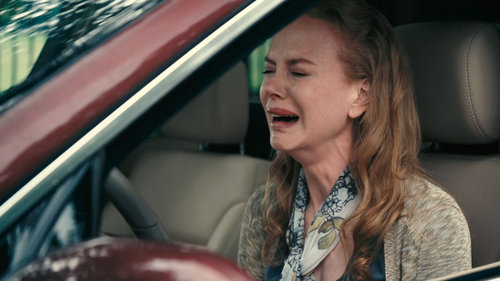
'Becca (Nicole Kidman) is going through the motions. She's doing everything expected of her and dutifully. The planting of new flowers in the garden, the making of stringent recipes of comfort food, the grief support group. All those motherly instincts and nothing to mother, and everything—absolutely everything—reminds her of the void in her life. Her child is dead, a victim of a car-pedestrian accident. Her sister (Tammy Blanchard) is pregnant, her mother (Dianne Wiest) keeps bringing up her own dead child—Becca's brother, friends with kids avoid her as if death were communicable, the flowers get crushed, the pans go empty. Life goes on, horribly.

Husband Howie (Aaron Eckhart, all clenched jaw and knotted body language) can't let go, sitting up every night endlessly watching a phone-video of little Danny  This frustrates 'Becca. So do the "professional wallowers" of the support group. She's avoiding grief, while Howie and the others are embracing it, and both sides are going too far  She starts to find ways of relieving herself of Danny's things, each one precious to Howie. They start to splinter, the pressures of the void hammering them from both sides.

Life goes on, horribly.
Audiences have been avoiding Rabbit hole like those parents avoid Becca, the subject matter presuming to be a downer. More's the pity as there is enough humor in the cracks of the angst to make it worth seeing and nod appreciatively at the simulations of life and death and the grief that comes between. Director John Cameron Mitchell stays out of the way, mostly, merely observing the struggles from sympathetic angles, while not making a big thing of the POV—making him a far subtler director than, say, Tom Hooper of The King's Speech.  The performances are pitch-perfect along the scale of emotional expression, from buried thought to screaming match, with Kidman sublimating technique for organic feeling to Wiest's haunted portrait of mother love. You pull for these people as they learn to live with death, even if they only get a "C" average.

It would be unfair to say too much of the plot other than the set-up, but
it touches briefly on comics and concepts of parallel universes and alternate realities—an alternate form of Heaven and the possibility that somehow, somewhere, things are different and that the cosmic dice might roll a different way. Possibilities erode the concept of the concrete reality, and sometimes the best way out of a trap is to imagine the way out, rather than accept that there isn't.

A downer? Maybe. But I found something heartening in a film that suggests that
the only way to fill the void of death is with larger doses of life. And that the holes those voids leave can only be healed—not so much in reality—but, in another dimension, the warrens of our soul.


Wednesday, April 20, 2016

The Spectacular Now

Written at the time of the film's release...

The Sins of the Sons of the Father
or
What if the Hokey-Pokey IS What It's All About?

(500) Days of Summer was one of my favorite movies a couple years back, a smart combination of naiveté, winsomeness, and cynicism about the whole "love" thing...especially from the needy/selfish male point of view, and was very charitable to the elastic female point of view...something you wouldn't find in your basic Woody Allen (or any male-written) love story.

The director, Marc Webb is off (er...) web-slinging on the re-booted "Spider-man" series, but writers Scott Neustadter and Michael Weber have done a new screenplay of Tim Tharp's National Book Award finalist The Spectacular Now, directed by James Ponsoldt, who's less flashy than Webb, a little less assured technically (especially in the sound department), but has a great casting eye as he's gotten a spectacular ensemble cast for this film.

When we first meet Sutter Keely (Miles Teller, who is brilliant in this, his face morphing between man and boy with split-second speed), he's filling out a college entrance question: "Describe a misfortune, hardship or challenge in your life: How did it affect you, and what did you learn from it for the future?" Sutter doesn't even hesitate: "Dear Dean of Admissions: Up until yesterday, I had the best fucking girlfriend in the world. Sorry, I probably shouldn't say 'fuck' in this..."

Miles Teller, the breakout performance of The Spectacular Now

It's true.  Sutter's just gone through a bad break-up with Cassidy (Brie Larson), who, in his eyes, was the perfect girlfriend and they were the perfect couple, the hit at every party (and there are a lot of them), but it's all come crashing down when she says "I'm done!" over Sutter helping his buddy get a girl, by giving a couple of fellow high-schoolers some of the ice-cooler'd beers he regularly stashes in his trunk. Sutter's good for that, but for Cassidy that's not good enough. They're through, so over and done.

Cut to the title. Next thing we know, we're looking up at a sun-blocking silhouette saying: "Hey!  Hello?  He-lllooo!  Oh my God, you're alive!"
It's 6 am. He's passed out on a lawn of a house he's not familiar with, his car is nowhere to be found, and standing over him is Aimee Finecky (Shailene Woodley, proving that her instinctually felt performance in The Descendants was no fluke), who is out doing her Mom's paper route, only to find a body on the way. They know each other from school. Aimee helps Sutter up, and the two continue the route with two missions: delivering the papers and looking for his car. The goals are short-term, which suits Sutter just fine.

It's clear early on that Sutter is a boat without a rudder (or even a paddle), and the women in his life, be they his Mom (Jennifer Jason Leigh, welcome back), Cassidy or the new Aimee, keep him focused and on the true. Or as true as Sutter will let himself be (and Teller has a wonderful ambling gait, which I started calling "The Sutter Strut" that is both assured yet not going altogether fast, keeping anything approaching at a measured pace). Fairly early on, we learn that Sutter may indeed be "the life of the party," but he's also considered a flake and unreliable. A heated discussion in the family kitchen produces a "Sometimes, you remind me so much of your father..." comment (and not in a complimentary way) from his mother and he's annoyed because a) his father, having left the family early with no subsequent contact, leaves a void about how that should be taken; and b) he harbors the notion that the reason Dad's gone is that it's Mom's fault, all evidence to the contrary gone missing. In the meantime, and for the moment, he is spending his critical senior year in High School marking time, regretting Cassidy and "hanging out" with Aimee.

"Dude, she's not a rebound!" he assures a buddy, but it's pretty clear she is, at least at the start, using her as an excuse to go see Cassidy at a kegger. It's a quid pro quo kind of arrangement: she can help him with algebra, he up's her social quotient—she's never had a boyfriend and he's an established arm to hang on. But before long, the conversations start to get deep, the facile conversations ("what's your 'thing?'") turn personal, the "maybe-I'll-see-ya's" become orchestrated "bump-into's" and the period apart starts to become a noticeable measure of time. They're starting to fall into something: for her it means someone to share her plans for the future and college; for him, a long-term commitment is asking her to the prom.
She already knows what he's just beginning to suspect.
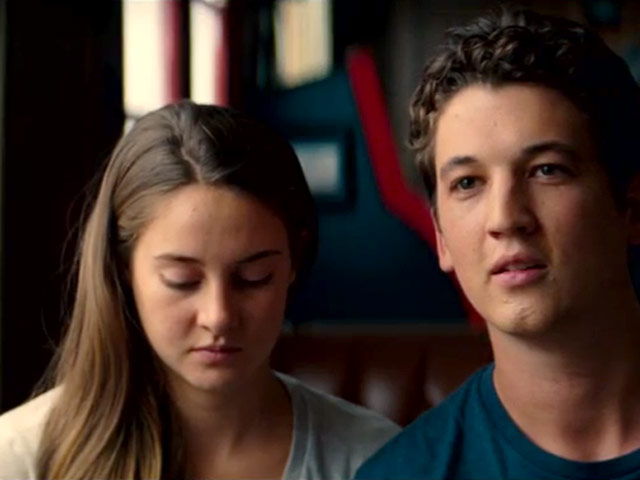
Now, before we go too far into this, let me say what a joy it is to watch Teller and Woodley riff off each other. The lines are established, sure, but the way they stumble, falter, eke out, and fly from each other's mouths colliding in awkward crashing cadences and emotional ranges between feigned self-assurance to tip-toeing fear is truly something to see and enjoy. Both actors are top of the line working with the other actors, but, with each other, there's a yearning sparring that feels like the magnetism of puppy-attraction. If it ain't convincing as love, it sure is convincing as fresh conversation that feels real (and spoken for the first time), and is as fine as any movie bantering I've seen in years between young actors.*
So, with all that raw talent going for it,** where does the movie go? There's been so much writing here, one worries that too much is going to be given away, and any particulars in subject matter and how it is revealed will result in the spoilage of any sort of subtle enjoyment of the film and how it subtly ingratiates and glad-hands you into darker territory. It skirts Afterschool Special territory, but does it in so circumspect a way that you may not even be aware of The Problem, until you are confronted with it in the same way Sutter confronts it, in reflection, but he sees it, not when he looks in the mirror, but when he is especially focused on something other than a short-term goal, but rather on the realization of a dream. Sutter has no depth, except in what he avoids, and he only realizes it to his horror and imagined shame. The Spectacular Now includes author Tim Tharp's original ending for the book, but the screen-writers give Sutter an "out" to end on an up-beat note in the grand Hollywood "bauble" tradition, but at least they take a page from Mike Nichols' play-book, and don't make it a comfortable one, but leaves him...and the audience hanging on a precipice, leaving the Spectacular Now and entering an Uncertain Future.***
"Stumble, falter, eke out and fly..."- Teller and Woodley


* Come to think of it, they remind me of the Andrew Garfield-Emma Stone hemming-hawing in The Amazing Spider-man.

** And I haven't even told you about Kyle Chandler, who plays against "type" and does it so unnervingly well, you want to start a barroom brawl with the guy.

*** The view from the "Now:" Talk about an uncertain future—Marc Webb got bumped off the "Spider-man" series after the under-performing Amazing Spiderman-2, Teller gained a more reputable role in Whiplash and doused it with Fantastic Four, and Shailene Woodley has very nearly wasted her talent with the "Divergent" series (Teller has co-starred in those). These are all talented people—what are they doing wasting their talents on "tent-poles?"

Thursday, September 3, 2015

Fantastic 4

"It's CLOBBERIN' Time!"
or 
"This Movie!...This Monster!"

The latest Marvel superhero movie to come out is the third attempt to make a viable tent-pole of one of the comics line's most venerable titles—the first to be published by Marvel, The Fantastic Four. Four friends who, on a space mission, are turned into super-heroes by a bombardment of radiation, the four—"Mr. Fantastic" (Reed Richards), who can stretch, "The Invisible Woman" (Sue Storm) who can turn invisible, "The Human Torch" (Sue's brother Johnny), who turns into a flying human fire-ball, and "The Thing" (Ben Grimm), who is turned into a super-strong rock-like bi-ped. Together, "they fight crime" (as the cliche goes), but for this relatively human team, the challenges were more cosmic and more mind-bending as they had to contend with threats from other galaxies and other dimensions (drawn from the seemingly endless imaginative ink-well of Jack "The King" Kirby), while, at the same time, serving up the mandatory Marvel "soap opera" quotient with Reed and Sue's love story, Johnny's hipster hot-head, and Grimm's impenetrable angst over being an unlovable freak. With its combination of mind-blowing themes and (*choke*) tear-duct-blowing melodrama, it became a big hit with teens and the college-crowd.
Reed, Sue, Johnny and Ben as rendered by Jack Kirby
It was self-trumpeted (a bit prematurely on the cover of issue #4) as "The World's Greatest Comic Magazine!" but the appeal of the FF couldn't be denied. Attempts were made in 1994 (under the producing of Roger Corman and is the ONLY film in his low-budget exploitation career that was NEVER released) and revived again in 2005 (with Jessica Alba, Michael Chiklis and a flaming Chris Evans, as well as the guy who got crushed by a container on the Golden Gate Bridge in San Andreas) in two films (Fantastic Four and Fantastic Four: Rise of the Silver Surfer) that were a bit premature in the new wave of CGI mounted comic-book films. Those two FF movies are consigned to "The Zero Zone," along with Ben Affleck's Daredevil movie.

The 90's FF (Hyde-White, Staab, Underwood and Smith) and the 00's FF (Alba, Gruffud, Evans and Chiklis)


But, it seems there must be a "Fantastic Four" movie attempted every decade from now on. The latest, Fantastic 4, is no improvement on the others. The cast is younger, more diverse (despite fan-boy grumbling—the most conservative of critics), the effects improved, and an attempt has been made to update the story and make it more hi-tech for the 21st century. That it ultimately fails leads one to question if it's one of those properties that just doesn't work in any other medium than the four-color comic. Or it makes one question if any other studio than one working in tandem with Marvel can produce anything decent. The director of this one, Josh Trank (who made the interesting Chronicle) has gone public, grousing that studio interference messed up his vision of Lee and Kirby's vision.
The origin story does need some updating, however, now that we're out of the 1960's of the Four's re-birth and into the 21st century. Instead of doing some experimental space-travel, the four and their co-worker Victor Von Doom (an eye-rolling name that, if anything needed to be changed, should have been a priority), instead, are exploring matter transference—a working "transporter" being a dream project of Richards' (in this case, Miles Teller) since he was a boy. At a science fair where he demonstrates a break-through, he's invited by Dr. Franklin Storm (Reg E. Cathey, in a performance that is quite...well, "restrained" would be a nice way of putting it) to join a team involving his son Johnny (Michael B. Jordan), adopted daughter Sue (Kate Mara), and banished upstart Von Doom (Toby Kebbel) to see the project through to completion. But before a NASA administrator (Tim Blake Nelson) can start trials, Reed, Johnny, Victor and Reed's boy-hood chum Ben Grimm (Jamie Bell—remember him as Tintin in Steven Spielberg's film?  Of course you don't—you won't remember him in this, either, as his part is mostly motion-capture) who's there for some inexplicable reason, decide they're going to test it on themselves first. The mission does not go well, affecting the travelers in variant and horrific ways—it also alters Sue Storm, who is left back at the control room for some reason, but suffers the consequences, anyway.
Sue, Johnny, Dr. Storm and "Vic" von Doom.
Von Doom is left on the "Zero Planet" (as it's called), while Reed's body is turned malleable, Johnny erupts in flames, Sue turns invisible, and Ben is changed into a rock-like monster. It is horrific for all, but the NASA suits see them as an opportunity for weaponization (after some experimentation), but Reed slithers out of his shackles and escapes the complex they're being held in against their will, vowing he will free the others and turn them back to normal. For those left behind, Reed is simply a turncoat and to the government he's a threat. This takes a good hour to set up and less than that to resolve, including a return to the Hell-Planet, where the four confront Von Doom who is constructing one of those Marvel movie things that throw off an energy stream that shoots up into the sky, but you have no idea why.*
A lot of it looks good—there's a subdued color palette and a tendency to dimly light things that give it the look of a good old fashioned horror movie, which when you have people disappearing, disfigured and on fire isn't much of a stretch (hey, I just described everybody's powers in one sentence!). But, there is an awful lot wrong with it. One could nit-pick over dialogue and acting and failures in logic and potential throughout this movie. But, simply put, there are four key errors in this Fantastic 4 that makes it unique among bad super-hero movies.
1.  Consider the Source: The Fantastic 4 are superheroes at their most puerile, designed to impose a family structure on disaffected little boys. They are instantly recognizable as Mom and Dad (Reed and Sue) and the bickering kids (Ben and Johnny). Whatever conflicts they go through (and they go through a lot internally and externally), the family dynamic pulls them through. That's one thing that's consistent about the Fantastic Four and part of its basic DNA. In this film, however, "family" is given lip service. The group is quarantined after the accident and restrained by the NASA industrialists and the four turn into factions—Johnny and Sue against Ben and everybody against Reed, "the turncoat," who has escaped and seemingly abandoned the other three. Nobody trusts anybody and its every man and woman for themselves until Dr. Doom (Bwa-ha-HA!) serves as an over-arching threat that unites them. Up until the last few minutes of the film, they're not even a team at all and are actually pissed at each other. This is so fundamentally opposed to the appeal of the original concept, it may be the biggest mistake of the film. If you're going to make a superhero film about a creation that's 55 years old, at least realize what it is that's made it last so long.
2. Did You Know That You're My Hero?: That's the thing about super-heroes. They are us but better. Smarter, faster, stronger, and certainly more altruistic to the point where the whole genre might be considered science-fiction, given the proclivities of the populace. They train themselves to make use of their gifts in the service of others, and if something should befall them—a spider-bite, a lightning strike, or a birthright—they seek its use for the betterment of their neighbors. Sure, the Fantastic Four may have turned into embodiments of the four elements: Earth, Air, Fire and..Rubber, but rather than grieving, drinking and saying "how do I fix this?" they use their new handicaps, and in that very tendency they are heroes. That's not what you get here. You don't get heroes, you get victims. The explosion of the transporter makes everybody helpless and easy prey for the militarists hoping to exploit the four by "helping" them. And Reed is so beset by guilt, he wants to "fix it."** So he runs away to become a super-genius Ted Kaczynski in the woods. The victimization of the Fantastic Four here aligns them with most of the other Marvel heroes—and not just the Marvels, but others of the sub-genus—making the origins part and parcel of the cause they fight for. But that was never the Fantastic Four in the comics. There was not too much brooding to be done over their conditions (except for Ben), not when there were whatzit's to invent and cosmic crises to insert themselves into. The 4, for the most part, accepted what happened and moved on, making the most of the situation.  It would be nice to see more of that.
3. Sometimes Origin Stories Don't Matter: The origin of The Fantastic Four is completely unremarkable and gives no purpose to their being—an accident that changes them and inspires them to make lemonade out of lemons. In the comics, they are all gifted in some way (even Ben Grimm is a test-pilot, which is why he's on board the doomed space-ship) and their instincts are to use those gifts for some greater purpose. That origin does not make a mission—to find the person responsible, to prevent the same thing from happening to others or such. And yet the "How-They-Came-To-Be" story is trotted out like that's the thing to do. Unfortunately, that story (which provides no "hook" to a franchise) takes up more than half the movie, time that could have been better spent on anything else. Like story or character or "Something Big." It would have been far better to start in media res—assume the group simply is and concentrate on something world-shaking that they have to overcome. As it is, the movie is extraordinarily lop-sided, the majority of it being Origin Story followed by 15 Minutes of Action, and rather negligible action at that. Really, all they do at the end is beat Dr. Doom up and turn his "Whatever-It-Is" against him. If you're going to make a superhero movie...
4. Make it ABOUT Something, Damn It!:  There isn't much of a story here besides the origin, a quick confrontation with the motivation-less villain, and then the movie ends without the group having a purpose...merely a headquarters. Maybe that's to make the whole thing seem more in line with The Avengers, but that group has a goal before they decide to move in together, and without that there is certainly no triumph to the ending, merely a mortgage. There is no reason for the team to exist. They beat up Dr. Doom and that's it. What's the point to continuing the series—to find a cure for the mutations, to perfect the errant experiment that caused them, to block it from happening again (as it appears to be a bad place), to establish a support group for Zero Planet victims—what's the job? Hopefully, that HQ has a meeting room with a white-board or something so they can figure it out before the next movie (despite the poor box-office, Fox is already talking one up...for now).

In the end, it's all false advertising—it's not the comics and only resembles it in name and powers—and right down to the name: Not so fantastic.  And if you're into rating movies, only 1 out of 4. 
Reed Richards can make himself look like anything with that stretch-power.
So why does he choose to look so dumpy?

* Marvel Comics was always soft on science—there always seemed to be a scene where the four were looking up at some huge cosmic something-or-other with dialogue that summarized "I don't know what it is, but it sure is BIG!" 

The Marvel movie equivalent seems to be "I don't know what it does, but it sure spits out a lot of sparks!"
"I don't know what it is, but it sure is BIG!"
** Reed does want to help Ben Grimm in the comics, as that character is his friend and the most traumatized by the "accident." Everybody else is fine with their powers and set about how to use them and improving them.

Friday, July 24, 2015

The Spectacular Now

Written at the Time of the Films Release.

The Sins of the Sons of the Father
or
What if the Hokey-Pokey IS What It's All About?

(500) Days of Summer was one of my favorite movies a couple years back, a smart combination of naiveté, winsomeness, and cynicism about the whole "love" thing...especially from the needy/selfish male point of view, and was very charitable to the elastic female point of view...something you wouldn't find in your basic Woody Allen (or any male-written) love story.

The director, Marc Webb is off (er...) web-slinging on the re-booted "Spider-man" series, but writers Scott Neustadter and Michael Weber have done a new screenplay of Tim Tharp's National Book Award finalist The Spectacular Now, directed by James Ponsoldt, who's less flashy than Webb, a little less assured technically (especially in the sound department), but has a great casting eye as he's gotten a spectacular ensemble cast for this film.

When we first meet Sutter Keely (Miles Teller, who is brilliant in this, his face morphing between man and boy with split-second speed), he's filling out a college entrance question: "Describe a misfortune, hardship or challenge in your life: How did it affect you, and what did you learn from it for the future?"  Sutter doesn't even hesitate: "Dear Dean of Admissions: Up until yesterday, I had the best fucking girlfriend in the world.  Sorry, I probably shouldn't say 'fuck' in this..."


It's true.  Sutter's just gone through a bad break-up with Cassidy (Brie Larson), who, in his eyes, was the perfect girlfriend and they were the perfect couple, the hit at every party (and there are a lot of them), but it's all come crashing down when she says "I'm done!" over Sutter helping his buddy get a girl, by giving a couple of fellow high-schoolers some of the ice-cooler'd beers he regularly stashes in his trunk.  Sutter's good for that, but for Cassidy that's not good enough. They're through, so over and done.

Miles Teller, the breakout performance of The Spectacular Now
Cut to the title.  Next thing we know, we're looking up at a sun-blocking silhouette saying: "Hey!  Hello?  He-lllooo!  Oh my God, you're alive!"

It's 6 am.  He's passed out on a lawn of a house he's not familiar with, his car is nowhere to be found, and standing over him is Aimee Finecky (Shailene Woodley, proving that her instinctually felt performance in The Descendants was no fluke), who is out doing her Mom's paper route, only to find a body on the way.  They know each other from school.  Aimee helps Sutter up, and the two continue the route with two missions: delivering the papers and looking for his car.  The goals are short-term, which suits Sutter just fine.


It's clear early on that Sutter is a boat without a rudder (or even a paddle), and the women in his life, be they his Mom (Jennifer Jason Leigh, welcome back), Cassidy or the new Aimee, keep him focused and on the true.  Or as true as Sutter will let himself be (and Teller has a wonderful ambling gait, which I started calling "The Sutter Strut" that is both assured yet not going altogether fast, keeping anything approaching at a mesured pace).  Fairly early on, we learn that Sutter may indeed be "the life of the party," but he's also considered a flake and unreliable.  A heated discussion in the family kitchen produces a "Sometimes, you remind me so much of your father..." comment (and not in a complimentary way) from his mother and he's annoyed because a) his father having left the family early with no subsequent contact leaves a void about how that should be taken; and b) he harbors the notion that the reason Dad's gone is that it's Mom's fault, all evidence to the contrary being missing.  In the meantime, and for the moment, he is spending his critical senior year in High School marking time, regretting Cassidy and "hanging out" with Aimee.

"Dude, she's not a rebound!" he assures a buddy, but it's pretty clear she is, at least at the start, using her as an excuse to go see Cassidy at a kegger. It's a quid pro quo kind of arrangement: she can help him with algebra, he up's her social quotient—she's never had a boyfriend and he's an established arm to hang on. But before long, the conversations start to get deep, the facile conversations ("what's your 'thing?'") turn personal, the "maybe-I'll-see-ya's" become orchestrated "bump-into's" and the period apart starts to become a noticeable measure of time.  They're starting to fall into something: for her it means someone to share her plans for the future and college; for him, a long-term commitment is asking her to the prom.
She already knows what he's just beginning to suspect.

Now, before we go too far into this, let me say what a joy it is to watch Teller and Woodley riff off each other.  The lines are established, sure, but the way they stumble, falter, eke out, and fly from each other's mouths colliding in awkward crashing cadences and emotional ranges between feigned self-assurance to tip-toeing fear is truly something to see and enjoy.  Both actors are top of the line working with the other actors, but, with each other, there's a yearning sparring that feels like the magnetism of puppy-attraction.  If it ain't convincing as love, it sure is convincing as fresh conversation that feels real (and spoken for the first time), and is as fine as any movie bantering I've seen in years between young actors.*

So, with all that raw talent going for it,** where does the movie go?  There's been so much writing here, one worries that too much is going to be given away, and any particulars in subject matter and how it is revealed will result in the spoilage of any sort of subtle enjoyment of the film and how it subtly ingratiates and glad-hands you into darker territory..  It skirts Afterschool Special territory, but does it in so circumspect a way that you may not even be aware of The Problem, until you are confronted with it in the same way Sutter confronts it, in reflection, but he sees it, not when he looks in the mirror, but when he is especially focused on something other than a short-term goal, but rather on the realization of a dream.  Sutter has no depth, except in what he avoids, and he only realizes it to his horror and imagined shame.  The Spectacular Now includes author Tim Tharp's original ending for the book, but the screen-writers give Sutter an "out" to end on an up-beat note in the grand Hollywood "bauble" tradition, but at least they take a page from Mike Nichols' play-book, and don't make it a comfortable one, but leaves him...and the audience hanging on a precipice, leaving the Spectacular Now and entering an Uncertain Future.
"Stumble, falter, eke out and fly..."- Teller and Woodley


* Come to think of it, they remind me of the Andrew Garfield-Emma Stone hemming-hawing in The Amazing Spider-man.

** And I haven't even told you about Kyle Chandler, who plays against "type" and does it so unnervingly well, you want to start a barroom brawl with the guy.

Friday, January 2, 2015

Whiplash (2014)

In Search of Charlie Parker
or
Goose-Stepping to a Different Drummer

Whiplash is a movie about crazy people.

In other words, it's about musicians.


Not entirely fair, that. But, it would seem to be the attitude of Whiplash, which tells the story of an ambitious student (Miles Teller) at a music academy. A devotee of Buddy Rich (superb drummer, but a bit of a prick), Andrew Nieman is studying drums with the idea to perfect his technique, constantly practicing, hammering away at the skins until his fingers bleed. But, at the moment, he's merely an alternate in the second string jazz ensemble, not a "core" player. The best he can do is turn the core's pages.

One day bursts in Terence Fletcher (J.K. Simmons in a performance that only be described as un-medicated, making you worry he'll have a stroke on-screen), the leader of the school's award-winning jazz group. He's recruiting new players and puts all prospects through withering, if brief, auditions. When he's through, he dismisses the core player and puts Andrew in the hot seat. Andrew lasts a little longer and is told "Room B16. 6 am. Don't be late."
Of course, he is, arriving an hour late. But no one's there. At 7:59 am, the band starts to crash in, taking their places and quickly prepping. At precisely 8, Fletcher walks in the room, removes his hat and coat and earplugs. Time to begin. The class is sitting at attention, waiting for him to raise his arm and wave a count. He announces the first piece and they begin.
Things don't progress very far. Andrew, turning the core's pages, observes as Fletcher starts the group and cuts it off. "This one really upsets me. We have an out of tune player." He scans the band like an eagle looking for a salmon. He asks for the offending player to confess. Silence. "This is your chance..." then a minute pause.  "...and there it goes." He singles out an overweight trombone player and spits out a series of withering insults until the humiliated student runs out of the room. Fletcher brightens and addresses the class. "For the record, Wentz wasn't out of tune. You were, Erickson. That he didn't know is bad enough."

And that's Fletcher in a playful mood. Over the course of the movie, he will talk up, talk down, harangue, berate, persecute, scream, threaten and play his jazz band like they were his own personal slaves. They're buck privates and he's the sadistic DI. As a conductor, he doesn't conduct himself very well. Chairs will be thrown as well as tantrums, and drummer Andrew Nieman is the one he attacks in triple time.
Nieman is fair game. He's already a perfectionist, arrogant enough to expect the best of himself, unsure enough to keep raising his own personal bar that he might never achieve. The duet the two play is a discordant battle of wills that's mutually destructive. At some point, the music gets lost in the scuffle...
But one is always drawn in by the work of music supervisor Andy Ross (the intricate score is by Justin Hurwitz and it's a subtle stunner) and writer-director Damien Chazelle who constructs the musical sequences out of bits and pieces of intricate camera moves and pointed insert shots. Those sequences are impressive, exciting and prove him to be (at least) an interesting video director, building suspense and paying it off. His script sat on The Black List for a couple years until he was encouraged to make a short (with Simmons as Fletcher) that impressed film festival crowds enough to encourage financing a feature.

Short "presentation" films are well and good, but Whiplash is a sustained effort that so impresses that one suspects that Chazelle could become more than second-string, and step up to be a major player.