Showing posts with label Forest Whittaker. Show all posts

Tuesday, August 24, 2021

Respect

re: 'Re
or
Tell You What She Means To Me...
 
There had been an Aretha Franklin bio-pic in the works for some time, and it was inevitable with the successes of Ray, Walk the Line, Get On Up, Bohemian Rhapsody, and Rocketman. Supposedly, Franklin didn't mind the project and did some work approving it before her death in 2018. It's debut last Christmas was delayed by the Corona virus pandemic and it managed to make its debut on-screens near the anniversary of her passing.
 
It is expecting too much for the resulting movie, Respect, to do her justice. Franklin was an original, one of those barrier-breakers who created a genre by doing her own thing, galvanizing the music of the past and sending it soaring into the future, doing it her way, not just as a stylist, but as a creator. An established song in Aretha's guardianship became something else entirely, almost unrecognizable from the source. She had a fierce discipline in the studio, and an evangelical core of inspiration and expression. 

And her voice was powerful, scarily rafter-shaking. When Luciano Pavarotti called in to The Emmy's one year, pleading illness, it should have come as no surprise that Franklin, as a last-minute replacement, would knock it out of the theater (and probably cure Pavarotti's cold, as well!)—one can see that performance in one of the clips provided below. She was the Queen of Soul, in a time when jazz and gospel greats were still around to say "Amen." And probably "Hallelujah!"

The first scene sets the stage. The Rev C.L.Franklin (Forest Whittaker) wakes up a 10 year old Aretha (Skye Dakota Turner) to tell her she's supposed to sing for his party guests. As she makes her way to the living room, she waves to her Dad's acquaintances, "Hi, Mr. Tatum!" "Hi, Uncle Duke!" "Hi, Aunt Ella!" "Hi, Uncle Sam!" Hey, no pressure, kid. But, she manages to belt out her song impressing the luminaries. Aretha and her sisters live with their father and grandmother in Detroit, while their Mother (Audra McDonald) lives apart. Aretha lives for those visits with her mother, who counsels her to never let any man control her, that she never has to sing if she doesn't want to, or speak if she doesn't want to.
Whether her mother ever spoke those words is a matter of conjecture, but they might be a dramatic contrivance as Aretha, once her Mother has passed, stops speaking, stops singing (until counseled by Rev. James Cleveland—played by Tituss Burgess—that "music will save your life!"), and is victimized by a pedophile-friend of her father's, resulting in her first pregnancy at the age of 12. Then, her father starts using her in his services and she begins to sing during events for the Rev. King. At this point, we have a confused young woman torn between her gifts and others' desires to control them, which frustrates her and makes her succumb to "her demons." Such as taking up with bad-boys, like her first husband and eventual manager Ted White (Marlon Wayans), much against her father's wishes. It will be a contentious marriage with physical abuse and a wrestling match over crowing rights when she becomes a success.
But, that success doesn't come quickly enough for Aretha, who is grateful to be signed with Columbia Record (Tate Donovan plays producer John Hammond, and rather unctuously), but spins out four records of standards without a hit—the frustration is palpable as she is separated in her vocal booth from a studio full of white orchestra men. A dust-up at a club performance by a hacked-off Dinah Washington (Mary J. Blige in full dudgeonous diva mode), who suspects Franklin of riding her coat-tails and wasting her own talent, has her making a move (through the machinations of White) to Atlantic Records and producer Jerry Wexler (Marc Maron—priceless), who is willing to give her just enough leverage for her to sign.
But, rather than record in New York, as she's used to, Wexler takes her to Muscles Shoals, Alabama, with a motley crew of white musicians with attitude, where tensions run a little high, but Franklin starts getting the sound she wants. She starts to chart and as her star rises, so does White's desire to be seen as the genius behind the sound.
There have been enough of these "rock-star biographies" that one could walk in with a list of check-boxes and start marking them off—professional jealousy, bad partner, shady managers, unfulfilling success, going off the rails, substance abuse (with stage fall), and revelation followed by redemption. One wishes that the scripts emphasis on Aretha seeking love and approval might make it unique, but that's about every music-biography through-line (whether "based on a true story" or fictional) that's ever been done. I told a friend that I'd seen Respect and the reply was "Isn't that the Tina Turner story?" and after a beat, said "Well, actually, yes...yes it is!"
 
The only difference is we're talking about Aretha flippin' Franklin, and the talent that can't be denied, and however familiar the trail, that is still one mountainous talent that one has to try and duplicate.
It's got to be a daunting task to play Aretha Franklin, but Jennifer Hudson is up to it. You can quibble with the sound (maybe, but, jeez' she's as close as you can come), and she's got Franklin's speaking voice and demeanor down. It's like director John Milius said about casting Arnold Schwarzenegger for Conan the Barbarian: "If we didn't use him, we'd have to BUILD one!" That's how tough it is. Franklin's in our shared musical DNA—one of the voices in our collective heads. Doing an imitation will get you through a song, but not a full-length movie, and Hudson barrels her way through it and does the hardest work with her eyes. Look, if Rami Malik can win an Oscar for Freddie Mercury, Hudson should be a sure thing for this performance, both acting AND singing an indomitable role. Let's just give it to her NOW.
And now, Aretha Franklin...


Wednesday, February 28, 2018

Black Panther (2018)

Black Panther 1; Hamlet 2
or
It Takes a Wakandan Village

First off, let me express my prejudices; I am becoming increasingly disenchanted with super-hero movies. I find them to be a bit one-note and superficial and I really (really) am tired of the "revenge scenario" that seems to dominate super-hero movies, especially when it's the hero who seeks revenge. I'd rather my heroes be heroic. Is that too much to ask—to fit the job-title? And I'd rather that their aspirations be un-ironically for the good. Too often these superhero movies have toughened up their heroes, dressing them in leather and dimming the lights to make them "credible" in a live environment. Credibility isn't a bad thing, it's just that it has a tendency to muddy up the motivations of do-gooder's. I mean, if you want to do good, don't mope about it, or don't be so cavalier that you tend to come off like a jerk. I like humble heroes. I like them spreading the wealth. I like them having a good purpose and a good soul.

I love Black Panther. Oh, it has its issues—some dodgy CGI (don't they all...really?), very confusing early action sequences—you see director Ryan Coogler (Fruitvale Station, Creed) gain confidence and communicate arena-geography very quickly on a steep learning curve—a derivative story-line (but derivative in an interesting way), the usual things that make me hesitant going to "another" super-hero movie.
But, this one has a good heart. That may be because its story is a bit of a fairy-tale about a distant mystical land and the stuff of kings. There is a child-like wonder to it, its kingdom of Wakanda (located in Nigeria) has a fleshed-out, fully-formed quality to it that you don't get no matter how many times we've seen Asgard in the Thor movies, and the major characters all have a purpose and a clearly defined function that makes you care for each and every one of them. Nobody's an empty plot-device, nobody is marking time, this is a community on film all to the service of the story and (mostly) to the service of the newly-crowned King, T'Challa (Chadwick Boseman) who is taking the mantle for his slain father.*
Wakanda has been blessed (? cursed?) with a huge store of the Marvellian super-metal vibranium—deposited aeons ago by meteorite—and has kept it secret for its own gain, establishing itself as a technological power while keeping the knowledge of it "off the grid." To the world, Wakanda is a peaceful land of textiles and subsistence farming, while beneath an obscuring force-field, the five tribes of Wakanda maintain an alliance of wealth and power which is ruled by succession mitigated by the challenge of ritual combat, their leader taking on not only the mantle of King, but also that of The Black Panther, protector of Wakanda, who is given extraordinary powers by imbibing the broth of a native herb suffused with vibranium.
Except for the vibranium story (which is given a nice "Tell me a story" beginning with a reverberating end question), this is all pretty much communicated by plot and visual story-telling, which, frankly, is just plain wonderful film-making. We, the audience, learn as we go, even as our eyes are popping with incredible art-design and costuming, making the learning part and parcel of the whole experience. Coogler and his artisans have done such an effective job that one wonders if, when the inevitable sequels come out, that uniqueness will fade as it has with other Marvel films, and for a similar leap in imagination, Star Wars, but it's a bit premature to be worrying about that. One should be grateful for what's there that such a worry even exists.
The story proper begins in 1992 in an Oakland project. While the neighborhood kids are out playing B-ball with a basket made of a broken milk-crate, two men are approached by the guards of the King of Wakanda, T'chaka (Atwanda Kani—the son of the actor who plays the older, late King, John Kani). He greets one as his brother, N'jobu (Sterling K. Brown), but it is not a joyous reunion; N'jobu has been sent to America as a Wakandan spy—the nation's only way of keeping tabs on the outside world without betraying its advanced status. It seem N'jobu has been dealing with an international arms smuggler, Ulysses Klaue (Andy Serkis—and not just a CGI Andy Serkis—who's been hovering around the last couple Marvel team movies) to get weapons for giving the villain much prized vibranium. This, the King says, cannot be allowed. There is a family quarrel about this and N'jobu ends up dead for his duplicity. Hidden by a cloak of clouds and night, the Wakandans take off back to Africa, leaving the basketball players to look up in wonder.
That is the past. In present day, T'chaka's son, T'challa, is on his way back to his kingdom to claim the throne, ferried by his personal guard Okoye (Danai Gurira) of the Border Tribe and head of the elite Dora Milaje forces. But first, they must pick up T'challa's former love Nakia (Lupita Nyong'o) of the River Tribe, who is working undercover as a Wakandan spy, freeing kidnapped Wakandan women from a slaver group. All safe and sound, they enter the camouflaging force-field hiding the technologically advanced city from the eyes of the world and are greeted by T'Challa's mother Ramonda (Angela Bassett), his techno-whiz-kid-sister Shuri (Letitia Wright) and Zuri (Forest Whitaker), the tribe's spiritual leader. Amid much pomp, T'Challa is installed as King, but not before he is challenged for the position by M'Baku (Winston Duke) of the Jabari Mountain Tribe in a fight for supremacy against a de-powered Black Panther. In a fight to the death, T'Challa convinces the proud M'Baku to yield because "your people need you!"
Already, Black Panther has set itself apart from other "superhero flicks:" it's hero is a combatant, but he must continually prove his place as champion—he has a birth-right, sure, but he has to earn his stature, and he can lose it if he falls short—that sets him apart from the heroes-by-accident and privilege of most of the genre. And that "your people need you" cry has a charitable diplomatic streak that you don't find, either, amongst the "all of nothing" spandex-set. He also has a vast support-system surrounding him, guiding him in his actions, whether supportive or adversarial, to find a path that is most beneficial to all sides. This tests the new Wakandan leader to become the King that he might not otherwise be if left to his own devices.
T'Challa goes to "the spirit realm" to talk to panthers with "Kubrick" eyes.
He'll need it. His greatest challenge in this particular chapter will come from an incident in the past that will ultimately alter the course of the nation of Wakanda in the form of Killmonger** (Michael B. Jordan), who has sided with that Klaue guy to steal vibranium. Here's another thing I like about Black Panther—they do make room for the standard "revenge-story" trope that I find so tiresome in super-hero motivation. However, it is Killmonger who is in the "you shall be avenged" business, following Hamlet, The Lion King and Inigo Montoya to seek revenge for the slaying of his father to the obsessive point of caring about nothing else. That "bit" feels far much more comfortable as a villain motivation than for a hero and as bad a dude as Killmonger is, the film still manages to evoke some sympathy for the guy and his circumstances—an empathy that provides one of the best "grace" notes of the film and sets the movie far above the usual fare by making its "super-hero" a...well...an actual hero.
After so many years of these films, have film-makers actually started to get it right? There are very few really good super-hero films that are good as merely films, but I can count on one hand how many espouse some sort of selfless heroism—the first Christopher Reeve Superman, Captain America: The First Avenger, Wonder Woman...and this.*** And I will be so bold to say that of every superhero movie I've seen, this and that first one are the only ones I'd recommend for kids. It's the spirit of the thing. And their eyes will pop at the sight of it all. It's good imagination-stirring stuff.
Now, the challenge comes. The second films of the Marvel Studio series all take a large step downward in quality (with the exception of Captain America: The Winter Soldier). Black Panther is on such sure footing, one hopes that the second isn't a mis-step. Director Coogler is saying he'll be back for another and that gives me the most hope that it will be just as edifying—even if the visuals will not be as surprising—as this effort. Very worth seeing.
"I did not yield. And, as you can see, I am not dead.
The challenge continues."


* As seen in Captain America: Civil War —"Jaunty" Jim

**  I know, I know "Killmonger" (shudder), but, trust me, it could have been worse—in the comics, M'Baku is known as "Man-Ape."

*** Okay, I know YOUR favorite may not be there, but I'm talking about completely heroic movies that go right out and un-ironically espouse and show heroism and not make some crack about it. So, yeah, Dark Knight, sure, Winter Soldier and Civil War, okay, Ant-Man, Guardians of the Galaxy, The Avengers...then....

Friday, December 16, 2016

Rogue One: A Star Wars Story

The Force is Strong with this One
or
"You've Got to Start Some-where..."

Even though, as they say, I had "a bad feeling about" it, maybe this selling "Star Wars" to Disney may have been a good idea.

Rogue One: A Star Wars Story comes with the hype and anticipation as any entry in the saga "a long time ago in a galaxy far, far away" will. But, Rogue One goes in uncharted territory: it doesn't start with the big "Star Wars" crescendo and an opening crawl to infinity and beyond, the cast is unfamiliar and made up of mostly new characters.* And the synopsis we already know—it was in the opening crawl of the first "Star Wars" movie in 1977:

"It is a period of civil war. Rebel spaceships, striking from a hidden base, have won their first victory against the evil Galactic Empire. During the battle, Rebel spies managed to steal secret plans to the Empire's ultimate weapon, the Death Star, an armored space station with enough power to destroy an entire planet."
Rogue One is the story of those rebel spies, and it's a curious mixture of taking things in new directions while being devoted to the first film's original intentions. One thing that's always bothered me about the "Star Wars" films—after that first one that basically exploded a brand new Universe in a Big Bang and being so rich in detail, the sequels—all of them—collapsed on themselves. Sure, they'd visit a new planet with a singular eco-system (an ice planet, a "gas-planet," a "forest moon," a city-wide planet, a lava-planet), but they'd pretty much stage a galactic war in one place—budget considerations, probably. This movie gambit made that supposed galaxy-wide conflict pretty much a bottle-world where an event in one little corner would affect the Universe. Some "Empire."
But, Rogue One takes us all over the space-place, some new, some familiar. In fact, it jets around from one planet to another, not unlike the first film and the only other one that did, pre-tinkering, Revenge of the Sith. Those used to the usual limited-Universe view may actually become a bit confused at some point wondering "what planet is this, again?"
Before we get to the other aspect of it I liked, a brief synopsis: The building of the Death Star has fallen behind schedule and Imperial Director Orson Krennic (Ben Mendehlson) travels to the home of Galen Erso (Mads Mikkelson), one of the original engineers of the project, who has retired to a simple life of farming. Krennic's arrival is not welcome and Galen instructs his wife Lyra and daughter Jyn to go into hiding to avoid detection. Krennic will not hear of Erso's protests that The Death Star will not actually "bring peace to the galaxy" but terror. "You have to start somewhere," replies Krennic (with my favorite line of the movie).

Protests aside, Krennic takes Erso away, Lyra is killed and little Jyn goes into hiding, where her pre-arranged rescuer is Saw Gererra (Forest Whittaker), veteran of The Clone Wars and a leader of the Resistance.
It's 13 years later and the Death Star nears completion, which creates an up-tick of activity among the Rebels: an Imperial pilot named Bodhi Rook (Riz Ahmed) has defected, charged with taking a holographic message from Galen Erso to the Rebels. Their main base is the fourth moon of Yavin, where they bicker about strategies and have doubts about the Empire's so-called "super-weapon" (after thirteen years, no wonder!) Rook makes it to Gererra, now on the planet Jedha, and who is seen as "too radical" by the main force of the rebellion, and Jyn (all grown up to be Felicity Jones)is rescued from an Imperial Labor Camp by rebel Cassian Andor (Diego Luna) and a re-purposed Imperial droid named K-2SO (voiced by Alan Tudyk, who makes the most of his lines) to be taken to Jedha in the hopes of her leading them to Galen, so the rebels can kill him.
Well, they get to Jedha just in time for an uprising against the Rebellion by the populace, aided and abetted by two "Protectors" of "the Whills,"** Cherrut Imwe (Donnie Yen), a blind warrior dedicated to the ways of The Force, but not a Jedi and his companion Baze Malbus (Wen Jiang) a mercenary sharp-shooter (when you're a blind swordsman against Storm-troopers with blasters, it's good to have one of those around!). They all get captured by a group working for Gererra, who has a complicated history with Jyn that needs going over before he can show her the hologram of her father.
In the message, Erso tells his daughter that he has been forced to work on the Death Star against his will, but has taken pains to create a defect in the system that they can find out by procuring the weapon's plans held by the Empire's version of "Iron Mountain" on the planet of Scarif.*** Jyn wants to go to the area of space where the Death-Star is being built to try and rescue her father (which the Rebels are all-too-willing to agree to, since they want to KILL her father).
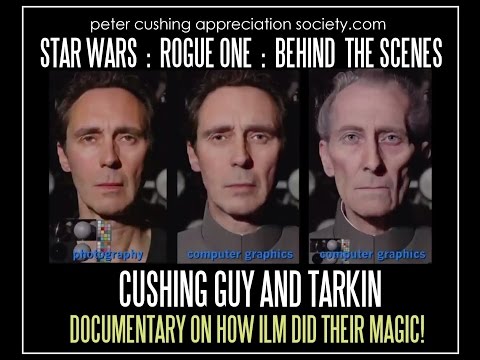
Things do not go so well for both the Rebels and Krinnic: Krinnic's control of the Death Star is undermined by the knowledge that he has let slip a security breach (oh, those uncontrolled servers) and this allows the Grand Moff Tarkin (Guy Henry, CGI'd to look like Peter Cushing****) to take control of the Death Star. His first target: the rebel base at Jedha. If you've seen "Star Wars," you're all too familiar with the sequence of events—a lot of switch-throwing, reaching for dials, and SSHHHHZZZZT! But, this is not the Death Star at full-power—it's firing just enough to wipe out a city, which it does with extreme effectiveness in a mult-plumed mushroom cloud. As K-2SO says, "There's a problem on the horizon. There IS no horizon!!"
The man battle and where things come to a head is the security facility on Scarif, which features an all-out assault between the Empire and the Rebels to get hold of those plans and director Gareth Edwards (he directed 2014's austere and weirdly effective version of Godzilla), where the disparate band of fighters with aerial support from Yavin fight to get those plans against everything the Empire has to throw at them, including things we only saw in the sequels. It's a terrific sequence that has genuine moments of edge-of-your-seat direness, and in case you think there's going to be a follow-up to this movie, there isn't...unless you count the original Episode IV.
And that's one of the things I like about Rogue One: it is its own movie, to be sure, but it is so tuned to the zeitgeist on the inspiration for "Star Wars" that it seems less removed from Lucas' sources than even Lucas managed. There are strains of Kurosawa throughout this, a level of disparity among the roles, not just in ethnicity but also in background story. Some are inspired by religion, some by revenge, some just because they're bad-asses itching for a fight. This Magnificent 7 are all scruffy, none of them polished—even K-2S0 is a might rusty—and the world they fight in is smudged, lived in and full of little goo-gah's that don't call attention to themselves, but exist as if they're part of the real world, not because they serve a dramatic purpose in the story-telling. 
The TIE-fighter doesn't appear in the movie, but it sure is cool-looking, in'it?
There's a strain of seriousness in the story-telling (not that there aren't lots of laughs along the way), it's just that Rogue One plays for keeps and is a bit more mature in its story-telling and less of (as one friend puts it) "a cheese-fest" than the rest of the "Star Wars" series. This is what happens when a "Star Wars" maker gets "serious" (oh, and is talented...there are way too many serious fan-flicks out there that suck) and is faithful to the spirit but not slavish to the style of a series. Great things can come of that. 
Rogue One doesn't diminish "Star Wars" (as I think The Force Awakens does). It builds on it, makes it a bigger Universe with more potential.

And that's what the series has needed since it started making sequels.
* Oh, don't worry. There are a lot of familiar faces...and face-plates...scattered throughout the movie, some of whom may surprise you.

** "The Whills" is a piece of Star Wars arcana dating way back to the novelization of Star Wars (released before the movie came out) written by Lucas and Alan Dean Foster based on Lucas' notes, the original "Star Wars" story was taken from "The Journal of the Whills" which was a tome...like the Bible...of ancient stories of the Galaxy. I remember there was a line attributed to Princess Leia Organa at the beginning—"They were at the wrong place at the wrong time. Of course, they became heroes."

*** They might have saved a half-hour of screen-time of Galen had just said in his already super-secret message that he took pains to smuggle out: "Look there's this thermal exhaust port, right below the main port—it's about two meters wide that if you send a proton torpedo down it, it'll set off a chain reaction and blow the whole thing up!. Get a really sharp pilot, you know, like a moisture-farmer who can bull's-eye womp-rats, like in Beggar's Canyon on Tattooine." But, he doesn't say that. He tells them to go get the plans at Scarif and figure it out for themselves. What, you can only have one secret per hologram in this Universe?

****

Tuesday, November 22, 2016

Arrival

Octo-Mom
or
If You Had It to Do Over Again...Would You Have an Inkling?

Science fiction is always a problematic genre, dramatically. Thesis overwhelms character. And character buries the lede. Some of the best science-fiction has been melodramatically inert, its characters cut from templates—my favorite movie, 2001: A Space Odyssey, has professional people, but one can't see much personality in them. Events are too big for traits beyond hubris to penetrate. When personality plays into the scenario—think Interstellar—it undercuts the ideas and the scale, making the grand scale of ideas a mere backdrop for the problems of the two little people in a crazy multiverse.

Science fiction asks the Big What if? And perhaps we've gotten to the saturation point where the concept of alien visitation has gotten old-hat since the time Klaatu visited, turned out all the lights, and threatened to spank if we didn't get our WMD's together.

And it shouldn't. Alien arrival—dare we say "immigration?"—would be a global game-changer, causing both societies and sects to do major pivoting in their by-laws and arcana, causing re-writes and "spins" in order to maintain their global and universal pecking orders. It was ever thus.
Arrival has no room for such speculation—the world just freaks out like they would on Independence Day, from fender-benders in parking lots to international posturing and saber-rattling without benefit of resets. Twelve crescent-shaped objects appear hovering over various parts of the planet, the only thing they have in common (as one "expert" opines) is that Sheena Easton had a #1 hit there in 1981.* The press speculates idly, trying to fill air-time while the respective governments evacuate and cordone off the touchdown sites. They ask and reverberate the same questions the populace has: why are they here?; why now?; Are they here for peaceful or harmful purposes?; if it's The Rapture, what should I wear?
The government—all the governments—ask the same questions. But, first they have to figure out how to communicate with The Visitors (if they're merely Visiting) without the benefit of them understanding English, providing a Universal Translator, Absorbascon, or music-activated light-show.** The colonel in charge of solving the problem, Col. Weber (Forest Whittaker) seeks out linguistics professor Louise Banks (Amy Adams) to apply her skills to try and decode the guttural rumbles the arrivers emit.
We've already spent some time with Dr. Banks—a prologue begins the movie with a narrated slice-of-life montage straight out of Terence Mallick of Banks as seen through the life (and death) of her daughter. She speaks over it:
"I used to think this was the beginning of your story. Memory is a strange thing. We are so bound by time, by its order. I remember moments in the middle. And this was the end. But, now I'm not so sure in beginnings and endings. There are moments that are beyond your life. Like the moment "they" arrived.
That narration had me checking the IMDB credits to see if it was Malick or Christopher Nolan who was directing the movie. But, no, it's Denis Villeneuve (who directed Incendies, Prisoners, and Sicario).

Banks first gets an inkling of events when she shows up to teach her class and only a handful have shown up—and it isn't even after homecoming. Their cell-phones start beeping, with alerts, texts, and (I'm sure) questionable Facebook posts. Banks turns on the class monitor to the TV and stares blankly at what she sees. Then, the evacuation alarm goes off. Class dismissed.


Before long, Whittaker's colonel is in her office, playing a recording of the E.T. utterances, and after some initial reluctance—on both their parts—she's whisked away to Montana to one of the ground zero's where the slightly-scalloped ships are hovering 30 feet above the ground. Ferried with her is Dr. Ian Donnelly (Jeremy Renner), who's been reading up on Banks, allowing light-hearted verbal sparring about the best approach to talking to the aliens.

"The cornerstone of civilization isn't language—it's science," he opines. "How about we talk to them before throwing math problems at them?" she counters.

The control center in Montana, where they're flown to is an amalgamation of boots on the ground and ghosts in the machine—while the troops are providing security and infrastructure, there are banks of computers analyzing and skyping other countries  reporting their progress—or lack of it. With all that intel, there's an NSA agent, Halpen (Michael Stuhlbarg), who's acting as filter for both communication and hindrance. 

The highlights of the film are, of course, the contact scenes, where Donnelly and Banks meet and greet the aliens and Villenueve creates an curious milieu for these. There is an interesting and metaphorical gravity re-orientation, and the specialists meet the "heptapods" (as they're soon labeled, although, for personal reasons, I prefer the term Krakenators)—creatures that appear like elephant-hided octopi—in an inconvenient, but dramatically-stylized movie screen-apertured tank. Most of the creativity and a fair share of the budget go into these scenes, and the efforts to interpret and correspond are editorially compressed to spare us the intricacies and timeline of establishing common-ground. We get the highlights, but no squabbling over syntax or masculine/feminine articles. 
The "heps" communicate using an inky, representational hieroglyphics, that being a better entree to understanding than trying to figure out the whale-like rumblings they use aurally. Not to get too much into detail—because that's where the most surprises come from—but before long, screen-time-wise, the bipeds get a pretty good idea what the general intentions of the heps are (and it has nothing to do with protesting our treatment of calamari, which is a good thing—you don't want to have to explain the process of deep-frying and try to put a positive spin on it).
It is Banks who makes the breakthroughs, and for whom the heptapods have the most trust—she is, after all, the first one who takes off the alarming enviro-suits to give the "heps" a good look at the fragile creatures we actually are. And more importantly, she does it not through much words and language as action, which given the species is a much more reliable presentation of intent.
Actions speak louder than linguistics, and the actions of the humans world-wide put any sort of understanding—among humans or heptapods—in jeopardy. It all hinges on Banks, who, when things come to crisis, comes up with a unique little talent that comes out of nowhere (the line from Captain America: Civil War came to mind: "Okay, anybody on our side hiding any shocking and fantastic abilities they'd like to disclose? I'm open to suggestions.") and for which there has been no...inkling...previously, and which seems really convenient.
Now, don't get all curious about that ability—don't jump to some conclusion that it has anything to do with the aliens, that Amy Adams is a secret heptapod, or they're the souls of lost loved ones, or anything like that. The twist isn't that clever...or relevant. It's merely a lucky happenstance that she's chosen to be on this team—at least lucky for the writers who might've come up with it just to get out of a third-act jam. That there is nothing that presages it makes it feel lazy...and also makes you wonder why, previously, everybody has been working so hard, as well as negating all sorts of things along the thread of the movie.
"Look! I could be in another Spielberg movie! (I was in Catch Me if You Can, remember? No?)"
The problem is not that Arrival has an unreliable narrator, so much as it has an unreliable narrative. It keeps that important piece of information from us—a sort of weak Shyamalayan-twist that has nothing to do with the circumstances of the movie's draw, and keeps the movie from feeling like an integrated whole. Here, the consequences of a world-changing event doesn't change much in the movie's sphere, at least in the intentions of the movie-makers. It's just a hook, which could have been accomplished by any means, even trivial, rather than cosmic. In which case, it's a bit of a cheat: Arrival doesn't inspire a sense of wonder, so much as a wonder why.

* In case you were wondering it's "Morning Train (9 to 5)," and, no, it has nothing to do with anything.

** Don't get me started on Google Translate®.