Showing posts with label John Qualen. Show all posts

Tuesday, October 25, 2022

The Devil and Daniel Webster (1941)

The Devil and Daniel Webster (aka All That Money Can Buy) (William Dieterle, 1941) I've known about this film for years, because it was the film that won composer Bernard Herrmann his only Oscar for Best Score ("of a Dramatic or Comedy Picture"), over 19 other scores nominated that year, including his own music from Citizen Kane
 
The score is the stand-out element of the movie, with Herrmann accompanying the presence of "Mr. Scratch" with a particularly saw-toothed violin jig that raises the hair on the back of your neck. It is for sure that Academy voters had never heard anything quite like it, even if it did include some American folk-tunes (including "Pop Goes the Weasel!"). I was well acquainted with the music before I could track down the actual film.
It tells the story of Jabez Stonr (James Craig) a farmer, not making it in 1840 New Hampshire, who sells his soul to the Devil (Walter Huston) for seven years of prosperity, which he gets, along with a swelled head, the enviousness of the community, and a reputation as a cruel businessman and a cool husband. Still, he is prominent enough to make the acquaintance of Daniel Webster (Edward Arnold), famed orator, lawyer and politician—who has (so far) resisted Scratch's offer to make him President of the United States. But, as the contract date comes near, Mr. Scratch doubles down on the offer, tempting Jabez for the soul of his new-born son. Stone turns to Webster for legal help with the Devil, naturally.
The Devil and Daniel Webster, adapted from the Stephen Vincent Benet's 1936 short story published in The Saturday Evening Post, had a checkered history at the studio, though. After doing less than blockbuster business, RKO Studios cut it by 20 minutes and released it with a sexier, less folksy ad campaign (see right) under the name All That Money Can Buy, which would seem  to celebrate the profligate life-style its protagonist comes to regret wishing for in the film, rather than the altruistic, socialist one ultimately preached.
It seems that Jabez Stone only really finds redemption until he's joined the Grange. I may be revealing the ending here, but, really, the outcome is inevitable considering the extraordinarily heavy hand that is used to show the tyrannies of wealth, lust, and greed that are the by-products of selling your soul to the Devil. Fortunately, the great orator
Daniel Webster is around to plead the case for the defense when a breach of contract occurs. Usually these scenes are the highlights, but in this film it's a disappointment. 
Even though played vigorously (by the least likely actor,
Edward Arnold, well-known for playing power-brokers and fascists in many a movie) the Webster homilies that are spun are so much sentimental goo and would curl the lip of Aimee Semple McPherson, much less the hardened denizens of Hell that make up the jury in the matter. Even Frank Capra must have rolled his eyes. But Dieterle seems to have shirked those sections to go all-out for his scenes with The Devil. Mr. Scratch's entrances are extravaganzas with light and smoke, he has the best lines (of course), and a truly creepy performance by Walter Huston (John's dad) with maliciously twinkling eyes, and a smile that's so broad that it may turn feral at any moment. Huston is the thing to see in this film, although Jane Darwell (Ma Joad from The Grapes of Wrath) and Simone Simon (just before she became big with Cat-People) do wonders with their material as well.

Thursday, September 23, 2021

The Fugitive (1947)

 The Fugitive (John Ford, 1947) Not the 1993 Harrison Ford movie based on the classic TV series (for that, go here) This John Ford-directed film is based on Graham Greene's "The Power and the Glory," adapted by Dudley Nichols (although when Ford got to Mexico to film, he basically threw out the script, and let his images do most of the talking) and starring Ford cast-stalwarts as Henry Fonda, Ward Bond, John Qualen, Jack Pennick, and Pedro Armendariz, and with a crew made of indigenous film-craftsmen. It took Ford out of his comfort zone, but also inspired him—finding what he had with cameraman Gabriel Figueroa—to make a film of shadows in a sun-blasted environment, more in line with the kind of film Ford was making when he was trying to make a statement.

One of the pervasive criticism's of Ford's body of work is its occasional moments of sentimentality, and for a tone inconsistency that interrupted drama for comedy (or "hi-jinks"). The Fugitive is one of those instances where Ford's tone is relentlessly consistent and low comedy is completely shorn from the narrative, and everything is played in deadly earnest. And, because their is no consistency in the world, especially the world of criticism, this one is often criticized for its consistent tone of religious fervor. You can't please everybody, no matter how hard you pray.
You know when someone is making an "art film" when they get a little hazy on the details, not wanting to nail down time and place, but planting it in some metaphorical zone that won't get anyone's back up, and The Fugitive begins with this narration:
"The following photoplay is timeless. The story is a true story. It's also a very old story that was first told in the Bible. It is timeless and topical, and is still being played in many parts of the world. This picture was entirely made in our neighboring Republic, Mexico, at the kind invitation of the Mexican government and of the Mexican motion picture industry. It's locale is fictional. It is merely a small state a thousand miles north or south of the Equator - who knows."
The film follows an unnamed Catholic priest (Fonda), who is trying to avoid arrest and execution in a Mexican State run by a tyrannical despot who has told his police to eradicate all religious practices in the state. Being the last priest left alive and dressed in peasant clothes and without the trappings of a priest, he is on the run, but is consistently called upon to practice his faith among the people surreptitiously. Discovered hiding in an abandoned church by a village woman (Dolores Del Rio), he makes a promise to baptize her illegitimate child and all the children who have not been baptized.
The Lieutenant of Police for the State (Armendariz)—who just so happens to be the father of that illegitimate child—lets it be known that he will take a hostage from every village to execute until the last remaining priest turns himself in. At the same time, a bank robber (Bond) has arrived in town but is able to avoid capture, due to attention being diverted to the priest. The two men run parallel paths to avoid being captured, but their fates become joined as the search intensifies.
The film differs quite a bit from Greene's book—the priest was originally the father of the child, but that wouldn't have passed the Hays Office—and Ford, once he got to Mexico, diverged so much from Nichols' script that the two—who had been a team for 30 years—decided to never work together again. To be fair to Nichols, there are a couple places where Fonda's priest could have easily been captured by the Lieutenant, but for the fact that he doesn't recognize him as the man in the wanted posters plastered around town. It seems a little far-fetched, considering that Fonda tends to stand out from the other peasants.
However one views the script or what Ford did with it, one aspect of The Fugitive makes it essential viewing—the miracles of cinematography that Ford pulled off with Figueroa. Evocative of Ford's work in The Grapes of Wrath, The Informer, and The Long Voyage Home, the images contain some of the blackest blacks in cinema history contrasting with the bleached exteriors of the Mexican landscapes. Ford's painterly eye was never so evident as here* as he photographically shows a Dark Age being pierced by enlightenment.

* And here's another couple images...

Friday, May 28, 2021

Anytime Movies #5: The Searchers

While I catch up on the reviews still in "Draft" phase here, I'll re-run a feature I ran when I first started this blog seven years ago,**** when it was suggested I do a "Top Ten" List.

I don't like those: they're rather arbitrary; they pit films against each other, and there's always one or two that should be on the list that aren't because something better shoved it down the trash-bin.

So, I came up with this: "Anytime" Movies.


Anytime Movies are the movies I can watch anytime, anywhere. If I see a second of it, I can identify it. If it shows up on television, my attention is focused on it until the conclusion. Sometimes it’s the direction, sometimes it’s the writing, sometimes it’s the acting, sometimes it’s just the idea behind it, but these are the movies I can watch again and again (and again!) and never tire of them. There are ten (kinda). They're not in any particular order, but the #1 movie IS the #1 movie.


It’s a film that chills me right down to my bones and makes me cry every single time.* It throws itself into the deepest pits of despair and within moments, prat-falls into low comedy. It’s a western…about race relations, and in the house of mirrors of a “genre” piece deflects the self-righteous tone of a sermon. It stares into the soul of people at their worst, and exults in their best.

It is arguably
John Ford’s best film (and he made many great ones). It is inarguably John Wayne's finest performance on-screen, while completely working against the image that Marion Morrison had built as “John Wayne,” American Hero.

Oh no. We’re talking about
The Searchersa “western” made during the somnambulant 50’s …and with John Wayne, ferchrissakes! How corny can you get?

Back up, pilgrim.

The Searchers has just been re-released (to mark its 50th anniversary**) in a
gloriously re-mastered DVD, and has come under critical review for being too corny, too obvious, and more than a little dated. 

Worse still, it has been branded a “film-school darling” that has skated too long on an undeserved reputation as a masterpiece.
Bullshit.

Like Pauline Kael’s faulty detective work
dissecting Citizen Kane and Elvis Mitchell’s naïve un-analysis of 2001, the work in Slate smacks of a critic either looking for something to write about or make a name for themselves bucking “conventional wisdom.” Having to spend a summer reviewing the third X-Men movie, the fifth “Superman” opus AND an entirely superfluous “Pirates of the Caribbean” sequel is bound to make anyone crabby.

But it shouldn’t lower one’s standards, and there’s enough slip-shod work in the article to indicate that’s the case. At the very least, it’s a terrible gloss-over.

At the worst, it displays a film reviewer who hasn't even seen the film he was supposedly watching for the prejudices and pre-conceived notions that he would rather cling to rather than objectivity.

The Searchers is a masterpiece—the culmination of decades of film-making experience that John Ford had accumulated since the silent era—while crystallizing Ford’s growing disenchantment with the Myth of the West. In a time when westerns were still basically built around the simplistic formula of “Cowboys vs. Indians,” Ford was starting to speak out more explicitly for the latter sixteen years before such accepted “consciousness-raising” films as Little Big Man or Soldier Blue. Like any masterpiece, it displays the sum of a body of work and breaks new ground, paving the way for the future.

The Searchers tells the story of an obsessive 10 year hunt for a lone family member taken in a violent Comanche raid. It’s led by the worst person possible: the child’s uncle--a hate-obsessed confederate soldier, self-exiled from his family, who still carries his saber on his hip, bitterness in his soul and his heart on his sleeve. Mix in a venomous race-hatred for all non-whites and you have the most flawed anti-hero to appear in movies. Ethan Edwards starts his search to bring his niece back alive, but as the years pass and she matures into womanhood, he gives her up as one of the Enemy, and sets out to kill her. At the center of the film’s black heart is that most archaic and useless word: miscegenation.

It’s rough stuff. Rougher still are the attitudes of the settlers towards the Indians that border on hysteria. There’s a haunting scene late in the film where Edwards and his fellow traveler (played by future "Star Trek" Captain Pike and “Teenage Jesus,” Jeffrey Hunter) ride into a fort on the Trail of Tears to inspect some kidnapped white women who have been re-captured—"rescued" they would say—by the Cavalry. 

“It’s hard to believe they’re white” a sergeant says. 

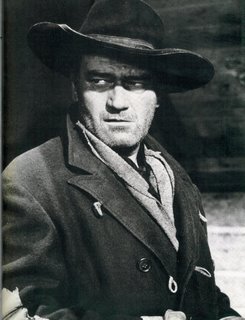
They ain’t white,” spits Edwards, and at the sound of a shriek from one of the women, he turns to look at her. Ford trucks in the camera fast onto Wayne’s face (mirroring the shot he used to introduce Wayne in their first film together, Stagecoach) and it’s amazing. Wayne was always blessed with a mug that the camera loved***—it could read every emotion that played across it—and in a performance minus the “hero façade” and that turns on the full after-burners that usually blew his co-stars off the screen, this one quiet moment radiates a combination of hate, disgustand abject fear. No words need to be said to make the point. No words could.

It's what made Ford a great director and Wayne a great actor.

"No, Ethan!  No, you don't!"
And yet, for all its depths of despair amid bloodshed and the race-hysteria, Ford tries to balance it with entertainment. That’s quite the tight-rope walk. But then, it’s not a sermon. It’s a Western. Ford was never so pretentious to be caught lecturing. He’d say if you want to send a message, use the Pony Express. Better to sneak the lessons into the fabric of the story, and distract with shenanigans about wayward lovers, goony old men, and green cavalrymen with pointy swords. One of the incidents involves the unintended marriage of Hunter’s character to a portly Indian maid. It’s the source of raunchy comedy in the vein of Ford’s The Quiet Man—all roughhouse and bad taste. But when Ford’s good guys “The Cavalry” decimate a Native village and the luckless character along with it, Hunter is left to ask “What’d they have to kill her for? She never hurt anybody!” The question hangs in the air with indictments all around.
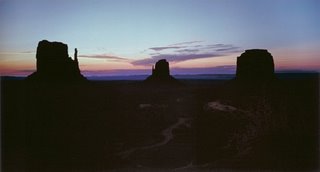
The Searchers begins and ends with a black screen. In the beginning, the blackness gives way to the vast magical vista of Monument Valley (which figures in two of my anytime movies. If God lives anywhere on Earth, I think it’s on that vast acreage of land overseen by the Navajo) that to Garry Wills suggests an irising lens, but to these eyes seems more of a proscenium arch. At the end it shuts out Ethan Edwards who is left out of the warmth of a family embrace to wander the desert (Of course, Wayne’s character is going to come in eventually and eat…but Ford chooses to leave Edwards outside). His prejudice does not belong with home and hearth...and society…and Civilization. Yet it is also Ford’s choice to leave the character alive, the wolf always at the door.
It’s as if having made his plea for tolerance, Ford cautions us that it will always exist, somewhere.

Will we ever...finally...lose the hate?

“That’ll be the day.”

Robert McGinnis' portrait of Wayne in The Searchers.
Anytime Movies:
The Searchers

* A comment on this post and movie—when it was stationed at another blog—asked: "
The Searchers makes you cry?!?!? Is it because of all the dead Indians?" Sure. Go with that. But, a lot of settlers are killed, too, and the hunt in The Searchers is precipitated by one such massacre, the matriarch of which is the one woman that Ethan Edwards loves. It's what entwines his search into one of need and of vengeance. 

No, the thing that makes me cry is the act that comes right before the line "Let's go home, Debbie." That line. From that character. At that time. Despite all evidence to the contrary. It's what gives one a small tiny quantum of hope that belies the sentiment of "That'll be the day..."

** And now, it's a few years shy of its 70th.  I wasn't even a year old when it was released.  It's like an old friend that's grown up with me.

*** Screenwriter Robert Towne has a better term for it, the "camera-love" phrase implying a happy accident that doesn't give enough credit to the actors, their craft and experience. He says that actors like Wayne, Henry Fonda, and Gary Cooper are "ruthlessly efficient" in that they can communicate differing emotions with an economy of expression. Those words are particularly apt for Wayne's performance in The Searchers.

**** And, on Sunday, we'll put up a "Don't Make a Scene" feature from each week's film.

Wednesday, May 21, 2014

Anytime Movies (Transplanted): The Searchers

While I have a few reviews "in the works," It's as good a time as any to re-boot (actually transplant from the old movie blog) a feature I started years ago, when it was suggested I do a "Top Ten" List. 

I don't like those: they're rather arbitrary; they pit films against each other, and there's always one or two that should be on the list that aren't because something better shoved it down the trash-bin. 

So, I came up with this: "Anytime" Movies. 

Anytime Movies are the movies I can watch anytime, anywhere. If I see a second of it, I can identify it. If it shows up on television, my attention is focused on it until the conclusion. Sometimes it’s the direction, sometimes it’s the writing, sometimes it’s the acting, sometimes it’s just the idea behind it, but these are the movies I can watch again and again (and again!) and never tire of them. There are ten (kinda). They're not in any particular order, but the #1 movie IS the #1 movie.
It’s a film that chills me right down to my bones and makes me cry every single time. It throws itself into the deepest pits of despair and within moments, prat-falls into low comedy. It’s a western…about race relations, and in the house of mirrors of a “genre” piece deflects the self-righteous tone of a sermon. It stares into the soul of people at their worst, and exults in their best.

It is arguably
John Ford’s best film (and he made many great ones). It is inarguably John Wayne's finest performance on-screen, while completely working against the image that Marion Morrison built as “John Wayne.”

Oh no. We’re talking about
The Searchersa “western” made during the somnambulant 50’s …and with John Wayne, ferchrissakes! How corny can you get?

Back up, pilgrim.

The Searchers has just been re-released (to mark its 50th anniversary*) in a gloriously re-mastered DVD, and has come under critical review for being too corny, too obvious, and more than a little dated. Worse still, it has been branded a “film-school darling” that has skated too long on an undeserved reputation as a masterpiece.
Bullshit.

Like Pauline Kael’s faulty detective work dissecting Citizen Kane and Elvis Mitchell’s naïve un-analysis of 2001, the work in Slate smacks of a critic either looking for something to write about or make a name for themselves bucking “conventional wisdom.” Having to spend a summer reviewing the third X-Men movie, the fifth “Superman” opus AND an entirely superfluous “Pirates of the Caribbean” sequel is bound to make anyone crabby.

But it shouldn’t lower one’s standards, and there’s enough slip-shod work in the article to indicate that’s the case. At the very least, it’s a terrible gloss-over.

At the worst, it displays a film reviewer who hasn't even seen the film he was supposedly watching for the prejudices and pre-conceived notions that he would rather cling to rather than objectivity.

The Searchers is a masterpiece—the culmination of decades of film-making experience that John Ford had accumulated since the silent era—while crystallizing Ford’s growing disenchantment with the Myth of the West. In a time when westerns were still basically built around the simplistic formula of “Cowboys vs. Indians,” Ford was starting to speak out more explicitly for the latter sixteen years before such accepted “consciousness-raising” films as Little Big Man or Soldier Blue. Like any masterpiece, it displays the sum of a body of work and breaks new ground, paving the way for the future.

The Searchers tells the story of an obsessive 10 year hunt for a lone family member taken in a violent Comanche raid. It’s led by the worst person possible: the child’s uncle--a hate-obsessed confederate soldier, self-exiled from his family, who still carries his saber on his hip, bitterness in his soul and his heart on his sleeve. Mix in a venomous race-hatred for all non-whites and you have the most flawed anti-hero to appear in movies. Ethan Edwards starts his search to bring his niece back alive, but as the years pass and she matures, he gives her up as one of the Enemy, and sets out to kill her. At the center of the film’s black heart is that most archaic and useless word: miscegenation.

It’s rough stuff. Rougher still are the attitudes of the settlers towards the Indians that border on hysteria. There’s a haunting scene late in the film where Edwards and his fellow traveler (played by future Captain Pike and “Teenage Jesus,” Jeffrey Hunter) ride into a fort on the Trail of Tears to inspect some kidnapped white women who have been captured—"rescued" they would say—by the Cavalry. “It’s hard to believe they’re white” a sergeant says. 

They ain’t white,” spits Edwards, and at the sound of a shriek from one of the women, he turns to look at her. Ford trucks in the camera fast onto Wayne’s face (mirroring the shot he used to introduce Wayne in their first film together, Stagecoach) and it’s amazing. Wayne was always blessed with a mug that the camera loved*—it could read every emotion that played across it—and in a performance minus the “hero façade” and that turns on the full after-burners that usually blew his co-stars off the screen, this one quiet moment radiates a combination of hate, disgustand abject fear. No words need to be said to make the point. No words could.

It's what made Ford a great director and Wayne a great actor.

"No, Ethan!  No, you don't!"
And yet, for all its depths of despair amid bloodshed and the race-hysteria, Ford tries to balance it with entertainment. That’s quite the tight-rope walk. But then, it’s not a sermon. It’s a Western. Ford was never so pretentious to be caught lecturing. He’d say if you want to send a message, use the Pony Express. Better to sneak the lessons into the fabric of the story, and distract with shenanigans about wayward lovers, goony old men, and green cavalrymen with pointy swords. One of the incidents involves the unintended marriage of Hunter’s character to a portly Indian maid. It’s the source of raunch comedy in the vein of Ford’s The Quiet Man—all roughhouse and bad taste. But when Ford’s good guys “The Cavalry” decimate a Native village and the luckless character along with it, Hunter is left to ask “What’d they have to kill her for? She never hurt anybody!” The question hangs in the air with indictments all around.
The Searchers begins and ends with a black screen. In the beginning, the blackness gives way to the vast magical vista of Monument Valley (which figures in two of my anytime movies. If God lives anywhere on Earth, I think it’s on that vast acreage of land overseen by the Navajo) that to Garry Wills suggests an irising lens, but to these eyes seems more of a proscenium arch. At the end it shuts out Ethan Edwards who is left out of the warmth of a family embrace to wander the desert (Of course, Wayne’s character is going to come in eventually and eat…but Ford chooses to leave Edwards outside). His prejudice does not belong with home and hearth...and society…and Civilization. Yet it is also Ford’s choice to leave the character alive, the wolf always at the door.
It’s as if having made his plea for tolerance, Ford cautions us that it will always exist, somewhere.

Will we ever...finally...lose the hate?

“That’ll be the day.”

Robert McGinnis' portrait of Wayne in The Searchers.


The Searchers
Mr. Smith Goes to Washington
Chinatown
American Graffiti
To Kill a Mockingbird
Goldfinger

Bonus: Edge of Darkness


* And now, it's a couple years shy of its 60th.  I wasn't even a year old when it was released.  It's like an old friend that's grown up with me.

** Screenwriter Robert Towne has a better term for it, the "camera-love" phrase implying a happy accident that doesn't give enough credit to the actors, their craft and experience. He says that actors like Wayne, Henry Fonda, and Gary Cooper are "ruthlessly efficient" in that they can communicate differing emotions with an economy of expression. Those words are particularly apt for Wayne's performance in The Searchers.