Showing posts with label Jerry Goldsmith. Show all posts

Saturday, January 14, 2023

Black Patch

Saturday is traditionally "Take Out the Trash" Day. The music's good, though...

Black Patch (Allan H. Miner, 1956) Low budget western best known in film-music afficianado circles for being the first feature scored by Jerry (nee Jerrald ) Goldsmith.* Shot at Gene Autry's ranch town, the film benefited from being filmed in a television hiatus, its screenplay—penned by Black Patch bad guy Leo Gordon—started out as an idea for a "Gunsmoke" episode and utilizing crew from the recently wrapped "Dragnet" season (that show's crews were the fastest in Hollywood). Not quite as "B"-western as a lot of the early Republic Studios product, Black Patch tries to explore the psychological aspects of Westerns—motivations beyond "he wears a black hat"—that was finding its decade with the collaborations of Anthony Mann and James Stewart in the genre.

Black Patch can't hold a...er...patch to them.
George Montgomery plays Marshall Clay Morgan, but he's disparagingly called "Black-Patch" by the folks in Santa Rita, New Mexico for the eye-patch he sports over his right eye, a result from an old Civil War injury. Being one-eyed makes it tough to be a sharp-shooter with no depth perception. And one could say that it's affected him personally as he has a myopically steadfast approach to his job. It's cost him, and the town under his singular watch treat him with a suspicious respect.
So, things get a little squirrelly when Morgan's friend from The War, Hank Danner (screenwriter Leo Gordon) pays a visit to town with his wife Helen (
Diane Brewster, who would play the late wife of Dr. Richard Kimble on TV). In a Casablanca-like set-up, Helen and Morgan were once lovers, and so the Marshall is both pleased and conflicted to see them. He starts to question how his actions towards Danner, a known bank robber, are lit by his sense of duty or the torch he's carrying for the man's wife.
It's a small town, so word gets around of the trio's pasts, but it starts to flame up when word comes that a bank on the way had been robbed and Morgan slams Danner in jail for the crime. But, there are "vultures, vultures everywhere," the most prominent being saloon owner "Frenchy" De'vere (Sebastian Cabot, who clearly relishes playing villainous roles) who conspires to spring Danner from jail with an idea to split the ill-gotten gains as a reward. It all further complicates Morgan's life, and threatens it, as things shake out, eventually seeing him put on trial for murder.
It's a good set-up, and the execution is fairly straight-forward—the film was shot in 14 days—but, there are some plot elements that stray into the area of contrivance, that one could only excuse by objecting that Santa Rita must be a pretty small town (with Contrivance being a nearby suburb). The motivations of one character seem extremely opportune, but only if it takes place in a town with very few women. And how quickly can you learn to be a fast-draw? At least to best someone who's been a gun-slinger for years?
It's not all that bad, just not something you want to write home and send pony-express** about. And, for a first score, Goldsmith did a great job...but, then, he'd been doing live-TV for awhile, making changes to his scores on the fly, even as it was being played. He certainly could have handled the technical intricacies of film scoring.

* It's also one of the Goldsmith "lost" scores—nobody can find acetates or tapes in "the vaults" (or somebody's hiding them) and there's never been a release. Although, a Kickstarter campaign was started to re-record the score for this and for The Man, an obscure political film from 1972. They were released by Intrada records.
 
** "When it absolutely, positively has to be there before two weeks..." 

Friday, May 14, 2021

Anytime Movies #7: Chinatown

While I catch up on the reviews still in "Draft" phase here, I'll re-run a feature I ran when I first started this blog seven years ago,****** when it was suggested I do a "Top Ten" List.

I don't like those: they're rather arbitrary; they pit films against each other, and there's always one or two that should be on the list that aren't because something better shoved it down the trash-bin.

So, I came up with this: "Anytime" Movies.


Anytime Movies are the movies I can watch anytime, anywhere. If I see a second of it, I can identify it. If it shows up on television, my attention is focused on it until the conclusion. Sometimes it’s the direction, sometimes it’s the writing, sometimes it’s the acting, sometimes it’s just the idea behind it, but these are the movies I can watch again and again (and again!) and never tire of them. There are ten (kinda). They're not in any particular order, but the #1 movie IS the #1 movie.

This is one of the “Anytime Movies” that falls into the category of “Lost Causes and the Futility of Good Intentions,” but lest anyone think these films are depressing, they’re not.

Well, okay, this one is. But, a good movie never depresses me. It impresses me.

It’s also perfect. Given the nature of the trio of men who oversaw its creation—screenwriter Robert Towne, director Roman Polanski, and producer Robert Evans—the thing could have self-destructed like a fragment grenade. And, in fact, the planned trilogy of films featuring detective JJ “Jake” Gittes investigating three big changes to California's landscape (water, land, and no-fault divorce—which would put Gittes out of a job) stopped after the personality clashes that derailed the first attempt at filming The Two Jakes. Polanski couldn’t set foot on American soil due to rape charges, and Evans (who was producing the film and co-starring in it) and Towne (writing and directing this time) clashed on the set. The combination of expanded roles and egos this go-round, following upon the first film’s success, caused the production-gears, already turning, to stall (necessitating the destruction of returning production designer Richard Sylbert's already finished sets), and it was only the patience and dogged efforts of star Jack Nicholson, who took over directing, that allowed the film to be made...ever. They say that great films need a miracle – Chinatown had it, but its sequel The Two Jakes didn’t have a prayer.

“Middle of a drought and the water commissioner drowns. Only in L.A., huh?” 

Based loosely on the development and construction of the William Mulholland designed aqueduct, and the real estate swindles it engendered, Chinatown starts out as a mystery even more steeped in the locale of L.A. than Chandler’s Marlowe stories. Here, the very city is a part of the crime and corruption is steeped in its soil and water. Water is the heart of Chinatown. Its ebbs and flows are constantly monitored –the original object of investigation is the city’s head of the Department of Water and Power who then becomes the victim of a grisly murder. Water is never too far from the surface of the story. Even Jerry Goldsmith’s shimmering score suggests water in its low harp trills, and the sighing of, yes, water phones.
Chinatown gets all its details right—the language, the costumes—Richard Sylbert’s period work is amazing, and a perfect cast makes the most of Robert Towne’s wise-acre dialog. A perfect cast? Right down to the smallest part. There’s a favorite moment of mine when Gittes, after badgering the secretary of the new head of Water and Power, is distracted by an odd squeaking noise. He, of course, has to investigate, and opens the outside door on the two work-men who are scraping the dead man’s name off the door. The one guy looks irritated—the other guy smiles, nods, and as the door is closing shakes his head ruefully—“Happens every time.” It’s a tiny little moment that feels so authentic, so much more than a mere movie might provide, it provides a moment of truth in a continuous string of truths.
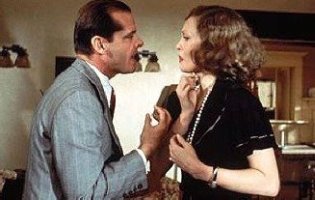
One of Chinatown's weird echoes:  the face of Mrs. Mulwray (Faye Dunaway)
while Jake and she talk about his past, walking the beat in Chinatown.

But, that is a moment you can appreciate as it happens. Chinatown lives on in the memory. After the mystery is solved, moments come back, as the pieces come together and the journey to the conclusion coalesces. They haunt. On repeat viewings, Chinatown is a treasure trove of call-backs and foreshadowing’s.* Little things, like the odd cadence of a name, mispronunciations that can be traced back, a birth-mark—lead you downstream to a resolution that you should, in retrospect, have seen all along. Like Gittes, its only at the end that you get the full story. Of course, like him, you follow the most obvious things that seem out of place or arouse suspicions. ** But the world is a more complicated place and long after the film is finished does it strike you that the two most suspicious people while watching the film are actually the most decent and altruistic ones acting with the best of intentions. Of course, in this world they come to a bad end.
“Do you know how long I've been in this business?

And here’s where that mix of personalities comes in. Towne’s original screenplay (before the Polanski re-write) is very grey—Jake Gittes at the beginning of the film—the very beginning—gets angry and abusive with his moaning client, Curly (In the film, there’s only an impatient irritation). Later dialog casts a sympathetic spin on water magnate Noah Cross. The original screenplay ends with, if not a happy ending, then a triumphant one. Evans loved the screenplay (though he didn’t quite "get" it), but in one of those odd bursts of inspiration that sustained him throughout an eccentric career as a producer, decided that the film needed a European sensibility, and so, brought in Polanski, who had left the country and Los Angeles following the murder of his wife Sharon Tate by the Manson family. 

His perverse take on the city and the material focused it, and made a stronger delineation between good that is good and evil that is truly evil—and provided the ending that doomed those most in need of rescuing. Chinatown ends in shock, and with a sense of tragic inevitability. That Jake, in a moment of selfishness and hubris, sets up a series of events that ends up completely bollixing up his good intentions, completes a circle and a character arc that had been percolating below the surface the entire time. He ends up ignoring the lessons he learned in Chinatown (the district, not the film), and paying the same consequences. The final words are ironic--“Forget it, Jake. It’s Chinatown.” Forgetting isn’t his problem. Remembering is. Towne would hammer the point home with the last line of The Two Jakes—“Kitty! You never get over it.”

But by that time it wasn’t necessary to say.

Jake wants the truth.
He can't handle the truth.

Anytime Movies:

Above, you'll see a link to a fascinating book by Sam Wasson called "The Big Goodbye: Chinatown and the Last Years of Hollywood." I just finished reading it, and it has a nifty little conceit: it takes the four principles—Polanski, Towne, Evans, and Nicholson—and relates how they struggled (separately and together and against each other) to make the film, saw its stunning successful and quite unconsciously (maybe) turning their lives into a version of the story...with ample help from history, ego, hubris, toxic masculinity, rampant sexism, too much opportunity and too much cocaine. Their failings get the better of them, and, with their eyes wide shut, they no longer become the heroes of their own stories. None of them come out looking good, and the one hero of the story seems to be composer Jerry Goldsmith (yay!), who received a knock on his door from Robert Evans one day, begging him to help replace a score that wasn't working to Evans' mind, and within 10 days had created a full score, the main theme of which made Evans weep. Fascinating read, with a lot of threads to it, and Wasson's style is fast moving and doom-laden. But, it doesn't have a happy ending.

* On my most recent viewing, I noticed a moment that shocked me. After Jake and Evelyn flee a scene in her car amidst a hail of gunfire, the superbly coiffed Evelyn touches her left eye—as if she has something in it. Whether it was Polanski’s or Dunaway’s choice, it’s a brilliantly sick one. 

** Towne’s screenplay is so fully formed that, unlike Chandler’s Marlowe stories, a first person narrative isn’t necessary. We are always aware of what Gittes is doing, and thanks to Nicholson’s performance, what he’s thinking.
"Forget it, Jake."

And...an extra.


This was part of a series of reviews of the ASUW Film series back in the '70's. Except for some punctuation, I haven't changed anything from the way it was presented, giving the kid I was back in the '70's a bit of a break. Any stray thoughts and updates I've included with the inevitable asterisked post-scripts. Chinatown was part of a "detective" double-bill with The Thin Man.

Chinatown (Roman Polanski, 1974)


Gittes: Hello Claude. Where'dja get the midget?
Midget: Yer a nosey fellow, kitty-kat, huh? Ya know what happens to nosey fellas, huh? No? Wanna guess? Huh? No? (slices Gittes' nose). Next time you lose the whole thing. Cut it off and feed it to my goldfish. Understand? Understand?!
Mulvehill: Tell 'im you understand, Gittes.
Gittes: I unnerstand!
As opposed to the whimsy of The Thin Man, Chinatown is a film of deadly earnest, a perfect example of what is termed "film noir"-which means, in melodramatic terms "when the streets are dark with something more than night," usually the feeling of purveying evil. That is certainly there in Chinatown, although it would be hard to pin that evil on the influence of the film's all-encompassing villain, or the influence of its director, Roman Polanski, who incidentally played that strangely accented "midget" with a knife you heard in that tape segment.*** Polanski shaped this film into a first-rate thriller, even more, into the best film coming out of a major studio in 1974, deserving of every Oscar that The Godfather Part II won that year.**** As with most of these films, each and every performance is perfectly played from the starring performances of Jack Nicholson, Faye Dunaway, John Huston and John Hillerman, down to a lowly sign painter.*****
Chinatown--a section of Los Angeles inhabited mostly by Asian-Americans due to a suppression of their people.

Chinatown--the former beat of two L.A. patrolmen, J.J. Gittes and Lou Escobar; a beat they think in "bad luck" for "you can't always tell what's going on."

Chinatown--the symbol of all evil to Jake Gittes, private detective, for it reminds him of his own tragic failures.

"Mrs. Mulwray, have you ever heard the expression 'let sleeping dogs lie?"

Jake Gittes is hired by a Mrs. Mul'-wray to investigate her "philandering" husband. But as Jake investigates, he realizes that Mr. Mul-wray' is not what he seems, Mrs. Mul'-wray is not what she seems, and Jake finds himself investigating a larger scandal, one encompassing city-wide fraud and personal tragedy. Jake knows all the moves he is supposed to make while investigating--tailing, picking up clues, following them to the next step--and the whole way, he thinks he has the whole case going smoothly. But he doesn't. It is much too big for him to stop. He ignores those little details that he, and we, only can remember later. And Jake Gittes, when the case is over, relives a tragic part of his past, and can only take consolation in the caring words of an associate--"Forget it, Jake. It's Chinatown."
"But, Mrs. Mulwray, I goddamn near lost my nose. And I like it. I like breathing through it.
And I still think you're hiding something."


The ending of Chinatown is a complete reversal of what the film had, supposedly, been leading up to. It will undoubtedly shock and disappoint you. Some critics have said it is ill-considered and "tacked on." But it isn't. It is perfect for the film that Roman Polanski made, and it makes the experience of viewing Chinatown that much more resonant.

Broadcast on KCMU-FM November 11th and 12th, 1975.

Some revisions should be made to this (if I were making revisions). I was being too much of a "nanny" critic, telling people how they should feel. And I kind of blew any surprise that ending SHOULD have had by telling an audience to expect it.

And Chinatown isn't "the symbol of all evil" for Gittes. That's giving him too much thought for the place. It's just a place to be avoided. Bad luck. Fool me once, shame on you. Fool me twice--

And Walsh's words to Gittes aren't "caring," he says it because there's nothing more to say. "Get over it. What'd you expect?"

I've written about Chinatown more extensively here (actually the article at the top of the page). But there's more to say. Reading a nearly final script by Towne of this film tells you that Polanski brought more sense of moral rage to the film (interesting, for Polanski). Evil is evil. Good is good. I've always "gotten" the sense that Hollis Mulwray is not only a good man, but practically a saint. There are things implied in Polanski's direction that point even further in that thought. But, in Towne's screenplay, more sympathy is ascribed to the villain. He is not pure evil as the film would have him appear. He is merely weak, and anything can happen in a moment of weakness. Evelyn Mulwray is also less of a victim in that screenplay, though her actions are seen to be a trifle hysterical. There are no easy answers in Towne's early screenplay. Things are not black and white, merely shades of gray. And given Polanski's history--the concentration camps, and his wife, Sharon Tate's grisly murder at the hands of the Manson gang, and his own past films, one would see why he'd tilt it to the side of the devils.
"He OWNS the police!"

In 1991, Chinatown became a part of the National Film Registry.

*** Yeah--you don't get the taped segment. Sorry. The transcript will have to do. I've always loved the way Nicholson drawled out "Hello, Claaaahde. Where'dja git the midgit?" It runs a close second to my favorite Nicholson line, from Five Easy Pieces: "Don't tell me 'bout the GOOD life, Eldon, 'cuz it makes me PUKE!"

**** Although The Godfather, Part II also deserved every Oscar it won. Except maybe score. And I don't think that's hyperbole saying the best film coming out of a major studio that year. That's also due to its Executive Producer, the extremely savvy producer Robert Evans. Say what you will about Evans, but under his stewardship, Paramount could not be topped as the dominant movie studio in Hollywood. Look at 'em now, folks.


***** Actually, Chinatown is one of the few films where every performance is perfect. And that sign painter--it's one of my favorite bits in movies, because it rings so true. The guy's watching his assistant scrape the name off a door, and that scrape gets detective Gittes to investigate, opening the door. The painters look up at Gittes, who, realizing what it is, shuts the door...and AS IT'S CLOSING, the guy in charge replaces his nodding greeting with a rueful shake of his head "Happens every time." Of course it does. But it's the sort of detail Chinatown is full of, as so few movies are.

****** And, on Sunday, we'll put up a "Don't Make a Scene" feature from each week's film.

Wednesday, September 24, 2014

The Blue Max

The Blue Max (John Guillerman, 1966) Everything soars in this tale of a vainglorious WWI fighter pilot from the (evidently historically inaccurate) planes dog-fighting through the skies, the performance of its star (the usually uni-dimensional George Peppard), the high-flying score by Jerry Goldsmith (one of his best and not even nominated for an Oscar) and the swooping direction of John Guillerman that seems to be caught in the jet-streams of its vehicles and characters.  

Adapted by black-listed writer Ben Barzman from the novel by Jack D. Hunter, it tells the story of a common trench soldier, who sees an opportunity to rise in stature during the war and German society by becoming a flying ace, obsessively seeking the country's highest honor, the blue max (awarded for twenty kills), by daring and deceit. But the filmmakers changed the story from the novel, turning it more into a modern telling of Icarus than the author's original intent.


Hunter wrote a sequel, "The Blood Order," in which the protagonist of "The Blue Max," as Aryan as one could be, finds himself embroiled in the rise of the Nazi Party in the years between world wars.


The film of The Blue Max made any idea of a sequel impossible.

Peppard plays Bruno Stachel, a German soldier fighting in 1916, who sees a squad of planes ripping through British defenses during one horrific battle and decides then and there to join the German Army Air Corps. But he finds it hard to take off with so much resistance.  The aces are all aristocratic, from good families—in fact, Willi Von Klugermann (Jeremy Kemp) is the nephew of General Count Von Klugermann (James Mason) (and having an affair with the general's much younger predatory wife, played by Ursula Andress). Stachel's ambitions and duplicitous ways of achieving them rankles the aces and angers his commanding officer (Karl Michael Vogler), who is determined to never see Stachel wins his medal.
"It's a cruel world, Herr Hauptmann..."
But Stachel makes good PR—a commoner among the elite—and the General, to flag waning public acceptance of the war, uses the handsome young pilot as a symbol of Germany's greatness that the people can embrace.
He does his job only too well because one of those embracing is his own wife, Kaeti, who begins an affair with Stachel during a propaganda tour of Berlin, which only emboldens Stachel and increases the rivalry between the general's nephew and him. The two carry on a bitter feud on the ground and in the skies, and when Willi is killed in a competition of who might be the better pilot, Stachel claims the other's kills as his own, and becomes reckless and insubordinate in his missions.  And with the General's support, he can do no wrong.
Stachel's first kill and his satisfied smile
The story is a great little condemnation of martial glory after years of heroics in post-WWII war films that paint a more rosy picture of the nihilism of war, and paper it over with honor and patriotism and ideals that might seem attractive to new recruits. Certainly, for Stachel, it is better to be high in the clouds, raining death on the ground than being stuck in the mud in the trenches. And his motivations are self-serving and covetous. He is the new face of war for the 20th Century, hiding behind machines and industrialization, in the last vestiges of the personal combatant. There is no chivalry in his actions (which infuriates the other aces, still clinging to romantic notions of war and themselves as oil-soaked knights) and his motivations are his own. He is not a fighting noble man as they think themselves. He is a sociopath for whom killing is easy and the ladder to his ambition.

What he doesn't understand in his youth and his avarice, that he is merely a cog in a much bigger war machine.

With that cynicism being the heart of the story, Guillerman's direction provides the fluorish.  The aerial photography is amazing, yes. But, even on the ground Guillerman (and his cinematographer Douglas Slocombe) take a romantic's view of the proceedings, burnishing the settings, filming at eccentric angles, and moving, making the camera heave and swoop in places that are sometimes thrilling—I'm thinking of the rushing scan along the crowd during the last scene's air acrobatics, in sharp contrast to the embittered drama going on indoors. The shot choices are not safe, not staid, and contain a certain pictorial power that might give a last salute to the legends while simultaneously shooting them down.
And, as usual for the composer, Jerry Goldsmith's score provides the missing element of what the visuals can't convey—the soaring exhilaration of flight, and Stachel's over-arching ambition.  Yes, the actions we're seeing are horrible, but Goldsmith makes them thrilling with heraldic trumpets, soaring, sometimes shimmering strings, military cadences, and (as was his habit of using unusual instrumentation) even a keening wind machine to add an element of pace and danger.  The music conveys something that nothing else does—it gets into Stachel's head and perversely convinces us of why he does what he does.  It is his own version of heroism...and damned fun when things are going his way. But, like the country and cause he's ostensibly fighting for, it's doomed to failure.  

It just doesn't know it yet.
There will be no sequel...

Thursday, May 15, 2014

Personal Heroes: Jerry Goldsmith

(This one's still for Warren...)


This falls under the category of "writing about music is like dancing about architecture." Suffice to say that any attempts will be nothing but empty metaphors and vacuous hyperbole.

Jerry Goldsmith is my favorite composer. He wrote film scores--an odd little art not too different from the usual classical commissioned pieces but also having to fit the limitations of the medium, both mechanical and dramatic. Such was my appreciation that when I heard he was giving a series of concerts for his 70th birthday in Scotland (and realizing that he was getting "up there") I was determined to see Goldsmith in concert before one of us died ("Hey, honey, ya wanna go to Scotland?" was how I approached K.) It's one of the best decisions (for the most trivial of reasons) I've ever made. We spent 10 days in Scotland, primarily Edinburgh, which was absolutely wonderful. Truth to tell, the Goldsmith concert, though terrific, was a bit anti-climactic. Still, it was an opportunity to see Goldsmith conduct, and a symphony orchestra play, his wildly-weird music for the first Planet of the Apes movie -- piano players pounding on the strings, brass players playing with their mouth-pieces reversed, percussionists hammering on metal mixing bowls bought that afternoon at Harrod's. And its also important, in this world of recorded music, to see your favorite music performed live, and FEEL it--feel the power of the orchestra pushing against your body. I had a great time.

It hit me hard when he died (July 21, 2004—at the age of 75). He was still composing up until a few months before his death from cancer (His last film, incongruously being
Looney Tunes: Back in Action--a bizarrely eclectic and technologically challenging score for someone weak from chemotherapy).  I was inspired to make a compilation of some of my favorite music of his, combined with some of his most challenging pieces--and for the booklet, this is, in part, what I wrote:


Notes on Jerry Goldsmith

So, why this? And why these selections?

It came purely as a reflexive move upon hearing of Goldsmith's death, and as sad as that was, came another thought, purely selfish--well, that means no more new music (And with that, the remembrance of the story about the two directors leaving
Ernst Lubitsch's funeral. "Well, no more Lubitsch." said the one. The other--Billy Wilder-- replied: "Worse! No more Lubitsch movies!"). The canon stops right here on this date. No more surprises. No more smiles of recognition. No more new music because the source of that music is no more.

Goldsmith is over.

From the time when I bought my second soundtrack album (with my own money), I have had a great love for the music of
Jerry Goldsmith. I bought the Patton LP just to have a record of the Patton "speech." I played that a few times, but once I went beyond the words, I found the music spoke more eloquently of the man, and more importantly, had a life beyond the subject matter. It spoke of depths of time and emotion, and I was hooked for the rest of Goldsmith's output. I started to seek him out in record stores.  Papillon came out, and upon the first hearing I was disappointed--this wasn't the same music. It was undoubtedly Goldsmith, but he was doing different things. This music was more wistful, and also savage. I didn't know whether I liked it. But upon putting needle to record a second time, this "new" Goldsmith spoke to me. After the shock of the new, the appreciation took over, and each new release had its own shocks and new discoveries.

And that's what made Goldsmith so interesting. It wasn't the same old wine in new bottles ala
Mancini and Horner and, yes, even Bernard Herrmann. This was new wine. As if he went back and re-constructed his career and experience for the sake of the next film. Sometimes, masterpieces would emerge:  The Wind and the Lion;  QBVII;  Islands in the Stream;  Hoosiers. But there would be the failures, also: the  I.Q.'s  and  Mr. Baseball's, and the Mom and Dad Save the World's. Interesting failures, to be sure, but sometimes in the quest for a solution to the film's problems, the music itself would suffer. And for some reason, the essence of film-comedies seemed to elude Goldsmith.

It was fun anticipating new works. What was he going to do for
Logan's Run? He's doing Chinatown? When did that happen? Oh, man! Goldsmith landed Star Trek: the Motion Picture!! The new wine flowed and in amazing quantities, from a seemingly inexhaustible and eclectic vineyard. Sometimes it would be good. Sometimes bad. Sometimes magnificent. He reportedly didn't like science-fiction, and claimed he didn't understand it. Yet he scored seminal science-fiction films. Each had its own signature sound: whooping electronics for Logan's Run; High-flying nautica for Star Trek;  Filigreed textures for Alien. All were different. They were, in fact, worlds apart. Goldsmith did not write for the genre. He wrote for the drama and the story. Rather than overlay a double dose of emotion to tell the audience how it should feel, he wrote inside the story. His music told you how the characters feel.

And he could be counted on to bolster up the infrastructure of the film as well, the perfect example being Planet of the Apes. A cheap-jack story with obvious ape make-up filmed at the Fox Ranch.  But Goldsmith, in the film's first twenty minutes, sets up the crucial mystery and strangeness and other-worldliness. His music distracts us from the Utah locations these "astronauts" are hoofing over, and it's not some cheesy lightning mattes telling us that it's an alien planet. It is Goldsmith's tentative, echoing, uneasy music that takes us off Earth and someplace "not here." All those cooing notes, poinking mixing bowls and cracking balsa wood blocks tell us that despite all the apes speaking English, despite the silly suggestion of a reverse-Darwinism, despite everything on screen and in the story telling us (look, folks...) we're still on Earth.  The ending still comes as a shock. And it's Goldsmith--nothing else--doing that.

There's another example in a later minor film called
Malice. It opens with a girl on a bicycle, and a sweet melody that evokes naive innocence. In fact, it's too sweet, in a morose and saccharine kind of way. It's icky-sweet, and you wonder if Goldsmith has fallen off his rocker. Well, the girl in the bicycle becomes a victim of a serial killer, but the sweetness of the melody stays, now tinged with regret and tragedy; what might have been. And it sets you up for the surprise ending of the film two hours later. The melody returns with its hints of victimization and a cruel world, and it blinds you to the fact that the villain of the piece is, in fact, the female lead. You should have seen it coming a mile off. But Goldsmith musically and intellectually trips you up. These movies needed Goldsmith desperately and he made them better than they were.

Well, that's the films. But, as to the selection of the music for the 2 disc overview, I'll admit to leaving off some standards. The Theme from Star Trek is there in the form of "The Enterprise." There's no Alien to speak of (but you could count the Freud selection which Ridley Scott and his editor chucked into the film's mix). No Papillon. There is none of his essential (and endlessly reused) music for the TV version of "The Twilight Zone." You don't even hear the cascading trumpets of the Patton march.

No. What I was going for was artistry. This is Goldsmith at his characteristic best. His way of taking a melody, adding an off-rhythm and punching up the adrenaline. There are themes that thrill or make you cry - music that may clobber you with its brio or savagery. It's music that bolsters the spirit, or dresses you down. I dare you to listen to "A Game of Pool" from
Studs Lonigan, one of Goldsmith's very early film scores, and not have your eyes widen at the turns, cartwheels and jaunts that the young Goldsmith throws at his orchestra (and mention should be made, too, of the incredible performance of session musician "Johnny" Williams at the piano. I'm surprised Williams and Goldsmith remained friends after the rigors of that cue!). His themes for The Omen aren't here, but the horrors evoked from Goldsmith in "Jadwiga Revisited" from QBVII are more real, and unsettling.

There are very familiar pieces, too:
The Blue Max, Chinatown, Basic Instinct and "The Man from U.N.C.L.E." But there are some that aren't heard enough--or simply have not received the release they should, for example the amazing action writing from Lonely Are the Brave that features some kinetic writing for percussion--then followed by a similar technique used in his score for Under Fire, with a completely different sound. Goldsmith's plaintive melody for solo-guitar for Rio Lobo is far removed from the celebratory Copland-like Americana the (now) late Elmer Bernstein wrote for John Wayne. His music for the little-seen John Huston romp The List of Adrian Messenger sounds like it was written for Mr. Scratch himself. And a couple of his concert pieces--"Fireworks," "09-11-01," and "Soarin' over California"--are also included. If only there was room for his fanfares for the Academy Awards and for Universal pictures.

But, alas, that's the limitations of CD's. This compilation actually started out as one CD of some of my favorite Goldsmith music, and it was impossible. My first cut included an extra twenty minutes of music. So, a second CD was planned--and it was soon filled to overflowing as well. There are many things I'd wished I could include on this--"The Invaders" from "The Twilight Zone," for instance--but it would've gobbled up twelve precious minutes of CD-time. Time better spent on Goldsmith's masterful Prologue music for
The Agony and the Ecstacy. This is a pretty good overview: Goldsmith at his most celebratory and introspective. Musical moments of high adventure and deep despair.

It's odd, though. There is a curious thing about the sequencing: it goes from a light mood to dark on both discs. Perhaps it's just my sadness at Goldsmith's passing, but it's actually the way I preferred the music to flow. One would wish to end on a note of triumph, but at the end of the day, it's the end of the day. For example, I felt that Goldsmith's triumphal music to
Omen III: The Final Conflict was absolutely necessary, but once it soared announcing the Second Coming, it transitioned back into a dark section, and served as the lynch-pin between the two sections of celebration and darkness. That seemed to work naturally, just as the sad triumph of QBVII's End Titles seemed the perfect way to end Disc 2. And there was no better way to end disc 1 than the Patton coda. All glory is fleeting.

Long after the gold plating on Goldsmith's sole Oscar for The Omen flakes and cracks, the music will remain: constant and eternal.

Bravo, Maestro. Though I understand there'll be no encores, I'll keep applauding anyway.


Some Goldsmith video's: The first, a part of the featurette on the score with interviews with the participants on the creation of the movie Star Trek theme, that would go on to be the signature theme for the movie series.

The second: Goldsmith's cue from The Planet of the Apes—"The Hunt." You think it's frenetic here, you should see an orchestra playing it live (as I did in 1999)!


The third: Goldsmith's devastating work for orchestra and chorus for the End Titles of the "ABC Novel for Television" QB VII.

The fourth: Goldsmith's quick turnaround composing the music for Chinatown belies its complete perfection for mood and nuance. A detective noir involving L.A.'s water supply, Goldsmith makes it drip with heavy romance and interesting tonal waves.

Finally, The Main Titles for Howard Hawks' Rio Lobo. The director must have really liked the music.


Jerry Goldsmith On-Line -a pretty definitive fan-site
Jerry Goldsmith at imdb-Wow! He got nm0000025
Jerry Goldsmith at Wikipedia
FSM's tribute to Goldsmith
NPR (All Things Considered) report remembering Goldsmith
NPR (Weekend Edition) Aprreciation of Goldsmith
Extended video interview with Goldsmith (ostensibly about The Sand Pebbles but is fairly wide-ranging)


Wednesday, May 7, 2014

Anytime Movies (Transplanted): Chinatown

While I have a few reviews "in the works," It's as good a time as any to re-boot (actually transplant from the old movie blog) a feature I started years ago, when it was suggested I do a "Top Ten" List. 

I don't like those: they're rather arbitrary; they pit films against each other, and there's always one or two that should be on the list that aren't because something better shoved it down the trash-bin. 

So, I came up with this: "Anytime" Movies. 

Anytime Movies are the movies I can watch anytime, anywhere. If I see a second of it, I can identify it. If it shows up on television, my attention is focused on it until the conclusion. Sometimes it’s the direction, sometimes it’s the writing, sometimes it’s the acting, sometimes it’s just the idea behind it, but these are the movies I can watch again and again (and again!) and never tire of them. There are ten (kinda). They're not in any particular order, but the #1 movie IS the #1 movie.


This is the one of the “Anytime Movies” that falls into the category of “Lost Causes and the Futility of Good Intentions,” but lest anyone think these films are depressing, they’re not.

Well, okay, this one is.

It’s also perfect. Given the nature of the trio of men who oversaw its creation—screenwriter Robert Towne, director Roman Polanski, and producer Robert Evans—the thing could have self-destructed like a fragment grenade. And, in fact, the planned trilogy of films featuring detective JJ “Jake” Gittes investigating three big California crimes (water, land, and nuclear) stopped after the personality clashes that derailed the first attempt at filming The Two Jakes. Polanski couldn’t set foot on American soil due to rape charges, and Evans (who was producing and co-starring) and Towne (writing and directing) clashed on the set. The combination of expanded roles and ego following the first film’s success shut down production, and it was only the efforts of star Jack Nicholson, who took over directing, that allowed the film to be made. They say that great films need a miracle – Chinatown had it, but its sequel The Two Jakes didn’t have a prayer.

“Middle of a drought and the water commissioner drowns. Only in L.A., huh?” 
Based loosely on the construction of the William Mulholland designed aqueduct, and the real estate swindles it engendered, Chinatown starts out as a mystery even more steeped in the locale of L.A. than Chandler’s Marlowe stories. Here, the very city is a part of the crime and corruption is steeped in its soil and water. Water is the heart of Chinatown. Its ebbs and flows are constantly monitored –the original object of investigation is the city’s head of the Department of Water and Power who then becomes the victim of a grisly murder. Water is never too far from the surface of the story. Even Jerry Goldsmith’s shimmering score suggests water in its low harp trills, and the sighing of, yes, water phones.
Chinatown gets all its details right—the language, the costumes—Richard Sylbert’s period work is amazing, and a perfect cast makes the most of Robert Towne’s wise-acre dialog. A perfect cast? Right down to the smallest part. There’s a favorite moment of mine when Gittes, after badgering the secretary of the new head of Water and Power, is distracted by an odd squeaking noise. He, of course, has to investigate, and opens the outside door on the two work-men who are scraping the dead man’s name off the door. The one guy looks irritated—the other guy smiles, nods, and as the door is closing shakes his head ruefully—“Happens every time.” It’s a tiny little moment that feels so authentic, so much more than a mere movie might provide, it provides a moment of truth in a continuous string of truths.
One of Chinatown's weird echoes:  the face of Mrs. Mulwray (Faye Dunaway)
\while Jake and she talk about his past, walking the beat in Chinatown.
But, that is a moment you can appreciate as it happens. Chinatown lives on in the memory. After the mystery is solved, moments come back, as the pieces come together and the journey to the conclusion coalesces. They haunt. On repeat viewings, Chinatown is a treasure trove of call-backs and foreshadowing’s.* Little things, like the odd cadence of a name, mispronunciations that can be traced back, a birth-mark—lead you downstream to a resolution that you should, in retrospect, have seen all along. Like Gittes, its only at the end that you get the full story. Of course, like him, you follow the most obvious things that seem out of place or arouse suspicions. ** But the world is a more complicated place and long after the film is finished does it strike you that the two most suspicious people while watching the film are actually the most decent and altruistic ones acting with the best of intentions. Of course, in this world they come to a bad end.

“Do you know how long I've been in this business?
And here’s where that mix of personalities comes in. Towne’s screenplay is very grey—Jake Gittes at the beginning of the film—the very beginning—gets angry and abusive with his moaning client, Curly (In the film, there’s only an impatient irritation). Later dialog casts a sympathetic spin on water magnate Noah Cross. The original screenplay ends with, if not a happy ending, then a triumphant one. Evans loved the screenplay (though he didn’t quite get it), but in one of those odd bursts of inspiration that sustained him throughout an eccentric career as a producer, decided that the film needed a European sensibility, and so, brought in Polanski, who had left the country and Los Angeles following the murder of his wife Sharon Tate by the Manson family. His perverse take on the city and the material focused it, and made a stronger delineation between good that is good and evil that is truly evil—and provided the ending that doomed those most in need of rescuing. Chinatown ends in shock, and with a sense of tragic inevitability. That Jake, in a moment of selfishness and hubris, sets up a series of events that ends up completely bollixing up his good intentions, completes a circle and a character arc that had been percolating below the surface the entire time. He ends up ignoring the lessons he learned in Chinatown (the district, not the film), and paying the same consequences. The final words are ironic--“Forget it, Jake. It’s Chinatown.” Forgetting isn’t his problem. Remembering is. Towne would hammer the point home with the last line of The Two Jakes—“Kitty! You never get over it.”

But by that time it wasn’t necessary to say.

Jake wants the truth.
He can't handle the truth.

Chinatown
American Graffiti
To Kill a Mockingbird
Goldfinger

Bonus: Edge of Darkness


* On my most recent viewing, I noticed a moment that shocked me. After Jake and Evelyn flee a scene in her car amidst a hail of gunfire, the superbly coiffed Evelyn touches her left eye—as if she has something in it. Whether it was Polanski’s or Dunaway’s choice, it’s a brilliantly sick one. 

** Towne’s screenplay is so fully formed that, unlike Chandler’s Marlowe stories, a first person narrative isn’t necessary. We are always aware of what Gittes is doing, and thanks to Nicholson’s performance, what he’s thinking.
"Forget it, Jake."


An extra.


This was part of a series of reviews of the ASUW Film series back in the '70's. Except for some punctuation, I haven't changed anything from the way it was presented, giving the kid I was back in the '70's a bit of a break. Any stray thoughts and updates I've included with the inevitable asterisked post-scripts. Chinatown was part of a "detective" double-bill with The Thin Man.


Chinatown (Roman Polanski, 1974)


Gittes: Hello Claude. Where'dja get the midget?
Midget: Yer a nosey fellow, kitty-kat, huh? Ya know what happens to nosey fellas, huh? No? Wanna guess? Huh? No? (slices Gittes' nose). Next time you lose the whole thing. Cut it off and feed it to my goldfish. Understand? Understand?!
Mulvehill: Tell 'im you understand, Gittes.
Gittes: I unnerstand!
As opposed to the whimsy of The Thin Man, Chinatown is a film of deadly earnest, a perfect example of what is termed "film noir"-which means, in melodramatic terms "when the streets are dark with something more than night," usually the feeling of purveying evil. That is certainly there in Chinatown, although it would be hard to pin that evil on the influence of the film's all-encompassing villain, or the influence of its director, Roman Polanski, who incidentally played that strangely accented "midget" with a knife you heard in that tape segment.* Polanski shaped this film into a first-rate thriller, even more, into the best film coming out of a major studio in 1974, deserving of every Oscar that The Godfather Part II won that year.** As with most of these films, each and every performance is perfectly played from the starring performances of Jack Nicholson, Faye Dunaway, John Huston and John Hillerman, down to a lowly sign painter.***
Chinatown--a section of Los Angeles inhabited mostly by Asian-Americans due to a suppression of their people.

Chinatown--the former beat of two L.A. patrolmen, J.J. Gittes and Lou Escobar; a beat they think in "bad luck" for "you can't always tell what's going on."

Chinatown--the symbol of all evil to Jake Gittes, private detective, for it reminds him of his own tragic failures.

"Mrs. Mulwray, have you ever heard the expression 'let sleeping dogs lie?"
Jake Gittes is hired by a Mrs. Mul'-wray to investigate her "philandering" husband. But as Jake investigates, he realizes that Mr. Mul-wray' is not what he seems, Mrs. Mul'-wray is not what she seems, and Jake finds himself investigating a larger scandal, one encompassing city-wide fraud and personal tragedy. Jake knows all the moves he is supposed to make while investigating--tailing, picking up clues, following them to the next step--and the whole way, he thinks he has the whole case going smoothly. But he doesn't. It is much too big for him to stop. He ignores those little details that he, and we, only can remember later. And Jake Gittes, when the case is over, relives a tragic part of his past, and can only take consolation in the caring words of an associate--"Forget it, Jake. It's Chinatown."
"But, Mrs. Mulwray, I goddamn near lost my nose. And I like it. I like breathing through it.
And I still think you're hiding something."
The ending of Chinatown is a complete reversal of what the film had, supposedly, been leading up to. It will undoubtedly shock and disappoint you. Some critics have said it is ill-considered and "tacked on." But it isn't. It is perfect for the film that Roman Polanski made, and it makes the experience of viewing Chinatown that much more resonant.

Broadcast on KCMU-FM November 11th and 12th, 1975.


Some revisions should be made to this (if I were making revisions). I was being too much of a "nanny" critic, telling people how they should feel. And I kind of blew any surprise that ending SHOULD have by telling an audience to expect it.


And Chinatown isn't "the symbol of all evil" for Gittes. That's giving him too much thought of the place. It's just a place to be avoided. Bad luck. Fool me once, shame on you. Fool me twice--

And Walsh's words to Gittes aren't "caring," he says it because there's nothing more to say. "Get over it. What'd you expect?"

I've written about Chinatown more extensively here (the article above). But there's more to say. Reading a nearly final script by Towne of this film tells you that Polanski brought more sense of moral rage to the film (interesting, for Polanski). Evil is evil. Good is good. I've always "gotten" the sense that Hollis Mulwray is not only a good man, but practically a saint. There are things implied in Polanski's direction that point even further in that thought. But, in Towne's screenplay, more sympathy is ascribed to the villain. He is not pure evil as the film would have him appear. He is merely weak, and anything can happen in a moment of weakness. Evelyn Mulwray is also less of a victim in that screenplay, though her actions are seen to be a trifle hysterical. There are no easy answers in Towne's early screenplay. Things are not black and white, merely shades of gray. And given Polanski's history--the concentration camps, and his wife, Sharon Tate's grisly murder at the hands of the Manson gang, and his own past films, one would see why he'd tilt it to the side of the devils.
"He OWNS the police!"
In 1991, Chinatown became a part of the National Film Registry.


* Yeah--you don't get the taped segment. Sorry. The transcript will have to do. I've always loved the way Nicholson drawled out "Hello, Claaaahde. Where'dja git the midgit?" It runs a close second to my favorite Nicholson line, from Five Easy Pieces: "Don't tell me 'bout the GOOD life, Eldon, 'cuz it makes me PUKE!"

** Although The Godfather, Part II also deserved every Oscar it won. Except maybe score. And I don't think that's hyperbole saying the best film coming out of a major studio that year. That's also due to its Executive Producer, the extremely savvy producer Robert Evans. Say what you will about Evans, but under his stewardship, Paramount could not be topped as the dominant movie studio in Hollywood. Look at 'em now, folks.


*** Actually, Chinatown is one of the few films where every performance is perfect. And that sign painter--it's one of my favorite bits in movies, because it rings so true. The guy's watching his assistant scrape the name off a door, and that scrape gets detective Gittes to investigate, opening the door. The painters look up at Gittes, who realizing what it is, shuts the door...and AS IT'S CLOSING, the guy in charge replaces his nodding greeting with a rueful shake of his head "Happens every time." Of course it does. But it's the sort of detail Chinatown is full of, as so few movies are.